With their station facing permanent shutdown and the river rising, an aging deaf operator hands the live microphone to a silent teen.
Chapter 1: The Sixty-Second Chime
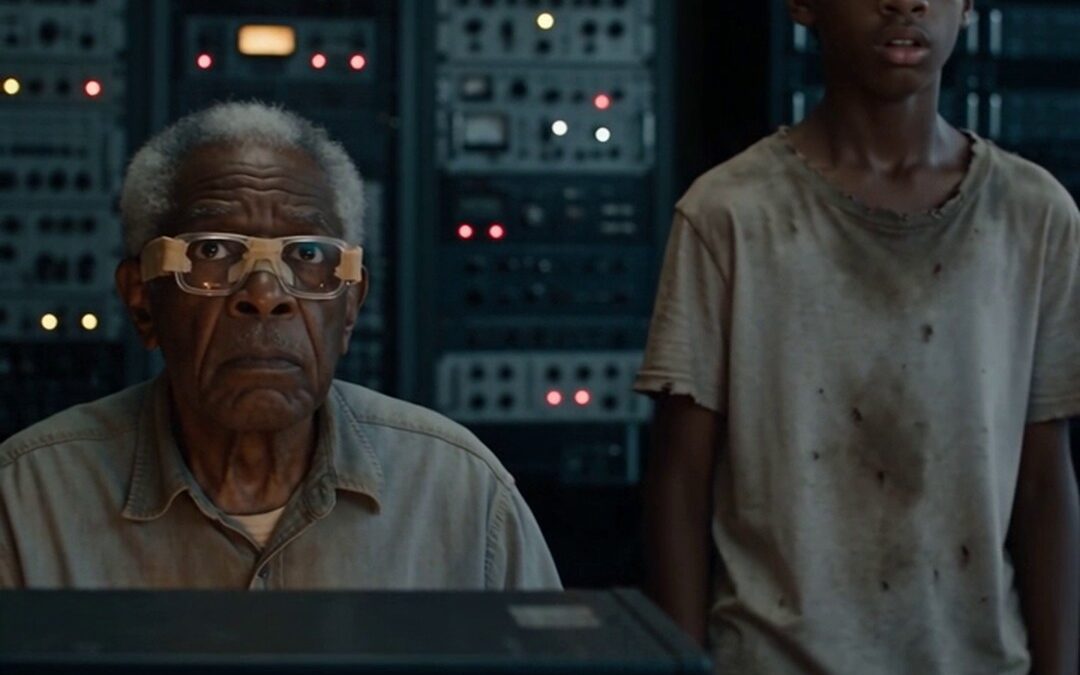
Kit Mercer dropped a steel ball bearing into the grooved copper pipe on the radio console at four seconds before five.
The bearing rolled down, hit the brass stop-pin, and dropped into an empty tobacco tin with a clean ring.
Across the counter, Silas Boone did not look up from the yellow pad where he logged the dawn transmission.
His taped bifocals sat crooked, reflecting the dim amber glow of the console’s twin VU meters.
Outside the cinderblock shack of WPCD, the bottomland between the grain elevator and the Illinois River smelled of diesel exhaust and damp corn dust.
Silas was sixty-eight, with thirty-five years of barge winching behind him and a left ear deafened by towboat engines.
Kit was sixteen, lived in a travel trailer by the gravel pit, and had not spoken a full sentence at school since sixth grade.
Words always locked behind his teeth like gravel in an auger.
Instead of speaking, he tapped the brass Gallet stopwatch on the console twice with his knuckle.
The second hand swept toward the top marker with the steady tick of a mechanical escapement.
Every morning, Kit’s father parked his utility truck on the shoulder with headlights cutting through the river fog.
Gideon Mercer kept his window cracked to hear the 1260 AM signal on his dash, but he never stepped inside.
“You sweep the floor, grease the fans, and keep your mouth shut,” Gideon had told Kit.
Beside the transmitter rack, a wall calendar carried black grease-pencil slashes across August.
Only eighteen days remained before a syndicate from Omaha took the frequency and silenced the local booth forever.
At 5:14 AM, the emergency teletype clattered with erratic, violent chatter.
A surge crackled through the board, and the automated Omaha satellite feed went flat.
The station manager, Ardis Cole, kicked the back door open with a damp clipboard in his fist.
“Peoria’s tower took lightning,” Ardis shouted over the cooling fans.
“We have dead air in thirty seconds, and Omaha is logging the outage.”
Silas Boone did not reach for the backup tape.
Instead, he looped the Gallet stopwatch’s cord over Kit’s wrist and shoved the tearing teletype paper into the boy’s hands.
Silas laid his heavy palm flat against the master fader.
“Read the river crest,” Silas said, looking straight into Kit’s eyes.
Chapter 2: The River Gauge
“Don’t touch that slider,” Ardis shouted, throwing his clipboard onto the metal desk.
“You don’t put a kid on a commercial frequency without a broadcast permit.”
Silas Boone did not flinch, his thumb resting firmly on the red plastic fader knob.
“The automated relay is dead in the water, Ardis.”
“The towboat pilots coming through the lock at Peoria need the stage report before sunrise.”
“Then run the tape loop,” Ardis said, stepping between the desk and the gray equipment rack.
“The tape loop has the river three feet below flood stage from Tuesday,” Silas said.
Kit’s fingers seized around the curling edge of the thermal teletype paper.
The paper rattled in his grip with a faint, papery rustle that sounded loud in the small room.
His throat clamped shut, tight and dry like a pinched copper line.
He tried to draw air past his collarbone, but his chest locked against the pressure.
Every face from his third-period civics class seemed to crowd into the dim cinderblock corners.
He remembered the silent minutes standing at the chalkboard while Mr. Henderson tapped an eraser against his thigh.
He remembered the stifled snickers from the back row when his jaw shook without producing a vowel.
Silas reached across the console, his rough palm cupping Kit’s trembling fingers against the desk.
“Don’t look at the window, Kit.”
“Look at the sweep hand on the Gallet.”
The brass stopwatch clicked against the boy’s wrist with a dry, mechanical pulse.
*Tick, tick, tick, tick.*
Four beats to the second, steady as an idling diesel engine on an empty canal barge.
Kit dropped his chin, his eyes locking onto the fine red needle sweeping across the white enamel dial.
The room’s panic faded beneath the absolute predictability of the brass balance wheel.
Silas shoved the master fader upward until the amber needle on the modulation meter leaped to eighty percent.
The small red studio light above the acoustic tile popped on with a faint hum.
Kit swallowed once, feeling the cold brass casing pressing into his wrist.
He did not try to talk to Silas, and he did not try to look at Ardis.
He fell into the rhythm of the escapement, pacing his lungs to the four-beat measure of the gear train.
“Peoria… pool… sixteen… feet,” Kit said into the foam-covered microphone.
His voice did not sound like his classroom voice.
It was low, clipped, and rhythmic, falling squarely on every second beat of the ticking watch.
“Crest… at… midnight… twenty-one… point… four.”
Ardis stopped reaching for the master breaker, his hand frozen inches from the main knife switch.
“Barge… traffic… halted… south… of… copperas… creek,” Kit continued, never looking up from the paper.
The cadence was strange and deliberate, like an old telegrapher sending code down a single iron wire.
Every syllable landed exactly where the needle struck a black second line on the dial.
There were no blocks, no choked repetitions, and no gasping catches for breath.
“Next… reading… at… five… thirty… a… m.”
Kit lifted his hand from the paper, his index finger tapping the tobacco tin once.
Silas pulled the master fader down into the soft felt stop.
The red studio light clicked off.
The cooling fans in the back of the transmitter rack hummed into the silence like a distant tractor.
Ardis stared at the boy, his mouth open slightly beneath his gray mustache.
“What in God’s name was that cadence?” Ardis whispered.
“That was navigation time,” Silas said, without taking his eyes off the broadcast logbook.
“That was thirty-five words in fifteen seconds, clean as a whistle.”
“It’s against every network regulation we signed with Omaha,” Ardis said, though his voice lacked conviction.
“Omaha is three hundred miles away in an air-conditioned office tower,” Silas muttered, writing the timestamp in black ink.
“The lockmaster at Copperas Creek just wrote down twenty-one point four feet.”
Outside on the wet gravel shoulder, a pair of halogen headlights flashed twice through the fogged front window.
Kit looked toward the dark glass, the brass watch suddenly feeling heavy against his skin.
“Your father’s waiting,” Silas said quietly, unlooping the black cord from Kit’s wrist.
Kit handed the stopwatch back, his hands completely still now.
He pulled his canvas work jacket tight around his shoulders and moved toward the weathered plywood door.
“Tomorrow at five, Kit,” Silas called out before the latch clicked shut.
“Don’t be late for the grain wire.”
Kit stepped out into the damp dawn air, his work boots crunching softly on the wet limestone gravel.
The river fog hung thick over the cornfields, smelling of muddy willow bark and sulfur.
He walked toward the idling utility truck, where the exhaust pipe blew pale white plumes against the bumper.
Gideon Mercer sat behind the wheel, his yellow hard hat resting on the passenger seat beside a grease gun.
The dashboard radio was tuned to 1260 AM, the volume knob turned all the way to the right.
Kit pulled open the heavy steel passenger door and climbed onto the cracked vinyl seat.
Gideon did not put the truck into gear immediately.
He rested his calloused hands on the top of the steering wheel, looking straight ahead into the gray mist.
“I heard you through the speaker,” Gideon said, his voice flat and restrained.
Kit stared down at his knees, picking at a loose thread on his denim pants.
“I told you not to mess with their equipment,” Gideon continued, shifting into reverse with a sharp clunk of the gearbox.
“I told you people in this county listen to that station when they’re milking cows.”
“They don’t need a boy making strange noises over their breakfast.”
Kit kept his lips pressed together, refusing to attempt an explanation that would only knot in his throat.
“You’re sixteen years old, Kit.”
“Next month we move down to the substation job outside Little Rock.”
“You don’t need folks around here remembering you like some kind of carnival trick.”
The truck bounced over the railroad crossing and turned onto the two-lane state highway.
Neither of them spoke for the three miles back to the gravel quarry.
The silence between them was an old, familiar weight, built from years of doctors’ waiting rooms and speech therapy pamphlets.
Gideon had paid for three different clinics in Peoria when Kit was ten, working overtime on high-line transmission towers.
Each specialist had told Gideon to be patient, to use flashcards, and to make the boy speak slowly in front of a mirror.
Kit had only grown quieter, until the house felt like an empty well before his mother finally left for St. Louis.
After that, Gideon had bought the travel trailer and taken the traveling high-voltage contracts.
A traveling rig had no neighbors to ask questions, and a gravel lot required no polite conversations.
When they pulled up beside the aluminum trailer, Gideon cut the engine and picked up his lunch cooler.
“Get some sleep,” Gideon said, opening his door.
“The contractor needs us pulling wire on the substation trench at two this afternoon.”
Kit nodded, stepped out into the gravel, and climbed the two rusted iron steps into the trailer.
Inside, the narrow kitchen counter was covered with radio chassis, glass vacuum tubes, and spools of enameled copper wire.
Kit sat on the edge of his narrow bunk and pulled a small leather-bound notebook from beneath his mattress.
He uncapped a pencil and drew a neat circle on the blank page, dividing it into sixty precise hash marks.
Beneath the circle, he wrote three words in careful block letters: *twenty-one point four*.
He tapped his pencil eraser against the plywood wall, keeping the four-beat rhythm of the Gallet watch in his head until his eyes grew heavy.
Two days later, the afternoon heat hung thick and stagnant over the river valley.
Kit walked the mile and a half from the quarry to the station with a cardboard box tucked under his arm.
The station’s red brick chimney was venting hot air from the aging transmitter tubes.
Inside, the cinderblock studio was dim, illuminated only by the small desk lamp and the warm filaments of the equipment rack.
Silas sat in his swivel chair with the back panel of the audio console removed, a soldering iron smoking in his left hand.
“Ground wire came loose on the auxiliary channel,” Silas said without turning around.
“Ardis is at the bank signing the final transfer paperwork with the Omaha lawyers.”
Kit set his cardboard box on the desk and reached into his pocket for his small brass wire-stripper.
Silas watched from beneath his taped glasses as the boy picked up a spool of silver-bearing solder.
Kit did not ask permission; he simply leaned over the exposed circuit board, found the broken solder joint, and cleaned the lug with a steel brush.
“You have steady hands,” Silas remarked, setting his own iron down in its metal cradle.
“My hands used to be steady when I worked the winches on the Ohio River.”
“Thirty years of pulling three-inch steel cable out of the mud will shake the grease out of your joints, though.”
Kit touched the hot tip to the terminal, flowed a neat silver bead across the wire, and blew on it until it turned frost-gray.
Silas touched the wire with the blade of a pocketknife, testing the mechanical bond.
“Solid,” Silas nodded.
“Better than the factory job Ardis paid fifty dollars for last winter.”
Kit reached into his cardboard box and pulled out a heavy glass tube with an embossed black base.
It was an RCA 833A power triode, cleaned of all carbon soot, its plate pins polished with emery cloth.
Silas’s eyes widened slightly behind his thick lenses.
“Where on earth did you dig up an 833A?”
Kit pulled a small scrap of cardboard from the box and pointed to a pencil sketch he had made of a substation transformer bank.
“Scrap… bin,” Kit whispered, pushing the word through his teeth with a sharp breath.
“Sub… station.”
Silas took the heavy tube into his hands, turning it under the yellow desk light like a jeweler inspecting a gem.
“This is the exact tube the old Collins transmitter uses out in the doghouse,” Silas said.
“They haven’t made these since nineteen seventy-eight.”
“Ardis told the Omaha crowd we didn’t have a backup tube for the main stage.”
“He told them that’s why we had to sign their contract before winter.”
Silas let out a dry, rasping laugh that rattled in his throat like dry leaves.
“Wait until that suit from Nebraska sees this sitting on the spare shelf.”
It was the first time Kit had heard the older man laugh without bitterness.
Silas set the tube carefully on the counter and reached into his desk drawer, pulling out a heavy green ledger.
“Come here,” Silas said, patting the edge of the console desk.
“Let me show you how this station used to work before they invented computers.”
The ledger was filled with thousands of handwritten lines in faded blue and red ink, dating back to 1964.
Every entry listed the frequency, the kilowatt output, the weather, and the exact signature of the operator on duty.
“In seventy-two, an ice storm took down the primary line from the powerhouse,” Silas said, pointing to a smear of dried coffee on the page.
“We ran the entire county broadcast off a John Deere tractor engine hooked to an alternator with a fan belt.”
“We read the obituaries, the school closures, and the pig prices every twenty minutes for four days straight.”
“People came down the gravel road on snowmobiles just to bring us hot stew so we wouldn’t freeze our fingers off.”
Kit traced the yellowed paper with his finger, reading the precise times written in the margins.
“Now,” Silas said, his voice dropping an octave, “Omaha wants to put a digital server in that corner with an ethernet cable.”
“Nobody in the room.”
“No weather report unless it comes from a weather service radar twenty miles south.”
“Just canned rock and roll and automated car commercials recorded in Kansas City.”
Silas looked down at his own hands, his knuckles swollen and scarred from decades of cold river iron.
“A machine doesn’t know when the river is rising behind the levee, Kit.”
“A machine doesn’t care if the cattle are standing in two feet of water down at District Four.”
Kit nodded, understanding the quiet, stubborn anger that lived inside the old man’s chest.
It was the same anger Kit felt when people spoke slowly to him, assuming his mind was as locked as his tongue.
The next morning, August fourteenth, Kit arrived at the studio ten minutes before five.
He carried a small metal chassis no larger than a tobacco tin, fitted with a bright green light-emitting diode on the front face.
Silas was already at the desk, leaning within three inches of the monitor speaker, his good right ear turned toward the paper cone.
The speaker was hissing with faint white noise, but Silas was frowning, repeatedly flicking the volume potentiometer back and forth.
Kit noticed the slight tremor in the old man’s jaw as he struggled to hear the low-frequency carrier hum.
Without saying a word, Kit walked behind the desk and unplugged the speaker line.
Silas jerked around, his hand instinctively reaching for the knob.
“What are you doing?” Silas barked, his face tightening with sudden defense.
Kit set the small chassis directly in front of the master fader, right where Silas’s right hand naturally rested.
He clipped two alligator leads from the box into the output jacks of the audio board.
When Silas turned the monitor volume up, the green diode flashed with sharp, brilliant pulses that matched the rhythm of the station identification chime.
Every rise and fall of the broadcast signal translated into an instant pulse of green light.
Silas stared at the pulsing light, his hand slowly relaxing on the wooden armrest of his chair.
He looked from the diode to Kit’s face, his expression stripping away forty years of towboat armor.
“You knew,” Silas said softly.
Kit did not nod, and he did not look away.
He simply placed his hand on the Gallet stopwatch beside the board, tapping the brass rim twice.
“I can’t hear the bottom hundred cycles anymore,” Silas said, his voice cracking slightly before he cleared his throat.
“Haven’t been able to hear them since the diesel turbo blew out on the *Moline Star* five years back.”
“Ardis thinks I’m just getting old and careless with the modulation.”
“He’s been looking for an excuse to push me out before the Omaha check clears.”
Silas reached out and touched the smooth aluminum casing of Kit’s little light box.
“With this,” Silas whispered, “I don’t have to guess if the carrier is clipping.”
“I can see it right in front of my thumb.”
Kit pulled the brass bearing from his pocket and set it at the top of the grooved copper pipe.
At four seconds before five, he let it go.
The bearing rolled, the tin clinked, and the green diode flashed bright as a railroad signal.
Silas hit the fader with absolute precision, right on the beat, smiling for the first time in months.
Over the next ten days, the dawn broadcast took on a strange, electric perfection that had not existed at WPCD in twenty years.
Word began to spread quietly through the bottomland farms.
At the Blue Silo cafe beside the grain terminal, the breakfast counter stopped talking when 5:14 AM arrived.
The farmers sat with their coffee mugs halfway to their lips, listening to the rhythmic, telegraphic cadence of the boy on 1260 AM.
“He sounds like a clock,” one elderly farmer remarked, tapping his fork on the formica counter.
“You can set your tractor’s throttle by how he reads the corn futures.”
“No stuttering, no rambling about the high school football team—just the numbers and the river.”
On the river itself, towboat pilots pushed their barges up from Havana, listening to the small AM station on their bridge receivers.
A pilot named Henderson called the station’s request line one Tuesday morning at six.
“Tell that kid reading the river stage that his reading on the lower pool was dead-on,” the pilot said through the static.
“Saved us an hour of waiting for the tender at the lower lock.”
Silas wrote the pilot’s message on a piece of cardboard and taped it directly above the microphone boom.
Kit looked at the cardboard every morning before he touched the copper pipe.
Something inside the boy was shifting, loosening like a rusted hinge soaked in penetrating oil.
When he walked past the gas station on his way to the studio, he no longer kept his chin buried in his collar.
He looked at the men pumping fuel into their tractors, and though he still did not speak, his shoulders were square beneath his canvas coat.
Then came the morning of August twenty-second.
The weather had turned oppressively hot, with yellow thunderheads piling up along the western horizon like bruised knuckles.
Kit arrived at five, but Ardis Cole was already standing inside the studio, pacing the narrow space between the tape bins.
In Ardis’s hand was a blue legal folder stamped with the corporate seal of the Omaha Broadcasting Company.
“The field engineers are coming on the twenty-eighth,” Ardis said without looking at Kit.
“A week early.”
“They’re bringing the digital satellite receiver and the automated computer rack on a flatbed truck.”
Silas did not take his jacket off.
“The contract said September first, Ardis.”
“They paid an extra three thousand dollars to take over the frequency before the Labor Day holiday,” Ardis said, tossing the folder onto the desk.
“They want the local transmitter shut down and sealed by next Tuesday night.”
Ardis turned and pointed a blunt finger directly at Kit’s chest.
“And they specifically asked who has been operating the microphone during the dawn hours without an FCC restricted radiotelephone permit.”
“He’s an apprentice,” Silas said, stepping forward so that his broad shoulder blocked Kit from the manager’s view.
“There are no apprentices in automated radio, Silas!” Ardis shouted, his face reddening under the fluorescent tube.
“There is an automated server and a service technician who comes once a month from Davenport!”
“If Omaha’s legal team hears an unregistered voice on this frequency during their inspection week, they void the building lease!”
“They void the lease, and this station doesn’t get its final buyout payment!”
“I don’t get my settlement, and you don’t get your pension stipend!”
Ardis slammed his hand against the top of the Collins transmitter cabinet.
“He does not touch that microphone again.”
“He does not touch the board.”
“If I see him in this booth after today, I will change the padlocks on the outer door and have the county sheriff escort both of you off the property.”
The room fell dead silent, save for the rhythmic *tick-tick-tick* of the Gallet watch resting on the console desk.
Kit stood frozen, his eyes fixed on the blue corporate folder.
The fragile world he had built over six weeks—the brass bearing, the green diode, the forty-year-old ledgers—crumbled into dust.
“You heard me,” Ardis said, his voice dropping into a harsh, uneven murmur.
“Go home, kid.”
Kit looked at Silas, hoping for a word, a sign, or a refusal.
Silas did not look at him; the old man stood staring at the yellow legal pad, his jaw clenched so hard the muscles jumped beneath his weathered skin.
Kit backed away from the counter, his boot catching on the edge of the rubber floor mat.
He did not wait for the five o’clock chime.
He pushed the plywood door open and ran into the gray, humid fog of the river road.
The heat outside felt like wet wool pressed against his face.
He did not stop running until he reached the gravel quarry, his lungs burning with ragged, hitching gasps.
He climbed the rusted steps of the travel trailer and threw himself onto his narrow mattress, burying his face in his rough wool blanket.
That evening, the heat refused to break.
Gideon came home from the high-voltage substation with his blue denim shirt soaked through with salt rings.
He set his heavy tool belt on the kitchen table with a dull metallic crash that shook the tin cups in the sink.
“Pack your tools, Kit,” Gideon said, wiping his neck with a red bandana.
Kit sat up on his bunk, his eyes red-rimmed in the dim light of the trailer’s single bare bulb.
“The contractor called a double-shift on the Arkansas line,” Gideon continued, not noticing the boy’s expression.
“The utility company needs the new substation energized before the first of September.”
“We’re pulling the trailer out of here on Sunday morning.”
Kit’s throat locked with sudden violence.
“N-n-no,” he choked out, the syllable snapping like a dry twig in his mouth.
Gideon stopped drying his neck, his eyebrows drawing together in a sharp line.
“What did you say?”
Kit stood up, his fists clenched at his sides, his chest heaving against his ribs.
“S-s-stay,” Kit forced out, his face turning crimson with the effort.
“W-w-we… c-can’t…”
“We have to go where the work is, Kit,” Gideon said, his voice firm but weary.
“I don’t have a choice.”
“This county doesn’t have enough electrical work to keep a dog alive through the winter.”
“You knew this was a temporary job.”
Kit pointed wildly toward the door, toward the river road where the transmitter tower blinked its single red warning light against the dusk sky.
“R-r-radio,” Kit gasped, his jaw shuddering as the word caught behind his teeth.
Gideon’s face softened slightly, but his eyes grew guarded and protective.
“I talked to Ardis Cole at the gas station this afternoon, Kit.”
Kit froze, his hands dropping to his sides.
“He told me what happened,” Gideon said, his voice dropping into that quiet, heavy register that admitted no argument.
“He told me he told you to stay away from the station.”
“I warned you, Kit.”
“I told you those people weren’t your friends.”
“They used you to read their farm reports because the old man couldn’t hear the board, and now that the money people are coming, they tossed you out into the ditch.”
“That’s how this world works when you can’t talk like everyone else.”
“They take what they need from you, and then they lock the gate so nobody sees you standing in the yard.”
“Now pack your radio parts into the crates.”
“We leave at dawn on Sunday.”
Gideon turned and walked into the small shower stall at the back of the trailer, pulling the plastic curtain shut.
Kit stood in the center of the narrow trailer, the sound of running water drumming against the aluminum roof like a heavy rain.
He looked at his wooden workbench, where his soldering iron sat cold in its metal holder.
He reached into his pocket and pulled out the small brass key to the station’s side supply door that Silas had given him three weeks earlier.
He had forgotten to return it.
The next afternoon, August twenty-sixth, the heat broke into a strange, sickly greenish sky that signaled high-altitude wind shear.
Kit walked down the river road for the last time, the small brass key clutched tightly in his fist.
He wanted to leave the key on the desk, take his green diode box, and walk away without seeing anyone.
When he reached the cinderblock shack, a black rental sedan with Nebraska license plates was parked in front of the door.
Two men in polo shirts and khaki trousers were unloading gray aluminum server racks from the trunk of the car.
Through the screen door, Kit could hear Ardis Cole’s loud, deferential laughter.
Kit slipped around the corner of the building, toward the rusted metal door of the supply room.
He inserted the key, turned the tumbler with a soft click, and pulled the door open just enough to squeeze his thin frame through.
Inside the dim storage room, surrounded by dusty coils of coaxial cable and old wooden speaker cabinets, Kit listened.
Silas Boone was sitting at the broadcast desk in the next room.
“The analog lines will be completely dead by Monday evening,” one of the Nebraska men said, his voice brisk and nasal.
“Our satellite receiver locks directly onto the transponder feed out of Chicago.”
“You won’t need anyone in this chair to log the transmitter output.”
“The system runs self-diagnostics every six minutes and files the reports automatically to the FCC portal.”
“What happens when the river crests over the county highway?” Silas’s voice asked, low and raspy.
“The national weather service issues a county-wide push alert to cell phones,” the technician answered with a dismissive chuckle.
“Nobody listens to AM radio for weather warnings anymore, old-timer.”
“It’s an antique medium.”
Silas did not answer.
Kit heard the squeak of the old man’s swivel chair, followed by the heavy, dragging footsteps that carried him toward the storage room.
The wooden door between the booth and the storage shed swung open, and Silas stopped dead in his tracks.
Kit stood against the brick wall, his hand holding his green diode box against his stomach.
For three seconds, neither of them moved.
Silas’s eyes were bloodshot behind his taped glasses, and his chamois shirt was buttoned crooked at the neck.
Kit held out the small brass key on his flat palm.
Silas looked down at the key, then up at Kit’s face.
Instead of taking the key, Silas reached into his pocket, pulled out the brass Gallet stopwatch, and shoved it roughly into Kit’s jacket pocket.
“Get out of here, Kit,” Silas whispered, his voice trembling with a harsh, urgent edge.
“Don’t let them see you.”
“Just take it and go.”
Kit recoiled as if he had been struck with a copper pipe.
The roughness in Silas’s voice, the sudden shoving motion, felt like an eviction.
It felt like the old man was ashamed of him, desperate to hide the boy before the men from Omaha looked through the doorway.
Kit turned, pushed the heavy exterior door open, and ran into the humid heat without looking back.
He ran all the way to the trailer, his chest heaving, his fingers clutching the cold brass watch through the canvas of his jacket pocket.
He threw the watch onto the kitchen table, where it slid across the formica and struck the edge of Gideon’s toolbox with a sharp metallic *ping*.
He collapsed onto his bunk and did not move for hours, even when the wind began to rattle the trailer’s aluminum roof vents.
Late that night, Gideon sat at the kitchen table, oiling the threads of a heavy cable clamp under the yellow bulb.
The wind outside had picked up, howling through the branches of the cottonwood trees along the quarry rim.
Gideon reached for a rag and his hand brushed against the brass stopwatch lying beside the socket set.
He picked it up, feeling the weight of the solid Swiss brass in his palm.
He turned it over and read the faded engraving on the back plate: *Illinois River Towing Co. — 1974 — S. Boone*.
Gideon stared at the engraving for a long time.
He remembered that name from twenty years back, when Silas Boone was the lead winchman at the Havana grain locks.
He remembered the men talking about Boone after the explosion on the *Moline Star*—how he had stayed on the burning deck to trip the tow-lines so three barges of aviation fuel wouldn’t drift into the highway bridge.
Boone had lost his hearing in that explosion, but he had never taken a disability pension, staying on the river until the company sold its boats to a conglomerate.
Gideon looked toward the narrow bunk where his son lay curled against the wall, breathing in shallow, fitful rhythms.
He set the stopwatch down, wiped his hands on his trousers, and picked up his rain slicker from the hook.
“I’ll be back in an hour,” Gideon said quietly into the dark trailer.
Kit did not answer.
Gideon drove his truck through the rising storm, the windshield wipers slapping furiously against the sheets of warm rain.
When he reached the cinderblock station, the yellow light inside was the only illumination for three miles along the river road.
Gideon pushed the front door open without knocking.
Silas Boone was sitting alone at the desk, an unlit cigar stub clamped between his teeth, staring at the green LED light on Kit’s little chassis.
The room smelled of stale coffee, ozone, and old paper.
Silas looked up, his hand dropping from the console with a weary, defeated motion.
“Station is closed to the public,” Silas said mechanically.
Gideon took off his dripping hard hat and set it on the corner of the desk.
“You gave my boy your watch,” Gideon said, his voice cutting clearly through the hum of the transmitter rack.
Silas looked at the hard hat, then at Gideon’s broad, weather-beaten face.
“He earned it,” Silas said.
“He doesn’t want your charity, Boone.”
“It’s not charity,” Silas snapped, standing up from his chair with a sudden surge of old towboat steel in his posture.
“That boy kept this station on the air for three weeks when my ears were completely gone.”
“He built that light box out of scrap so I wouldn’t get fired for clipping the carrier.”
“He stood at that microphone and read the river crests when Ardis Cole was ready to let the whole county go dark.”
Silas pointed a thick finger at Gideon’s chest.
“You think he’s broken because he can’t talk fast like a salesman?”
“He has a better sense of time than any man I ever worked with on thirty-five miles of river.”
“When he holds that watch, he doesn’t miss a beat.”
“He has a voice like a church bell, if you’d just shut up and let him ring it.”
Gideon stood motionless, his jaw working slowly as he processed the old man’s words.
The defensive anger that had guarded Gideon’s heart for ten years—the fear of pity, the hatred of doctors who looked at his son like a puzzle—began to crack.
“He thinks you threw him out,” Gideon said, his voice dropping into a quiet, painful honesty.
“I didn’t throw him out,” Silas whispered, looking down at his worn hands.
“Those Omaha bastards were in the front room.”
“They were talking about bringing the sheriff to lock the building.”
“I didn’t want him to see them take this place apart.”
“I didn’t want him to see me sitting here like an old dog waiting for the vet to put him down.”
Outside, a brilliant flash of blue-white lightning split the sky, followed instantly by a concussive boom of thunder that rattled the glass in the front window.
The lights in the studio flickered twice and died, plunging the room into absolute darkness.
For three seconds, there was only the sound of the wind screaming through the guy-wires of the transmitter tower outside.
Then, with a heavy diesel groan, the emergency generator in the shed behind the station coughed, sputtered, and caught.
The overhead fluorescent tubes flickered back to life with a sickly yellow hum.
On the roof, a violent tearing sound echoed through the ceiling tiles, followed by a metallic screech that made both men look up.
“The satellite dish,” Silas said, stepping toward the window.
“The wind sheared the mounting brackets right off the roof parapet.”
Through the rain-streaked glass, they could see the gray fiberglass dish tumbling across the soybean field like a giant broken plate.
Inside the equipment rack, the digital Omaha server began to emit a shrill, continuous alarm tone.
The red error lights blinked across all eight channels: *CARRIER LOST. RELAY DISCONNECTED.*
At that moment, the telephone on the desk rang with a loud, mechanical jangle that sounded like an alarm clock.
Silas picked up the heavy black receiver and pressed it hard against his good right ear.
“WPCD,” Silas barked.
He listened for twenty seconds, his face hardening into gray stone.
“Where?” Silas asked.
“How wide is the breach?”
He slammed the receiver down onto the cradle with a force that chipped the black plastic.
“The levee at District Four,” Silas said, looking at Gideon.
“The north wing collapsed five minutes ago.”
“The river is pouring into the bottomland toward the trailer park and the state highway.”
“The county emergency system in Peoria is completely down—their digital microwave line went dark when the substation blew.”
“Nobody in the lower valley knows the water is coming.”
Silas lunged for the master power switch on the Collins transmitter cabinet, throwing the heavy knife switch upward with a shower of blue sparks.
The cooling fans roared to life, and the four massive vacuum tubes began to glow with a deep, furious orange light.
“We can transmit on the old analog antenna,” Silas said, his voice shaking with urgency.
“The tower is still standing.”
“I can reach every farm between here and Havana on twelve-sixty.”
He grabbed the microphone boom and pulled it toward his mouth, but when he looked at the audio console, his hands froze.
The modulation meter was fluttering erratically between zero and one hundred and twenty percent.
The sudden power surge from the lightning strike had thrown the audio bias transformer completely out of balance.
Without Kit’s green diode box, the sound coming through the transmitter was nothing but a deafening, distorted shriek of feedback that would blow the circuit breakers in ten seconds.
Silas adjusted the potentiometer with a trembling hand, but his ears heard only the dull hum of his own tinnitus.
“I can’t tune it,” Silas cried out, his voice cracking with absolute despair.
“I can’t hear the carrier null.”
“I’m deaf, Gideon!”
“I’m completely deaf to it!”
The door flew open with a violent bang against the cinderblock wall.
Kit stood in the doorway, soaked to the skin, his canvas coat dripping water onto the floor.
In his right hand, he held the brass Gallet stopwatch by its black lanyard.
In his left hand, he held his small cardboard box containing his soldering iron, his wire cutters, and the spare RCA 833A tube.
Behind him, Ardis Cole pushed through the doorway, his raincoat torn at the shoulder, clutching a soggy corporate contract to his chest.
“You can’t power this transmitter!” Ardis screamed over the roar of the diesel generator.
“The Omaha agreement says any unauthorized analog transmission during an outage carries a fifty-thousand-dollar penalty against the licensee!”
“The FCC will revoke our charter!”
“We will lose everything!”
Ardis lunged toward the main knife switch, his fingers hooked like claws.
Gideon Mercer took one single, massive step forward, planting his six-foot-two frame directly in front of the electrical panel.
He did not raise his fists, and he did not shout.
He simply placed his huge, grease-stained palm against Ardis’s chest and pushed the station manager back into the wooden swivel chair with the irresistible force of a hydraulic jack.
“Sit down, Ardis,” Gideon said, his voice cold and steady as river ice.
“The levee broke at District Four.”
“My neighbors are sleeping in those trailers.”
“If you touch that switch, I will throw you out into the ditch myself.”
Ardis collapsed into the chair, clutching his wet papers, his face pale and slack with shock.
Silas looked at Kit, his eyes wild with desperate hope.
“Kit,” Silas choked out.
“The bias is drifting.”
“The feedback is tearing the plate circuit apart.”
“I can’t find the zero beat.”
Kit did not hesitate for a fraction of a second.
He dropped his wet coat onto the floor, kicked off his boots, and vaulted over the counter into the operator’s chair.
He plugged his green diode chassis into the auxiliary output with one smooth, practiced motion.
The green light did not pulse; it burned with a solid, blinding glare that indicated total audio saturation.
Kit grabbed the small plastic tuning wand from the clip behind the monitor.
He reached into the narrow access hole on the side of the audio board, turning the brass ferrite core with microscopic precision.
He did not rely on his ears.
He watched the green diode with absolute concentration, his eyes narrowing as he turned the screw a quarter-turn to the left.
The brilliant glare flickered.
He turned it an eighth of a turn more.
The green light dropped from a solid glare into a gentle, rhythmic breathing pulse that matched the sixty-cycle line frequency.
The screaming distortion in the monitor speaker vanished, replaced by the clean, quiet hiss of an open carrier wave.
Silas let out a ragged breath that sounded like a sob.
“It’s clean,” Silas whispered.
“The channel is completely open.”
Silas reached for the microphone boom, but his hand was shaking so violently he could barely hold the metal arm.
He looked at the yellow teletype strip on the desk, then at the clock on the wall, then at the boy sitting beside him.
Silas did not take the microphone.
He looped the Gallet stopwatch’s cord over Kit’s wet wrist, just as he had done on that first morning two weeks ago.
“You take it, Kit,” Silas said, stepping back so that the red studio light shone directly down upon the boy’s head.
“Give them navigation time.”
Kit looked at his father.
Gideon stood beside the breaker panel, his yellow hard hat tucked under his arm, his eyes locked on his son with an expression Kit had never seen before in his life.
It was not worry, and it was not protective fear.
It was absolute, unwavering respect.
“Go ahead, Kit,” Gideon said quietly.
“Tell them.”
Kit clicked the knurled crown of the stopwatch with his thumb.
*Tick, tick, tick, tick.*
The four-beat pulse traveled up his arm, through his collarbone, and settled directly into his lungs.
The world narrowed to the sweeping red hand, the green pulsing diode, and the black microphone grille.
Kit pulled the master fader all the way to the top.
The red studio light clicked on, burning bright and steady against the dark cinderblocks.
Kit leaned into the foam windscreen.
“Attention… all… residents… south… of… copperas… creek,” Kit said.
The words did not stumble.
They did not catch behind his teeth.
They rolled out into the Illinois night with the steady, unyielding power of an ocean-going bell buoy in a gale.
“The… levee… at… district… four… has… breached.”
“Water… is… crossing… the… south… pasture… toward… highway… twenty-four.”
“Evacuate… immediately… to… the… high… ground… at… the… grain… elevator.”
“Repeat.”
“The… levee… has… breached.”
“Take… your… livestock… and… move… north.”
For fifteen minutes, without a single break or hesitation, Kit held the frequency.
He read the mile markers.
He read the names of the drainage ditches that were backing up into the farm lanes.
He read the elevation numbers from the old green ledgers he had studied with Silas, giving the farmers the exact contours of the land in the dark.
In the trailer park two miles away, families woke to the blaring sound of their kitchen radios.
Men ran out into the rain in their work boots, unhooking trailers, loading horses into trailers, and driving pickup trucks up onto the gravel levee road just as the first six inches of brown river water crept across the asphalt.
At the high-voltage substation, the utility crew heard the broadcast through the service truck’s dash receiver and cut the primary feeder lines before the rising water could hit the transformers and blow the valley grid.
Inside the cinderblock studio, Ardis Cole sat with his head in his hands, listening to the boy’s voice fill the small room like an organ pipe.
When the clock on the wall struck six, the station’s telephone began to ring.
It did not stop ringing.
The sheriff’s dispatcher called to confirm the evacuation coordinates.
The lockmaster at Copperas Creek called to report that thirty families had reached the high concrete apron of the grain terminal with their trucks.
A woman from the bottomland road called just to say that she had gotten her elderly mother out of her bedroom two minutes before the front porch floated away.
At 6:15 AM, the storm clouds parted in the east, revealing a pale, washed-out dawn that turned the muddy floodwaters into a sheet of beaten pewter.
Kit spoke his final coordinate into the microphone.
“Next… reading… at… six… thirty… a… m.”
He pulled the master fader down into the soft felt stop.
The red studio light clicked off.
Kit sat back in the operator’s chair, his hands resting flat on the console desk beside the little green light box.
His shirt was dry now, warmed by the heat radiating from the Collins transmitter tubes.
He was exhausted down to his marrow, but his chest felt light, open, and clear, as if a steel hoop had been cut from around his ribs.
Silas Boone reached across the desk and picked up the broadcast logbook.
With his black ink pen, the old man wrote the final entry on the last page of the book: *August 31 — 0515 to 0615 — Emergency Transmission — Operator: Kit Mercer — Modulation: 100%*.
Silas pushed the book across the desk to Ardis Cole.
“Sign it, Ardis,” Silas said quietly.
“Sign the apprentice hours.”
Ardis looked up from his soggy papers, his eyes red and swollen.
He looked at the boy, whose face was completely calm in the gray morning light.
Ardis pulled a pen from his pocket and signed his name across the bottom of the page, certifying the transmission under the official seal of the station.
“The Omaha truck will be here at noon to take the transmitter,” Ardis whispered, his voice shaking.
“I know,” Silas said.
“They can have the iron.”
“They can’t have this morning.”
Two days later, the sun rose over a clean, quiet bottomland.
The river was already receding from the cornfields, leaving behind thick coats of dark alluvial silt that smelled of rich earth.
In front of WPCD, the transmitter tower stood silent, its analog feed officially terminated by the Omaha network engineers.
Inside the cinderblock shack, the gray automated server hummed in its new air-conditioned cabinet, feeding canned pop music to a frequency nobody on the river was listening to anymore.
Out on the levee road, beside the high concrete wall of the grain elevator, Gideon Mercer’s utility truck sat parked on the gravel shoulder.
The tailgate was down, and Silas Boone sat on the rusted steel bed, his legs swinging slowly above the limestone riprap.
He held a paper cup of black coffee from the Blue Silo cafe in his hand, watching the white gulls circle over the muddy water.
Beside him, Gideon stood leaning against the truck’s rear fender, rolling an unlit cigar between his calloused fingers.
“The contractor offered me the maintenance supervisor job for the local grid,” Gideon said, looking out across the river valley.
“No more traveling.”
“We’re keeping the trailer parked at the quarry until we can rent the old Miller place up on the bluff.”
Silas took a slow sip of his coffee.
“The community college in Peoria has an electronics program,” Silas remarked, his good ear turned toward the gentle lap of the river against the bank.
“They teach radio engineering and commercial broadcast systems.”
“Takes two years.”
“You need six hundred hours of certified apprentice time to get the state license.”
“He already has sixty,” Gideon said with a quiet smile.
Down on the narrow concrete dock below the levee, Kit stood near the edge of the water.
He was wearing clean denim pants and a new canvas work jacket that Gideon had bought him in town the previous afternoon.
In his right hand, he held the solid brass Gallet stopwatch, its black cord wrapped three times around his knuckles.
In his left hand, he held the polished steel ball bearing from the station console.
He pulled back his arm and skipped the steel bearing across the flat, brown surface of the river.
The bearing skipped three times, sending small circular ripples across the muddy water, before dropping with a soft *plink* into the deep current.
Kit lifted the stopwatch to his ear, listening to the four-beat escapement ticking away inside the heavy brass case.
He did not need to count the beats anymore.
The time belonged to him now, solid, steady, and clear as a bell across the open water.








