A Bakery Dishwasher Dropped a Burning Cake at a Senator’s Fundraiser—Then He Saw the Name Underneath
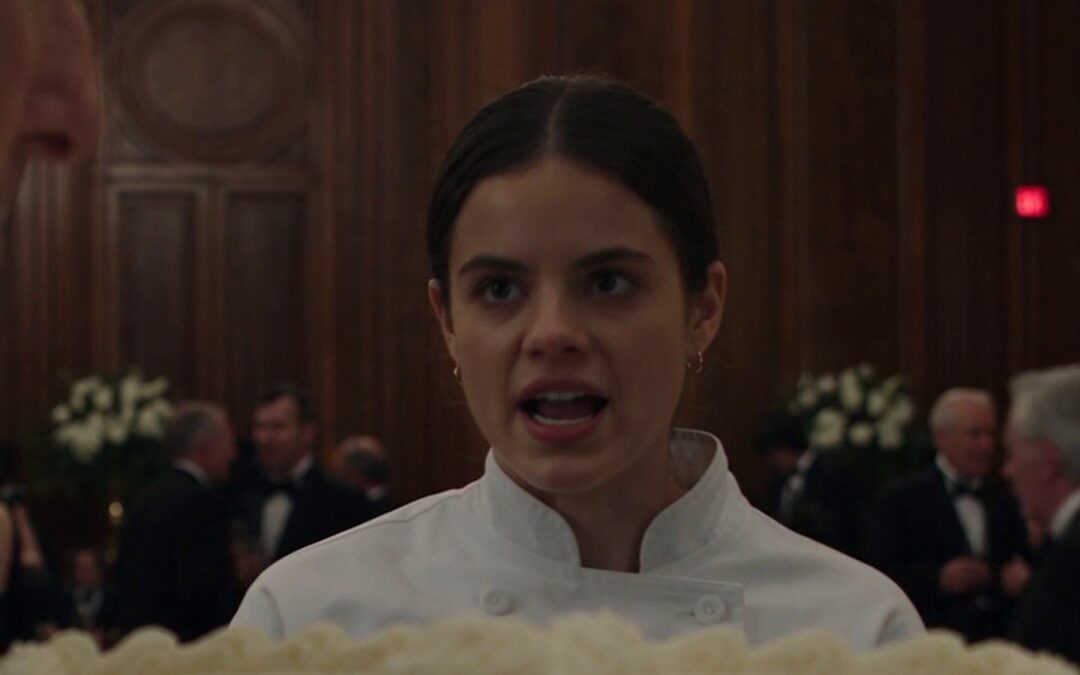
Chapter 2: The Name Beneath
The doors clicked shut.
The senator still held the tray.
Nessa watched the candle gutter.
The quartet had stopped playing.
Donors faced the cake.
The frosting had slid aside.
JUNE VALE showed beneath it.
The letters were blue.
The handwriting leaned sharply right.
Nessa knew it from birthday cards, grocery lists, and the last note her mother had left beside the stove.
Senator Ellis Whitaker stared at the name.
Then he looked at Nessa.
“Open those doors,” he said.
A guard stood beside the entrance.
“Senator, police are coming.”
“Then open them before they arrive.”
The guard hesitated.
Nessa set the candle upright.
Her fingers shook.
The flame steadied.
“You said my mother was dead,” Whitaker said.
“She is.”
“When?”
“Twenty years ago.”
“Where?”
“You know where.”
A murmur moved through the room.
The senator lost color.
“Not here.”
“You asked me.”
“I asked who made the cake.”
“You asked if I was June Vale’s daughter.”
“You should go home.”
“I can’t.”
He glanced toward the locked doors.
“Why not?”
“Because you had them locked.”
A woman in a dark green gown stepped from the crowd.
“Ellis.”
He turned.
“Marian.”
“Let them through.”
Marian Whitaker had once been a public defender. Her name still appeared on courthouse plaques in three counties.
She met Nessa’s eyes.
“Are you hurt?”
“No.”
“Did anyone threaten you?”
“Not yet.”
Marian looked at her husband.
“Open the doors.”
The guard lifted the latch.
Two officers entered.
A man in a gray suit followed, carrying a leather portfolio. A silver lighthouse pin gleamed on his lapel.
Nessa recognized him from the event invitation.
Martin Rusk.
Whitaker’s chief of staff, once a city prosecutor. People said he could turn an inquiry into a press release before a witness finished speaking.
“What happened?” he asked.
“A cake fell,” Nessa said.
“Was anyone injured?”
“No.”
“Then there’s no emergency.”
“There was a locked door.”
Rusk looked at the senator.
“Security protocol.”
“Who ordered it?”
“The senator’s detail.”
“Which person?”
“Are you accusing someone?”
“I’m asking whose hand locked the door.”
One officer stepped closer.
“We’re here because someone reported a disturbance.”
“Then ask the person who called.”
Rusk looked toward the staff. Nobody met his eyes.
“Senator,” Marian said, “we should speak privately.”
“No,” Nessa said.
Her voice carried.
“My mother’s name is on that cake. I want to know why.”
Whitaker glanced at the donors. Several had phones raised.
Rusk noticed.
“Perhaps we should clear the room.”
“Absolutely not,” Marian said.
“They don’t need to witness a family matter.”
“It became public when a senator told a worker to leave before police arrived.”
“I didn’t order her to leave.”
“You told me to go home,” Nessa said.
“That’s what I said.”
Rusk stepped between them.
“Miss Vale, the senator has known your family a long time. He’s trying to protect you.”
“From what?”
Rusk paused too long.
“From being dragged into something you don’t understand.”
“I understand my name.”
“Your mother’s name.”
“My name is Vale.”
“What is your full name?”
“Nessa Vale.”
The senator closed his eyes.
Rusk’s expression shifted. He had not expected the answer.
“My mother never mentioned him,” Nessa said.
“She had her reasons,” Whitaker replied.
“Tell me one.”
“Not here.”
“Then tell me somewhere else.”
“Not tonight.”
“Why?”
“Because you’ve had a frightening evening.”
“I’ve washed dishes in kitchens where men threw knives.”
“That’s not the point.”
“I know.”
The senator’s mouth tightened.
Rusk stepped forward again.
“Let’s take this into a private room.”
“No.”
Nessa looked at the cake.
“What was under the name?”
Nobody answered.
The silver tray’s edge pressed into Whitaker’s palms.
“Nothing,” Rusk said.
“You didn’t look.”
“We know what it is.”
“What is it?”
“Cake.”
Nessa pulled a napkin from her apron.
The shifted frosting exposed a folded paper strip stuck to the cardboard base.
She reached for it.
Rusk moved faster.
Marian caught his wrist.
“Don’t.”
The paper stayed in place.
“Mrs. Whitaker,” Rusk said, “you’re making this worse.”
“No. I’m stopping you from making it worse.”
The senator set down the tray.
His hands trembled.
Nessa peeled the paper free.
A blue wax dot sealed it.
Her mother’s handwriting crossed the back.
For Nessa, if Ellis denies the bell.
Whitaker stared at the words.
Rusk’s face went blank.
Nessa broke the wax.
Inside was a short strip of paper.
Ask him what he heard at 9:17.
She looked up.
“What did you hear at 9:17?”
Whitaker didn’t answer.
Rusk took a step toward her.
An officer raised a hand.
“Stay there.”
“You can’t treat this as evidence,” Rusk said.
“It’s a note,” Nessa replied. “What evidence do you think it is?”
“Miss Vale,” the officer said, “we need to ask you a few questions.”
“Ask.”
“Did you bring the cake?”
“No. I baked it in the hotel kitchen.”
“Who gave you the note?”
“I don’t know.”
“Did you know it was there?”
“No.”
“Did you intend to threaten the senator?”
“No.”
The officer wrote each answer down.
Rusk watched the pen.
“Was anyone in the kitchen when you assembled the cake?”
“Three people.”
“Names?”
“Chef Calder. Mina from pastry. The event manager.”
“Did any of them see the note?”
“I don’t know.”
“What time did you assemble the cake?”
“Six twenty.”
“Who had access to the kitchen?”
“Everyone with a staff badge.”
“Your badge number?”
Nessa stared at him.
“You want my badge number?”
“I’m gathering facts.”
“You’re the senator’s chief of staff.”
“And you’re holding a note that could raise a security concern.”
“Then let the police gather facts.”
“I’m answering their questions.”
“Are you?”
“Martin,” Whitaker said.
Rusk went still.
“What?” he asked.
“Stop.”
The officer looked from one man to the other.
“Senator, did you hear something at 9:17?”
Whitaker kept his eyes on the note.
“I heard a bell.”
“What bell?”
“A service bell.”
“Where?”
“On the old bridge.”
Rusk shook his head.
“That’s enough.”
“No,” Nessa said.
“Miss Vale, you don’t know what you’re asking.”
“Then explain it.”
“I can’t.”
“Because it’s secret?”
“Because it’s complicated.”
“Was my mother there?”
Whitaker glanced at Marian. She had gone pale.
“Ellis,” she whispered.
He rubbed his face.
“It was the night the east span failed.”
Nessa knew the story. Every schoolchild in Harbor City knew it.
Twenty years earlier, the east span of Bellweather Bridge had been closed after a failure during a storm.
Nobody died.
That was how the official account began.
Maintenance worker June Vale had been blamed for signing off on an inspection she never performed.
She lost her job, her pension, and nearly everything else to the court case.
Nessa had been six.
She remembered her mother’s wet wool coat, bills covering the kitchen table, and the newspaper headline:
WORKER’S NEGLIGENCE CLOSES BRIDGE.
Her mother never said she had signed the report.
She never said she hadn’t.
She only said, “A bad page can outlive a good person.”
“Why were you there?” Nessa asked.
“I was a junior attorney. I represented the city.”
“Did you hear the bell?”
“Yes.”
“What did it mean?”
“I didn’t know.”
“What did my mother say?”
He stared at the note.
“She said, ‘You heard it too.’”
The paper trembled between Nessa’s fingers.
“What happened next?”
“I told her I hadn’t.”
Someone whispered.
Rusk turned toward the officers.
“You’ve heard enough. This is a private family dispute.”
“It isn’t,” Marian said.
“Marian, don’t.”
“You’ve spent twenty years telling me June signed the report.”
“I believed she did.”
“Did you?”
He didn’t answer.
Rusk leaned toward the senator.
“The press is recording this.”
“Let them.”
“You’re endangering the campaign.”
“I know.”
“Your staff spent months securing those donors.”
“I know.”
“Ellis, you can’t confess to something you haven’t reviewed.”
“I haven’t confessed.”
“You admitted—”
“I admitted I lied about a bell.”
Nessa felt heat rise under her collar.
“Why?”
Whitaker looked at her.
“Martin told me your mother was trying to sell a story.”
Rusk’s jaw flexed.
“I told you she was trying to profit from a tragedy.”
“You told me you had proof.”
“I had a report.”
“You had one signature.”
“My mother’s signature was copied,” Nessa said.
Rusk turned to her.
“How would you know?”
“She wrote my name in my schoolbooks. I saw her handwriting every day.”
“That proves nothing.”
“It proves I know her blue ink.”
“No. It proves you have an opinion.”
“It’s why I know the writing beneath this cake is hers.”
The officer picked up the note with a gloved hand.
“Who wrote the bridge report?”
Rusk answered before Whitaker could.
“June Vale. It’s public record.”
“Then the original should be easy to find,” Marian said.
“It is.”
“Is the original public?”
Rusk said nothing.
Nessa turned to Whitaker.
“Where is it?”
“I don’t know.”
“You signed the city’s settlement.”
“I was an associate.”
“You represented the city.”
“I know.”
“You let them say she signed it.”
“Yes.”
“Why?”
His face crumpled for a moment.
“Because I was afraid.”
“Of what?”
“Losing my job.”
“Your job was worth more than her life?”
“I thought I was protecting the city.”
“That’s not what I asked.”
He lowered his eyes.
“No.”
Rusk stepped closer.
“Senator, stop talking.”
“What happens if he keeps going?” Nessa asked.
“Nothing good.”
“Good for whom?”
Rusk lowered his voice.
“Nessa, listen to me. The city paid your mother’s claim.”
“My mother never received a claim.”
“Her attorney did.”
“She didn’t have an attorney.”
“An appointed representative.”
“Name?”
“I don’t recall.”
“You handled the file,” Marian said.
“It was twenty years ago.”
“You remember everything else.”
“I’m not litigating this in a ballroom.”
The officer wrote down Rusk’s name.
“We’ll need your contact information.”
“My counsel can provide it.”
“Then we’ll contact counsel.”
Rusk looked at Nessa.
“You should go home.”
“I want the file.”
“The file is sealed.”
“Then I want to know who sealed it.”
The senator touched the tray.
“Marian, call Owen.”
“Your lawyer?”
“Not the campaign lawyer.”
“Are you sure?”
“Yes.”
Rusk let out a tight breath.
“You can’t be serious.”
“I’m serious.”
“Any statement becomes a liability.”
“It already is.”
“Your staff will resign.”
“Let them.”
“The donors will pull out.”
“Then they will.”
“The election—”
“Martin.”
Rusk stopped.
“You said my mother was trying to sell a story,” Nessa said. “Did she?”
“I don’t know.”
“You said she signed the report.”
“She did.”
“You said you had proof.”
“I had a copy.”
“Where is it?”
“In the city archive.”
“Then we’ll see it.”
“You won’t get access without a request.”
“Then we’ll make one.”
The officer offered Nessa a card.
“Your statement is voluntary. We can take it now or arrange an interview tomorrow.”
“I’ll do it now.”
“Good.”
Whitaker stepped toward her.
“Would you let me speak to you?”
“Not alone.”
“Marian can stay.”
“Not tonight.”
“Then tomorrow.”
“I don’t know.”
“That’s fair.”
“Do you know why my mother wrote the note?”
“No.”
“Do you know how it got under the cake?”
“No.”
“Do you know who put it there?”
“No.”
The answers came cleanly.
For the first time, Nessa believed him.
It did not make her feel better.
The officers took brief statements from guests and caterers.
Chef Calder knew nothing about the note.
Mina had seen a blue wax dot on the cardboard base and thought it was decoration.
The event manager had transported the cake from the hotel kitchen in a closed carrier.
The senator’s security team checked the carrier at the loading entrance.
The note could have been placed there at any point. It could have been planted by anyone with kitchen or event access.
Nessa’s shift ended two hours later.
She left with her apron folded into her tote.
Rain drifted across the street.
A news van waited at the curb.
A reporter called the senator’s name.
Whitaker stayed inside.
Nessa walked toward the bus stop.
A black sedan rolled alongside her. The rear window came down.
Marian sat inside.
“Can I offer you a ride?”
“No.”
“An umbrella?”
Nessa glanced at the drizzle.
“I have one.”
It was broken, but she didn’t mention it.
Marian nodded.
“May I call you tomorrow?”
“Yes.”
“Thank you.”
The window rose.
The sedan pulled away.
Nessa took the bus home.
Tomas was asleep on the couch, his inhaler beside him.
His fever had dropped.
The meter showed three doses left.
She set water on the table, then sat on the kitchen floor and unfolded the event schedule.
The fundraiser was over.
The name on the cake was not.
* * *
At 8:12 the next morning, Nessa called the number on Marian’s card.
Marian answered on the second ring.
“I’m glad you called.”
“Did the senator sleep?”
“No.”
“Did he say why the bell mattered?”
“He said he’d tell you in person.”
“Does he know where the report is?”
“He thinks the city archive has the original.”
“Does he know why the note was under the cake?”
“No.”
“Then don’t ask me to trust him.”
“I won’t.”
“Can you get me the case number?”
“Yes.”
“Send it.”
“I will.”
Nessa hung up.
She had already contacted a legal aid clinic that handled wrongful termination and public records.
A volunteer lawyer named Tasha Reed called before lunch.
Tasha was in her forties, with a dry voice and a habit of asking one question at a time.
“Is your mother alive?”
“No.”
“When did she die?”
“Eleven years ago.”
“What did the bridge case do to her?”
“It made work hard to find. She spent everything on lawyers, then cleaned offices.”
“Was there a trial?”
“No. The city settled.”
“What did the settlement say?”
“I don’t know.”
“Did your mother talk about it?”
“She said the city paid to make her go away.”
“That could mean several things.”
“I know.”
“Did she keep papers?”
“She kept everything.”
“Where?”
“In storage.”
“Have you opened it?”
“No.”
“Why not?”
Nessa watched Tomas sleeping on the couch.
“I didn’t know what I was looking for.”
“Now you do.”
That afternoon, Tasha met Nessa at the storage facility.
The unit smelled of cardboard and dust.
A standing fan leaned against the wall.
Boxes held clothes, old cookbooks, school drawings, and folded blankets.
Nessa found her mother’s filing cabinet beneath a plastic sheet.
The top drawer jammed.
Tasha worked a thin pry tool into the gap.
“Don’t break it,” Nessa said.
“I’m trying not to.”
“My mother fixed this after the lock broke.”
“Then she knew how to break it herself.”
The drawer gave with a metallic click.
Inside, folders were sorted by year.
Nessa found one marked BRIDGE.
Tasha opened it.
First came notices, then the city’s report.
It was a blurry photocopy, three pages long.
June Vale’s signature appeared beneath INSPECTOR on the second page.
“It isn’t hers,” Nessa said.
“You’re sure?”
“Look at the J.”
Tasha bent over the page.
The signature began with a loop. Her mother’s J began with a straight downstroke.
“And this,” Nessa said. “She crossed the V through the center.”
“Someone could have signed quickly.”
“No.”
“We’ll need an expert.”
Tasha photographed each page.
“Do you see the original?”
Nessa searched the folder.
There was a copier receipt, a hearing notice, a letter from an unfamiliar lawyer, and a blue envelope with one corner torn away.
She opened it.
Inside was a handwritten list of times.
8:43. Pressure alarm.
8:51. Bell test.
9:02. Crew cleared.
9:17. Bell.
9:19. East span closed.
At the bottom, in her mother’s handwriting, was a note.
He heard it.
Nessa’s mouth went dry.
“Who is he?” Tasha asked.
“I don’t know.”
“Whitaker?”
“Maybe.”
“Or the bridge operator.”
“Maybe.”
Tasha placed the page in a clear sleeve.
“We don’t guess. We document.”
The bottom drawer held a cassette recorder.
Its battery compartment had rusted.
Beside it lay two blank cassettes and one labeled OCT 14—BRIDGE.
Nessa stared at the date.
The date of the failure.
“Could it still work?”
“Maybe. A specialist needs to inspect it.”
Nessa picked it up carefully.
“We’ll preserve it.”
Tasha photographed the cassette and recorded where she found it.
“Your mother’s records may be relevant,” she said. “They aren’t proof by themselves.”
“I understand.”
“We’ll request the city file, settlement documents, and any original inspection materials.”
“How long?”
“Weeks. Maybe months.”
“Could they destroy it?”
“Not after we send a preservation letter.”
“Can you send it today?”
“I can.”
At four, Nessa met the senator and Marian in Tasha’s office.
Ellis Whitaker arrived without staff.
He carried no briefcase and looked older in daylight.
Tasha introduced herself.
“I represent Nessa Vale.”
“I understand.”
“Then direct your questions through me.”
“I will.”
Nessa sat opposite him.
“What did you hear at 9:17?”
“A bell from the east span.”
“What kind?”
“Two strikes.”
“What did you think it meant?”
“That the bridge operator was still inside.”
“Why?”
“Because the evacuation tone was one long strike.”
“Did you see my mother?”
“Yes.”
“Where?”
“Beside the service gate.”
“Did she say anything?”
“She said the west alarm had failed.”
“Did you check?”
“No.”
“Why not?”
“Rusk said the control room was clear.”
“Why did you believe him?”
“He had the inspection schedule.”
“Did you know it was false?”
“No.”
“Did you tell investigators she signed the report?”
“I said I believed she had.”
“Why?”
“I was afraid to say I hadn’t checked.”
“So you let the report stand.”
“Yes.”
“Was anyone hurt?”
“Not physically.”
“How was my mother hurt?”
“Her job. Her reputation. Her pension. Her life.”
Nessa’s hands curled around the chair.
“Did you ever contact her?”
“No.”
“Apologize?”
“No.”
“Do you expect me to forgive you?”
“No.”
“Do you expect me to let you help?”
“No.”
“That’s something.”
“I’ll give you every document I have.”
“Do you have documents?”
“My old case notes.”
“Where?”
“At home.”
“Will you give them to Tasha?”
“Yes.”
“Will you sign a statement?”
“Yes.”
Tasha interrupted.
“Not yet. We need to preserve and review the record first.”
Whitaker nodded.
“Of course.”
Nessa looked at him.
“Did my mother try to sell a story?”
“Martin told me she offered to trade evidence for money.”
“Did she?”
“I don’t know.”
“Did you ask her?”
“No.”
“Did you tell anyone she did?”
“Yes.”
“Who?”
“The mayor’s office, the city attorney, and two reporters.”
“Did you know it was false?”
“No.”
“Did you check?”
“No.”
Nessa stood.
Tasha touched her wrist.
“Sit down if you can.”
“I can’t.”
Whitaker stayed seated.
“I’m sorry.”
“Don’t say it like you’re reading a statement.”
“I’m not.”
“You still got to be a senator.”
“Yes.”
“My mother got to be a rumor.”
He bowed his head.
“I know.”
“No, you don’t.”
“You’re right.”
Nessa left the office.
Outside, Tasha caught up.
“He admitted key facts.”
“He admitted being afraid.”
“That matters.”
“Not to my mother.”
“No. It doesn’t undo what happened.”
“Does it matter in court?”
“It could matter to an investigation. Maybe to a civil claim.”
“I don’t want a check.”
“I didn’t ask.”
“I don’t want him buying my silence.”
“Then we’ll make that clear in writing.”
Tasha drafted a preservation request that afternoon.
It went to the city clerk, transportation department, old bridge authority, and Whitaker’s counsel.
Nessa signed it.
The city acknowledged receipt the next day.
A week later, it produced the settlement file.
The records were incomplete.
There was no original report, only a typed copy.
A payment record showed the city had sent $84,000 to Weller and Pike, labeled “consulting and claimant resolution.”
June’s signature appeared on the settlement form.
This time it looked closer.
Tasha enlarged it.
“Still not hers,” Nessa said.
“What makes you certain?”
“The V. She wrote our rent checks. I watched her sign them.”
Tasha nodded.
“We’ll ask the examiner.”
The file included a cover note dated five days after the bridge failure.
From: M. Rusk.
To: City Claims Office.
Subject: Vale matter.
The note read: Secure execution before press interest. Claimant has no counsel. Use standard representative form.
Nessa read it twice.
“Who is Weller and Pike?”
“I’ll find out.”
“Were they her lawyers?”
“I don’t know yet.”
“Why would the city pay them?”
“I’ll find out.”
“Everything is ‘I’ll find out.’”
“Because we haven’t confirmed it.”
Tasha stayed patient.
Nessa wanted certainty.
Tasha gave her process.
The cassette went to a university audio lab.
A technician called two weeks later.
The tape had survived but was brittle.
They would digitize it and keep the original untouched.
“Does it contain a recording?” Nessa asked.
“We haven’t played it. We’re preserving it first.”
“Can we hear it?”
“After we make a stable copy.”
“Could you do that today?”
“We’re doing it now.”
That evening, Nessa’s apartment buzzer rang.
A courier waited downstairs with an envelope and no return address.
Inside was a color printout of a twenty-year-old article.
The headline read: CITY BLAMES INSPECTOR FOR BRIDGE FAILURE.
Someone had circled her mother’s face in red ink.
Across the bottom, blue marker said:
SOME THINGS STAY CLOSED.
Tasha photographed the envelope.
Nessa called the nonemergency police number.
An officer took a report.
There was no direct threat. The case was logged as harassment.
Nessa slept badly.
Tomas found her at the kitchen table after midnight.
“Do you know who sent it?”
“No.”
“Is it the senator?”
“No.”
“The man from the ballroom?”
“I don’t know.”
“Is it about Mom?”
“Yes.”
“Are you going to stop?”
“No.”
“Good.”
He touched the envelope.
“Should we be scared?”
“Yes. A little.”
“Are you scared?”
“Yes.”
“Then we can both be scared.”
It was the first time he made her laugh all week.
The laugh did not last.
But it helped.
* * *
The audio lab finished the transfer three days later.
Tasha invited Nessa to listen at her office.
Whitaker came with his independent attorney.
Rusk did not attend.
The recording began with a low mechanical hum.
Then a woman’s voice.
“Control, this is Vale. Pressure is holding.”
Another voice answered.
“Copy.”
A distant metallic clang followed.
Then June spoke again.
“Bell test.”
Static.
“Two strikes,” a man said.
“Confirmed.”
The tape continued.
A voice announced the time.
“Twenty-one hundred and seventeen.”
A bell rang twice.
June said, “The east gate is still occupied.”
A man answered, “Negative. Cleared.”
“I see a light in the tower.”
“Evacuated.”
“I have a second person.”
“Vale, leave the span.”
“I’m not leaving someone up there.”
Static burst across the recording.
Then another voice.
“June, this is Ellis. Do you copy?”
The senator leaned closer.
His face went pale.
On the tape, the young Whitaker said, “June, I heard the bell.”
Nessa stopped breathing.
“I heard it,” the recording continued. “I’m going to the control room.”
A second man interrupted.
“Ellis, don’t. The access road is flooded.”
“Who is in the tower?”
“No one.”
“June says she sees a light.”
“She’s confused.”
“Then check.”
“Ellis, the route is closed.”
The tape clicked.
A minute of static passed.
Then June spoke again.
“Someone came down.”
“Who?”
“The guard from the east tower.”
“Name?”
“He’s injured. His ankle.”
“Is he alive?”
“Yes.”
“Do you need medical?”
“No. I’m taking him to the west gate.”
“Do not report this until the bridge is secured.”
The younger Whitaker’s voice returned.
“June, I’m at the control room.”
“Then you can hear the bell.”
“I can.”
“Write down what happened.”
“I will.”
“Write down that the evacuation list was wrong.”
“I will.”
“Write down that someone changed the inspection record.”
Static.
The tape ended.
Nobody spoke.
Then Whitaker asked, “Can we replay the last minute?”
The technician played it again.
Nessa watched the senator’s clenched hands.
“You went to the control room,” she said.
“Yes.”
“You heard the bell.”
“Yes.”
“You knew my mother found someone on the bridge.”
“Yes.”
“Why did you deny it?”
“Martin called before the investigators arrived. He said the guard had left town and the city would handle it. He said my account would complicate the response.”
“Did you know June had been accused?”
“Not until the next day.”
“Did you correct it?”
“No.”
“Why?”
“I thought I could repair it later.”
“Later never came.”
“No.”
“Did you write a statement?”
“I wrote notes.”
“Where are they?”
“At home.”
“Can we see them?”
“Yes.”
Tasha placed the recording in its protective case.
“This needs a forensic review. We’ll need confirmation the voices are who they appear to be.”
“I can identify my voice,” Whitaker said.
“That won’t be enough by itself.”
“I understand.”
The technician made a certified copy.
Tasha requested the lab’s custody records.
The digital audio would be preserved. The cassette would go into a sealed evidence locker.
Nessa copied her mother’s handwritten timeline.
The times matched the recording.
8:43 pressure alarm.
8:51 test.
9:02 crew cleared.
9:17 bell.
9:19 bridge closed.
June had recorded the sequence.
The official report said she left at 8:50.
The tape proved she was there later.
The log showed the west alarm failed, though the report claimed it did not.
Tasha requested the city’s original alarm logs.
The city said it had none.
The bridge authority said microfilm had been archived.
The university lab began searching for a readable copy.
A week later, a records clerk called Tasha.
She had found an index card: the alarm logs had been transferred to a North County storage facility.
She had not found the reels, only the transfer receipt.
It bore two signatures.
M. Rusk.
P. Kellen.
Nessa recognized the second name from her mother’s notes.
Peter Kellen had been the bridge’s night operator.
Tasha found him in a small town outside the city.
He was retired and living with his daughter.
He agreed to meet them at a diner.
“Is Martin Rusk coming?” he asked when they sat down.
“No,” Tasha said.
“Good.”
Peter was seventy-eight, wearing a fishing windbreaker.
He ordered coffee and left it untouched.
“I told the city the alarm failed,” he said. “Twice.”
“Did you report it in writing?” Tasha asked.
“I did.”
“Do you have a copy?”
“I did.”
“Where is it?”
“Rusk took it.”
“Why?”
“He said it was a duplicate. He’d file it.”
“Did he?”
“I don’t know.”
“Did you hear the bell?”
“Yes.”
“What did it mean?”
“Someone pulled the manual release.”
“Could June have pulled it?”
“Not from the east gate. The release was in the control booth.”
“Who was inside?”
“I was.”
“Did the report say that?”
“No.”
“Who changed it?”
“I never saw the final one.”
“Did you sign it?”
“No. I signed my shift log. Then they gave me a typed statement and called it a summary.”
“Did you read it?”
“I was tired.”
“Did you object?”
“I did. They said I was confusing the times.”
He looked at Nessa.
“I should have fought harder.”
“You were working a night shift,” she said.
“I was the adult in the room.”
“So was my mother.”
He nodded.
He brought a box from his truck.
Inside were old pay stubs and a spiral notebook.
“I kept this after they laid me off.”
The notebook contained his original shift notes.
9:11—alarm reset failed.
9:17—manual bell, east span.
9:20—Vale reports tower guard at west gate.
A later line had been scratched out so hard it nearly tore the paper.
Tasha photographed each page.
“Would you sign an affidavit?”
“If it doesn’t say what I didn’t see.”
“It will say what you saw.”
“Then yes.”
“Would you give a sworn interview?”
“Yes.”
“Would you testify?”
Peter looked at Nessa.
“If it helps clear June’s name.”
“It does.”
“Then yes.”
He slid the notebook across the table.
“Take it.”
Tasha made a chain-of-custody record.
Peter kept the original and let them scan it.
On the drive back, Nessa stared out the window.
“What?” Tasha asked.
“I keep waiting for someone to say my mother was right.”
“Several people have.”
“That isn’t the same as the city saying it.”
“No.”
“Will they?”
“If the evidence holds.”
“What if they bury it again?”
“Then we keep copies.”
“What if they attack her?”
“They already did.”
“Can the law put a name on it?”
“Yes.”
“Can it make them say what they did?”
“Sometimes.”
“Can it make it hurt less?”
“No.”
Tasha kept her eyes on the road.
“But it can stop them from doing it again.”
The road unspooled beneath them.
Nessa had spent years watching her mother try to be believed.
Now people who had silenced her were beginning to speak.
It did not feel like victory.
It felt like opening a door in a dark house.
* * *
Martin Rusk called Whitaker the next morning.
The senator put him on speaker with Tasha present.
“You’re creating a serious problem,” Rusk said.
“I’m correcting one.”
“You’re exposing the campaign to legal trouble.”
“You told me June was lying.”
“I told you she was unreliable.”
“You told me she wanted money.”
“She had a claim.”
“She had evidence.”
“She had an old cassette.”
“Did you know about it?”
Silence.
“Martin?”
“I knew she had recordings.”
“What happened to them?”
“I don’t know.”
“Did you take them?”
“No.”
“Did you alter the report?”
“I didn’t prepare the report.”
“Did you tell the city to use her signature?”
“I sent the file to claims.”
“That wasn’t the question.”
“You’re putting me on speaker with a lawyer.”
“Yes.”
“Then I’ll speak through mine.”
“Fine.”
“You should consider what this will do to your family.”
Tasha leaned toward the phone.
“Mr. Rusk, that may be interpreted as intimidation.”
“It was a warning.”
“About what?”
“About a public fight.”
“You contacted my client’s family?”
“No.”
“Did you send the marked clipping to her apartment?”
“No.”
“Do you know who did?”
“No.”
“Can you confirm that under oath?”
“I’m not answering questions.”
The call ended.
Whitaker stared at the screen.
“He didn’t sound surprised.”
“He may have expected me to call,” Tasha said.
“Or someone told him we had the tape.”
“Who knew about it?”
“Me, Nessa, the lab, the technician, my lawyer.”
“Then we preserve the call record.”
Tasha logged the call and sent another notice to preserve Rusk’s emails and documents.
That afternoon, a local paper reported that Whitaker had acknowledged “an historical error in a city bridge case.”
It said he had not yet explained the error.
The next morning, Nessa’s employer told her to stay home for a week.
“The fundraiser people called,” her manager said.
“What did they say?”
“That you disrupted a private event.”
“I was working.”
“They said you brought a note.”
“I found one under the cake.”
“We’re not taking sides.”
“You took me off the schedule.”
“Only for a week.”
“Will I be paid?”
The manager hesitated.
“I don’t know.”
Nessa hung up.
Rent was due in six days.
Tomas was improving, but his inhaler needed refilling.
Tasha arranged shifts at a neighborhood bakery.
The owner, Darlene, asked one question.
“Can you start at five?”
“Yes.”
“Then you’re hired.”
Nessa sliced bread, mixed batter, and scrubbed pans.
The work was quiet.
No gala.
No locked door.
No one asked about the senator.
Then a television over the counter showed Whitaker at city hall.
“I failed to correct a false account,” he said. “I knew evidence had been withheld from public review. I let silence protect my office and my career.”
A reporter shouted, “Did you know June Vale was innocent?”
“I knew the report against her was unreliable.”
“Did you help cover it up?”
“I did.”
Nessa stopped wiping the counter.
Rusk stood behind him on the steps.
Whitaker continued.
“I have asked the state inspector general to review the case. I have also requested an independent investigation into the handling of city records.”
A reporter asked if he would resign.
“I won’t ask the public to trust a title. I’ll provide records, give testimony, and accept the consequences.”
Rusk leaned toward the senator.
“Off the record.”
Whitaker turned from the microphones.
The camera caught his face without a smile or pose.
Just a man leaving the steps.
Darlene turned down the television.
“Want to talk about it?”
“No.”
“Good. The dough needs proofing.”
Nessa washed her hands and went back to work.
* * *
The state inquiry began in November.
Its first request asked for the original bridge file.
The city produced the typed report, settlement agreement, and several emails.
It did not produce the original.
The inquiry issued a subpoena.
The city challenged it.
A judge ordered the archive to search its offsite storage.
The search found a microfilm box marked EAST SPAN—MAINTENANCE.
Its seal was broken.
Inside were three reels.
One held the original inspection schedule.
Another held dispatch records.
The third was marked “duplicate—no value.”
A state examiner found the inspection page had been altered.
Two entries had been erased.
One was added in different ink.
June’s name appeared on the signature line, but the signature had been pasted from a separate page.
The examiner compared it with June’s actual work forms.
It was a cut-and-copy, not a hand-drawn forgery.
The original report had been assembled from pieces.
The typed settlement copy also omitted a paragraph requiring the city to give June a copy of the final report.
The payment record showed the city paid Weller and Pike.
Tasha traced the firm. It had represented the city, not June.
The “appointed representative” was a claims contractor.
There was no record June had a lawyer, signed the settlement, or received the $84,000.
Nessa searched the storage unit again.
In a cookbook, she found a thin envelope folded into the back cover.
It contained a copy of a $2,400 check payable to June.
The endorsement was not hers.
The date was the week the settlement closed.
The bank was still open.
A fraud investigator obtained the archived endorsement image.
It matched the signature on the settlement form, not June’s.
A second signature belonged to A. Pike, one of the law firm’s partners.
The records pointed closer to Rusk.
A 2006 email showed him telling the city claims director:
June is likely to appeal. We should close the claimant payment through the contractor and avoid reopening the inspection question.
Another email from the following morning read:
Do not circulate the tape reference. The senator’s office has been informed.
It was sent by Martin Rusk to a city lawyer.
The message did not prove Rusk knew what the tape contained.
It showed he knew it existed.
The inquiry subpoenaed him.
He refused to answer without counsel, then said he was prepared to comply.
Investigators found a second set of emails on a former city server.
Rusk had asked the claims office to create a substitute signature page.
He said it would save time.
The claims director replied:
We cannot use a signature we do not have.
Rusk answered:
Then reconstruct the execution copy from the intake sheet.
That was the first clear evidence of his role.
The inquiry also obtained Peter Kellen’s shift book.
His declaration matched the cassette.
The lab authenticated the recording’s date through a mechanical clock tone at the beginning of the tape.
Two former dispatchers identified the voices.
Whitaker identified himself.
A state examiner confirmed June’s voice.
A month later, the inquiry announced a public hearing.
It would address the altered report, settlement payment, and failure to correct the record.
The hearing room filled.
June’s family sat in the first row.
Nessa sat beside Tomas and Tasha.
Whitaker sat at the witness table.
Rusk sat behind his attorney.
The city attorney sat on the other side.
The hearing chair, a former judge, opened with a reminder.
“This is a fact-finding inquiry, not a criminal trial. Potential criminal conduct has been referred to the appropriate office.”
Whitaker was sworn in.
He answered questions for two hours.
The inquiry played the tape.
The bell rang twice through the courtroom speakers.
A few people flinched.
Whitaker closed his eyes.
“Senator,” the chair asked, “did you hear that bell on October fourteenth?”
“Yes.”
“Did you know Ms. Vale was still on the bridge?”
“Yes.”
“Did you tell investigators?”
“No.”
“Why not?”
“Martin Rusk told me the control room had cleared the bridge. He said Ms. Vale’s account would complicate the city’s response.”
“Did you verify that?”
“No.”
“Did you know the report carried her signature?”
“I learned that the next day.”
“Did you challenge it?”
“No.”
“Why?”
“I was afraid of the political cost.”
“Was that worth the damage to June Vale?”
“No.”
The chair turned toward Rusk.
“Did you instruct the claims office to reconstruct the execution copy?”
His attorney objected.
The chair allowed Rusk to answer under counsel’s advice.
“I don’t recall.”
The chair showed him the email.
“You wrote this.”
“I did.”
“Did you know there was no signed execution page?”
“I believed the intake sheet supported the file.”
“That was not my question.”
“I’d need to review the complete record.”
“You reviewed this email.”
“Yes.”
“You knew the claimant had no lawyer?”
“I believed she had a representative.”
“Was that representative a lawyer?”
“I don’t know.”
The chair showed him the payment record.
“Do you recognize this?”
“Yes.”
“Did you direct the payment?”
“I referred the matter to claims.”
“Did you know June Vale received only $2,400?”
“I did not.”
“Did you tell Senator Whitaker that she tried to sell a story?”
“I don’t remember the exact conversation.”
“Did you tell him she had evidence?”
“I may have said she had a recording.”
“Did you explain what it contained?”
“I don’t recall.”
The chair turned another page.
“Did you tell the press office that June Vale admitted signing the report?”
“No.”
“Did you approve the headline calling her negligent?”
“I didn’t write headlines.”
“Did you brief reporters?”
“I was a young prosecutor then.”
“That is not an answer.”
Rusk’s attorney objected.
The chair sustained it.
Rusk leaned toward the microphone.
“I gave the city a legal recommendation. I did not forge a document.”
Nessa felt her hands tighten around the program.
Tasha whispered, “Stay with the facts.”
Rusk continued.
“I didn’t take the settlement money. I didn’t alter the original report. I had no personal financial interest.”
He was arguing well.
He had not signed the false page.
He had not deposited the check.
He had routed the file and shaped the narrative.
He made himself sound like a careless messenger, not the architect.
A city clerk testified next.
She had worked in claims in 2006.
She said Rusk asked her to make the paperwork match the story.
“Why did you keep the email?” the chair asked.
“Because I printed it.”
“Why?”
“The instruction bothered me.”
“Did you report it?”
“No.”
“Why not?”
“I had two children and a temporary contract.”
The chair thanked her.
The state records examiner showed enlarged images of the signature page.
“This stroke is from a separate document,” she said. “The blue ink differs in age and composition. The copied signature has no pressure marks from the surrounding text.”
A reporter asked if that proved who assembled it.
“No,” the examiner said. “It proves it came from separate materials.”
Tasha entered the audio authentication report.
The recording had not been edited.
The cassette housing was consistent with the date.
The timing matched the handwritten shift book.
Voice identification was strong enough for the inquiry, though the examiner cautioned that audio alone did not prove every claim.
Peter Kellen testified in his fishing windbreaker.
His hands shook as he sat down.
“Did you see the pressure warning?” the chair asked.
“Yes.”
“Did you report it?”
“Yes.”
“Was it fixed?”
“No.”
“Did June Vale know?”
“She was checking the span.”
“Did she sign the inspection report?”
“No.”
“How do you know?”
“I was on shift.”
“Did she falsify the inspection?”
“No.”
“Did you hear the bell?”
“Yes.”
“What did it mean?”
“Someone pulled the manual release.”
“Who was in the tower?”
“The guard.”
“Was he injured?”
“He had a sprained ankle. He walked out with June.”
“Could the crew list have shown that?”
“Yes.”
“Did it?”
“No.”
The city attorney asked if Peter had a record of the guard’s name.
“I wrote it down.”
“Where?”
“On the page that was removed.”
“Do you know who removed it?”
“No.”
“Did you see Mr. Rusk remove it?”
“No.”
“Did you see Senator Whitaker remove it?”
“No.”
“Then you cannot say who removed it.”
“I said I don’t know.”
The answer drew a few restrained nods.
Then the chair called Nessa.
She explained the storage unit, the folder, the note, the list of times, and the cassette.
She also described the cake.
“Did you write the message that read, ‘Ask him what he heard at 9:17’?” the chair asked.
“No.”
“Did you know the note was under the cake?”
“No.”
“Did you place the cake?”
“No. I baked it.”
“Did you know your mother’s name was under the frosting?”
“No.”
“Who wrote it?”
“I believe my mother did. The handwriting matches her note from the storage unit.”
“Has that been examined?”
“Yes. The examiner found the slant and letter formation consistent, not conclusive.”
“Did you know Senator Whitaker before the fundraiser?”
“No.”
“Did you seek money from him?”
“No.”
“Did you ask him to clear your mother’s name?”
“Not before that night.”
“Did you want him to?”
Nessa paused.
“I wanted the truth.”
“Is that what you want now?”
“I want the record corrected. I want whoever changed it held responsible. I want my mother’s name restored.”
“Do you want money?”
“I want what she was owed. I don’t want a private check to make this disappear.”
“Would you accept a lawful payment ordered through the proper process?”
“Yes.”
“Why?”
“It would belong to her estate and my family. It wouldn’t buy my silence.”
The chair thanked her.
Rusk’s attorney asked whether she had spoken with her mother about the bridge.
“Yes.”
“What did she tell you?”
“That she had not signed the report.”
“Did you believe her?”
“Yes.”
“Why?”
“She never asked me to lie for her.”
“Could a parent be mistaken?”
“Yes.”
“Could she have forgotten signing?”
“No.”
“That’s your opinion.”
“Yes.”
“Did you see the bridge report before the fundraiser?”
“No.”
“Did you plan to confront the senator at the fundraiser?”
“No.”
“Did you use the cake to create a public scene?”
“No.”
He asked it again in different words.
Nessa gave the same answer.
Then she looked at the chair.
“May I ask him something?”
“Through counsel.”
Tasha leaned over.
“Ask about the red circle.”
Nessa turned to Rusk.
“Did you send a marked copy of the old article to my apartment?”
“No.”
“Do you know who did?”
“No.”
“Did you know someone was contacting me?”
“No.”
“Did you know my employer was told I disrupted the fundraiser?”
“I wasn’t involved.”
“Did you call the event company?”
“No.”
“Did you ask anyone to call?”
“No.”
Tasha asked the chair to preserve the answer.
He agreed.
Rusk remained composed.
He had an answer for everything.
He had not made the first injury.
He had carried the file.
He had not forged the page.
He had recommended reconstruction.
He had not pocketed money.
He had routed the claim through a contractor.
He had not threatened Nessa.
He had warned her about a public fight.
Each answer was narrow.
The chair understood.
So did the reporters.
The final witness was a retired claims director, now in his eighties, testifying by video.
He admitted approving the payment.
“I thought it went to June,” he said.
“Did you verify receipt?” the chair asked.
“No.”
“Why not?”
“Rusk said the contractor had confirmation.”
“Did you see confirmation?”
“No.”
“Did you ask?”
“No.”
“Was there a personal relationship between you and Rusk?”
“No.”
“Any payment?”
“No.”
“Any promise?”
“No.”
“Then why did you follow his recommendation?”
“He was a young prosecutor. I thought he had checked.”
“Did you tell the press June signed?”
“No. They asked me to confirm the city had closed the matter. I did.”
“Did you know the report was a composite?”
“No.”
The hearing ended after dark.
Outside, the rain had stopped.
The senator approached Nessa on the courthouse steps.
His attorney stood nearby.
“May I speak?”
“What do you want to say?”
“I’m sorry.”
“You said that before.”
“I know.”
“Then say something else.”
“I should have told the truth that first night.”
“Yes.”
“I should have told it the next day.”
“Yes.”
“I should have told it every day after.”
“Yes.”
He looked down.
“I can’t give you those years back.”
“No.”
“I can help restore the record.”
“You should.”
“I can help recover the money.”
“You should.”
“I’ll testify if charges are brought.”
“You should.”
“Is there anything you want me to do that I haven’t named?”
“Yes.”
“What?”
“Stop asking me what you can do. Do what you owe.”
He nodded.
“I will.”
It was not forgiveness.
It was a boundary.
Nessa walked down the steps with Tasha and Tomas.
Behind them, reporters crowded Whitaker.
A month later, the inquiry issued its findings.
It found June had not signed the inspection report.
It found that the report was assembled from separate pages.
It found that the city failed to verify the settlement payment.
It found that Rusk directed the claims office to reconstruct a signature page and repeatedly described June as unreliable without disclosing the recording.
The inquiry referred the case to the state attorney general.
The attorney general opened a criminal investigation.
No one was arrested at the hearing.
The state requested more records and interviewed more witnesses.
During the wait, Nessa kept baking.
Tomas returned to school.
His inhaler was refilled.
The city issued a formal correction: June Vale had been wrongly identified as the inspector who signed off on the bridge.
The council restored her pension credit.
The attorney general later charged Rusk with document fraud, obstruction, and misuse of public records.
The indictment alleged he knowingly arranged the reconstructed signature page and concealed evidence.
Rusk pleaded not guilty.
His trial began eight months later.
The state presented emails, microfilm, bank records, and the recording.
The former claims director testified.
So did Peter Kellen.
The audio lab explained how it had preserved the cassette.
A handwriting specialist testified that June’s signature had been cut from an earlier maintenance form.
Rusk’s defense argued he relied on the claims office, never meant to harm June, and that the city had approved the settlement.
The jury deliberated for three days.
Rusk was convicted on two counts.
The jury could not agree on a third.
The judge sentenced him to probation, community service, restitution, and a permanent ban from public office.
The state did not charge Whitaker.
He cooperated fully.
The inspector general found no evidence he altered the report or received money.
The report also found that he knowingly allowed a false account to stand.
He resigned from the Senate before the next election.
He did not ask Nessa to defend him.
The city reopened June’s claim.
A hearing officer reviewed the payment record and restitution order.
The city concluded June received none of the settlement funds.
It paid her estate the amount owed, adjusted under the original claim’s terms.
The money went into a trust for Nessa and Tomas.
Nessa used her share to settle her mother’s remaining debts and put the rest into an education account for Tomas.
She didn’t buy a house or quit the bakery.
She helped Darlene repair the old oven.
The city also created a public archive for the bridge records.
The altered report was displayed beside the corrected version.
A small plaque bore June’s name:
June Vale reported the alarm failure.
She stayed until the span was clear.
The record failed her.
Nessa visited on opening day.
Whitaker stood at the back of the room without a security detail.
He carried a folder of old case notes.
Tasha stood beside him.
He had signed an affidavit confirming the recording was genuine and that he heard the bell.
Nessa read the plaque.
Then she turned to him.
“Did you bring the notes?”
“Yes.”
“Did you give them to the inquiry?”
“Yes.”
“Did you keep a copy?”
“No.”
“Good.”
He nodded.
“Your mother was brave.”
“She was tired.”
“Both can be true.”
Nessa looked at him.
“Do you still think you were protecting the city?”
“I think I was protecting myself.”
“That’s more honest.”
“I should have said it sooner.”
“Yes.”
“May I ask you something?”
“What?”
“Would you let me apologize to your brother?”
“Ask him.”
He did.
Tomas listened, then said, “I don’t know you.”
“I understand,” Whitaker replied.
“Good.”
The senator accepted that.
He did not turn the moment into absolution.
Nessa noticed.
She did not thank him.
But she did not tell him to leave.
* * *
By spring, the bakery’s new oven worked without a wrench wedged beneath its front leg.
Darlene made a sign for the window.
Nessa Vale, Pastry Lead.
Nessa teased her about the title.
“You make cakes,” Darlene said. “You’re leading the pastries.”
“I wash pans too.”
“Then you’re a versatile leader.”
Tomas laughed from the counter.
He had grown taller.
His inhaler stayed in his backpack.
The court had ended.
The investigation had ended.
People still argued.
Some said the city had made a fair correction.
Others said it was too late.
Some donors said Whitaker did the right thing by confessing.
Others said he spoke only after the tape surfaced.
Nessa let them argue.
The record held the facts.
She didn’t have to carry every opinion.
A local paper asked her to write about June.
She declined the first request.
She accepted the second after Tasha helped her keep it short.
“My mother was not perfect,” Nessa wrote. “She could be stubborn. She left pans on the stove until the kitchen smelled like burnt onions. She paid bills late and apologized to strangers before she apologized to me. She was a person, not a headline. The city took her work and her name. It has corrected the record. That matters. It does not return her years.”
The newspaper printed it beside a photograph of the bridge.
A nonprofit offered the bakery a grant to teach young people job skills.
Darlene wanted a second mixer first.
Nessa wanted better ventilation.
Tomas wanted a bigger refrigerator.
They argued over it at the kitchen table.
The nonprofit funded all three.
Nessa taught two teenagers how to make dough.
One was shy.
The other talked constantly.
Both were good with their hands.
One afternoon, the shy one dropped a bowl.
It shattered.
She froze.
Nessa put a hand on the counter.
“Are you hurt?”
“No.”
“Then get the broom.”
The girl blinked.
“Am I in trouble?”
“Not unless you pick up glass with your fingers.”
The girl smiled.
They swept together.
The day continued.
Months later, the city asked whether Nessa would attend a public memorial at Bellweather Bridge.
She said yes.
The bridge had been repaired and reopened years earlier.
The east span carried buses, cyclists, and late-night traffic.
A public address system stood near the old service gate.
The event would include a reading of the corrected report.
Nessa brought the cassette in its sealed evidence case.
The archive had approved its display.
She set it on a table beneath a clear cover.
The cassette label was still in her mother’s handwriting.
OCT 14—BRIDGE.
People stopped to look.
Some had worked on the bridge.
Some had known June.
Others had only read about her after the correction.
Peter Kellen came with his daughter.
He walked slowly but stood without help.
Marian Whitaker came alone.
The senator did not.
He had called Nessa three days earlier to ask if his presence would be welcome.
She had said, “Not this time.”
He had answered, “I understand.”
It was the first boundary he did not test.
The event began at sunset.
A city official read the report.
A former dispatcher explained the alarm system.
Peter described the manual bell.
Then Nessa spoke.
She held a small card but did not read from it.
“My mother was on the bridge because she saw someone still there. The record said she had left. The recording says she stayed. The shift book says she stayed. The people who knew her said she stayed.”
She looked toward the water.
“She didn’t stay because she thought anyone would thank her. She stayed because somebody was still in danger.”
The crowd remained quiet.
Nessa placed the card beside the cassette.
“Thank you for correcting her name.”
The city official nodded.
The applause was brief.
Not triumphant.
Just enough to fill the space.
Afterward, people came to speak with her.
A retired bridge inspector said June once covered his shift when his child was sick.
A neighborhood woman said June taught her to make lemon cake.
A man remembered June repairing a loose stair rail in his building.
Those memories had existed before the hearing.
They had simply never been printed.
Nessa listened.
She did not collect them as proof.
She let them be what they were.
At the edge of the crowd, Tomas leaned against the rail.
“You okay?”
“Yes.”
“Do you want to go?”
“In a minute.”
The sunset caught the water below the bridge.
The city lamps came on.
A bell sounded from the roadwork station.
Two short strikes.
Everyone looked up.
It was a signal test.
Nessa smiled.
“Two strikes,” Tomas said.
“Yeah.”
“Does it still scare you?”
“Not now.”
He watched traffic cross the span.
“Do you think Mom would like the plaque?”
“She’d say they spelled her name right.”
Tomas grinned.
“She would.”
They stayed until the crowd thinned.
The cassette went back into its sealed case.
Nessa carried it to the car.
The object once hidden beneath a cake had become a record nobody could quietly remove.
It couldn’t give her mother back.
It couldn’t restore the years of work she lost.
It couldn’t make everyone who believed the headline feel ashamed.
But people could find the truth.
That night, Nessa baked a small cake at the bakery.
No name was hidden beneath it.
No note.
Just lemon icing and a crooked line of sugar flowers.
She brought it home.
Tomas cut the first slice.
“Too much lemon,” he said.
“You say that every time.”
“And every time I’m right.”
“You ate half.”
“I’m checking the balance.”
Nessa laughed.
The kitchen window was open.
Warm air moved through the room.
On the shelf, her mother’s recipe card leaned beside the flour tin.
The handwriting slanted right.
The blue ink had faded.
Nessa touched the card’s edge.
Her mother’s name had been there long before anyone tried to erase it.
She left it where it was.
THE END


