He Shut His Wife Inside a Perfume Display for His Mistress—Then the City’s Most Feared Owner Opened the Glass Door
Chapter 2: The Signature in the Ledger
Nolan’s silence lasted three seconds.
Tessa counted each one.
The guests nearest the booth waited for him to answer.
He smiled at the assistant.
“You must have misunderstood me.”
“I wrote it down,” she said.
“Then you wrote it down wrong.”
Gideon handed the blue vial back to Tessa.
“Your name?” he asked the assistant.
“June Mercer.”
“Did you keep your note, June?”
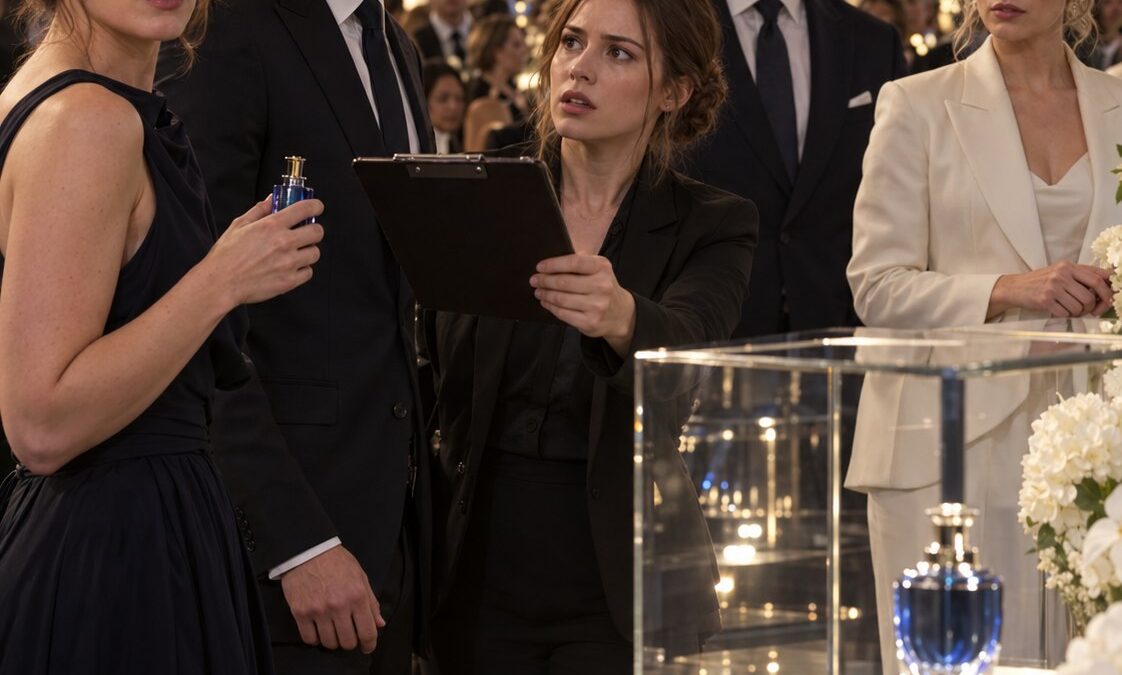
She held up the clipboard.
Nolan reached for it.
June stepped behind Gideon.
That small movement changed the room.
Tessa took the clipboard from her.
Thursday’s date appeared beside a delivery notation.
Envelope: lot release and replacement authorization.
Recipient: Mrs. Wynn.
Below it, in June’s neat print: Mr. Wynn says signed already.
Tessa read it twice.
“I asked for these records.”
“I sent them,” June said.
“The envelope was gone when I arrived.”
Nolan gave an exasperated sigh.
“People move papers in a busy lab.”
“Who moved this one?” Gideon asked.
“I have no idea.”
“Then we’ll find out.”
Ivy tried to lead Nolan away.
“We should get the investors into dinner.”
Gideon looked toward the pedestal.
“The launch is suspended.”
Nolan’s smile cracked.
“You can’t do that.”
“I just did.”
“We have contracts.”
“They can wait until we know what’s in those bottles.”
A woman from Gideon’s staff came to his side.
He asked her to hold every carton at the loading dock and contact the company’s quality lead.
He gave the instructions within Tessa’s hearing.
There was no dramatic seizure.
No slammed doors.
Just two phone calls and a decision that stopped the truck.
Tessa felt her knees loosen.
She braced herself against the glass booth.
Gideon noticed.
“Would you like a chair?”
“I’d like the records.”
“Both are possible.”
Nolan turned to her.
“You know what this looks like?”
“Yes.”
“Your sample could be old.”
“It is.”
“That’s my point.”
“It’s from the approved batch.”
“We improved the production formula.”
“Without the person who made it?”
Ivy looked at the watching guests.
“Can we discuss this privately?”
Tessa wanted privacy too.
But Nolan had used it for months, shutting doors and changing stories inside them.
“The records first,” she said.
Gideon sent a staff member for the quality lead.
June stayed.
Her hands trembled around the clipboard, though she did not put it down.
Tessa remembered being twenty-three and telling a supervisor that a supposedly empty tank still smelled of solvent.
He had called her difficult until another worker checked it.
She moved beside June.
“You did the right thing.”
June’s eyes flicked to Nolan.
“He said you were expecting it.”
“I was.”
That was the cruelest part.
Tessa had spent Thursday watching her lab station for an answer.
At ten that night, Nolan had called to say he was running late.
She had eaten crackers over the sink and left the lab light on for him.
A man in a charcoal suit arrived with a tablet.
Gideon introduced him as his company’s quality director, Owen Price.
Owen saw the uncapped display bottle and immediately closed it.
“Has anyone reported a reaction?”
“None that I know of,” Tessa said.
“Good.”
He photographed the bottle, the pedestal label, and Tessa’s vial.
He asked June to note who had handled them.
Tessa watched the care he took.
Her own work had rarely received that much respect.
“Where are the batch files?” Gideon asked.
“On our secure drive,” Owen said.
“Who can access them?”
“Quality, production, and the listed formula owner.”
“That’s me,” Tessa said.
Owen’s fingers stopped above his tablet.
“The system lists Mr. Wynn.”
Nolan spoke quickly.
“For administrative reasons.”
Tessa looked at him.
“You said I was the owner.”
“You are.”
“Your system disagrees.”
“We were correcting it.”
Owen opened the release record.
His face settled into a professional stillness.
He turned the tablet toward Gideon, then toward Tessa.
A scanned form carried her printed name.
Under it was a signature that looked remarkably like hers.
Remarkably.
Tessa had signed thousands of labels by hand.
Her last letter always rose sharply because she lifted the pen too soon.
This signature ended in a smooth, careful curl.
“I didn’t sign that.”
Nolan made a sound in his throat.
“Here we go.”
Tessa pointed to the date.
“Wednesday at four twelve.”
“I know you were at the lab,” Nolan said.
“I was at the hospital.”
Her father had been gone four months.
On Wednesday, she had returned to collect the watch he had left for her.
She had signed for it at the desk at four sixteen.
Nolan knew that too.
He looked away.
Owen enlarged the second page.
The forged signature authorized a replacement blend.
It also accepted responsibility for final testing and release.
Tessa read the last line.
If stores received the new bottles, the documents would say she had approved every drop.
She looked at Nolan.
He had not merely taken her place onstage.
He had made a place for her when blame came due.
* * *
They moved into a small conference room off the hall.
Tessa insisted June come with them.
Nolan objected.
“She’s a junior employee.”
“She carried the envelope,” Tessa said.
“And you’d prefer she wasn’t here.”
Gideon pulled out a chair for June.
“Please sit.”
Ivy remained standing by the door.
Owen called his lab supervisor and asked her to preserve unopened production bottles from three separate cartons.
He requested the original mixing records and purchase orders.
Tessa watched him work.
She did not need anyone to tell her the scent had changed.
She did need proof of when, where, and by whom.
A lawyer named Celia Hart joined them by video.
Gideon introduced her as outside counsel for the company that financed the launch.
Celia listened, then asked everyone to stop speaking at once.
It helped.
“What do we know?” she asked.
“We have two different scents,” Owen said.
“We have a disputed signature,” Tessa added.
“And we have a suspended shipment.”
“That’s enough to preserve records,” Celia said.
“It is not enough to accuse anyone of a crime.”
Nolan folded his arms.
“Thank you.”
Celia looked straight at him through the screen.
“I wasn’t speaking on your behalf.”
Tessa almost smiled.
Celia asked Owen to secure the files without altering them.
She asked June to photograph the clipboard page and send it directly to her.
Then she asked Tessa whether the blue vial had remained in her possession.
“Since Wednesday,” Tessa said.
“Did you leave it unattended?”
“For ten minutes while I showered.”
Nolan seized on that.
“Exactly.”
Tessa turned toward him.
“In the apartment we share.”
His expression hardened.
Gideon said nothing.
That restraint made Nolan look smaller.
Celia asked for the original signed development agreement.
Nolan said he could send it tomorrow.
“I’ll obtain the copy your company submitted,” she said.
Tessa remembered signing an agreement six months earlier.
She had read every page.
She had kept a copy in the drawer beneath her workbench because her father used to say a good recipe needed both a clean method and a paper trail.
Nolan had laughed when she told him.
She had kept the copy anyway.
“It’s at the lab,” she said.
“Can you retrieve it?”
“Yes.”
“Go with Owen,” Celia said.
“I’d like Gideon there too.”
Nolan gave a sharp laugh.
“Is that necessary?”
Gideon rose.
“I own the building.”
“That wasn’t my question.”
“It’s my answer.”
The lab occupied two rooms above the old bank’s loading bay.
The lights were on when they arrived.
One bench was clean.
Tessa’s was not.
Someone had opened its lower drawer.
Her folders lay crooked.
The development agreement was gone.
Nolan stopped in the doorway.
“Looks like you misplaced it.”
“I don’t stack papers by the window.”
He had learned that about her after seven years of marriage.
She hated sunlight on printed pages.
It faded ink.
The folders were beside the window now.
Owen photographed the drawer.
Celia asked them to leave everything in place until she could arrange a proper review.
Tessa touched the edge of the workbench.
A square of clear tape clung beneath it.
She knew exactly what it had held.
Her father’s watch had come in a flat cardboard sleeve.
On Thursday she had taped the sleeve under the bench, away from splashes, because she could not bear to put it in her bag beside the sample vials.
Now it was empty.
Nolan followed her gaze.
For a moment, she saw fear.
Then he looked bored again.
“Did you take my father’s watch?” she asked.
“No.”
“Someone took the sleeve.”
“I don’t know why you put things in strange places.”
Gideon stepped closer.
“Is something missing besides the agreement?”
Tessa shook her head.
The watch was in her coat pocket.
She had taken it home Thursday night.
Nolan did not know that.
She pulled it out.
Its worn leather strap hung across her palm.
“My father gave me this,” she said.
“I found it yesterday.”
Nolan stared.
Owen’s phone rang.
The lab supervisor had found the blending records.
He put her on speaker.
“There are two formula files,” she said.
“One is B-13.”
“And the other?” Tessa asked.
“B-13R.”
“Who wrote the revision?”
“The metadata says you.”
Tessa looked at the blue vial.
“I wrote no revision.”
The supervisor hesitated.
“The file was created from your terminal.”
Celia’s voice came through the tablet.
“Was anyone else able to use it?”
Tessa thought of the evening Nolan brought her soup.
She had been exhausted and left the terminal unlocked while she washed her hands.
He had said he only wanted to help.
The supervisor read the revision’s new ingredients.
The first substitution was a cheaper wood accord.
The second replaced an expensive floral absolute.
The third was an ingredient Tessa had explicitly rejected during development because it overwhelmed everything around it.
None of them necessarily made the perfume dangerous.
Together, they made it cheaper and unmistakably different.
Owen asked for purchase records.
The supervisor searched.
“Those substitutions came from a supplier called Alder Supply.”
“I’ve never used them,” Tessa said.
Nolan cleared his throat.
“They offered a discount.”
“How large?” Gideon asked.
“Substantial.”
“Who approved it?”
“I handle procurement.”
Owen scrolled through the invoices.
“The savings went where?”
Nolan’s answer came too slowly.
“Into the launch budget.”
Owen searched the payment ledger.
He found no matching credit.
Celia asked him to stop there and preserve the records.
Nolan leaned against the doorframe.
“This is becoming ridiculous.”
Tessa thought of the empty sleeve beneath the bench.
Somebody had searched her workspace.
Somebody had taken her agreement.
Somebody had built a new formula under her name.
And the man who shared her apartment had known she would be out collecting her father’s watch when the release was signed.
She looked at Gideon.
“I need to go home.”
“I’ll arrange a car.”
“No.”
She shook her head.
“I need to see what’s still there.”
Celia spoke from the tablet.
“Don’t search the apartment alone.”
“I wasn’t planning to.”
Nolan straightened.
“Tessa, we live together.”
“For now.”
His face tightened.
The words surprised her as much as they surprised him.
She had not decided where to sleep.
She had decided she could no longer ask his permission to find out what was true.
Owen received another message.
He opened the supplier registration attached to Alder Supply’s first invoice.
The company’s mailing address was familiar.
Tessa knew the street.
She knew the building.
It was the office where Ivy Bell had told her she worked.
* * *
Ivy denied owning Alder Supply.
She said she rented a desk in the same building.
That could be true.
Celia advised them to check before confronting her further.
Gideon agreed.
Tessa noticed how reluctantly.
He had watched Ivy take credit for her work.
He had watched Nolan threaten her reputation.
The restraint cost him something.
It made her trust him a little.
Outside, the old bank’s service entrance smelled of rain and exhaust.
Gideon’s driver waited by the curb.
Tessa stopped beside the car.
“You don’t have to come to my apartment.”
“I know.”
“You have guests downstairs.”
“They’ve been offered dinner.”
“You paid for this launch.”
“I did.”
“You’re taking it remarkably well.”
“I’m taking notes.”
She glanced at him.
His mouth shifted.
It was almost a smile.
He did not touch her.
He opened the car door and let her decide.
Tessa climbed in.
During the ride, she called her friend Mara, who managed the soap maker where she worked mornings.
Mara answered on the first ring.
“Are you still at that launch?”
“I need a place to stay.”
“You have a key.”
“I know.”
“Then come.”
Tessa closed her eyes.
Mara had offered that spare room after Tessa’s father died.
She had said Tessa could use it whenever the apartment felt crowded with grief.
Tessa had refused because Nolan said married people should sleep under one roof, however difficult the week had been.
She wished she had listened to Mara sooner.
At the apartment, the hallway light had burned out again.
Tessa used her phone to find the keyhole.
Nolan’s shoes were missing from the rack.
He had come ahead of them.
Inside, the closet stood open.
Two suitcases were gone.
The kitchen table held a sheet of paper.
Tessa read it without touching it.
Nolan had written that she was confused, tired, and prone to imagining injuries when under pressure.
He had taken the development agreement for safekeeping, it said.
Gideon read over her shoulder only after she handed him the page.
“He’s offering an explanation before anyone asks.”
“He knows people will ask.”
Tessa went to the drawer beside the refrigerator.
Her father’s recipe box was there.
It had held not recipes, but the small things he saved: repair receipts, old photographs, a bus pass from his first job.
After his death, she had placed copies of her agreements beneath the photographs.
She opened it.
The copies were gone.
Her father’s photograph remained.
He stood outside a narrow house, grinning beneath a sunhat too large for him.
Tessa held the picture by its edges.
For seven months, Nolan had known exactly where those papers were.
Gideon waited by the doorway.
“You can take a minute.”
“I’ve taken too many.”
She put the photograph in her coat pocket.
Then she opened her laptop.
A password prompt appeared.
Her own password failed.
She tried again.
The account was locked.
Celia called while Tessa was staring at it.
“The company’s security team has preserved the access logs,” she said.
“Please don’t try to recover anything yourself tonight.”
“Nolan changed my password.”
“We’ll document that.”
Tessa looked around the kitchen.
The chipped blue mug she loved stood in the sink.
Nolan’s expensive new coffee machine sat polished beside it.
She had spent the day worrying about whether the perfume would make him proud.
He had spent it making sure she could not prove she made it.
“What happens to the bottles?” she asked.
“They stay held,” Celia said.
“Owen is arranging independent testing.”
“What happens to Nolan?”
“We follow the records.”
A knock sounded at the apartment door.
Gideon checked the peephole.
Two uniformed officers stood in the hall.
Tessa felt a pulse of cold.
Celia heard her voice change.
“What is it?”
“The police are here.”
Gideon opened the door.
One officer introduced himself and asked for Tessa Wynn.
She stepped forward.
They had received a report from Nolan, he explained, alleging that company property had been taken from the lab.
He asked whether she had a blue sample vial.
Tessa looked at the vial in her hand.
She had brought it home after the launch.
Nolan had made his report fast.
“It’s mine,” she said.
“May we see it?”
Celia’s voice came from the phone.
“Tell them you have counsel on the line.”
Tessa did.
She answered the officers’ questions.
She showed them the vial without surrendering it until Celia and the officers agreed on a documented transfer for testing.
The officers were courteous.
They did not decide ownership in her kitchen.
They noted Nolan’s allegation and Tessa’s response.
When they left, Tessa sat down.
Gideon filled her blue mug with water.
The handle had a crack.
He set it on the table within reach.
“I thought he might leave,” she said.
“I didn’t think he would call the police.”
“He needs you frightened.”
“He knows what frightens me.”
Gideon pulled out the chair across from her.
“Then we make sure he knows less tomorrow.”
She looked up.
“That sounded threatening.”
“It was practical.”
“Are those different, where you come from?”
“Usually.”
She smiled despite herself.
He waited until she drank the water.
Then Celia called again.
Owen had found Alder Supply’s registration through the state database.
Ivy was not listed.
The sole owner was a holding company.
Celia read its name.
Gideon’s expression changed.
“What?” Tessa asked.
“I know who controls it,” he said.
He had acquired the holding company years earlier with a group of unrelated investments.
Someone inside his business had used one of its dormant subsidiaries.
Only a few people had authority to reactivate it.
Celia gave the name from the current manager filing.
Victor Rook.
Gideon’s older brother.
* * *
Gideon asked Celia to bring in outside forensic accountants.
He did not ask his own people to investigate his brother alone.
Tessa noticed.
She had heard the stories about Gideon’s temper.
She had expected him to make a call and end someone’s career before dawn.
Instead, he asked which records had to be preserved and who should hold copies.
By morning, the first lab results confirmed what Tessa’s nose had told her.
The production perfume differed significantly from B-13.
The substituted ingredients met the basic standards Owen had checked, but the product could not honestly be sold as the formula approved for launch.
That answered one question.
It opened several others.
Victor chaired the investment committee that had financed Morrow.
He had approved Nolan’s budget increases.
He had also pressed for the first retail shipment to leave before the launch ended.
Celia showed Tessa the email chain.
Victor’s messages sounded reasonable.
A retailer had booked shelf space.
The marketing spend was committed.
Delays would embarrass everyone.
Tessa had heard versions of each argument from Nolan.
She read the dates again.
The first message pushing shipment had gone out before she approved B-13.
Victor had been planning a faster release while she was still refining the scent.
“What does he gain?” she asked.
“Possibly a fee through the supplier,” Celia said.
“Possibly more.”
The accountants were tracing the money.
Celia warned that it could take weeks.
Tessa believed her.
Real answers had become slower than Nolan’s lies.
For two days, she worked from Mara’s spare room.
Mara made toast badly and left it outside the door with a note that said: Eat this before you save civilization.
Tessa corrected three lab records she could verify from her notebooks.
She labeled every correction with the date and reason.
She did not try to improve her memory after the fact.
On Friday, June called.
“I remembered something about the envelope.”
Tessa sat upright.
“Tell Celia too.”
“I will.”
June said she had placed it at Tessa’s station beside a small white fan.
When she returned an hour later, the fan was running.
It had been off before.
The envelope was gone.
The fan mattered because the lab security camera faced the sink, not the bench.
Its reflection in the dark window sometimes caught movement behind the camera’s view.
Tessa had complained about the glare for months.
Owen checked the preserved footage.
At 5:41, the fan started.
In the window’s reflection, a figure reached across Tessa’s bench.
The image did not show a face.
It showed a hand with a wide silver ring.
Nolan wore one.
Victor did too.
Gideon looked at the still frame.
“My brother’s ring has a black stone.”
The reflection was too blurred to show a stone.
Celia would not let him choose an answer.
They asked building security for badge logs.
Nolan’s badge had entered the lab at 5:37.
Victor’s had entered the building at 5:34.
Neither log proved who took the envelope.
But someone had returned a badge at the service desk that evening.
The attendant had written a receipt.
Tessa recognized the signature.
Not Nolan’s.
Victor’s.
“Why return it?” she asked.
“He reported it damaged,” Celia said.
“The chip had stopped working.”
“Did it?”
“We’re checking.”
That afternoon, the accountants found a second thread.
Alder Supply had charged Morrow for the cheaper ingredients at the price of the original ones.
The difference was large enough to matter.
Several similar invoices had been submitted to other small brands financed by Victor’s committee.
The accountants could not yet say where all the excess money went.
They could say the pattern was older than Morrow.
Tessa read the report at Mara’s kitchen table.
“So I was the latest one.”
“Possibly,” Celia said.
Nolan had called her eleven times that morning.
His messages shifted from anger to apology to concern.
She saved them.
She answered none.
At sunset, Gideon arrived with a sealed bag from the lab.
Inside was Tessa’s original development agreement.
The security team had found it in a locked drawer in the office Nolan used when he visited.
Tessa pressed her hand to the table.
“I thought he destroyed it.”
“He kept it,” Gideon said.
“Why?”
Celia answered.
“Because the terms could still benefit him.”
The agreement gave Tessa ownership of the formula she created.
It gave Nolan’s company a license to market it after an approved release.
A forged replacement formula could let the company claim she had made the cheaper version.
If complaints followed, it could blame her judgment.
If sales succeeded, Nolan could keep marketing it.
Either way, the signature on the release shifted responsibility toward Tessa.
“Can we prove he forged it?” she asked.
“Not yet,” Celia said.
“We can prove the document is disputed.”
Gideon remained by the window.
He had barely spoken since reading the invoice pattern.
Tessa understood why.
Victor was his family.
The fraud had moved through companies carrying his name.
She closed the agreement.
“You can step back.”
“I won’t.”
“You don’t owe me a family war.”
“I owe everyone who bought into this a proper accounting.”
He looked at her.
“And I owe you an apology for putting my name on a company that treated you this way.”
“You didn’t put me in that booth.”
“No.”
The word was careful.
Tessa appreciated that more than an excuse.
Celia’s phone rang.
She listened for a full minute.
Then she asked the caller to send the document securely.
When the file arrived, she read it without speaking.
“What is it?” Tessa asked.
“A bank record.”
Alder Supply had made a large payment to a private account the morning after the launch.
The account belonged to Nolan.
Its reference line read: final cooperation.
Victor’s name was attached to the transfer approval.
Nolan had sold her work, and the price of helping bury it was in writing.
* * *
The hearing took place eight days later.
It was not a trial.
Celia made sure Tessa understood that before they walked into the conference center.
Gideon’s investment group had called an emergency meeting to decide whether Victor would keep control of its funds while the outside investigation continued.
Retail partners had been invited.
So had the founders of two other brands whose invoices showed the same supplier pattern.
Tessa had been asked to speak because Morrow was the first project with a disputed formula release.
She wore a dark green suit borrowed from Mara.
The sleeves were slightly short.
Mara said that made it fashionable.
Tessa suspected Mara was being kind.
Nolan waited near the doors.
He had shaved.
He looked tired enough to be honest and polished enough to resist it.
“Tessa.”
She kept walking.
“Please.”
Celia stopped beside her.
Nolan glanced at the lawyer.
“I only need a minute.”
“You can speak through counsel,” Tessa said.
“We’re married.”
“You filed a police report against me.”
“I withdrew it.”
“You filed it.”
His face tightened.
“I was scared.”
“So was I.”
She entered the room before he could answer.
Victor sat at the long table with a folder arranged squarely before him.
He resembled Gideon around the eyes.
Everything else about him seemed rehearsed.
Ivy sat two chairs away.
She did not look at Tessa.
June had come too.
She sat at the back with her hands folded over the same clipboard.
The group’s independent chair opened the meeting.
Celia presented the outside accountants’ preliminary findings.
Alder Supply had sold substitutions to several financed brands.
Invoices had concealed the lower cost.
Money had passed through accounts controlled by Victor’s investment office.
The accountants were continuing to trace the full amount.
Victor did not interrupt.
When it was his turn, he stood.
He spoke well.
He said small companies routinely changed suppliers.
He said quality leads could approve revisions.
He said a chairman relied on managers to execute decisions.
Then he turned to Tessa.
“Mrs. Wynn had access to every formula file.”
“Yes,” she said.
“She kept a sample outside normal control.”
“Yes.”
“She has a personal dispute with her husband.”
“Yes.”
He spread his hands.
“I understand why this feels persuasive.”
Tessa felt the room shift toward him.
He had arranged three true facts and left the false conclusion for everyone else to draw.
Victor continued.
“Before we destroy careers, we should ask whether a talented but exhausted creator misunderstood a lawful production change.”
Tessa looked at the blue vial on the table.
She was tired.
She had been tired for a year.
Her exhaustion did not make the records belong to someone else.
Celia asked Victor who authorized the change.
“The project team.”
“Which person?”
“The release bears Mrs. Wynn’s signature.”
“It is disputed.”
“Many signatures are disputed when money is at stake.”
Gideon’s fingers closed around his pen.
He did not speak.
Tessa picked up B-13.
“May I?”
The chair nodded.
“I made this batch on a Tuesday morning.”
She turned the vial so the silver crimp faced the room.
“The crimping tool had a nick.”
She pointed to a tiny crescent impressed in the metal.
“Every sample I sealed that week has the same mark.”
Victor leaned back.
“What does that establish?”
“That this vial came from my lab.”
“No one denies you made samples.”
Tessa nodded.
He was right.
The mark alone would not prove who changed production.
She held up the vial’s handwritten label.
“B-13 is written in ink that smears if I touch it too soon.”
A few people leaned forward.
“I wait for it to dry before I put the vials away.”
She set B-13 down.
“On Wednesday, I found B-13R in the system.”
“That is your handwriting on the release,” Victor said.
“That’s what I’m here to discuss.”
She took a printed photograph from Celia.
It showed the scanned release form.
“My signature ends upward.”
She drew her name on a blank sheet.
“The one on that form curls down.”
Victor smiled faintly.
“People sign differently.”
“They do.”
Tessa lifted another document.
“Someone copied my signature from the agreement I signed in March.”
The chair examined both pages.
Celia had obtained the original agreement from Nolan’s drawer.
A document examiner hired by the outside lawyers had compared them.
The release signature matched the March agreement too closely, including a stray ink mark left by a faulty pen.
The mark appeared in precisely the same place on both images.
Tessa watched Victor’s smile disappear.
“Who had the agreement?” the chair asked.
“Nolan kept it,” Tessa said.
Nolan half rose.
“I had a business copy.”
“You had my copy from my bench too.”
He sat down.
Victor recovered first.
“Even if the signature was copied, that does not identify who did it.”
“Correct,” Celia said.
She signaled Owen.
He displayed the system logs.
The B-13R file had been created from Tessa’s unlocked terminal.
But the copied signature had been inserted later, using a user account assigned to Victor’s investment office.
The account had also uploaded the revised supplier invoice.
Victor studied the screen.
“Shared credentials,” he said.
“Then we should identify the user,” Celia replied.
June stood at the back.
“I can help.”
She described the envelope, the fan, and the badge returned to security.
Then the independent security examiner showed the badge’s chip report.
It had not stopped working.
It had been used to enter the lab twice after Victor reported it damaged.
The second entry came after Tessa left for the hospital.
Victor’s jaw moved once.
“Badges are transferable.”
“They are,” Celia said.
She had warned Tessa not to expect one piece of evidence to settle everything.
Then she showed the independent confirmation.
The service desk had photographed every returned badge for its records.
Victor had handed his badge across the counter himself at 6:02.
At 6:14, that same badge entered the lab again.
The examiner had reviewed the hallway camera.
Nolan used it.
The images showed him carrying a flat envelope when he left.
Victor had given Nolan access after telling security the badge was damaged.
Nolan stared at the table.
Ivy looked at him.
He could have been carrying any envelope, Victor argued.
That was possible.
Then Owen opened the preserved production order.
Its approval history included a comment visible only in the archived version.
V. Rook: Release before launch. N. Wynn will manage creator.
No one spoke for several seconds.
Tessa looked at Nolan.
He had promised to manage her as if she were a delay in shipping.
Victor closed his folder.
“I made a commercial decision,” he said.
“You concealed costs,” the chair replied.
“You took a risk to protect the brands.”
“You charged those brands for ingredients they did not receive.”
Victor looked at Gideon.
“You built this group to move faster than timid people.”
Gideon met his eyes.
“I built it to keep promises.”
Victor gave a short laugh.
“Promises do not pay invoices.”
Tessa thought of her car loan.
Of Mara’s burnt toast.
Of the father who taught her to save receipts because honest work deserved a record.
“They do when customers pay for what we promised,” she said.
The chair called a recess.
When the meeting resumed, Victor’s authority over the funds was suspended.
The group referred its findings to the appropriate authorities and its insurers.
The retail shipment remained held.
Ivy asked to speak.
She admitted Nolan had told her Tessa wanted no public role.
She admitted she had presented Tessa’s speech as her own.
She said she had not known about the forged release until the launch.
The investigators would check that claim against her messages and files.
Tessa believed one part of it.
Ivy had looked frightened when June mentioned the envelope.
That did not erase the speech.
It did not erase the applause she had accepted.
Nolan approached Tessa after the room emptied.
“I never meant for you to get hurt.”
She looked at him.
“You made a plan for when I did.”
He swallowed.
“Victor said the revision was safe.”
“You let me take responsibility for it.”
“I thought we could fix it later.”
“You had weeks.”
“I know.”
That was the first honest sentence he had given her.
It did not bring back the others.
She left with Celia.
Over the following months, the outside investigation widened.
Authorities brought fraud and forgery charges against Victor and Nolan.
Both entered pleas under agreements that required them to account for their roles and repay money they had taken.
The court’s orders and the group’s civil settlements took longer than the launch night had.
The affected brands received documented restitution from the recovered funds and the group’s own reserve.
Ivy testified and lost her position.
Tessa did not ask anyone to ruin her.
She also declined Ivy’s request to help rebuild her reputation.
The last time Victor addressed Tessa at the courthouse, he called her a fortunate woman with powerful friends.
Tessa stopped beside him.
“I had a notebook,” she said.
“And I kept it.”
* * *
Spring came slowly.
Mara’s spare room grew crowded with Tessa’s coats, notebooks, and too many sample strips.
On a Sunday morning, Mara opened the window and threatened to label every cup in the kitchen as a new fragrance.
“Notes of cold coffee,” she announced.
“Hints of unpaid rent.”
“You own the apartment,” Tessa said.
“Then call it artistic debt.”
Tessa laughed hard enough to spill her tea.
She had not expected laughter to return without warning.
The original Morrow formula still belonged to her.
The settlement confirmed what her March agreement had said all along.
Gideon’s company offered to finance a proper launch under her name.
The terms were fair.
She made Celia read them anyway.
Then she asked for changes.
Part of the first year’s profits would support training placements for young lab workers.
The quality team would report independently of sales.
Every person who contributed to a formula would receive credit that could not disappear when a presentation changed hands.
Gideon read the marked contract across from her.
“You added twelve pages.”
“Nine.”
“Two are in very small print.”
“You can say no.”
“I could.”
He signed.
She watched the pen.
His signature was quick and untidy.
“You’re pleased with yourself,” he said.
“I’m pleased with the independent quality team.”
“That too.”
She had learned his face over the months.
He looked severe when he was listening closely.
He looked almost gentle when he believed no one was watching.
They met for business often enough that people began inventing reasons.
Tessa ignored them.
Gideon never arrived without telling her why.
He never used a business meeting to ask for a private answer.
One evening, after a long supplier review, he walked her to the street.
“You don’t have to keep doing that,” she said.
“I know.”
“You say that often.”
“You often tell me what I don’t have to do.”
She smiled.
“It’s a useful reminder.”
He looked toward the cars passing through the rain.
“May I ask you to dinner next week?”
“You’ve asked me to dinner before.”
“With six other people and a contract.”
“This would be without either.”
Tessa considered him.
She wanted to say yes.
Wanting did not make the decision simple.
Her marriage had ended on paper only recently.
She was still learning which choices felt like her own.
“I’d like some time,” she said.
“You have it.”
He did not ask how much.
He did not look wounded.
He told her goodnight and crossed the street.
Tessa watched him go until the light changed.
She returned to Mara’s apartment and found a letter from Nolan.
It had come through his lawyer, as she had requested.
His apology was plain.
He named what he had done.
He admitted calling the police because he wanted the vial out of her hands.
He did not ask her to tell the court he was a better man.
He asked whether she might someday speak to him.
Tessa read the letter twice.
Then she wrote a reply.
She accepted that he had apologized.
She did not forgive the stolen months on demand.
She would communicate about the divorce through their lawyers.
She hoped he kept telling the truth when it cost him something.
Mara offered to mail it.
Tessa put it in the outgoing tray herself.
The next week, she visited her father’s old house.
His watch was on her wrist.
It ran six minutes slow no matter who repaired it.
He used to call that a manageable flaw.
Tessa sat on the back steps with her notebook.
She wrote a new scent proposal.
It began with clean linen, bitter orange, and the green smell of a broken stem.
It ended somewhere warmer.
She left room on the page for a name.
On Monday, June came to interview for the training program.
Tessa hired her.
“You have more qualified applicants,” June said.
“Yes.”
June stiffened.
Tessa showed her the job description.
“This one calls for someone who notices a missing envelope and says so.”
June smiled.
They worked through the afternoon.
At four, Tessa called Gideon.
“Is the dinner offer still open?”
“It is.”
“One dinner.”
“One dinner.”
“No photographers.”
“Agreed.”
“No speeches.”
“I’ll try.”
She could hear his smile.
They went to a small restaurant with uneven tables.
Gideon asked about her father’s watch.
Tessa told him the truth.
She told him it used to annoy her when her father arrived late for everything, even his own birthday dinners.
After he died, she had kept the watch instead of having its stubborn minutes corrected again.
Gideon did not turn that into a lesson.
He told her about the night his brother taught him to ride a bicycle and then let go too soon.
“He caught me,” Gideon said.
“Eventually?”
“Before I hit the curb.”
“That’s a complicated endorsement.”
“It’s all I can honestly give.”
Tessa liked him more for leaving it complicated.
When dinner ended, he walked her to a taxi.
He stopped an arm’s length away.
“May I see you again?”
“Yes.”
“Next week?”
“Yes.”
“Is there a third condition I should know?”
“Probably.”
He waited.
“I’ll tell you when I find it.”
He laughed.
Tessa took his hand before she got into the car.
She let go when she chose.
Across the following year, they learned each other in ordinary places.
A grocery aisle.
A crowded sidewalk.
Mara’s kitchen, where Gideon proved unable to make toast any better than Mara.
They argued once over a supplier whose paperwork he trusted and Tessa did not.
He checked.
She was right.
The next time they disagreed, he checked before either of them raised a voice.
Morrow finally launched in a smaller room with clear windows and chairs for everyone who had worked on it.
Tessa spoke about the formula herself.
She thanked June, Owen, and the lab team by name.
Gideon stood near the back.
He applauded when the others did.
Afterward, Tessa carried a production bottle outside.
She opened it beneath the cool evening air.
It smelled like the future she had meant to make.
Gideon came to stand beside her.
“You named the second scent,” he said.
“I did.”
“What is it?”
“Later.”
“That seems unfair.”
“I’ve waited a year to use that word.”
He offered his hand.
She took it.
* * *
Four years after the first launch, the old currency hall no longer held a glass scent booth.
Tessa had insisted it go.
The testing area now had open tables and wide aisles.
Guests could step forward, sample something, and leave whenever they wished.
That evening, June stood behind one of the tables teaching new trainees how to compare two formulas without guessing what their supervisors wanted to hear.
Mara arrived late with a paper bag of pastries.
Gideon accepted one before she could accuse him of behaving like a host.
Tessa watched them from the doorway.
She wore her father’s watch.
It was six minutes slow.
She had stopped trying to correct it.
The room smelled faintly of Morrow.
It also smelled of the new scent.
Tessa had finally named it Open Door.
She had kept B-13 in a drawer for years, sealed in its blue glass.
Its crimp still bore the nick from her old tool.
That morning, she had taken it out to show the trainees how a small mark could connect an object to its history.
She had also told them what it could not prove by itself.
They asked good questions.
They wrote things down.
No one told them to smile for a camera.
Gideon crossed the hall toward her.
“The caterer wants to know who approved the pastries,” he said.
“Mara did.”
“That explains the quantity.”
“She ordered enough for everyone.”
“And everyone’s neighbors.”
Tessa looked at the open tables.
“The first night here, I thought leaving that booth would cost me everything.”
Gideon followed her gaze.
“You opened the door yourself.”
“You held it.”
“I remember.”
She slipped her hand into his.
Across the hall, June called the trainees together.
Mara offered a pastry to a guest who had mistaken her for the caterer.
A young perfumer uncapped a vial and asked for a second opinion.
Tessa went to help.
She smelled the sample, then handed it back.
“What do you think?” she asked.
The young woman considered it.
Tessa waited for her answer.
THE END