A Deaf Girl Was Accused of Ruining the Winter Benefit—Until Her Mother’s Chalk Map Exposed the Family’s Secret
Chapter 2: The Room Beneath
The detective held the doorway.
Martin kept the map folded.
Celeste’s hands remained very still.
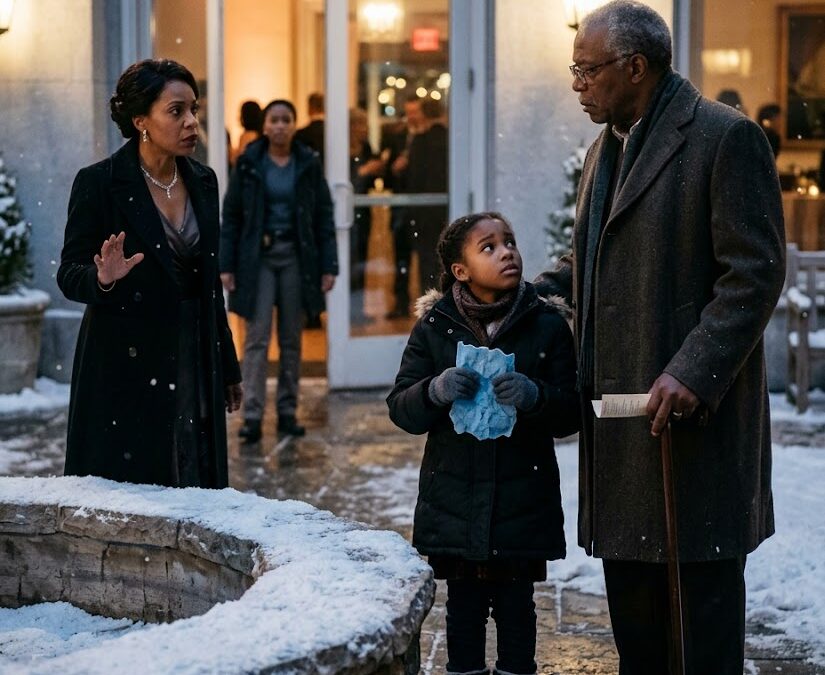
Nessa stood beside the fountain.
Snow melted in her hair.
“Mrs. Vane,” the detective repeated.
Celeste looked toward the phones.
“Detective, this is absurd.”
“Then a few questions should settle it.”
“Not in front of donors.”
“Your husband’s name brought us here.”
The guests shifted.
Someone set down a champagne glass.
The quartet had stopped playing.
Nessa watched the detective’s mouth.
Then she looked at Martin.
He signed the words carefully.
“She wants to ask Celeste questions.”
Nessa nodded once.
Her shoulders stayed tight.
Detective Priya Shah showed her badge.
“I’m investigating the disappearance of Evelyn Bell.”
Celeste’s face remained composed.
“Evelyn worked here briefly.”
“She disappeared last February.”
“She left town.”
“Her daughter says otherwise.”
Nessa held up the chalk map.
Martin unfolded it on a table.
The blue lines crossed the museum’s courtyard.
One line ended beneath the fountain.
The small star rested under its central basin.
Detective Shah leaned closer.
“Who made this?”
“My mother,” Nessa signed.
Martin translated.
“When?”
“Before she vanished.”
Celeste let out a short, brittle laugh.
“She is nine years old.”
“She knows what she saw,” Martin said.
“And you know what?”
“I know this notation.”
Martin tapped the map’s corner.
“Evelyn copied old maintenance marks.”
“You’re certain?”
“I taught her the archive system.”
Celeste stared at him.
“You were retired then.”
“I was still helping her.”
The detective looked from one to the other.
“Why?”
Martin paused.
“Because she was trying to find a missing ledger.”
“What ledger?”
Celeste’s jaw tightened.
“None of this is relevant.”
Detective Shah took out a small notebook.
“Did you know Evelyn?”
“She worked in records.”
“Did you know she was pregnant?”
The question brought a visible flinch.
Nessa looked at Martin.
He signed the words again.
Celeste answered before he could translate.
“I knew she had a child.”
The admission moved through the courtyard.
Not a gasp.
A series of small, unmistakable reactions.
A hand lowered a phone.
A guest turned toward Celeste.
Nessa kept staring at her.
The detective wrote something down.
“Did you know where Evelyn went?”
“No.”
“Did your husband?”
Celeste’s lips pressed together.
“My husband is dead.”
“His death was ruled accidental.”
“Then why are you asking me?”
“Because his car was found near the museum that night.”
“He drove everywhere.”
“His phone showed a call to Evelyn.”
Celeste glanced at the map.
That tiny motion told Martin more than her words.
The detective saw it too.
“Mrs. Vane?”
“I want a lawyer.”
“You’re free to call one.”
“Then I’m leaving.”
The guard stepped aside.
Celeste walked through the doors.
The crowd parted for her.
Nessa remained motionless.
Martin signed slowly.
“She knows something.”
Nessa touched the folded map.
“She knew Mom was here.”
The detective crouched to Nessa’s height.
“Can you tell me what your mother said?”
Nessa watched her face.
Then she signed.
“She said the room had a door.”
“Did she say where?”
“At the star.”
Martin looked down at the fountain.
The stone around its base had a ring of darkened mortar.
A shallow groove curved around the basin.
He had seen the same pattern in photographs from a renovation report.
“Someone sealed a hatch.”
Detective Shah turned to him.
“Where?”
“Under that lip.”
The guard moved back as Martin approached.
He ran his fingers along the fountain’s base.
The map’s star sat exactly above a small brass pin.
A pin painted white to blend with the stone.
“Don’t touch it,” the detective said.
“I’m not.”
Martin stepped away.
The detective called the museum director.
Then she requested the city’s structural engineer.
The guests began to leave.
Some looked embarrassed.
Others kept recording.
Nessa stayed beside the table.
Her fingers curled around the hearing aid case.
“Did your mother wear that?” Martin asked.
Nessa nodded.
“She gave it to me.”
“Why?”
“Because mine broke.”
Martin looked at the case.
It was old, scratched, and empty.
The paper strip had been tucked beneath its lining.
A second seam ran along the inside.
Nessa pointed to it.
“There’s more.”
Detective Shah took gloves from her bag.
She opened the case carefully.
A flat metal sliver slid into her palm.
It was stamped with three numbers.
Then a tiny letter.
“B-seven,” Martin said.
The detective checked the map.
“Is that a room?”
“An archive cabinet.”
“Where?”
“Sublevel two.”
Martin looked toward the service corridor.
The museum’s lower level held crates, old exhibit hardware, and records awaiting cataloging.
The museum director returned with the engineer.
A police technician photographed the map and case.
No one touched the fountain.
The engineer examined the hidden pin.
He said the basin could be lifted safely, but only after supports were placed.
A crowd waited outside the marked perimeter.
Phones filmed the process through the courtyard glass.
Nessa sat on a bench.
Martin sat beside her.
“I should have noticed,” he signed.
“What?”
“That Evelyn was afraid.”
Nessa looked at his hands.
“She told me not to trust the museum.”
“Did she say why?”
“She said the walls kept secrets.”
Martin looked at the carved stone.
“I helped her search.”
“Did you find anything?”
“No.”
“You stopped.”
“I thought she had left.”
Nessa turned away.
Martin did not reach for her.
He let the hurt remain between them.
Detective Shah came over.
“The engineer found a hollow space.”
Nessa stood up.
“Is she there?”
“We don’t know yet.”
“Can you open it?”
“After we secure the structure.”
Nessa looked at the fountain.
“She said there was still someone inside.”
Detective Shah’s expression changed.
“Did your mother mean a person?”
Nessa nodded.
The engineer called the police team.
They brought portable supports and lights.
The guests had mostly cleared out.
The few remaining donors stood behind the doors.
Martin stayed with Nessa.
The work moved slowly.
The engineer marked the stone.
A technician checked for wiring.
A second officer logged every step.
A bolt came free.
Then another.
The fountain’s narrow panel shifted a fraction.
Cold air rose from the opening.
Nessa grabbed Martin’s sleeve.
He covered her hand with his.
The gap widened.
Below it, metal steps descended into darkness.
A police officer went first.
Then Detective Shah.
Martin was asked to remain above.
Nessa was too.
She watched the beam of a flashlight move below.
“Anyone down there?” the detective called.
No answer came.
The officer moved farther in.
A muffled sound returned.
Not a voice.
A metallic knock.
Three times.
The detective called it in.
A rescue team arrived.
The opening was widened with the engineer supervising.
The stairs led to a narrow service chamber.
It had no outside door.
Only a sealed interior wall.
The metal cabinet marked B-seven sat against it.
Someone had cut a small vent into its side.
The officers heard another knock.
This time, it came from behind the wall.
Martin’s cane slipped from his hand.
The rescue team opened the cabinet.
Inside lay a bundle of old plans.
Beneath them sat a brass latch connected to the wall.
The latch turned.
A narrow panel swung inward.
A woman stepped into the light.
She was thin.
Her hair had been cut short.
Her eyes went directly to Nessa.
“Mom,” Nessa signed.
Evelyn Bell dropped to her knees.
Nessa ran into her arms.
The detective moved back.
Martin covered his mouth.
For several seconds, nobody spoke.
Evelyn held her daughter’s face.
Nessa signed too fast to follow.
Evelyn answered with shaking hands.
The detective asked for a medic.
Evelyn refused to let go of Nessa.
“He locked me in,” she said.
“Who?” Detective Shah asked.
Evelyn looked toward the courtyard.
“Celeste’s husband.”
“Gideon Vane?”
Evelyn nodded.
“He knew I had copied the ledger.”
“Why keep you here?”
“He needed time.”
“Time for what?”
“To change the records.”
The detective called for another officer.
Evelyn’s knees buckled.
A medic helped her sit.
Nessa held her hand.
Martin stayed nearby.
Evelyn looked at him.
“You found the map.”
“Nessa did.”
“I thought they destroyed it.”
“Who did?”
“Celeste.”
Detective Shah turned back.
“Did Celeste know you were alive?”
Evelyn swallowed.
“She came here once.”
“When?”
“Three months after Gideon died.”
“Why didn’t you leave?”
“The latch was jammed from the outside.”
“You had no way to signal?”
“The wall blocked everything.”
“Then how did you survive?”
“Water pipes. Stored crackers. A maintenance sink.”
The medic checked her pulse.
Evelyn’s voice was hoarse.
“She didn’t bring food.”
The detective’s eyes sharpened.
“Celeste?”
“She opened the panel. She looked at me.”
“Did she call for help?”
“No.”
“Did she say anything?”
“She said Gideon’s work was finished.”
Nessa clutched her mother’s hand.
“Then she shut the door.”
Detective Shah asked the medic to wait.
“Can you tell me about the ledger?”
Evelyn’s gaze went to the map.
“It showed the harbor fund’s money.”
“Missing money?”
“Moved through shell contractors.”
“Who controlled them?”
“Gideon.”
“And Celeste?”
“Signed the approvals.”
The museum director stepped forward.
Detective Shah stopped him.
“No one goes downstairs.”
A uniformed officer escorted the director back.
Evelyn looked at Martin.
“You taught me those marks.”
“I should have stayed.”
“You couldn’t know.”
“I knew you were frightened.”
She held his gaze.
“You believed my resignation letter.”
“I did.”
“Then you didn’t believe me.”
He lowered his eyes.
Nessa watched them.
Evelyn squeezed her hand.
The detective asked whether Evelyn could identify the route used to reach the chamber.
Evelyn said there was only one entrance.
It opened from the fountain side.
The key had been held by Gideon.
After he died, the museum said the key was missing.
“Celeste had it,” Evelyn said.
“How do you know?”
“She used it.”
The detective looked at the map again.
“Why did you send Nessa here?”
“I didn’t.”
Nessa shook her head.
She signed to her mother.
Evelyn read her hands.
Then her face changed.
“Nessa?”
“I found the map in our apartment.”
“Where?”
“Inside the heater.”
Evelyn stared.
“That was hidden for you.”
“By who?”
Evelyn’s eyes moved toward Martin.
“By Gideon.”
The name landed hard.
“He left it?” Martin asked.
“He tried to tell me something.”
“What?”
“He said Celeste had taken the original ledger.”
The detective wrote it down.
“Why would he help you?”
“He wasn’t helping me.”
Evelyn looked at her daughter.
“He was afraid she’d use the money to erase everything.”
The detective asked if Gideon had told her that directly.
“Not in words.”
“Then how?”
“He left the room key behind.”
Evelyn pointed to the case.
“That metal sliver opens the archive cabinet.”
The evidence technician photographed it.
“Could it hold the original records?”
“No. It held a duplicate.”
“Where is the original?”
“Celeste took it.”
“Do you know where?”
“Her house.”
The detective took a breath.
“Can you identify it?”
“I can identify the book.”
“What does it look like?”
“Green cloth. Brass corners.”
“Is it marked?”
“Inside the cover, Gideon wrote a date.”
“What date?”
“October seventeenth.”
The detective checked the calendar.
“That was the night he died.”
Evelyn nodded.
“He said if I found the ledger, I’d know what happened.”
The rescue team moved Evelyn to an ambulance.
Nessa climbed in beside her.
Martin followed in his car.
At the hospital, doctors treated dehydration and exhaustion.
They found no major injury.
A social worker came to check on Nessa.
Nessa refused to leave her mother.
The detective waited in the hall.
Martin stood beside her.
“What was the room?” he asked.
“A sealed museum service chamber.”
“Who sealed it?”
“We’ll establish that.”
“You know it was Celeste.”
“I know what Evelyn says.”
“Isn’t that enough?”
“It’s a lead. We need proof.”
Martin nodded.
“Then let’s get it.”
Detective Shah looked at him.
“You’re a witness now.”
“I understand.”
“Don’t contact Celeste.”
“I won’t.”
“Don’t search her house.”
“I won’t.”
“Don’t warn anyone.”
“I won’t.”
She handed him a card.
“If you remember anything about the old plans, call.”
“I will.”
Nessa came out of the room.
The social worker had given her a blanket.
She looked smaller beneath it.
“Can we go home?” she signed.
“Soon,” Martin replied.
“Is Mom coming?”
“Yes.”
“Can we take her?”
The question cut through him.
Evelyn watched from the bed.
The nurse said she needed observation overnight.
Nessa climbed onto the chair beside her.
Martin went to the vending machine.
He bought a packet of crackers.
Nessa took one and gave the rest to Evelyn.
Evelyn ate slowly.
“Your map brought us here,” Martin signed.
“She made it,” Nessa answered.
“Your mother did.”
“I carried it.”
Both things were true.
The next morning, Detective Shah returned.
A judge had approved a search warrant for Celeste Vane’s home.
The warrant cited Evelyn’s statement, the recovered key, the museum chamber, and the disappearance inquiry.
Police seized records from a locked office.
They found several green ledgers.
Only one had brass corners.
The date inside the cover matched October seventeenth.
But the pages covering the harbor fund were missing.
Celeste’s attorney arrived at the museum.
She denied knowing Evelyn was alive.
She said Gideon had acted alone.
She claimed the ledger was planted.
Detective Shah did not arrest her that day.
The evidence needed examination.
The chamber needed documentation.
The museum needed to preserve its records.
Evelyn needed time to recover.
For a week, the story stayed in headlines.
A museum employee had vanished.
A child had mapped a sealed room.
A powerful family had hidden both.
Reporters gathered outside the hospital.
Nessa hated the cameras.
The detective arranged a private exit.
Evelyn was discharged to a temporary safe apartment.
Martin visited with groceries.
He left them outside the door.
Evelyn opened it after he knocked.
“You can come in,” she said.
He set the bag down.
“I brought bread.”
“I can see that.”
“I didn’t know what else.”
“Thank you.”
Nessa showed him the map.
She had traced it onto fresh paper.
“Why copy it?”
“So it won’t disappear.”
Martin looked at the blue lines.
“What will you do with it?”
“Keep it.”
“That sounds wise.”
Evelyn sat at the table.
She had rested, but her face remained drawn.
“Tell me what you remember,” Martin said.
“About the night?”
“Anything.”
Evelyn spoke in short pieces.
Gideon had called her to the museum.
He said he wanted to return the duplicate ledger.
She found him near the fountain.
Celeste arrived soon after.
The two argued.
Evelyn heard Celeste say the family could not survive an audit.
Gideon wanted to turn over the records.
Celeste wanted him to wait.
“He said he had already made copies,” Evelyn said.
“What happened next?”
“Celeste left.”
“And Gideon?”
“He gave me the key.”
“Then?”
“He heard someone coming.”
“He hid me downstairs.”
“Why?”
“He said the police would arrest us both if they found the books.”
“That doesn’t make sense.”
“He thought I could prove the fund had been diverted.”
“And then?”
“Gideon told me he’d come back.”
“But he died.”
“Yes.”
The detective had confirmed Gideon’s car crashed on a wet road outside the city.
No one had established whether the crash was deliberate.
Evelyn had heard the impact from the chamber.
She had waited for him.
Then she had heard Celeste open the panel.
The police obtained the crash report.
It showed the car’s brake line had been cut.
The damage could not be explained by the initial weather report.
The old investigation had missed it.
A forensic review began.
Detective Shah visited again.
She brought a sketch of the chamber.
“We found two sets of fingerprints on the latch.”
“Mine and Gideon’s?” Evelyn asked.
“One set matches yours. The other is incomplete.”
“Celeste?”
“We’re checking.”
“Can you prove she locked me in?”
“Not yet.”
Evelyn looked at Nessa.
“I heard her say she was finishing his work.”
“That supports your account,” the detective said.
“But it doesn’t prove the crash.”
“No.”
“What proves the ledger?”
“We’re testing the paper and ink.”
Evelyn nodded.
“You need the missing pages.”
“Yes.”
“Celeste took them.”
“Where would she hide them?”
“I don’t know.”
Nessa touched the map.
“The map has a line beyond the star.”
Everyone looked.
She had copied the original exactly.
A faint line continued under the fountain mark, toward the east wall.
Martin leaned in.
“That route ends at the old cart lift.”
“Where is that now?” Detective Shah asked.
“Behind the exhibit storage.”
The museum consented to a search.
The old lift’s shaft had been sealed.
The police opened a maintenance hatch.
There was no ledger inside.
But a square of blue fabric clung to a bolt.
Evelyn recognized it.
“It’s from my work coat.”
“Could it have caught there years ago?” the detective asked.
“It could.”
Martin studied the shaft.
“There’s another access point.”
“Where?”
“Records basement.”
The team checked it.
A metal panel had been screwed shut from the inside.
They found a second service corridor.
It led to a small office that no longer appeared on museum plans.
The office had been cleared.
Dust covered the floor.
One fresh shoe print crossed it.
The building had been accessed recently.
The detectives checked security footage.
The camera facing that corridor had been disabled three weeks earlier.
A maintenance key had opened the service entrance.
The key was registered to the museum director.
He said Celeste had borrowed it.
The director denied that.
The access log had been edited.
The database retained a backup.
The director’s administrator account had removed the entry.
The police brought him in for questioning.
He admitted deleting the log.
He said Celeste had told him the room contained confidential donor records.
He claimed he never knew Evelyn was there.
The evidence brought the lie closer to home.
The museum’s own director had helped conceal the access trail.
He had not built the scheme.
He had kept it breathing.
The director’s name was Peter Lasker.
He resigned before charges were filed.
Detective Shah stayed careful.
The case had two separate tracks.
The disappearance.
The financial fraud.
The car crash.
The museum’s records were preserved.
The city suspended the harbor fund.
An independent accountant examined its payments.
The accountant found transfers to four shell firms.
Three led back to companies controlled by Gideon.
The fourth led to a trust owned by Celeste.
The money had funded a luxury property on the coast.
Evelyn had copied the transfer codes.
The missing ledger pages would establish the signatures.
Without them, Celeste could argue the payments were authorized.
Nessa began attending a neighborhood school.
Her hearing aid was repaired.
The audiologist showed her how to clean it.
Nessa hated the buzzing test tone.
She laughed anyway when Martin tried to imitate it.
The laugh was brief.
It was real.
Evelyn stayed close.
She had nightmares about the sealed chamber.
Nessa slept on a mattress beside her bed.
Martin asked before visiting.
Sometimes Evelyn said no.
He accepted it.
One afternoon, she invited him to the kitchen.
“I’m sorry,” she said.
“For what?”
“For making you think I’d left.”
“You didn’t make me think that.”
“I sent the letter.”
“You wrote that you were moving away.”
“I had to keep you out of it.”
“You could have told me.”
“Gideon said they were watching the staff.”
“Still.”
“I know.”
He sat across from her.
“I believed a piece of paper over you.”
“Yes.”
“I’m sorry.”
Evelyn looked toward Nessa’s room.
“Can you forgive that?”
“I can work on it.”
“That’s fair.”
“I won’t pretend it didn’t matter.”
“I don’t want you to.”
They sat quietly.
The apology did not repair everything.
It gave them a place to begin.
The pressure came two weeks later.
Nessa found a plain envelope under the apartment door.
No return address.
Inside was a photograph of the museum courtyard.
The fountain appeared in the background.
A red circle marked Nessa’s school entrance.
Evelyn called Detective Shah.
The detective arrived with an evidence bag.
She told them not to touch the envelope again.
The threat remained indirect.
No words.
No demand.
Only a message about being watched.
Police placed an officer near the school.
They moved Evelyn and Nessa to another temporary apartment.
Nessa asked if Celeste had sent it.
“We don’t know,” the detective said.
“But she wants us scared.”
“That’s possible.”
“Are we going to hide forever?”
“No.”
“Are you going to catch her?”
“We’re going to prove what happened.”
Nessa looked at her mother.
“Then we help.”
Evelyn took her hands.
“We help by telling the truth.”
Detective Shah traced the photograph’s source.
It had been printed at a copy shop near the museum.
The store had a camera.
The footage showed a man wearing a museum contractor’s jacket.
The face was blurred by a cap.
The jacket belonged to a company hired by Celeste’s foundation.
That did not prove Celeste ordered the message.
It connected the threat to her orbit.
Detective Shah obtained a warrant for the contractor’s phone records.
The contractor said he had taken the picture for a donor newsletter.
He denied leaving the envelope.
His phone showed a payment from one of the shell companies.
He had also called Celeste’s assistant that afternoon.
The assistant admitted Celeste asked him to “keep an eye on the family.”
She said the phrase meant press monitoring.
The detective seized the assistant’s work phone.
A deleted message remained in the backup.
“Make them understand the room stays closed.”
The message had been sent from Celeste’s number.
Celeste’s attorney said her phone had been cloned.
The phone company’s records showed the message originated from her device.
Still, the detective needed more.
The accountant found a safe deposit box linked to the shell company.
A judge approved a search.
Inside were contracts, bank statements, and pages torn from the green ledger.
The signatures matched Celeste’s archived handwriting.
An examiner confirmed the ink was consistent with the year of the transfers.
The pages showed that Celeste had approved payments to her trust.
They also recorded a loan to Gideon’s company.
The date matched the week before his death.
The final entry bore a handwritten note.
“E.B. has a copy.”
The initials were Gideon’s.
Detective Shah brought the page to Evelyn.
“Is this his handwriting?”
“Yes.”
“Can you explain it?”
“He knew I had copied the ledger.”
“Did he know you were in the chamber?”
“Yes.”
“Did Celeste?”
“She found me there.”
The detective set down another photograph.
It showed the sealed entrance before the fountain was renovated.
A maintenance crew had removed the panel.
A worker’s clipboard was visible.
The sign-off carried Celeste’s initials.
The work order stated: “Seal lower access until records recovery.”
Records recovery had never been completed.
Celeste had personally authorized sealing the entrance.
The detective looked at Evelyn.
“We have enough to seek charges.”
“What about Gideon’s crash?”
“The brake line analysis is complete.”
“And?”
“Someone cut it.”
“Whose prints?”
“None recovered.”
“Can you connect Celeste?”
“The contractor’s phone records place him near the car the night before.”
“Was he acting for her?”
“He says he was paid to move it.”
“By whom?”
“He used a cash service.”
“That’s not enough.”
“No.”
The detective did not pretend otherwise.
She could charge Celeste for fraud, obstruction, and unlawful confinement.
The crash would require more evidence.
Evelyn accepted that.
“She’s still going to say I’m lying.”
“She can.”
“Will people believe her?”
“They might.”
The city scheduled a public hearing on the harbor fund.
The museum’s board had to answer for the missing records.
Celeste’s foundation was a major donor.
The hearing would be held in the museum’s restored assembly hall.
The board invited Evelyn to testify.
She hesitated.
Nessa sat beside her.
“You don’t have to,” Nessa signed.
“I know.”
“Do you want to?”
Evelyn took a while.
“Yes.”
“Then I’ll come.”
The hearing drew a packed room.
Donors filled the front rows.
Reporters lined the aisles.
Celeste sat with her attorney.
She wore a dark suit and a calm expression.
Martin sat behind Evelyn.
Nessa sat beside him.
The brass case rested in a clear evidence bag on the table.
The map had been authenticated.
The original was displayed under glass.
The hearing chair opened the session.
The city auditor described the transfers.
The museum director’s resignation was noted.
The police described the sealed chamber.
Celeste’s attorney objected to the phrase “sealed chamber.”
He called it an unused utility space.
The chair allowed the description.
Evelyn took the witness seat.
She described her job.
She described finding the ledger.
She described the argument at the fountain.
She described the door closing.
Celeste’s attorney stood.
“Ms. Bell, did you ever see my client lock you inside?”
“Yes.”
“Did she touch the latch?”
“Yes.”
“You say this happened eleven months ago.”
“Yes.”
“Why did you not call for help?”
“I did.”
“No one heard you.”
“The room was built below a stone basin.”
“Convenient.”
Martin shifted.
The chair tapped the table.
“Counsel.”
“Did you have food?”
“Some.”
“Water?”
“A pipe.”
“You survived.”
“Yes.”
“Then the room was not a prison.”
Evelyn looked at him.
“Was the door open?”
“No.”
“Could you leave?”
“No.”
“Then it was a prison.”
The attorney moved to the ledger.
“You stole records from the museum.”
“I copied a ledger.”
“Without permission.”
“I did.”
“You sought money from Gideon Vane.”
“No.”
“You had a reason to frame the family.”
“I had a reason to expose the transfers.”
“After you were paid?”
“I was not paid.”
“Your daughter lived in a subsidized apartment.”
“She still does.”
“Your employer gave you access to archives.”
“Yes.”
“You had the knowledge to falsify these records.”
“I had the knowledge to copy them.”
The chair interrupted.
“Proceed to the evidence.”
The accountant presented the payment trail.
The police technician described the recovered pages.
The handwriting examiner explained the comparison.
Celeste’s attorney argued the signatures could have been copied.
Then Detective Shah introduced the message sent from Celeste’s phone.
The defense said the device had been compromised.
The phone company’s records confirmed the device location.
A security recording showed Celeste entering the museum’s lower corridor three months after Gideon died.
She stayed there for eleven minutes.
She left alone.
The board members watched.
Celeste did not look toward Evelyn.
Her attorney called Peter Lasker.
The former director said Celeste had borrowed the key.
He admitted he deleted the entry.
He said he believed she was protecting donor privacy.
The chair asked if he had heard about the missing employee.
“I had.”
“Did you report it?”
“No.”
“Why?”
“I was told she had resigned.”
“By whom?”
“Celeste.”
The attorney objected.
The chair overruled him.
The room’s attention turned to Celeste.
Her attorney stood.
“My client denies that account.”
Celeste rose herself.
“I’ll speak.”
Her attorney tried to stop her.
She shook him off.
“I authorized the payments,” she said.
The chair looked down.
“Mrs. Vane, you are not under oath.”
“I know.”
“Your statement may be used in a criminal case.”
“I know.”
She looked at Evelyn.
“Gideon built the system.”
“He moved the money.”
“You signed the transfers,” Evelyn said.
“I signed what he put in front of me.”
“You knew what they were.”
“I knew the foundation was in danger.”
“Then you should have stopped.”
“I did what I thought would preserve it.”
“You preserved your house.”
Celeste’s jaw tightened.
“I preserved the staff’s jobs.”
“With stolen money?”
“With money we could have repaid.”
“When?”
“When the next development closed.”
“The one Gideon died before?”
Celeste stopped.
Her attorney put a hand on her arm.
She pulled away.
“You took the ledger,” Detective Shah said.
“I did.”
“You sealed the access.”
“I wanted the records secured.”
“You knew Evelyn was inside.”
Celeste looked at the board.
“Not when it was sealed.”
Evelyn’s face did not change.
“You opened the panel months later.”
“I thought she was gone.”
“You saw me.”
“I saw a woman hiding from the law.”
“You knew I hadn’t left.”
“I did.”
The admission cut through her defense.
“Why didn’t you call for help?” the chair asked.
Celeste answered after a pause.
“Because she had the records.”
The room went quiet.
The explanation was not reasonable.
It was complete.
Detective Shah rose.
“Mrs. Vane, you are under arrest for unlawful confinement, obstruction, and financial fraud.”
The officers moved in.
Celeste turned toward Evelyn.
“You have no idea what this will do to everyone.”
Evelyn stood.
“I know what you did to me.”
“You think this makes you clean?”
“No.”
“You think they’ll forgive you?”
“I’m not asking them to.”
Celeste’s last sting came softly.
“You left your daughter alone.”
Evelyn looked at Nessa.
“I came back.”
The officers escorted Celeste away.
The hearing did not end with applause.
It ended with records being entered into evidence.
The city suspended the foundation.
An independent trustee took control of its remaining assets.
The museum board commissioned a full audit.
The court later allowed the financial evidence.
Celeste pleaded not guilty.
The case took months.
The crash inquiry continued separately.
A mechanic testified that the brake line had been cut with a tool used by the contractor.
The contractor accepted a plea deal.
He said Celeste had paid him to frighten Gideon and take the ledger.
He claimed the crash was accidental.
The prosecutor could not prove he had been ordered to cut the brake line.
The grand jury indicted Celeste for fraud, unlawful confinement, witness intimidation, and obstruction.
The crash remained unresolved as an intentional act.
The contractor was sentenced for the crimes he admitted.
Celeste’s trial began the following spring.
The jury heard Evelyn’s testimony.
They saw the map.
They saw the hidden latch.
They saw the ledger pages.
The defense challenged every piece.
The phone message survived the challenge.
So did the account records.
The jury found Celeste guilty of financial fraud, unlawful confinement, and obstruction.
The judge sentenced her to prison.
The contractor’s testimony about Gideon’s crash could not support a murder charge.
The prosecutor said the file would remain open.
Evelyn listened without anger.
Justice had not made the past whole.
It had named what happened.
After the trial, Celeste sent a letter through her attorney.
Evelyn read it once.
She did not answer.
The letter said she was sorry for the “pain of the situation.”
Evelyn folded it and put it away.
“That isn’t an apology,” Nessa signed.
“No,” Evelyn replied.
“Will you forgive her?”
“I don’t know.”
“Do you have to?”
“No.”
The museum offered Evelyn her old job back.
She declined.
The institution had failed her.
She would not pretend otherwise.
The board offered a settlement.
She accepted enough to cover the legal expenses and the months of lost wages.
The rest went into a fund for families seeking missing relatives.
She asked that the fund pay for interpreters and public records requests.
The board agreed.
Martin offered to help catalog the recovered archive.
Evelyn accepted one day a week.
“Only if I set the hours,” she said.
“Of course.”
“And I leave when I want.”
“Agreed.”
“And you don’t decide what I can handle.”
“I won’t.”
“Then we can work together.”
He nodded.
Nessa asked whether the museum could keep her map.
Evelyn said it belonged to her.
The museum offered to exhibit a copy.
Nessa agreed, on one condition.
Her name would be printed beside it.
The new display opened six months later.
The map hung beside the brass hearing aid case.
A small plaque explained the sealed room.
It did not call Nessa a hero.
She did not want that.
It said she had followed the evidence her mother left.
Evelyn stood with her at the opening.
A child in a blue coat studied the map.
“Did you draw it?” he asked.
“My mother did,” Nessa signed.
Then she pointed to herself.
“I found it.”
Martin translated for the child.
The boy leaned closer to the display.
“Was it scary?”
“Yes.”
“Were you brave?”
Nessa considered.
“I was scared.”
“That’s not the same thing.”
“No,” she signed.
“Sometimes it is.”
The boy thought about that.
Then he walked to the next exhibit.
The ordinary days came back by inches.
Evelyn learned the city again.
She took the subway with Nessa.
She bought apples at the market.
She slept with the bedroom door open.
Some nights, she woke and checked the locks.
Nessa began hearing the school bell through her repaired device.
She disliked the cafeteria noise.
She liked the library.
Martin visited on Sundays.
He brought soup.
He stopped bringing the kind Evelyn hated.
The first time he made that mistake, Nessa covered her mouth to hide a laugh.
He noticed anyway.
“Too much pepper?”
“Too much everything,” Evelyn said.
“Noted.”
The room at the museum was reopened after structural repairs.
The fountain was moved.
The sealed entrance became a glass panel.
The chamber remained empty.
The city placed copies of the recovered records in a public archive.
The fund’s victims received restitution where possible.
The museum changed its access policies.
Staff could report donor pressure directly to an outside office.
Evelyn helped write the policy.
She insisted on plain language.
A year later, she was offered a permanent archives position at a public library.
The pay was modest.
The hours were regular.
She accepted.
Nessa chose the room beside the kitchen.
She wanted to hear the kettle.
Martin asked Evelyn to join him for dinner.
She said yes.
He asked again the next week.
She said yes again.
Neither called it anything more than dinner.
They were careful with each other.
They had earned the caution.
On the anniversary of Evelyn’s rescue, Nessa took the copied map to the fountain site.
The museum had restored the courtyard.
The basin was gone.
A low ring of stone marked where it had stood.
She placed a blue chalk star there.
A guard watched from the door.
He did not stop her.
Evelyn stood beside her.
Martin waited a few feet away.
The wind lifted the edge of the map.
Nessa held it down.
“Do you remember what you asked me?” Evelyn signed.
“Whether you were coming home.”
“I remember.”
“You came back.”
“I did.”
Nessa looked at the chalk mark.
“Then the map worked.”
Evelyn touched her cheek.
“The map showed a door.”
“You opened it.”
“You found it.”
They stood together beneath the glass roof.
Sunlight warmed the stone.
Years passed.
Nessa grew tall.
She studied design and archival preservation.
She learned to make clear maps for people who needed to find their way.
Evelyn kept working at the library.
Martin retired again, this time for good.
He still visited on Sundays.
The museum’s courtyard became a place for school groups.
Children gathered around the outline of the old fountain.
Nessa returned there at twenty.
She carried the blue chalk map in a protective sleeve.
The original had faded at the folds.
The star remained visible.
A little girl beside her watched the paper.
“Is this a treasure map?”
“It led to someone,” Nessa said.
“Was there treasure?”
“Yes.”
“What was it?”
“My mother.”
The girl studied the old lines.
Then she looked up.
“Did you know where you were going?”
“No.”
“Were you scared?”
“Yes.”
The girl nodded.
Nessa placed the map in the museum’s archive case.
The brass case rested beside it.
Its scratched lid caught a line of light.
The map had once been a route through locked rooms.
Now it was proof that a child could carry truth farther than fear.
Evelyn stood beside her daughter.
Martin waited by the courtyard doors.
The old fountain’s stone ring held a small blue star.
No one tried to erase it.
The smallest mark had opened the door.
The family walked home together.
THE END








