A General Abandoned the Commissioning Stage After Spotting a Name Sewn Inside a Father’s Coat
Chapter 2: The Name in the Lining
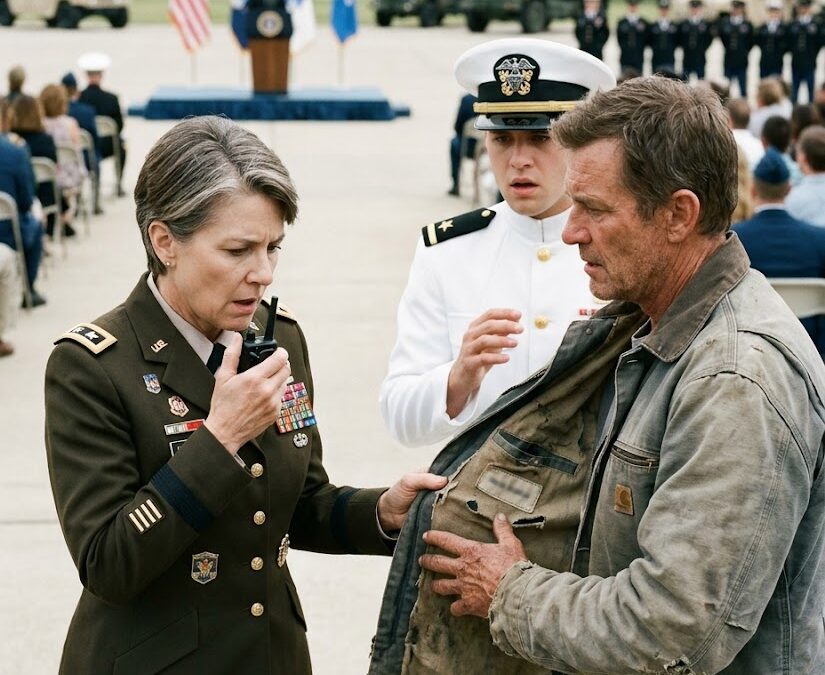
The radio crackled against Major General Ruth Calder’s shoulder.
“Lock down the archive. Elias Venn is alive.”
The last word crossed the parade ground.
It reached Nolan Venn, still wearing his new second lieutenant’s bars.
His father stood in the aisle, one hand holding open his coat.
The name showed in the torn lining.
ELIAS VENN.
Calder lowered the radio.
“Mr. Venn, stay where you are.”
Nolan stepped down from the platform.
“Dad?”
“I’m right here.”
“That isn’t what she meant.”
“No.”
The band director raised a hand.
The musicians stopped.
Families rose in uneven waves.
Calder’s aide moved to her side.
“Ma’am, the ceremony is still live.”
“End it.”
The announcer’s voice came through the speakers.
“Please remain in your seats while we address an unexpected matter.”
They did not remain seated.
Nolan reached his father.
“Tell me what she knows.”
“I don’t know.”
“Your brother’s name is inside your coat.”
“I know that much.”
“Why is it there?”
“Because I put it there.”
“Why?”
“So somebody would see it.”
Calder heard him.
“I saw it.”
“You did.”
“Then we need to move.”
“Move where?” Nolan asked.
“Somewhere private.”
“I just got commissioned.”
“You are still in a public ceremony.”
“And he is my father.”
“That is why I’m asking you to come.”
“Then ask him.”
Calder turned toward the older man.
“Will you come willingly?”
He looked at Nolan.
“Do you want me to?”
“I want the truth.”
“That isn’t the same answer.”
“It’s the one I have.”
His father nodded.
“All right.”
They moved to a conference room in the administration building.
Calder shut the door.
Her aide remained outside.
Nolan held his cap in both hands.
“Start with the name.”
“Elias Venn was my older brother,” his father said.
“Was?”
“The government said he died in 2002.”
“Did he?”
“I never saw a body.”
Calder took a seat facing the exit.
“Where did the flood happen?”
“North Fork Depot, in western North Carolina.”
“The operation had another name.”
“Not one we should say here.”
“There’s no classification on this room.”
“Then I’ll keep the old habit.”
Nolan leaned forward.
“You had a brother who vanished in a flood, and you never told me.”
“I told you I had an older brother.”
“You said he went away.”
“He did.”
“For twenty-four years?”
“Yes.”
“What did you do?”
“I kept working.”
His father’s hands were scarred and wide.
He repaired commercial refrigeration systems, spending nights in grocery basements and driving a dented van.
Nolan had watched him work through a fever to keep a hotel kitchen running.
That man had paid for Nolan’s uniform through weekend service calls.
“I carried you to school,” his father said.
“I know.”
“I showed up when your mother left.”
“I know.”
“I fixed that apartment heater every winter.”
“You told me.”
“I wasn’t hiding from you.”
“You were hiding a whole person.”
“I was protecting you from the parts that could reach you.”
Calder tapped her tablet.
“An old disaster file contains a witness note with your name.”
“What note?” Nolan asked.
“An unverified statement, entered by an Army liaison. It concerns the hour before the depot failed.”
His father looked at the screen.
“You have the file?”
“Not here.”
“Then get it.”
“I’m trying to establish what happened.”
“Then establish it.”
Nolan’s patience broke.
“Stop speaking like I’m not in the room.”
His father looked at him.
“You’re in the room.”
“I’m graduating from the Army today.”
“I know.”
“You’ve been here the whole time.”
“Yes.”
“And you still let me believe—”
“I let you believe he left.”
“That’s still a lie.”
“It was the safest version.”
“For whom?”
His father did not answer.
Calder declined a call on her tablet.
“Someone has already noticed the name.”
“Who?” Nolan asked.
“People who read old records.”
His father’s face changed.
“What’s the first name?”
“Carter.”
“Colonel Carter?”
“Former deputy director of the regional emergency office,” Calder said. “He serves on the state resilience board.”
“Not retired,” his father said.
Calder stared at him.
“You know him?”
“Elias did. He built the relay system Carter used to claim success.”
Calder stood.
“Then we need the archive.”
“I need a lawyer,” Nolan said.
“We can arrange counsel.”
“My father needs one too.”
“Yes.”
“And nobody interviews him without me there.”
“That is your choice.”
His father shook his head.
“You should be with your class.”
“I am with my family.”
The words came out too sharply.
Nolan regretted them at once.
Calder lifted her tablet.
“General Counsel will meet us.”
A knock came at the door.
The aide opened it a few inches.
“Ma’am, the chief of staff is asking for you.”
“Tell him I’m occupied.”
“He says the governor’s office called.”
“That can wait.”
The aide shut the door.
Calder turned to Nolan.
“This could become a federal matter.”
“Then do it correctly.”
His father looked at him.
“You don’t know what you’re stepping into.”
“I know enough to ask for a lawyer.”
“That’s a start.”
“Don’t praise me yet.”
Calder looked down at the file on her tablet.
“The name in the lining may be the only surviving link.”
“Link to what?” Nolan asked.
“To the official account of North Fork.”
His father’s fingers curled.
“The official account says Elias caused the collapse.”
Nolan went still.
“Caused what?”
“The depot failure.”
“Did he die there?”
“The report says yes,” Calder said.
“Then why does my father have his name?”
Calder turned the tablet around.
“Because someone wrote the report after the flood.”
“Who?”
“Deputy Director Miles Carter.”
His father looked up.
“He wrote it.”
* * *
The legal office assigned them Dana Holt, a civilian lawyer from the Army’s inspector general support panel.
She met them in a secure conference room.
Her first question was whether Nolan wanted to remain.
He said yes.
Her second was whether his father understood he could refuse questions.
He said yes.
Her third was whether Calvin Venn consented to Calder staying as a witness.
“I agree,” Calvin said.
“Then no one speaks for him except me,” Holt said.
Calder sat back.
“Understood.”
Holt began with the coat.
She photographed its lining and asked permission to examine the seam.
Calvin took it off and laid it on the table.
The lining had been repaired by hand.
The stitches around the name were newer than the cloth.
“Who sewed it?” Holt asked.
“I did.”
“When?”
“Three days ago.”
“Why?”
“I heard the commissioning ceremony would be covered by the regional command.”
“Why use the name?”
“Because General Calder’s office acknowledged a report from my brother.”
Calder looked sharply at him.
“Elias sent me a report?”
“Not you personally. Your office.”
“I was a captain then.”
“You signed the acknowledgment.”
“I don’t remember it.”
“You wouldn’t.”
“What did the report say?”
“That the flood gates were unsafe.”
Holt raised a hand.
“Let’s stay with what you know firsthand.”
“I know Elias called me before the flood.”
“What did he say?”
“He said the lower gate was locked against the wrong pressure.”
“Did he name anyone?”
“Carter. He said the site manager had ignored his test.”
“Did you drive to the depot?”
“I drove there after the call. I was working construction near Asheville. It was about eighty miles.”
“Did you arrive before the collapse?”
“No. I arrived after the first wave.”
“Did you see Elias?”
“No.”
“Did you look for him?”
“For two days.”
“Who told you he was dead?”
“A state recovery officer named Glen Foster.”
“Was there a death certificate?”
“They gave me a notice.”
“Do you have it?”
“No. Carter’s office said it was a duplicate and asked me to return it.”
“Did you sign anything?”
“A next-of-kin acknowledgment. It said I had no claim against the state or contractors.”
Nolan looked at him.
“Why did you sign?”
“I was twenty-nine, exhausted, and told my brother was dead.”
“You knew it was wrong?”
“I knew I hadn’t seen him.”
“But you signed.”
“Yes.”
Holt made a note.
“Did you keep any of his things?”
Calvin reached into the coat’s inside pocket and removed a small brass disk.
It was round, flattened at one edge, and stamped with a number.
Nolan had seen it once as a boy.
His father had called it a washer.
“What does it belong to?” Holt asked.
“A relay box. Elias’s field transmitter.”
“Why keep it?”
“He gave it to me before the flood.”
“What did he say?”
“If you ever hear a clean story, look for the dirty part.”
Nolan frowned.
“What did that mean?”
“I thought it was a joke about his work.”
Holt photographed the disk before placing it in an evidence sleeve.
“Was the coat yours?”
“It was his first. I had it altered.”
“You wore your brother’s coat and never told me?”
“I wore it after he disappeared.”
“Why hide the name?”
“The first time I asked the state to correct the record, they said there was no person by that name.”
“So you kept proof that you remembered him.”
“Yes.”
Calder searched her archive catalog.
“I have a copy of the warning. It has a handwritten note.”
“Can you show it?” Holt asked.
“Once counsel authorizes access.”
“Then we’ll request the original.”
A message lit Calder’s tablet.
“The archive custodian found an emergency index card,” she said. “A transmitter assigned to Elias was signed in after the flood.”
Nolan stared at her.
“The next morning?”
“Yes.”
His father closed his eyes.
“Then someone had the unit.”
“Or the inventory record is wrong,” Holt said.
“Either way, we need the original logs,” Calder replied.
The archive custodian placed the North Fork collection on hold.
That evening, a state board message arrived.
“Chairman Carter wants to know why a twenty-four-year-old file was flagged,” Calder said.
“That fast?” Calvin asked.
“His office monitors archived grants and contracts.”
“Why?”
“He still advises on them.”
Holt closed her notebook.
“We proceed through the inspector general. Nobody calls Carter. Every communication gets preserved.”
The next day, they went to Fort Mason’s regional archive.
A civilian archivist, Mara Quinn, checked their authority and verified the seals.
She brought out the incident file and equipment logs.
The warehouse smelled of paper and dry metal.
Calder read the first pages.
“Elias reported abnormal pressure readings two days before the collapse.”
A signature appeared beneath the warning.
Miles Carter.
Beside it, someone had written:
Hold until scheduled inspection.
“Can you confirm his handwriting?” Holt asked.
“Not from this copy,” Calder said. “The signature resembles his.”
“Resembles isn’t confirmation.”
Agreed, Calder photographed the page.
The next memo said the pressure reading had been “corrected by field staff.”
No staff member was named.
Calvin leaned over the page.
“That’s not right.”
“What isn’t?” Nolan asked.
“The first reading is in pounds per square inch. This one is in feet of water.”
“Could it be a conversion?” Holt asked.
“No. Those are separate readings.”
“What would the change do?”
“It would make an unsafe reading look normal.”
“Can you prove someone changed it?”
“Not from the paper.”
Mara located the equipment logs.
One page listed a message from Elias to the control office at 4:18 p.m.
Another marked it received.
The acknowledgment field was blank.
“Was that included in the final report?” Nolan asked.
Calder checked.
“No.”
His father pointed to a line farther down.
“There was a second relay on the north embankment.”
“Was it recovered?” Nolan asked.
“Unknown.”
Mara found its number in an equipment intake sheet.
“Unit 31,” Calder said. “That’s the transmitter listed on the index card.”
The receiver field was empty.
The next sheet showed the unit transferred to a state maintenance depot eight days later.
No recipient was named.
Holt made a note to request a preservation hold at the surplus center.
They found no body recovery entry.
They found no hospital admission under Elias’s name.
They found a death notice issued three days after the flood, supported by a missing “field identification memorandum.”
The classification stamp carried Carter’s initials.
“That is enough for today,” Holt said.
“It doesn’t answer whether my uncle survived,” Nolan said.
“No,” she replied. “It doesn’t.”
An archive message came as they packed up.
The state surplus center had located the transmitter’s chassis number.
A salvage contractor had signed it out six years earlier.
The contractor, Linden Recovery, had stored it because its serial number was missing from the disposal list.
The inspector general arranged a preservation hold.
A week later, a federal evidence technician, Saira Penn, extracted the tape under witness.
The unit had a cracked corner.
A label inside read:
NORTH RELAY — TEST LOOP.
Penn photographed each stage and warned them that the tape might be incomplete.
The reel turned.
Static filled the room.
Then a man’s voice came through.
“North Fork control, this is Venn.”
Calvin leaned forward.
Penn raised a hand.
“Please don’t touch the equipment.”
The recording continued.
“The north gate is registering reverse pressure.”
Static.
“Repeat, reverse pressure on the lower gate.”
A click.
Then another voice.
“Message received.”
“Identify yourself.”
“Control desk.”
“Name.”
“Carter.”
Nolan looked at Holt.
Elias’s voice returned.
“Carter, the lower gate is locked.”
“Your reading is wrong.”
“The gauge is holding.”
“Stand down.”
“The channel is flooding.”
“Do not move the gate.”
“It will breach.”
“Do not touch it.”
A sharp crackle cut the recording.
Then three seconds of silence.
A different voice said:
“Power failure at north relay.”
The tape stopped.
Calvin rose so quickly his chair scraped backward.
He steadied himself against the wall.
“Dad.”
“I heard him.”
“I know.”
“I heard him.”
Penn made two digital copies.
One went into evidence storage.
An audio examiner found the recording consistent with a field transmission. He could not conclusively identify the speaker, but the control-room voice matched a sample of Carter’s voice with strong consistency.
The receiver log placed the message at the same time.
The disaster report did not include it.
The examiner needed a known sample of Elias’s voice.
Calvin remembered a birthday cassette he had given their mother.
Their cousin Maribel had kept it after the house was cleared.
She sent it through the inspector general’s office.
The examiner found a moderate match between the cassette and the relay recording.
It was not conclusive alone.
The inquiry now had a warning, a response, a missing patient, and a recording.
It still did not know where Elias had gone.
* * *
The threat arrived the next morning in a polite email from Carter’s office.
Its subject read: Historical Clarification.
The message said the North Fork incident had been investigated extensively.
It warned that releasing partial records could damage public trust.
It offered Carter’s cooperation if the inquiry remained confidential.
Holt saved it.
“Do not reply.”
Nolan read the last paragraph twice.
“He says Elias caused the failure.”
“He says the existing report attributes fault to him,” Holt said.
“That’s the same thing.”
“It’s carefully phrased.”
Calvin returned to work.
A supermarket’s freezer bank had failed overnight, and he refused to cancel the service call.
Nolan watched him test the compressor.
“Are you going to keep working?”
“I have a job.”
“You’re part of a federal inquiry.”
“I can be both.”
“You could take the day off.”
“I spent yesterday in an archive.”
“That was useful.”
“So is this.”
The freezer hummed back to life.
His father wiped his hands.
“Your uncle taught me to listen before replacing parts.”
“What does that mean?”
“A machine tells you what’s wrong if you stop talking over it.”
“Does that apply to people?”
“Sometimes.”
“Does it apply to you?”
“Usually.”
“Then answer me. Why let me think Elias left?”
“I couldn’t tell you what I didn’t know.”
“You could have told me the report said he died.”
“Yes.”
“You could have told me you were still looking.”
“Yes.”
“Why didn’t you?”
His father took off his glasses.
“I was ashamed.”
“Of what?”
“Of surviving with no answer.”
“That isn’t a reason.”
“No.”
A woman stepped out of a truck and carried a brown envelope.
“Calvin Venn?”
“Mrs. Shaw.”
Her husband had worked on the North Fork recovery crew.
She had heard about the reopened inquiry and brought a copy of his old shift sheet.
“My husband said one man came out of the drainage channel after the collapse,” she said. “The crew truck arrived with a blanket over someone.”
“Did he know the man was alive?” Holt asked.
“He thought so. They said it was a rescue transfer.”
“What happened to the record?”
“He said someone told him he’d misremembered.”
The shift sheet listed an unidentified male transferred to county medical at 6:42 a.m.
The receiving officer’s initials were visible.
“Can your husband speak with us?” Holt asked.
“He died in 2019.”
“Would you provide a sworn statement?”
“Yes.”
Calvin looked at the transfer line.
“Did your husband say where the man went?”
“St. Agnes Hospital.”
The hospital had since closed, but its records had been transferred to a county storage facility.
Mrs. Shaw remembered another detail.
Her husband said the stranger wore a cracked steel ring.
Calvin took off his own ring.
A split ran along one side.
“Elias wore the same one,” he said. “I gave it to him when he left.”
Nolan looked at the band.
“You kept yours?”
“I thought he might come back for it.”
Holt requested the hospital records and contacted the retired county medic whose initials appeared on the shift sheet.
Allen Rusk met them at a community center.
He remembered a man with a cut on his forehead.
“He was conscious on and off,” Rusk said. “When I asked his name, he said Eli.”
“Did he give a surname?”
“No.”
“Did he have visitors?”
“A man came twice in a navy-blue raincoat. First time, the patient turned away. Second time, they spoke for several minutes.”
“Did the visitor take him?”
“Not while I was there.”
“Do you remember the discharge?”
“I kept a copy because the transfer sheet looked wrong.”
Rusk had tucked it into a fire-service notebook.
The discharge line contained one letter.
E.
“Why save it?” Holt asked.
“Because a man without a name is easy to lose twice.”
The hospital’s surviving register listed the patient as “Eli V.”
The bed log showed an eleven-day stay.
The discharge register showed him leaving September seventeenth.
The destination field was blank.
It did not prove the patient was Elias.
It did prove someone survived the collapse and left the hospital.
That afternoon, Penn’s office confirmed that the transmitter had been recovered with its tape cartridge intact.
The voice evidence was still being reviewed.
Calvin sat with Nolan in the courthouse parking lot.
“Do you believe he survived?” Nolan asked.
“I believe someone did.”
“Do you think it was him?”
“I’m afraid to.”
“Why?”
“Hope makes every blank space look like a door.”
Nolan stared at the courthouse steps.
“You taught me not to quit.”
“I taught you to finish the work.”
“What’s the difference?”
“Quitting is stopping because it hurts. Finishing is finding out whether the answer can stand.”
“Will you keep going?”
“Yes.”
“Even if the answer is no?”
“Yes.”
“Then I will too.”
The inquiry traced the transmitter’s storage records.
A state maintenance officer had signed the unit out under Carter’s authorization.
The officer was dead.
The salvage contractor, Linden Recovery, belonged to Carter’s nephew.
The nephew had kept the unit because its serial number was missing from the disposal list.
That decision had preserved the recording.
The inquiry also located Carter’s archived calendar.
On September seventh, 2002, he had met a state emergency official and a contractor representative for forty-three minutes.
The meeting notes were missing.
A travel voucher showed Carter had driven to St. Agnes that afternoon.
The records did not prove he took Elias from the hospital.
They did prove he was close enough to know.
“Why would he take him?” Nolan asked.
“We don’t know yet,” Holt replied.
“Why suppress the warning?”
“We need the original draft.”
The draft surfaced in a contractor’s retained files, scanned during an unrelated procurement dispute.
The original language said:
Unresolved hydraulic defect requires closure until repair.
The final report said:
Field employee entered the channel without authorization and altered the lower gate.
No work order supported the claim.
The draft’s author, a retired safety officer named Bernard Crowe, testified that Carter had reviewed it.
“Did you have evidence Elias altered the gate?” Holt asked.
“No.”
“Why did the final report say he did?”
“Carter said the contractor had a witness.”
“Did you meet the witness?”
“No.”
“Did you see a statement?”
“No.”
“Why approve the change?”
“Carter told me the matter was closed.”
Crowe had received a promotion two months later.
He could not say whether it was tied to the report.
He had kept his original draft.
A second copy came from the contractor archive.
Both showed the same deletion.
The inspector general scheduled Carter’s interview.
Two days before it, a black sedan followed Calvin home for six blocks.
Calvin did not speed or turn onto a side road.
He called the sheriff and drove to the station.
The sedan disappeared before a deputy arrived.
The incident was documented.
No one claimed Carter had ordered it.
Holt arranged temporary lodging near the federal office.
“You should stay with me,” Nolan told his father.
“I have the shop.”
“The shop can wait.”
“Your commission started today.”
“I can be both too.”
Calvin looked at him.
“All right.”
The state resilience board met a few days later.
Carter argued that removing him from the board would imply guilt without a finding.
He described the old report as a decision made under pressure.
Then he turned toward Calvin.
“Pain can make old memories feel certain.”
Calvin stood.
“Then don’t question my memory.”
The board chair struck the table.
“Mr. Venn, please.”
“I’m not here to accuse anyone. I want the record corrected.”
Carter said the incident had been reviewed by multiple agencies.
The board chair deferred questions until the formal inquiry.
After the meeting, a former board member approached Holt with a sealed envelope.
He had received it years earlier, he said, and kept it because he recognized the archive number.
The envelope contained a procurement memo.
Carter had supported a private flood-control contract.
Its performance bonuses depended on meeting a delivery date.
Repairing the gate would have delayed the project six months.
The contractor could have lost an $11 million extension fee.
A notation showed Carter’s brother-in-law held a consulting stake.
The relationship had not been disclosed.
The contractor’s records showed a $48,000 payment to Carter nine months after the collapse.
Carter called it repayment for a private loan.
The supposed loan document was dated after the payment.
A forensic accountant found no earlier transfer.
The motive had a shape now.
Protect the contract.
Hide the warning.
Blame the man who issued it.
Carter’s name was attached to the altered report.
The reason was money.
* * *
The exposure hearing took place at the county courthouse.
It was open to the public.
Reporters, former emergency workers, and families displaced by the flood filled the room.
Calvin wore the old coat.
The evidence lab had repaired its lining.
The brass tag sat in a clear sleeve.
Nolan sat beside his father in uniform.
The chair opened the hearing.
“Today’s question is whether the North Fork incident report was materially falsified.”
Carter’s attorney argued that the case relied on incomplete records, old memories, and an uncertain audio fragment.
The archive specialist established the seals and chain of custody.
The audio examiner described the extraction.
He could not identify the speaker with absolute certainty, but the voice comparison supported Carter’s identity.
Carter’s attorney pressed him.
“You cannot state the voice belongs to my client?”
“Not with absolute certainty.”
“Could the tape have been altered?”
“We found no evidence of alteration.”
“Could it be another recording?”
“The serial number and storage records link it to the North Fork site.”
The attorney sat.
Crowe testified about the original draft and the revised report.
Carter’s initials appeared beside the deleted safety warning.
“Your career advanced after you signed the final version,” Carter’s attorney said.
“Yes.”
“You share responsibility.”
“Yes.”
“Why should the board trust you now?”
“You shouldn’t trust my memory alone. Trust the paper I kept.”
He placed the original draft beside the contractor’s copy.
The two versions showed the alteration.
The retired medic followed.
Rusk described the unidentified patient, the head wound, and the hospital transfer.
He did not claim the patient was Elias.
The hospital register supported his testimony.
“Could ‘Eli V.’ refer to anyone?” Carter’s counsel asked.
“Yes,” Rusk said.
The records established that the report’s claim of immediate death had no identified body or confirmed patient.
They did not identify the man who left St. Agnes.
Calvin took the witness chair.
“Did you see your brother after the flood?” Holt asked.
“No.”
“Did you identify a body?”
“No.”
“Did you receive a death certificate?”
“I received a notice without a body identification.”
“Why keep his name inside your coat?”
“Because the record said he died, and I didn’t know if he had.”
“Why bring it to the commissioning ceremony?”
“She was the first officer whose office had acknowledged his warning.”
“Were you trying to embarrass the Army?”
“No. I wanted someone to preserve the evidence.”
“What did you want?”
“A record that didn’t call my brother a liar.”
Carter’s attorney stood.
“You never saw Elias after September sixth.”
“No.”
“You cannot prove he survived.”
“No.”
“You cannot prove Mr. Carter ordered the report changed.”
“No.”
“You cannot prove the hospital patient was Elias.”
“No.”
“Then what can you prove?”
“That the warning was sent.”
Calvin touched the evidence sleeve.
“That the warning was removed from the report.”
He looked at Carter.
“That someone blamed my brother without evidence.”
“Do you believe my client did that?”
“I believe the evidence points to him.”
“That is not what I asked.”
“It’s what I can say under oath.”
Carter testified after lunch.
He described the emergency office as chaotic and said the report reflected the best information available.
He denied remembering the relay call or the visit to St. Agnes.
He said the $48,000 was repayment for a private loan.
He produced a note signed by his brother-in-law.
The forensic accountant said the note was created after the payment.
Carter argued that Elias had entered the drainage channel without permission.
The chair asked for supporting evidence.
Carter pointed to the final report.
“That is the record.”
“The record whose changes are under review,” the chair replied.
The original draft appeared beside the final report.
One warned of an unresolved defect.
The other blamed Elias.
The contractor’s copy matched the original.
The auditor explained the bonus terms, the family connection, and the payment.
Carter had answers for every piece.
The contract would have lapsed.
The money was a loan.
The report was an emergency summary.
The omitted message was a filing error.
One at a time, the explanations might have stood.
Together, they began to fail.
The audio recording played.
Elias warned that the gate was failing.
Carter’s voice told him to stand down.
The room listened.
Carter’s face did not change.
The examiner reaffirmed that the recording was authentic to the recovered unit.
The chair asked if there was direct proof Carter personally altered the report.
The auditor said Carter’s initials and approval established his responsibility for the revision.
There was no proof he knew Elias had survived.
There was no proof the hospital patient was Elias.
The chair invited Carter to add anything.
“I know what it is to lose someone,” he said. “I have not asked this family to forgive me.”
“You blamed my brother,” Calvin said.
“I followed the record.”
“You wrote the record.”
“I reviewed many pages.”
“Then explain the missing warning.”
“I cannot.”
“Explain the patient.”
“I cannot.”
“Explain the payment.”
“It was private.”
“Then explain the loan.”
“My counsel addressed that.”
“No,” Calvin said. “He explained why you want the board to stop asking.”
The chair struck the table.
“Mr. Venn.”
Calvin sat back.
The board recessed.
During the break, the inspector general announced that the United States attorney had opened a criminal inquiry into false statements, record tampering, and improper contracting.
No charges had been filed.
Carter remained free to leave.
He stayed.
The board found that Carter had approved a material alteration to the report.
It found that the change removed a safety warning and assigned blame without supporting evidence.
It found an undisclosed conflict involving the contractor.
The board referred the contract and payment records for prosecution review.
It removed Carter from his state duties and recommended that the false death finding be corrected.
It did not declare Elias alive.
It did not identify the hospital patient.
Carter spoke to reporters outside.
He said the board had punished him for using imperfect records in an imperfect emergency.
He said history would judge the matter.
Reporters turned toward Calvin.
He did not take the microphone.
“I don’t need him to admit what the papers already show,” he said.
Then he walked to the car with his son.
The criminal inquiry took fourteen months.
Carter was indicted on false statement and records-retention charges.
The contractor’s president was charged with procurement fraud.
Carter pleaded guilty to falsifying a federal record.
The procurement charge against him was dismissed as part of the agreement.
He received probation, a substantial fine, and a permanent bar from public contracting.
He lost his state board position.
He returned the $48,000 under the plea agreement.
The money went into a fund for North Fork families.
The contractor’s president pleaded guilty to fraud.
The government corrected Elias’s status to “unconfirmed.”
The report no longer blamed him for the collapse.
It named the warning and its omission.
The government did not find Elias.
The county hospital records ended at the discharge.
No later employment record could be linked to him with confidence.
No death certificate appeared.
No grave matched his name.
They followed every lead that held up.
They dismissed the ones that did not.
The answer remained incomplete.
It was no longer a lie presented as certainty.
* * *
Months passed.
Nolan began his first assignment at Fort Liberty.
Calvin returned to the repair shop.
The building’s owner offered him a rent-free year in exchange for a long lease.
Calvin refused.
Instead, he negotiated a smaller shop with a shared tool room.
Nolan helped paint the walls.
The old place smelled of oil and coffee.
A customer brought in a restaurant freezer that clicked each time it started.
Calvin listened for a full minute.
“Loose fan bracket,” he said.
“You heard that?” Nolan asked.
“I heard the click stop when the compressor loaded.”
“Could have been the motor.”
“Could have been.”
“It wasn’t.”
“No.”
The customer watched them.
“Are you two going to argue all day?”
“Probably,” Calvin said.
Nolan laughed.
It was the first time they had laughed together since the ceremony.
They replaced the bracket.
The freezer ran smoothly.
Calvin tucked the customer’s check into his shirt pocket.
Nolan noticed an envelope on the bench.
“What’s that?”
“General Calder sent it.”
“What does she want?”
“To discuss the historical review.”
“Do you want to meet her?”
“I don’t know.”
A week later, Calvin agreed.
Calder came to the shop alone.
She looked at the mended coat.
“I’m sorry I didn’t recognize what the name meant sooner.”
“You were a captain.”
“I read the acknowledgment.”
“Did you read the warning?”
“I saw a summary.”
“What did it say?”
“That the pressure reading was under review.”
“Did you ask who reviewed it?”
“No. I trusted Carter’s office.”
“You signed the receipt.”
“Yes.”
“Do you think you could have stopped the report?”
“I don’t know.”
“Would you have?”
“I hope so.”
“Hope isn’t the same as a choice.”
“No.”
She accepted that.
“I wanted to say it in person. Your family shouldn’t carry the burden of my office’s silence.”
“Your office didn’t tell me Elias was dead,” Calvin said. “Carter did. Your office let his report stand.”
“Yes.”
“Then help correct it.”
“What do you need?”
“Every surviving copy that says Elias caused the collapse should be marked false.”
“I can do that.”
“Not as a favor.”
“As a duty.”
The Army’s historical office published a correction.
It said the original report had been altered without evidentiary support.
It included the warning and the omitted relay log.
It did not claim Elias had survived.
Calvin read it twice.
“Is that enough?” Nolan asked.
“It’s correct.”
“That wasn’t my question.”
“No. It isn’t enough.”
“What’s missing?”
“Elias.”
A month later, Holt called with a possible lead.
A labor advocate in Kentucky had found an old intake card.
A man calling himself Eli Venn had worked at a river repair yard in 2003.
The birth year was wrong by three years.
The photograph was missing.
They checked the handwriting.
It was not Elias’s.
The employer’s payroll records showed the worker had left after six weeks.
No address remained.
Calvin drove to Kentucky.
Nolan went with him.
The old river yard had become storage units.
A former foreman remembered the worker as quiet, with a possible broken nose.
“He ever talk about North Carolina?” Nolan asked.
“No.”
“Did he give his full name?”
“He said Eli.”
The foreman found a timecard.
E. Venn.
No birth date.
No signature.
The pay had been collected in cash through a labor intermediary who had died.
The trail ended there.
Calvin kept the timecard copy beside the relay transcript.
“You can’t make them fit,” Nolan said.
“I know.”
“Then why keep both?”
“Because they’re what we have.”
They continued through the proper offices.
The inspector general sent the records to the National Archives.
The county reopened its inquiry into the missing intake card.
The Army gave the family a complete copy of the corrected report.
There were no hidden pages left in the known collections.
Calvin refused a documentary offer and a paid interview.
He accepted a speaking invitation from a disaster safety group, asking only for travel costs.
He told the audience that the record never proved Elias had died.
He also told them it did not prove he was alive.
“Uncertainty shouldn’t be polished into a convenient story,” he said.
Nolan sat in the back.
Afterward, a young engineer asked Calvin what to do when a supervisor dismissed a pressure drop as normal.
“What did the readings show?” Calvin asked.
“Different units.”
“Did you check the gauge?”
“Yes.”
“Did you check where it was placed?”
“No.”
The engineer went back to check.
A month later, he reported that the gate needed repair.
No one was hurt.
Calvin called it a correction, not a victory.
On the anniversary of Nolan’s commissioning, they returned to the parade ground.
The stands were gone.
The grounds crew cleared dry leaves from the paths.
Nolan wore civilian clothes.
His father wore the old coat, its lining repaired.
“Do you regret bringing it?” Nolan asked.
“No.”
“Even with the cameras?”
“I didn’t bring it for the cameras.”
“What did you bring it for?”
“To give the right person a chance to see it.”
“And then?”
“Then she did.”
Nolan looked across the open space.
“The ceremony feels smaller now.”
“It was one day.”
“It changed everything.”
“It showed us what was already there.”
“Did it?”
His father turned toward him.
“I knew you were brave.”
“I didn’t know you thought that.”
“I didn’t say it enough.”
“That’s one thing we can fix.”
“Yes.”
They stood where the general had stopped.
Nolan remembered the families rising.
The band falling quiet.
The name exposed by a damaged seam.
He remembered his father closing his hand over the coat.
“Where did you get that name?” the general had asked.
“My brother gave it to me.”
That answer had opened the past.
It had not closed the question.
“Do you still think he might be alive?” Nolan asked.
“I think the record never proved he died.”
“That isn’t the same.”
“No.”
“What do you hope?”
Calvin looked at the empty stands.
“I hope he got somewhere safe.”
“Do you hope he comes back?”
“I hope he had a life.”
Nolan rested a hand against the coat’s shoulder.
“That’s enough?”
“No.”
“Then why say it?”
“Because it’s true.”
A breeze crossed the parade ground.
The coat shifted against Calvin’s arm.
He took the brass tag from his pocket.
Its edges were worn.
The number remained legible.
For the first time, Nolan understood that it was not proof of what happened to Elias.
It was proof that someone had tried to send a warning.
Someone else had received it.
A family had carried the missing name until someone could read it again.
“Your brother gave it to you,” Nolan said.
“Yes.”
“And you gave it to us.”
“I did.”
They walked toward the parking lot.
The coat stayed buttoned.
The name stayed inside.
The truth had no clean ending.
But it had a place to stand.
THE END








