A Kitchen Boy Was Dragged From the Winter Benefit—Until a Blue Glass Plate Revealed Who Had Stolen His Name
Chapter 2: The Name Beneath the Glaze
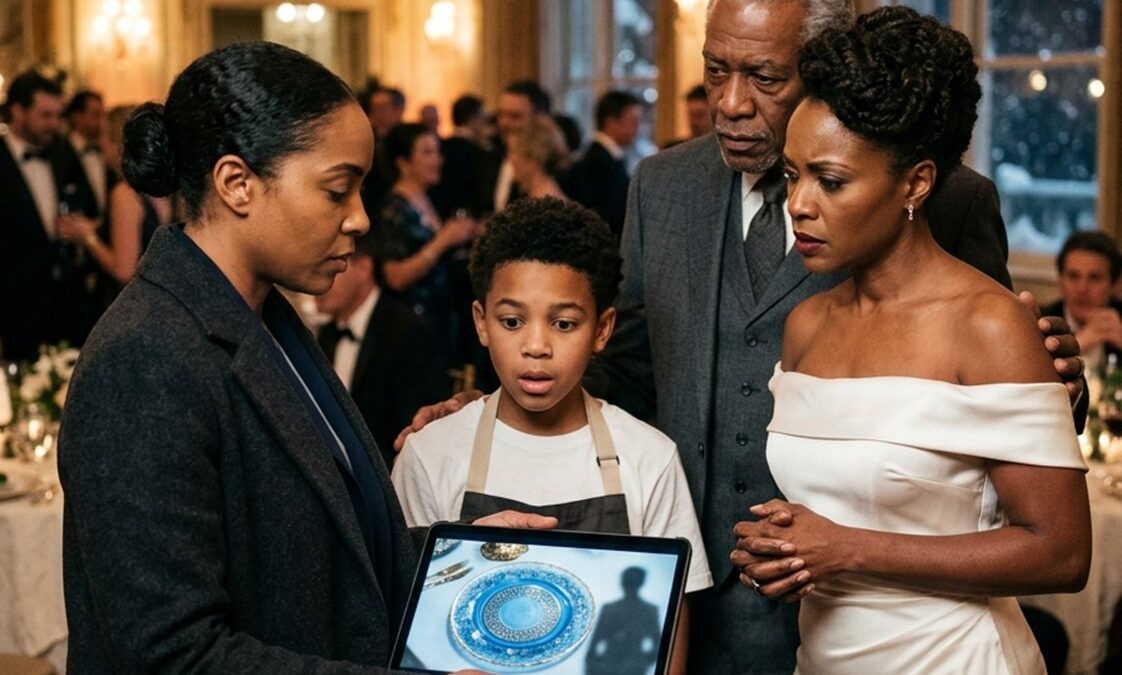
The tablet glowed between them.
Noah leaned closer.
The ballroom had gone quiet.
“Do you recognize that person?”
He stared at the dark figure.
A silver cuff showed beneath one sleeve.
He had seen it before.
On Celeste’s wrist.
Her hand closed around it.
Arthur noticed.
So did the detective.
“Everyone stay where you are.”
Two uniformed officers appeared behind her.
Celeste recovered first.
“This is a fundraising event.”
“It is also a scene,” the detective replied.
“I own this building.”
“Not this investigation.”
Noah’s knees trembled.
The guard released his arm.
“Was my mother in that room?”
Celeste said nothing.
“My name is Detective Lena Ortiz,” the detective said.
“I need you to come with me.”
“Am I in trouble?”
“No.”
“Is she?”
“That is what we’re finding out.”
A waiter approached with a coat.
Noah pulled away.
He did not want anyone touching him.
Arthur removed his black scarf.
He laid it across Noah’s shoulders.
“Your feet are bleeding.”
Noah looked down.
A thin red line crossed one heel.
“I can walk.”
“I believe you.”
Ortiz turned to Celeste.
“You’ll remain here.”
“You don’t have a warrant.”
“Not yet.”
“Then you can’t detain me.”
“I haven’t.”
An officer stayed beside Celeste.
The other opened a path through the guests.
Noah followed Ortiz toward the service corridor.
Arthur came with them.
“Your Honor,” Celeste called.
“Don’t make this uglier than it is.”
Arthur kept walking.
“It already is.”
* * *
The corridor smelled of lemon cleaner.
The music faded behind them.
Noah stopped beside a laundry cart.
“I can’t go back to the kitchen.”
“Why not?” Ortiz asked.
“Mr. Pell said I’d lose my job.”
“You won’t be fired for speaking with police.”
“He said I’d be put out.”
Arthur glanced at Noah.
“Where are you staying?”
“Above the bakery.”
“Alone?”
“Mrs. Alvarez rents me a room. She checks on me.”
“Does she know your mother is missing?”
“She called the police first.”
Ortiz knelt to his level.
“Do you know when you last saw Mara?”
“April third.”
“What happened?”
“She went to work here.”
“Did she tell you she was meeting anyone?”
“She said she had to get her name back.”
Arthur’s brows drew together.
“What did that mean?”
Noah reached under his apron.
He pulled out a folded paper.
It had softened at the creases.
“My mother left this in the flour tin.”
“May I read it?” Ortiz asked.
Noah nodded.
The note held four lines.
Ortiz read them silently.
Her thumb stopped at the bottom.
“Can I see?” Arthur asked.
She handed him the note.
He read it aloud.
“Ask about the blue plate.”
“Keep the name Bell.”
“Don’t trust the hotel records.”
“Find the woman in the silver cuff.”
Noah looked toward the ballroom.
“Celeste.”
“Maybe,” Ortiz said.
“Or someone wearing her jewelry.”
“That was her cuff.”
“Can you prove that?”
Noah shook his head.
“Not yet.”
“We’ll start with the plate.”
“What happens if records say it wasn’t hers?”
“We check the records.”
“My mother said not to trust them.”
“Then we won’t rely on only one.”
Arthur nodded.
“What happens to the boy tonight?”
Ortiz called the child protection liaison assigned to the case.
June Park arrived twelve minutes later.
She introduced herself without using the word “placement.”
“Do you have someone safe tonight?”
“Mrs. Alvarez.”
“Can we call her?”
“She’ll come.”
“Would you rather wait here or at the station?”
“Here.”
“Then we’ll stay here.”
Noah’s eyes lowered.
“Will my mother come back?”
Park took a breath.
“I don’t know yet.”
“Tell me if you find her.”
“I will.”
He searched her face.
Then nodded.
* * *
Ortiz collected the shard.
A hotel technician brought the case key.
Celeste watched from the ballroom threshold.
She was no longer smiling.
The remaining plate sat beneath a glass dome.
Its ocean-blue glaze caught the corridor lights.
The display card said it came from Victor Vane’s estate.
“Her grandfather?” Arthur asked.
“Great-uncle,” Celeste said.
“Family records say it was purchased in 1962.”
“Records can be wrong,” Noah said.
Celeste turned sharply.
“You have no idea what you’re talking about.”
“My mother made pottery.”
“That doesn’t make her an expert.”
Ortiz looked at him.
“What should we look for?”
“The foot ring.”
The technician lifted the plate with gloved hands.
Noah pointed without touching it.
A narrow crescent had been cut into the clay.
“My mother did that on every plate.”
The technician angled it toward the light.
The crescent was there.
Two crossed lines rested beside it.
Noah knew those too.
“Why those marks?” Arthur asked.
“She said they told her which pieces were hers.”
The technician photographed the base.
Ortiz requested the hotel’s acquisition records.
Celeste folded her arms.
“The plate came from my family.”
“Then the paperwork will show that.”
“It will.”
“Good.”
Hotel archivist Martin Pell hurried down the corridor with a ledger.
He looked at Noah, then Ortiz.
“I have the acquisition file.”
“Where did it come from?” she asked.
“The hotel archive.”
“Who maintained it?”
“I did.”
“Open it.”
Pell turned to the relevant page.
The entry listed one blue serving plate.
Donated by Victor Vane.
June 1979.
Noah squinted.
“That’s not my mother’s name.”
“No,” Pell said. “It says Vane.”
“Look at the next page.”
A faint blue carbon impression showed beneath the main entry.
Noah leaned closer.
The archived sheet had preserved a reversed line.
Ortiz brought over a forensic light.
Letters came into view.
Mara Bell.
Mara’s name had been scraped away.
* * *
They moved to a conference room.
Noah’s bare feet were wrapped in gauze.
Mrs. Alvarez arrived in a flour-dusted sweater.
She touched his shoulder gently.
“I’m here.”
“I know.”
“Your oven is still on.”
“Did you turn it off?”
“I did.”
“You can’t leave bread in there.”
“I rescued the rolls.”
“You burned them, didn’t you?”
“Only the bottoms.”
Noah’s face softened.
Mrs. Alvarez turned to Ortiz.
“What do you need from me?”
“Can you confirm where Noah stayed?”
“Any night.”
“Do you know Mara’s last address?”
“I do.”
“Did she discuss the plate?”
“Not with me.”
“What did she tell you before she disappeared?”
Mrs. Alvarez looked at Noah.
He gave a small nod.
“She came to the bakery in March,” Mrs. Alvarez said.
“She was shaking.”
“She said the hotel had changed her work records.”
“What kind of work did she do?”
“She was a ceramics restorer.”
Noah looked up.
“You said she cleaned rooms.”
“I wanted people to leave her alone.”
“She repaired the plates?”
“Some.”
“Why didn’t you tell me?”
“Your mother asked me not to.”
“She never said that.”
“She said you had enough to carry.”
“I could’ve helped.”
“You were nine.”
“I was still her son.”
Mrs. Alvarez’s mouth tightened.
“You’re right. I should have told you.”
He turned away.
Ortiz waited before asking her next question.
“What records changed?”
Mrs. Alvarez pulled a notebook from her bag.
“Mara showed me pay stubs.”
“She’d been listed as a cleaner for years.”
“She said she’d restored pieces for the hotel.”
“Did she file a complaint?”
“Not that I know.”
“Did she keep anything?”
“Photographs. At her storage unit.”
“Do you know the address?”
Mrs. Alvarez recited it.
Mara had paid through the end of the month.
She had left Mrs. Alvarez a spare key.
Ortiz asked to retrieve it with them.
Mrs. Alvarez agreed.
Noah stood.
“Can I come?”
“Not tonight,” Park said.
“I want to look.”
“You can choose to go with Mrs. Alvarez.”
“Then I choose to go.”
Ortiz looked to Park.
Park explained that the unit might hold evidence, and that Noah might see upsetting things.
“I already saw my mother’s name erased,” he said.
Park nodded.
“We’ll go slowly.”
* * *
The storage unit was twelve minutes away.
A patrol car followed them.
The building manager opened the gate.
Inside stood Mara’s pottery wheel, two lamps, and boxes of invoices.
Noah stopped at a photograph taped to the wall.
His mother stood beside a kiln.
Clay smudged her cheek.
She looked tired and happy.
He touched the picture’s edge.
Ortiz photographed the room before anyone moved anything.
Three portfolio boxes held photographs of restored hotel pieces.
The blue plate appeared in one.
Mara held it in both hands.
A handwritten note read: “Finished for the Vane collection. Retain Bell mark beneath foot.”
Noah stared at it.
“She made it.”
“Looks that way,” Ortiz said.
“Can you prove this photo wasn’t staged?”
“The negative is in the box,” Mrs. Alvarez said.
“Your mother labeled it.”
Ortiz bagged the print and negative separately.
Another box held invoices.
They showed payments for restoration work.
The hotel had paid Mara through Vane Heritage Services.
Her tax records listed housekeeping.
“She said she was missing money,” Mrs. Alvarez said.
“How much?” Ortiz asked.
“She didn’t know. They kept changing what her work was worth.”
“Did she keep anything else?”
A thin envelope lay beneath the invoices.
Noah recognized his mother’s handwriting.
He did not open it.
Ortiz asked his permission.
He nodded.
Inside were two letters.
One questioned unpaid restoration invoices.
The other requested credit for the original plate.
At the bottom, someone had written: “Meeting confirmed. April 3. Vane suite.”
The date Mara disappeared.
“She went there to get her name back,” Noah said.
“Yes,” Ortiz replied.
“And Celeste was there.”
“We’ll find out who attended.”
The detective photographed each page.
* * *
Ortiz requested a search warrant for hotel records.
She also asked for service-corridor surveillance.
The hotel’s lawyer arrived before dawn.
Celeste stayed in a separate room.
Her lawyer said she would cooperate after reviewing the warrant.
“That’s her right,” Ortiz told Noah.
“It feels like she gets to choose everything.”
“She gets a lawyer.”
“Does that mean she wins?”
“No.”
“Does it mean we wait?”
“Sometimes.”
Noah stared at the plate beneath its glass.
“Then we wait.”
Ortiz called the hotel’s outside security company.
The manager sent a retention log.
Footage from April third had been marked for deletion.
A backup existed because the service system had been upgraded.
The manager had preserved it after noticing an access mismatch.
The detective watched first.
Then Arthur.
Then Mrs. Alvarez.
Noah asked to see it.
Park stood beside him.
“You can stop whenever you want.”
“I want to know.”
The video showed the service elevator.
Mara entered at 9:14 p.m.
She carried a flat cardboard box.
A woman in a pale coat entered behind her.
The camera hid her face.
The elevator doors closed.
Fourteen minutes later, Celeste left alone.
She wore the silver cuff.
The cardboard box was gone.
At 9:51, a hotel van left the loading bay.
Its route card listed a delivery to a North Harbor storage building.
“Who drove it?” Ortiz asked.
The security manager said the driver was a contractor.
“He’s retired now.”
“Can we reach him?”
“We can try.”
“Do.”
Noah faced the screen.
“My mother went into the elevator.”
“Yes,” Ortiz said.
“She didn’t come out.”
“Not on this camera.”
“Where did the van go?”
“We’re finding out.”
* * *
The retired driver agreed to speak by secure video.
His name was Howard Pike.
He remembered the van and the date.
He remembered a locked cabinet strapped into the back.
“Who loaded it?” Ortiz asked.
“Ms. Vane’s assistant.”
“What did she say it contained?”
“Hotel art.”
“Did you go to North Harbor?”
“Yes.”
“Where?”
“A private archive called Vane House.”
The address matched a family records facility.
The detective requested its logs.
Celeste’s attorney objected to a broad search.
The judge approved a narrow warrant for the date and storage bay.
Facility logs showed Celeste’s assistant had entered.
The item description read: “Blue ceramic display crate.”
A later entry read: “Relocated to lower archive.”
The archive director met Ortiz there.
The crate was empty.
Dust marked its former shape.
A brown envelope sat nearby.
Inside was a receipt from a private auction.
The seller was listed as “M. Bell.”
The signature was not Mara’s.
The auction had taken place two months after her disappearance.
A buyer paid cash.
The item description was vague: “Decorative blue plate, attributed Vane family.”
Ortiz photographed the receipt.
“Can you trace the auction house?” Arthur asked.
“Yes.”
“Can you trace cash?”
“Not by itself.”
The lot number led to a catalog entry.
The plate had been purchased by Northline Heritage.
Its registered agent was a lawyer.
Its beneficiary was Celeste Vane.
Noah watched Ortiz write that down.
“So she sold it.”
“Possibly.”
“But it’s still at the hotel.”
“The catalog item might have been a reproduction.”
“Or another plate.”
Ortiz nodded.
“We need to identify the one in the case.”
The lab examined the recovered shard.
Its clay matched the displayed plate.
The fracture edges fit.
The glaze held a trace mineral used by a local pottery supplier.
Mara’s invoices showed she bought from that supplier.
The lab could not prove she made the plate from chemistry alone.
The maker’s marks did.
The hotel’s restoration photographs also showed the crescent.
The dates aligned.
Mara had made it.
The hotel had taken credit.
* * *
The records led closer to Celeste.
But they led to someone else first.
Martin Pell’s name appeared on every changed file.
He had altered the staff classifications.
He had certified the plate as Vane property.
He had entered the false donation record.
Ortiz interviewed him.
“I followed instructions,” he said.
“Whose?”
“Ms. Vane’s office.”
“Which person?”
“I can’t remember.”
“You signed the entries.”
“I was told the hotel’s ownership was disputed.”
“By whom?”
“Celeste’s father.”
“He died six years ago.”
“I know.”
“Then how did he give those instructions?”
Pell looked down.
“I didn’t ask.”
“Did you change Mara Bell’s employment classification?”
“Yes.”
“Why?”
“Finance asked.”
“Who asked?”
“Celeste’s controller.”
“Name.”
“Graham Vane.”
Celeste’s cousin had overseen finance.
“Did he know the plate belonged to Mara?”
“He knew the file was disputed.”
“Did he see the original work order?”
“Yes.”
“Did he alter it?”
“I don’t know.”
“Who was in the suite on April third?”
“Celeste.”
“Anyone else?”
“I don’t know.”
“Did you see Mara that night?”
“No.”
“You were on the service floor.”
“I was working.”
“You signed the van authorization.”
“I didn’t know what was inside.”
“Did you hear them arguing?”
Pell’s eyes shifted.
“I heard voices.”
“Whose?”
“Ms. Bell and Celeste.”
“What did Mara say?”
“She said, ‘You can’t erase my name twice.’”
Noah went still.
“What did Celeste say?” Ortiz asked.
“She said the hotel had already paid.”
“Was that true?”
“I don’t know.”
“Did you hear anything about leaving?”
“No.”
“About the van?”
“No.”
“Where Mara went?”
“No.”
Pell lowered his eyes.
“I should have reported the altered record.”
“Yes,” Ortiz said.
“You should have.”
* * *
Graham Vane appeared in the financial trail.
He had approved the payment that ended Mara’s restoration contract.
He had authorized a $38,000 settlement.
The document carried Mara’s forged signature.
A handwriting examiner found inconsistencies.
Mara’s genuine signatures slanted upward.
The settlement signature ran downward.
The letter B formed differently.
The paper had been printed six months after its stated date.
Graham said Celeste handled the contract.
Celeste said Graham controlled the money.
Both had lawyers.
Neither agreed to an interview.
The detective obtained a warrant for financial files.
The $38,000 had gone into a shell company.
That company paid a consulting firm.
The firm paid Celeste’s private account.
A second transfer went to Graham.
The money had not been a settlement.
It had been divided.
“Why did they take her work?” Noah asked.
“Because they wanted the collection to look older,” Arthur said.
“Why?”
“To raise its value.”
“How much?”
Ortiz looked up from her notes.
“The hotel was negotiating a sale of its art collection.”
It had been valued at $23 million.
If pieces belonged to the Vane family, the sale could proceed without paying their makers.
“How much would that cost them?” Noah asked.
“The sale might stop,” Ortiz said.
“And they wanted the plate?”
“Probably because it showed the records were wrong.”
“Why not just hide it?”
“Your mother wanted it credited.”
Mrs. Alvarez reached for Noah’s hand.
He let her take it.
* * *
The investigation spread across the city.
Police checked hospitals, shelters, transit records, and unidentified-person files.
Nothing matched Mara.
Noah asked Ortiz whether the footage could be enhanced.
The lab found a reflection in the elevator’s brass trim.
A second person stood in the hallway.
The silver cuff appeared again.
This time, the hand held a keycard.
The card belonged to Graham’s office.
Celeste wore the cuff.
Graham held the card.
Both had access.
Ortiz requested another interview with Celeste.
Her attorney declined.
The hotel issued a statement calling the claims “a regrettable misunderstanding.”
It said the plate’s origin was “under active review.”
It described Mara’s disappearance as unrelated.
The city’s art commission froze the collection sale.
A civil judge ordered the hotel to preserve its provenance records.
The state labor office opened a wage investigation.
No criminal charge had been filed.
No body had been found.
Noah saw the statement on a television above the bakery counter.
“They’re making it sound like she got confused.”
Mrs. Alvarez switched it off.
“People do that when the truth costs them.”
“Will anybody believe us?”
“They believed the records for years.”
“That’s not what I asked.”
She sat beside him.
“Some will.”
“And the others?”
“We’ll keep showing what happened.”
Ortiz arrived with news.
They had located a second plate with Mara’s marks.
It belonged to a private collector.
The collector provided it voluntarily and kept a letter from the hotel.
The letter credited Mara as its maker.
Three months later, someone crossed out that credit.
Graham’s initials marked the revision.
Celeste’s assistant had countersigned it.
“Why would the hotel admit it first?” Arthur asked.
“They planned to credit her after the sale,” Ortiz said.
“After the buyer had no recourse?”
“Possibly.”
Noah stared at the letter.
“So they knew she made them.”
“They knew.”
“And still called her a cleaner.”
“Yes.”
* * *
The real threat arrived after the city’s preservation order.
Mrs. Alvarez received an envelope at the bakery.
There was no return address.
Inside lay a copy of Noah’s room lease.
Someone had drawn a line through the landlord’s number.
Beside it, they wrote:
Temporary arrangements can become permanent.
Noah read it twice.
Mrs. Alvarez took the paper.
Ortiz photographed it.
A camera outside showed a courier van.
Its plate belonged to a delivery service.
The driver had carried packages across the city.
He could not identify the sender.
The note did not prove Celeste was responsible.
Ortiz added it to the file.
She arranged a safety plan.
Noah stayed with Mrs. Alvarez.
A patrol car passed the bakery at unpredictable intervals.
The city moved him to a safe interview location.
He hated it.
“I’m not in trouble,” he said.
“No,” Ortiz told him.
“Why am I the one changing everything?”
“Because someone tried to frighten you.”
“That’s not fair.”
“No.”
“Can you arrest them?”
“Not from this note alone.”
“Then what can you do?”
“Trace the delivery.”
“Will it work?”
“I don’t know.”
Noah looked away.
Arthur sat across from him.
“Your mother chose evidence.”
“She didn’t choose what happened.”
“No. But you can choose what happens next.”
Noah looked at Ortiz.
“I won’t hurt them.”
“Good.”
“I want them to answer.”
“That takes proof.”
“I’ll help.”
“You already have.”
She showed him the photograph of the plate.
“Your observation about the foot ring led us to the maker’s marks.”
“My mother taught me.”
“You noticed the label.”
“She taught me that too.”
“Then you helped.”
Noah looked at the threatening note.
“Will you tell the judge?”
“Yes.”
“Will the judge believe it was Celeste?”
“I won’t say that unless we can prove it.”
“Even if you think it was?”
“Especially then.”
Noah nodded.
“Keep it honest.”
“That’s the plan.”
* * *
The records yielded another lead.
A security contractor remembered Graham requesting delivery access to the bakery.
The request came through a hotel account.
The contractor had refused to share Noah’s address.
He had saved the email because it violated company policy.
It showed Graham’s office had sought the child’s lease.
It did not prove Graham sent the threat.
Ortiz obtained a warrant for the office computer.
A draft message read: “Make the boy’s guardian reconsider.”
It had no recipient.
The date matched the day before the envelope arrived.
A second file mapped the bakery’s street and rear exit.
Graham was arrested for witness intimidation and evidence tampering.
He denied sending the note.
His lawyer called the draft a routine insurance review.
The judge ordered Graham to stay away from Noah and Mrs. Alvarez.
Celeste’s attorney said she had no connection to his actions.
The hotel board suspended her.
She resigned two days later.
Her statement blamed Graham.
His lawyer blamed her.
Their accounts did not match.
The false invoices carried Graham’s approvals.
The van authorization carried Celeste’s signature.
The sale trust belonged to her.
Pell’s edits changed the ledger.
Together, they had built the lie.
* * *
Ortiz found a maintenance log from the harbor facility.
A keypad had been changed on April fourth.
The request came from Celeste’s assistant.
The work order listed a unit belonging to Vane Heritage Services.
A search uncovered a metal lockbox.
Inside were a hotel access card, a silk scarf, and a tape recorder.
Mrs. Alvarez identified the scarf.
Noah did too.
The recorder was old but intact.
A lab recovered part of an audio file.
It began in the middle of an argument.
A woman said, “That credit belongs on the piece.”
Another voice replied, “You signed the settlement.”
“I never signed it.”
“You were paid.”
“I was erased.”
The recording stopped.
It did not identify either voice.
The recorder had been purchased by the hotel’s security office three years earlier.
The hotel denied knowing about it.
Pell said he had never seen it.
Celeste said nothing.
Graham’s lawyer called it meaningless.
The audio alone proved little.
The scarf and access card mattered more.
The lockbox had been stored under Celeste’s company.
Facility logs showed her assistant entered twice: April fourth and three weeks later.
No one went again.
Ortiz laid the evidence on the table.
The plate.
The false ledger.
The scarf.
The access card.
The recorder.
“Do you think they hurt her?” Noah asked.
“I think we have evidence they hid what happened.”
“That isn’t the same answer.”
“No.”
“Do you think she’s alive?”
Ortiz paused.
“I don’t know.”
“Will you keep looking?”
“Yes.”
* * *
A week later, harbor patrol found a stolen car submerged near an old pier.
It belonged to the hotel’s transport contractor.
There was no one inside.
A second cardboard sleeve held a shipping manifest for the blue plate.
The planned transfer to Northline Heritage was dated April fourth.
It had never been recorded as completed.
A handwritten note said: “Move to secure site.”
The car had been abandoned before the transfer.
Police checked the pier and nearby buildings.
They found no sign of Mara.
The state’s evidence review found enough to charge Celeste and Graham with fraud, falsifying records, and obstruction.
The prosecutor did not charge them over Mara’s disappearance.
There was no proof either had caused her death.
There was no proof she was dead.
“You can charge them for lying,” Noah said.
“Yes,” Ortiz replied.
“But not for what happened to my mother.”
“Not yet.”
“What would you need?”
“A witness who saw what happened, a record showing where she went, or evidence linking someone to her disappearance.”
“Then we keep looking.”
“We do.”
* * *
The first court hearing took place in March.
Celeste sat at one table.
Graham sat at another.
Pell appeared beside his attorney.
Noah listened from a family room.
The prosecutor presented the altered employment files, false settlement, trust payments, van log, auction receipt, and Graham’s office access request.
The hotel called the records clerical errors.
The prosecutor showed the same false classification had affected fourteen artists.
The defense argued the blue plate was family property.
The lab report showed the shard fit the displayed plate.
Old photographs showed Mara holding it before the hotel’s recorded donation date.
A former restorer confirmed her work.
The hotel’s invoice book credited her.
The ledger did not.
The judge ordered the plate returned to Mara’s estate.
Noah asked what an estate meant.
“Her legal property,” Arthur explained.
“I’m her family.”
“You are.”
“Does that make it mine?”
“It means you’ll have a say.”
The judge suspended the art sale and ordered the hotel to disclose every piece made by outside workers.
The labor office began restitution proceedings.
Graham’s intimidation charge moved forward.
Celeste remained free pending trial.
Noah left through a side exit.
A reporter called his name.
He kept walking.
Mrs. Alvarez held his hand.
“Do you forgive Celeste Vane?” the reporter shouted.
Noah stopped.
Mrs. Alvarez looked at him.
He turned.
“I don’t know her.”
The reporter lowered the microphone.
Noah kept walking.
* * *
The criminal trial opened four months later.
By then, the hotel board had dismissed Celeste.
Graham had pleaded guilty to witness intimidation and financial fraud.
He admitted seeking Noah’s address but not sending the threat.
Pell pleaded guilty to falsifying records and agreed to testify.
The trial decided what could be proven.
It did not decide what happened to Mara.
The prosecutor said so plainly.
Celeste’s attorney argued the hotel relied on family ownership records.
He said Mara had been paid as a contractor.
He called the missing signature a paperwork problem.
He called the sale “a disagreement.”
The prosecutor showed the work orders, invoices, and photographs.
Then she showed the first ledger page.
Beneath it, the carbon impression.
Mara Bell.
Pell testified that he scraped the name away under instruction.
The defense questioned whether he had heard Celeste give the order.
“No.”
“Did you see her order the name removed?”
“No.”
“Then you cannot say she ordered it.”
“I can say Graham’s office sent the revision.”
“Did you see Graham write it?”
“No.”
“You want the jury to guess.”
“I’m telling them what I did.”
“Because you want a deal.”
“Yes.”
The answer weakened his testimony.
It also made it believable.
An outside archivist explained the carbon impression, the maker’s marks, and the dated photograph.
The forensic report confirmed that the broken shard fit.
A retired ceramics professor recognized Mara’s foot-ring cuts.
He had documented her work twenty years earlier.
His community exhibition catalog listed her beside a blue bowl marked with the same crossed lines.
The defense called the marks decorative.
The professor explained their consistency with Mara’s work.
A photograph dated six years before the hotel claimed to acquire the plate showed Mara beside it.
The lab verified the negative.
The defense argued she might have copied an older family design.
The professor said the clay had not come from the family’s documented workshops.
Its glaze matched a local supplier.
Mara’s invoices showed she had bought from that supplier.
The evidence proved this plate was hers.
It proved the name had been removed.
* * *
Celeste took the stand in a charcoal suit.
The silver cuff was gone.
She said she had met Mara once.
She said Mara presented the plate as a gift.
She called the unsigned settlement a draft.
She denied directing anyone to change the ledger.
The prosecutor showed the hotel footage.
Celeste entered the elevator wearing the cuff.
Graham’s office keycard appeared in the brass reflection.
She said she did not remember the night.
The prosecutor showed her signature on the van authorization.
“I signed hundreds of forms,” Celeste said.
The prosecutor showed the trust documents.
“Graham managed that trust.”
Then the $38,000 transfer.
“Did Mara Bell receive any of it?”
“I don’t know.”
“Did she sign the agreement?”
“It appears so.”
“An examiner says the signature is forged.”
“I cannot speak to that.”
“Who wrote the false entry?”
“I don’t know.”
“Who arranged the transfer?”
“I don’t know.”
“Who moved the plate?”
“I don’t know.”
The defense argued the questions made Celeste sound guilty.
The prosecutor sought admission of the altered files.
The judge allowed them.
The record still did not show that Celeste planned to harm Mara.
No one could explain what the van carried after leaving the hotel.
No one had found Mara.
The jury could decide the records case.
It could not decide an unproven disappearance.
* * *
The jury deliberated for two days.
It found Celeste guilty of fraud and falsifying provenance records.
It found her not guilty of witness intimidation.
The jury could not agree on one obstruction count.
The judge set a later hearing.
Graham’s guilty plea covered intimidation and financial fraud.
Pell received probation and a ban from archival work.
Celeste’s sentence included a short jail term, restitution, and an order requiring independent cataloging of the Vane collection.
She did not apologize.
Outside court, she told reporters, “The hotel is paying for inherited mistakes.”
Noah stood with Mrs. Alvarez.
A reporter turned toward him.
“Was justice served?”
Noah looked at the courthouse steps.
“My mother’s name is back.”
“Is that enough?”
“No.”
He walked away.
* * *
The hotel’s board offered Noah a settlement.
It included money and a scholarship in Mara’s name.
In return, it asked him to release the hotel from future civil claims.
A judge appointed an independent representative to explain the agreement.
Mrs. Alvarez sat beside Noah.
Arthur sat on his other side.
Ortiz attended as a witness.
The representative read every page.
“What happens if I say no?” Noah asked.
“The lawsuit continues.”
“What happens if I say yes?”
“You receive the funds, and the hotel creates the scholarship.”
“Can I choose what the money does?”
“Some of it.”
Noah thought about the offer.
He did not want a room named after his mother.
He did not want a plaque at the entrance.
He wanted the workers paid.
He wanted every maker credited.
He wanted an account for children whose parents had disappeared.
He turned to Mrs. Alvarez.
“What do you think?”
“You get to decide.”
“I want the account.”
“Then ask for it.”
The settlement changed.
Half the money went to a restitution fund for workers whose art had been miscredited.
A quarter funded legal help for families searching for missing people.
The rest went into a trust for Noah’s care and education.
The hotel agreed to publish a complete maker list.
It also agreed to display the blue plate under Mara’s name.
Noah signed after the judge approved the terms.
He folded his copy and put it in his backpack.
“Do you feel better?” Mrs. Alvarez asked outside.
“No.”
“That’s honest.”
“Maybe later.”
“Maybe.”
* * *
Mara’s disappearance case remained open.
Ortiz followed every lead.
The audio gave no final answer.
The harbor car gave none.
The storage unit gave none.
The false records explained why the plate had been concealed.
They did not prove a kidnapping or a death.
The prosecutor asked the family to trust the process.
Noah trusted Ortiz.
He did not trust the hotel.
He visited his mother’s storage unit twice a month.
He sorted photographs with Mrs. Alvarez.
He kept the pottery wheel and gave the kiln to a community arts center.
In a box, he found old postcards.
Each carried an ordinary note.
Buy flour.
Call the dentist.
Pick up Noah.
He held those longest.
The city’s missing-person office checked unidentified-person records in neighboring counties.
Nothing matched.
It checked hospital admissions under unknown names.
Nothing matched.
Ortiz interviewed a former hotel assistant who had moved abroad.
She remembered a dispute but not Mara’s departure.
Noah kept a blue folder of the case.
He added every new letter.
* * *
Spring arrived.
The hotel reopened its ballroom for a smaller event.
The blue plate sat in a glass case near the entrance.
A new label read:
MARA BELL
CERAMIC ARTIST
MAKER OF THIS PIECE
A second line explained the false record and its court correction.
Noah stood before the case.
He wore proper shoes.
Mrs. Alvarez stood beside him.
Arthur carried a small paper bag.
“What’s that?” Noah asked.
“Rolls.”
“From the bakery?”
“Your mother’s recipe.”
“She didn’t make rolls.”
“Mrs. Alvarez did,” Arthur said.
“Why is Arthur carrying them?”
“Because he offered.”
Arthur opened the bag.
The bottoms were dark.
“These are burned,” Noah said.
“Only the bottoms,” Arthur replied.
“You keep saying that.”
“Then it must be true.”
Noah almost smiled.
The plate’s glaze caught the light.
He could see the crescent beneath the rim.
He could see the crossed lines.
“My mother made this before I was born.”
“That’s right,” Mrs. Alvarez said.
“I thought it was the last thing she left me.”
“It was one thing.”
“What were the others?”
“Her notes,” Mrs. Alvarez said.
“Her work,” Arthur added.
“Us.”
Noah looked at the label.
The court record named Celeste.
The plate named Mara.
* * *
A year passed.
The worker restitution fund opened.
Three artists received payments.
One came to the courthouse and thanked Noah.
He told her he had only noticed the mark.
She said noticing was sometimes the first step.
The hotel hired an independent registrar.
Every object received a verified record.
The old ledger stayed in the archive.
The carbon impression remained visible.
Pell’s name appeared beside the correction.
He had requested that.
Noah did not forgive him.
He did not have to.
Pell sent a letter admitting what he had done.
Noah kept it.
He did not answer.
Celeste served her sentence.
Graham moved to another state.
The investigation recovered most of the stolen proceeds.
Police kept searching for Mara.
One autumn morning, Ortiz called the bakery.
A woman matching Mara’s age had used a shelter clinic in another county.
The clinic had no photograph.
The name on the form was false.
Noah went quiet.
“Could it be her?”
“It could be,” Ortiz said.
“Do you have a location?”
“We have an intake address.”
“Can we go?”
“We’ll take Mrs. Alvarez.”
“Can I come?”
“Your guardian decides with you.”
Mrs. Alvarez stepped closer.
“I’ll go.”
Noah swallowed.
“Could it be someone else?”
“Yes.”
“Could it be my mother?”
“Yes.”
“Then we go.”
The address led to a small outreach center.
Staff reviewed the intake records but could not release private information without consent.
Ortiz showed the court order.
The director checked the file.
A woman had passed through and left before staff could arrange follow-up.
The signature read “M. Bell.”
There was no photograph.
The place of birth matched Mara’s.
The ink smudged where the last name ended.
The trail led to a bus station.
The station had no usable footage.
“She was there,” Noah said.
“Maybe,” Ortiz replied.
“She wrote Bell.”
“Yes.”
“Could someone else use the name?”
“Yes.”
“Could it be her?”
“Yes.”
He closed his eyes.
Then he faced the detective.
“Keep checking.”
“I will.”
* * *
The search continued without a promise.
The shelter network circulated a confidential notice.
Hospitals received a new image.
A local pottery group shared a missing-person card with permission.
Noah helped choose the photograph.
He chose the one beside the kiln.
His mother was laughing in it.
The city did not publish his address.
The hotel did not control the search.
The family did.
Each winter, the ballroom hosted an exhibition for artists.
The blue plate stayed in its case.
Noah no longer entered through the service doors.
He walked through the front.
The guard knew his name.
The staff called him Mr. Bell.
He hated that.
“Just Noah,” he said.
The label stayed.
“Property of Mara Bell” remained beneath the glaze.
* * *
Six years later, Noah returned to the ballroom.
He was eighteen.
The marble floor had been polished again.
The same ceiling clouds watched overhead.
The blue plate sat in the same case.
A visible seam repaired its old break.
The repair did not hide the damage.
It held the pieces together.
A new exhibition surrounded it.
The artists’ names appeared beside their work.
Noah had helped build the catalog.
He had learned to check signatures and dates.
He asked who had written every label.
The hotel offered him a job.
He declined.
Instead, he worked for the city’s missing-person office.
He helped families sort records and separate verified facts from guesses.
He never promised an answer.
He brought Mrs. Alvarez to the exhibition.
She had gone gray at the temples.
She still burned the bottoms of rolls.
Arthur had died the year before.
He left his blue scarf to Noah.
Noah wore it now.
“Do you remember that night?” Mrs. Alvarez asked.
“Every part.”
“Even the rolls?”
“Especially the rolls.”
“Those were Arthur’s.”
“He said you made them.”
“I did.”
“Then you were both guilty.”
She laughed softly.
Noah stood before the plate.
His mother’s name had not moved.
* * *
That winter, the missing-person office received a call.
A woman in a coastal town had seen Mara’s photograph.
She said a patient at a community clinic had asked about ceramics.
The patient used another name.
The description matched.
The clinic had no identifying details.
The woman left before officers arrived.
Noah and Ortiz went to the town.
They spoke with the clinic director.
They checked a pottery studio, a shelter, and the bus station.
A teacher remembered a quiet woman who repaired bowls.
She had left two months earlier.
She had asked for somewhere no one knew her.
The teacher gave her a map.
It showed a ferry route with three stops.
Noah looked at the schedule.
They checked each town.
They found no woman.
They found no evidence that she was gone forever.
* * *
That evening, Noah stood on the pier.
Water moved beneath the lights.
Ortiz waited beside him.
“You’re old enough to ask for the full file.”
“I’ve had it for years.”
“You’ve had a copy.”
“What’s different?”
“The restricted pages.”
“Can I see them?”
“Yes.”
“Does it change anything?”
“It may answer where the van went.”
“Did it?”
“No.”
“Then what does it say?”
“A shipping crate reached the harbor archive.”
“And?”
“Someone removed it.”
“Who?”
“Celeste’s assistant.”
“Did she say why?”
“She said she followed a work order.”
“From Celeste?”
“She couldn’t remember.”
Noah watched the dark water.
“Everybody forgets when it matters.”
“Some people.”
“Do you think my mother is alive?”
Ortiz stood quietly.
“I hope she is.”
“That’s not what I asked.”
“I don’t know.”
He nodded.
“Keep the case open.”
“It stays open.”
“Even if I move?”
“Yes.”
“Even if I stop asking?”
“Yes.”
He let the answer settle.
Then he looked toward the ferry lights.
The plate had not brought Mara home.
It had given her name back.
That mattered.
It was not enough.
It was still something.
* * *
The next winter, the exhibition moved from the hotel.
The workers chose a community arts center.
The blue plate came with them.
Noah helped carry its sealed case.
He placed it beside the kiln.
Children walked through the room.
Some were learning to shape clay.
Some waited for their parents.
A girl stopped at the case.
“Who made it?”
“Mara Bell,” Noah said.
“What happened to her?”
“She disappeared.”
“Will she come back?”
Noah thought about the clinic record.
The bus station.
The ferry.
The unfinished trail.
“I don’t know.”
“Are you still looking?”
“Yes.”
The girl nodded.
Then she went to the pottery table.
Noah stayed beside the plate.
Blue glaze held the light.
A visible seam crossed the old break.
The name beneath it remained.
Mara’s work.
Mara’s name.
Still searching.
Still loved.
THE END








