A Stranger’s Son Waited Beneath Our Staircase With My Wife’s Silver Seal, and the Truth About His Mother Shattered Our Family
Chapter 2: The Name Inside
I read the words twice.
The boy watched my face.
Tessa watched my hands.
“Give me the sleeve,” she said.
“Tell me what it means.”
“It’s a forgery.”
“Then why do you want it?”
She glanced toward the open door.
A man stood beside her car.
He wore a dark suit.
He wasn’t our driver.
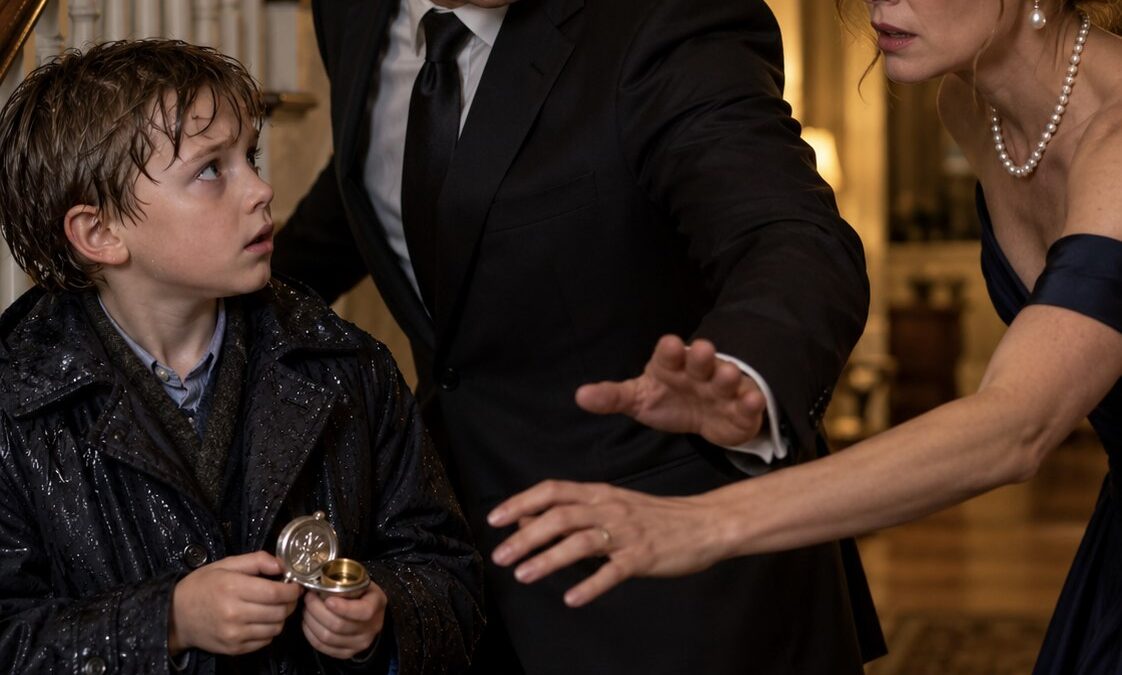
“Come inside, Ellis,” I told the boy.
He moved closer.
Tessa’s expression changed.
“You know his name?”
“He told me his mother’s.”
I closed the front door.
The man remained outside.
My phone was upstairs.
So was my daughter.
June was thirteen.
She had slept at a friend’s house after the gala.
I had checked twice before bed.
Still, I thought of her.
“Is June safe?” I asked.
Tessa looked offended.
“Of course she is.”
I didn’t believe her answer.
I believed the sleepover’s address.
Ellis rubbed his wet sleeves.
I took my coat from the hall hook.
He let me put it around him.
Tessa noticed.
For one second, her face softened.
Then she saw the seal again.
“Ruth sent him here alone?”
“No,” Ellis said.
“Her friend drove me.”
“Where is the friend?”
“She went for help.”
Tessa looked toward the window.
The man outside checked his phone.
I picked up the house telephone.
Tessa took one step forward.
I held up my hand.
“What are you doing?”
“Calling my lawyer.”
“You’re frightening him.”
“He was frightened when he arrived.”
I dialed Mara Voss.
She had handled our company’s acquisitions for eleven years.
She answered on the fourth ring.
“Mara, come to my house.”
“What happened?”
“Bring your own car.”
Tessa let out a sharp breath.
I gave Mara the address anyway.
Then I called June’s friend’s father.
He answered sleepily.
June was downstairs eating pancakes.
I asked him to keep her there.
He heard my voice change.
“I will,” he said.
Tessa folded her arms.
“You’ve made your point.”
“I haven’t made one yet.”
Ellis studied the brass sleeve.
His mother had trusted him with it.
That was a terrible amount of trust.
“Did she explain those words?” I asked.
“She said you were supposed to be away.”
“Where?”
“On the plane.”
Tessa’s eyes closed.
I had canceled a flight that morning.
A fuel-system warning delayed departure.
I went home instead.
“Ruth didn’t know?” I asked.
Ellis shook his head.
“She saw your name on the news.”
My stomach turned.
The news had shown me beside Tessa.
We had opened a new shipping terminal.
I looked again at the sleeve.
My signature.
A false death.
A seal my wife kept locked away.
Tessa reached for the banister.
“What happened three years ago?” I asked.
Her voice came out thin.
“Ruth was never a thief.”
* * *
Mara arrived with a police detective.
Neither knew the full story.
Mara had called him after hearing Ellis’s name.
Detective Ben Ortiz took one look at the boy.
His questions became careful.
“Is your mother safe?”
“I don’t know.”
“Where did you last see her?”
“At the courthouse.”
Ortiz called the station.
Ruth Calder was there.
She had walked in at 7:12 that morning.
She was giving a statement.
A uniformed officer had stayed with her.
Ellis’s shoulders dropped.
Only then did he begin to shiver.
Tessa offered to make tea.
Ortiz asked her to remain seated.
The man outside drove away.
I gave Ortiz his license plate.
Mara photographed the seal.
She photographed the brass sleeve.
Then she asked where it had been kept.
“In Tessa’s desk,” I said.
Tessa shook her head.
“It’s a ceremonial stamp.”
“Who made it?” Mara asked.
“I don’t remember.”
Ellis spoke quietly.
“My mother does.”
He said Ruth had worked at our company for nine months.
She reviewed bids before they went to clients.
We knew that much.
He knew more.
“She found envelopes with flowers on them.”
Tessa’s foundation used a blue iris.
Its annual fundraiser paid for school libraries.
The envelopes went to donors.
Sometimes they carried invitations.
Sometimes they carried our competitors’ bid prices.
That was Ruth’s claim.
Mara looked at me.
“Did she raise it with you?”
“Through my office.”
I remembered the message.
It had arrived while I was overseas.
My assistant marked it urgent.
When I returned, Tessa told me Ruth had withdrawn it.
Two days later, Ruth was accused of theft.
I had never spoken to her.
That absence sat between us.
Ortiz asked to see the brass sleeve.
He read the inscription.
“Why make this?”
Tessa said nothing.
Mara held it beneath a lamp.
A number was stamped inside the rim.
She photographed that too.
“Batch number,” she said.
“It could identify the maker.”
Ortiz sealed the pieces in separate evidence bags.
I wanted them left in my hand.
I let them go.
Evidence needed a trail.
My anger could wait.
A patrol officer came for Ellis.
Ruth had asked to see him.
He looked at Tessa before leaving.
“She knew my name,” he said.
Tessa’s eyes filled.
“I knew your mother.”
“That wasn’t what I said.”
I walked him to the door.
He gave my coat back.
“Keep it,” I said.
“It’s too big.”
“You’ll grow.”
He almost smiled.
After he left, Mara asked Tessa one question.
“Who told you Ruth stole the bids?”
Tessa stared at the floor.
“My brother.”
I had never heard that before.
Cal Rourke sat on our company board.
He had introduced Tessa and me.
He also chaired the committee that investigated Ruth.
Mara pulled out her phone.
She asked her assistant for the old case file.
Within minutes, the first report arrived.
Ruth had supposedly opened a restricted bid folder.
The access log showed her badge.
It also showed a second badge.
A board administrator’s badge.
Cal’s badge.
I looked at Tessa.
“Did you know?”
“Not then.”
“When?”
“Two years ago.”
Mara stopped scrolling.
Tessa lifted her chin.
“Cal told me Ruth was stealing.”
“So you believed him?”
“I saw a copy of the bid.”
“From whom?”
“Cal.”
Ortiz’s phone rang.
He stepped into the hall.
Tessa’s fingers twisted her pearls.
I had bought them for our tenth anniversary.
She had worn them while accusing Ruth.
Ortiz returned.
Ruth had finished her first statement.
She had also given police a copy of a filing.
Mara read it on his phone.
A transfer of my voting shares.
Effective upon a certified declaration of death.
Filed with a private trustee.
Signed by Tessa.
Witnessed by Cal.
My name appeared beneath theirs.
I had never signed it.
Mara looked up.
“The seal was made for the transfer.”
Tessa shook her head.
“I didn’t file that.”
But her signature was there.
The lie had reached our own table.
* * *
The board office called before noon.
Cal wanted an emergency meeting.
He said confidential material was missing.
Mara told me not to attend alone.
I told her I wouldn’t attend at all.
First, we went to Ruth.
Ortiz arranged the meeting at the station.
Ellis sat beside her.
She looked older than I remembered.
She looked directly at me.
“You finally read my message.”
“I didn’t,” I said.
“Tessa answered it.”
Ruth glanced at Mara.
“I have the delivery receipt.”
She placed a printed email on the table.
It had been forwarded from my account.
Tessa had access to that account then.
We shared an assistant.
We shared almost everything.
Ruth’s message listed three leaked bids.
It named Cal.
It asked me to call her privately.
The reply said I had reviewed her concerns.
It instructed her to destroy her notes.
The language sounded like me.
I had never written it.
“I kept working,” Ruth said.
“Then they accused me.”
She lost her clearance.
The company sued for its equipment.
The suit was dropped months later.
By then, no client would hire her.
“Why disappear?” I asked.
“I moved to my sister’s.”
“You could have called me.”
“I thought you wrote that reply.”
She had a point.
I looked at Ellis.
He drew a square on scrap paper.
Then another square around it.
Ruth touched his shoulder.
“Last week, Cal contacted me.”
“What did he want?”
“The original seal.”
She nodded toward the evidence bag.
“I took it from Tessa’s office three years ago.”
Tessa had left it in a document box.
Ruth found the box during the investigation.
She recognized a supplier’s label.
Her brother repaired office machines.
He had once shown her the same workshop’s mark.
The workshop made custom stamps.
Ruth checked its invoice.
Cal had ordered the seal.
Tessa was listed as the recipient.
“I took photographs,” Ruth said.
“Why keep the object?”
“Because Cal controlled the records.”
She had hidden the seal with her sister.
Last week, someone searched that house.
Nothing valuable disappeared.
The seal had been inside Ellis’s school art box.
Ruth reported the break-in.
Then she took the seal apart.
The sleeve slid out.
She read its inscription.
She called Mara’s office.
Mara had been in court.
Before Mara returned the call, Ruth saw a news alert.
My canceled flight had made local news.
The airport had briefly closed a runway.
My photograph accompanied the story.
“I realized why Cal wanted it,” Ruth said.
“He expected a different headline.”
Ortiz did not guess aloud.
Neither did I.
The planned flight had carried six executives.
Nobody could have predicted an accident.
But Cal didn’t need one.
He only needed a declaration.
Mara explained the filing’s language.
A trustee could act after receiving certain documents.
A false certificate might briefly move the shares.
A court could unwind it.
The damage during that interval could last.
Cal wanted a vote that afternoon.
Our largest rival had offered to buy our harbor leases.
I had opposed the sale.
Cal needed my voting shares.
“And Tessa?” I asked.
Ruth looked at me.
“I don’t know what she knew.”
That was honest.
It hurt more than an accusation.
Mara’s phone buzzed.
The trustee had received notice that morning.
Someone had claimed I died overseas.
A scanned certificate came with it.
The date was yesterday.
I had eaten dinner with June yesterday.
Ortiz took the phone.
He asked for the trustee’s contact.
Then my phone lit up.
Cal.
I let it ring.
A message followed.
Your wife has been carrying this alone.
I showed Ortiz.
He copied it.
Outside, the afternoon traffic hummed.
Inside, Ellis kept drawing squares.
“What are those?” I asked.
“Doors,” he said.
He drew a small opening in the last one.
“Mom says every door needs a way out.”
Ruth smiled at him.
It was tired.
It was real.
Then Ortiz received a photograph.
The man outside our house had been identified.
He worked for Cal’s security contractor.
His assignment began three days earlier.
The architect had sent him.
Cal wanted my vote, my shares, and Ruth’s silence.
* * *
The board meeting began at four.
Mara entered first.
Ortiz stayed outside with another detective.
An investigator from the state’s corporate division joined them.
They had not come to arrest anyone.
They had come with questions.
The trustee had frozen the transfer.
The bank had preserved its records.
Ruth had given a sworn statement.
That was enough to interrupt a vote.
It was not enough to finish a case.
Cal sat at the head of the table.
He looked disappointed to see me alive.
Then he smiled.
“Owen.”
“Cal.”
Tessa sat two seats away.
She hadn’t come home after the station.
I had not called her.
Our company president, Helena Price, stood up.
“What is happening?”
Mara placed the trustee’s notice before her.
Helena read the first page.
Then she read it again.
Cal spread his hands.
“It’s an administrative error.”
“It declares me dead,” I said.
“Obviously an error.”
“Why did you request a vote?”
“Because the buyer has a deadline.”
Helena looked at him.
“Did you know about this filing?”
“No.”
Tessa said nothing.
Mara placed a photograph beside the notice.
The brass sleeve.
The inscription faced upward.
Cal’s smile remained.
“That could have been made anywhere.”
“It could,” Mara said.
She laid down the workshop invoice.
Its batch number matched the sleeve.
Cal had paid for it personally.
His assistant had collected it.
He read the invoice without touching it.
“I commissioned a prop for a fundraiser.”
“Why inscribe Owen’s death?” Helena asked.
Cal turned to her.
“It was a proposed estate exhibit.”
Nobody answered.
He tried again.
“Our foundation once discussed legacy giving.”
“That foundation is mine,” Tessa said.
Her voice was barely audible.
Cal looked at her.
For the first time, he seemed angry.
Mara placed the transfer papers before the board.
Tessa’s signature appeared on page nine.
Cal tapped it.
“She signed.”
Tessa closed her eyes.
“Yes.”
I felt the table edge beneath my fingers.
“When?” I asked.
“Two years ago.”
“Why?”
“Cal said it was a contingency.”
“You read the death clause.”
“He said it only mattered if you died.”
“You knew I hadn’t.”
“I didn’t know he filed it.”
Cal laughed once.
It had no warmth.
“She benefited from everything.”
Tessa met his eyes.
“I believed your story about Ruth.”
“For three years?”
“For one.”
The room went still.
She turned toward me.
“I found the bid payments later.”
“You never told me.”
“No.”
“Why?”
“Cal had copies of my signed papers.”
“He threatened you?”
“He said June would learn I helped ruin Ruth.”
“That was already true.”
Tessa nodded.
“I know.”
Helena asked about the leaked bids.
Cal gave her a practiced answer.
Clients changed their prices.
Competitors watched the market.
Coincidences happened.
Then Mara opened another folder.
Ruth’s original notes listed six bids.
Three had been submitted.
Three had existed only in our system.
The rival’s winning prices undercut each one.
Exactly.
Cal leaned back.
“That proves someone leaked them.”
“Yes,” Mara said.
She turned to Helena.
“Your IT team preserved the download logs.”
Helena nodded.
She had authorized the search that morning.
The logs showed access through Cal’s board account.
Each download preceded a foundation mailing.
The mailings went to a holding company.
The holding company belonged to the rival’s adviser.
A bank had confirmed the foundation’s receipts.
Cal did not reach for the documents.
“Foundations receive donations,” he said.
“They do,” Helena replied.
“Not on the morning of every bid.”
The investigator stepped inside.
She introduced herself.
Cal stood.
“Am I under arrest?”
“Not here,” she said.
“I’d like to speak with you.”
He looked at Tessa.
“You told me the seal was destroyed.”
“I said it was missing.”
“You let Ruth keep it.”
“I didn’t know she had it.”
He looked at me.
“You would have sold eventually.”
“Maybe.”
“You’re sentimental about those leases.”
“They employ four hundred people.”
“The buyer would keep most of them.”
“Then let them make an honest offer.”
Cal’s face hardened.
“Your wife signed.”
“She’ll answer for that.”
“So will you,” Helena told him.
The board suspended the vote.
Cal resigned before they could remove him.
That evening, June came home.
I told her enough to be truthful.
I did not ask her to choose sides.
Tessa stayed with her cousin.
We arranged calls through Mara.
Ruth’s old accusation was formally withdrawn.
The company sent corrected letters to every client.
I signed each one.
Months passed.
Cal pleaded guilty to fraud and unlawful access.
The bid case brought separate charges.
The court ordered restitution.
The company pursued the remaining money.
Tessa admitted signing the transfer.
Prosecutors did not charge her with the leaks.
They did require her testimony.
She left the foundation board.
Its new trustees published an independent audit.
Cal’s last message came through his lawyer.
He said I had known nothing because I wanted to know nothing.
I read it once.
Then I gave Ruth my unanswered email.
“I should have called,” I told her.
“Yes,” she said.
I accepted that.
* * *
By winter, the house sounded different.
June played music while cooking.
She used too much cinnamon.
We ate the results anyway.
Ellis visited with Ruth one Saturday.
He had outgrown my coat.
He brought it back clean.
I told him to keep it.
He said his mother had taught him to return things.
Ruth had a new job.
Helena hired her firm for an outside audit.
Ruth negotiated the contract herself.
She did not want to work for me.
I respected that.
We drank coffee at the kitchen counter.
June showed Ellis how to fold dumplings.
His first one looked like a wallet.
He insisted it was a fish.
Tessa arrived at noon.
June had invited her.
I knew in advance.
The four of us had practiced careful visits.
This was the first with guests.
Tessa stopped when she saw Ruth.
“I can come back.”
Ruth shook her head.
“Stay.”
They stood across the kitchen.
Neither reached for a chair.
“I let them blame you,” Tessa said.
“Yes.”
“I was afraid of Cal.”
“Yes.”
“That doesn’t excuse it.”
“No.”
Tessa gripped her bag.
“I’m sorry.”
Ruth waited.
Then she said, “Thank you for saying it.”
That was all.
It was enough for the day.
June carried a plate between them.
“The fish is Ellis’s,” she said.
Tessa smiled at him.
He did not smile back.
He took the plate.
No one demanded more.
After lunch, Tessa asked to speak with me.
We went to the front hall.
The staircase stood behind her.
“I found an apartment,” she said.
“Is it close to June’s school?”
“Fifteen minutes.”
“Good.”
“I’ll keep the visits we agreed on.”
“June wants that.”
Tessa looked at the empty space beneath the stairs.
“I thought protecting us meant keeping Cal quiet.”
“It protected Cal.”
“I know.”
She handed me an envelope.
It held papers for her foundation shares.
She wanted to transfer them to me.
I handed them back.
“Let the trustees decide.”
“I thought you might use them for Ruth.”
“Ruth can decide what she needs.”
Tessa put the envelope away.
“I keep offering things.”
“You can keep showing up for June.”
She nodded.
It was a boundary.
It was also a way forward.
The company recovered some of the money.
We used it to create a paid training program.
Employees could learn compliance work without a degree.
Ruth helped write the curriculum.
She billed us her full rate.
Mara said that was the healthiest invoice she had ever seen.
June made a sign for the first class.
She drew a small door in one corner.
Ellis recognized it.
“You copied my picture.”
“I improved it,” she said.
He inspected it carefully.
“You gave it a handle.”
June shrugged.
“Doors need one.”
That spring, Ruth asked me for a favor.
Ellis wanted to see the harbor.
I knew every pier.
She asked if I would take them.
I asked Ellis what he thought.
He considered me for a long moment.
“Will June come?”
“If she wants to.”
“Then okay.”
We went on a clear Saturday.
Ellis counted cranes.
June counted ships.
Ruth asked questions I could answer.
No one spoke about Cal.
For two hours, the harbor belonged to them.
* * *
Four years later, I stood beneath the staircase again.
Ellis stood beside me.
He was twelve now.
Almost as tall as June had been that morning.
Ruth had come for dinner.
Tessa was coming later for June’s graduation photographs.
We had learned how to share a room.
It took time.
It still took care.
The silver seal sat in a glass case nearby.
The court had returned it after the trial.
I asked Ellis before displaying it.
He said the case should explain what happened.
June wrote the card.
It named Ruth.
It named the false accusation.
It named the evidence that cleared her.
No family legend softened the facts.
Ellis read it again.
“My mother said you’d recognize this,” he said.
“I recognized the wrong thing.”
“You recognized the seal.”
“I didn’t recognize what she’d been trying to tell me.”
He looked toward the front door.
Ruth was laughing with June.
“Now you do,” he said.
Tessa rang the bell.
I opened the door.
She carried flowers for June.
She asked before coming in.
Behind me, Ellis moved out from beneath the stairs.
He walked toward his mother.
June called everyone to the porch.
The camera timer began to blink.
Ruth.
Ellis.
Tessa.
June.
Me.
We stood where we chose.
When the camera flashed, Ellis was smiling.
THE END








