At a Charity Gala, a Nine-Year-Old Cut Open Her Grandmother’s Quilt and Found the Receipt That Could Ruin Her Family
Chapter 2: The Name Beneath the Stitching
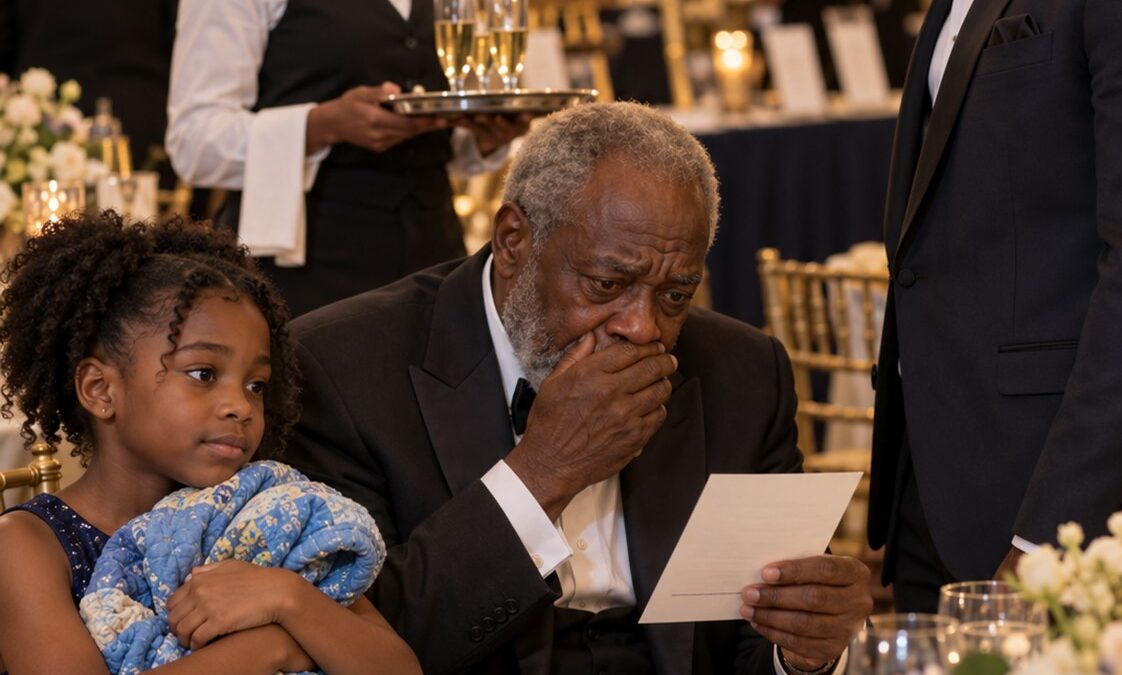
Augustus kept staring at the receipt.
Victor reached for it.
“Don’t,” Augustus said.
The pianist stopped playing.
Nora held the torn quilt against her chest, hiding the open seam.
Her mother crossed the ballroom, set down her tray, and put herself between Nora and Victor.
“She’s nine,” Tessa said.
“I can see that.”
“Then step back.”
Victor glanced at their father.
“She brought a child here to stage this.”
Tessa’s cheeks burned.
She had worked seven hours serving drinks at her own family’s gala.
The agency paid twenty-two dollars an hour.
She needed the money for Nora’s winter coat and a past-due electric bill.
“I didn’t know,” she said.
Augustus looked at Nora.
“Did your mother tell you to cut it?”
“No.”
“Who did?”
“Grandma showed me the seam.”
“When?”
“Before she went to the hospital.”
Victor spread his hands toward the guests.
“You’re taking financial advice from a child with scissors.”
“I’m reading a receipt,” Augustus said.
Two people near the auction table lowered their phones.
Augustus folded the paper once.
Then he stopped himself and laid it flat.
The transfer was dated three years earlier.
Four hundred eighty thousand dollars.
The amount missing from the foundation’s mobile clinic fund.
The amount Augustus had accused Tessa of stealing.
His signature authorized the transfer.
The destination belonged to a company called Calder Ridge Holdings.
Victor owned Calder Ridge.
Tessa had never heard its name.
She studied her father’s face for a sign that the receipt had surprised him.
She found one.
His hands shook.
“What did you think you were signing?” she asked.
Victor answered first.
“A routine property deposit.”
“Nobody asked you.”
Augustus gripped the table.
“Victor told me the clinic needed land.”
“The mobile clinic?” Tessa asked.
“Yes.”
“It had wheels.”
A guest looked away.
Augustus said nothing.
Victor leaned close enough for Tessa to smell his expensive cologne.
“This can be handled privately.”
“For three years,” Tessa said, “that was your favorite word.”
She turned to Nora.
“Did Grandma put anything else in there?”
Nora touched a square of stitching inside the quilt.
“She said the blue side came first.”
“There’s another side?”
Nora nodded.
Victor moved again.
Augustus caught his arm.
It was the first time Tessa had seen her father stop him.
Nora let her mother hold the scissors.
Tessa opened the second seam carefully.
Inside lay a folded letter addressed to her.
Her mother’s handwriting slanted across the envelope.
Tessa opened it with trembling fingers.
The letter was short.
Eleanor had written that she believed Tessa from the day the money disappeared.
She had saved the receipt while searching for proof of who changed the destination.
At the bottom, one sentence stood alone.
“I never believed you stole a cent.”
* * *
They left through the kitchen.
Nora walked between Tessa and Augustus.
Victor stayed in the ballroom, promising the guests that an old accounting question had been misunderstood.
Tessa heard him through the swinging door.
She had heard versions of that sentence before.
At her apartment, she set the quilt on the kitchen table.
Augustus stood in a room smaller than his dressing room.
He had never visited it.
Nora noticed.
“Grandma knew where we lived,” she said.
Augustus looked at the worn numbers on the refrigerator.
Tessa paid rent with shifts at a catering agency and bookkeeping work for two neighborhood shops.
Three years earlier, she had been the foundation’s finance director.
She had challenged an unexplained transfer on a Thursday.
By Monday, Victor had shown the board a report bearing her initials.
Augustus had asked for her resignation.
No criminal charges followed.
The board had quietly replaced the missing funds, then issued a statement about “internal controls.”
Tessa’s name had never appeared.
It hadn’t needed to.
Everyone in their circle knew who had left.
Augustus pulled out a chair.
“I owe you—”
“You owe me the truth.”
He sat.
Tessa laid the receipt beside her mother’s letter.
She remembered the week of the transfer.
The clinic needed two vans, medical equipment, and a place to keep them overnight.
Land had been discussed.
Only Victor had proposed buying it.
“He told you it was a deposit,” she said.
“He said the site would save rent.”
“Did you read the transfer instructions?”
“I read a summary.”
“His summary?”
“Yes.”
Augustus closed his eyes.
Tessa turned the receipt over.
A blue pencil mark crossed the back.
Eleanor had written two dates and a name: Helen Cho.
Helen had managed records at the foundation before retiring.
Tessa called her.
Helen answered on the fourth ring.
“Your mother told me you might call,” she said.
“She died six weeks ago.”
“I know.”
“Why didn’t you contact me?”
“She asked me to wait until you had what she left.”
Tessa looked at the quilt.
Helen’s voice tightened.
“She couldn’t prove who submitted the final instructions.”
“Can you?”
“I kept my old work calendar.”
Helen agreed to meet them at the public library the next morning.
Augustus offered to call the bank himself.
Tessa shook her head.
“First, we make copies.”
He seemed ready to object.
She held his gaze.
“Copies you can’t take home.”
He nodded.
At the library, Helen brought a binder.
She was sixty-eight, precise, and angry.
She spread out appointment notes from the week the money vanished.
Tessa recognized her own meeting with the van supplier.
Then Helen pointed to Friday afternoon.
Victor had booked the foundation’s conference room for a call with Augustus and the bank.
Tessa’s initials appeared on the resulting transfer report.
“I wasn’t there,” Tessa said.
“I know,” Helen answered.
Helen’s calendar put Tessa at the van depot across town.
A supplier’s signed inspection form confirmed it.
Tessa remembered crawling beneath the first van with a mechanic.
The exhaust system had needed work.
She had come home with grease on her sleeve.
The memory hurt more than the accusation.
She had been doing the job she lost.
Augustus examined the inspection form.
“Why didn’t I see this?”
“Nobody asked me,” Helen said.
Tessa found the line that had bothered her three years ago.
The report listed a property account as though it belonged to the clinic.
She had questioned it before her dismissal.
Now she read the account number against the receipt.
They matched.
Helen tapped the page.
“I also kept the board packets.”
Victor’s proposed land purchase had vanished from the final packet.
Augustus had seen an earlier version.
Tessa had seen the final one.
They had argued from different documents while Victor held both.
Helen had one more record.
A state filing showed Calder Ridge Holdings had been formed eight days before the transfer.
Its manager was Victor Vale.
Augustus stared at his son’s name.
Tessa could already hear Victor’s answer.
Owning the company did not prove he had stolen the money.
The land might have been purchased for the clinic.
She asked Helen for the property address.
Helen slid a printed map across the table.
Calder Ridge had bought a vacant parcel beside the foundation’s headquarters.
The clinic vans were never meant to park there.
Victor had sold that parcel to a commercial developer the following year.
* * *
Tessa hired an attorney with money Eleanor had left in a small account for Nora.
She hated using it.
The attorney, Ms. Bell, told her the first consultation would cost nothing.
“The child’s account stays the child’s,” Bell said.
Nora sat in the waiting room with a book while the adults reviewed the documents.
Bell studied the receipt under a lamp.
“This shows where the funds went.”
“It doesn’t show who changed the instructions,” Tessa said.
“Correct.”
“Victor says Dad approved it.”
“Your father did sign.”
“He didn’t know what company he was paying.”
“That matters,” Bell said, “if we can prove it.”
She wrote down the sources they needed.
Bank records.
The foundation’s approval history.
The developer’s purchase documents.
The original electronic report that carried Tessa’s initials.
Bell asked Tessa to write everything she remembered about her access to the foundation’s system.
Tessa listed passwords she had changed, terminals she had used, and the date her key card stopped working.
Then she stopped.
“The report was generated on a Friday,” she said.
“Yes.”
“My account couldn’t approve transfers.”
Bell looked up.
“I could prepare them.”
“Who could approve them?”
“Victor and my father.”
The report with her initials had made her look responsible.
It had never meant she could send the money.
Bell requested records from the foundation’s independent auditor.
Augustus agreed in writing that afternoon.
Victor called him nine times while they waited.
On the tenth call, Augustus answered.
“No,” he said.
He listened.
“No one is taking Nora’s quilt.”
Then he hung up.
Tessa watched him.
“What did he say?”
“He thinks your attorney has confused you.”
“He’s been saying that since I was thirty-four.”
Augustus accepted the blow.
The next day, Tessa’s catering agency canceled her weekend shift at the Vale house.
Its manager sounded embarrassed.
“The client asked for someone else.”
Tessa thanked her and ended the call.
An hour later, an envelope arrived by courier.
Victor’s lawyer demanded the return of “foundation property,” including the receipt and quilt.
Bell replied that the documents would be preserved.
She also advised Tessa to keep a record of every contact.
That evening, Nora found her mother calculating rent on the back of an advertisement.
“Did I make us poorer?” she asked.
Tessa put the pencil down.
“No.”
“Uncle Victor looked scared.”
“He did.”
“Grandpa looked sad.”
“He did, too.”
Nora touched the uneven blue stitches.
“I cut right where Grandma showed me.”
“You did.”
“She said grown-ups sometimes need help seeing.”
Tessa wrapped the quilt around Nora’s shoulders.
Eleanor had spent her last months unable to travel far.
She had still carried fabric squares to appointments.
She had stitched the quilt in a reclining chair while Nora chose the blue pieces.
Every seam had been a place to put another scrap of cloth.
One had held a way back to the truth.
The auditor called Bell the next morning.
Bell put him on speaker.
The approval history showed that Victor had uploaded a revised transfer instruction after Augustus signed the first authorization.
The revision changed the destination account.
Only Victor’s credentials had accessed that page.
Victor had used his authority as foundation treasurer to turn his father’s signature into a payment to his own company.
* * *
The foundation called a special board meeting.
Tessa insisted it be held where the donors and clinic staff could hear the findings.
Bell warned that the board might refuse.
Augustus signed the request himself.
For once, his name opened a door Tessa needed open.
Victor arrived with two lawyers and a neat stack of papers.
He did not look frightened.
He had spent three years learning exactly what the board wanted to believe.
The clinic director sat in the front row.
So did Helen.
Nora stayed with a neighbor, who promised hot chocolate and an early bedtime.
Tessa had asked her permission to leave the quilt with Bell for the meeting.
Nora had said yes.
She wanted the torn blue square displayed.
“It’s the part Grandma worked hardest on,” she said.
Bell placed the quilt beside the receipt.
The meeting began with the auditor’s timeline.
Victor interrupted twice.
He called the receipt incomplete.
He called the electronic log open to interpretation.
Then he spoke about the clinic.
Two vans were treating patients now.
The building had opened.
Families had been helped.
He asked the board to consider what public allegations would cost the foundation.
Several members listened carefully.
Tessa understood why.
Victor had built their annual dinners, secured their biggest donations, and remembered their children’s names.
He was giving them a reason to keep their eyes on what worked.
Bell asked him one question.
“Did Calder Ridge own the parcel sold to the developer?”
“Yes.”
“Did you disclose that ownership to the board?”
“The transaction was managed within my authority.”
“That wasn’t my question.”
Victor leaned back.
“I did not believe disclosure was necessary.”
Augustus lowered his head.
Victor turned toward Tessa.
“My sister found an irregular entry and panicked.”
Tessa stood.
“I found an account that didn’t belong to the clinic.”
“You accused people before you understood the deal.”
“I asked for the account holder.”
“And then records went missing.”
Tessa felt the old shame move through the room.
She had spent years trying to explain herself to people who had already chosen a story.
This time, she had the date.
“Your report carries my initials,” she said.
“I have the report.”
“So do I.”
Bell projected it.
Tessa pointed to the time stamp.
“At that hour, I was inspecting the first van.”
Victor shrugged.
“An assistant could have entered your initials later.”
“Yes,” Tessa said.
“Someone did.”
Bell displayed the auditor’s access record.
Victor’s credentials had entered the initials from his office.
One of Victor’s lawyers leaned toward him.
Victor whispered something back.
Then he stood.
“Credentials get shared.”
Helen rose from her seat.
“Not in that office.”
Victor looked at her.
“I installed those controls.”
The board chair asked Helen to sit, but Bell requested that her statement be taken formally.
The chair agreed.
Helen described the terminal assigned to Victor.
She described his instruction that nobody else use it.
Then the bank’s records appeared on the screen.
They had arrived that morning under a records request the foundation itself had authorized.
The bank held the original authorization Augustus had signed.
It named a clinic property account.
It also held the revised instruction, submitted later from Victor’s office.
That instruction named Calder Ridge.
Victor studied the screen.
For the first time, he had no paper to lift between himself and the room.
The board chair suspended him as treasurer pending an independent investigation.
The foundation referred the records to law enforcement.
Bell asked the board to correct the statement it had made about Tessa’s departure.
The chair promised a vote after the investigators finished.
Tessa did not accept a promise as an answer.
“Put that in the minutes,” she said.
The secretary typed it.
Outside, Victor caught up with her near the steps.
“You’ll always be the one who tore this family apart.”
Tessa held the folded quilt.
“Nora cut one seam.”
She walked past him.
Months passed before the legal case ended.
Investigators obtained the sale records and traced the profit from the parcel to Victor.
He pleaded guilty to fraud and agreed to repay the foundation under a court-supervised agreement.
The court imposed a sentence.
The board published its findings and corrected its statement.
Tessa’s initials disappeared from the false report.
The original report remained in the case file, where it belonged.
* * *
Winter came without a gala.
Tessa found steady work managing the books for three neighborhood clinics.
The hours ended early enough for her to meet Nora after school.
Their apartment stayed small.
The electric bill stayed current.
Nora’s new coat was yellow.
She had chosen it because it was visible from a long way off.
Augustus began visiting on Sundays.
The first time, he brought a box of pastries and arrived forty minutes early.
Tessa made him wait while Nora finished breakfast.
At the table, he apologized.
“I should have listened to you.”
“Yes,” Tessa said.
“I trusted the wrong person.”
“You also chose not to check.”
He looked at his hands.
“Yes.”
Nora divided a pastry into three unequal pieces.
She gave herself the largest.
Augustus noticed.
“She’s very fair,” he said.
“She knows her worth.”
He came back the next Sunday.
He never entered without being invited.
In March, the foundation offered Tessa her old job.
The letter included a higher salary and a public apology.
She read it twice.
Then she declined the position.
She had helped build those clinics once.
She still cared about the patients.
But she liked the people she worked with now, and Nora liked knowing when she would come home.
Tessa offered to help the foundation design a better review process as a paid consultant.
The board accepted.
She asked that clinic staff have seats on the committee approving major purchases.
The board accepted that, too.
Eleanor’s quilt went to a textile conservator.
The torn seam could be repaired without hiding the cut.
Tessa asked that it remain visible.
Nora approved the choice.
“It’s part of what happened,” she said.
Augustus asked to pay for the work.
Tessa let him.
It was a repair he could make.
One afternoon, he brought Eleanor’s sewing basket.
He had found it beside her favorite chair.
Inside lay blue thread, blunt needles, and a card in Eleanor’s handwriting.
She had written down Nora’s measurements for a birthday dress she never finished.
Nora held the card for a long time.
Then she asked her grandfather whether he could sew.
“Very badly.”
“Grandma said practice helps.”
They spent three Sundays making a crooked dress for Nora’s stuffed bear.
Augustus learned to tie a knot.
Nora learned that she could tell him when a stitch was wrong.
At the end of April, Augustus asked Tessa whether Nora might visit the Vale house again.
“She’s welcome,” he said.
Tessa considered the word.
Nora had always been welcome there on paper.
“Ask her,” Tessa said.
“And if she says no?”
“Then you have your answer.”
Augustus asked.
Nora wanted to see her grandmother’s garden.
She also wanted her mother to come.
On the day of the visit, the gardeners had planted new herbs along the path.
Augustus had not ordered a photographer.
He had set out three chairs.
Tessa noticed both things.
Nora ran ahead to the rosemary.
The bushes were larger than she remembered.
“She said I could take some,” Nora called.
Augustus found the small garden shears.
He handed them to Tessa first.
Tessa passed them to Nora.
“Only what you need,” she said.
Nora clipped three sprigs.
One for each of them.
* * *
Five years later, the ballroom looked different.
The tables were set for an evening celebrating the mobile clinic’s tenth year.
Two vans had become six.
The foundation had published its finances every year since Victor’s case.
Augustus was no longer its chair.
He sat near the back with a cup of tea, watching people carry chairs into rows.
Nora, now fourteen, carried the blue quilt through the doorway.
The repaired seam ran across its center.
Tessa helped her hang it behind a small display about Eleanor and the first clinic van.
Beside it stood the receipt.
Its account number was covered.
The foundation had included enough to tell the truth without turning anyone’s private details into a decoration.
Nora stepped back.
“You can still see where I cut it.”
“Yes,” Tessa said.
“I used to think Grandma would be mad.”
“She knew you might need to open it.”
Nora touched the seam with one finger.
“She spent forty hours making something I could cut.”
“She spent longer making sure you knew when to.”
Across the room, Augustus rose to help a clinic nurse move a chair.
He waited for her to show him where it belonged.
Tessa watched him carry it.
The foundation had repaid the clinics.
Victor had answered in court.
Augustus had learned to ask.
Nora had kept the yellow coat until the sleeves grew too short.
The quilt held one visible scar.
It held a family’s truth, too.
Nora slipped her hand into her mother’s.
“Come on,” she said.
“They’re opening the doors.”
Together, they went to welcome everyone in.
THE END








