At a Glittering Transit Gala, a Cleaner’s Eight-Year-Old Held Up a Green Timetable and Challenged a Star’s Free Night Bus
Chapter 2: The Route That Never Ran
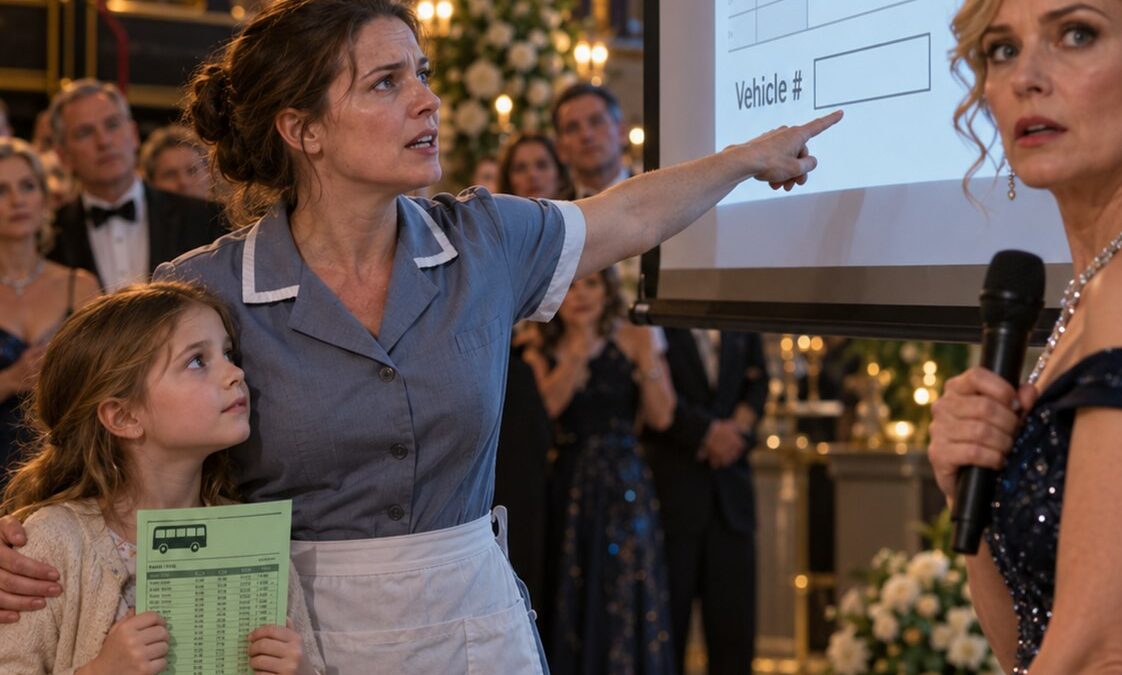
Celia turned toward the screen.
The canceled line stayed there.
So did Nell’s finger, raised from the floor.
“Change it,” Celia said.
The man beside the projector froze.
“Leave it,” Tessa said.
Her voice carried farther than she expected.
Celia lowered the microphone.
“That sheet needs context.”
“Then give it context.”
Tessa felt Nell’s hand tighten inside hers.
A woman in a dark suit approached the stage.
She had been standing beside a donation table.
“I’m the foundation’s operations director,” she said.
“My name is Paige Rusk.”
Paige glanced at the screen.
“That’s a draft dispatch report.”
A guest near Tessa lifted his phone.
Paige noticed.
She softened her voice.
“Some trips get canceled when nobody books a seat.”
“We were at the stop,” Nell said.
“Had you booked?”
“The timetable said walk up.”
Paige looked at Celia.
Celia looked at the green paper.
“May I see that?” Celia asked.
Nell did not move.
Tessa crouched beside her.
“You can show her while I hold it.”
Nell nodded.
Together they raised the card.
Celia read the front.
“Walk-up service,” she said quietly.
Paige stepped closer.
“This version should never have been distributed.”
“Your staff put it with tonight’s programs,” Tessa said.
Paige’s eyes moved to Tessa’s cleaning uniform.
“Who gave you access to those programs?”
“I found this on a chair,” Nell said.
Celia handed the microphone to Paige.
“Tell them why the trip was canceled.”
Paige turned toward the audience.
“The system marks an unused trip canceled automatically.”
“The bus still ran?” someone asked.
“Yes,” Paige said.
Tessa looked at the screen.
The word sat in a narrow column marked VEHICLE.
Not passenger.
She had spent six years entering maintenance reports for the city transit depot before its cleaning work was contracted out.
She knew the difference between an empty bus and a bus that never left.
“Which vehicle?” she asked.
Paige blinked.
“What?”
“Show the vehicle number.”
Paige’s gaze returned to the sheet.
A blank cell stood beside CANCELED.
“That information is on another page.”
“Put it up.”
“This is a charity event.”
“A charity event about buses.”
Nell held the timetable still.
Her arm began to tremble.
Celia noticed.
She stepped down from the stage and offered Nell a chair.
Nell took it.
It was the first kind thing Celia had done.
It made Tessa angrier.
“You knew families were waiting,” Tessa said.
Celia’s face changed.
“I knew there had been complaints.”
“How many?”
“I was told the first week had problems.”
“We waited last week.”
Paige folded her hands.
“Our review is ongoing.”
Behind them, the screen went black.
The man at the projector held up both hands.
“I didn’t touch it,” he said.
The donation display above the bar went dark too.
Then the chandeliers dimmed.
A power change clicked through the old station.
Emergency lights came on.
Nell gripped the chair.
Tessa put one hand on her shoulder.
“It’s okay.”
“I know.”
Across the room, people complained about their drinks.
Celia looked at the dark screens.
“Can someone restore the file?”
Paige reached for her phone.
“It’s stored with our vendor.”
“What vendor?” Tessa asked.
Paige ignored her.
The guest with the phone came forward.
“I recorded the sheet,” he said.
Paige gave him a hard look.
He held the phone closer to his chest.
Tessa could see only his name badge.
BEN ALDER, LOCAL RADIO.
“You can send that to me,” she said.
“I can.”
Paige placed a hand on Celia’s arm.
“Say nothing until counsel reviews it.”
Celia pulled away.
She looked at Nell.
“How often do you go to the clinic?”
“Every Tuesday.”
“Why?”
“My feet turn inward,” Nell said.
“The exercises help.”
Celia nodded.
“You waited in the cold?”
“It was warm that night.”
Nell said it without accusation.
Tessa saw Celia look away.
The chandeliers brightened.
The big screen remained blank.
Paige’s phone rang.
She answered with her back to them.
Tessa caught one sentence.
“Take the route page down now.”
Ben heard it too.
He stopped recording and put his phone away.
Celia stepped toward Paige.
“Who are you talking to?”
Paige ended the call.
“Our website team.”
“You said the file was with a vendor.”
“It is.”
Celia glanced at Tessa.
Then at the timetable.
Tessa turned the paper over.
A small line of text ran along its bottom edge.
PRINTED FOR SERVICE LAUNCH: APRIL 8.
That was six weeks ago.
Below it sat a second line.
APPROVED BY C. VOSS.
Tessa showed Celia.
Celia stared at her own printed name.
“I didn’t approve this,” she said.
* * *
By midnight, the gala had emptied.
Tessa’s supervisor told her to leave her keys.
He said he would call about her shifts.
She knew what that meant.
Nell fell asleep against her shoulder on the bus home.
A regular city bus.
One that came every thirty minutes.
Tessa kept the green timetable flat inside her coat.
Ben Alder had given her his card.
He had also sent her the video.
The canceled line was clear enough to read.
So was Paige’s answer.
Tessa watched it once after putting Nell to bed.
Then she called the number on the card.
Ben answered immediately.
“I’ve got more,” he said.
“From the screen?”
“From the public charity filing.”
“What does it say?”
“That the foundation paid for seventy-two night trips.”
“Did they?”
“That’s what I’m trying to find out.”
Tessa sat at her kitchen table.
The electric bill lay beneath a salt shaker.
“I know someone at the depot,” she said.
Ben paused.
“Someone who can talk?”
“Someone who knows which records to request.”
The next morning, Tessa visited the public transit office.
She did not ask an old friend for a favor.
She asked the records clerk for the route agreement.
It was a public contract with the foundation.
The clerk gave her a request number.
He said the dispatch logs would take longer.
Tessa wrote the number on the back of her grocery list.
Then she went to Nell’s school.
Her daughter had asked to attend.
Tessa had nearly said no.
At the classroom door, Nell’s teacher greeted her gently.
“I saw a video,” the teacher said.
“So did everyone.”
“Nell was very clear.”
“She was scared.”
“She can be both.”
Tessa watched Nell join her classmates.
A boy asked about the famous actress.
Nell answered, “She talked to me.”
Then she took out her math book.
Tessa wished adults could move through shame that quickly.
Outside the school, Celia waited beside a plain gray car.
She wore a sweater and no makeup.
There were no cameras.
Tessa stopped walking.
“You shouldn’t be here.”
“I know.”
“Then leave.”
“I came to apologize to your daughter.”
“She’s in class.”
“I can wait.”
“No.”
Celia accepted that.
She reached into her bag.
Tessa stepped back.
Celia withdrew a copy of the green timetable.
“I found this in my office.”
“Why bring it?”
“Look at the date.”
Tessa glanced down.
This copy had been printed seven weeks earlier.
It listed a launch date of April 8.
“You told the crowd the buses were running.”
“I was told they began that day.”
“By Paige?”
“Yes.”
“Did you check?”
“No.”
Celia said it without decoration.
Tessa appreciated the honesty.
It did not make the answer better.
“I saw two families at the announcement,” Celia said.
“They thanked me for the service.”
“Did they ride it?”
“I didn’t ask.”
Celia looked toward the school doors.
“I thought I knew how the foundation worked.”
“You put your name on it.”
“I did.”
“That means the families trusted you.”
Celia folded her copy.
“I called the dispatch company this morning.”
“And?”
“They said they don’t run a night route.”
Tessa felt something settle heavily inside her.
“What company?”
“Harbor Link.”
“That’s the daytime service.”
“It’s the company named on the invoices.”
Tessa knew Harbor Link’s blue minibuses.
They stopped operating at seven.
A late bus could not have come from them.
“Did they deny the invoices?” she asked.
“They said they had to review them.”
“Ask in writing.”
“I already did.”
Celia opened the car door.
Tessa thought she would leave.
Instead, Celia waited.
“I offered your family money last night.”
“You made Nell a spectacle.”
“Yes.”
“The money won’t fix that.”
“I know.”
Tessa looked down at the two green cards.
They were identical except for a tiny code.
H14-03 appeared on hers.
H14-01 appeared on Celia’s.
“Where did you find this copy?” Tessa asked.
“Inside a folder Paige sent me.”
“Was there another version?”
“Three.”
“Keep all of them.”
Celia nodded.
Tessa started toward the bus stop.
Then she turned.
“If you speak to Nell, I’ll be there.”
“That’s fair.”
“And you’ll tell her the truth.”
Celia’s hands tightened around the folder.
“I’m trying to learn it.”
At home, Tessa laid the two timetables side by side.
The route map looked the same.
The clinic stop looked the same.
The phone number at the bottom did not.
She dialed the number on Celia’s early copy.
A recorded voice answered.
“Night Ride reservations,” it said.
She pressed one.
The recording offered a call back.
Tessa hung up.
She dialed the number on Nell’s card.
It went straight to an out-of-service message.
She called Ben.
“Can you help me trace a number?”
“I can ask who owns it.”
“The printed number changed after launch.”
“That matters.”
“I think the first one took reservations.”
“Then where did those reservations go?”
Tessa looked at Nell’s empty chair.
“That’s what we need to find out.”
Two days later, the records clerk emailed the route agreement.
The foundation had hired Harbor Link for daytime rides.
A separate company had been added for nights.
Its name was Lantern Mobility.
Tessa had never seen a Lantern bus.
The contract listed an office address.
She knew the building.
It was three blocks from the station.
Paige Rusk’s consulting firm occupied its top floor.
* * *
Ben met Tessa outside the building.
He carried a notebook and a paper cup.
“I checked the business registry,” he said.
“Lantern Mobility was created in March.”
“Who owns it?”
“The public filing names a manager.”
“Paige?”
“No.”
He showed her the screen.
The manager was Malcolm Rusk.
“Her husband?” Tessa asked.
“Her brother.”
They did not go upstairs.
A name in a filing was not proof of a crime.
Tessa knew that.
Ben knew it too.
They went to the transit office instead.
A supervisor had agreed to explain the public records.
His name was Omar Dace.
He remembered Tessa from the depot.
“You used to catch the wrong mileage entries,” he said.
“Only when drivers asked for overtime twice.”
“That was often.”
He did not smile.
He knew why she had come.
On his desk lay the route agreement.
Beside it sat a city map.
“We never licensed a Lantern vehicle,” he said.
“Could they have used a private one?” Ben asked.
“Only with a permit.”
“Did they get one?”
“No.”
“Could the buses have run without telling you?”
“Not legally from our stops.”
Omar tapped the clinic stop.
“This one belongs to the city.”
Tessa thought of the broken streetlight.
Nell had waited beneath it.
A real bus would have needed a place to pull in.
“Did anyone ask about that stop?” she said.
“Not until last Friday.”
“Who asked?”
“The foundation.”
“Who at the foundation?”
“Celia Voss.”
Ben wrote it down.
Omar opened another file.
“I requested dispatch reports after her call.”
“Have they arrived?”
“Some.”
He turned the monitor.
The first six weeks showed blank vehicle numbers.
Each planned trip had a status.
CANCELED.
CANCELED.
CANCELED.
Then a few entries read COMPLETE.
Those were gala dates.
“Were buses at those events?” Ben asked.
“Chartered vans.”
“Did they serve the route?”
“No.”
Omar pointed to the addresses.
One van had carried donors from a parking garage.
Another had taken staff to a television studio.
Tessa found April 8.
The launch date.
A completed trip began at the station.
It ended four minutes later.
“Where did it go?” she asked.
Omar enlarged the location field.
“It never left the block.”
A charter van had driven around the station for cameras.
Tessa remembered the gala screen.
The smiling driver.
The picture had been taken beside the station curb.
“May I photograph the public entries?” Ben asked.
Omar nodded.
He explained which parts could be published.
Names of passengers were protected.
The vehicle and route fields were not.
Tessa asked for one more thing.
“The invoice codes.”
Omar opened a scanned payment sheet.
The first invoice listed H14-01.
The same code printed on Celia’s timetable.
The next listed H14-02.
Then H14-03.
Nell’s card.
“What does the H mean?” Ben asked.
“Harbor?” Omar guessed.
Tessa shook her head.
“Harbor Link uses letters for depots.”
“Could it be a print version?”
“It could.”
She studied the card again.
The green paper had a pale stripe near its edge.
A cutting mark ran across the stripe.
There was another mark lower down.
A printer had made multiple versions on one sheet.
“Who printed these?” she asked.
Omar didn’t know.
Ben took a photograph.
They left with enough evidence to ask harder questions.
Not enough to accuse Paige publicly.
Outside, Tessa’s phone buzzed.
Her supervisor had finally called.
He offered her a shift washing floors at another venue.
It was half the hours she had worked.
“You embarrassed the client,” he said.
“I spoke about a bus.”
“You interrupted an event.”
“My daughter asked a question.”
“You let her.”
Tessa watched a bus pull into the stop.
“Put the offer in writing,” she said.
He hung up.
Ben had heard only her side.
“You okay?”
“No.”
“What will you do?”
“Keep my daughter’s school shoes clean.”
That evening, Tessa told Nell about the reduced hours.
She kept the details simple.
Nell looked at her sneakers.
“Because of me?”
“Because I answered with you.”
“Are you sorry?”
“I’m worried.”
“That isn’t the same.”
Tessa sat beside her.
“No, it isn’t.”
Nell leaned against her.
They worked through her clinic exercises.
Toe lifts.
Slow steps.
A rubber band stretched between her hands.
Afterward, they made scrambled eggs.
Tessa had just washed the pan when the doorbell rang.
A delivery driver stood outside.
He carried an envelope.
No sender.
Inside was a copy of a route reservation.
It showed Nell’s name.
Her clinic stop.
Last Tuesday’s date.
A booking number.
Across the bottom, a clerk had typed:
NO VEHICLE ASSIGNED.
There was a second page.
It listed twenty-eight other bookings.
The names were covered with black bars.
Every line ended the same way.
Tessa called Ben.
“Someone sent us proof people booked rides.”
“Who sent it?”
“I don’t know.”
“Don’t publish it yet.”
“I wasn’t going to.”
“Keep the envelope.”
Nell came to the kitchen doorway.
“What is it?”
Tessa turned the first page over.
“The bus knew we were waiting,” she said.
Then she saw a handwritten note beneath it.
ASK CELIA WHO SIGNED THE PAYMENTS.
* * *
The next morning, Tessa put the envelope inside a clean folder.
She took Nell to school.
Then she went to a legal aid office Ben had found.
Attorney Ruth Fen met her in a small room with two chairs.
Ruth read the agreement.
She read the dispatch records.
She read the reservation.
Then she placed each page in a separate clear sleeve.
“Did you request these yourself?” she asked.
“Some.”
“Who sent this envelope?”
“I don’t know.”
“We can use it to guide questions.”
“Can you use it as proof?”
“First we find its source.”
Tessa nodded.
She had expected that.
Ruth looked at the timetable.
“Where did you get this?”
“Nell found it at the gala.”
“Did anyone see her take it?”
“She picked it up beside me.”
“It was being handed to guests?”
“Yes.”
Ruth wrote that down.
“Celia offered your family money publicly.”
“One hundred thousand.”
“Do you want me to pursue that?”
“I want the buses accounted for.”
“We can do both.”
Tessa looked at her.
“She said Nell had to prove they weren’t running.”
“The records may settle that.”
“I don’t want Nell put on a witness stand over a dare.”
Ruth closed her notebook.
“Neither do I.”
They agreed that Ruth would contact the foundation’s counsel.
Ben would keep reporting from public records.
Tessa would ask questions only of people willing to speak.
Nobody would enter Paige’s office.
Nobody would take private files.
Outside, Tessa called Celia.
Celia answered on the second ring.
“Did you sign the Lantern payments?” Tessa asked.
A long pause followed.
“Yes.”
“Did you read the invoices?”
“Paige summarized them.”
“That wasn’t my question.”
“No.”
Tessa gripped the phone.
“How many?”
“Six monthly batches.”
“Did any mention vehicles?”
“They said service hours.”
“Someone sent me reservations with no vehicle assigned.”
“Who?”
“I don’t know.”
“I need to see them.”
“Ruth Fen has copies.”
Celia repeated the name.
“I’ll have my attorney call her.”
“That’s better.”
Celia sounded tired.
“I asked Paige for the originals.”
“And?”
“She said they were archived.”
“After six weeks?”
“She’s also asked me to postpone the route review.”
“Will you?”
“No.”
That afternoon, the foundation posted a statement.
The night route was temporarily paused.
It offered no explanation.
For families who had waited at its stops, the word paused was strange.
Tessa’s phone filled with messages.
One father had taken two buses to the job center.
A grandmother had waited outside the shelter.
A teenager had missed a class interview.
Tessa saved the messages.
She asked each sender if Ruth could contact them.
Several said yes.
One person called her ungrateful.
Another said Celia had done plenty for the city.
Tessa did not argue.
She had seen good work done badly before.
The passengers still needed answers.
At five, her supervisor texted again.
There were no shifts next week.
Tessa took a photograph of the message.
Then she put her phone face down.
Nell came home with a paper drawing.
It showed a green bus with square windows.
Inside sat six people.
One held a cane.
One held a lunch pail.
One had a blue backpack.
Nell had drawn herself at the front.
“Where are we going?” Tessa asked.
“Everywhere it says.”
Tessa hugged her.
The drawing stayed on the refrigerator.
At six, Ruth called.
She had reached the printer.
The print shop had produced three timetable versions.
Its owner remembered the order because the foundation demanded same-day delivery.
Version one carried the reservation number.
Version two changed the pickup times.
Version three replaced the working number with a disconnected one.
“Who ordered the change?” Tessa asked.
“Paige,” Ruth said.
“Why?”
“The owner kept the signed proof forms.”
“What did Paige write?”
Ruth paused.
“She wrote, ‘Reduce calls before audit.’”
Tessa looked at the green drawing.
The audit was scheduled for the week after the gala.
Ruth continued.
“Paige’s brother owns Lantern.”
“I know.”
“There’s more.”
A foundation accountant had contacted her counsel.
He was the person who mailed the reservation pages.
He had also kept a payment memo.
It showed who told Celia the buses were running.
And who knew they were not.
Paige Rusk had built the route on paper.
She had collected for every canceled mile.
* * *
Three days later, the foundation board met in the restored station.
The gala decorations were gone.
Morning light crossed the marble floor.
Tessa had cleaned that floor many times.
Now she sat at a table facing the people who signed the checks.
Ruth sat beside her.
Ben waited at the back.
He would report after the meeting.
Nell was at school.
Tessa had promised her she could read the outcome at home.
Celia sat across the table.
Paige sat two chairs away from her.
Paige’s lawyer had joined by video.
A city contract officer attended.
So did an investigator from the state charity office.
The board chair opened the meeting.
“We are here to determine what service was delivered,” she said.
Paige straightened a folder.
“Then we should begin with the good it delivered.”
She passed out a report.
It listed families who had received daytime rides.
The numbers were real.
Tessa recognized the clinic.
She recognized the shelter.
“Harbor Link made those trips,” Paige said.
“We helped those families.”
Nobody disputed it.
Paige turned to the investigator.
“The night program was a pilot.”
“Your publicity called it an operating route,” he said.
“Our language was overconfident.”
“You invoiced completed trips.”
“Our vendor used a standard billing category.”
“The vehicle numbers were blank.”
“The software was new.”
Paige spoke calmly.
She had a reason for every page.
Then she looked at Celia.
“You signed the payments.”
“I did,” Celia said.
“You stood on that stage.”
“I did.”
“You asked donors to trust us.”
Celia held her gaze.
“Yes.”
Paige turned to the board.
“We can discuss management mistakes.”
“We should not pretend one person acted alone.”
Tessa watched several directors shift.
Paige almost had them.
She had given them a way to call the missing buses a process failure.
The chair looked at Ruth.
“What do you have?”
Ruth placed the green timetable on the table.
Paige gave a small, dismissive smile.
“A flyer.”
“Three versions,” Ruth said.
She set the others beside it.
The cards looked nearly identical.
Ruth turned them over.
Each carried an invoice code.
H14-01.
H14-02.
H14-03.
“The printer supplied its proof forms,” Ruth said.
“The forms identify who approved each change.”
Paige leaned forward.
“Marketing approved them.”
“The forms bear your signature.”
“I authorized printing.”
Ruth nodded.
“On the third form, you wrote an instruction.”
She read it aloud.
“Reduce calls before audit.”
Paige’s lawyer said something through the speaker.
Paige raised one hand toward the screen.
“That referred to duplicate calls.”
“Why replace the reservation number?” the chair asked.
Paige opened her mouth.
Tessa answered first.
“The new number didn’t work.”
“I didn’t know that,” Paige said.
Ruth placed a service record beside the cards.
The telephone company had confirmed the third number was disconnected before the cards were printed.
The investigator read it.
Paige looked toward Celia.
Celia did not move.
“There were still reservations,” Paige said.
“People used the first number.”
“Yes,” Ruth said.
She handed over the authenticated log.
The foundation accountant had explained how the system worked.
Each reservation created a trip request.
Lantern’s invoice software copied that request.
It marked the trip complete when a payment batch was prepared.
No driver had to confirm it.
No vehicle had to exist.
“That’s a software design,” Paige said.
“Who chose it?” asked the investigator.
“I don’t recall.”
The accountant’s memo supplied the answer.
Paige had asked him to leave driver fields optional.
He had warned her in writing that it would allow unverified billing.
She had replied that the launch was too close to delay.
Ruth showed the email to the board.
Paige’s face lost color.
The chair read it twice.
“Malcolm Rusk owns Lantern,” she said.
“He manages it.”
“He’s your brother.”
“Yes.”
“You disclosed that relationship?”
Paige pointed to an attachment.
“It was listed in my annual statement.”
The attachment was there.
Buried on page fourteen.
Paige had disclosed the tie.
She had also told the board that bids were competitive.
Ruth offered the bid sheet.
Two other vendors had quoted the route.
Neither had been selected.
One quoted less.
The other had actual buses available at night.
Paige’s lawyer objected to the word fraud.
Ruth had not used it.
The investigator asked for copies.
He said his office would compare invoices with bank and tax records.
The city officer said the route permit had never been approved.
She would document that separately.
No one announced an arrest.
No one struck the table.
The board voted to suspend Paige.
It voted to preserve all records.
It voted to appoint an outside auditor.
Celia did not participate in the vote.
She had signed the checks under review.
Afterward, Paige stood beside the table.
“You got your spectacle,” she told Tessa.
Tessa folded Nell’s timetable.
“I asked where the bus was.”
Paige looked at the card.
“It was a pilot.”
“People were at the stops.”
“That wasn’t my intention.”
“It was the result.”
Paige left with her lawyer still speaking from the laptop.
Tessa stayed.
The board chair approached her.
“We owe your daughter an apology.”
“You can tell her yourselves.”
“We will.”
“And the riders?”
“We’ll contact them.”
“Tell them what happened.”
The chair nodded.
Tessa waited until she wrote it down.
Six weeks later, the auditor issued a report.
Lantern had billed for forty-nine night trips with no vehicle records.
Some money had paid ordinary startup costs.
Much had moved to accounts controlled by Malcolm Rusk.
Investigators obtained bank records through lawful requests.
A court later ordered repayment and penalties after Malcolm and Paige admitted falsifying invoices.
The case took months.
Tessa followed it through official notices and Ben’s reports.
Celia’s public statement came earlier.
She said she had failed to check what her name promised.
She apologized to the families who waited.
She apologized to Nell by name, with Tessa’s permission.
Then she paid the one hundred thousand dollars she had promised.
The check came without another camera.
Tessa did not cash it immediately.
* * *
Spring reached the station before the legal case ended.
The cleaning company offered Tessa her old shifts back.
Its manager said the gala had put everyone in a difficult position.
Tessa asked for the missed wages.
He said he could not offer them.
She thanked him and left.
By then, she had a different job.
Omar had told her about a dispatcher opening at the city depot.
Tessa applied.
She passed the test.
She had spent years seeing where routes broke down.
Now her job was to help keep them running.
Her first week began at five each morning.
She packed Nell’s lunch at four.
Some days, the sandwiches came out crooked.
Nell complained about that with great seriousness.
“Straight bread tastes better,” she said.
“I’ll tell the baker.”
Tessa’s new schedule left Tuesday afternoons free.
They rode together to the clinic.
The city bus arrived within two minutes of its posted time.
Nell checked her watch anyway.
The foundation had promised a replacement night service.
Tessa did not trust promises made from a stage.
She attended the public planning meetings.
So did riders from the shelter and the job center.
The city required vehicle permits.
It required a dispatcher on duty.
It required records showing actual pickup and drop-off times.
The foundation offered to pay for three years.
The city would operate the route.
That mattered to Tessa.
A rider could call a public number when a bus failed to arrive.
An empty space on a report would have someone assigned to answer for it.
At the first meeting, Celia sat in the back.
She took notes.
She did not speak until the chair asked her a direct question.
“Will the foundation fund the full evening schedule?”
“Yes,” she said.
“Even if donations fall short?”
“Yes.”
Tessa watched the chair ask for that in writing.
Celia signed the commitment the following week.
It did not make her a hero.
It made the route possible.
At home, the check remained in a drawer.
Ruth helped Tessa understand its terms.
There were no conditions.
The money belonged to Tessa and Nell.
Tessa paid the electric bill first.
She paid an old dental bill next.
She put enough aside to keep their apartment safe through a bad year.
Then she asked Nell what the rest should do.
Nell studied the number.
“Can money buy more buses?”
“Some of a bus.”
“That sounds strange.”
“It is.”
“Can it buy people rides?”
“Yes.”
“Then some of that.”
They chose a small rider fund at the clinic.
It covered fares when someone missed the last connection.
They also bought a sturdy bench for the stop beneath the streetlight.
The city replaced the broken light.
Nell asked if they could paint the bench green.
The city said no.
She accepted blue.
Celia visited their apartment once.
She asked first.
Tessa invited her for thirty minutes.
Nell sat at the kitchen table with her drawing.
Celia looked at it.
“Is that the new route?”
“It’s the one I wanted,” Nell said.
“I like the windows.”
“They’re big so people can see their stop.”
Celia nodded.
“I owe you an apology.”
“You said one on the news.”
“I did.”
“You can say it here.”
Celia looked at Tessa.
Tessa remained by the sink.
“I used you to make the crowd laugh,” Celia said.
“That was cruel.”
Nell pressed her pencil against the paper.
“Some people did laugh.”
“I heard them.”
“You didn’t stop them.”
“No.”
“Why?”
“I cared more about looking right.”
Nell considered that.
“You looked wrong.”
“I did.”
Celia almost smiled.
Then she stopped herself.
“I’m sorry, Nell.”
“Okay.”
Nell returned to her drawing.
Celia waited.
Tessa understood what she wanted.
She was hoping for more.
“Nell doesn’t have to make you feel better,” Tessa said.
“I know.”
Celia stood.
At the door, she turned to Tessa.
“I’ve asked the board to create a rider seat.”
“A seat where?”
“On the route committee.”
“You’re asking me?”
“I am.”
“I already attend the public meetings.”
“This would give you a vote.”
“Is it paid?”
“Yes.”
“Then send the details to Ruth.”
Celia did.
Tessa read them.
She accepted a one-year term.
She told the board she would leave if the route became an advertisement again.
They agreed to keep every bus free of Celia’s face.
The first night bus ran in September.
Tessa and Nell stood at the clinic stop.
A real vehicle came around the corner.
Its route number glowed above the windshield.
The driver lowered the door.
“Going somewhere?” he asked.
Nell held up the green timetable.
It was the old one.
The driver studied it.
“That schedule’s out of date.”
“We know,” Nell said.
“Do you have the new one?”
He handed her a white card.
The times were different.
The phone number worked.
The driver gave them both a moment to check.
Then Nell stepped aboard.
* * *
Four years later, the restored station hosted another gala.
The chandeliers still shone.
A silk ribbon hung near the doors.
This time, it marked the opening of a public transit help desk.
Tessa came after work.
Nell came with her.
At twelve, she was nearly as tall as Tessa’s shoulder.
She carried a folder of school drawings.
Her bus from the clinic had brought her there.
The evening route had grown.
It served two more neighborhoods.
Its drivers knew the shelter stop was busiest on Thursdays.
They knew the clinic needed extra time for passengers using walkers.
A dispatcher checked every missed pickup.
Tessa helped build that system.
She still checked it.
At the help desk, an employee showed Nell a display.
Under glass lay the first green timetable.
It was faded now.
Beside it sat the three print proofs and a short explanation.
The cards had helped show how the false route was advertised.
The display also named the riders who helped design the real one.
Tessa’s name was there.
So were fifteen others.
Nell read every line.
“Can they keep this?” she asked.
“They asked,” Tessa said.
“And you said yes?”
“After they promised to explain it.”
Celia entered without a camera crew.
She greeted the desk workers.
Then she came toward them.
“May I say hello?” she asked.
Nell nodded.
Celia looked at the drawings.
“Still making maps?”
“Better ones,” Nell said.
“That seems fair.”
Outside, a bus pulled to the station curb.
People boarded beneath the new timetable.
A woman with a lunch pail.
A boy holding his father’s hand.
A man carrying a cane.
Nell saw them through the tall window.
She pointed toward the bus.
“Where does it stop?” she asked.
Tessa read the glowing route sign.
“At the clinic.”
“After that?”
“The job center.”
“And after that?”
“The shelter.”
Nell watched the doors close.
The bus pulled away.
For once, nobody had to wonder whether it would come.
THE END








