At His Family’s Winter Benefit, a Girl Poured Ink on the Guest Book—and Her Grandmother’s Last Promise Named the Thief
Chapter 2: The Names Beneath
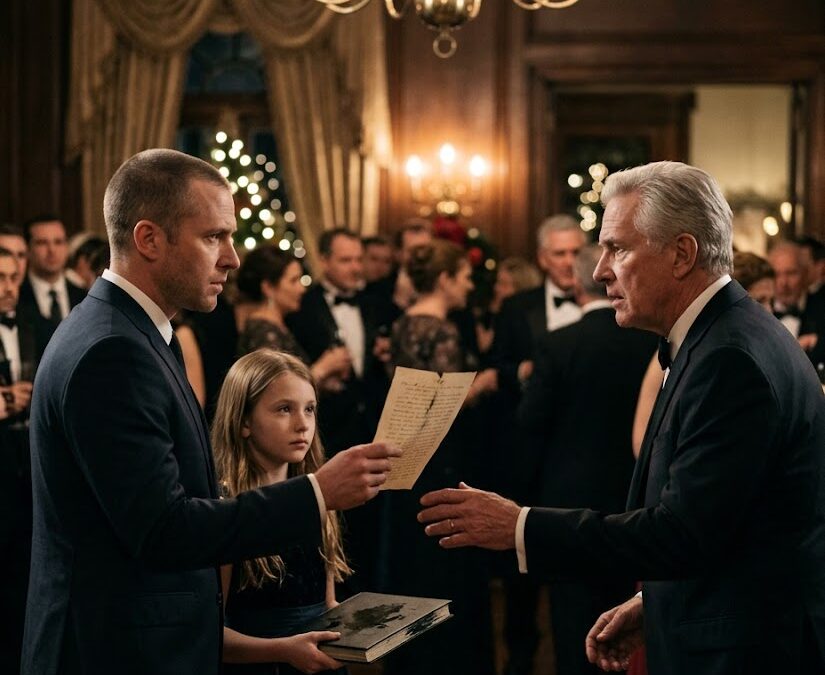
The page trembled in Daniel Vale’s hand.
Black ink ran down his cuff.
Willa stood beside the guest book.
A hundred people had heard her.
Conrad Vale raised one hand.
“Everyone, please remain seated.”
No one sat.
His voice had settled boardrooms.
It did not settle the room.
Daniel held the page away from him.
“Don’t touch it.”
“You are making a scene,” Conrad said.
“You ordered me to remove my daughter.”
“She ruined a book.”
“She exposed something.”
The string quartet had stopped.
Several guests kept filming.
Willa wanted them to stop.
She also wanted someone to remember.
Gold lettering named the Vale Foundation Winter Benefit.
Ink covered three pages and pooled around signatures.
The folded sheet was older than the book.
A dark red seal marked one corner.
Daniel’s thumb hovered over it.
“Dad, what is this?”
Conrad did not answer.
A woman in a navy suit stood.
“Mr. Vale, I’m the foundation’s attorney.”
“This is a private family matter.”
“Not if it concerns foundation property.”
“It doesn’t.”
“You haven’t seen it.”
“Give it to me.”
Daniel pulled back.
“No.”
The answer landed like another stain.
Willa’s father had spent years saying yes.
Yes to Conrad’s holiday schedule.
Yes to the family business.
Yes to keeping his mother’s name out of arguments.
Now his hand shook.
But he kept the page.
“I need to secure it,” the attorney said.
“Your firm represents the foundation,” Conrad replied.
“And the foundation must preserve its records.”
“The page is not a record.”
“Then you won’t mind an independent review.”
Conrad looked at the book.
“Of course.”
Daniel slid the sheet into a plastic sleeve.
He did not fold it again.
The visible column listed a clinic, land, and a family trust.
Several names were crossed out and rewritten.
The date read May 14, twenty years earlier.
At the bottom sat Daniel Vale’s signature.
Willa leaned closer.
“Did you sign it?”
“I don’t know.”
“That’s your name.”
“It looks like my name.”
“Did you?”
“I was twenty-three.”
“He signed many routine transfer forms,” Conrad said.
“What was transferred?” Daniel asked.
“Nothing that concerns you.”
“I’m on the page.”
“You are not the only Daniel Vale.”
“I’m the only one in this family.”
The attorney held out her gloved hand.
“I’ll preserve it.”
Daniel looked at Willa.
She nodded.
He gave the sleeve to the attorney.
Conrad faced the doors.
“Everyone may return to dinner.”
Nobody moved.
“You’ve said three different things about that page,” a guest said.
“I owe you no explanation.”
“You asked us to fund the family clinic,” his wife replied.
“That is not at issue.”
“It may be.”
Some guests edged closer.
Others drifted toward the exits.
The attorney held the page against her folder.
“I’m placing the original under preservation protocol.”
“You have no authority to seize it.”
“I’m preserving a potential foundation record.”
“You are an employee.”
“I am counsel of record.”
Conrad turned to the room.
“Beatrice enjoyed creating drama.”
Willa flinched at her grandmother’s name.
Daniel did too.
“Don’t talk about her,” he said.
“Your mother spent years hiding documents.”
“From whom?”
“Everyone.”
“That sounds convenient.”
Conrad looked at Willa.
“Your grandmother was sick near the end.”
“She was sick for five days,” Willa said.
“She was confused.”
“She told me to keep the book.”
“That proves nothing.”
“She said the ink would show where you put the page.”
A whisper moved through the guests.
Daniel stared at his daughter.
“What exactly did Grandma tell you?”
“She said, ‘When they call your mother a thief, make the record impossible to ignore.’”
Conrad’s hand closed around his cane.
The attorney stepped between him and Willa.
“Please remain where you are.”
“I’m not moving.”
“Good.”
A bell rang from the kitchen.
Dinner had been expected to proceed.
No one went to the tables.
The attorney returned with a uniformed officer.
“We’ll need a quiet room,” she said.
“My office is available,” Conrad replied.
“We’ll use the foundation library.”
“That room is locked.”
“Then someone will open it.”
The officer asked who controlled the house.
“I do,” Conrad said.
“Please unlock the library.”
Conrad looked at Daniel.
“You are still my son.”
“I know.”
“Nothing in that page changes that.”
“Then why are you afraid of it?”
Conrad said nothing.
At last, he handed his keys to an assistant.
The library opened onto the back hall.
Its glass doors reflected the chandeliers.
The attorney led Daniel and Willa inside.
The officer switched on his body camera.
Conrad stayed with the guests.
The attorney set the sleeve beneath a desk lamp.
The names formed a list.
A clinic.
A parcel of land.
A family trust.
Dates and initials sat beside each entry.
The final line was in Beatrice’s hand.
Willa recognized the loop of her grandmother’s B.
“Original conveyance attached. No payment accepted.”
Daniel shut his eyes.
The attorney turned the page over.
Another signature sat beneath the words:
“Witnessed and refused.”
Daniel’s name was clear.
“Do you remember this?” the attorney asked.
“No.”
“Can you tell what the document is?” the officer asked.
“Not from this page alone.”
“Then what do we know?”
“That your family’s story just changed.”
She lifted the book carefully.
A thin strip remained inside its spine.
“There’s a second insert,” she said.
Conrad stepped toward the door.
“Leave that book alone.”
“I’ll document it before anything moves.”
“Call the police,” Conrad said.
“I intend to.”
That seemed to surprise him.
“You think this helps you?” he asked Daniel.
“I don’t know what it is.”
“You should.”
“I was twenty-three.”
“You were the witness.”
Daniel went still.
Not signer.
Witness.
“Witness to what?” Willa asked.
“To nothing.”
“You just said I was the witness,” Daniel said.
“You witnessed a transfer.”
“What transfer?”
“Your mother’s.”
Willa’s stomach tightened.
“Mom didn’t steal anything.”
“I never said she did.”
“You told everyone she took money and left.”
“She accepted a settlement.”
“My mother never signed a settlement,” Daniel said.
“I was in the house.”
“You were not part of that conversation.”
“I was there.”
“You were told to stay out of it.”
Daniel’s face had gone pale.
Willa looked at the ink-soaked book.
She remembered Beatrice guiding her hand over its pages.
Her grandmother had said records could be made to lie.
“Grandma told you where she put it,” Willa said.
Conrad answered too quickly.
“No.”
“That was direct,” the attorney said.
“It was a foolish question.”
“Did you know there was another document in the binding?”
“I know nothing about the book.”
His words did not fit his face.
The attorney made a note.
The original page remained unread beyond its visible lines.
A seal.
A date.
Her father’s name.
Her mother’s missing signature.
And Conrad’s admission that Daniel had witnessed something.
The officer asked for statements.
The guests stayed.
The attorney asked them not to share photographs.
Several had already posted.
Daniel sat beside Willa at the table’s end.
He had not reached for his coat.
“Are we leaving?” she whispered.
“Not yet.”
“Are you angry?”
“Yes.”
“Because I spilled the ink?”
“Partly.”
“That’s fair.”
“I’m also scared.”
“Of Grandpa?”
“Of what I might remember.”
He set his hand on the table, palm up.
Willa placed her fingers in it.
The officer secured the library while Leo Mercer arrived from the city archive.
He was a document conservator with thin gloves and a camera.
“Has anything been removed?” he asked.
“No,” the attorney said.
“Has anything been added?”
“Not since the book arrived.”
“Who handled the sheet?”
“Daniel. Once.”
Leo photographed both sides.
He examined the paper under a narrow lamp.
The strip had been folded against the stitching.
It seemed too small to matter.
Leo eased the fibers apart with a thin spatula.
A second narrow sheet emerged.
It was part of a carbon copy.
The top bore a law office’s name and a date.
A line read:
“Instructions received from: C. Vale.”
Conrad’s initial.
Leo photographed it.
He did not say what it proved.
He recorded that the mark existed.
“Can you read the lower edge?” the attorney asked.
“Not without a full scan.”
“I’ll arrange it.”
Conrad’s lawyer arrived with a polished briefcase.
He asked the officer to stop.
The officer explained that no one had been detained.
The attorney said the original remained in their custody by consent.
Daniel consented.
Conrad did not.
The lawyer requested a copy.
The attorney agreed to provide it through counsel.
Conrad’s hand tightened around his cane.
When Leo finished documenting the strip, the attorney asked Daniel about his mother.
“What was her full name?”
“Marian Vale.”
“Was she named in the trust?”
“Before she married my father.”
“Did you see her sign a transfer?”
“No.”
“Did she say she planned to leave?”
“She said she needed to talk to my mother.”
“Beatrice?”
“Yes.”
“What happened afterward?”
“I came home from college. My father said Marian had signed away her claim and left.”
“Did you see paperwork?”
“No.”
“Did you speak to her?”
“No.”
“Why not?”
“I thought she didn’t want me.”
Willa stared at him.
He did not look away.
“How long did you believe that?” the attorney asked.
“Until she died.”
“Did you know she was sick?”
“I learned later.”
“From whom?”
“Grandmother. She said Marian died in a small apartment in Providence.”
Willa’s heart thumped once.
“Mom died in Providence?”
Daniel turned to her.
“I didn’t know until I was twenty-five.”
“You never told me.”
“I thought you were too young.”
“I’m twelve.”
“I know.”
“You never told me at all.”
He lowered his eyes.
The attorney wrote that down.
“When did Beatrice tell you?”
“About sixteen years ago.”
“Did she say why Marian left?”
“She said she was forced out.”
“By whom?”
“She wouldn’t tell me.”
“Did she provide records?”
“No.”
“Why did you believe her?”
“She had tried to tell me before.”
“And you did not listen?”
“I didn’t.”
The answer landed cleanly.
Willa’s eyes burned.
She had imagined her mother somewhere, choosing not to call.
She had pictured birthdays, flights, and a new family.
No one had told her the truth.
“Willa, you don’t have to stay,” the attorney said.
“I want to.”
“Tell me if you need a break.”
“I don’t.”
Daniel reached for her shoulder.
She stepped away.
It hurt him.
It did not change her mind.
“Do you have letters from Marian?” the attorney asked.
“I don’t.”
“Beatrice kept some.”
“Where?”
“In her room.”
“Is it still intact?”
Conrad spoke from the hall.
“No.”
Everyone turned.
“The staff cleared it years ago.”
“What happened to her things?” Daniel asked.
“I retained what mattered.”
“What did you retain?”
“My memory.”
The attorney stood.
“Mr. Vale, please wait outside.”
“I’m in my own house.”
“Then you may remain silent in it.”
Conrad looked at her.
“You’re forgetting who your client is.”
“I represent the foundation.”
“Which exists because of me.”
“It exists because of its donors.”
The officer asked Conrad’s lawyer to take him outside.
Conrad pulled away from his lawyer.
“You think this page restores Marian’s reputation?”
“I think it raises questions,” the attorney said.
“Then answer them.”
“We are trying.”
“Try faster.”
He walked out.
Leo finished his work and placed the original in a sealed archival sleeve.
The attorney ordered a preservation hold on every related record.
She asked an outside property lawyer to review the trust and land filings.
No one promised an easy answer.
In the car, Willa sat beside her father.
He did not turn on the radio.
“Did Grandma really keep letters?” she asked.
“Yes.”
“Where?”
“I don’t know.”
“Did you look?”
“I never did.”
“Why?”
“I thought it would hurt.”
“It hurt anyway.”
“I know.”
“You can be angry with me,” he said.
“I am.”
“You can be angry with Grandma too.”
“I’m not.”
“You don’t have to defend her.”
“I don’t.”
Rain traced thin lines across the windows.
“Do you want to see the lawyer tomorrow?” he asked.
“Yes.”
“Do you want a night to think?”
“No.”
“Do you need anything?”
“My old pictures.”
“I’ll find them.”
“Not the ones from the wall.”
“The box in the closet?”
“Yes.”
“I’ll get them.”
“Then don’t lose them.”
“I won’t.”
That night, Willa slept badly.
The next morning, the foundation attorney called.
The conservator’s scan revealed another faint line on the carbon copy:
“Hold original conveyance until beneficiary is unavailable.”
The attorney asked them to meet with an independent property lawyer.
Daniel agreed.
Conrad did not.
Nina Park handled old trusts and disputed property.
She studied the scans in her downtown office.
“Has anyone verified the land records?” she asked.
“Not yet,” Daniel said.
“Then we start there.”
The name on the carbon copy belonged to Vale Shore Holdings.
The company had dissolved eight years earlier.
Its mailing address led to a post office box.
Nina studied the seal.
“This could matter.”
“Does it prove my mother owned the land?” Willa asked.
“Not yet.”
“What would prove it?”
“The original conveyance, recorded deed, trust documents, and signature history.”
“Can we get those?”
“We’ll request them.”
Nina explained that Beatrice and Conrad had created the foundation twenty-four years earlier.
Its annual reports listed them as founders.
The current board had seven members, including three outside trustees.
One was retired judge Harriet Goss.
She agreed to meet them that afternoon.
Harriet arrived with a folder and a plain red scarf.
“I joined the board after the transfer,” she said.
“What did you know about Marian?” Daniel asked.
“Only what Conrad told us.”
“What did he say?”
“That she had surrendered her interest.”
“Did you see the surrender?”
“No.”
“Did you ask for a copy?”
“Yes. Conrad called it a private agreement.”
“And the board accepted that?”
“At the time, I did.”
Harriet did not excuse herself.
Two years earlier, she had requested a complete asset schedule and found a missing parcel.
It was the shoreline property outside Newport.
“What was it supposed to be?” Nina asked.
“According to the founding charter, land pledged to a family health trust. Marian was the beneficiary.”
Daniel stared at her.
“How long have you known?”
“I found the discrepancy two years ago.”
“Why didn’t you tell us?”
“I did not know Marian’s heirs. I believed Conrad’s account that she had left.”
“You didn’t search?”
“I should have.”
Harriet opened her folder.
The property remained under Vale Shore Holdings.
Its taxes had been paid from a foundation account.
No deed transferring it had been recorded.
Nina asked for the charter.
Harriet handed it over.
It named Marian and any descendants she might have.
The property could not be sold without the beneficiary’s consent.
A side letter, signed by Beatrice, required trustees to preserve the original conveyance.
“Where is it?” Nina asked.
“I thought it was in the foundation files.”
“Was it?”
“No.”
“Did you ask Conrad?”
“I did. He said Beatrice had taken it.”
“Did you believe him?”
“I did then.”
Harriet drew out a note from Beatrice’s final year.
“I found this among my board papers.”
It read:
“If Marian’s record is missing, ask Daniel what he saw before the ferry.”
Daniel’s hand went still.
“What ferry?” Willa asked.
“The ferry to the island,” he said. “I was a kid.”
“Did you see something?”
“I remember a blue folder on the dock.”
“Who had it?”
“Grandmother. Then Father took it.”
“Why?”
“I don’t know.”
“Was Mom there?”
“Yes. She had a suitcase.”
The memory returned in fragments.
Wind off the water.
Beatrice gripping the folder.
Conrad speaking quietly.
Marian waiting by the ferry ramp.
Daniel was thirteen.
He remembered his mother bending to kiss him.
He remembered his father calling her name.
Then Beatrice told him to wait in the car.
Willa reached across the table.
“Did you see Mom leave?”
He nodded.
“Did she come back?”
“I don’t know.”
“Did she say goodbye?”
“She kissed me.”
“Then she didn’t just leave.”
Daniel’s eyes shone.
“I’m sorry.”
Nina asked Harriet to help locate the old records.
The county archive held a certified copy of the parcel’s deed.
It showed a transfer to Vale Shore Holdings, dated twenty years earlier.
The signature bore Marian’s name.
The notary’s stamp was dated three days after her supposed departure.
Nina studied it.
“We need to know where Marian was.”
Daniel found the hospital name.
Providence General released a summary through legal request.
Marian had been admitted twelve days before the notarization and was recovering from surgery.
The record did not prove she could not sign.
It made the signature harder to explain.
The notary, Evelyn Rhodes, was eighty-four and retired.
She remembered the Vale name and agreed to meet.
A framed certificate hung near her kitchen.
She studied the deed copy with reading glasses.
“My stamp, yes.”
“Do you remember Marian signing?” Nina asked.
“I remember that day.”
“Was Marian there?”
“No.”
“Who signed?”
“I asked Conrad.”
“What did he say?”
“That his son had witnessed her signature.”
Daniel stared at the copy.
Evelyn turned to him.
“You were Daniel?”
“Yes.”
“Were you with me?”
“I don’t remember.”
“I’m sorry.”
Nina asked whether Evelyn kept her journal.
She brought out a small bound ledger.
The date matched.
The entry read:
“Signature acknowledged by Conrad Vale as agent for Marian Vale.”
Below it:
“Witness: Daniel Vale.”
There was no signature by Marian.
There was no separate authorization for Conrad.
Evelyn looked at Daniel.
“You were not with me.”
“No.”
“Did you sign the deed?”
“I don’t remember.”
“Did you witness it?”
“No.”
She agreed to certify the journal copy.
The evidence now formed a line.
A deed with a questionable signature.
A notary who had not seen Marian.
A journal listing Conrad as her agent.
Daniel’s name on the witness line.
The carbon copy bearing Conrad’s initial.
Nina warned them that the line still needed proof.
“We need the original deed and a handwriting comparison.”
“Can the county provide it?” Daniel asked.
“We can request inspection.”
“What else?”
“The land company’s accounting.”
The company’s old accountant had retired to Maine.
He remembered the parcel and agreed to speak by phone.
“Was there a purchase price?” Nina asked.
“There was a number on the ledger.”
“Was it paid?”
“No.”
“Why was it entered?”
“Conrad called it an internal reclassification.”
“Did Marian agree?”
“I never spoke with her.”
The accountant mailed Nina a copy of the closing schedule.
The payment line showed zero.
The declared value was $1.8 million.
A later entry charged the foundation for “family land stabilization.”
A forensic review compared the deed signature with Marian’s bank card, letters, and hospital form.
The expert found a high likelihood that the signature had been traced from a known sample.
He could not identify who traced it.
Daniel read the report twice.
“Could my father have forged it?”
“Possibly,” Nina said.
“Could my grandmother?”
“Possibly.”
“Someone else?”
“Yes.”
“Then we need more.”
“Yes.”
“Can the land return to the trust?”
“That depends on the trust, the law, and what a court finds.”
“Can it?”
“Yes.”
“When?”
“Not today.”
They were not asking for quick.
They were asking for the truth.
The foundation board met four days later.
Conrad declined to attend and sent a written statement.
It called the transfer an administrative act approved by family consent.
It described Marian as financially unstable and voluntarily absent.
It called the hidden page an incomplete personal note.
Harriet read it aloud.
The outside trustees suspended Conrad as chair while the evidence was reviewed.
They froze payments tied to the shoreline property and hired an independent auditor.
Daniel was not a trustee and did not vote.
He sat beside Willa in the public seats.
“Does suspending him mean he’s guilty?” she whispered.
“No.”
“What does it mean?”
“The board won’t let him oversee the records.”
“Is that enough?”
“It’s a start.”
The auditor found that the foundation had paid the parcel’s taxes and maintenance for twenty years.
The company received no rent.
No sale proceeds went to the trust.
The only payment connected to Marian was a $420 check from Beatrice’s personal account for medical costs during Marian’s last week.
Marian had died after surgery.
Daniel had been twenty-five.
He had not attended her funeral.
His father had said the service was private.
Willa found the death notice.
“Was it private?”
“No.”
“Was there a service?”
“Yes.”
“Who went?”
“Grandma.”
“Did she tell you?”
“She tried.”
“Did you go?”
“No. I believed my father.”
The notice bore the address of a church in Providence.
The church still had burial records.
Marian’s grave was under her married name.
Daniel and Willa traveled there with Nina.
The stone read:
Marian Elise Vale.
Beloved daughter.
Beloved mother.
Daniel touched the cold granite.
“I came,” he said.
Willa did not tell him it was enough.
She did not tell him it was too late.
The church ledger showed Beatrice had paid for the plot.
It proved one thing Conrad had not said.
Marian had not vanished without anyone remembering her.
The county let Nina inspect the original deed under supervision.
Its paper was older than its notary date.
The signature pressure marks did not match an original signing.
A faint transfer outline aligned with Marian’s bank signature.
The filing clerk had kept the presentation envelope.
On its back, someone had written:
“Leave clean copy only.”
The handwriting matched Conrad’s office notes.
The clerk swore that Conrad had delivered the deed himself.
Nina set out the evidence.
“The record supports a fraudulent conveyance.”
“Can we prove who did it?” Daniel asked.
“The records point to your father. A court decides.”
“Is the property still there?”
“Part of it.”
“What about the buyers?”
“Some cottages were sold to people with no connection to the family.”
“That matters.”
“It does.”
“Can we protect them?”
“Not by pretending the deed was valid. The court can consider their rights.”
Daniel studied the county map.
A new road cut across the old parcel.
The cedar house was gone.
Cottages stood along the edge.
The old landing remained.
“Can we find out what happened to the house?” Willa asked.
“We can check,” Nina said.
“Then let’s.”
The house had been demolished twelve years earlier.
The land could not be returned whole without affecting innocent owners.
The foundation board later voted to preserve the claim and cooperate with the state charity office.
Conrad called Daniel after the vote.
“You are turning this into a public scandal,” he said.
“The evidence is already public.”
“Only because Willa made it so.”
“She told the truth.”
“She is twelve.”
“She knew what she saw.”
“She knew what your mother told her.”
“Yes.”
“Have you forgotten who paid for your education?”
“No.”
“Who gave you your first job?”
“You did.”
“Who bought your house?”
“You didn’t.”
“I helped with the down payment.”
“You called it a loan.”
“I forgave it.”
“After I asked you not to.”
Conrad paused.
“You are a father. You should know the difference between protecting a child and burdening her.”
“I do.”
“You let her humiliate the family.”
“She asked why her mother was erased.”
“You could have explained privately.”
“I didn’t know the facts.”
“Then why help?”
“Because I was wrong.”
“Do you think that changes what she lost?”
“No.”
“Do you think a document gives back the years?”
“No.”
“Then what do you want?”
“An honest record.”
“That is a childish wish.”
“It is reasonable.”
“You are acting against your own blood.”
“I am acting for my daughter.”
“Your daughter has been fed a story.”
“Then let the evidence answer.”
The call ended.
Willa had listened without moving.
“Was I a burden?” she asked.
“No.”
“Did Grandma burden me?”
“I don’t think so.”
“Did you believe him when he said she manipulated me?”
“I should not have.”
“Why didn’t you stop him?”
“I was still afraid of him.”
“Are you afraid now?”
“Yes.”
“Then say that.”
“I’m afraid.”
Willa nodded.
“What will you do?”
“Keep helping Nina.”
“Even if Grandpa gets angry?”
“Yes.”
“Even if the foundation stops paying you?”
“I don’t work for the foundation.”
“You work at Vale Maritime.”
Conrad chaired the company.
A week later, Daniel was placed on leave for a conflict of interest.
He lost his office and access to the family insurance plan.
He told Willa before she heard from someone else.
“I might need another job,” he said.
“Will we lose the house?”
“No.”
“Will I change schools?”
“No.”
“Will we be poor?”
“We’ll be careful.”
“That’s not an answer.”
“It’s honest.”
“Can I still afford violin lessons?”
“Probably not for a while.”
“I can stop.”
“You don’t have to decide tonight.”
“Mom played violin.”
“She did.”
“Did she want me to?”
“She wanted you to choose.”
“Then I choose to keep playing.”
“We’ll make it work.”
He did not ask her to forgive him.
He did not ask her to protect his reputation.
The state charity office opened a review of the foundation’s land handling.
It examined the missing records, transfer, and use of charitable funds.
The family hired separate counsel.
Then an envelope appeared beneath Daniel’s windshield wiper.
Inside was a copy of Willa’s school schedule.
There was no note.
Daniel called the police.
The officer took the envelope and alerted the school.
The paper came from an office supply shop used by Vale Maritime.
That narrowed the source but proved nothing.
Building cameras showed a courier leaving it by the wrong car.
The courier worked for a private investigator hired by Conrad’s lawyer.
The investigator said he was locating records and had included the schedule by mistake.
Nina asked the state examiner to take a statement.
The investigator declined voluntarily.
No charge followed.
The family kept the envelope, footage, and receipt.
Conrad asked Daniel to meet alone.
Nina advised him not to go without counsel.
Daniel asked Conrad to bring his lawyer.
Conrad refused.
Daniel stayed home.
Two days later, Conrad called.
“Your mother is dead,” he said.
“I know.”
“You cannot help her now.”
“I can help my daughter know what happened.”
“Your daughter has enough.”
“She has records.”
“Records can be wrong.”
“Then show us the right ones.”
“You have no standing.”
“Then let the board ask.”
“They have.”
“And you refused.”
“I said the inquiry was unnecessary.”
“Why?”
“It will damage good people.”
“Who?”
“The foundation staff.”
“Did they make the transfer?”
“No.”
“Then they need the truth too.”
“You are naïve.”
“I was.”
“Meet me.”
“Bring your lawyer.”
“No.”
“Then no.”
“You’ll regret this.”
“I already regret enough.”
Daniel ended the call.
Willa sat across from him.
“Was that another threat?”
“It could be.”
“Did you record it?”
“No.”
“Should we?”
“Next time, I’ll ask Nina how.”
“Good.”
“I’m not meeting him alone.”
“Good.”
“You don’t have to praise me.”
“I’m not.”
She returned to her book.
Daniel sat beside her.
The foundation board invited him to a closed meeting.
Nina attended, as did the state examiner.
Conrad arrived with counsel.
The room had no family portraits.
Harriet read the agenda: the shoreline property, missing records, and possible restoration.
Conrad’s lawyer objected to the phrase “transfer.”
Harriet changed it to “recorded conveyance.”
“You have already decided,” Conrad said.
“We have not.”
“You suspended me.”
“We preserved the foundation.”
“I built it.”
“Beatrice helped.”
“Beatrice spent money.”
“She pledged the land.”
“She was ill.”
“She was not ill when she signed.”
“You have no proof.”
“Do you have a medical record?” Harriet asked.
“We have testimony.”
“From whom?”
“Mr. Vale.”
Harriet looked at Conrad.
“You are the witness.”
“I was her husband.”
“You controlled the property company.”
“That is irrelevant.”
The attorney asked Conrad not to answer further questions.
Harriet nodded.
“Then the board will consider the evidence.”
The auditor presented the company ledger.
No sale proceeds had been received.
The notary’s journal showed no appearance by Marian.
Hospital records placed her under care.
The examiner’s report said her signature had likely been traced.
The hidden carbon copy carried Conrad’s initials.
The foundation had paid the land’s expenses.
Conrad’s lawyer challenged each item.
He said the handwriting report was not definitive.
He said the hospital summary did not prove Marian could not sign.
He said the witness line did not prove forgery.
He said the accountant’s recollection was old.
He said the foundation had benefited from maintaining the land.
Each point sounded plausible alone.
Together, they sounded thinner.
Harriet asked Daniel to speak.
“My mother was said to have taken a settlement,” he said.
He placed the certified deed on the table.
“No payment was made.”
“She was said to have signed the deed.”
He showed the notary’s journal.
“The notary says she did not appear.”
“She was said to have left voluntarily.”
He showed the ferry manifest.
“She traveled out and had no recorded return.”
“She was said to have abandoned us.”
He showed the church ledger.
“My grandmother paid for her burial.”
Conrad’s face remained fixed.
“I believed your story because you told it,” Daniel said. “I was twenty-three. I chose to believe you because it was easier.”
“I am not asking for revenge,” he continued. “I want the land record corrected. I want the foundation’s money restored. I want my daughter to know her mother did not steal.”
“Those things can happen without calling your father a criminal,” Conrad’s lawyer said.
“If the evidence supports that, I’ll accept it.”
“And if it doesn’t?”
“I’ll accept that too.”
The board voted to preserve the claim and refer the accounts to the state charity examiner.
The examiner opened a formal review.
The board published a limited statement that it had found material irregularities in an old property conveyance.
It named no individual.
It did not describe Marian as a thief.
The correction was not enough.
A month later, Conrad came to the family house.
He stayed on the porch beneath the light.
Daniel opened the door but did not invite him in.
“Your daughter is at the window,” Conrad said.
“She can hear us.”
“Tell her to go upstairs.”
“No.”
“I need to speak with you.”
“You can speak here.”
“Not with an audience.”
“Then write.”
Conrad looked past him.
“Willa, you need to understand.”
“I understand you lied about my mother,” she said.
“You do not know the whole story.”
“Then tell it.”
“It is not simple.”
“Was the deed real?”
“It was signed.”
“The notary says Mom wasn’t there.”
“The notary is old.”
“She has her journal.”
“She may have made a mistake.”
“The hospital record says Mom was there.”
“People can leave hospitals.”
“Was she there?”
Conrad’s mouth tightened.
“Did Mom receive the money?” Willa asked.
“She received support.”
“The records say $420.”
“That was medical reimbursement.”
“Did you write the note in the book?”
“I don’t know what you mean.”
“The carbon copy says you told the lawyers to hold the original until Mom was unavailable.”
“Those words could mean anything.”
“Did you write them?”
“I will not discuss an incomplete record.”
“Then this is over,” Daniel said.
Conrad turned to him.
“You think she will forgive you for this?”
“I haven’t asked her to.”
“You think your daughter will trust you?”
“I haven’t asked her to.”
“You think a dead woman can be restored?”
“No.”
“Then what are you doing?”
“Making sure the living stop repeating the lie.”
Conrad stared at him.
“You cannot put this family back together.”
“I know.”
“Then you’ve lost everything.”
“No.”
“What have you kept?”
“My daughter.”
Conrad walked down the steps.
Willa watched from the window until his car left.
The land company’s bank records arrived two days later.
A microfilm ledger showed money transferred from the foundation to Vale Shore Holdings.
It was not a purchase price.
It was a loan for the company’s taxes.
The loan was later forgiven.
The property had also secured a Vale Maritime loan after a poor shipping season.
The loan kept the company from selling two vessels.
Conrad had risked the property to save the family business.
He had not wanted to lose it.
He wanted to keep control.
The lie about Marian’s settlement kept her from challenging the transfer.
The family’s later wealth had been protected by the same act.
The land was harder to restore because innocent people had bought cottages there.
Nina proposed a settlement that would return the undeveloped marsh and old landing to the Marian Vale Trust.
The cottage owners would keep their homes.
The foundation would receive the public access strip.
The family company would repay the trust $1.8 million, adjusted for interest and later use.
The independent trustees approved it.
The state examiner supported it.
Conrad’s counsel rejected it.
They filed in court.
The hearing came seven months after the benefit.
Reporters and foundation staff filled the gallery.
Willa sat beside Nina.
Daniel sat on her other side.
Conrad sat behind his lawyer in a dark suit and silver tie.
The judge asked the lawyers to focus on the record.
Nina presented the charter, authenticated hidden page, and carbon copy.
The notary’s journal showed Conrad had appeared alone.
The hospital record placed Marian in care.
The document examiner explained the tracing pattern.
The accountant testified no payment had been made.
Harriet testified that the foundation had never approved a sale.
Conrad’s lawyer argued that the family shared an understanding.
He said Marian had been unstable.
He said Beatrice controlled the records.
He said buyers had relied on the deed.
The judge asked whether Conrad had produced a signed settlement.
He had not.
The judge asked whether Marian had appointed Conrad as her agent.
There was no evidence of it.
The judge asked whether an unverified signature could convey property.
Conrad’s lawyer said the matter was disputed.
“There are also records,” the judge said.
Conrad did not testify.
Daniel did.
He told the court about the ferry, the blue folder, and the day Marian left.
He did not claim to know what the folder contained.
He said only what he remembered.
“Did you witness Marian sign the deed?” the judge asked.
“No.”
“Did you sign a witness line?”
“Yes.”
“What did you believe you were acknowledging?”
“That the family papers had been delivered.”
“Did you mean that you witnessed Marian sign?”
“No.”
“Why did you sign?”
“My father told me it was a receipt.”
The judge reviewed the exhibits.
The signature on the deed had been traced.
The witness line had been misrepresented.
The notarial acknowledgment had been improperly completed.
The court set aside the conveyance.
It restored the property to the trust, subject to the cottage owners’ rights.
It approved the negotiated division and ordered Vale Maritime to pay the trust $1.8 million, with adjustments.
The judge did not find criminal intent.
That question belonged to other processes.
Outside, reporters called Daniel’s name.
“Was your father responsible?”
“My mother was not a thief.”
“Did you forgive him?”
“That is not a legal question.”
“Is the family split?”
“It already was.”
“Will you speak to him?”
“Not today.”
A reporter turned to Willa.
“Do you hate your grandfather?”
Nina stepped closer.
Willa answered anyway.
“I want him to tell the truth.”
The reporter asked whether she thought he would.
“I don’t know.”
That evening, the family company announced Conrad’s resignation as chairman.
It said the company would cooperate with the state review.
The review later found foundation funds had covered company liabilities without board approval.
The company repaid the money.
Conrad accepted a civil penalty.
He did not admit fraud.
The law acted on what it could prove.
The foundation corrected its public records.
Its statement named Marian as the intended beneficiary of the shoreline trust and called the conveyance invalid.
It also said the family had been wrong.
The letter went to the guests who had attended the benefit.
It said Marian had not received a settlement.
She had not abandoned her child.
Daniel read it first, then gave it to Willa.
“Does it sound right?” he asked.
“It sounds like a board wrote it.”
“What would you add?”
“She was kind.”
He handed her a pen.
“She made pancakes shaped like animals,” Willa said.
“She did.”
“She let me put too much cinnamon in the batter.”
“She did.”
“She had a blue sewing box. She kept my hospital bracelet in it.”
Daniel added those details.
The board included them.
The statement named Marian as a mother and a person, not only a beneficiary.
The shoreline was surveyed.
The trust received the marsh, landing, and cedar strip.
The cottage owners kept their homes.
The foundation maintained the public path.
Vale Maritime paid the restoration amount in installments.
Daniel’s job did not return.
He found work at a smaller shipping firm and took a pay cut.
He and Willa moved from the townhouse to a modest rental near her school.
They sold one car.
They kept her violin lessons.
At her first recital, Willa played a piece Marian used to hum.
Daniel listened from the front row.
Afterward, he asked if Willa wanted to visit the cemetery.
“Not today,” she said.
“Okay.”
“Maybe in spring.”
“Okay.”
“Can we visit the shoreline first?”
“Yes.”
The old landing had been repaired.
A low railing marked the public path.
A plaque named Marian as the original beneficiary.
Willa ran her fingers over its wooden edge.
“Do you think Mom liked it here?”
“Yes.”
“How do you know?”
“She brought a book and ignored everyone.”
“Even Grandma?”
“Especially Grandma.”
“Did they fight?”
“Sometimes.”
“Did they love each other?”
“Yes.”
The foundation held its first community day at the path.
There were folding tables, local food, and a tent for the trust office.
A neighborhood boy asked Willa if the land belonged to her.
“No,” she said.
“Who owns it?”
“The trust.”
“What’s a trust?”
“It holds something for someone.”
“Who is it for?”
“People who need care.”
“Can the board be bad?”
“Yes.”
The boy nodded as if that settled it.
Willa helped hand out paper cups.
Harriet brought cinnamon biscuits.
The foundation attorney brought the public access map.
Leo Mercer brought the repaired guest book for a supervised display.
A faint stain remained across its pages.
The hidden sheet stayed sealed in the archive.
A note explained how it had been discovered.
No one called Willa a vandal.
No one called the ink a miracle.
It was an act she had chosen, and she remembered its cost.
The benefit had raised less money after the scandal.
The clinic faced a budget gap.
The foundation used its reserve to keep it open.
It also created an independent review committee.
The staff kept their jobs.
Patients kept their appointments.
The change was practical.
It was not a grand gesture.
Conrad sent a letter asking to see Willa.
He did not demand.
He did not blame Beatrice.
Daniel gave Willa the unopened envelope.
“Do you want to read it?”
“Not yet.”
The letter stayed in a drawer for three weeks.
Then Willa opened it at the kitchen table.
Conrad wrote that he had believed he was protecting the company.
He said Marian’s claim threatened a loan.
He thought he could repair the transfer later.
He admitted Beatrice had asked him to reverse it.
He refused.
He admitted telling Daniel a false story.
He said Daniel’s silence made the lie easier.
He apologized for what Willa had been told.
He did not ask her to forgive him or visit.
His last line read:
“I should have told you the truth before you had to make a stain.”
Willa folded the page.
“Do you believe him?” Daniel asked.
“I believe he wrote it.”
“That’s fair.”
“Does he understand what he did?”
“I don’t know.”
“Do you?”
“More than I did.”
“Are you sorry?”
“Yes.”
“Can you be sorry and still be mad?”
“Yes.”
She put the letter back.
“Can I respond?”
“If you want.”
“Will you read it?”
“Only if you ask.”
She wrote three sentences.
She said she did not hate Conrad.
She said she did not trust him.
Any visit would be public, with Daniel present.
She asked him to correct the story whenever he heard it repeated.
She made no promise beyond that.
Conrad agreed to the boundary.
He said he had corrected the story with the remaining relatives.
He attached a copy of his statement.
Years passed.
The shoreline path became a place families used after school.
The trust funded a small mobile clinic for fishing towns along the coast.
Willa finished school and studied archival law.
She learned how records could disappear, change, or be brought into view.
Daniel stayed at the smaller shipping firm.
He became a manager.
He never returned to Vale Maritime.
He and Willa spoke about Marian more often.
A cousin had kept a box of her letters.
They read them together.
Some were ordinary: a grocery list, a note about rain, a postcard from a bus station.
Others held years.
Marian wrote to Daniel when he was fourteen, sixteen, and nineteen.
None of the letters had been delivered.
They said she loved him.
She was waiting.
She would not ask him to choose between her and his father.
Daniel read each one.
He did not ask Willa to make the words easier.
They visited Marian’s grave every spring.
They brought market flowers.
They did not bring the guest book.
It remained in the archive with its ink stain and sealed sheet.
The chain of custody stayed intact.
The public could request to see it.
A decade after the benefit, Willa returned to the landing.
She was twenty-two.
Daniel was fifty-two and walked with a cane after knee surgery.
Conrad had died the previous winter.
Before his death, he sent one final signed statement.
He acknowledged ordering the deed prepared.
He admitted Marian had not signed it.
He admitted telling Daniel she had accepted a settlement.
He admitted keeping the property to protect the family company.
The state examiner received the statement.
It confirmed the administrative record.
It did not restore the years.
Conrad named the lawyers who handled the transfer.
One had died.
The other had surrendered his license years earlier.
He said he planned to reverse the conveyance after the company loan matured.
The loan matured.
He did not reverse it.
The land remained pledged to the company.
Marian remained dispossessed.
Willa kept the letter.
She did not display it.
At the landing, Daniel looked over the water.
“Do you remember the benefit?” he asked.
“I remember the ink.”
“I remember your face.”
“I thought you were going to send me away.”
“I almost did.”
“But you didn’t.”
“No.”
“Why?”
“I saw my name.”
“That was all?”
“It was enough to make me stop.”
The book had made her father see himself.
It had not made him brave.
It had given him one chance to choose.
He had taken it.
“Grandma said the record mattered,” Willa said.
“She was right.”
“Was she right to use me?”
“No.”
“Can I still love her?”
“Yes.”
“Can I still be angry?”
“Yes.”
“Good.”
A child ran along the path with a paper kite.
Its blue tail lifted above the cedars.
Daniel took the old photograph from his pocket.
It showed Marian by the ferry.
The blue folder rested in her mother’s hands.
“Do you want it?” he asked.
Willa took the photograph.
“I’ll keep it.”
“Where?”
“In the archive.”
“Not at home?”
“Home too.”
She held it gently.
“Maybe both.”
The trust had invited her to join its records committee.
The invitation had been hers to accept.
She said yes because she knew what a missing page could cost.
She also knew a record had to preserve the people inside it.
The names.
The mistaken belief.
The silence.
The apology.
The boundary.
The life that continued afterward.
They walked back along the path.
Willa carried the photograph.
Daniel carried the empty sleeve.
Behind them, the landing stayed open.
The tide kept its own record.
The family lost its clean story.
Marian’s name remained.
The ink did not disappear.
Neither did the truth.
THE END








