At the Marlowe Store’s Centennial Banquet, a Nine-Year-Old Pulled Its Antique Register Apart and Exposed the Theft That Destroyed Her Father
Chapter 2: Beneath the Drawer
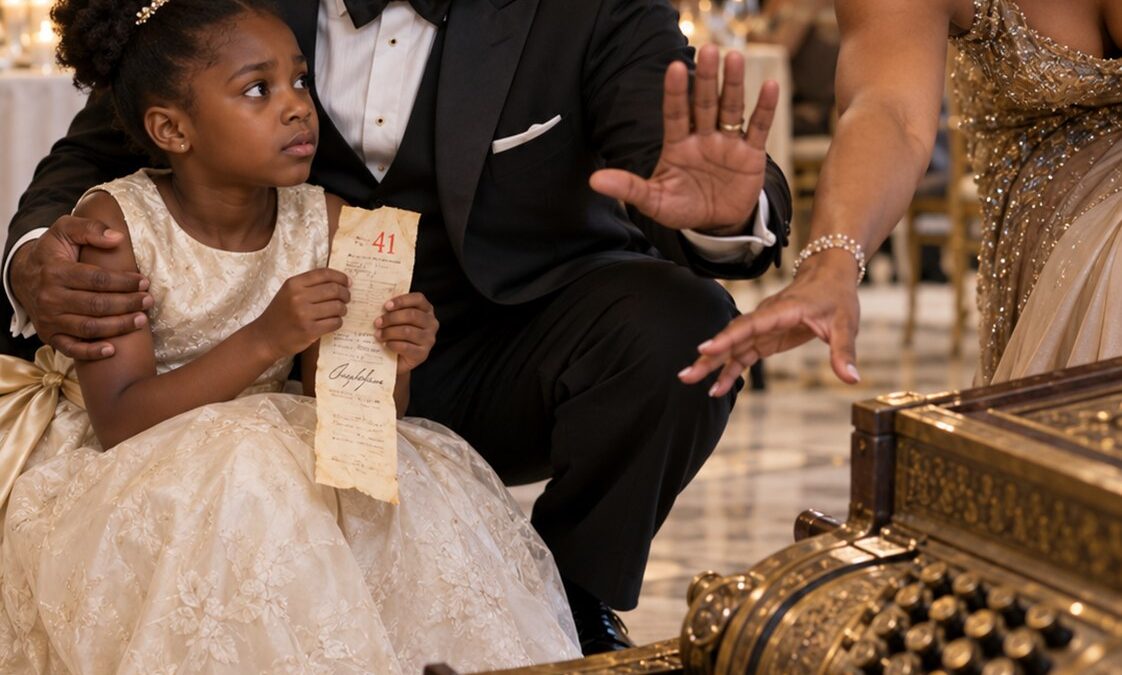
Conrad sets the paper on the banquet table.
Celeste reaches across him.
He moves it away.
“Let me see the register,” he says.
“You just did.”
“The drawer.”
Nora watches his hands.
They are steady when he speaks to guests.
They shake now.
The register lies on its side, its brass keys scattered across the marble.
A server kneels to gather them.
“Leave it,” Conrad says.
The server backs away.
Nora wishes her father were here.
Owen Marlowe is across town, closing the repair shop where he works six nights a week.
He refused his invitation.
He said a room full of people who remembered him as a thief could celebrate without him.
Grandmother June had asked him to come.
That was before she died in March.
Nora kneels beside the register.
Conrad lowers himself beside her.
“What did she tell you?” he asks.
“To look for the red number.”
“When?”
“The day she went to the hospital.”
Celeste folds her arms.
“Mother was confused by then.”
“She knew my birthday,” Nora says.
Conrad looks up sharply.
June had remembered birthdays better than anyone.
Nora lifts the cash drawer.
It comes free with a dry metallic scrape.
Underneath sits a narrow wooden panel.
Conrad presses one corner.
Nothing happens.
“Here,” Nora says.
Grandmother had shown her the worn screw beside the hinge.
Conrad turns it with a coin from his pocket.
The panel lifts.
Inside is a flat envelope wrapped in waxed paper.
Celeste steps forward.
“Dad, give that to me.”
“Why?”
“It belongs to the company.”
Conrad studies her.
“I’m the chairman.”
“You signed over daily control.”
“Not my judgment.”
He opens the envelope.
There are three photographs and a handwritten letter.
The first photograph shows a bank deposit slip.
The second shows a check.
The third shows Owen at nineteen, standing behind the store’s service counter.
A date is stamped in the corner: November 1998.
Nora knows that photograph.
A cropped version appeared in an old newspaper article Celeste once showed her.
The caption called Owen the employee accused of taking the winter relief fund.
In Grandmother’s photograph, another person stands at the edge of the counter.
Celeste.
Her hand rests on the cash drawer.
Conrad reads the letter without speaking.
His mouth tightens.
Celeste reaches for the envelope again.
He closes it.
“Mother wrote this,” he says.
“She wrote many things.”
“She says you told her Owen signed a confession.”
“He did.”
“Where is it?”
“The lawyers had it.”
“Which lawyers?”
Celeste names a firm that closed years ago.
Conrad looks at the receipt tape.
The red number, 41, sits beside a refund of $86,400.
Nora has never seen so much money written on one line.
“She said forty-one mattered,” Nora whispers.
Conrad turns over the bank photograph.
June has written four words on the back.
Ask who owned Forty-One.
Celeste sees them.
For the first time, she looks frightened.
A waiter approaches with a dustpan.
Conrad tells him to keep everyone clear of the register.
Then he takes out his phone.
“Call your father,” he tells Nora.
Celeste lets out a hard breath.
“Don’t drag Owen into this again.”
Conrad looks at her.
“He never left it.”
* * *
Owen arrives wearing his work jacket.
The banquet has ended.
Most guests left after Conrad announced a private family matter.
Three board members remain nearby.
They do not approach.
Owen stops when he sees Nora beside the broken register.
“Are you hurt?”
“No.”
He checks her hands anyway.
A small cut crosses her thumb.
He takes a clean cloth from his pocket and wraps it.
“You pulled this thing over?”
“I tried to open it.”
“That sounds familiar.”
Grandmother used to say Owen had broken three cabinet latches before he learned to read the labels.
Nora almost smiles.
Then Conrad offers him the photographs.
Owen does not take them.
“I’ve seen that article.”
“These are the originals.”
Owen looks at the uncropped picture.
He sees Celeste beside him.
“I remember the photographer,” he says.
“She came from the local paper.”
“June kept this print,” Conrad says.
“She kept everything.”
“Not everything.”
Owen’s voice stays quiet.
He remembers the night the relief fund vanished.
He had stayed late to balance the winter donation receipts.
The money was supposed to buy heaters and groceries for employees whose homes flooded that month.
When the books failed to match, Celeste called him into the office.
She said his access code appeared on a refund.
She said their father would call the police unless Owen resigned.
He had asked to see the bank records.
Celeste told him the bank would only speak to the company.
Conrad listens without interrupting.
“You told me Owen admitted it,” he says to Celeste.
“He admitted using the code.”
“I admitted it was mine,” Owen says.
“The register assigned it to me.”
Celeste lifts her chin.
“Which is why the records pointed to you.”
Nora looks at the red 41.
“Whose number is that?”
Owen answers first.
“A register number.”
“There were six registers,” Conrad says.
Owen shakes his head.
“Six at the front counters.”
He points toward the old machine.
“This one stayed upstairs.”
The banquet hall occupies what was once the store’s furniture department.
In 1998, the antique register sat in the executive office.
Only managers used it to enter large adjustments before the books were closed.
Celeste says that Owen had access.
He says he carried paperwork upstairs, but he never had its key.
June’s letter lists the people who held copies.
Conrad.
Celeste.
And June herself.
Conrad remembers losing his key that autumn.
June’s remained in the safe at home.
Celeste’s was attached to her office ring.
None of that proves who used the machine.
Owen says so.
“I spent twenty-eight years with people calling me a thief,” he tells Conrad.
“I won’t build the next twenty-eight on a guess.”
Conrad nods.
He calls the company’s current counsel, a woman named Adrienne Park.
She arrives an hour later with a laptop and a careful expression.
She photographs the tape where it lies.
She photographs the register, the drawer, the panel, and June’s envelope.
She asks each person when they touched anything.
Nora tells her about pulling the register.
Conrad admits opening the panel.
Celeste says she never touched the tape.
Nora remembers her aunt reaching for it.
Adrienne writes that down.
“Can you prove what forty-one means?” Conrad asks.
“Perhaps,” Adrienne says.
“We need the old records.”
Celeste gives a thin smile.
“The flood ruined most of them.”
“Most,” Adrienne repeats.
Adrienne asks for access to the company archive and bank correspondence.
Conrad grants it.
Celeste objects that the board must approve.
Conrad calls the board’s vice chair.
By midnight, Adrienne has written authorization from a majority of the independent directors.
Nora falls asleep against Owen’s shoulder while the adults work.
When she wakes, the hall is empty.
The register sits inside a clear storage crate.
Owen carries her downstairs.
Outside, cool air smells of rain.
“Did I make it worse?” she asks.
He stops beneath the awning.
“No.”
“But everybody looked at you.”
“They’ve done that before.”
“I wanted them to look at her.”
Owen holds her closer.
“Let the records decide where they look.”
The next morning, Adrienne finds a box June donated to the city historical society.
The donation form names the contents: Marlowe Store, register manuals and accounting samples.
June had insisted the box remain sealed until after her death.
Nora hears Conrad read the inventory aloud over speakerphone.
Instruction sheets.
Key assignments.
Audit copies.
A folder marked Refund 41.
Owen sits down.
Adrienne opens the folder with a historical society employee watching.
Inside is the original authorization form.
Owen’s code appears on the transaction.
Beside it is Celeste’s signature.
Under that signature is a second notation in June’s handwriting.
Owen did not approve this transfer.
* * *
Adrienne does not call the handwriting proof.
She calls it a lead.
By afternoon, she has hired an outside accounting firm.
The board suspends Celeste’s access to company accounts while the accountants review both the old transaction and current funds.
Celeste sends Conrad a letter through her lawyer.
She says the suspension damages the store during its busiest month.
She says June’s memories became unreliable.
She says Owen manipulated Nora into creating a spectacle.
Nora reads none of it.
Owen does.
He folds the copy and puts it facedown.
“She’s coming after you,” Conrad says.
“She started when I was nineteen.”
“I should have asked more questions.”
“Yes,” Owen says.
Conrad accepts the answer.
They sit in Owen’s repair shop after closing.
The place holds twelve clocks, three lamps, and a row of radios waiting for parts.
Conrad has not been inside before.
Nora watches him take it in.
Owen earns enough to cover rent, food, and Nora’s school trips.
In slow months, he repairs neighbors’ appliances for cash.
Conrad once believed Owen had chosen this life to avoid responsibility.
He sees the labeled shelves and the careful books beside the counter.
He says nothing about them.
Instead, he sets a paper bag on the workbench.
Inside are sandwiches.
“I didn’t know what you liked,” Conrad says.
“Nora likes turkey.”
“I know.”
Owen unwraps hers first.
The next day, Adrienne obtains copies of the 1998 bank statements from an old litigation file.
An employee had sued the company after losing promised flood assistance.
The case settled, and the lawyer who handled it kept a copy.
His daughter now runs the practice.
She verifies where the records came from before releasing them to the accountants.
The statements show the relief fund received $86,400.
Two days later, the money moved to an account labeled Project Forty-One.
Celeste says that account paid contractors repairing the flooded store.
The accountants request the contractor invoices.
Several are missing.
Three carry the same postal address.
A current search shows the address belonged to a property company Celeste owned.
That proves a conflict.
It does not yet prove the money reached her.
Adrienne says they need the destination bank records.
A subpoena may be required.
The board votes to authorize a report to the state attorney general’s office concerning the current findings.
Owen does not attend the vote.
He has a repair pickup scheduled.
Nora goes with him.
They drive to a small apartment above a bakery.
An older woman opens the door.
She recognizes Owen at once.
“Your grandmother bought me a heater,” she tells Nora.
“After the flood?”
“After the company said the money was gone.”
Her name is Della Price.
She worked in the children’s department for thirty-one years.
June had paid several employees herself.
Della kept every thank-you note she sent.
She also kept the letter denying her relief application.
It bears Celeste’s signature.
The letter says Owen’s misconduct exhausted the fund.
Della places it on the table.
“I believed it then,” she says.
Owen studies the floor.
“You didn’t know.”
“I could have asked you.”
“You had water in your kitchen.”
Della touches Nora’s shoulder.
“Your grandmother never told us she was paying.”
“She didn’t want anyone embarrassed,” Nora says.
Della nods.
“She was like that.”
Back at the shop, Owen pins a copy of the denial letter beside the workbench.
Not as a wound.
As a reminder that people were waiting while the family argued.
Two nights later, a city building inspector visits the shop.
He says someone reported hazardous wiring.
The inspection finds a loose outlet in the back room.
Owen repairs it that evening.
The inspector apologizes for the timing.
He cannot say who made the complaint.
An anonymous account also posts the old newspaper clipping online.
Nora sees it before Owen can hide his phone.
Her classmates may see it too.
She asks whether Celeste did it.
Owen tells her he does not know.
“That doesn’t mean we stop,” she says.
“No,” he answers.
They bring both incidents to Adrienne.
She documents them without making an accusation she cannot prove.
The accountants keep working.
At the end of the week, they find another Project Forty-One transfer.
It is dated six months ago.
The money came from a new employee emergency fund.
It went to the same property company.
This time, the bank records are current.
The account holder is clear.
Celeste Marlowe.
* * *
The board meets in the old banquet hall on Monday.
No centennial decorations remain.
The antique register sits on a covered table.
Adrienne has arranged for an outside forensic accountant to present his findings.
Two investigators from the attorney general’s office attend as observers.
They make clear that they have reached no conclusion.
Celeste arrives with her lawyer.
She has prepared a binder.
She speaks before anyone else can.
The store has lost money for years, she says.
The property company owned buildings the store needed.
Transfers between related businesses were recorded poorly, but they kept employees working.
The 1998 relief fund was not stolen.
It was used during an emergency to keep the store open.
“The alternative was closing our doors,” she tells the board.
“Families would have lost their paychecks.”
One director asks why she concealed her ownership.
Celeste says Conrad knew.
Conrad says he approved leases with a company name, not with hers.
“You signed them,” she replies.
“I did,” he says.
“I should have examined them.”
Her lawyer points to Owen.
He says Owen’s old code still appears on the refund tape.
He says June’s note has no date.
He says a child damaged an object that might have been examined intact.
Each point lands.
Adrienne does not interrupt.
Nora sits beside Owen in the back row.
She has never seen Celeste speak for so long without looking at her.
Owen leans toward Nora.
“You can wait outside with Della.”
“I want to hear.”
He nods.
Celeste turns a page.
She has letters from employees thanking her for keeping the store open.
Some are genuine.
Nora knows that makes the story harder.
The accountant stands.
He agrees the store faced financial trouble in 1998.
He also agrees the property company paid some legitimate bills.
Then he displays the 1998 bank statement.
The relief fund paid Project Forty-One in full.
Project Forty-One paid Celeste’s property company.
The property company made a payment toward a private apartment Celeste purchased that winter.
Her lawyer says money in an account cannot be traced to one expense.
The accountant agrees.
Then he shows a second document.
It is a loan application Celeste filed with the property company’s bank.
She listed the relief transfer as her company’s available cash.
Celeste looks toward Adrienne.
“Where did you get that?”
“The bank supplied it under the board’s written authorization,” Adrienne says.
“The company guaranteed that loan.”
Celeste’s lawyer asks for a recess.
The board chair grants ten minutes.
Celeste remains seated.
Conrad walks to Owen.
“I believed her,” he says.
“I know.”
“I let her tell me what your silence meant.”
“I asked you to look at the records.”
“I remember.”
Owen does not soften the moment for him.
Across the room, Nora notices the register’s brass drawer handle.
She remembers Grandmother’s last instruction.
Find the red number.
Nora had found it.
But June also told her to let people look at the whole strip.
Nora touches Owen’s sleeve.
“The paper keeps going,” she says.
He looks at the covered table.
Adrienne has photographed the visible section.
The rest of the tape remains on its roll.
She has not unwound it because she wanted an examiner present.
The forensic accountant approaches.
With the board’s permission, he removes the register from its crate.
He wears gloves.
An investigator observes while he releases the roll.
A longer strip emerges.
Entry 41 appears twice.
The first line shows the transfer.
The second, entered three weeks later, reverses a smaller amount into the fund.
Celeste’s lawyer immediately stands.
“There,” he says.
“She corrected it.”
The accountant continues unwinding.
A third entry appears beneath the reversal.
The same amount went out again the next morning.
This time, it is marked as a store maintenance expense.
The red 41 remains beside it.
June had circled all three entries in pencil.
The accountant compares the sequence with the bank statements.
Every amount matches.
An independent copy of the maintenance payment appears in the bank file.
It went to Celeste’s company.
The board chair asks Celeste whether she entered the transactions.
She looks at the paper.
“Yes.”
“Did Owen authorize them?”
“No.”
Owen’s hand closes around the edge of his chair.
Celeste turns toward him.
“You were supposed to leave quietly.”
The room holds still.
“I did,” Owen says.
Adrienne advises the board to preserve every document and let investigators proceed.
The board votes to remove Celeste from her executive position.
The company refers the current transfers to law enforcement and files a civil claim to recover the funds.
The investigators take copies and later arrange to examine the originals.
Nobody is arrested in the hall.
Nora had imagined a louder ending.
Instead, Celeste walks past her with her lawyer.
She stops beside Owen.
“You think this gives back your life?”
“No,” he says.
“It gives Nora the truth.”
Months pass.
The attorney general’s office brings charges concerning the recent emergency fund transfers.
Celeste eventually pleads guilty to falsifying company records connected to those payments.
A court orders restitution and imposes a sentence that includes supervised probation.
The older relief fund theft is too old for a criminal case.
The company settles its civil claim and uses the recovered money to repay the employee fund.
Conrad signs a public statement correcting the accusation against Owen.
He reads it aloud at a staff meeting.
Owen attends.
He does not stand beside Conrad.
He stands with Della.
* * *
In November, the repair shop gets busy.
Cold weather sends people in with broken heaters and lamps.
Owen hires a part-time assistant.
Nora helps by writing pickup tags in careful block letters.
She is forbidden from testing anything with a plug.
She considers this rule unfair.
Della visits every Thursday.
She brings pastries from the bakery below her apartment.
Conrad comes once a week with lunch.
At first, he waits near the door.
Eventually, Owen gives him a stool beside the counter.
Conrad learns to sort screws by size.
He is terrible at it.
Nora makes him a chart.
“Your columns are crooked,” he tells her.
“So are your screws.”
He laughs.
Owen looks up from a radio.
For a moment, the three of them are simply in the same room.
Conrad has apologized more than once.
Owen has asked him to stop repeating the words.
“What matters is what you do now,” Owen says.
So Conrad does things.
He reviews the company’s relief fund with the new board.
Employees now choose two of its trustees.
Applicants receive written decisions and a way to appeal.
Della agrees to serve for one year.
The company offers Owen a senior management role.
He declines.
“I like this shop,” he says.
Conrad offers to buy the building so Owen never has to worry about rent.
Owen declines that too.
Then Owen makes a request.
The employees denied help in 1998 are traced where possible.
The company sends them the money they should have received, adjusted by an independent accountant.
Some accept it.
One returns the letter unopened.
Conrad respects that choice.
June’s own payments are also documented.
Owen asks that those amounts go to a heating assistance charity in her name.
He asks Della to choose the organization.
Nora receives an envelope from the historical society.
Inside is a photograph of the register on display before the banquet.
On the back, a curator has written that the broken machine can be repaired.
Nora shows Owen.
“Will it still have the tape?”
“The original goes in an archive,” he says.
“That’s where it belongs.”
She runs her finger along the photograph.
“I broke Grandmother’s register.”
“You opened it.”
“I also broke it.”
“Yes.”
Owen waits.
“We should fix it,” she says.
“That sounds fair.”
They take the machine to a specialist.
Conrad pays for the repair because it belonged to the company.
Nora insists on helping clean the loose brass keys under supervision.
She works slowly.
The specialist shows her how each key returns a different number.
When the bell rings again, Nora startles.
Then she asks to try it twice more.
At home, Owen keeps the uncropped photograph of his younger self in a drawer.
He does not put it on the wall.
Nora asks why.
“I know what happened now,” he says.
“I don’t need to see that night every morning.”
She thinks about this.
“Can I keep a copy?”
“Why?”
“Grandmother’s in the window.”
June is visible in the reflection behind the photographer.
Owen had not noticed her there.
He looks at the picture for a long time.
“Yes,” he says.
Nora puts her copy beside her bed.
In December, Conrad asks Owen whether he may attend Nora’s school concert.
He asks Owen first.
That matters.
Owen says yes.
At the concert, Conrad sits two rows behind them.
Nora spots him from the stage.
Afterward, she takes his hand while they cross the parking lot.
He does not ask her to forgive Celeste.
No one does.
* * *
Three years later, the Marlowe store marks its next anniversary without a banquet.
Its top floor now holds a small public exhibit about the people who worked there.
Della helped write the labels.
Owen corrected several dates.
Conrad approved a panel that describes the missing relief money and the company’s failure to investigate Owen’s accusation.
The restored register stands in a glass case.
Beside it lies a copy of the complete receipt tape.
Entry 41 remains visible.
So do the two entries that followed it.
Nora is twelve now.
She visits with Owen and Conrad on a rainy Saturday.
A little boy asks why anyone saved an old receipt.
Nora crouches beside him.
“Because it answered a question,” she says.
“What question?”
“Who used the register.”
The boy studies the red number.
“Couldn’t they just ask?”
“They did,” Nora says.
“They asked the wrong person.”
Owen hears her.
He waits until the boy moves on.
Then he puts a hand on her shoulder.
Across the room, Della calls Conrad over to correct another crooked label.
He goes without arguing.
Nora looks at the photograph beside her bed, now printed large enough for the exhibit.
Her father is nineteen.
Her aunt stands beside the drawer.
Grandmother appears in the window, watching from behind the camera.
For years, Owen thought she had believed the lie.
June’s letter answered that too.
She had doubted it from the beginning.
She had spent years gathering what she could prove.
Nora wishes she had finished while she was alive.
Owen wishes the same.
Neither of them has to pretend otherwise.
The little boy runs back and points at the register.
“Does the bell still work?”
The curator opens the case for a demonstration.
Nora steps aside.
The boy presses a key.
The bell rings through the old furniture floor.
Conrad turns.
Della smiles.
Owen takes Nora’s hand.
This time, nothing falls.
THE END








