At the Vale Ferry Terminal’s Grand Opening, a Nine-Year-Old Cut Open a Life Jacket and Exposed Her Uncle’s Deadly Lie
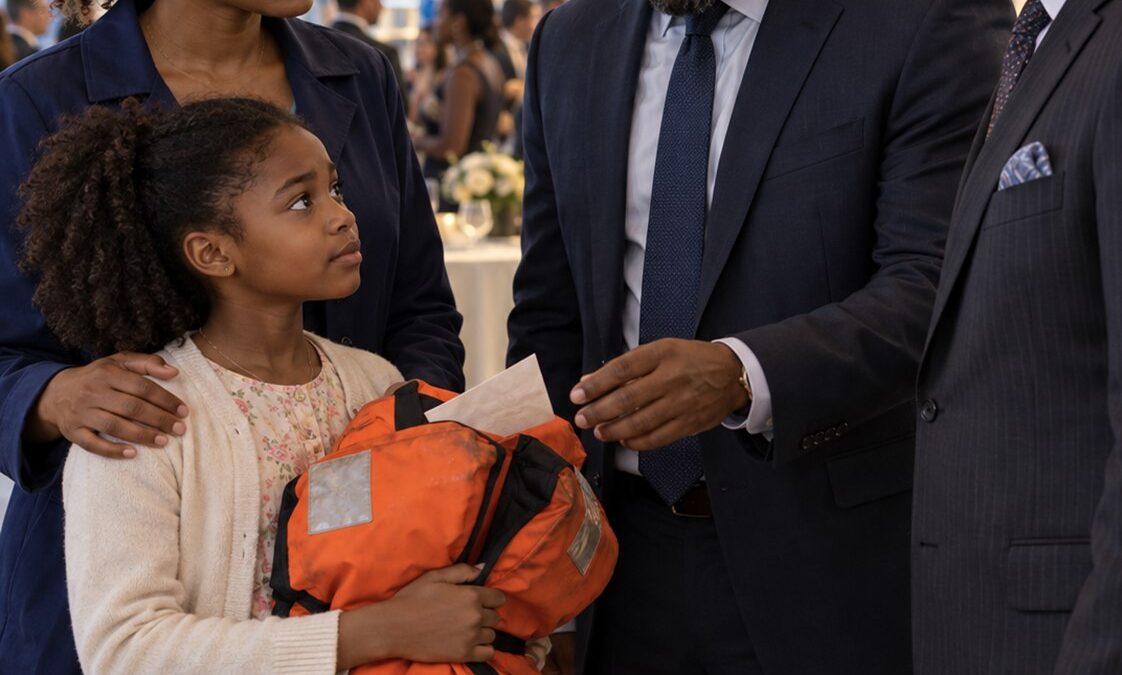
Chapter 2: The Warning Page
Reed pulled again.
The paper held.
The crease began to whiten.
“Let go,” June’s grandfather said.
Reed looked at him.
“She’s a child, Walter.”
“I can see that.”
“She doesn’t understand what she found.”
“Then explain it.”
Reed released the page.
June backed against the torn jacket.
Her grandfather lowered himself until they were eye to eye.
“May I read it?”
June checked the room.
Guests stood beside polished tables and untouched champagne.
Her mother was near the doors, still wearing the navy coat from her shift at the pharmacy.
Mara had come because June had begged.
Now she looked ready to carry her out.
June handed Walter the page.
He held it by its dry edges.
The ink was faded, but the words remained clear.
Thirty-six adult jackets in forward locker fail inspection.
Buckles separate under ordinary pull.
Replacement required before Friday departure.
Below that sat a date.
May 14.
The ferry had sunk on May 17.
Walter read it twice.
“Where did this come from?”
“Inside Dad’s jacket,” June said.
“Who put it there?”
“Grandma.”
Reed gave a quick shake of his head.
“Mother couldn’t have known what this was.”
June looked at him.
“She told me.”
“Before she died?”
“In February.”
Walter turned to Mara.
“Did you know?”
Mara crossed the marble floor.
Her shoes made almost no sound.
“I knew Evelyn left June a jacket.”
“You knew about this page?”
“No.”
Mara crouched beside her daughter.
June’s fingers were trembling.
Mara took the scissors from her gently and placed them on a table.
“You should have told me.”
“You would’ve kept me home.”
“I would have come with you.”
“I didn’t know that.”
Mara closed her eyes for a moment.
When she opened them, she looked at Walter.
“Your son asked for replacements,” she said.
Walter stared at the page.
“The inquiry said he signed the clearance.”
“That’s what the company gave them.”
“I saw his signature.”
“So did I.”
Reed took one step toward them.
“Walter, this is exactly why we shouldn’t discuss it in front of a crowd.”
Walter folded the page once.
“Then the crowd can leave.”
“Dad.”
“Ask them.”
Reed did not move.
Walter raised his voice.
“The opening is over.”
Staff began guiding guests toward the exits.
Nobody protested.
The speech disappeared from the screen.
A photograph of a new ferry took its place.
June watched its bright orange life jackets line the rails.
“Grandma said he was brave,” she whispered.
Mara pressed a hand against June’s back.
“He was.”
Walter looked from the photograph to his granddaughter.
For eight years, he had allowed a different story to stand.
His younger son had taken an overloaded ferry into rough weather.
His younger son had neglected the safety check.
His younger son had died trying to correct his own mistakes.
Walter had repeated that story in an interview.
He had never apologized to Mara.
Now he unfolded the warning again.
The bottom edge had been torn from a larger sheet.
A faint line of type ran across the top.
Maintenance report: Vessel 12.
Walter knew the form.
His company had used it for decades.
“He filed this,” Walter said.
Mara nodded.
“And somebody removed it.”
* * *
A harbor investigator arrived before the last guest left.
Walter had called her himself.
He also called the attorney who had represented the company during the inquiry.
Mara noticed the order.
“You called your lawyer first?”
“I called the investigator first.”
“That matters.”
“I know.”
Investigator Dana Pike wore a raincoat darkened at the shoulders.
She did not take the page from June.
Instead, she asked who had handled it.
June named herself, Reed, and Walter.
Mara added that she had touched the jacket.
Dana wrote each name down.
Then she photographed the paper where Walter had laid it.
“This may be evidence,” she said.
Reed folded his arms.
“Or a souvenir someone wrote years later.”
Dana studied him.
“That’s one possibility.”
June drew closer to Mara.
Dana noticed.
“Would you mind showing me the jacket?”
June lifted it from the table.
Its white lining hung open.
The page had been tucked inside a narrow stitched pocket beside the collar.
The pocket had been closed with blue thread.
The rest of the seams were orange.
“Did your grandmother sew?” Dana asked.
“She fixed everything,” June said.
“Did she tell you why she hid this?”
June shook her head.
“She said Grandpa needed to see the inside.”
“When did she give it to you?”
“At her house.”
“Was anyone else there?”
“Mom was in the kitchen.”
Mara remembered that afternoon.
Evelyn had been tired.
June had brought home a torn school backpack.
Evelyn had repaired its strap while they talked about the terminal opening.
She had taken the jacket from a cedar chest before they left.
Mara had assumed it was another gift June would never wear.
Dana placed the jacket in a large paper evidence bag.
She put the warning page in a separate sleeve.
June watched every movement.
“Will I get it back?”
“When we can return it.”
“Grandma gave it to me.”
“I’ll write that down.”
Reed’s attorney arrived shortly afterward.
He spoke to Reed near the windows.
Walter’s own attorney, Denise Bell, asked for the inquiry files.
“The official finding depended on two things,” Denise said.
“A signed departure checklist and a copy of the maintenance log.”
Walter remembered both.
“The checklist was Daniel’s.”
“Was it?”
“It had his name.”
Denise looked at the warning page.
“That answers less than it used to.”
Dana asked whether the company still held its paper archives.
Reed answered before Walter could.
“Records older than seven years are off-site.”
“Where?”
“An independent storage contractor.”
“Who has access?”
“Legal and operations.”
“And who heads operations?”
Reed said nothing.
Walter answered.
“My son.”
Dana wrote it down.
They met the next morning at the harbor office.
Mara brought a folder Daniel had kept at home.
It held fuel receipts, pay stubs, and a handwritten list of repairs he had requested.
She had almost thrown it out twice.
Instead, she had moved it through three apartments.
The folder smelled faintly of the garage where Daniel used to leave his work boots.
Denise spread its pages across a conference table.
There were repeated notes about the forward locker.
There were dates.
There were jacket counts.
The final entry read: Buckles returned. Refuse departure if replacements absent.
Mara touched the line.
“He told me that night he might lose his job.”
“Why didn’t you tell the inquiry?” Walter asked.
“I did.”
Walter looked up.
Mara kept her hand on the page.
“They said there was no record.”
Dana opened the inquiry transcript on her laptop.
Mara’s testimony was there.
So was the company’s response.
No corresponding maintenance request located.
Reed, then the operations director, had signed that response.
Walter leaned back.
He looked older than he had at the opening.
The storage contractor sent scans that afternoon.
The maintenance log had a gap.
The page before May 14 was numbered 216.
The next was 218.
Denise enlarged the margin.
Page 217 had been removed from the bound volume.
The torn edge on June’s page matched its position.
Dana would need the physical book to compare the paper.
Still, the missing number changed the room.
“It could have been removed for copying,” Reed’s attorney said over the phone.
“Yes,” Dana replied.
“Or for any number of routine reasons.”
“Yes.”
Reed sounded impatient.
“Then don’t pretend this proves a crime.”
Dana looked at the list of repairs.
“I haven’t.”
Mara had worked beside Daniel long enough to know how he wrote dates.
He drew a short line beneath the month when a report might be read later.
It kept his sevens from looking like ones.
The warning page had that line.
So did every note in the folder.
“It’s his,” Mara said.
Dana did not argue.
She only asked for the originals.
By evening, the storage contractor delivered the bound log under a documented handoff.
Its cover carried a sticker from the old terminal.
Dana examined the torn binding.
Then she turned to the checklist the company had supplied after the sinking.
Daniel’s signature stood at the bottom.
The box beside it said all safety equipment had passed.
Walter stared at the familiar mark.
“Can you test whether he signed it?”
“An examiner can compare it,” Dana said.
“Will that take long?”
“A while.”
Mara bent over the form.
Daniel’s signature troubled her less than the boxes above it.
He had filled out hundreds of these sheets at their kitchen table.
He used a pen for his name.
He used a blunt pencil while counting equipment.
He could erase a number and check it again.
“This isn’t how he worked,” she said.
Reed’s attorney asked what she meant.
She pointed.
“All the counts are ink.”
“People change habits.”
“Daniel didn’t change that one.”
Dana turned the sheet sideways.
The ink in the count boxes was darker than the ink in the signature.
She made no claim about when either had been written.
She photographed the difference.
Then she checked the form’s tracking number.
It belonged to a packet printed the morning after the sinking.
* * *
Walter closed the terminal for two days.
He told staff the new ferry would remain at the dock while an independent inspection took place.
Reed accused him of destroying public confidence.
Walter signed the inspection order anyway.
At noon, the company’s records manager called Denise.
Someone had tried to access the archived purchasing files.
The request used Reed’s account.
Reed said his assistant had been gathering documents for counsel.
Dana asked the storage contractor to preserve its access logs.
She asked the company to preserve emails, purchasing records, and security footage.
Walter sent the notices himself.
He had spent eight years treating the sinking as a wound the company had survived.
Now he had to consider what the company had done afterward.
June knew only that adults kept speaking in rooms she could not enter.
Mara took her to the public pier that evening.
Rain had washed the salt from the railings.
The ferries sat across the water with their lights on.
“Did I make everybody angry?” June asked.
“Some people were angry before you opened the jacket.”
“Grandpa looks sad.”
“Yes.”
“Is it because of me?”
Mara rested her elbows on the railing.
“No.”
June thought about that.
“Uncle Reed looked scared.”
Mara watched a deckhand carry a crate aboard.
“I saw that.”
“Grandma knew he would.”
“What else did she tell you?”
June pulled her sleeves over her hands.
“She said I didn’t have to do it if I got scared.”
“And?”
“She said she wished she had been braver sooner.”
Mara turned.
“Those were her words?”
June nodded.
Evelyn had visited Mara after the inquiry.
She had brought groceries.
She had brought money once, which Mara refused.
She had never said she doubted the official account.
Mara had mistaken her silence for agreement.
On the pier, she felt the weight of that mistake.
The next morning, Denise found Evelyn’s appointment books.
Walter had kept them in her study.
In the final year of her life, Evelyn had met twice with a lawyer outside the company.
She had also met with a retired ferry inspector named Paul Mercer.
The inspector agreed to speak at his kitchen table.
He remembered Evelyn clearly.
“She wanted to know if a jacket could pass a pull test after a buckle cracked.”
“What did you tell her?” Dana asked.
“That it couldn’t.”
“Did she show you one?”
“She showed me photographs.”
Paul opened an old email account.
Evelyn had sent six images.
Each showed a buckle stamped with the same supplier’s mark.
Below them, she had written: These were delivered to Vale Ferry before the last trip.
Paul had advised her to bring them to the harbor authority.
“She said she would,” he told Dana.
“Did she?”
“I never heard back.”
Dana checked the date.
The email was sent seven years after the sinking.
Evelyn had found the jackets long after the inquiry closed.
That explained her delay.
It did not explain why she had hidden Daniel’s warning.
Denise found the answer in Evelyn’s lawyer’s file.
Evelyn had asked him to hold a statement until she could obtain the purchasing records.
She feared the warning alone would let Reed blame Daniel again.
If Daniel knew the jackets failed, Reed could argue, why had he sailed?
Evelyn wanted proof that Daniel had been overruled.
She became ill before she got it.
Her written statement remained with the lawyer.
It described finding Daniel’s jacket in a locked company storeroom.
The collar felt stiff.
She opened a seam and discovered his warning folded inside.
Daniel must have hidden the page there before sailing.
Evelyn had sewn it shut again.
She had also written about a conversation after the disaster.
Reed had told her that Daniel signed the clearance.
When she asked to see the original form, Reed showed her a scan.
He said the paper copy had been damaged by water.
Dana read that sentence twice.
The inquiry had received a paper original.
It had a tracking number from the following day.
Someone had created it after the ferry sank.
Denise called Walter.
“Did you know Reed showed Evelyn a different account?”
“No.”
“Did you ask her?”
Walter’s answer came slowly.
“No.”
The independent inspection of the new ferry found no unsafe jackets.
That offered relief to the crew.
It did nothing for the old records.
Dana obtained the supplier invoices through the purchasing department.
The company had ordered certified jackets.
The invoices showed full price.
Bank records showed a lower payment to another supplier, one whose jackets lacked the required certification.
The difference had gone to a consulting firm owned by Reed.
Walter looked at the figures.
The amount was enough to pay a terminal crew for almost a year.
“He saved money on the jackets,” Walter said.
“He moved the savings,” Denise answered.
Dana pulled up one more document.
It was an internal message sent on May 15.
Daniel had asked Reed to cancel the Friday sailing until the replacements arrived.
Reed replied: We have a contract to meet. I will handle the clearance.
Walter gripped the edge of the table.
Reed had wanted the route open for a holiday weekend.
He had taken the money meant to keep it safe.
* * *
Reed called a board meeting before Walter could call him.
He asked members to remove Walter as chief executive.
His letter claimed Walter had compromised an investigation by displaying unverified evidence at a public event.
It also claimed Mara had encouraged June to damage company property.
Denise read the letter aloud.
Mara made her read the sentence about June again.
“That part is false.”
“We can answer it.”
“I want June left out of his fight.”
“We’ll say exactly what happened.”
Walter sat across from them.
“Reed won’t stop.”
“I know,” Mara said.
“You shouldn’t have to face him alone.”
“I faced your company alone eight years ago.”
Walter accepted that.
The board meeting took place in the old terminal conference room.
Reed had chosen it because the walls were covered with family photographs.
Daniel appeared in three of them.
In one, he stood beside Reed on their first day at work.
Both wore jackets too large for their shoulders.
Mara sat beneath that photograph with Denise and Dana.
June stayed with a neighbor.
Walter had asked permission for her to attend.
Mara had said no.
The board chair opened the meeting.
Reed spoke first.
He did not deny that Daniel had written a warning.
He argued that Daniel had concealed it.
“He put a document in his own jacket,” Reed said.
“He did not deliver it through the reporting system.”
Dana placed a certified copy of the log on the table.
“It was removed from the reporting system.”
“You cannot say who removed it.”
“That’s correct.”
Reed turned to the board.
“Daniel was beloved here.”
His voice softened.
“Nobody wants to speak badly of him.”
Mara watched his hands.
They were steady.
“But a warning written before departure creates a hard question,” Reed continued.
“Why did he sail?”
He let the room sit with it.
Then he looked directly at Mara.
“I wish he had asked for help.”
Mara felt the old anger rise.
It had nowhere useful to go.
Denise slid the May 15 message to each board member.
“He did,” Mara said.
Reed read it without touching the page.
“I said I would handle the clearance.”
“You didn’t replace the jackets.”
“I believed the existing stock met the standard.”
Dana produced the supplier invoices.
Reed studied them.
“These are preliminary records.”
“The bank transactions are final,” Dana said.
His attorney leaned close to him.
They spoke quietly.
Reed returned to the board.
“The consulting payments were for route planning.”
“Your firm billed on the same dates as the jacket deliveries,” Denise said.
“That proves timing.”
“It does.”
“Nothing more.”
Reed nearly had them.
A few board members exchanged looks.
The warning, the invoices, and his message painted a picture.
A picture could still be challenged.
Then Dana opened a clear evidence sleeve.
Inside was a small white tag.
It had been stitched into the lining of Daniel’s orange jacket, beneath the blue thread Evelyn used later.
June’s scissors had cut close to it without touching it.
Dana had found it while examining the pocket.
“The tag carries the original supplier’s production code,” she said.
Reed frowned.
“The jacket was standard issue.”
“Yes.”
“The code proves nothing about my decisions.”
“It identifies this jacket as part of the uncertified shipment.”
Reed looked at Walter.
“Dad, you know how many of those we had.”
“Thirty-six,” Walter said.
“That number came from Daniel’s warning.”
“No,” Dana said.
She laid out a second record.
It was a port delivery receipt obtained from the outside shipping company.
Its driver had recorded thirty-six cartons arriving two days before Daniel’s warning.
Each carton carried the same production code as the tag.
The shipping company had retained the signed receipt for its own billing dispute.
Reed’s signature appeared at the bottom.
He had accepted the shipment himself.
Dana let him examine it.
Reed’s attorney asked for a private break.
The board chair granted one.
Reed walked out without looking at Mara.
Walter remained seated.
“What happens now?” he asked.
“Investigators keep working,” Dana said.
“The board can decide what Reed does today.”
Denise turned to the chair.
“The company can preserve every record and remove his access.”
They voted to place Reed on leave.
His account was disabled before he returned to the room.
He stopped at the doorway.
“This will ruin the family,” he told Walter.
Walter glanced at Daniel’s photograph.
“You already let it.”
The inquiry did not change its finding that afternoon.
No one was arrested in the conference room.
Dana spent months tracing payments and interviewing employees.
A document examiner concluded that Daniel’s signature on the clearance form had been copied from an older inspection sheet.
The form’s tracking number and printer records placed its creation after the sinking.
A former clerk confirmed that Reed had brought her a completed packet and asked her to file it as the original.
She had kept a calendar entry because the request came on the morning her office reopened after the storm.
Reed’s attorneys challenged each piece.
The investigators answered with records from people outside the company.
By winter, prosecutors had charged Reed with fraud, falsifying safety records, and obstructing the original inquiry.
He later pleaded guilty to the record and fraud charges under an agreement that included repayment and prison time.
The harbor authority corrected its report.
It stated that Daniel had warned management about the jackets and had been falsely blamed for approving them.
Mara read the revised finding at her kitchen table.
She did not feel lighter right away.
For eight years, the lie had shaped where she worked, where she lived, and what strangers said when they recognized her name.
A corrected report could not give those years back.
It could give June the truth.
* * *
In March, Walter came to Mara’s apartment with a folder.
June was at school.
Mara let him sit at the small kitchen table.
He looked at the repaired chair beneath him.
Daniel had fixed it with a different shade of wood.
Walter ran one finger across the joint.
“I remember him making this.”
“He said he would stain it later.”
“He never did.”
“No.”
Walter set the folder down.
It contained a proposal from the company’s board.
A settlement fund would compensate the families harmed by the sinking and the false inquiry.
Mara’s claim was included.
Reed’s recovered money would pay part of it.
The company would pay the rest.
Walter waited while she read.
The amount was substantial.
It would clear her debts and pay for June’s education.
Mara closed the folder.
“I’ll have my own lawyer review it.”
“Of course.”
“I won’t sign away my right to speak about Daniel.”
“That clause isn’t there.”
“I’ll check.”
Walter nodded.
She expected him to leave.
Instead, he folded his hands.
“I owe you an apology.”
Mara looked toward the sink.
“Then say it.”
“I believed what Reed told me because believing him was easier.”
He swallowed.
“I let people call Daniel careless.”
“I asked you to listen.”
“I remember.”
“You told me grief made me unreliable.”
Walter lowered his eyes.
“I did.”
Mara let the words remain between them.
Outside, a delivery truck stopped and started again.
“I can’t make that right,” Walter said.
“No.”
“But I can tell the truth whenever I’m asked.”
“That would help June.”
“I want to do that.”
Mara pushed the folder toward herself.
“There’s something else.”
Walter waited.
“June wants to know you.”
“I want to know her.”
“That has to be her choice.”
“It should be.”
“And you don’t get to ask her to keep peace with Reed.”
“I won’t.”
“You don’t get to call Daniel reckless when remembering him becomes painful.”
“I won’t.”
Mara watched him.
Walter had once made promises with a signature and expected everyone to trust the page.
This time, she wanted to see the days that followed.
June came home an hour later carrying a drawing.
It showed the terminal in purple and orange crayon.
The ferries were too small.
The life jackets were enormous.
Walter smiled when she explained that everyone on board needed one.
He asked if he could come to her school’s harbor history fair.
June looked at Mara first.
Mara said, “That’s up to you.”
June thought for a long moment.
“You can come if you don’t give a speech.”
“I can manage that.”
“And you have to see my whole project.”
“I’d like to.”
She set the drawing on the table between them.
Walter kept his hands away until she slid it closer.
The settlement became final after Mara’s lawyer negotiated the wording.
Mara used part of it to move into a warmer apartment near June’s school.
She used part to return to the training program she had left when Daniel died.
She had always wanted to repair marine electrical systems.
Now she could take the classes without working a closing shift first.
The rest went into savings for June.
Walter asked whether he could name a new vessel after Daniel.
Mara said no.
Daniel had been a person, not a way to improve the company’s image.
Walter accepted that.
Months later, the board established an independent safety fund at the public harbor college.
It paid for equipment training for crew members from any ferry company.
Mara agreed to help choose its first students.
She insisted that the fund carry no Vale name.
At the harbor history fair, Walter arrived ten minutes early.
He bought a paper cup of weak coffee and listened while June explained how a buckle should close.
He asked one question.
She answered for nearly five minutes.
Mara watched from the back of the classroom.
June saw her and waved.
Walter waved too, then seemed embarrassed.
Mara waved back.
It was a small thing.
They had earned only small things so far.
That was enough to begin.
* * *
Five years later, the old terminal became a public maritime center.
The chandeliers stayed.
The speeches were shorter.
June, now fourteen, helped install an exhibit about the sinking.
She checked every caption herself.
Daniel’s warning appeared beside the corrected harbor report.
The original page stayed in protected storage.
A reproduction was enough for visitors to read.
Beside it hung the orange life jacket.
Its torn lining had been repaired around a clear panel.
The blue thread remained visible.
Evelyn’s stitches.
Daniel’s warning.
June’s cut.
Walter stood near the exhibit on opening day.
He had retired from the company.
Reed’s sentence was nearly over.
June had asked once whether she had to see him when he came home.
Mara had told her no.
She had asked whether Walter still loved him.
Walter had answered yes.
Then he had added that love would not change what Reed had done.
June seemed satisfied with that.
At the exhibit, a younger boy studied the jacket.
“Why did she cut it?” he asked his father.
June heard him.
She walked over.
“Because I thought someone needed to look inside.”
The boy peered through the clear panel.
“Were you scared?”
“Yes.”
“Did you get in trouble?”
“A little.”
His father smiled.
June did too.
Across the room, Mara reached for Walter’s arm as they stepped away from a group of visitors.
She was helping him find a quieter place to sit.
He still asked before joining family dinners.
Sometimes June said yes.
Sometimes she had other plans.
He came when invited.
Mara’s phone buzzed with a message from the harbor college.
One of their first students had earned her certification.
Mara showed it to June.
June read the name and grinned.
Outside, ferries crossed the gray water.
Crew members checked their equipment before each departure.
Inside, the jacket hung open.
Nothing else was hidden there.
THE END








