“Dad, Keep That Red Light On,” His Daughter Cried at the Radio Station—Then Her Dead Mother’s Warning Reached the School
Chapter 2: The Warning They Buried
Adrienne pulled against Nolan’s grip.
He let go.
He needed both hands free.
“Call the school,” he said.
“That indicator is unreliable.”
“Then the school can tell us.”
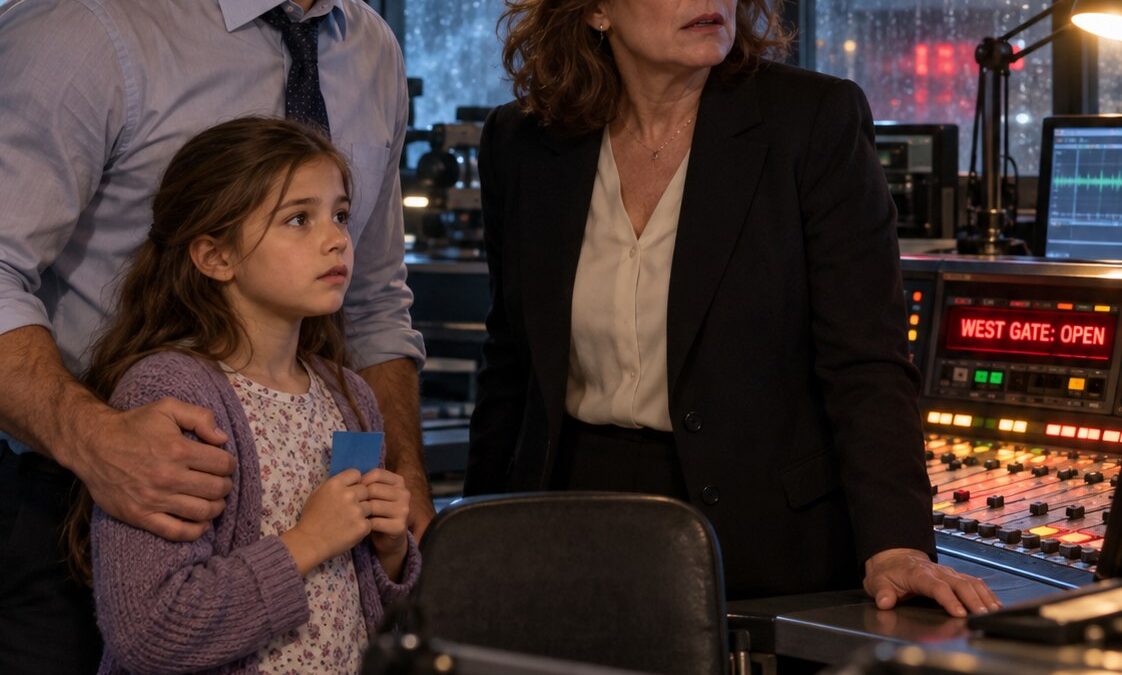
Tessa held out the blue card.
Nolan took it carefully.
The paper had gone soft at its corners.
Nora had once laminated everything.
Grocery lists.
Bus schedules.
A drawing Tessa made at three.
This card was the exception.
Its blue surface carried four printed steps for field reporters during severe weather.
Nora had written a fifth on the back.
CALL 418.
ASK FOR THE GATE READING.
Nolan looked up.
Adrienne saw the writing.
For a moment, she forgot the board.
“Where did she get that?”
“It was Mom’s,” Tessa said.
“I know whose it was.”
Nolan stepped between them.
The studio smelled of warm plastic.
Rain struck the high windows.
On the wall screen, the weather alert advanced another minute.
The creek was rising.
Alder Elementary stood two blocks from it.
Tonight, families had filled its auditorium for the winter music concert.
Tessa should have been there.
A fever that morning had kept her home.
By evening, she felt better.
Nolan had brought her to the station while he checked the weather desk.
He had thought it was safer.
“Call them,” he repeated.
Adrienne folded her arms.
Nolan reached across the board.
The station’s landline still worked.
A secretary answered on the third ring.
He heard children behind her.
Music stands scraped the floor.
“This is Nolan Pierce.”
“Yes, Mr. Pierce?”
“Has anyone told you the west gate is open?”
A pause followed.
“We received a routine weather notice.”
“Did it mention the gate?”
“No.”
“Please move everyone upstairs.”
“Is there an evacuation order?”
“Not yet.”
He hated those words.
“Move them anyway.”
The secretary called for the principal.
Nolan handed the phone to the evening producer, who had just entered from the hall.
“Stay with her,” he said.
The producer, Miles, nodded.
Adrienne moved toward the monitor.
Nolan blocked her.
“Leave it.”
“That feed isn’t official.”
“Whose feed is it?”
“Ours.”
“Where does it come from?”
“The barrier system.”
“Who maintains that system?”
Adrienne said nothing.
Their company did.
Not the station.
A separate Pierce division serviced the tide gate under a city contract.
Nolan had approved the renewal in March.
Adrienne had managed the division since he bought the hotel group.
She had been the capable one.
The person who read every inspection.
The person who knew which employee had a sick parent and which bank wanted a call returned.
Four years ago, Nolan had believed her when she said Nora drove into the flood against every warning.
He had needed to believe someone.
Tessa pulled his sleeve.
“Mom sounds scared.”
“She does.”
“She was asking for help.”
Nolan lowered himself beside her.
“You’re safe here.”
Tessa looked at the red light.
“No one heard her.”
He could not answer.
Nora’s voice had come from a file Miles found that afternoon.
It had been labeled as a weather training clip.
He had loaded it for Nolan to review after the concert.
Tessa saw Nora’s name on the screen and pressed play while Nolan stepped out to take a call.
Miles had forgotten the studio feed was live.
The recording had reached the air for eleven seconds.
Then Adrienne cut it.
Nolan looked at Miles.
“Did you make a copy?”
“The file’s still on the server.”
“Lock the account.”
Adrienne laughed once.
“He’s your employee.”
“He has a job.”
“You’re going to frighten the whole town over an old recording?”
Nolan pointed at the current indicator.
“Tell me why it says OPEN.”
Adrienne glanced toward the hall.
Nolan saw the choice form in her face.
She could deny knowing.
She could blame the sensor.
She could let him take the risk.
“The manual gate was opened for drainage,” she said.
“By whom?”
“Operations.”
“When?”
“This afternoon.”
“Who authorized it?”
“We don’t have time for a board meeting.”
“No,” Nolan said.
“We don’t.”
He called the county dispatch desk.
He gave his name and the station’s live gate reading.
The dispatcher took the call number.
Nolan read it from Nora’s card.
There was a click of keys.
Then silence.
“Sir,” the dispatcher said, “that’s a call from four years ago.”
“I know.”
“It’s marked resolved.”
“Read the resolution.”
The dispatcher hesitated.
“I can’t release that over the phone.”
“What was the caller’s name?”
“I can’t—”
“Was it Nora Pierce?”
Another pause.
“Yes.”
“And who marked it resolved?”
The dispatcher asked him to hold.
Nolan watched Adrienne.
She had gone still.
The dispatcher returned with a supervisor.
A road crew was being sent to the gate.
Police were going to Alder.
The school would receive an evacuation recommendation.
Nolan put the phone on speaker.
The supervisor spoke carefully.
“Your current reading matches ours.”
Adrienne closed her eyes.
“It’s open?” Nolan asked.
“Yes.”
“And Call 418?”
“That call was never resolved,” the supervisor said.
“It was closed by your company.”
* * *
The police reached Alder first.
They moved families to the upper floor.
The principal called the station.
Her voice held steady until she mentioned the kindergarteners.
There were thirty-two of them.
The youngest could not carry their instruments and hold the stair rail.
Older students helped.
Parents helped.
Nobody waited for the concert to finish.
Nolan asked the principal if the station could air her instructions.
“Yes,” she said.
Adrienne stepped forward.
“You can’t put unverified information on the air.”
“The principal verified it.”
“You know what I mean.”
Nolan did.
He knew the cost.
Their company had built a restaurant row beside the creek.
The hotel’s new event wing sat farther uphill.
The west gate protected both.
An open gate drained their construction basin toward the old creek channel.
A closed gate sent runoff through a slower system that could back up into their property.
Nolan had signed the project budget.
He had not asked enough questions about the gate.
Now he switched on the microphone.
The red light burned above him.
“This is Nolan Pierce,” he said.
“Families at Alder Elementary, follow the staff upstairs.”
“County crews have confirmed an open flood gate near the school.”
“Police are on site.”
“Do not drive toward Alder.”
“We’ll share instructions as officials give them.”
He switched off the mic.
No one spoke.
Tessa studied the card in her hands.
“Mom tried to do that,” she said.
“Yes.”
“Did you help her?”
Nolan looked at the floor.
“No.”
The answer hurt because it was true.
He had been at the hotel that night.
A lender from Chicago had flown in despite the storm.
The meeting could have waited.
Nora had called him twice.
He missed both calls.
By the time he called back, her phone went to voicemail.
Adrienne had told him Nora had taken the school route to get home.
She had said Nora ignored a road closure.
The official report repeated it.
Nolan had never asked who supplied the route.
He had been busy finding Nora.
Then burying her.
Miles pulled a chair beside the server terminal.
“The audio file’s longer,” he said.
“How long?”
“Six minutes.”
Adrienne looked sharply at him.
“I told you not to load it.”
“You told me to clear the old rack,” Miles said.
“I found a drive in the transmitter cabinet.”
“You should have brought it to me.”
“I did.”
“You brought me a list.”
“I brought you the drive number.”
Miles turned to Nolan.
“I kept it when she told me to wipe it.”
Adrienne’s face changed.
For years, Nolan had watched her win meetings without raising her voice.
Now she sounded breathless.
“That drive was scheduled for disposal.”
“It still had station material,” Miles said.
He clicked the file open.
A waveform stretched across the screen.
Nolan stopped him before he pressed play.
“Make copies first.”
Miles nodded.
One copy went to a clean external drive.
Another went to the station’s remote backup.
Miles wrote down the original file path and time stamp.
He photographed the drive label.
Adrienne watched every movement.
“You think that makes it evidence?” she asked.
“It makes it harder to lose,” Nolan said.
The phone rang.
County public works had arrived at the gate.
The crew chief said the gate stood partly open.
A manual locking pin was missing.
Water was moving through the channel.
A second crew was bringing the replacement part.
Nolan asked how long.
The chief would not guess.
Neither would Nolan.
He put the crew chief’s practical advice on the air.
Stay off Creek Road.
Follow police directions.
Leave the bridge clear for workers.
At Alder, the last group reached the upper floor.
Tessa’s best friend, June, was with them.
June’s mother called Tessa’s phone.
Nolan heard the quick, fierce relief in his daughter’s voice.
Then Tessa gave him a thumbs-up.
He returned it.
For one second, she looked eight again.
Not like the girl who had watched her aunt reach for a switch.
Miles put on headphones.
He listened to the first minute of the old recording.
His shoulders stiffened.
“Nolan.”
“What?”
“You need to hear this.”
The file began with a click.
Then wind.
Nora’s voice cut through it.
“This is field call four-eighteen.”
“I’m outside Alder Elementary.”
“Children are still inside.”
She gave the date.
She gave the time.
She read the gate indicator displayed on a public works panel near the school.
OPEN.
Then a second voice came on the line.
Adrienne’s.
“Take her off the studio feed.”
Nolan looked across the room.
Adrienne held his gaze.
Miles let the recording run.
Nora said she had already called county dispatch.
Adrienne told the board operator the school had been cleared.
Nora shouted that she could see lights in the classrooms.
A child cried somewhere behind her.
Nolan’s throat tightened.
Adrienne’s recorded voice returned.
“Mark the gate report resolved.”
Nora demanded to know who had checked it.
No one answered.
The recording ended with a line Nolan had never heard.
Not in a report.
Not from his sister.
Not from anyone who claimed to know Nora’s last hour.
“I’m going in,” Nora said.
“The children are still there.”
* * *
The west gate closed at 9:18.
Public works sent a photograph.
The new pin sat through its bracket.
A crew member had measured the water upstream.
The level had risen above the school’s lower playground.
It had not reached the building.
Police escorted families out by the north road.
June’s mother sent a picture from her car.
June held her violin like a lifeboat.
Tessa laughed when she saw it.
Then she asked for the recording again.
Nolan shook his head.
“Later.”
“She was brave.”
“She was.”
“I want to hear all of it.”
He put his arm around her.
“You can.”
“Promise?”
“Yes.”
Adrienne stood near the door.
“Don’t promise her that.”
Nolan turned.
“You don’t get to decide.”
“You know what that recording will do to her.”
“I know what hiding it did.”
Adrienne looked at Tessa.
“Your mother made a choice.”
“So did you,” Tessa said.
It was quiet.
Adrienne left.
Nolan did not follow.
He called the station’s lawyer first.
Then the county supervisor.
He gave them the drive number and asked where to deliver a copy.
The lawyer told him to preserve the original equipment.
She also told him to stop touching company records without documenting each step.
Nolan listened.
He had spent years buying his way out of delays.
This required patience he had never practiced.
By midnight, the station had aired three official updates.
Alder was empty.
No one had been hurt.
The hotel’s event wing had taken water at its loading entrance.
Nolan heard that from the night manager.
He told her to get the staff out and leave the boxes.
“Even the wedding delivery?” she asked.
“Especially the wedding delivery.”
At home, Tessa fell asleep on the couch.
She still held Nora’s blue card.
Nolan eased it from her fingers.
A pale dent crossed the back.
Nora had written Call 418 hard enough to mark the paper beneath.
He remembered the day she printed the cards.
The station was new then.
Nora had argued that reporters needed a way to confirm warnings from two sources.
The printed steps said so.
Call dispatch.
Read the gauge.
Name the location.
Repeat the instruction.
She had made every field reporter carry one.
Nolan had teased her about the blue paper.
She said people could find it in a dark car.
He had remembered the color.
He had forgotten the purpose.
In the morning, he took Tessa to his neighbor, Mrs. Bell, who had watched her since preschool.
Tessa accepted breakfast.
She did not accept his plan to go alone.
“I was there too,” she said.
“You helped people.”
“Mom helped people.”
Nolan crouched beside her chair.
“I’m going to find out what happened.”
“Will you tell me?”
“Yes.”
“Even if it’s bad?”
“Especially then.”
At the county office, a records supervisor met him with the station lawyer.
Her name was Lena Ortiz.
She had worked dispatch on the night Nora died.
Nolan recognized her voice from the phone.
Lena placed a printed call log on the table.
She covered personal information from unrelated calls.
Call 418 began at 6:42 p.m.
Nora reported the open gate.
The operator notified a Pierce maintenance number.
At 6:49, the operator entered “company confirms closure.”
At 7:03, Nora called again.
She said the gate was still open.
At 7:05, the company line sent a second confirmation.
The log carried employee IDs.
No name yet.
The county needed its older system archive to identify the person who sent them.
“Why didn’t this change the report?” Nolan asked.
“The final storm review relied on maintenance certificates,” Lena said.
“Your company supplied them.”
“And my wife?”
Lena’s expression softened.
“Her calls were in the dispatch file.”
“Did the investigators hear them?”
“They requested summaries.”
“Did they get the audio?”
“I don’t see a request.”
Nolan studied the paper.
Two columns.
Time and action.
A life could disappear between them.
He showed Lena the blue card.
“She wrote this number herself.”
Lena compared the handwriting to Nora’s signature on the call form.
“I remember her,” she said.
“She asked me to repeat the gate reading.”
“What did you say?”
“I said I could see the same thing.”
Nolan turned toward her.
“You knew it was open?”
“Yes.”
“And then our company said it wasn’t.”
“Yes.”
Lena had spent four years wondering why.
She had given a statement during the storm review.
Its summary was two sentences long.
She had kept her own notes.
She had not been asked for them.
The lawyer requested a copy through the proper process.
Lena agreed to preserve them.
Outside, Nolan stood beneath a bright, cold sky.
Four years ago, Adrienne had handed him a maintenance certificate.
He had signed the family statement that followed.
Nora had “driven into unsafe conditions despite available warnings.”
The sentence had traveled farther than the truth.
It appeared in newspapers.
It appeared in a hotel insurer’s report.
It sat in Tessa’s baby book only because Nolan had not known where else to put the clipping.
His phone rang.
A hotel employee said the company’s compliance portal had gone down.
Inspection files were unavailable.
Adrienne had told staff it was routine maintenance.
Nolan called the IT director.
The director confirmed the portal was offline.
No deletion had been reported.
Backups remained intact.
“Keep them that way,” Nolan said.
The IT director asked if he should notify Adrienne.
“She already knows.”
Nolan returned to his car.
A second call came from the lawyer.
She had found the signer on the old maintenance certificate.
The signature belonged to Nolan’s former operations manager.
But the certificate had been uploaded from Adrienne’s office.
And it had been uploaded twelve minutes after Nora’s second call.
* * *
By noon, someone had sent the recording to a local news account.
Only twenty seconds.
Nora’s warning.
Adrienne’s order.
No context.
The station’s number filled with calls.
Some demanded Adrienne’s arrest.
Some accused Nolan of inventing a scandal to save his hotel after the new flood damage.
A man called Nora reckless.
Nolan ended that call.
He did not answer the next one.
The lawyer told him to make a short statement.
The county was investigating.
The station had preserved the file.
The school had evacuated safely.
Anything else could wait.
Nolan recorded it once.
His voice sounded tired.
That was fine.
Adrienne called minutes after it aired.
“You let them turn her into a weapon.”
“You did that four years ago.”
“You don’t know what happened.”
“Then tell me.”
“I kept the company alive.”
“At whose expense?”
She hung up.
At home, Tessa sat at the kitchen table.
Mrs. Bell had put out crayons.
Tessa had drawn a square red light.
Beneath it she drew stairs.
Small figures climbed them.
Nolan looked for himself.
He was the one at the bottom, pointing upward.
“Where’s your mother?” he asked.
Tessa tapped the light.
Nolan sat beside her.
For a while, he watched her color.
Then he told her one fact he knew.
“Nora called the school because children were there.”
Tessa chose a blue crayon.
“Did they get out?”
“Most did before she arrived.”
“Most?”
“The last class was upstairs.”
Tessa stopped coloring.
“She went for them?”
“Yes.”
“Did she find them?”
“We’re checking.”
Tessa pressed the crayon so hard it snapped.
Nolan picked up the broken piece.
“You don’t have to solve this.”
“I know.”
He did not think she believed him.
That evening, the lawyer brought him a copy of the old storm review.
It listed seven Alder staff members and forty-six students who had stayed after school for a rehearsal.
A custodian reported Nora arriving at the building.
She helped staff guide the last children to a service exit.
The report placed her death on the drive home.
Nolan read that page twice.
Something troubled him.
The road where her car was found did not lead home.
It led to the county depot.
Nora had told him once that the depot kept physical gauge charts.
She trusted those more than a screen.
He had laughed at her.
“Paper can lie too,” he had said.
“Of course,” she answered.
“That’s why you ask who wrote on it.”
The county depot had flooded that night.
Some files were lost.
Others had been boxed.
The lawyer called for an appointment.
Nolan knew the technician who had worked there.
Drew Vance had been with Pierce maintenance for twenty years.
He had retired the spring after Nora died.
Nolan drove to Drew’s house the next morning.
Drew lived inland.
His porch looked out over an ordinary garden.
He answered wearing a coat with the old company logo.
When he saw Nolan, he pulled the door nearly shut.
“I talked to the investigators,” Drew said.
“I read your statement.”
“Then you know.”
“I know what it says.”
Drew looked past him toward the road.
Nolan stayed on the porch.
He had brought the lawyer.
She introduced herself and explained they were gathering records.
Drew refused to let them inside.
He did, however, take a photograph from his coat pocket.
It showed the west gate mechanism four years ago.
The locking pin lay on the concrete beside it.
Nora’s blue card had prepared Nolan for that image.
A small piece of metal could decide where water went.
“Who took this?” Nolan asked.
“I did.”
“When?”
“Before the storm.”
“Why?”
“Because I was told to remove it.”
Drew gripped the photograph.
“Who told you?”
Adrienne’s car turned onto the street.
Drew saw it first.
His face lost color.
Nolan stepped away from the door.
Adrienne parked across from the house.
She did not get out.
Drew handed the photograph to the lawyer.
“I kept the original,” he said.
“I kept the work order too.”
“Where?”
“With my attorney.”
Adrienne’s car remained there.
Drew shut the door.
Nolan walked back to his vehicle.
His lawyer photographed the car’s plate and the time.
They did not approach her.
Ten minutes later, Drew’s attorney called.
Drew wanted to give a formal statement to the county.
The photograph had a date.
The work order had a name.
Adrienne Pierce had ordered the pin removed to drain water away from the hotel construction site.
* * *
Three days later, Nolan sat in the county emergency center.
Rain marked the windows.
The storm had passed.
Water remained in the lower streets.
The school had reopened its upper floor for supply distribution.
The county had scheduled a public hearing on the gate.
Adrienne came with two lawyers.
Nolan came with one.
Parents filled the chairs.
So did hotel employees.
Drew sat near the front.
Lena Ortiz sat beside him.
Nolan had asked Tessa to stay with Mrs. Bell.
She had asked if she could watch the public recording later.
He said she could decide when she was ready.
Adrienne took her seat without looking at him.
The hearing officer explained the order.
First, current operations.
Then the events four years earlier.
Then public questions.
Nolan listened to the city engineer.
The gate had been opened last week under a Pierce work order.
The request cited drainage from the hotel’s event wing.
A temporary pin should have been installed.
It was not.
The gate moved farther open as water rose.
Adrienne’s lawyer asked whether the school would have flooded.
The engineer said no one could know from that reading alone.
The early evacuation had prevented anyone from needing to find out.
That answer irritated people.
It was also honest.
Nolan preferred it.
A parent asked who had issued the work order.
The engineer read the name.
Adrienne Pierce.
She raised her hand.
“My office issued it,” she said.
“That does not mean I selected the equipment.”
Her lawyer leaned toward her.
She kept speaking.
“The crew made a field decision.”
A crew supervisor stood up.
The hearing officer asked him to wait his turn.
He sat.
Nolan could see his hands shaking.
Adrienne argued that the old storm had been worse.
The city system had failed.
Her company had tried to protect jobs and property.
Nora’s recorded call, she said, was incomplete.
A frightened reporter had seen one display.
She had no proof the gate remained open.
Drew’s photograph showed a removed pin, not a crime.
The work order described ordinary drainage work.
For a few minutes, Nolan could feel the room lean toward her.
Adrienne spoke clearly.
She knew the contracts.
She knew where city responsibility ended and company responsibility began.
She reminded everyone that no family had been hurt last week.
A woman in the second row stood.
“My daughter was at Alder,” she said.
“I would have liked the warning earlier.”
The hearing officer thanked her.
Adrienne looked down.
Her lawyer took over.
He asked Nolan whether he had approved the hotel expansion.
“Yes.”
Whether he had signed the maintenance contract.
“Yes.”
Whether he knew the gate could be opened manually.
“Yes.”
Had he read every work order?
“No.”
Had he read Nora’s calls four years ago?
“No.”
The lawyer paused.
“So you trusted your sister with the details?”
“I did.”
“And now you want the public to believe you had no responsibility?”
Nolan looked at Adrienne.
“I have responsibility.”
His lawyer shifted beside him.
Nolan kept going.
“I signed what I should have read.”
“I repeated an account I never checked.”
“I let my daughter grow up with it.”
The room stayed quiet.
“That was my failure,” he said.
“It does not make the false records true.”
Adrienne finally met his eyes.
She looked almost grateful.
As if his admission might save her.
The hearing officer called Lena.
She described Nora’s dispatch calls.
She explained how operators recorded a caller’s words.
Then she identified her own notes.
The county had compared them with its stored call log.
They matched.
Adrienne’s lawyer asked whether Lena saw the gate.
“No.”
“Then you relied on a screen.”
“Yes.”
“Like Mrs. Pierce.”
“Like Nora Pierce,” Lena said.
“And like your client’s company.”
Next came Drew.
He described the removed pin.
He described the order.
He also described his own silence.
He had been afraid of losing his job.
After Nora died, he had been ashamed to speak.
He did not ask anyone to excuse him.
Adrienne’s lawyer showed him the work order.
“Does it say to endanger the school?”
“No.”
“Does it say to falsify a certificate?”
“No.”
“So you made assumptions.”
“I made a record,” Drew said.
“I wish I’d made it sooner.”
The hearing officer asked for the photograph’s original file.
Drew’s attorney provided it.
The date placed him at the gate before the storm.
The company’s vehicle log placed his truck there too.
That proved removal.
It did not yet prove who had closed Nora’s warning.
Adrienne seemed to understand the gap.
She sat straighter.
The hearing officer played the station recording.
Nora’s voice filled the room.
Nolan fixed his eyes on the table.
He had heard the whole file the night before.
Tessa had not.
Nora asked the board operator to keep the warning live.
Adrienne told him to cut it.
Nora said she could see lights at Alder.
Adrienne said the school was clear.
Then Nora said she was going inside.
The audio stopped.
Adrienne’s lawyer was ready.
“Was this copied from its original system?”
“Yes,” Miles said.
“How many times?”
“Twice.”
“Can you prove no one edited the source?”
Miles explained the drive.
He explained its station inventory label.
The lawyer pressed him.
Nolan watched the parents.
Some believed the recording.
Some wanted something firmer.
He wanted it too.
He reached into his coat.
The blue card rested in a clear sleeve.
Tessa had lent it to him that morning.
“You bring it back,” she said.
“I will.”
Nolan placed it before the hearing officer.
On the back, Nora had written Call 418.
She had also written a time.
6:42.
Below it, in smaller letters, she had written “school first.”
Nolan had missed those words until the lawyer enlarged a photograph.
Adrienne’s lawyer glanced at the card.
“A handwritten note proves little.”
“Agreed,” Nolan said.
Adrienne looked surprised.
“The number lets us find the other recording.”
Lena leaned forward.
County dispatch had kept every incoming call on a separate system.
The station’s file and the county’s file were made at different places.
The county had retrieved its original archive after Nolan supplied the call number.
The hearing officer played it.
Nora’s voice came through a thinner speaker.
She reported the gate.
She asked for school evacuation.
The dispatcher contacted Pierce maintenance.
A man answered.
He identified himself and gave a company code.
The hearing officer stopped the audio.
The county’s old employee-code register appeared on the screen.
The code belonged to Adrienne.
Her lawyer objected that employees shared phones.
Lena nodded.
“They did.”
Then she played the rest.
The caller said, “This is Adrienne Pierce.”
Nolan felt the chair beneath him.
In the recording, Adrienne said the gate had been secured.
Lena repeated Nora’s report.
Adrienne said Nora was seeing an old reading.
She asked the dispatcher to close the call.
At 7:03, Nora called again.
At 7:05, Adrienne called back.
She said the second report had been checked.
She said there were no children at Alder.
The school attendance sheet showed forty-six.
Alder’s custodian had signed them out after 7:20.
Adrienne’s face hardened.
“People make mistakes during storms.”
“Yes,” the hearing officer said.
He asked a county investigator to present the digital maintenance records.
The investigator had obtained them through the company’s preserved backups.
The certificate claiming the gate was closed had been created at 7:17.
It used Drew’s credentials.
Drew was at the gate then.
His truck tracker placed him there.
The upload came from Adrienne’s office computer.
Adrienne’s lawyer asked whether anyone else could have used it.
The investigator said several staff had access to the room.
Only Adrienne’s account had authorized the upload.
That was the independent confirmation Nolan had needed.
Not one voice.
Not one card.
Separate systems.
Separate people.
The same timeline.
Adrienne spoke before her lawyer could stop her.
“I was trying to prevent a panic.”
A father in the back row stood.
“My son was in that building.”
“You think I wanted him hurt?”
“I think you wanted the hotel open.”
The hearing officer called for order.
Adrienne turned to Nolan.
“She went there because you didn’t answer.”
The words struck where she intended.
Nolan stood.
“Yes,” he said.
“She called me.”
“I should have answered.”
He looked at the families.
“Nora went because children needed her.”
“She deserved a warning that reached them first.”
Adrienne had no answer.
The hearing officer referred the records to county investigators.
The city suspended the Pierce gate contract pending review.
The school district requested a separate report on its warning procedures.
No one was arrested in the room.
No one applauded.
People had children to collect and damaged homes to check.
Outside, Nolan returned Tessa’s card to its sleeve.
A reporter asked whether he would sue his sister.
He said his first job was to pay for an independent repair and cooperate with the investigation.
Then he went home.
* * *
Eight weeks later, the hotel lobby smelled of wet paint.
The lower loading entrance had been rebuilt.
Nolan walked through it with an inspector.
A new barrier stood where boxes had once been stacked.
It had a manual lock and a public gauge.
The city, not Pierce maintenance, controlled it.
The inspector tested the gate signal twice.
Both times, the station received the same reading the city did.
Nolan asked him to test it a third time.
The inspector smiled.
“You can watch me do it.”
At home, Tessa had developed a habit of checking the weather before breakfast.
Nolan tried not to make it a ritual of fear.
Some mornings, he asked about her spelling words instead.
Some mornings, she asked why the clouds looked purple.
He never told her to stop looking.
They listened to Nora’s full recording together one Sunday afternoon.
Mrs. Bell stayed for lunch.
Tessa sat with a blanket over her knees.
Nolan told her she could stop it whenever she wanted.
She listened all the way through.
At the end, she cried quietly.
Then she asked what happened to the children.
Nolan showed her a letter from Alder’s former principal.
All forty-six had left safely.
Nora had helped the last class through a side exit.
She had gone toward the county depot afterward.
The road washed out before she arrived.
Tessa read the letter twice.
“She knew they were safe?”
“Yes.”
“She didn’t leave them.”
“No.”
Tessa folded the letter.
“I like knowing that.”
Nolan did too.
It did not fix the four years behind them.
It gave those years a truer shape.
The formal investigation moved slowly.
Adrienne resigned from every Pierce company position.
Her lawyers challenged the records.
Investigators interviewed the board operator, the maintenance crew, the school staff, and the county dispatcher.
Nolan gave them his phones and the old company files they requested.
He did not call Adrienne.
She sent him a letter.
It began with complaints about the hearing.
Halfway down the second page, she wrote that she had been afraid of losing everything.
She said she was sorry Tessa had heard Nora’s voice that way.
She did not apologize for cutting it off.
Nolan read the letter once.
Then he put it away.
He did not show it to Tessa.
Months later, Adrienne pleaded guilty to falsifying company safety records.
The prosecutor addressed the false county confirmations in the same case.
A judge imposed a sentence that included restitution and a ban from managing public safety contracts.
Civil claims continued after that.
Nolan answered them.
The company paid for the city’s gate work and the school’s new warning system.
The hotel’s investors demanded their own accounting.
Nolan opened the books.
Some withdrew.
He sold the event wing.
It had been built where Nora had warned him not to build.
One buyer offered a generous price if Nolan would keep the property’s name.
He declined.
The proceeds funded repairs through an agreement overseen by the city and school district.
Nolan kept no seat on its board.
Tessa asked whether that meant they were poor.
He looked around their kitchen.
There was food in the refrigerator.
Her rain boots stood by the door.
The roof did not leak.
“No,” he said.
“Does it mean you have to work?”
“Yes.”
She considered that.
“Mrs. Bell says you needed a hobby.”
Nolan laughed before he could help it.
He still owned the station.
Now he came in before the morning broadcast.
He learned who checked the weather feed.
He learned how long backup power lasted.
He learned that Miles drank terrible coffee because the good machine leaked.
He replaced the machine.
Miles accused him of finally understanding management.
One afternoon, Tessa visited the studio.
The ON AIR sign was dark between programs.
She stopped beneath it.
Adrienne had grabbed for the board in that very spot.
Tessa remembered.
So did Nolan.
“Do you still like coming here?” he asked.
“Yes.”
“You can tell me if that changes.”
“I know.”
She took Nora’s blue card from her pocket.
Its clear sleeve had a new crack.
Nolan offered to replace it.
Tessa shook her head.
“She carried it like this.”
“She carried three,” Nolan said.
“She lost them constantly.”
“Did she?”
“One turned up in the freezer.”
Tessa grinned.
“Why?”
“She was looking for ice.”
“That sounds like you.”
“It does.”
For the first time in months, the studio held a memory of Nora that did not hurt first.
Tessa wanted to know how a live microphone worked.
Miles showed her the switch.
Then he let her read the weather from a sheet he had prepared.
No flood warning.
A chance of rain.
A high of sixty-two.
Tessa practiced twice.
Before the third try, she looked at Nolan.
“May I go on the air?”
He checked with Miles.
Miles gave a solemn nod.
“Yes,” Nolan said.
Tessa pressed the button.
The red light came on.
She read every word clearly.
Afterward, she asked whether her mother would have liked it.
“She would have checked your facts,” Nolan said.
“And then?”
“She would have loved it.”
That night, Nolan put the blue card back on Tessa’s shelf.
He placed it beside the principal’s letter.
He did not put the newspaper clipping there.
He had removed it from her baby book.
He had explained why.
“I should have checked before I kept that story,” he told her.
“I’m sorry.”
Tessa touched the blue card.
“Will you check the next one?”
“Yes.”
She nodded.
Forgiveness came slowly.
Trust came from what he did next.
* * *
Five years later, Tessa stood beneath the same red light.
She was thirteen.
The studio chair had to be raised for her when she first came in.
Now she lowered it.
Alder School had invited her to record a short program about storm readiness.
She had asked two classmates to help.
One explained where families could find official alerts.
The other interviewed the city engineer about the west gate.
Tessa read the final lines.
She had written them herself.
“Ask where a warning came from.”
“Check what people need.”
“Help them hear it in time.”
Nolan watched through the studio window.
He was older.
His hair had begun to gray near his temples.
Miles still complained about the coffee.
Mrs. Bell still called to ask if he had eaten lunch.
Alder had a working alarm.
The creek had a public gauge.
The old hotel event wing was gone.
Adrienne had completed her sentence.
Her letters to Tessa went through Nolan first.
Tessa had chosen to read one.
She had chosen to answer none.
Nora’s name stood on a small sign by the school’s new media room.
The school had asked permission before putting it there.
Tessa had said yes.
Beside the microphone lay the blue card.
The printing had faded.
The handwritten call number remained.
Once, it had pointed Nolan toward the warning Nora tried to send.
Now Tessa kept it beside her script.
She finished the program.
Miles signaled that they were clear.
The red light went dark.
Tessa came out carrying the card.
“Was the gate part too boring?” she asked.
“No.”
“You have to say that.”
“I have to tell the truth.”
She studied him.
Then she slipped her hand into his.
Outside, a light rain had begun.
Nolan reached for their coats.
Tessa looked back at the studio.
“Dad,” she said, “make the red light stay on.”
He remembered her voice at eight.
He remembered Nora’s at the school.
Then Tessa smiled.
“For the next person who needs it.”
Nolan opened the door for her.
“We will.”
THE END








