“Dad, That’s Mom’s Coat,” His Daughter Cried at the Charity Auction—Then She Found a Letter Sewn Inside
Chapter 2: The Name on the Form
Last Thursday.
Reid checked the date again.
October eighth.
June had written the letter eight days ago.
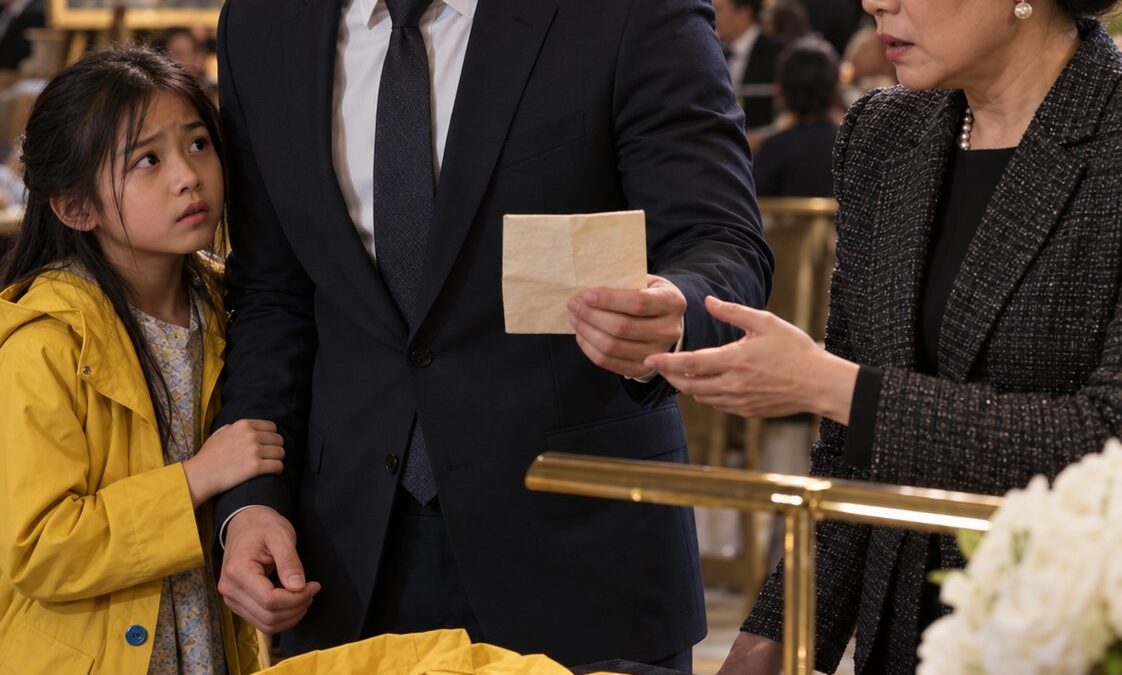
Willa stood against his side.
The auction continued around them.
Someone raised a numbered paddle.
Someone laughed near the bar.
Maren watched the letter.
“Give me that,” she said.
“Why?”
“It belongs to the donor.”
“Who donated the coat?”
“I’ll check.”
“You recognized it.”
“Willa recognized it.”
“You tried to pull her away.”
“She was getting upset.”
Reid took off his jacket.
He put it around Willa’s shoulders.
Her fingers were cold.
“Did Mom write it?” she asked.
“It looks like her writing.”
“Then she’s here?”
“I don’t know.”
He should have said those words years ago.
Instead, he had accepted Maren’s answers and given them to Willa as facts.
Maren glanced toward the entrance.
“There are reporters here.”
Reid’s company name covered the wall behind the stage.
The Harlow Family Fund paid for the auction.
Maren chaired its board.
She had arranged the cameras, the guest list, and Willa’s place at the front table.
“I don’t care about the reporters,” he said.
“You will if they photograph her.”
Reid turned the letter over.
A second page was folded beneath it.
Maren’s eyes dropped.
Willa saw that, too.
“She knows what it says,” Willa whispered.
Reid led Willa through a side door.
Maren followed them into a service corridor.
He unfolded the pages beneath a catering lamp.
The second page was a donation receipt.
One yellow raincoat had arrived at the fund’s collection office on October eighth.
June Harlow had signed as donor.
Maren Harlow had signed as recipient.
“You saw her last Thursday,” Reid said.
“I saw a woman drop off a coat.”
“Was it June?”
“She had her hood up.”
“Did you speak to her?”
“Briefly.”
“What did she say?”
Maren looked at Willa.
“She asked if Willa was well.”
Willa pressed closer to Reid.
“What did you tell her?”
“That she was.”
“You came to dinner that night.”
“Yes.”
“You had eight days to tell us.”
“I wanted to speak to June again.”
“You could have told me where to find her.”
“I don’t know where she lives.”
Maren reached for the receipt.
Reid drew it back.
“Did she leave anything else?”
“No.”
“Maren.”
“That’s all she donated.”
He heard the careful shape of her answer.
Willa touched the crooked blue button.
She had sewn it on when she was five.
June had worn the coat the week she disappeared.
Reid had once asked what happened to it.
Maren said she had donated June’s things.
Now the coat was here.
So was a letter from last Thursday.
“I want to go home,” Willa said.
“Okay.”
Maren stepped toward the door.
“The driver can bring the car.”
“I’ll take her.”
“You’re shaking.”
He was.
He put the letter inside his jacket.
Maren noticed.
Four years earlier, she had brought him a signed form.
She said June wanted distance.
She said June wanted Willa to stay.
Reid had looked at June’s name.
Then he had stopped asking questions.
Willa pulled gently at his hand.
“Dad?”
“I’m here.”
He opened the door.
Maren spoke behind him.
“You should know she asked me to do it.”
Reid turned.
“Do what?”
“Handle the papers.”
The form in his desk drawer had June’s signature.
Maren had brought it to him herself.
* * *
At home, Willa laid the yellow raincoat on her bed.
It no longer fit.
She smoothed its short sleeves anyway.
Reid opened the locked drawer in his study.
The file inside held a letter on a law firm’s stationery.
Beneath it sat a Parenting Arrangement.
June had supposedly agreed to leave Willa with Reid while she sought treatment for an unspecified health issue.
She supposedly wanted no direct contact until she felt ready.
There was no case number.
No judge’s signature.
Only June’s name and Maren’s signature as witness.
Reid photographed every page.
Then he called the firm.
The office was closed.
He left a message.
Willa appeared in the doorway wearing pajamas under his jacket.
“Are you looking for Mom?”
“Yes.”
“Can I help?”
He nearly sent her to bed.
Then he remembered her hand on the yellow sleeve.
“You already did.”
She sat beside him.
“Maren said Mom couldn’t take care of me.”
“When did she tell you that?”
“Last year.”
Reid had asked Maren to avoid explanations Willa was too young to understand.
Maren had assured him she did.
“Did you tell anyone?”
“Grandpa.”
His father had died that spring.
“He said grown-ups get things wrong.”
Reid looked down at the form.
“I got something wrong,” he said.
“Can you fix it?”
“I’m going to try.”
June had worked as a book conservator.
She taught Willa to use blue thread so she could see each stitch.
The coat’s crooked button was Willa’s first repair.
Reid looked from it to the signatures.
June usually carried the loop of her J beneath the next letter.
The signature on the old form did.
The one on the new receipt did not.
That difference might mean nothing.
It needed checking.
The next morning, a lawyer named Nia Bell returned his call.
Reid sent her the first page.
Ten minutes later, she called again.
“Our stationery looked like that,” she said.
“But?”
“The address is wrong.”
The letter was dated September.
The firm had moved to that address the following January.
Nia also found no matter under either Harlow name in the firm’s index.
She gave Reid the number of a family lawyer.
Adeline Price met him that afternoon.
She read the arrangement.
“Did you file for divorce?” she asked.
“No.”
“Did June?”
“I don’t know.”
Adeline searched the public court docket.
There was no divorce case.
No parenting case.
No order requiring June to stay away.
“This might describe a private agreement,” she said.
“But it cannot do what someone told you a court ordered.”
Reid thought of every school form Maren had completed.
Every call she had taken for him.
Every time she said June had made her choice.
Adeline asked for the original donation receipt and the collection office’s intake log.
She also requested any video from October eighth.
Reid brought the raincoat.
Willa came with him.
Adeline photographed the opened seam and the blue button.
“Do you know when you sewed it?” she asked.
“Four years ago,” Willa said.
“I did it badly.”
“It stayed on,” Adeline replied.
The collection office manager called that evening.
Her name was Ruth Albright.
She had seen June arrive.
“She wore the coat,” Ruth said.
“Did Maren speak to her?” Adeline asked.
“They went into Maren’s office.”
“For how long?”
“About fifteen minutes.”
“Did June leave alone?”
“Yes.”
Ruth hesitated.
“She was crying.”
Reid looked across the kitchen.
Willa’s coat hung over a chair.
June had worn it into Maren’s office.
She had left it where Willa might recognize it.
After Willa went to bed, Reid searched the old file again.
At the back lay an inventory of things supposedly returned to June when she left.
Wallet.
Phone.
Blue canvas suitcase.
Yellow raincoat.
Maren had signed beside the list.
She had claimed June took the coat four years ago.
Last Thursday, she had received it again.
Reid sent the page to Adeline.
She called a minute later.
“The address on the false law firm letter,” she said.
“What about it?”
“The building belongs to Calder Street Holdings.”
Reid knew the company.
It belonged to Maren.
The next morning, he and Adeline visited Ruth.
June appeared on the office video at 10:14.
Her hair was shorter.
She wore the yellow raincoat.
Ruth directed her to Maren’s office.
At 10:31, June emerged without it.
She stood at the counter.
Then she wiped her face and left.
Reid watched twice.
Ruth had heard raised voices.
“I heard June say Willa’s name,” she said.
“I should have asked if she was all right.”
“You kept the records,” Adeline said.
“They matter.”
Maren arrived before they left.
She saw the video on the monitor.
“I see you’ve made this official,” she said.
“You told me you weren’t sure it was June,” Reid replied.
“I was trying to spare you another scene.”
“You spoke for fifteen minutes.”
“Is that a crime?”
“No,” Adeline said.
“We’re here for the records.”
“You can send questions to counsel.”
Maren turned to Reid.
“Willa went to school today?”
He felt the question land.
Maren was listed as Willa’s second emergency contact.
He called the school in front of her.
The principal confirmed Willa was in class.
Reid asked her to remove Maren from the pickup list.
Maren’s face tightened.
“I’m her aunt.”
“You signed a false letter.”
“You haven’t proved who made it.”
He and Adeline left with copies.
Outside, Adeline stopped by her car.
“June called after receiving my message,” she said.
Reid looked at her.
“She’s safe.”
“Will she meet me?”
“Tomorrow, in a public place.”
“Yes.”
“She asked that Willa not come yet.”
He nodded.
June deserved to decide how their first conversation went.
“Why did she bring the coat here?” he asked.
“She hoped Maren would give you the letter.”
“And when Maren didn’t?”
“She planned to attend the auction.”
Reid remembered looking through the crowd.
“She was there?”
“She saw Willa reach for the coat.”
“Maren’s security director asked her to leave.”
Reid had once told Maren to handle anyone who came asking for him at company events.
He had meant reporters.
“I gave her that power,” he said.
“Some of it,” Adeline replied.
“She chose how to use it.”
That night, Reid made grilled cheese.
He burned one side.
Willa called it the fancy side.
“Is Mom okay?” she asked.
“Yes.”
“Does she know I found the coat?”
“Yes.”
“Was she angry?”
“No.”
Willa ate another bite.
“Does she want to see me?”
“Yes.”
“Good,” Willa said.
After she went to bed, Reid searched his old emails.
A doctor named Elaine Voss had written two weeks after June left.
June had called her about a threatened complaint.
Elaine wanted Reid to know June had sought medical advice.
Maren had replied for the family.
She asked Elaine not to contact them again.
Reid also found a message from his company’s former human resources director.
She asked who authorized Maren to use a company legal assistant to prepare June’s family papers.
Maren replied that Reid had consented.
He had not.
Elaine returned Reid’s call the next morning.
June had already permitted her to speak.
“She came to me in August,” Elaine said.
“She was frightened by an allegation that she left Willa alone.”
“Was it true?”
“I saw no reason to think so.”
“Who made it?”
“I can’t release agency records.”
Elaine paused.
“But June showed me her notice.”
Maren’s name was on it.
* * *
June chose a diner halfway between their homes.
Reid arrived early.
He ordered coffee and left it untouched.
When June entered, he recognized her at once.
She wore a gray sweater.
Her hair stopped at her chin.
“Hello, Reid.”
“June.”
They sat without embracing.
The waitress brought water.
Reid took out the old arrangement.
“Did you sign this?”
“No.”
“Did you ask Maren to handle the papers?”
“No.”
June opened a thick folder.
“I kept what I could.”
The first page was a child services notice.
Maren had reported that June left Willa alone while she worked.
A caseworker visited.
The agency found no basis for intervention.
Reid read the closing letter.
“Why didn’t you tell me?”
“I did.”
“When?”
“The night before I left.”
He remembered the kitchen.
June and Maren were arguing.
Papers covered the table.
Reid had come home late and asked them to stop until morning.
Then he went upstairs to Willa.
By morning, June was gone.
“I should have stayed,” he said.
“Yes.”
She said it quietly.
He accepted it.
June showed him letters she had mailed after leaving.
The first asked to see Willa on Saturday.
There were postal receipts for eight letters.
“None reached me,” Reid said.
“I know that now.”
“How?”
“Your father called last winter.”
Reid stared at her.
“He found me through my old supervisor.”
“Why didn’t he tell me?”
“He wanted to.”
She showed him a note in his father’s handwriting.
I will speak to Reid after his trip.
Reid had been in Boston when his father entered the hospital.
They spoke once more.
His father said he needed to tell him something about Willa.
Reid promised to call the next morning.
There had been no next morning.
June touched the note.
“He apologized for believing Maren.”
Reid turned to another page.
“Did you ever come to the house?”
“On Willa’s sixth birthday.”
A magician had performed in the garden.
Maren had managed the gate because photographers were outside.
“The guard turned me away,” June said.
“Maren came down the drive.”
“What did she say?”
“That you knew I was there.”
“I didn’t.”
“She said you’d call the police if I frightened Willa.”
“I wouldn’t have.”
“I believe you now.”
June showed him messages Maren had sent their father.
One claimed Reid had instructed her to turn June away.
Another claimed June had agreed to wait until Willa was older.
Both were false.
“Why didn’t you file in court?” Reid asked.
“I hired a lawyer.”
The lawyer had requested mediation through Reid’s company address.
Maren’s office handled family correspondence there.
No answer came.
June had worked part time then.
She feared Maren would use the agency complaint against her.
“I believed she spoke for you,” June said.
“Sometimes that was easier.”
“Than what?”
“Believing you knew and didn’t care.”
Reid could not tell her that was impossible.
He had been careless enough to make it believable.
“I didn’t know,” he said.
“I see that.”
Four months ago, June had hired Adeline.
They confirmed there was no court order.
June drafted a letter to Reid’s home but hesitated to send it.
Then his father’s note reached her among his belongings.
She decided to ask Maren for the original arrangement first.
“Maren said you wouldn’t believe me,” June said.
“So I left the coat.”
“Why sew the letter inside?”
“Maren checked my bags during my last week at home.”
Reid felt his hands go cold.
“She said she was looking for a document your father needed.”
“What document?”
June drew out a bank authorization.
Reid’s father had created an education trust for Willa.
Maren wanted an amendment putting her in sole control.
June had been asked to witness it.
She refused.
“Your father didn’t want it,” June said.
“He told me to keep that version until he returned from surgery.”
“I saw a signed version later.”
“He didn’t sign the one I saw.”
June had returned her copy to his father.
She kept a scan.
The timeline took shape.
Maren made the complaint in August.
She brought Reid the false arrangement in September.
After June left, Maren took control of Willa’s trust.
Reid had signed annual summaries.
He had never checked the underlying records.
“How much did she take?” he asked.
“I don’t know if she took anything.”
“Then why keep you away?”
“I asked her last Thursday.”
“What did she say?”
“That your father promised Willa a future she couldn’t afford to give her.”
Reid looked at the paperwork.
“That doesn’t answer anything.”
“No.”
For a while, they spoke about Willa.
She liked astronomy.
She could ride a bike.
She called burnt grilled cheese fancy.
“Does she still sing while brushing her teeth?” June asked.
“Yes.”
Reid told her the song.
June covered her mouth.
Willa had kept singing it for four years.
Then his phone lit up.
The school principal had refused a caller claiming to be Willa’s aunt.
The woman wanted to know whether Willa was in class.
Reid showed June.
Adeline had warned them Maren might react.
They called her from the diner.
She asked them to come to her office and bring their records.
Reid looked at June.
“Will you come with me?”
“Yes.”
“Willa wants to see you.”
“If she still wants to after we talk.”
“She will have that choice.”
Before leaving, Reid called his company’s finance director.
He requested every statement relating to Willa’s trust.
He also asked about a large transfer made the previous spring.
“To Calder Street Holdings?” the director asked.
“Yes.”
“The approval came from your father.”
“My father died six weeks before that transfer.”
The director fell silent.
Reid looked at June.
Maren had signed a dead man’s name.
* * *
Adeline did not promise an arrest.
She sent the records where they could be checked.
After receiving notice of the disputed approval, the bank paused further trust transfers.
An outside accountant began reviewing the statements.
Reid supplied every annual summary he had signed.
June supplied her scan of the authorization she had refused to witness.
For three days, Reid collected Willa from school himself.
Maren left two messages.
One asked him to call.
The other said she loved Willa.
He saved both.
Adeline helped arrange June’s first meeting with Willa.
They chose the public library.
Willa had gone there with June every Tuesday when she was small.
On Saturday, she carried the yellow coat over her arm.
“Mom might want it,” she said.
June waited beside the children’s shelves.
She held no gift.
Willa saw her and stopped.
June stayed where she was.
“Hi, Willa.”
“Hi.”
“You got tall.”
“I know.”
Willa took three careful steps.
Then she ran.
June knelt.
Willa wrapped both arms around her.
Reid moved toward a shelf of gardening books.
He gave them room without leaving.
After a while, Willa asked, “Why didn’t you come?”
“I tried.”
“I waited.”
“I know.”
“Did you get my birthday cards?”
June looked at Reid.
He had never mailed any.
Willa had made them and kept them in a drawer.
“I didn’t,” June said.
“May I see them someday?”
“Yes.”
June touched the blue button.
“You fixed my coat.”
“It was falling off.”
“You saved it.”
Willa studied the seam.
“You saved the letter.”
“I hoped someone would read it.”
“Dad did.”
They spent an hour together.
Willa showed June a book about moons.
June showed her that her old library card still worked.
When Willa grew tired, she asked to go home.
June kissed her forehead.
“Can I see you again?”
“Tuesday,” Willa said.
“Tuesday works,” Reid answered.
At the door, Willa turned back.
“The coat is yours, Mom.”
“Keep it until Tuesday.”
That evening, the accountant called.
He had found three transfers from Willa’s trust to Calder Street Holdings.
Together, they totaled just over two million dollars.
The first occurred while Reid’s father was alive.
The next two came after his death.
Each approval showed the same signature.
Each also showed the same stray ink mark.
“The image was copied,” the accountant said.
“Where did the money go?” Reid asked.
“Calder Street bought the old Harlow mill.”
Reid knew the property.
His father had wanted to turn it into apartments.
Maren had argued it would cost too much to repair.
Reid drove past it the next morning.
A sign at the gate announced a residential development.
The planning office confirmed the conversion had been approved.
The surrounding land had been rezoned.
Its value had risen.
Maren had used Willa’s trust to buy an asset through her own company.
She might have planned to return the principal.
She had hidden the purchase and copied the approvals.
Reid asked the accountant to document each step.
Then he called Adeline.
“Where does the evidence go?”
“The bank’s fraud team,” she said.
“Then the appropriate investigators.”
“Can I ask Maren myself?”
“With witnesses and records.”
June was sitting beside him.
“You’ve done enough alone,” she said.
He did not argue.
Adeline arranged a Friday meeting.
Maren would attend as trust manager.
A bank representative and the accountant would join them.
Reid asked June to come.
He also informed the fund’s board chair that its office and staff appeared in the records.
The chair asked whether donations had been affected.
“I don’t know,” Reid said.
“Please have the auditor check.”
By Friday, the bank had placed another hold on the disputed funds.
The fund had suspended Maren’s authority pending review.
Maren still entered the meeting with her head high.
She sat opposite Reid and June.
“You finally got his attention,” she told June.
June said nothing.
Adeline opened with the transfers.
“I know what the forms say,” Maren interrupted.
“Then tell us,” Adeline replied.
“I bought the mill for Willa.”
“Through your company?” the bank representative asked.
“A company formed to manage it.”
“Without notifying the other trustee?”
“My father knew the plan.”
“He died before two transfers,” Reid said.
“He approved it earlier.”
“That isn’t what the forms say,” Adeline replied.
Maren glanced at the accountant.
“The signatures were copied for convenience.”
The bank representative set down her pen.
“Who copied them?”
Maren did not answer.
Reid had expected her to deny everything.
Her admission gave him no relief.
“Dad wanted that mill saved,” she said.
“He wanted it developed openly,” Reid replied.
“He wanted Willa provided for.”
“She already was.”
“Not enough for the life you give her.”
Willa needed ordinary things.
Shoes that fit.
Books she could keep.
Parents who answered her questions.
The trust had held more than enough.
“You never saw how much Dad worried,” Maren said.
“Then why didn’t you tell me?”
“You would have stopped me.”
“Yes.”
“I intended to pay it back.”
The accountant slid over a statement.
“Your company collected management fees.”
“For work I did.”
“The first fee predates the purchase.”
Maren studied the page.
Adeline brought out the child services notice.
“This has nothing to do with the trust,” Maren said.
“You made the complaint,” June replied.
“I was worried about Willa.”
“The agency found no basis.”
“I didn’t know what they would find.”
“You used the allegation anyway.”
Maren turned to Reid.
“June refused to help with the trust form.”
“She refused to witness something Dad hadn’t approved.”
“She was going to frighten him after surgery.”
“He deserved to know,” Reid said.
Adeline placed June’s scan beside the bank’s first transfer approval.
The accountant pointed to the matching ink mark.
The bank version had supposedly been signed months later.
It carried an exact copy of the earlier scan.
“This proves an image was copied,” Maren said.
“It doesn’t prove I copied it.”
The bank representative nodded.
“That distinction needs investigation.”
For a moment, Maren regained her composure.
Then Ruth Albright entered with the fund’s board chair.
Ruth carried the original donation receipt.
She also carried an envelope.
“On October eighth, Maren asked me to print this,” Ruth said.
“My printer had jammed.”
“What about it?” Maren asked.
“I used the printer in your office.”
Ruth had seen a trust folder in its output tray.
She had not known its importance.
When Adeline requested preservation of the office records, Ruth mentioned it to the fund’s auditor.
The printer log showed that Maren’s account had scanned a trust transfer form the week her father died.
The bank representative examined the record.
“We’ll verify the log independently,” she said.
Maren looked at Ruth.
“You’re turning a printer into a witness.”
“No,” Adeline replied.
“Ruth is a witness.”
Reid faced his sister.
“Why June?”
“She was going to tell Dad.”
“He was entitled to know.”
“She wouldn’t wait for him to recover.”
“So you made a complaint about Willa?”
“I made sure someone checked.”
“Then you told us both it meant something else.”
Maren folded her hands.
“You let me manage that house because you couldn’t bear to.”
The words landed.
Reid had gone to work.
He had left Maren to answer calls, open mail, and explain June’s absence.
“I did,” he said.
Maren looked almost relieved.
“I will answer Willa for that,” he continued.
“But you made this form.”
He placed the false arrangement on the table.
Maren did not deny it.
The meeting ended with copies, statements, and requests for originals.
Nobody was taken away.
The bank referred the transactions for investigation.
The fund’s board removed Maren as chair.
Reid stepped off its board while the charity’s records were audited.
He would not ask anyone to trust his name instead of the evidence.
The investigation took months.
Ruth gave two statements.
The retired law firm founder confirmed the address on the letter was wrong for its date.
The former legal assistant identified the file Maren had asked her to prepare.
Maren had called it a family draft.
The assistant had never met June.
The bank reviewed how it accepted the copied approvals.
A separate civil case addressed the trust.
Calder Street Holdings sold the mill under court supervision.
Willa’s trust recovered its money, the fees, and part of the gain.
Maren pleaded guilty to financial charges tied to the copied approvals.
Her sentence required repayment and a period under supervision.
She was barred from managing other people’s funds.
The false parenting arrangement became part of the record.
The child services finding remained unchanged.
The agency had found no basis for intervention.
Before sentencing, Maren sent Reid a letter.
She wrote that he would never have checked the trust if June had stayed quiet.
He read it once.
Then he filed it with the other records.
June asked whether he would answer.
“No,” he said.
“What will you tell Willa?”
“The truth, when she asks.”
* * *
Spring arrived slowly.
Willa began spending Saturdays with June.
Then Wednesday afternoons.
Then weekends.
Reid and June made the schedule with Willa in the room.
She wanted Tuesdays to remain library days.
They agreed.
She asked whether she could keep two toothbrushes.
They bought two.
She asked which house was her real home.
“Both, if you want,” June said.
Willa considered it for a week.
Then she decided both counted.
Reid learned to pack an overnight bag.
His first attempt held four sweaters and no socks.
Willa wrote him a list.
June drew socks at the bottom.
He taped it inside the closet.
Reid and June made a parenting agreement with their lawyers.
Their marriage did not repair itself on a schedule.
Sometimes they talked over coffee.
Sometimes a conversation went badly.
They stopped when they needed to.
Then they tried again.
“I let Maren speak for me,” Reid said one afternoon.
“I’m sorry.”
“I believed her at the gate,” June said.
“I should have found another way to reach you.”
Neither apology restored the missing years.
Both mattered to the next day.
June brought the yellow raincoat to Reid’s house.
She had mended its lining.
She left the crooked blue button where Willa put it.
“It should be in her room,” June said.
“If she wants it there,” Reid answered.
Willa appeared on the stairs.
“I do.”
She took the coat.
Then she looked at both of them.
“Can we have dinner?”
They could.
Reid made pasta.
June brought bread.
Willa set three places.
No one called it a reunion.
Willa described a science project involving worms.
Reid asked questions.
June asked better ones.
Willa answered all of them.
The fund’s audit found no loss of charitable donations.
Maren had used office equipment and staff time.
Those costs were repaid.
Reid offered to fund legal assistance for families in parenting disputes.
The board proposed putting his name on it.
“Give families a number they can call,” he said.
“That matters more.”
His company changed its mail policy.
No relative could intercept personal correspondence through a company office.
Reid wished the rule had existed four years earlier.
Willa turned ten in June.
She wanted a small party at the library.
June baked a moon cake.
Reid brought candles but forgot matches.
The librarian found a lighter.
“Successful team effort,” Willa announced.
Later, she asked whether Maren would ever visit.
Reid sat beside her on the library steps.
“I don’t know.”
“Did she say sorry?”
“Not to you.”
“Could I write to her?”
“Yes.”
“Do I have to?”
“No.”
Willa leaned against him.
“I’m not ready.”
“Then you don’t have to.”
At the end of summer, June was offered six months of book restoration work in another city.
Reid asked for the dates.
June had already checked when she could return.
They made a schedule with Willa.
“Can I visit the books?” Willa asked.
“Some of them,” June said.
“Can Dad?”
“If he behaves.”
“I’ll try,” Reid said.
“Are you getting married again?” Willa asked.
June set down her pen.
“No,” she said gently.
“We’re making sure you have us both.”
Willa accepted that.
Then she asked whether the new city had a planetarium.
It did.
They planned a visit.
Some days remained hard.
A classmate asked why June had been gone.
Willa said there had been a grown-up lie.
Her teacher called home.
Reid and June met with her together.
They shared only what Willa was comfortable sharing.
They told Willa she did not have to explain their family to anyone.
At home, Willa found her old birthday cards.
She gave June the one from her sixth birthday.
Three stick figures stood beneath a purple sun.
Inside, Willa had written, I saved you cake.
A frosting stain marked one corner.
“I’m sorry I missed it,” June said.
Willa leaned against her.
“You got this one.”
June kissed her hair.
“I did.”
That evening, June asked Reid to walk with her.
A trusted neighbor stayed with Willa.
“I need you to keep asking when something feels wrong,” June said.
“I will.”
“Even when you trust the person.”
“Especially then.”
That was a boundary they could both live with.
When they returned, Willa showed them a drawing.
Two houses stood on opposite sides of the page.
A path connected them.
On it stood a small figure in a yellow coat.
“She’s going both ways,” Willa explained.
“Is she cold?” Reid asked.
“No.”
“Then why the coat?”
Willa gave him a patient look.
“It helps people find her.”
* * *
Five years later, the auction hall became a community reading room.
The fund had sold the building to the city.
June helped restore its oldest books.
Reid paid for shelves and declined a plaque.
Willa, now fifteen, argued for more chairs.
The city listened.
On opening day, she stood beside the long table where she had once recognized a yellow sleeve.
Children’s drawings covered it now.
Paper moons hung above.
June carried a box of donated books.
Reid carried the heavier one.
Willa carried the coat.
It was too small for any of them.
She placed it inside a clear case near the entrance.
Beside it was a note she had written.
The note did not name Maren.
It said the coat had helped a family find its way back to one another.
The crooked blue button faced outward.
June had sewn a new pocket inside the lining.
Willa had sat beside her while she worked.
This time, they put nothing secret in it.
Willa tucked in her library card.
It worked in both neighborhoods.
June smiled.
“Is that where you want it?”
“For now.”
Reid looked at the coat.
He remembered Willa’s voice at the auction.
Dad, that’s Mom’s coat.
She had been right before he was ready to listen.
Willa came to stand between them.
“Are you going to stare all afternoon?”
“Possibly,” Reid said.
“There are books over there.”
“And chairs,” June added.
They crossed the room together.
A child reached for a book.
Her father helped her open it.
Willa sat by the window.
June took one chair beside her.
Reid took the other.
Willa began to read aloud.
Neither of them asked her to hurry.
THE END








