“Do not take another step toward my child,” the billionaire warned, but the soaking-wet street boy refused to run.
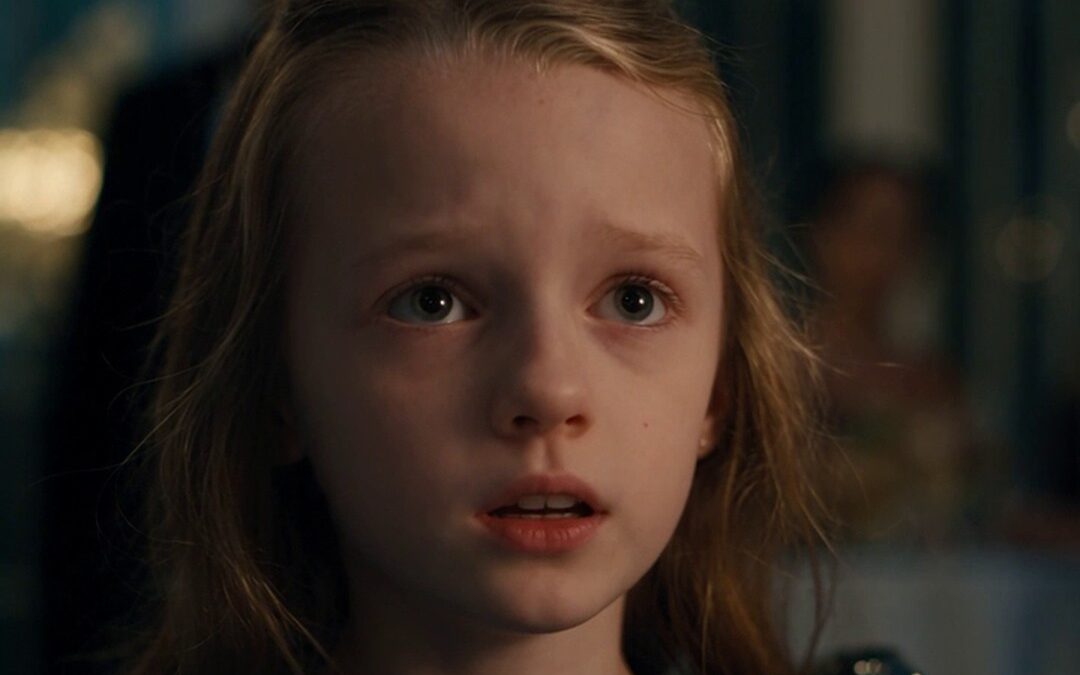
Chapter 2: The Broken Watch
Clara swayed on the marble.
Her knees buckled.
Vance caught her by the waist.
He pulled her into his chest.
She was trembling.
Her small hands gripped the silver watch.
She buried her face in his neck.
“Papa,” she sobbed.
“I have you,” Vance whispered.
“I have you, darling.”
Tears streamed down his cheeks.
He looked up at the boy.
Two security guards seized the boy’s shoulders.
The boy did not fight them.
“Let him go,” Vance ordered.
His voice was like iron.
The guards hesitated.
“Sir, he broke into the estate,” the head guard said.
“Take your hands off him,” Vance said.
The guards stepped back immediately.
The guests watched in dead silence.
Nobody in high society had ever seen Vance Montgomery cry.
Not at the funeral.
Not at the public hearings.
Not once in three agonizing years.
Vance lifted Clara into his arms.
She clung to his tuxedo jacket.
She refused to let go of the watch.
“Come with me,” Vance told the boy.
“My boots will ruin the rug,” the boy said.
“I do not care about the rugs.”
Vance turned toward the private corridor.
“Clear this room,” Vance told the staff.
“Send every guest home.”
“Cancel the rest of the gala.”
Julian Montgomery stepped into his path.
Julian wore an Italian dinner jacket.
He was Vance’s first cousin.
He was also the chief procurement officer of Montgomery Infrastructure.
“Vance, think about what you are doing,” Julian urged quietly.
“The press is outside.”
“This is an obvious shakedown.”
“Get out of my way, Julian,” Vance said.
Julian stared at the boy.
His jaw tightened.
A strange flicker crossed Julian’s eyes.
Not surprise.
Not concern.
Pure cold alarm.
“I am only protecting our family name,” Julian muttered.
“Step aside,” Vance repeated.
Julian stepped back against the glass wall.
Vance carried Clara into his private study.
The boy followed three paces behind.
The heavy mahogany doors clicked shut.
The noise of the ballroom died instantly.
A peat fire burned in the hearth.
Rain lashed against the tall leaded windows.
Vance placed Clara gently onto the leather sofa.
Her legs rested on the velvet cushions.
Her face was pale, but her eyes were alive.
The boy stood near the hearth rug.
Water pooled beneath his worn boots.
He was shivering violently.
His lips were faintly blue from the autumn chill.
Vance walked to the oak wardrobe.
He pulled out a heavy woolen blanket.
He draped it around the boy’s shoulders.
“Sit down,” Vance said softly.
The boy sat on the edge of a leather armchair.
He pulled the blanket tight around his thin chest.
“What is your name?” Vance asked.
“Jonah,” the boy replied.
“Jonah what?”
“Jonah Weaver.”
Vance knelt in front of the chair.
He did not care about the water on his trousers.
He pointed at the silver watch in Clara’s hands.
“Where did you get that, Jonah?”
“From the riverbank,” Jonah said.
“When?”
“The night the bridge fell.”
Vance felt a sharp pain in his ribs.
“Three years ago?”
Jonah nodded.
“You were only six years old,” Vance said.
“I remember every second,” Jonah answered.
“Why bring it tonight?”
“Because of the bulldozers,” Jonah said.
Vance frowned.
“What bulldozers?”
“The ones at the foundry flats,” Jonah said.
“Men came today with yellow papers.”
“They said our shacks are being torn down at dawn.”
“They said nobody could stop them.”
“My grandfather is too sick to move.”
“He told me to run.”
“He told me to bring the watch to the big house.”
Vance looked at Clara.
Clara was running her thumb over the carved swallow.
She pressed the tiny release button on the side.
The lid popped open.
The hands remained frozen at four eighteen.
That was the exact minute the center span collapsed.
Inside the lid was an engraved inscription.
Vance knew every single letter by heart.
To Eleanor, My Swallow, Forever Vance.
It was not a replica.
It was the one-of-a-kind timepiece he had designed for their wedding.
Vance swallowed hard.
“Your grandfather found it in the mud?” Vance asked.
“No,” Jonah said.
The boy looked directly into Vance’s eyes.
“My grandfather pulled Clara out of the water.”
* * *
The room seemed to lose all air.
Vance did not move.
His heart hammered against his ribs.
“Say that again,” Vance whispered.
“My grandfather pulled her out,” Jonah said.
“His name is Caleb Weaver.”
“He was an ironworker at the old foundry.”
“He was walking home along the riverbank that night.”
“The bridge cracked.”
“The big black car fell into the current.”
“He jumped into the freezing water.”
“He smashed the rear passenger window with a railroad spike.”
Vance gripped the arm of the chair.
His knuckles turned stark white.
“The police report said a fisherman pulled her out,” Vance said.
“The report said the fisherman ran away before the ambulances arrived.”
“That was my grandfather,” Jonah said.
“Why did he run?”
“He didn’t run to hide,” Jonah said.
“He was coughing up blood from the freezing water.”
“He had to get home to his medicine.”
“Before she sank, the lady in the front seat pushed this watch into his hand.”
“She told him to make sure Clara lived.”
“She told him the swallow always flies home.”
Clara began to weep softly on the sofa.
“Mama held my hand,” Clara whispered.
“Mama told the man to take me.”
Vance buried his face in his hands for five seconds.
He forced himself to breathe.
He stood up.
His mind shifted from grief to precision.
He was a builder.
He dealt in load-bearing facts.
“Where is your grandfather right now?” Vance asked.
“In our shack by the coal pier,” Jonah said.
“He cannot walk.”
“His lungs filled with water that night.”
“He has been on an oxygen tank ever since.”
Vance walked to his desk.
He picked up the landline telephone.
He dialed three digits.
“Martin,” Vance said when the call connected.
Martin Hayes was his chief legal counsel and closest friend.
“I need you in my study right now,” Vance said.
“Bring the private car around to the side terrace.”
“Do not use the main driveway.”
Two minutes later, Martin entered the study.
Martin was fifty, gray-haired, and sharp-eyed.
He took in the scene at a glance.
The shivering boy in the blanket.
Clara sitting upright without her chair.
The silver watch resting on the sofa.
Martin stared at Clara.
“My God, Vance,” Martin breathed.
“She is sitting up.”
“She spoke, Martin,” Vance said.
Martin adjusted his glasses.
“What is happening?”
“We are going to the foundry flats,” Vance said.
“Right now?”
“Right now.”
Vance called his head housekeeper, Mrs. Gable.
Mrs. Gable was fifty-eight and had raised Clara since infancy.
She came into the room with wide eyes.
“Stay with Clara,” Vance instructed gently.
“Do not leave this room.”
“Lock both doors from the inside.”
“Do not open them for anyone except me.”
“Not even family?” Mrs. Gable asked.
“Especially not family,” Vance said cold as ice.
Clara looked up at him.
“Papa, don’t leave me.”
Vance knelt beside her.
He kissed her forehead.
“I am going to find the man who saved your life,” Vance said.
“I will be back in one hour.”
“I promise you.”
Clara held out the silver watch.
“Take it with you,” she said.
“Keep it safe.”
Vance closed his hand over the silver casing.
The metal was warm from her palms.
He slipped it into his breast pocket.
“Come, Jonah,” Vance said.
They left through the garden terrace.
The cold autumn rain struck their faces.
Martin’s black sedan waited under the dripping oaks.
They climbed inside.
Martin steered the car past the iron gates.
They drove down the winding hill away from the estates.
They crossed into the lower industrial ward.
The streets grew narrow and cracked.
Abandoned brick warehouses loomed in the dark.
Water ran in deep gutters along the railway tracks.
Jonah pointed through the rain-streaked windshield.
“Down there,” Jonah said.
“Past the coal tipple.”
The car bumped over wet gravel.
Row upon row of dilapidated wooden shacks stood near the river.
They were built from salvaged timber and corrugated zinc.
The Blackwood River rushed black and swollen fifty yards away.
Two large yellow bulldozers sat parked in the mud.
Their engines were silent, but their steel blades gleamed in the headlights.
A sign was staked into the mud.
EMERGENCY MUNICIPAL CONDEMNATION.
DEMOLITION SCHEDULED 0600 HOURS.
BY ORDER OF THE METROPOLITAN TRANSIT AUTHORITY.
“This land belongs to the city,” Martin noted.
“No,” Vance said, studying the sign.
“Montgomery Infrastructure holds the lease on this shoreline.”
“We bought it twenty years ago.”
“I never authorized a demolition here.”
They stepped out into the pouring rain.
Jonah led them down a narrow wooden boardwalk.
He pushed open the door of a crooked shack.
The smell of damp pine and menthol hung in the air.
A small wood stove radiated faint heat.
An old man lay on a narrow cot against the back wall.
A plastic cannula ran from a hissing oxygen tank into his nose.
His face was gaunt, carved with deep wrinkles of hard labor.
His gray hair was plastered to his forehead.
He opened his watery blue eyes.
“Jonah?” the old man rasped.
“I am here, Grandfather,” Jonah said.
Jonah ran to the cot and took the old man’s hand.
“I brought him,” Jonah said.
The old man turned his head slowly.
He looked at Vance’s expensive overcoat.
He looked at Vance’s face.
“You look like her,” Caleb Weaver whispered.
“The eyes are different.”
“She had kinder eyes.”
“Her name was Eleanor,” Vance said.
He pulled a wooden stool beside the cot and sat down.
“I know her name,” Caleb said.
He reached under his thin mattress with trembling fingers.
He pulled out a flat tin box.
The metal was rusted around the hinges.
Caleb pushed the box toward Vance.
“Take it,” Caleb said.
“I never wanted to keep it.”
“I was afraid they would take Jonah away.”
“Who would take him?” Vance asked.
“The company men,” Caleb said.
Vance opened the tin box.
Inside was a pair of diamond-and-emerald earrings.
They matched the necklace Eleanor wore the night she died.
Beneath the earrings lay a small, water-damaged leather ledger.
It was Eleanor’s personal journal.
Her handwriting was faded by river water, but still legible.
Vance’s hands began to shake.
“She kept notes,” Caleb rasped.
“She knew the bridge was rotten.”
Vance looked up sharply.
“What did you say?”
“I worked forty years in the foundry,” Caleb said.
“I poured steel for thirty of them.”
“I knew the sound of bad metal.”
“When that bridge came down, it didn’t snap from water pressure.”
“The suspension anchors gave out.”
“Someone used cheap slag bolts.”
“They paid for grade-eight high-tensile steel.”
“They installed grade-two scrap iron.”
Caleb pointed a crooked finger at the tin box.
“There is a sheared bolt in the corner of that box,” Caleb said.
“I fished it out of the wreckage when I pulled the girl to shore.”
Vance reached into the box.
His fingers touched a heavy piece of jagged gray iron.
It was four inches thick.
The fracture was flat and porous.
Any junior engineer could see the truth in five seconds.
The metal was full of air bubbles and slag impurities.
It had sheared like dry chalk under the weight of the evening traffic.
On the flat head of the bolt, a manufacturer’s stamp was visible.
It was not the Montgomery foundry seal.
It was a crude counterfeit mark.
And stamped right below it was a batch code.
B-774-K.
Vance felt a freezing cold run down his spine.
He knew that batch code.
He had seen that exact code on an internal audit report two days after the collapse.
Julian had presented that report to the board of directors.
Julian had sworn under oath that the batch code belonged to an overseas supplier that went bankrupt.
Julian had signed the emergency replacement order himself.
“Julian,” Vance muttered.
The lie did not start in the river.
It started in his own family.
* * *
Vance closed the tin box.
The metal latch made a sharp snap.
“Martin,” Vance said without turning around.
“I am here,” Martin answered from the doorway.
“Call an private ambulance.”
“Get Caleb to St. Jude’s Memorial Hospital.”
“Book the private suite under my personal name.”
“Put two armed security guards at the door.”
“Nobody enters without my written signature.”
Caleb shook his head weakly against the pillow.
“I cannot pay for a hospital, Mr. Montgomery,” Caleb whispered.
“You will never pay for anything again,” Vance said.
“You saved my daughter.”
“You preserved the evidence of my wife’s murder.”
“Murder?” Martin echoed from the doorway.
Martin stepped into the dim light of the lantern.
“Vance, be careful with that word.”
“That is manslaughter at minimum,” Vance replied.
“Julian substituted structural bolts on a public suspension bridge.”
“He pocketed the price difference.”
“He knew Eleanor drove across that bridge every single evening at four fifteen.”
“Did she know?” Martin asked quietly.
Vance opened Eleanor’s leather ledger.
He turned the brittle, water-stained pages.
The ink was faded purple.
The entry was dated October twelfth, three years ago.
The exact day of the collapse.
Vance read the words aloud in a low, steady voice.
“Discovered the offshore invoices in Julian’s private safe.”
“He transferred seven million dollars to a holding company in Nassau.”
“The Blackwood anchors were forged from recycled slag.”
“I am taking the files to the district attorney at four thirty.”
Vance closed the book.
His chest burned with rage.
“She wasn’t driving home,” Vance said.
“She was driving to the prosecutor’s office.”
“Julian knew she had the files.”
“Did he know the bridge would collapse right then?” Martin asked.
“He knew the traffic load at four o’clock would stress the weak anchors,” Vance said.
“Or he simply didn’t care.”
“He gambled with hundreds of lives to cover his theft.”
A loud metallic crash echoed outside the shack.
Jonah jumped to his feet.
The boy pressed his face against the cracked glass of the window.
“The yellow machines are moving,” Jonah said.
Vance stood up.
He walked to the window.
Two heavy bulldozers had turned their headlights on.
The blinding beams cut through the pouring rain.
A dark black SUV was parked beside them.
Three men in heavy yellow slickers stood in the mud.
A fourth man stood under a large black umbrella.
Even through the rain, Vance recognized the tailored wool coat.
It was Julian.
Julian had followed them.
Julian spoke to the machine operators.
He pointed his umbrella directly at Caleb’s shack.
“He wants to destroy the shack tonight,” Martin said.
“He wants Caleb buried under the rubble,” Vance replied.
“He doesn’t know we have the box.”
Vance stepped out into the rain.
He did not take an umbrella.
Water soaked through his silk evening shirt.
He walked straight across the mud toward the headlights.
Martin followed close behind him.
The bulldozer engines roared, spitting black diesel smoke into the night air.
The steel blade lifted two feet off the ground.
The machine began to roll forward.
Vance stepped directly into the path of the left tread.
He stood motionless in the glare of the lights.
The driver slammed on the brakes.
The heavy steel machine skidded to a halt six feet from Vance’s chest.
Julian lowered his umbrella slightly.
His face was pale in the harsh halogen beam.
“Vance?” Julian shouted over the diesel roar.
“What on earth are you doing here?”
“Turn the engines off,” Vance said.
His voice was not loud, but it cut through the rain.
“This is a condemned zone,” Julian shouted.
“The city ordered an emergency clearance.”
“The soil is unstable after the heavy rain.”
“I am protecting the company from liability.”
“I said turn them off,” Vance repeated.
Julian gestured to the driver.
The driver cut the ignition.
The massive engine sputtered and died.
The only sound left was the pounding rain and the rushing river.
Julian walked forward through the deep mud.
His expensive leather shoes were ruined.
He tried to smile.
It was a tight, ugly grimace.
“Vance, you are having a breakdown,” Julian said smoothly.
“First the scene at the gala.”
“Now you are standing in a slum at midnight.”
“The board is already calling me.”
“They saw Clara stand up.”
“They think you staged a medical miracle to inflate stock value before the merger.”
Vance looked at his cousin.
He did not blink.
“You came here yourself, Julian,” Vance said.
“Why would the chief procurement officer supervise a midnight demolition?”
“I wanted it done cleanly,” Julian answered.
“Without press.”
“Without homeless advocates creating trouble.”
“Where is the boy, Vance?”
“Safe,” Vance said.
“Where is the old man?”
“Also safe.”
Julian’s eyes narrowed.
“The old man is a squatter, Vance.”
“He has no rights to this land.”
“He has something better than rights,” Vance said.
“He has evidence.”
Julian went completely rigid.
A droplet of rain fell from the tip of his nose.
“What evidence?” Julian asked.
“Batch B-774-K,” Vance said quietly.
Julian did not answer.
He did not blink.
He stood frozen in the headlights.
“I don’t know what that code means,” Julian said after four seconds.
“You signed the purchase order,” Vance said.
“You signed the shipping manifest.”
“And Eleanor found the offshore account in Nassau.”
Julian’s umbrella tilted backward.
His veneer of polished sophistication cracked down the middle.
“Eleanor was confused,” Julian whispered.
“She didn’t understand structural finance.”
“She understood theft,” Vance said.
“She understood murder.”
Julian took one step closer.
His voice dropped to a vicious hiss.
“You have no proof that holds up in a courtroom, Vance.”
“The bridge wreckage was cleared three years ago.”
“The city stamped the file as an act of God.”
“The state board closed the investigation.”
“You are one man carrying a dead woman’s diary.”
“The board of directors will remove you by noon tomorrow.”
“I already have four votes pledged to declare you incompetent.”
“You will lose the company.”
“You will lose custody of Clara.”
“She will spend the rest of her childhood in a private sanitarium.”
Vance felt a cold, deliberate calm wash over him.
He did not strike Julian.
He did not raise his voice.
He looked at the man he had shared holidays with for thirty years.
“Tomorrow morning at nine,” Vance said.
“The full board will convene at headquarters.”
“Bring your votes, Julian.”
“Bring every lawyer you have.”
“Because I am bringing the swallow.”
* * *
The boardroom of Montgomery Infrastructure sat on the fiftieth floor of the downtown tower.
The floor-to-ceiling glass windows overlooked the entire city.
Below, the Blackwood River looked like a silver ribbon cutting through the concrete.
It was eight forty-five in the morning.
Nine board members sat around the forty-foot table of polished rosewood.
They were men and women of immense wealth and conservative power.
They wore tailored gray suits and gold wristwatches.
Julian sat at the far end of the table.
He had showered and changed into a fresh navy suit.
His hair was neatly combed back.
He had two corporate defense attorneys sitting directly behind him.
In front of Julian lay a thick stack of printed binders.
On the cover of each binder was stamped:
PETITION FOR EMERGENCY LEADERSHIP TRANSITION.
Julian looked relaxed.
He sipped black coffee from a porcelain cup.
“Thank you all for arriving on such short notice,” Julian said smoothly.
“As you saw last night, our chairman has suffered a severe emotional break.”
“He brought a vagrant child into a public gala.”
“He claimed a medical miracle took place.”
“Then he spent the midnight hours confronting municipal contractors in a city slum.”
“The market opened twenty minutes ago.”
“Our stock has already dropped four percent on rumors of executive instability.”
“We cannot allow Vance’s personal tragedy to sink this enterprise.”
A senior board member, Arthur Vance, cleared his throat.
Arthur was seventy-two and Eleanor’s distant uncle.
“Where is Vance now, Julian?” Arthur asked.
“He has not arrived,” Julian replied with a sad shake of his head.
“His private secretary says he has not been home all night.”
“I fear he is no longer capable of rational governance.”
“I move that we vote immediately to appoint me as acting chairman.”
“I second the motion,” another director said.
The double doors at the end of the boardroom swung open.
The heavy brass latch clicked against the marble jamb.
Nobody spoke.
Vance walked into the room.
He wore a dark charcoal suit, crisp and immaculate.
His face was pale, but his posture was upright.
Beside him walked Martin Hayes, carrying a battered leather briefcase.
And behind them walked Detective Frank Miller of the State Financial Crimes Division.
Julian did not stand up.
His coffee cup rattled faintly against the saucer.
“Vance,” Julian said, recovering his smooth tone.
“We were just discussing your health.”
“I am in excellent health, Julian,” Vance said.
Vance walked to the head of the table.
He did not sit down.
He rested his palms flat against the polished rosewood.
“Before you vote on my removal,” Vance said, “there is a presentation you must see.”
“We don’t have time for personal dramatics, Vance,” Julian said sharply.
“The market is moving.”
“This is not dramatics,” Vance said.
“This is structural engineering.”
Martin Hayes opened his briefcase.
He pulled out the jagged gray piece of sheared steel.
He set it directly in the center of the table.
The heavy metal clunked against the rosewood.
Several board members leaned forward to look.
“What is that?” Arthur asked.
“That is the suspension anchor bolt from the Blackwood Bridge,” Vance said.
“Retrieved from the riverbank the night of the collapse.”
Julian let out a short, mocking laugh.
“That could be scrap metal from any junkyard in the county,” Julian said.
“You cannot verify chain of custody on a rusty piece of iron.”
“We can,” Detective Miller spoke up.
The detective stepped forward and placed a blue folder on the table.
“Caleb Weaver recovered this bolt,” Detective Miller said.
“He was the welder who pulled Clara Montgomery from the river.”
“His statement was sworn under oath this morning at St. Jude’s Hospital.”
“In the presence of the county prosecutor and an independent magistrate.”
Julian’s face tightened.
“A homeless squatter’s statement means nothing,” Julian argued.
“He is an illiterate laborer looking for a settlement.”
“He has forty years of union certifications,” Vance said.
“He knows more about high-tensile steel than anyone in this room.”
“And he kept something else.”
Vance reached into his pocket.
He pulled out Eleanor’s silver pocket watch.
He set it beside the bolt.
The room fell completely silent.
Every director recognized Eleanor’s watch.
“What does a broken watch prove?” Julian demanded.
His voice rose half an octave.
“It proves Eleanor knew what you did,” Vance said.
Vance reached out.
He pressed the release button on the watch.
The lid popped open.
Vance did not point at the hands stopped at four eighteen.
He slid his fingernail beneath the inner rim of the casing.
The inner dust cover snapped loose.
A tiny folded square of waterproof drafting film lay hidden inside.
Eleanor had placed it there before she left the house that morning.
Vance unfolded the translucent paper.
He laid it flat on the table.
It was a photocopy of a wire transfer receipt.
Seven million two hundred thousand dollars.
From the Montgomery Infrastructure procurement fund.
To an account at the Bank of Nassau.
Beneficiary: Julian Vance Montgomery.
Authorized by Julian’s private digital signature.
Julian stared at the paper.
The color drained completely from his face.
His hands began to shake on the table.
“That is a forgery,” Julian stammered.
“Anyone could produce a fake bank slip.”
“We didn’t rely on the slip,” Detective Miller said calmly.
Miller pulled a second document from his folder.
“We subpoenaed the Nassau account three hours ago under an emergency federal warrant.”
“The funds arrived on October tenth, three years ago.”
“Two days later, forty thousand dollars was transferred from that exact account to a commercial demolition firm.”
“To clear the shanties at the foundry flats.”
“And this morning, your offshore bank confirmed the account balance.”
Julian pushed his chair back.
The legs screeched loudly against the hardwood floor.
He looked around the table.
Not a single director looked back at him.
Arthur Vance looked at the floor in disgust.
The other board members turned their heads away.
“You don’t understand,” Julian whispered.
His voice was hoarse.
“The company was overleveraged.”
“The original steel supplier went on strike.”
“We were facing twenty million dollars in delay penalties.”
“I had to keep the project on schedule.”
“You substituted scrap iron,” Vance said.
“You knew the bridge could not carry the rush hour load.”
“And when Eleanor found out, you let her drive across it.”
Julian’s eyes darted toward the door.
Two uniformed state troopers stepped into the boardroom.
They stood with their hands resting on their utility belts.
Julian looked at Vance.
His polished mask fell away completely.
A raw, ugly venom showed in his eyes.
“You think you won, Vance?” Julian sneered.
“You built your whole life on concrete and steel.”
“And you couldn’t even keep your own wife alive.”
“She died in the mud while you were sitting in your glass tower.”
The room gasped at the cruelty.
Vance did not flinch.
He looked at Julian with cold, unwavering pity.
“She died saving our daughter,” Vance said.
“And a nine-year-old street boy had more honor than you will ever possess.”
Vance nodded to Detective Miller.
“Take him out.”
The troopers stepped forward.
The handcuffs clicked shut around Julian’s wrists.
The sound echoed clearly across the silent boardroom.
They marched him through the double doors.
His expensive shoes scuffed against the marble.
Then the doors closed.
The room was quiet.
Vance picked up the silver watch.
He held it gently in his palm.
“Meeting adjourned,” Vance said.
* * *
Six months passed.
Spring came to the valley.
The cold gray rains gave way to warm sunshine and budding apple trees.
In the garden of the Montgomery estate, the white lilacs were in full bloom.
Clara walked across the green lawn.
She did not use a wheelchair.
She did not use leg braces.
She held a small silver-tipped cane in her right hand, but her steps were steady.
Her cheeks were rosy with health.
Jonah walked beside her.
He was wearing clean canvas trousers and a fresh blue cotton shirt.
He carried a wooden basket filled with fresh strawberries.
“You walk faster than you did last week,” Jonah noted.
“The doctor said I don’t need the cane next month,” Clara said proudly.
“Can you run?”
“Watch me,” she laughed.
She let go of the cane and took five quick, running steps across the grass.
She stumbled slightly, but caught her balance.
She looked back at him, beaming.
Vance watched them from the stone terrace.
He held a cup of black coffee.
Beside him sat Caleb Weaver in a comfortable wicker armchair.
Caleb looked completely different.
His skin had color again.
He wore a warm tweed jacket.
A portable oxygen concentrator rested quietly beneath his chair, but the cannula hung loosely around his neck.
The doctors at St. Jude’s had cleared the chronic fluid from his lungs.
He lived now in a sunny brick cottage on the eastern edge of the Montgomery estate.
“She looks like a normal child again,” Caleb said softly.
“She is a normal child,” Vance said.
“Because of you.”
Vance reached into his jacket.
He pulled out an envelope of heavy cream paper.
He set it on the small glass table between their chairs.
“What is that?” Caleb asked.
“A settlement,” Vance said.
“Three million dollars in an unrestricted trust.”
“And the deed to the cottage.”
Caleb looked at the envelope.
He did not touch it.
He took a slow sip of his tea.
“Take it back, Mr. Montgomery,” Caleb said.
“Caleb, you risked your life,” Vance urged.
“You destroyed your health in that river.”
“You raised Jonah in a shack because you had no pension.”
“You earned every penny of this.”
Caleb shook his head firmly.
“I didn’t jump into that black water for a check, Vance.”
“I jumped because a little girl was drowning.”
“If I take three million dollars for that, it turns an honest act into a business deal.”
“I am an ironworker.”
“I don’t need three million dollars.”
“I have a warm bed.”
“I have three meals a day.”
“And I get to watch that boy eat strawberries in the sun.”
Vance looked at the old man.
He felt humbled.
In thirty years of business, he had never met anyone who refused wealth.
“Then let me ask you something else,” Vance said.
“Speak your mind,” Caleb said.
“The old foundry flats by the river,” Vance said.
“Montgomery Infrastructure owns all forty acres.”
“I canceled the municipal demolition.”
“I want to build something there.”
Caleb looked up, curious.
“Build what?”
“A trade academy and housing community,” Vance said.
“For the families who live along the rail line.”
“Clean brick apartments.”
“A modern clinic.”
“A school for technical apprenticeships.”
“And I want to name it the Weaver Institute.”
Caleb’s eyes filled with tears.
His chin trembled.
“You would do that?” Caleb asked.
“I have already funded the endowment,” Vance replied.
“Fifty million dollars.”
“You will serve as the honorary chairman of the board.”
Caleb wiped his eyes with a handkerchief.
“That,” Caleb whispered, “is something I will accept.”
Vance picked up the white envelope from the table.
He tore it cleanly in half.
He dropped the pieces into his pocket.
“Now there is one more matter,” Vance said.
He stood up and walked toward the lawn.
“Jonah,” Vance called out.
The boy stopped picking strawberries and ran up the stone steps.
“Yes, Mr. Montgomery?”
“Come sit down,” Vance said.
Jonah sat on the low stone balustrade.
Vance knelt down in front of him.
He looked the nine-year-old boy in the eye.
“You know Julian is going to federal prison,” Vance said.
“Yes,” Jonah said.
“The papers said twenty-five years.”
“That is correct,” Vance said.
“The court closed the case yesterday.”
“Justice has been done.”
“Now we have to think about the future.”
Jonah shifted nervously.
“Do I have to go to a boarding school?”
“Do you want to go to a boarding school?” Vance asked.
“No,” Jonah said immediately.
“Then you will not,” Vance smiled.
“Jonah, you have your grandfather.”
“He will always be your grandfather.”
“Nobody will ever take his place.”
“But Clara needs a brother.”
“And I would be honored to be your legal guardian.”
“To raise you here.”
“To send you to school.”
“To teach you how to build bridges that never fall.”
Jonah looked at Caleb.
Caleb smiled with tears rolling down his cheeks.
“Don’t look at me like that, boy,” Caleb said gently.
“You’ve got two homes now.”
“Go on and answer the man.”
Jonah looked back at Vance.
He held out his hand.
It was not a child’s timid gesture.
It was an ironworker’s firm grip.
“I would like that,” Jonah said.
“Very much, sir.”
“Call me Vance,” the man replied.
Clara ran up the steps.
She threw her arms around Jonah’s neck.
She pressed the silver watch into his palm.
“You keep it today,” Clara said.
“Why me?” Jonah asked.
“Because you brought it back to us,” she said.
* * *
Five years later.
October twelfth.
A crisp autumn afternoon in the valley.
The sky was pale blue, washed clean by morning breeze.
A crowd of three thousand people stood on the riverbank.
Flags fluttered in the wind.
Above the water stretched a magnificent new suspension bridge.
It was four lanes wide.
Its massive steel arches gleamed like burnished silver in the sun.
The suspension cables were three feet thick, anchored deep into solid granite bedrock.
A bronze plaque was mounted at the entrance of the pedestrian walkway.
THE ELEANOR MONTGOMERY MEMORIAL BRIDGE.
BUILT TO STAND FOREVER.
Vance stood at the center of the span.
His hair was silver at the temples, but his eyes were bright.
Beside him stood Clara.
She was twelve years old now.
She was tall and slender, with her mother’s dark hair and proud posture.
She wore a dark green coat and no cane.
She walked with complete confidence above the rushing water.
Beside her stood Jonah.
He was fourteen, broad-shouldered and tall.
He wore an apprentice engineer’s jacket from the Weaver Institute.
In his breast pocket rested the silver watch.
He had cleaned the gears himself in the foundry laboratory.
It ran smoothly now.
A soft, steady tick echoed against his chest.
Old Caleb sat in a wheelchair at the ribbon-cutting platform below.
He was waving up at them with a wide smile.
Vance looked down at the dark river fifty feet below.
The water was calm today.
Small ripples caught the afternoon light like scattered diamonds.
“Do you remember the water, Clara?” Vance asked quietly.
“I remember being cold,” she answered.
“And then I remember Caleb’s hands.”
“And Jonah’s voice.”
Jonah pulled the silver watch from his pocket.
He looked at the carved swallow on the lid.
The metal was polished until it shone like a mirror.
“Your mother was right,” Jonah said.
Clara looked at him.
“Right about what?”
Jonah opened the lid.
The tiny hands moved steadily around the dial.
Four seventeen.
Four eighteen.
Four nineteen.
The hands did not stop.
They swept past the tragedy into the future.
“The swallow always flies home,” Jonah said.
Clara smiled.
She slipped her hand into Jonah’s.
Vance put his arms around both of them.
The memory of fear was gone.
The cold was gone.
The silence was broken.
The bridge stood unbroken beneath their feet.
THE END








