Five Years After Our Divorce, I Was Unveiling a $300 Million Tower When My Daughter Put Her House Key on Its Model
Chapter 2: What the Key Opened
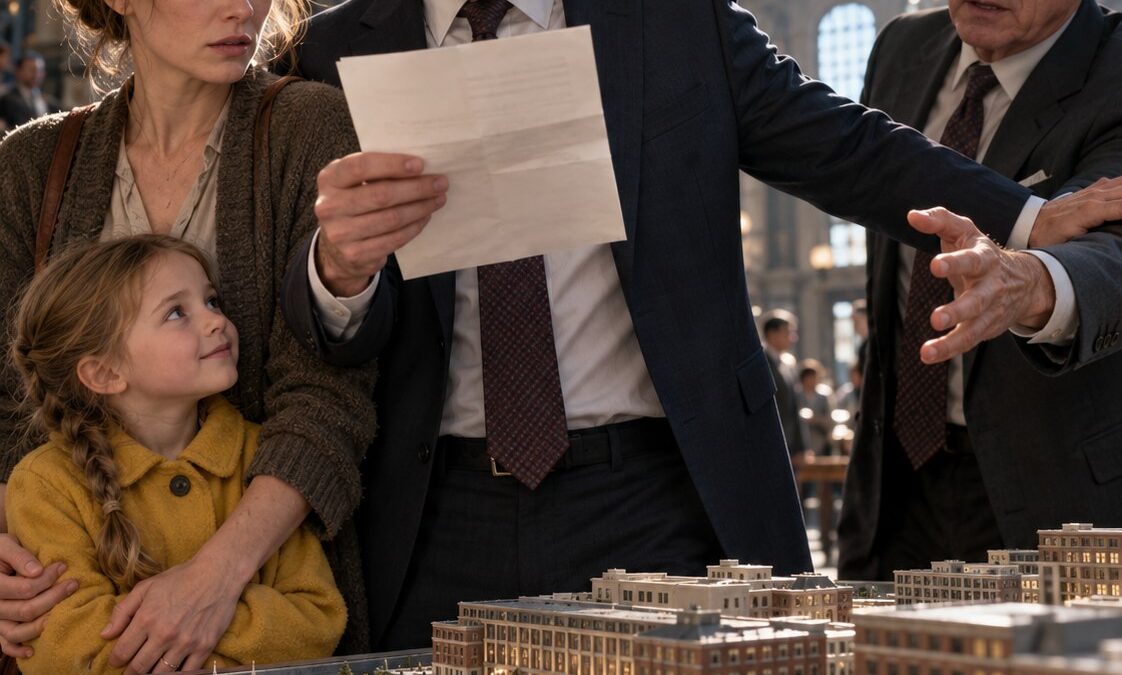
Conrad reached for Wren’s notice.
I took it first.
The paper was thin.
The threat was plain.
Vacate by six.
A property manager’s name appeared at the bottom.
No court order was attached.
“Where’s the rest?” I asked.
“That’s all they gave me,” Wren said.
Conrad adjusted his cuff.
“The formal notice was mailed.”
“Show me.”
“My office has it.”
“Call your office.”
The cameras were still pointed at us.
I turned to our public relations director.
“Please clear the room.”
She looked at Conrad.
I repeated myself.
Within minutes, the reporters had moved outside.
Two security guards remained by the doors.
June watched them carefully.
“They’re not here for you,” I told her.
She considered that.
Then she reached for Wren’s hand.
I called the closing attorney.
“I’m postponing the signing.”
Conrad stepped closer.
“The lenders can walk.”
“They can call me.”
“They won’t be gentle.”
“Neither was that notice.”
My attorney, Priya Shah, answered on the second ring.
She listened without interrupting.
“Send me a photograph,” she said.
I took one.
Wren lowered June onto a bench.
The girl’s shoes swung above the floor.
I set her key beside me.
She retrieved it at once.
“You said I could keep it,” she said.
“I was wrong,” I told her.
That earned the faintest change in Wren’s face.
Priya called back four minutes later.
“This paper doesn’t look like an eviction order.”
“It says six o’clock.”
“A property manager cannot set a move-out deadline like that on its own.”
Wren pressed her fingers against her forehead.
I wished I had heard about this before today.
I had made it difficult for her to reach me.
Conrad had apparently made it frightening.
“What lawyer?” I asked her.
She hesitated.
“The one who wrote after June was born.”
“What did he say?”
“That you knew about her.”
The hall seemed to tilt.
“He said you wanted custody if I asked for support,” Wren continued.
“I never hired a lawyer.”
She looked at me for a long moment.
Then she reached into her bag.
She handed me a letter with my name beneath a typed signature.
I read it twice.
The address was my old office.
The letter was dated three weeks after June’s birth.
On that date, my company had already moved.
Conrad had arranged the move.
I looked up.
“He knew you were pregnant,” I said.
* * *
Priya met us at her office an hour later.
Her assistant brought juice for June.
She brought Wren a charger for her phone.
Small things.
Wren thanked her for both.
I called the building’s property manager from Priya’s conference table.
The number on Wren’s notice rang through to voicemail.
Priya searched the state business registry.
The company existed.
It had been formed nineteen months earlier.
Its address belonged to a mail service.
“Who owns the building?” she asked.
“Mercer Development,” Conrad said from the doorway.
I had asked him to come.
He had arrived with a company lawyer.
Priya turned her screen toward him.
“According to the deed, Harbor Vale Holdings owns it.”
“A subsidiary,” Conrad said.
“Of whom?”
“Our group.”
“Send the ownership records.”
He glanced at me.
“After the signing.”
“There is no signing today,” I said.
His lawyer opened a laptop.
Conrad remained standing.
June was drawing at the far end of the table.
She had made six square windows.
In the top one, a purple cat watched the street.
I recognized the shape of Wren’s apartment building from the model.
Wren showed Priya her bank statements.
Eight monthly payments had left her account.
The amounts matched her lease.
Each payment had a confirmation number.
Priya called the bank to request certified records.
Then she called a tenants’ attorney she trusted.
The attorney agreed to meet Wren that afternoon.
Nothing about the rent claim required me to guess.
The records would show what had happened.
The other letter was harder to look at.
Its final paragraph warned Wren against contacting me.
It described an expensive custody fight.
It suggested I could provide a better home.
“Is that why you never told me?” I asked.
“I tried.”
“When?”
“Twice before June was born.”
She had gone to my office.
Both times, she had been turned away.
An assistant said I had received her message.
I had received nothing.
“Then the letter came,” she said.
“You could have called me directly.”
“I did.”
She gave me the date.
I remembered it because I had been in surgery.
A cycling accident had broken my shoulder.
Conrad had taken my phone during the operation.
He told me afterward that Wren had called to discuss the divorce paperwork.
I had believed him.
“I should have called again,” Wren said.
Her voice was steady.
“I was scared.”
I looked at June.
She was coloring the cat blue.
“You had reason to be.”
Conrad pulled out a chair.
“Are we really relying on memories from five years ago?”
“Her payments are from this year,” Priya said.
“We’ll review them.”
“The letter is from your former counsel,” Conrad said.
Priya shook her head.
“The firm named here has no attorney by that name.”
Conrad’s hand stopped on the chair.
Priya had called while we drove over.
The firm had confirmed it in writing.
They had never sent the letter.
I studied the printed signature again.
My full name was there.
The middle initial was wrong.
Conrad knew I had stopped using it after my father died.
He had used an older template.
I said nothing yet.
A mistake on a forged letter could identify its maker.
It could not do that alone.
I handed the page back to Priya.
“Preserve everything.”
She nodded.
“Originals, emails, envelopes, phone records.”
Conrad stood.
“My lawyer will coordinate.”
“No,” I said.
“Priya will.”
He looked at Wren.
“You came for money.”
Wren drew June’s picture away from the edge of the table.
“I came because she needed a bed tonight.”
June looked up.
“I have a bed.”
“Yes, sweetheart,” Wren said.
“You do.”
I held out my hand.
June studied me before giving me the brass key.
On its blue tag, I saw tiny white paint flecks.
Wren had painted their kitchen herself.
I had bought the paint.
That was the last useful thing I could remember doing in that apartment.
Priya’s assistant returned with the lease file she had requested from our own records.
The building had entered our project budget at a price I did not recognize.
It was far above the appraisal beside it.
Harbor Vale had bought it cheaply.
Six weeks later, Mercer Development had agreed to buy it from Harbor Vale.
Conrad had approved both figures.
The lie had a balance sheet.
* * *
By four, Wren’s tenants’ attorney had sent a written demand.
He asked Harbor Vale to withdraw the notice and confirm her tenancy.
He copied the company listed on her lease.
The reply came from Conrad’s office.
It said no action would be taken that evening.
It did not withdraw the claim.
Priya read it aloud.
Wren looked at June.
“She heard us,” I said.
“I know.”
June sat on the carpet with three markers.
She was drawing another building.
This one had a garden on its roof.
I wanted to tell Wren that I could fix everything.
I had been making promises that large for years.
I had kept too few of them.
“I can pay for a hotel,” I said.
“I don’t want her moved because someone frightened us.”
“Then we’ll stay until the lawyer gets an answer.”
Wren nodded.
The tenants’ attorney filed for emergency relief.
He said a judge might not need to act.
The notice itself gave Harbor Vale no power to remove them that night.
A lock change would create a separate legal problem.
He told Wren to call him and the police if anyone tried.
That advice steadied her more than my offer had.
I called our finance director.
She had worked with me for eleven years.
“Find every Harbor Vale transaction,” I said.
“Conrad controls that file.”
“Then get what accounting already has.”
She called back within an hour.
Three parcels had passed through Harbor Vale.
All three lay inside my redevelopment boundary.
In each case, Harbor Vale bought before our company paid a higher price.
The difference totaled nearly fourteen million dollars.
“That money went somewhere,” she said.
“Can you trace it?”
“I can trace what we paid.”
She would need bank records or an investigator for the rest.
Priya advised us to leave that to the proper people.
I agreed.
Conrad called six times.
I answered the seventh.
“You stopped a public project over an old argument,” he said.
“I stopped a signing.”
“The city expects this to proceed.”
“Then the city should see the right numbers.”
He was quiet.
“Wren told you June is yours.”
“She did.”
“You don’t know that.”
“I know you sent her a false letter.”
“You can’t prove I sent it.”
His answer came too quickly.
I looked at Priya.
She was listening on speaker.
“I didn’t say who sent it,” I told him.
The call ended.
Wren stood by the window.
Below us, the waterfront lights were coming on.
“She’s yours,” she said.
“I believe you.”
“I can show you the records.”
“I’ll come with you.”
She turned.
“I don’t need you to make me credible.”
“You’re right.”
That cost me something to say.
It should have been easy.
“I’d like to know her,” I said.
Wren glanced toward June.
“She gets to decide how fast that happens.”
“I know.”
“You don’t.”
Her words landed cleanly.
I had known June for six hours.
I had known how to build a tower for six years.
The two skills had nothing to do with each other.
June brought over her drawing.
“This is a place for the cat.”
“There’s a garden,” I said.
“He likes birds.”
She pointed to a narrow purple door.
“People can go in too.”
Wren took the paper gently.
For a minute, neither of us discussed Conrad.
Then Priya’s assistant came in.
The company registrar had sent the full ownership filing.
Harbor Vale’s manager was a firm that handled private holdings.
Its beneficial owner appeared on a separate disclosure.
Priya read it first.
She set the page flat between us.
Conrad owned Harbor Vale.
* * *
The city meeting was scheduled for Friday.
The redevelopment agreement required a public presentation before final approval.
My team had expected an easy vote.
I asked the clerk for time to correct our submission.
She told me where to file amended financial disclosures.
She did not promise the project would survive.
Conrad spent Thursday trying to make that uncertainty sound like my fault.
He called investors.
He called board members.
He told them I was putting a family dispute ahead of contractual duties.
Some listened.
Others asked for the Harbor Vale documents.
My finance director sent them to Priya.
An outside forensic accountant reviewed the purchase dates, prices, approvals, and disclosures.
He found no evidence that Conrad had disclosed his ownership.
Priya referred the transactions to the company’s audit committee.
She also notified the city attorney that the project figures were under review.
For Wren’s housing case, the tenants’ attorney obtained the property ledger.
Her rent had arrived each month.
Someone had marked it “unapplied” after receipt.
The ledger contained a user ID.
It belonged to an employee who reported to Conrad.
The employee had changed the entries on Conrad’s written instructions.
She gave the attorney copies.
She was frightened about losing her job.
I asked the audit committee to preserve her access and records.
They took over from there.
On Thursday afternoon, Wren took June to her usual pediatric appointment.
She allowed me to drive them.
I waited in the lobby.
June had asked why I came.
“Because I wanted to,” I told her.
She had considered that answer all the way there.
Afterward, we stopped at a bakery.
June chose a cinnamon roll bigger than her hand.
Wren divided it into thirds.
Mine was the smallest piece.
June noticed.
“Mama knows you’re big,” she said.
Wren almost smiled.
It was the first warmth I had seen from her.
I held the paper bag while June climbed onto a bench.
A loose thread hung from her yellow coat.
I wanted to buy her another one.
I asked instead.
“Does that button bother you?”
“No.”
She touched the empty spot.
“It got lost.”
“I can help find a matching one.”
“You know buttons?”
“Not yet.”
“Then Mama can teach you.”
Wren looked down at her coffee.
“I could.”
That evening, the tenants’ attorney received an email.
Harbor Vale withdrew the move-out demand.
It still claimed Wren owed rent.
The claim had become indefensible.
Conrad had kept it anyway.
“He needs me looking at the building,” I said.
Priya nodded.
“He may be trying to protect the land deals.”
“Can we prove he sent the old letter?”
“We’re working on it.”
Wren had kept its envelope.
The postage meter number led to a private mailing service.
The service kept invoices.
Priya requested them through counsel.
We could not make anyone turn over private records merely because we wanted them.
The audit committee could demand company records.
Lawyers could seek others through the case.
By Friday morning, we had one more piece.
My former assistant found her archived calendar.
On the day Wren first came to see me, Conrad had canceled my open afternoon.
He recorded a meeting that never happened.
On the day she returned, he had done it again.
I stared at the two entries.
Conrad had told me he was protecting my time.
For years, I had thanked him for it.
* * *
The public meeting filled the customs hall.
Residents from the waterfront sat beside investors.
City staff occupied the front row.
Wren arrived with her attorney.
June stayed with Wren’s neighbor.
Wren had decided that for herself.
The model still stood under the glass ceiling.
Someone had removed June’s little key from it.
She carried it in her coat pocket now.
Conrad entered with two lawyers.
He greeted the board chair first.
Then he took his usual seat beside me.
I moved to another table.
The chair asked why the city had received new financial disclosures.
I stood.
“The submission contains land purchases that need independent review.”
Conrad rose.
“My brother has confused a private dispute with this project.”
He spoke calmly.
He had practiced in front of harder rooms.
“The city needs housing, public space, and tax revenue,” he said.
“Delays have costs.”
People nodded.
He turned toward me.
“Elliot approved every company payment.”
“That is true,” I said.
“I signed them.”
Conrad spread his hands.
“Then he should explain why he questions them now.”
“I trusted your certifications.”
“That was your decision.”
He was right about that part.
I faced the city staff.
“I should have checked them.”
Conrad waited.
Perhaps he thought the admission ended it.
Priya handed the clerk the accountant’s report.
The clerk passed copies along the table.
“Harbor Vale bought three parcels,” I said.
“It sold them to us at much higher prices.”
Conrad leaned toward his microphone.
“That is how real estate works.”
“It is,” I said.
“When the buyer knows who owns the seller.”
The chair looked down at the ownership disclosure.
Conrad’s lawyer stood.
“This document has not been tested.”
“It will be,” Priya said.
“We’re asking the city to suspend approval while the audit proceeds.”
Conrad pointed to the rows behind us.
“Tell those people their jobs can wait.”
I heard someone shift.
My company employed hundreds of people.
The project mattered to them.
Conrad knew I would feel it.
“I’ll tell them what I know,” I said.
“I’ll pay our staff while this is reviewed.”
“You cannot guarantee every contractor’s schedule.”
“No.”
I let that answer stand.
The chair asked about the occupied building.
Wren’s attorney presented her lease and certified payment records.
He showed the ledger entries.
The company lawyer beside Conrad looked at the user ID.
He whispered something.
Conrad ignored him.
“The tenant was never removed,” Conrad said.
“She was told to leave by six,” I answered.
Wren’s attorney held up the notice.
A city lawyer asked whether it was a court document.
“No,” he said.
“Did it say that clearly?”
“No.”
Conrad’s case had grown narrower.
He looked across the hall at Wren.
“She came to a press event with a child.”
Wren stood.
“I came because no one answered me.”
The chair asked if she wanted to speak.
“Yes.”
She walked to the microphone.
Her hands trembled.
Her voice did not.
“I paid my rent.”
She placed the confirmations on the table.
“My daughter and I live there.”
She looked at Conrad.
“I wanted the truth written down.”
She sat.
No one applauded.
I was glad.
She had come for an answer, and the room owed her one.
Priya produced another document.
The audit committee had found it that morning in Conrad’s company email archive.
It was an invoice from the mailing service.
The charge matched the date and postage meter on Wren’s envelope.
The invoice described a legal letter sent to her address.
Conrad stared at it.
His lawyer leaned in.
After a moment, he sat back.
“You asked me to keep the company moving,” Conrad said to me.
“I asked you to run operations.”
“You let a marriage fall apart and expected everyone else to manage the wreckage.”
I looked at the key in Wren’s hand.
Five years of missed birthdays sat between us.
Conrad had caused some of the distance.
I had let him control the doors.
“I did,” I said.
“That part is mine.”
He gave a bitter laugh.
“You would have stopped the project for her.”
“For the false numbers,” I said.
“And for anyone threatened out of a home.”
The chair suspended consideration of the agreement.
The city referred the financial documents for review.
Our audit committee placed Conrad on leave that afternoon.
It could do that immediately.
Everything else took longer.
Over the following months, investigators obtained records and interviewed employees.
Harbor Vale’s bank statements showed where the resale profits went.
The mailing service supplied its invoice and delivery records.
The employee who altered the rent ledger confirmed Conrad’s instruction.
He faced civil claims from the company and the affected tenants.
Prosecutors brought fraud charges tied to the land transactions.
He eventually entered a guilty plea to those charges.
Wren’s false rent claim was dismissed.
Her legal costs were paid under a settlement she chose with her attorney.
The letter about June remained part of the record.
Conrad never apologized for it.
When he saw me after the plea hearing, he offered one last sentence.
“She would have left you anyway.”
I thought of the nights I had come home late.
I thought of the letter he had made sure she received.
“Maybe,” I said.
“She deserved to decide without you.”
* * *
Winter came slowly to the waterfront.
The project changed with it.
We removed the occupied building from the demolition plan.
An independent review identified other parcels that could be built on without displacing residents.
The revised design was smaller.
Its returns were smaller too.
My board debated it for three long meetings.
I attended every one.
I had finally learned that signing papers was only part of my job.
Wren kept her apartment.
The building got its stair repaired.
A carpenter replaced the third tread.
June insisted on testing it first.
She stomped once.
Then twice.
“Fixed,” she announced.
I asked Wren if I could visit on Sunday afternoons.
She said June would decide.
June approved one Sunday.
We played cards.
She invented rules whenever I began to win.
The following Sunday, I brought two matching buttons.
One was yellow.
One was shaped like a star.
June chose the yellow one.
Wren showed me how to sew it onto the coat.
My first attempt pulled the fabric into a knot.
June watched with grave concern.
“Mama is faster.”
“Yes,” I said.
“She is.”
Wren took the needle.
She let me hold the coat steady.
There were harder things to learn.
June asked why I had not come before.
I told her the truth she could carry.
“I didn’t know how to find you.”
Wren listened from the kitchen.
I added what June deserved to hear.
“I should have looked harder.”
June traced the brass key on the table.
“You know where we are now.”
“Yes.”
“Okay.”
That was all she gave me.
It was enough for that day.
A court-approved parentage test later confirmed what Wren had told me.
I was June’s father.
The result changed forms.
It did not change June’s pace.
I began sending regular support through an agreement Wren reviewed with her lawyer.
I set money aside for June’s future.
I offered Wren a larger apartment.
She declined.
“I like my windows,” she said.
“I remember.”
“You never saw them before last fall.”
“You told me.”
She smiled without looking away.
“That part you remember.”
I asked if she wanted to hear an apology.
She set down her cup.
“Only if you know what it’s for.”
“I let Conrad speak for me.”
“Yes.”
“I chose work when you needed me.”
“Yes.”
“I believed distance was easier than asking what had happened.”
Wren folded her hands.
“That one took five years.”
“I’m sorry.”
She watched the street through her window.
“I believe you.”
I waited.
“We don’t go back,” she said.
“I know.”
“We find out who we are now.”
It was more than I had expected.
It was less than I wanted.
I respected both facts.
Spring brought longer visits.
June asked me to attend her school show.
She gave me a seat number on a paper ticket.
I arrived forty minutes early.
Afterward, Wren, June, and I ate noodles at a place with uneven tables.
June told us she had missed one line.
Neither of us had noticed.
“That’s because I said it in my head,” she explained.
Wren laughed.
I nearly missed the next thing June said because I was watching her.
“Can Elliot come on our walk Saturday?”
Wren turned to her.
“Do you want him to?”
“Yes.”
Then she turned to me.
“Do you?”
“Yes,” I said.
I had meetings that Saturday.
I moved them myself.
* * *
Three years later, June led me into the customs hall.
She was seven.
Her yellow coat no longer fit.
Wren had kept the button in a small dish by their door.
The model was gone.
So was the tall tower that had once stood over their bedroom.
A new model showed a shorter waterfront building, an open walkway, and a garden beside the homes that remained.
Residents had helped design the garden.
Wren had argued for benches under the trees.
She had won.
The opening drew fewer cameras than my first announcement.
June preferred it that way.
She stood beside the model and took the brass key from her pocket.
The blue tag still carried flecks of white paint.
“Where should it go?” she asked.
“Your choice.”
She set it beside her building.
The tiny windows faced the water.
“Right there,” she said.
Wren joined us.
She slipped her hand into mine.
We had started doing that the year before.
June had noticed immediately.
She had questions.
We had answered them together.
Conrad had served his sentence.
The false debt was gone.
The old stairs held firm.
June knew where I lived.
I knew which nights she had homework.
I knew Wren liked the windows open, even in October.
June looked up at me.
“You can keep it,” she said.
I remembered her saying those words when she thought I could take her home away.
I closed her fingers gently around the key.
“It’s yours,” I said.
She grinned and ran toward the garden doors.
Wren followed.
I went with them.
THE END








