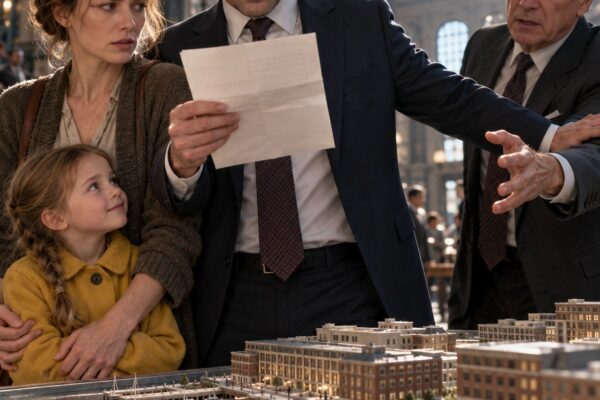
He Made His Wife Guard the Conservatory Door for His Mistress—Then the City’s Most Feared Investor Cut the Ribbon for Her
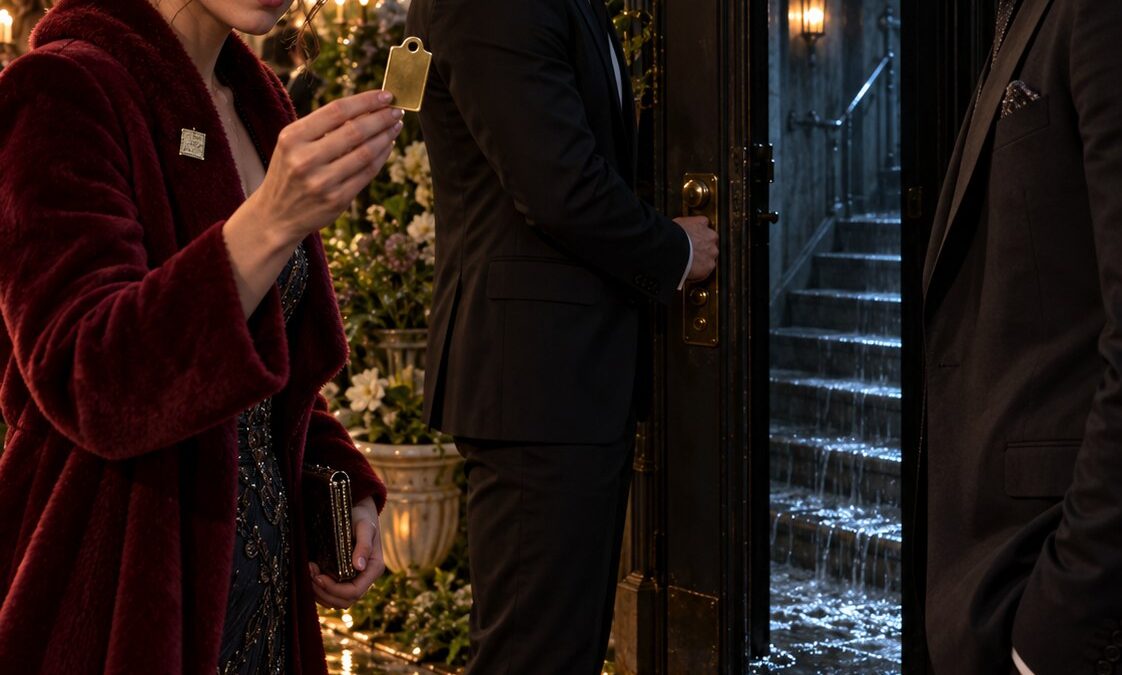
Chapter 2: What the Water Kept
Celia heard her assistants before she saw them.
“June?”
“Here.”
“Malik?”
“Behind the north cabinets.”
Water rushed down the center aisle.
Both voices sounded steady.
That helped.
The lights were out.
Emergency strips glowed near the ceiling.
Dorian held his phone flashlight low.
“Where’s the shutoff?”
“Past the cabinets,” Celia said.
She knew every step.
Her father had taught her to walk this room in darkness.
Not as a game.
Old buildings lost power.
Important things stayed put.
June stood on a rolling stool.
She held three cardboard boxes above her head.
Malik had lifted the bottom drawers from a cabinet.
Neither had panicked.
Celia loved them for it.
“Leave the paper,” she said.
June stared at her.
“Your father’s ledger.”
“It has a duplicate.”
“Since when?”
“Since I learned from him.”
June passed down the boxes.
Dorian carried them toward the stairs.
Malik followed with a sealed case.
Celia reached the pump panel.
Its cover hung open.
A yellow service switch pointed left.
It should have pointed right.
She photographed it before touching anything.
Then she moved the switch.
The motor’s pitch changed.
Water stopped pushing through the floor drain.
Dorian returned.
“Everyone upstairs.”
“The intake gate might still be open.”
“Can you reach it safely?”
“Yes.”
“Show me.”
Celia led him to a wheel mounted above the waterline.
She turned it.
The metal fought her.
Dorian put his hand beside hers.
“Tell me how much.”
“Half a turn.”
They turned together.
The flow weakened.
Somewhere above, the fire alarm began its slow recorded announcement.
Dorian’s sleeve was soaked.
He seemed unaware.
“Did someone change both controls?” he asked.
“Yes.”
“Could it be an accident?”
“Two controls in separate rooms?”
“Then leave them for the investigators.”
Celia looked at the panel.
He was right.
They went upstairs.
Firefighters met them at the landing.
Celia told the captain what she had seen.
She showed him the photographs.
He ordered everyone out and had his team check the utilities.
Rosalind stood in the rain beneath an umbrella held by a staff member.
Everett hovered beside her.
Corinne had vanished.
The guests streamed toward waiting cars.
They had come for a ribbon cutting.
They left through an alarmed side gate.
June put a dry coat around Celia’s shoulders.
“It’s mine,” June said.
“I know.”
“You’ll give it back.”
“Eventually.”
Dorian approached with the captain.
“The two rooms are clear,” the captain said.
“Your people can wait inside the west lobby.”
“What about the archive?” Celia asked.
“The pumps are drawing down.”
He glanced at her photographs.
“Our inspector will document the equipment before anyone touches it again.”
Celia nodded.
Everett came forward.
“Celia, I need a word.”
Dorian stepped back.
He did not speak for her.
Everett looked relieved until she said, “Here is fine.”
“Privately.”
“No.”
Rain struck the stone between them.
Everett lowered his voice anyway.
“You don’t understand what Rosalind authorized.”
“I understand what I saw.”
“It was a controlled test.”
“June and Malik were locked downstairs.”
“That part wasn’t planned.”
“Which part was?”
Everett looked past her.
“I’m trying to keep you out of this.”
“Then start telling the truth.”
His eyes dropped to the brass tag.
“Where did you get that?”
“From tray 14-K.”
“You shouldn’t have touched it.”
“It was in my archive.”
“It’s trust property.”
“That answer sounds familiar.”
He reached toward the tag.
Celia closed her hand.
Dorian moved closer.
Everett saw him and stopped.
“The tray held a copy,” Everett said.
“Of what?”
“A page that could be misunderstood.”
Celia remembered the fresh mark.
Her father’s three dots had been cut decades ago.
The fourth had scratched bright metal.
“What page?”
Everett said nothing.
June spoke from behind Celia.
“Your father’s lease file.”
Celia turned.
June’s face had lost its color.
“He made me promise I’d show you,” she said.
“If they ever tried to close this place.”
* * *
The fire department kept the basement sealed until morning.
Celia spent the night in June’s kitchen.
June lived three blocks away.
Her kettle sounded like an injured bird.
Neither woman slept.
At dawn, June set a canvas folder on the table.
Its edges were soft from handling.
“Your father gave me this,” she said.
“He trusted you.”
“He trusted you, too.”
“Then why didn’t he tell me?”
“He tried.”
Celia looked up.
June turned the folder toward her.
The first page was an old lease.
Not the current operating agreement.
An earlier one.
In 1974, the city had leased the Glasshouse conservatory to a charitable trust for ninety-nine years.
A donor had paid for the restoration.
The donor had also required the seed archive to remain open to public researchers.
If the trust ceased that work, the lease could return to city control after notice and a court process.
Celia read the clause twice.
“I know this,” she said.
“Rosalind called it obsolete.”
“She had counsel say the archive no longer existed.”
Celia stared at her.
“We’ve cataloged plants every day.”
“Her report calls this a display collection.”
June turned another page.
There was an inventory from 1998.
Tray 14-K appeared in a handwritten column.
Beside it, Celia’s father had written: Duplicate lease exhibit.
“Why put a legal document in a seed tray?”
“The flood ruined the office files.”
“He hid a copy among the brass tags?”
“He kept the original with the lawyer.”
Celia looked at the date.
The file was old enough to be useful.
It was not old enough to explain why Everett had touched the tag yesterday.
June seemed to know what she was thinking.
“Rosalind asked for the 14-K tray on Tuesday.”
“Did you give it to her?”
“I refused.”
“Who else knew?”
“I told Everett.”
Celia closed the folder.
June flinched.
“I thought he was helping you,” she said.
“So did I.”
Dorian arrived at eight with coffee and a woman in a navy coat.
He introduced her as Priya Shah, counsel for his foundation.
Priya did not promise an arrest.
She asked where the records had come from.
She asked who had held them.
She asked which documents could be checked elsewhere.
Celia found herself liking her.
“Copies can show us where to look,” Priya said.
“The city recorder may have the lease.”
“The city does,” June said.
“Rosalind’s lawyer claimed the exhibit was missing.”
“Then we request a certified copy.”
Dorian put coffee near Celia’s hand.
It was still hot.
She had forgotten to eat.
He placed a paper bag beside it.
No speech.
No expectation.
Celia opened it.
A plain egg sandwich.
She looked at him.
“You run an empire,” she said.
“You chose the cheapest breakfast.”
“The expensive one had lavender.”
“That’s a fair defense.”
Priya’s mouth twitched.
Then she returned to the folder.
“The immediate issue is evidence preservation.”
“Rosalind controls the building,” Celia said.
“The fire department has the utility rooms for now.”
“And after?”
“We ask a court to preserve the records.”
Dorian looked at Celia.
“Would you give a statement?”
“Yes.”
“Even if it names Everett?”
Celia folded the sandwich wrapper.
“Especially if it names Everett.”
They spent the morning working separately.
Priya contacted the city recorder.
Dorian called the conservatory’s insurer and gave them the incident number.
Celia checked her own inventory from the last five years.
June opened a backup drive she kept at home.
Every month, she had photographed the brass tags in active trays.
Not because she expected a crime.
Because damp paper warped and labels moved.
At eleven, Celia found a photo of 14-K from August.
Three dots on the back.
No fourth mark.
The photo recorded the date automatically.
Priya asked for the original file and its backup.
She copied both to a secure drive.
Then she wrote down who had possessed each device.
Celia watched her.
“You’ve done this before.”
“People tend to become interested in records when money changes hands.”
“Does it always change hands?”
“Frequently.”
By afternoon, they had permission to enter the dry upper archive with the fire inspector.
The basement remained restricted.
Rosalind met them at the west door.
Her expression was composed.
Her attorney stood beside her.
“Celia,” she said.
“I’m sorry you were frightened.”
“June and Malik were locked in.”
“I’m grateful they’re safe.”
“Then let the inspector see the access log.”
Rosalind’s attorney cleared his throat.
“All trust documents will be provided through counsel.”
Priya handed him a preservation letter.
“Good,” she said.
“Start with the access log.”
Rosalind turned to Dorian.
“Your donation bought repairs.”
“It did.”
“It did not buy authority.”
“No,” Dorian said.
“Your board has that.”
She smiled faintly.
“Then we understand each other.”
“I understand your duty.”
Her smile faded.
Inside, Celia walked past trays of winter seedlings.
She had watered them the night before the gala.
A few leaves had turned toward the gray light.
She checked the upper cabinets.
Nothing obvious was missing.
At the circulation desk, the visitor book lay open.
Corinne’s name appeared on Tuesday.
Everett’s appeared below it.
Both entries were in the same handwriting.
Celia photographed the page.
“Could someone sign for another visitor?” Priya asked.
“They’re supposed to show identification.”
“Who checked it?”
Celia looked at the initials in the margin.
E.W.
Everett had signed them both in.
“Is that his handwriting?” Dorian asked.
“Yes.”
“Can you establish it independently?”
“His old cards are in my office.”
Priya nodded.
“Keep this page here.”
Celia turned the next sheet.
The line for the following day had been torn out.
She stopped.
June came over.
“That wasn’t missing yesterday.”
“How do you know?”
“I added a delivery at four.”
Priya photographed the torn binding.
A staff member arrived with a box of rescued paper.
Inside were daily moisture logs.
Celia sorted them by date.
Monday.
Tuesday.
Thursday.
Wednesday was absent.
“The same day,” she said.
Dorian crouched beside the box.
“What would Wednesday show?”
“Pump readings.”
“Who took them?”
“I did.”
She remembered Wednesday clearly.
The backup pump had drawn too much power during a routine test.
She had written a maintenance request.
Everett had been in her office when she did it.
He had offered to carry the log to administration.
She let the page rest on the table.
Priya saw her face.
“What is it?”
“He took the original.”
“Do you have a copy?”
“The work order went by email.”
Celia pulled out her phone.
She found the message.
At 4:18 Wednesday afternoon, she had sent the pump warning to Rosalind, Everett, and the facilities contractor.
At 4:26, Everett had replied for Rosalind.
We’ll handle it before Friday.
“That gives them notice,” Priya said.
“Does it prove sabotage?” Celia asked.
“No.”
“I know.”
“It gives us a place to start.”
The contractor arrived while they were still upstairs.
He was a thin man named Luis Calder.
He had received Celia’s request.
He had quoted a replacement switch.
Rosalind’s office had declined the work.
He showed Priya the written response.
It was sent from Everett’s address.
Rosalind had been copied.
“Why would he decline it?” Celia asked.
Luis rubbed his forehead.
“He said the building was being transferred.”
Priya looked up.
“Transferred to whom?”
“He didn’t say.”
Dorian’s phone rang.
He stepped into the corridor.
When he returned, he looked directly at Celia.
“The city recorder found the lease,” he said.
“And the missing exhibit?”
“That too.”
Priya held out her hand for the phone.
Dorian gave it to her.
She listened for a moment.
Then she asked the clerk to send the certified records through the ordinary request process.
No shortcuts.
No favors.
When she ended the call, she looked at Celia.
“The archive clause is valid on its face,” she said.
“Rosalind’s report omitted it.”
June sat down.
“What did she file instead?”
Priya turned her screen.
A transfer application had been submitted to the city two weeks earlier.
It described the seed archive as permanently closed.
It attached a staff certification.
Celia recognized her own name beneath it.
The signature was false.
But the address printed beside it was hers.
And the witness was Everett Wynn.
* * *
By evening, the conservatory had become a public story.
A local station showed water crossing the gala floor.
It showed Dorian cutting the ribbon.
It showed Celia disappearing down the stairs.
The caption called her a staff member.
Celia let it stand.
Her work mattered more than her title.
Rosalind issued a statement blaming an unexpected storm and an aging drainage system.
Everett sent Celia twelve messages.
The first asked if she was safe.
The last said her statement could destroy both of them.
She saved them.
She did not answer.
Priya arranged a meeting with a city lawyer the next morning.
Before that, Celia wanted to inspect the collection.
The fire department had cleared the lower archive for supervised entry.
Water had reached the bottom shelves.
The sealed cabinets had held.
Loose paper had not.
June spread damp folders on blotting sheets.
Malik moved trays to the dry room.
Celia worked beside them until her back ached.
At noon, a courier brought an envelope.
No sender.
Inside was a photograph of Celia entering the basement with Dorian.
On the back, someone had written:
You can still say you made a mistake.
June took one look.
“Police.”
Celia agreed.
An officer collected the envelope and documented where it had been opened.
She did not speculate about fingerprints.
She did not tell him it was Corinne.
She did not know.
The threat was mild enough to sound deniable.
That made it feel practiced.
Dorian offered to have a driver take her home.
“My car works,” Celia said.
“I know.”
“Then why offer?”
“Because you’ve been awake for thirty hours.”
“That’s a better reason.”
She handed June the remaining tray list and let him drive.
He took her to her apartment.
Everett’s car was parked outside.
Dorian slowed.
Celia saw Everett sitting behind the wheel.
He looked tired.
For one foolish second, she wanted to ask whether he had eaten.
Eight years did not disappear in a night.
Then she remembered his hand on her wrist.
The locked basement door.
The forged signature.
“Keep driving,” she said.
Dorian did.
He stopped at a small hotel two blocks away.
Priya had reserved a room under the foundation’s account.
Celia paid for it herself.
Dorian watched the clerk hand her the receipt.
“You could let me cover this.”
“I could.”
“You won’t?”
“I need one thing today that belongs entirely to me.”
He accepted that.
Upstairs, the room smelled of clean linen and coffee.
Celia washed her hands twice.
Brass polish remained beneath one nail.
She put the tag on the nightstand.
Its fourth mark caught the light.
Her father’s three dots were round and deep.
The new mark was a shallow slash.
Someone had tried to make it look like another punch.
They had used the wrong tool.
Celia called June.
“Did Dad ever photograph the original exhibit?”
“He photographed everything.”
“Where?”
“The county archive kept his negatives.”
That surprised her.
“He donated them?”
“When they digitized the old gardens.”
Celia sat down.
“Can we get them?”
“I’ll ask.”
“Thank you.”
June hesitated.
“Celia?”
“Yes?”
“Eat something.”
“Everyone has become very interested in my lunch.”
“That’s because you skipped it yesterday.”
Celia promised a sandwich.
She meant it.
After the call, Dorian knocked once.
He had brought a paper bag.
She opened the door.
“You two are coordinating,” she said.
“June is persuasive.”
“What is it?”
“Soup.”
“That’s almost food.”
He held out the bag.
Celia took it.
For a moment, they stood without speaking.
Then Dorian said, “I knew your father.”
She stared at him.
“He never mentioned you.”
“He had reason.”
Dorian looked down the empty hallway.
“May I explain?”
Celia stepped aside.
He stayed near the door.
“He asked me to fund a public records project ten years ago.”
“You refused.”
“Yes.”
“Why?”
“I was buying the adjacent property.”
“The old printworks.”
“I wanted the conservatory’s access road.”
Celia remembered the fight.
Her father had spent six months at city meetings, arguing that service vehicles needed that road for the seed archive.
Dorian’s company had eventually moved its entrance.
She had thought the city forced him.
“You changed the plan,” she said.
“After he showed me the lease.”
“You believed him?”
“Not at first.”
Dorian’s honesty irritated her less than a polished apology would have.
“What changed?”
“He brought photographs of school buses unloading here.”
“That was his argument?”
“He asked what my road would be for.”
“And?”
“I didn’t have an answer I liked.”
Celia looked at the soup.
Her father had never told her the story.
Perhaps he had considered the result enough.
Dorian continued.
“Rosalind joined the trust board that year.”
“She was your choice?”
“No.”
“Did you know her?”
“Only by reputation.”
“Now?”
“Better.”
His phone buzzed.
It was Priya.
He put her on speaker after asking Celia.
“The city lawyer reviewed the filing,” Priya said.
“He wants the trust’s board minutes and the transfer agreement.”
“Will Rosalind give them to him?” Celia asked.
“He can require them.”
“What about Everett?”
“The city has been told he witnessed your signature.”
Dorian watched Celia.
Priya’s voice remained level.
“A forged signature may lead to a criminal investigation.”
“May,” Celia repeated.
“Yes.”
“I appreciate the word.”
“There’s more.”
Priya paused.
“The proposed buyer is Ashline Holdings.”
“I’ve never heard of it.”
“Neither had I.”
“What does it want?”
“The transfer application says botanical education.”
Dorian’s expression changed.
He knew the name.
Priya heard his silence.
“Dorian?”
“Ashline was formed by a firm that handles Rosalind’s family investments.”
Celia looked between the phone and his face.
“So she would sell the trust’s lease to herself?”
“Indirectly,” Priya said.
“Subject to approvals she hasn’t obtained.”
“What would she build?”
“We don’t know yet.”
Dorian moved to the window.
Beyond the hotel glass, the city shone under rain.
“The printworks site is being rezoned,” he said.
“A residential tower needs a wider access road.”
“The one my father saved?”
“Yes.”
Celia set the soup down.
Rosalind had not needed the archive destroyed for its own sake.
She needed it declared closed.
The flood would make closure look inevitable.
Then the access road could serve a tower.
Priya spoke again.
“There’s a partner listed in Ashline’s financing papers.”
“Who?” Celia asked.
Dorian turned.
“Everett’s firm.”
Celia gripped the edge of the table.
The fourth mark on the tag glinted beside her hand.
Everett had not merely helped Rosalind hide the lease.
He was buying the land her father had saved.
* * *
The next morning, Celia went to the county archive.
Dorian offered to accompany her.
She said yes.
She had stopped pretending company made her weaker.
The archive occupied two floors above a public library.
A clerk named Anton brought out digitized contact sheets from her father’s collection.
He explained which files were scans and which negatives remained in storage.
Celia asked for the accession records.
Anton found a signed donation receipt from nine years earlier.
Her father had given the county photographs of the conservatory, including a set marked 14-K.
The scans showed the lease exhibit laid beside the brass tag.
Three dots.
No slash.
The page contained a map.
On it, the seed archive’s service access road crossed the very strip Ashline needed.
“Can you certify these?” Priya asked over the phone.
Anton said the county could certify its own records and provide a declaration about when they were received.
He did not claim the photographs proved who had opened the tray this week.
Celia liked that, too.
Evidence had edges.
The strongest people seemed willing to say where they were.
They found another photograph.
Her father stood in the archive beside Rosalind.
The date was written on the back.
Ten years earlier.
Rosalind held the brass tag.
“She knew,” Celia said.
Dorian studied the image.
“She knew exactly what 14-K contained.”
Priya arranged for a records specialist to compare the transfer application with the city’s certified lease.
She also asked the facilities contractor for his emails and work records.
The fire inspector’s report arrived that afternoon.
The overflow gate had been opened manually.
The backup pump switch had been set to divert water.
The lock on the basement exit had been engaged from the upper landing.
The report did not name a culprit.
It ruled out the storm acting alone.
The police asked Celia, June, Malik, Everett, and trust staff for statements.
Celia gave hers with Priya present.
She described what she saw.
She described what she heard.
When the detective asked what she believed Rosalind intended, she said she could not know from looking at a switch.
The detective nodded.
Then he asked about Everett.
Celia’s voice held.
“He told me not to mention the controls.”
“Why would he say that?”
“I’m waiting to hear his answer.”
That evening, Priya called with an update.
The trust board had scheduled an emergency hearing for Friday.
Rosalind planned to ask them to close the archive permanently and approve temporary control by Ashline.
Priya had obtained a court order requiring the trust to preserve its records and equipment.
The judge had declined to decide the transfer dispute without a hearing.
“We have two days,” Priya said.
“Will the board listen?”
“They may.”
“And if they don’t?”
“The city still has authority over its lease.”
Dorian sat across from Celia at June’s kitchen table.
Malik was labeling dry boxes nearby.
He glanced at the clock.
“We can show what survived,” he said.
“We should,” Celia answered.
June made a list.
Active collection.
Public visits.
Research requests.
School programs.
Each had ordinary records.
Bus reservations.
Emails.
Entry logs.
Invoices for paper sleeves.
The work of a living archive.
Rosalind’s report called it closed.
Celia had never been so grateful for paperwork.
At ten, Everett appeared outside June’s house.
He stayed on the sidewalk.
Celia went to the porch.
Dorian remained inside.
Everett looked up at her.
“You’re making this worse.”
“It was bad before I knew.”
“Rosalind can protect the staff.”
“She locked two of them downstairs.”
“She didn’t order that.”
“Who did?”
Everett rubbed his face.
“You think everything is a conspiracy.”
“I have a photograph of your signature on a forged document.”
“That certification was prepared by counsel.”
“You witnessed it.”
“I trusted the process.”
“You knew I hadn’t signed.”
His mouth closed.
There it was.
The smallest honest thing he had given her in days.
“You could have called me,” she said.
“I thought we could solve it.”
“By making me guard the door?”
“That wasn’t my idea.”
“Whose was it?”
He looked toward the house.
Then down the street.
“You don’t understand what they promised.”
“Tell me.”
“If Ashline got the access road, my firm would finally own a stake.”
“Your firm?”
“Our future.”
“You made that choice without me.”
He tried a different voice.
Softer.
“You always wanted to keep the Glasshouse open.”
“Yes.”
“The new owners said it could move.”
“Where?”
“Somewhere with better equipment.”
“You don’t know.”
“Celia—”
“You never asked.”
He took a step toward the porch.
She stayed where she was.
“Who locked the basement exit?” she asked.
“I didn’t.”
“Who opened the gate?”
“I didn’t.”
“Who signed my name?”
Everett’s face changed.
He looked suddenly older.
“That wasn’t supposed to matter.”
Celia waited.
He gave her nothing else.
A car turned onto the block.
Everett glanced at it and walked away.
Celia watched him go.
Her hands were cold.
Inside, June set a warm mug near the door.
Dorian did not ask what Everett had said.
Celia told them anyway.
At the end, she picked up the brass tag.
“My father taught me to mark duplicates,” she said.
“Rosalind knew about his copy.”
“Everett opened the tray.”
“But who made the new mark?” June asked.
Celia studied the slash.
A memory came back.
Rosalind kept a narrow silver letter opener on her desk.
Its tip had a tiny nick.
Celia had repaired a torn envelope with that tool last winter.
The nick left a short double scratch.
She placed the tag under June’s desk lamp.
The fourth mark had two lines.
One shallow.
One deeper.
She did not declare it proof.
She called Priya and asked her to preserve the letter opener if it still existed.
Priya said she would seek it through the proper process.
The next morning, Corinne called Celia.
Her voice sounded thin.
“I need to tell you something.”
“Tell the detective.”
“I did.”
“Then why call me?”
“Because I watched you go downstairs.”
Corinne swallowed audibly.
“I thought the collection was empty.”
“Who told you that?”
“Rosalind.”
“And you believed her?”
“She showed me a closure memo.”
“Did it have my name?”
“Yes.”
Celia sat very still.
“What did you do?”
“I made the event signs.”
“And?”
“I wrote the press statement about the flood.”
“Before it happened?”
Corinne said nothing.
The answer filled the room.
She had prepared an announcement of disaster in advance.
Celia ended the call and gave the detective Corinne’s number.
* * *
Friday’s board hearing took place in the conservatory’s east hall.
It was open to staff, donors, and the city’s representatives.
A judge was not there.
A jury was not there.
The people with the power to stop the transfer were.
Celia wore a plain blue suit.
The brass tag rested in an evidence sleeve inside her bag.
June sat beside her.
Malik held a folder of visitor records.
Dorian remained two rows back.
He had offered his seat at the front.
Celia had thanked him and chosen her own.
Rosalind entered with her attorney.
Everett followed.
Corinne came last.
She did not look at the donors.
The board chair pro tempore called the meeting to order.
Rosalind spoke first.
She was good.
She described a building that leaked.
She described children visiting rooms without modern fire exits.
She described a staff that loved its work but could not fund repairs.
Much of it was true.
Celia knew every crack Rosalind named.
“The transfer gives this collection a chance to survive,” Rosalind said.
“Sentiment cannot keep water from a basement.”
Several trustees nodded.
Rosalind held up the flood photographs.
Celia’s stomach tightened.
In the images, the water looked inevitable.
It had been directed there.
Rosalind continued.
“Ashline will finance a new archive and maintain a public exhibit.”
The city lawyer raised his hand.
“Where is the proposed site?”
“Negotiations are ongoing.”
“Is there a binding funding agreement?”
“Not yet.”
“Is the archive closed?”
“It should be.”
“That was not my question.”
Rosalind’s smile thinned.
“Temporary public access has been suspended.”
“Your application says it ceased operating last year.”
“That wording came from staff reports.”
Celia felt June move beside her.
Priya stood.
“We have the staff records.”
The pro tempore chair allowed her to speak.
Priya did not give a speech.
She handed out copies.
Research visits.
School reservations.
Seed exchanges with universities.
Payroll for archive staff.
Utility bills tied to the lower cabinets.
The small, persistent evidence of use.
Rosalind’s attorney objected to the pile.
“These records have not been independently audited.”
“No,” Priya said.
“The city can audit them.”
Celia stood when she was asked.
She explained how the archive worked.
She named the accession system.
She showed the board the brass tag.
“Fourteen-K identifies a duplicate lease exhibit,” she said.
“After a flood, my father marked each duplicate with three dots.”
Rosalind leaned forward.
“That piece of metal could have come from anywhere.”
“It came from my tray.”
“You cannot prove when the fourth scratch appeared.”
“No,” Celia said.
“I can show what it led us to check.”
She projected the county photograph.
The tag appeared beside the lease map.
Three dots.
No fourth mark.
Anton’s certification showed the county had held the image for nine years.
Rosalind looked at the screen.
For the first time, she did not look prepared.
Priya presented the certified city lease.
Its exhibit included the access road.
The trust’s transfer application had omitted that exhibit.
The city lawyer asked Rosalind why.
Her attorney answered.
“The trust relied on a legal summary.”
“Who prepared it?”
“Outside counsel.”
“Who supplied the source documents?”
Everett stared at the table.
Rosalind said, “Administration.”
The city lawyer turned to him.
“Mr. Wynn?”
Everett cleared his throat.
“I relied on the chair.”
Rosalind looked at him.
It was a brief glance.
It carried years of instruction.
Then Corinne stood.
“I prepared the public announcement,” she said.
Rosalind’s attorney immediately asked her to sit.
Corinne remained standing.
“I was told to have two versions ready.”
“One for a successful gala,” the city lawyer said.
“And one for the flood.”
The room shifted.
Corinne held up her phone.
She had already given the draft files and message history to the detective.
The board could review copies through counsel.
Rosalind regained her balance.
“Contingency communications are ordinary,” she said.
“For a building under a storm warning, they are responsible.”
It was a strong answer.
Celia could see several trustees consider it.
Corinne looked at her.
“I was told the pumps would be tested,” she said.
“I didn’t know people would be downstairs.”
“Who told you?” the chair asked.
Corinne looked at Rosalind.
“Mrs. Quill.”
Rosalind’s face hardened.
“A disgruntled contractor’s recollection cannot decide this trust’s future.”
“No,” Priya said.
“It cannot.”
She passed out one more document.
The facilities contractor’s response to Celia’s maintenance request had been declined by Everett.
Rosalind was copied.
Attached was a revised event operations schedule.
At 8:15 p.m., it listed a controlled overflow test.
The schedule also listed the archive as unoccupied.
It had been sent the morning of the gala.
Celia checked the time.
At 2:40 that afternoon, June had emailed Rosalind and Everett to confirm that she and Malik would work late on a visiting researcher’s order.
Both had received it.
Rosalind read the page.
Everett stared at his hands.
The city lawyer spoke first.
“The trust’s application states that the archive was closed.”
He placed the certified lease beside it.
“The city will suspend review of the transfer pending investigation.”
The board chair called for a vote on temporary measures.
Rosalind argued that removing her would jeopardize emergency funding.
She was right about the funding.
The roof still needed repair.
Dorian raised his hand from the second row.
“My foundation’s existing grant remains available under its original terms,” he said.
“For safety repairs.”
Rosalind turned sharply.
“That grant required my approval.”
“It required the trust’s,” Dorian said.
“The board can choose an acting officer.”
Priya added that the foundation would document every payment.
The board voted to suspend Rosalind from trust decisions while independent counsel reviewed the transfer.
The vote was close.
It was enough.
Rosalind stood.
She turned to Celia.
“You may have saved a room full of seeds,” she said.
“You still have a dangerous building.”
Celia looked around the hall.
At the dripping seam near the glass roof.
At Malik’s carefully stacked folders.
At June’s hands, stained with paper dye.
“Yes,” Celia said.
“That’s why I reported the pump.”
Rosalind had no answer.
The board arranged emergency repairs.
The city began its own review of the lease.
Police continued investigating the utility controls and the forged certification.
Weeks passed before any charges were filed.
The evidence had to be gathered.
The witness statements had to be checked.
Corinne’s draft alone was not enough.
The contractor’s records mattered.
So did the lock log.
So did the original transfer documents.
Everett’s lawyer told the detective he would cooperate.
He eventually admitted witnessing a signature Celia had never made.
He said Rosalind had assured him the form was administrative.
The prosecutor charged him with offenses related to the false filing.
Rosalind was charged later, after investigators traced Ashline’s ownership and reviewed messages about the flood plan.
Neither case was resolved overnight.
Rosalind’s attorneys contested the charges.
Everett entered a plea on the false filing and agreed to testify truthfully about the transfer scheme.
The court imposed a sentence that included probation, restitution, and a bar on handling charitable trust accounts during its term.
Rosalind’s case went to trial the following year.
The jury convicted her on fraud charges tied to the transfer application.
The judge sentenced her under the law, not under Dorian’s wishes.
By then, Celia no longer looked for their faces in every crowd.
* * *
Spring came slowly to the Glasshouse.
The roof repair began with scaffolding.
The archive received new pumps.
The basement exit got an alarm that could not be locked while staff were below.
Celia checked it every Friday.
Malik called that excessive.
Then he checked it every Tuesday.
June hung his schedule beside hers.
The conservatory reopened to school groups in April.
On the first morning, thirty children arrived in raincoats.
They asked whether seeds could sleep.
They asked whether a cactus was lonely.
One asked whether a tree remembered being small.
Celia said she hoped so.
Afterward, she found Dorian beside a tray of tiny oaks.
He wore no suit jacket.
His sleeves were rolled up.
“You’re early,” she said.
“I wanted to see the reopening.”
“Did you see the question about the cactus?”
“I couldn’t answer it.”
“Nobody could.”
He held out a folded sheet.
It was a proposal from his foundation.
A larger grant.
Enough for a new archive wing.
Enough to put Dorian’s name above it.
Celia read the first page.
Then the second.
“The money would help,” she said.
“I know.”
“The name wouldn’t.”
“I expected that.”
“Did you?”
“I asked Priya to leave it negotiable.”
Celia handed it back.
“What if the wing carries the name of everyone who cataloged here?”
“That’s a long plaque.”
“We have a long wall.”
Dorian smiled.
They worked with the board for two months.
The grant paid for climate controls, public research desks, and paid training positions for young conservators.
The agreement was public.
The trust kept ownership of the collection.
Dorian’s foundation received annual reports.
Celia insisted on those reports herself.
“Do you enjoy making my accountants miserable?” he asked.
“I enjoy accurate numbers.”
“That’s a yes.”
Her divorce from Everett moved through ordinary paperwork.
It was less dramatic than the gala.
It was also harder on some mornings.
A marriage could end in public and still take months to leave the kitchen.
Everett sent one letter through his attorney.
It contained an apology.
No excuses.
He admitted that he had used Celia’s loyalty as a place to hide his ambition.
He did not ask her to forgive him.
She wrote back once.
I accept that you told the truth.
Please contact me only through counsel about the remaining documents.
She meant both sentences.
Corinne came to the archive in June.
She had left the public relations firm that arranged the gala.
She waited near the front desk until Celia finished with a visitor.
“I’m not here to ask for a tour,” Corinne said.
“That’s good.”
“I owe you an apology.”
“You do.”
Corinne looked down at her hands.
“I knew he was married.”
“I know.”
“I told myself that was his choice.”
“It was.”
“I made choices, too.”
“Yes.”
Corinne glanced toward the east hall.
The red ribbon had been removed months ago.
“I gave the detective everything I had.”
“That helped.”
“I’m sorry I treated you like you were in the way.”
Celia considered her.
At the gala, Corinne had seemed made of polished surfaces.
Now she looked like a woman who had finally heard the sound beneath them.
“I accept the apology,” Celia said.
“I don’t want a friendship.”
“I didn’t expect one.”
Corinne left by the public door.
Celia returned to the visitor register.
It felt good to write down a real arrival.
In August, Dorian asked Celia to dinner.
He did it outside the archive, after work.
There were no guests to watch.
No ribbon.
No rescue.
“Would you like to go?” he asked.
“As what?”
“Two people eating.”
“That sounds manageable.”
“There’s a place near the river.”
“Does it put lavender in everything?”
“Only the bread.”
“Then choose another place.”
He did.
They had dinner at a small restaurant with crooked tables.
Dorian asked about her father.
Celia asked about his first failed business.
He admitted that it had sold expensive umbrellas that turned inside out.
“You kept one?” she asked.
“In a box.”
“I’d like to see it.”
“That sounds like a threat.”
“It’s a professional interest in bad design.”
They saw each other again.
Then again.
Celia liked that he called before visiting.
She liked that he listened when she said no.
She liked that his power stayed outside a room unless she invited it in.
One evening, they walked past the conservatory after closing.
The glass roof glowed softly.
Dorian stopped by the gate.
“I want to ask you something,” he said.
Celia raised an eyebrow.
“If it’s about naming rights, the answer is still no.”
“It isn’t.”
He took her hand.
“May I keep showing up?”
“You’ve been showing up.”
“I know.”
“Are you asking whether I want you to?”
“Yes.”
She looked at their hands.
Her wedding ring had been gone for months.
A pale line remained.
It would fade in its own time.
“Yes,” she said.
“But ask again when you need to.”
“I can do that.”
* * *
Four years later, rain fell on the Glasshouse opening day.
Not a gala.
An opening day.
Admission was free.
The new archive wing held long tables, dry cabinets, and a window that looked over the old access road.
School buses still used it.
Celia had argued for that window.
She wanted children to see how they arrived.
June retired in June.
She stayed retired for eleven days.
Then she began volunteering on Thursdays.
Malik became head of collections.
He still checked the exit alarm every Tuesday.
Dorian’s umbrella still turned inside out in strong wind.
Celia kept it in her office.
Visitors liked it.
They assumed it was an exhibit about weather.
In a way, it was.
On the morning of the opening, Celia stood by the same glass door where Everett had pinned on her badge.
Dorian came through it carrying two coffees.
A child ran past them toward the seed display.
Her father followed, apologizing.
Celia told him running was fine on the stone.
Walking was better near the seedlings.
The child slowed to an exaggerated march.
Dorian handed Celia a cup.
“No lavender,” he said.
“You learn.”
“Slowly.”
On the wall behind them hung a modest case.
Inside lay the brass tag from tray 14-K.
Three old punched dots.
One newer scratch.
Beside it was a copy of the lease map and a photograph of Celia’s father at work.
The label did not describe a heroic rescue.
It explained why accurate records mattered.
Celia liked that.
A group of students gathered at the case.
One asked about the scratch.
“Someone added it,” Celia said.
“Why?”
“They wanted to find what the tag pointed to.”
“Did they?”
“Yes.”
“What happened?”
Celia glanced through the glass.
The access road was wet with rain.
A bus pulled up.
More children climbed out.
“Other people checked the record,” she said.
“And the record held.”
The student thought about that.
Then she asked if she could see the actual seeds.
“Of course,” Celia said.
She led them inside.
Dorian stayed at the door and held it open.
Celia looked back.
“Are you coming?”
He stepped through.
The archive lights warmed the glass.
June waved from a research table.
Malik carried a tray with both hands.
Outside, the rain kept falling.
Inside, nothing needed to be hidden from it.
THE END