Seven Years After My Divorce, I Was Signing a Billion-Dollar Harbor Sale When a Boy Pressed My Returned Letter Against the Glass
Chapter 2: What the Harbor Kept
Caleb leaned against his mother.
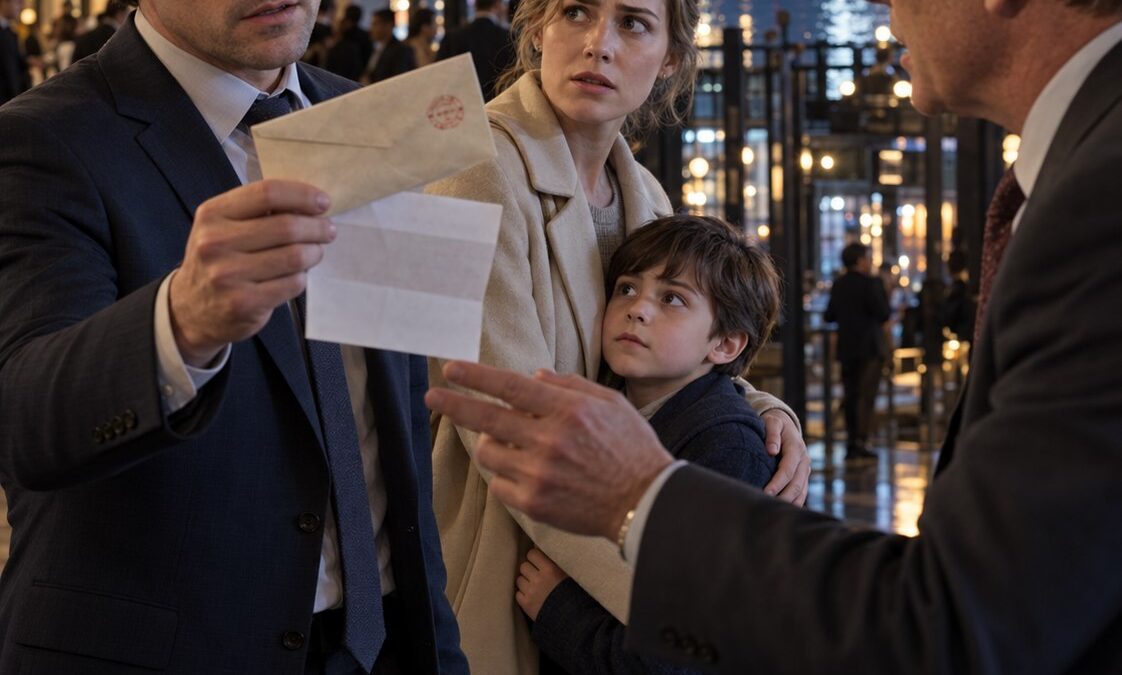
The envelope felt heavy in my hand.
The notice felt worse.
“I need his doctor’s number,” I said.
Tessa gave me a wary look.
“His breathing has settled.”
“I know.”
I looked toward the construction lights across the water.
“I need someone to stop the dust.”
Julian stepped between us and the ballroom.
“The contractor has permits.”
“Call the site supervisor.”
“He reports to our operations team.”
“Then call operations.”
Julian held my gaze for a moment.
Then he took out his phone.
Tessa led Caleb to a bench beneath an old departure board.
I asked the guard for water.
Caleb drank half the bottle.
His hands had stopped shaking.
Tessa kept watching his chest.
I knelt in front of him.
“You doing better?”
He nodded.
“Mom gets scared when I cough.”
“I can understand that.”
“She’s brave at other things.”
“I remember.”
Tessa looked away.
That small movement hurt more than anger would have.
Julian returned.
“The supervisor will halt work until morning.”
“Send the order in writing,” I said.
“I’ve already handled it.”
“Send it in writing.”
He walked away again.
Through the glass, I could see dust hanging beneath the work lights.
The clinic entrance stood beyond it.
I had visited Pier Four last month.
Someone had shown me floor plans.
Nobody had shown me the children’s drawings in those windows.
I examined the notice.
A scanned image of my signature appeared above the words AUTHORIZED TRUSTEE.
I had signed plenty of documents that week.
I knew the stroke of that pen.
This one looked like it had been lifted from another page.
“Tessa, where did you get this?”
“It was taped to the clinic door.”
“Who operates the clinic?”
“The county leases the space.”
She pulled Caleb’s hood over his damp hair.
“They provide respiratory care three afternoons a week.”
“And he goes there?”
“Since he was four.”
“Who told you it was closing?”
“The nurse found the notice this afternoon.”
“Did she call the county?”
“They told her the lease was still active.”
Caleb leaned into her side.
I looked at the sealed envelope.
“May I open it?”
Tessa nodded.
Inside was a short letter dated six years earlier.
She had written that Caleb had been born.
She wanted me to know he was healthy.
She wanted me to contact her through a lawyer if I wished to meet him.
At the bottom, she had written one more line.
Please answer before he learns your name from somebody else.
I read it twice.
The page had been folded into thirds.
One corner had gone soft from being handled.
“You wrote to me?”
“I did.”
“And when it came back?”
“I sent another.”
“What happened to that one?”
“A lawyer answered.”
She reached into her bag.
The paper she showed me carried my firm’s letterhead.
It said future contact should go through Julian Pike.
Then it warned that another direct approach might be treated as harassment.
“Did you call the lawyer?” I asked.
“I did.”
“What did he say?”
“Julian’s office would respond when you were ready.”
“How long did you wait?”
“Until Caleb was walking.”
“I never authorized this,” I said.
Tessa watched my face.
“I wanted to believe that.”
“Why didn’t you tell me tonight before now?”
“Julian told me you’d have security remove Caleb.”
Julian was across the room, speaking into his phone.
I looked down at the envelope again.
The routing number was his.
My office had received Tessa’s letter.
Someone had sent it back without telling me.
* * *
I called the buyer’s attorney first.
I told her the signing could not proceed that night.
She was furious.
She also understood that a disputed trustee authorization could become her problem.
She agreed to hold the documents until we resolved it.
“By tomorrow morning?” she asked.
“I can’t promise that.”
“Then put the reason in writing.”
“I will.”
Then I called Miriam Holt.
Miriam had handled my grandfather’s trust for twenty years.
She arrived at the terminal with reading glasses and a coat over her pajamas.
Julian tried to meet her at the door.
She walked past him.
“What did you sign?” she asked me.
“Nothing tonight.”
“Good.”
She read the clinic notice.
Then she held the envelope toward the light.
“This stamp belongs to your mailroom.”
“I recognized the route.”
“Recognition is a start,” she said.
“It is not proof.”
Tessa liked her immediately.
Miriam asked us to sit down.
She explained the trust without softening it.
My grandfather had placed the pier in trust for his descendants.
I served as trustee and held a beneficiary’s share.
Any living child of mine held a share, too.
A sale required an accurate list of beneficiaries.
For a minor, the court would appoint someone independent to review the transaction.
I stared at Caleb.
He was asleep against Tessa’s shoulder.
“You never asked me about children,” I said.
“I did, last month.”
Miriam opened her tablet.
She showed me her email.
Julian had answered on my behalf.
No children, he had written.
I had been traveling that week.
Miriam had requested a signed declaration afterward.
Julian sent her one that morning.
She had not yet filed it.
I read the signature.
It resembled mine.
It was not mine.
“Can you tell which document he used?” I asked.
“Not from a picture.”
Miriam enlarged the signature.
“The original file may tell us.”
“We preserve everything,” Miriam said.
I called my company’s security director, Anika Shah.
She came to the terminal and brought no one else.
I asked her to preserve the mailroom logs, the original files behind both signatures, and the access records for Julian’s office.
She asked whether Julian knew.
“He knows I saw the routing number.”
“Then I need to move quickly.”
She contacted our records vendor while we watched.
The vendor stored immutable copies of company mail scans.
It could identify when a scan was made and who had accessed it.
Anika placed a legal hold on those records.
She asked Miriam to put the request in writing.
Miriam did it at the bench.
Anika sent it to the vendor and copied outside counsel.
Julian watched from the ballroom doors.
For eleven years, I had let him decide what reached my desk.
Now I watched what reached his.
Miriam called outside counsel to represent the trust.
Tessa asked whether any of that would keep the clinic open.
“I’ll find out,” I said.
She shook her head.
“You used to say that when you meant you’d delegate it.”
She was right.
I called the county leasing office myself.
The lease ran another eight months.
The county had not agreed to close early.
The notice on the clinic door came from my company.
Its signature was the one I had not written.
Our contractor had received a separate instruction to begin interior preparation.
I asked Anika to get the instruction.
While she worked, I sat beside Caleb.
His head rested on Tessa’s sleeve.
“I was wrong to leave you alone with everything,” I told her.
She kept her eyes on the sleeping boy.
“You don’t know everything yet.”
“I know enough to say that.”
She turned toward me.
“You left before he was born.”
“I did.”
“You also left before we divorced.”
I could not argue.
Caleb stirred.
Tessa rubbed his back until he settled.
I remembered sending flowers to her mother’s hospital room.
I could not remember the name of her nurse.
The records vendor answered near midnight.
They had the scan of her first letter.
It had entered our mailroom on a Tuesday morning.
Julian’s assistant had routed it to his office.
Twenty minutes later, Julian had marked it for return.
The vendor also had the second letter.
That one had never been returned.
Julian had opened it.
* * *
Anika found the contractor’s instruction before dawn.
It had been sent from Julian’s account.
The message directed early preparation at Pier Four.
It described the clinic as vacant.
The contractor had photographed children’s drawings on the windows.
He had asked for clarification.
Julian’s office told him to proceed.
I forwarded the exchange to Miriam.
Then I went to the pier.
Tessa had insisted on bringing Caleb home first.
The doctor at the clinic checked him that morning.
He was breathing comfortably.
I met the county’s facilities manager outside the building.
He showed me fresh dust along the entrance.
No work had begun inside the clinic.
The contractor had opened a service wall in the adjoining warehouse.
That was enough to make the county close the entrance temporarily.
The manager pointed to a taped sign.
Appointments had been moved.
Some families had already arrived before anyone could call them.
I ordered our crew away from the site.
The facilities manager arranged an air check and cleaning.
I gave the county written notice that we would cover both.
“Can I tell the families Thursday is still possible?” he asked.
“Tell them the county will decide after the report.”
He nodded.
That answer disappointed him.
It was the only honest one I had.
By noon, someone had leaked the postponed sale.
The headlines blamed Tessa.
One called her an ex-wife with a last-minute claim.
Another called Caleb an alleged heir.
I asked our communications team to correct the record.
They drafted a statement about a scheduling issue.
I sent it back.
The revised statement said a child’s possible interest in the trust required independent review.
It said the clinic’s early closure was unauthorized.
I approved it under my name.
Julian called three minutes later.
“You’ve put a minor in the press,” he said.
“You already put him there.”
“The buyer will reduce its offer.”
“Then it can wait.”
“You don’t know what you’re risking.”
“I’m beginning to.”
He ended the call.
Anika asked him to surrender his work phone.
He refused.
Outside counsel advised us to restrict his company access while the investigation continued.
Our board chair agreed.
By evening, Julian no longer controlled the records.
That should have made me feel better.
Instead, Tessa received a message on her phone.
It came from an unfamiliar number.
You wanted his attention.
Now see what it costs.
She showed it to Miriam.
Miriam told her to save the message and avoid answering.
Anika preserved the screenshot and carrier information.
We did not know who sent it.
We knew it arrived after Julian lost access.
I wanted to confront him.
Tessa stopped me with a hand on my arm.
“Help us stay safe,” she said.
“I will.”
“Then let the records speak.”
I asked whether she wanted someone outside her building.
“I want my neighbor to know what happened,” she said.
“Then I want Caleb’s routine to stay the same.”
I respected both requests.
That evening, I visited her apartment.
Caleb sat at the kitchen table drawing ferries.
He gave each one a name.
The largest was called Home.
“The ferry doesn’t run anymore,” I said.
“It can in a picture.”
He handed me a blue pencil.
I drew a crooked window.
He fixed it without comment.
“Did your grandfather ride this ferry?” he asked.
“Every morning when he was young.”
“Did he own it?”
“No.”
“Then how did he get a pier?”
“He worked there for years.”
Caleb drew a narrow ramp.
“Mom works a lot, too.”
“I know.”
He pointed to an empty seat inside the ferry.
“You can sit there if you want.”
I colored it blue.
Tessa watched from the stove.
I could see how many ordinary evenings I had missed.
Miriam called while Caleb was washing his hands.
The outside lawyers had found a draft side agreement in the deal files.
The buyer would pay Julian a personal completion bonus if the pier sold by month’s end.
The bonus was enormous.
It was also conditioned on a clear beneficiary declaration.
Then Miriam found the email Julian had sent the buyer that morning.
It attached the declaration with my forged signature.
He had hidden Caleb to collect his bonus.
* * *
The board met the next afternoon.
Miriam asked Tessa to attend.
The trust lawyer joined her.
The buyer sent its attorney and a senior executive.
I asked the county’s facilities manager to join by video for the clinic portion.
Julian arrived with his own lawyer.
He looked tired.
He still wore the same precise navy suit.
Miriam laid the returned envelope on the table.
Julian barely glanced at it.
He argued that the trust language was unclear.
He said Tessa had waited too long to make a claim.
He described the early clinic work as a scheduling error.
The trust lawyer asked him for the county’s consent.
Julian said operations had handled it.
The facilities manager appeared on the screen.
“The county gave no consent,” he said.
He held up the current lease.
Julian looked at his lawyer.
Then he turned toward me.
“Ellis knew he had an ex-wife,” he said.
“He never asked whether she had a child.”
That landed.
I had not asked.
The board chair looked at me.
“I made mistakes in my marriage,” I said.
“I did not sign those documents.”
Julian spread his hands.
“You signed hundreds of pages.”
“Show us the originals,” Miriam said.
Julian’s lawyer suggested postponing.
The buyer’s attorney objected.
Her client had relied on the declaration.
She wanted to know whether it was authentic.
Anika displayed the vendor’s mail record.
Tessa’s first letter had reached our office.
A scan showed the sealed envelope and its tracking number.
A return order appeared twenty minutes later.
It carried Julian’s user ID.
Julian said an assistant could have used his computer.
Anika showed the badge log.
His assistant had been downstairs at the time.
Julian had entered his office alone.
He leaned back.
“That proves I returned a letter.”
“It proves more than that,” Miriam said.
She pointed to the small routing number on the envelope.
Julian had told the mailroom to mark it with his private route.
Only his office could issue a return through that route.
The letter Caleb had held against the glass had been preserved for six years.
Its stamp matched the vendor’s scan exactly.
Tessa touched the edge of the table.
She had kept that envelope after believing I rejected her son.
Now Julian had to look at it.
Julian’s lawyer asked for a break.
The board chair refused until Anika finished.
She showed the second letter’s scan.
Julian had opened it.
The attached image included Tessa’s account of Caleb’s birth.
Then Anika showed access records for the forged declaration.
Julian’s account had created the file.
A signature image had been copied from an unrelated contract.
The document had been sent from his office.
“Which contract?” the board chair asked.
“A warehouse insurance renewal,” Anika said.
She put both signatures side by side.
The stray ink mark beneath my name appeared on each.
On the declaration, it ended at the edge of a pasted white box.
The buyer’s attorney compared it with her own original file.
She confirmed the same creation history.
Julian studied the table.
He did not look at Tessa.
“You were going to lose the sale,” he told me.
“There were deadlines.”
“There was a child,” I said.
“There was a company with employees.”
“Those employees did not ask you to hide him.”
Julian’s voice hardened.
“You were never available to anyone who needed you.”
I felt Tessa shift beside me.
Julian had found the truth he could use.
“I wasn’t,” I said.
“That is mine to answer for.”
I touched the returned envelope.
“The rest is yours.”
Nobody spoke for a moment.
Then the buyer’s executive asked to withdraw from the signing until the trust was properly represented.
Miriam agreed.
The board suspended Julian.
Outside counsel referred the suspected forgery and threatening message to investigators.
They also notified the court overseeing the trust.
The next weeks moved slowly.
Investigators collected the original files from the vendor.
They interviewed the mailroom staff and the contractor.
The court appointed an independent representative for Caleb.
Tessa chose a lawyer of her own.
We followed the process their lawyers recommended.
A parentage test confirmed what the dates and our faces had suggested.
Caleb was my son.
I asked Tessa how she wanted to tell him.
“He already knows you’re his father,” she said.
“He wants to know if you know.”
“I do.”
“Then you can tell him that yourself.”
The carrier records later tied the message to a prepaid phone bought near Julian’s office.
Investigators handled that finding.
I stayed out of their way.
Four months later, Julian pleaded guilty to fraud and forgery charges.
The court imposed a sentence that included restitution and supervised probation.
The trust’s lawsuit recovered his bonus advance.
He sent one final message through his lawyer.
He claimed I owed him thanks for saving the company from my family.
I answered through counsel.
He had saved nothing.
* * *
The clinic reopened after cleaning and a clear air report.
Caleb returned on Thursday afternoon.
I waited outside with a paper bag of sandwiches.
Tessa came out first.
She saw the bag and smiled despite herself.
“He eats before his appointment,” she said.
“I remembered this time.”
“Good.”
It was a small word.
I held onto it.
The sale remained paused while Caleb’s representative reviewed the terms.
The buyer lowered its offer.
The new price was still large enough to make the board impatient.
It was also enough to fund repairs, keep the clinic open, and honor every beneficiary’s share.
I brought the revised plan to Tessa and Caleb’s representative.
The trust would retain Pier Four.
The county could keep the clinic there under a long lease.
Public access to the waterfront would stay in the sale documents.
Caleb’s share would be protected until he was an adult.
Tessa read every page.
She found two mistakes.
One was a missing clinic entrance on the access map.
The other let the buyer change visiting hours without county approval.
I corrected both.
“You don’t have to impress me,” she said.
“I know.”
“Then why are you doing all this?”
“Because I can.”
She looked unconvinced.
“And because I should have read your letter.”
We spent the following weeks learning how to stand in the same room.
Sometimes we failed.
I tried to arrange a specialist appointment without asking her.
She told me Caleb already had a doctor.
I apologized and canceled my arrangement.
Another day, I offered to pay her rent for a year.
She asked me to put any support for Caleb in a formal agreement.
I did.
There were lawyers.
There were calendars.
There were careful introductions.
Caleb called me Ellis.
I told him he could keep doing that.
At our third dinner, he asked whether I could build a ferry.
“I could help draw one,” I said.
“That’s different.”
“It is.”
He considered my answer.
“Then you should come see a real one.”
One Saturday, he asked me to ride the harbor ferry with him.
It was a tour boat now.
He studied every latch and window.
I told him which parts my grandfather had repaired.
“Was he nice?” Caleb asked.
“He could be.”
“Were you nice when you were little?”
“I hope so.”
Tessa laughed from the seat behind us.
It was the first time I had heard that sound in years.
Caleb turned around.
“What?”
“Your father gave a very careful answer,” she said.
He considered that.
“Mom says careful answers take longer.”
“She’s right,” I said.
At the end of the ride, he asked whether I would come again.
“Yes.”
He narrowed his eyes.
“Even if you have work?”
“Especially then.”
Tessa watched me after he ran toward the snack counter.
“Don’t promise more than you can keep.”
“I won’t.”
“You made promises to my mother, too.”
I remembered the hospital.
I remembered flowers delivered by someone else.
“I failed her,” I said.
“And I failed you.”
Tessa rested her hands on the railing.
“She liked you before all that.”
“I liked her.”
“She knew.”
We stood there while Caleb debated between two kinds of pretzels.
“I can forgive what you did,” Tessa said.
“I can’t pretend it didn’t happen.”
“I’m not asking you to.”
“We build this around Caleb.”
“Yes.”
“Slowly.”
“Yes.”
She looked relieved that I had stopped talking.
Caleb returned with a pretzel in each hand.
He gave one to Tessa.
Then he broke the other in half for me.
A month later, the court approved the revised sale.
The trust documents named Caleb correctly.
Pier Four stayed ours.
The county signed its long lease.
I went to the clinic on the first day under the new agreement.
A child had taped a drawing to the door.
It showed a ferry with six crooked windows.
Caleb had drawn it.
Mine was the crookedest.
That evening, he asked if I wanted to have dinner with them.
He asked Tessa first.
She said I could come if I brought dessert.
I arrived with a pie and three forks.
Caleb counted them.
“You remembered everybody.”
“I’m getting better at it.”
He opened the door wider.
* * *
Three years later, Caleb stood outside the old ferry terminal.
He was nine and wearing a coat that fit.
The glass doors were unlocked.
The county had turned part of the building into a public hall.
Families crossed the floor where buyers once waited for my signature.
Tessa was inside, helping set up a school exhibit.
Caleb held the returned envelope in a clear sleeve.
Miriam had given it back after the case closed.
He had asked to bring it for a project about the harbor.
His project showed the ferry route.
It showed the clinic, too.
The envelope belonged beside them because he had chosen it.
“Why keep it?” he asked me.
“Your mom wrote you into my life with that letter.”
“But it came back.”
“It reached me later.”
He considered the red stamp.
Then he looked through the glass at Tessa.
“She says you listened when it did.”
“I’m trying to.”
He slipped the envelope into his folder.
Inside, Tessa waved us over.
The clinic still had its rooms on Pier Four.
Caleb had a doctor who knew his name.
The waterfront had a path anyone could walk.
Tessa and I had separate homes and a shared calendar.
Some evenings ended with all three of us at the same table.
We kept our promises there.
Caleb ran ahead to show his mother the exhibit.
I followed him through the open door.
THE END








