The Night Cleaner Had Fifty-Two Dollars When She Defied a Feared Harbor Boss to Save His Grieving Son
Chapter 2: The Door Behind the Wall
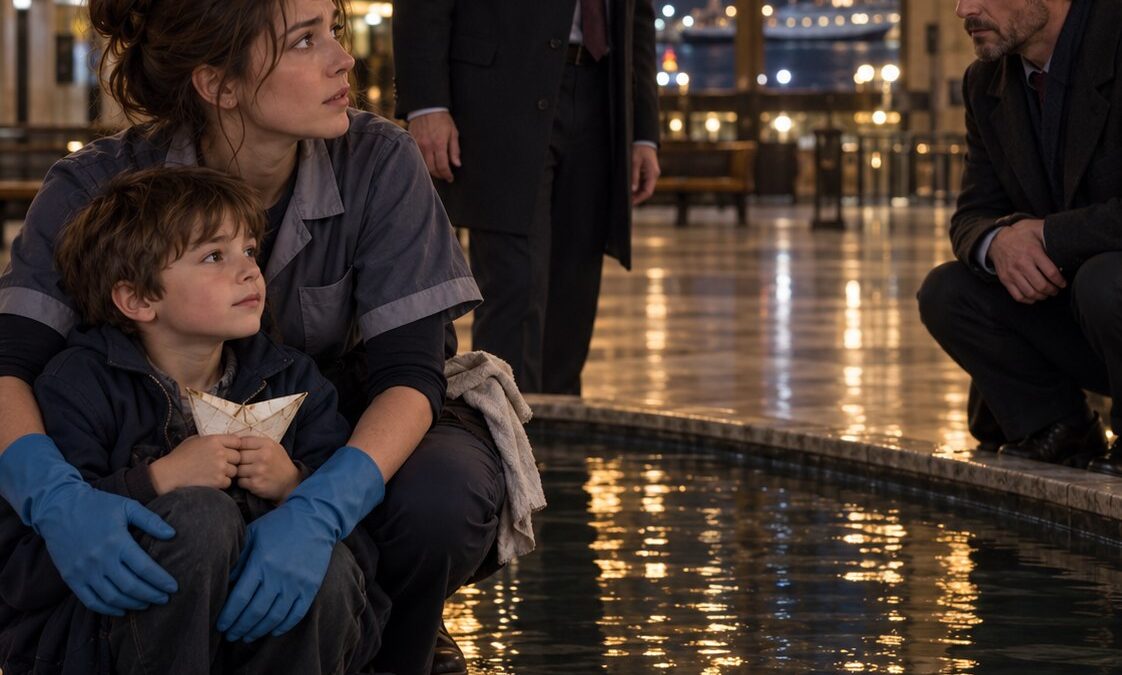
Victor Pike stopped beside the reflecting pool.
He looked at the paper in Micah’s hands.
Then he smiled.
“There it is,” he said.
Micah folded the boat shut.
Gideon remained on one knee.
“What is it?” he asked.
“A drawing Dana made for him.”
Victor’s voice carried easily across the emptying hall.
“She was always making things.”
Elise watched Micah’s fingers tighten.
The boy looked at the water.
“Victor said my boat was lost.”
Victor’s smile held.
“I thought it was.”
Gideon stood.
The guard moved beside him, but Gideon lifted a hand.
No one touched Victor.
No one touched the child.
“Micah,” Gideon said, “would you show me the inside?”
Micah looked at Elise.
“It’s yours,” she told him.
His shoulders lowered.
He held the boat out.
Gideon accepted it by its corners.
The paper had once been white.
Smoke had darkened one edge.
Across the center ran Dana Vale’s neat handwriting.
WEST DOOR—OPEN.
Beneath that were a date, a time, and six numbers.
Elise leaned closer.
The numbers had a printed box around them.
“That isn’t a drawing,” she said.
Victor turned toward her.
“She cleans floors, Gideon.”
“She can still read.”
Elise kept her eyes on the paper.
The box had a thin blue border.
She had seen one that evening.
A maintenance worker had left a fresh inspection ticket beside the service entrance.
Same border.
Same numbered box.
“This is the back of a work ticket,” she said.
Victor’s face lost its smile.
“It proves nothing.”
“Maybe.”
Gideon folded the boat gently.
“Micah needs to go home.”
“No,” Micah said.
Gideon stopped.
The boy’s eyes filled, but he held his ground.
“You said we could stay for the boats.”
Elise looked at Gideon.
For all the money in the hall, he seemed unable to offer his son another minute.
“I can stay,” she said.
“You have work.”
“My shift ends at midnight.”
“It’s nearly midnight.”
“Then I’m almost finished.”
Gideon pulled out a chair.
He sat beside the pool while Elise retrieved her little boat.
Micah placed it on his knee.
Victor waited behind them.
After a while, the boy spoke.
“Mom said to keep it dry.”
Gideon’s hand closed around the folded paper.
“Did she say why?”
“She said it would help somebody find the way.”
Victor stepped forward.
“Children remember things differently after a shock.”
Micah flinched.
Gideon saw it.
“Go home, Victor.”
“We need to discuss that ticket.”
“We will.”
Victor looked at Elise once before leaving.
The bell did not ring again.
Micah stayed until both paper boats grew heavy and sank.
When Gideon carried him out, he left Elise his card.
On the back he had written a number.
“Call if you remember anything about that form.”
Elise nodded.
He looked at the paper boat in his hand.
For ten months, he had believed Dana reached a sealed door.
Now he held a dated ticket saying someone had opened it.
* * *
Elise slept four hours.
At eight, she called the number.
Gideon answered himself.
“Do you know where the tickets are kept?” she asked.
“Yes.”
“Have someone photograph the whole book before Victor gets there.”
A pause followed.
“Why?”
“Tickets come in numbered sets.”
“If that one was removed, the gap matters.”
Gideon thanked her.
He did not ask why a cleaner knew about maintenance books.
She had spent three years emptying bins beside desks where people misplaced forms.
She knew which papers came in sets, which had carbon copies, and which were destroyed at the end of each month.
The blue-bordered tickets were different.
The city required the terminal to keep them for annual inspection.
By noon, Gideon’s lawyer had obtained the maintenance book from a locked cabinet.
Victor was not its keeper.
A facilities clerk was.
She signed a receipt when she handed it over.
Elise met them in the lawyer’s office that afternoon.
She wore yesterday’s shoes.
Her supervisor had taken her off the schedule pending a complaint from an auction guest.
Gideon noticed.
“Was that because of me?”
“I haven’t seen the complaint.”
“I’ll find out.”
“Please find out what happened to Dana first.”
He accepted that.
The lawyer, Helen Cho, spread photographs across a conference table.
One ticket remained attached to the book by a torn strip.
The number immediately before Micah’s boat was intact.
The number immediately after it was intact.
Dana had torn out the missing one.
Helen had called the city’s records office.
A copy had been filed electronically by the inspector who issued the book.
The office would release a certified copy through the proper request.
Until then, the photographs were a lead.
“What was the west door?” Elise asked.
“A loading exit,” Gideon said.
“The freight office was being renovated.”
“Victor said the door had been covered during construction.”
“Was it?”
“I believed him.”
Helen pointed to the number written by Dana.
“That is a ticket number.”
She pointed to another mark.
“This may be a gate designation.”
Gideon studied it.
“Dock Six.”
Dana’s death had been ruled accidental.
A small electrical fire had started in the freight office after hours.
Firefighters found her in a corridor.
The investigation said renovation barriers had narrowed the exits.
Gideon had read the report once.
Then he had put it away where Micah could not find it.
“Why was Dana there?” Elise asked.
“She served on our foundation board.”
“She wanted the old building made safe before the public tours began.”
Victor had been running the renovation.
He had also provided investigators with the site plans.
Helen turned to Gideon.
“We need the original plans from the city.”
“And the fire report,” he said.
Helen had already requested both.
They went to the terminal after the last ferry of the afternoon.
Micah stayed with Gideon’s longtime housekeeper.
Elise walked the public corridor with the facilities clerk.
The clerk, Renée, showed them a wall painted cream.
“There,” she said.
It looked like any other wall.
But the tile beneath it changed pattern.
A narrow row ran toward the harbor.
Elise followed it with her eyes.
“A threshold used to be here.”
Renée nodded.
“The door was covered after the fire.”
“Who ordered that?”
“Victor.”
Renée had signed the work order.
She showed Helen a copy from her files.
The order was dated three days after Dana died.
Gideon stared at it.
“I thought it happened before.”
“That’s what Victor told everyone,” Renée said.
Elise went back to the wall.
She did not touch it.
A painted panel could hide a lot.
It could also be removed.
Helen called the city building inspector.
She asked him to preserve the site as part of a reopened safety inquiry.
While they waited, Renée found another record.
Her desk calendar held the inspection schedule for the week of the fire.
On the morning Dana died, an inspector had tested the west door.
Renée remembered the test because it delayed a delivery.
The door opened freely at eleven.
Dana’s boat carried a later time.
Six forty that evening.
“That doesn’t tell us what happened at seven,” Helen said.
“No,” Gideon answered.
“But it tells us Dana was checking.”
That night, Helen received the certified city copy.
It showed Dana’s handwriting beside an inspector’s printed entry.
The west door had been open six hours before the alarm.
Below it, in a box for site representative, was a signature.
Victor Pike.
* * *
Victor called Gideon the next morning.
Gideon put the call on speaker in Helen’s office.
“You took company records to a lawyer?” Victor asked.
“Yes.”
“You could have called me.”
“I’m calling you now.”
Victor exhaled.
“Dana hated those renovation barriers.”
“She would have written anything to make us tear them down.”
“Did she write your signature?”
“I signed dozens of forms.”
“Come tell Helen which ones.”
“I’ll come when you’re ready to talk privately.”
The call ended.
Helen saved its time and her notes.
She made no claim that it was proof of a crime.
A signature on an inspection ticket showed Victor had been there.
It did not show what happened later.
That afternoon, Elise’s supervisor sent a termination notice.
It said she had approached a guest without authorization.
The attached complaint bore no guest’s name.
Elise forwarded it to Helen because the timing troubled her.
Then she went to the unemployment office.
She spent six dollars on bus fare and came home with forms.
Her brother called while she was filling them out.
“You sound tired,” Jonah said.
“I lost a shift.”
“You lost a whole job, didn’t you?”
She told him.
He offered money.
He drove a delivery van and had two children.
She thanked him, then declined.
“I have time to look for work.”
“You always say that when you don’t.”
She smiled despite herself.
“I have the morning.”
A knock came at her door.
Gideon stood in the hallway.
No guard.
No expensive gift.
He held an envelope.
“My company still has a contract with your employer,” he said.
“I know.”
“The complaint came from Victor’s office.”
Elise leaned against the doorframe.
“Can you prove that?”
“Renée found the email forwarding it.”
“Then Helen should keep it.”
“She does.”
He held out the envelope.
Inside was her final pay, issued early at his request.
Elise checked the amount.
It matched her hours.
“Thank you.”
“I can speak to your supervisor.”
“You can tell him to preserve the complaint.”
Gideon closed the envelope for her.
“All right.”
He saw the dark apartment behind her.
“The power?”
“Tomorrow.”
“I could—”
“I know.”
He stopped.
For the first time, Elise saw how much effort that cost him.
Micah appeared at the far end of the hall with the housekeeper.
He had refused to wait in the car.
In his hand was the small boat Elise had folded.
It had dried crooked.
“Dad said you made it,” he told her.
“You watched me make it.”
“I forgot the last fold.”
Elise crouched.
She showed him with a grocery flyer.
Micah copied each crease.
Gideon waited beside them.
When the boat was done, Micah placed it in her hand.
“You keep this one.”
“I thought it was yours.”
“We can make more.”
After they left, Elise set it beside the unpaid electric bill.
She called the utility company.
A payment plan kept the power on.
It cost her the money she had set aside for groceries.
She went to the market anyway.
Rice, eggs, and apples were enough for the week.
At Helen’s office, the inquiry widened.
The city had retained its inspection records.
The fire department retained photographs.
The construction company retained delivery logs.
One log showed a shipment of steel panels to Dock Six on the night of the fire.
The order came from Victor’s office.
The panels were not installed until three days later.
“So what were they doing there?” Elise asked.
Helen checked the delivery note.
“They were unloaded at the freight office.”
Gideon looked up.
Dana had found something there.
Helen obtained a court order to preserve the company’s financial records.
An independent accountant reviewed payments Victor had approved.
Three renovation invoices had no matching work.
The money had gone through a supplier Victor controlled through another company.
Dana, as a foundation board member, had asked about those invoices two days before the fire.
Her email remained in the company archive.
Victor’s reply promised to show her the freight office files.
At six thirty the following evening.
Gideon read the email twice.
Then he set it down.
“Dana went there to meet him.”
* * *
Helen arranged a meeting in the terminal boardroom.
She invited every foundation trustee.
Two city investigators attended after reviewing the certified records.
A police detective came to hear what Victor would say.
Gideon asked Elise to sit beside Renée.
“You noticed the ticket,” he told her.
“You should hear him answer.”
Victor arrived with his own lawyer.
He glanced at Elise, then took the chair nearest the door.
Helen did not begin with an accusation.
She laid out the invoices.
Victor studied them.
“The supplier was approved.”
“By you,” one trustee said.
“Under emergency renovation authority.”
“Where was the work?” Helen asked.
Victor pointed to the freight office.
“Some material was damaged in the fire.”
It was a plausible answer.
Several trustees looked at one another.
Then Helen showed the delivery log.
The panels had arrived after Dana’s meeting began.
Their installation had been recorded three days later.
Victor’s lawyer leaned toward him.
Victor waited.
“None of that connects me to the fire,” he said.
The detective nodded.
“That’s correct.”
Victor looked briefly satisfied.
Gideon stayed still.
“Why did you tell me the west door was sealed?” he asked.
“It was behind a construction barrier.”
“You said it had been sealed for weeks.”
“I may have used the wrong word.”
“You told my son he imagined it.”
Victor’s jaw tightened.
“He was frightened.”
“Then tell him the truth.”
Victor looked around the table.
“Gideon, this is a board meeting.”
“It was his mother.”
His voice remained level.
Victor leaned back.
“Dana came to challenge those invoices.”
“She was angry.”
“She threatened to take the records to the city.”
“She didn’t understand that some payments covered old obligations.”
Gideon met his eyes.
“Whose obligations?”
Victor glanced at the detective.
His lawyer touched his sleeve.
Victor said nothing.
Elise watched him look toward the room’s back wall.
The cream paint there matched the corridor.
The door had been covered with a panel.
She remembered the tile line.
“Where were the panels unloaded?” she asked.
Victor turned.
“In the freight office.”
“Why?”
“The crew needed space.”
“Beside an exit?”
“I don’t remember.”
Renée opened her folder.
“The crew’s daily sheet says you directed them.”
Victor’s lawyer asked to see it.
Renée handed over the original.
It named the panels, the west corridor, and Victor.
He signed at six fifty-eight.
The fire alarm had sounded at seven twelve.
Victor studied his signature.
“It says I directed unloading.”
“It doesn’t say I blocked a door.”
The detective agreed again.
“We’ll establish that separately.”
Helen unfolded Micah’s paper boat.
She placed it beneath a clear sleeve.
Dana had written OPEN beside the door at six forty.
“She was there before the panels arrived,” Helen said.
Victor’s eyes went to the paper.
“Where did you find that?”
“Micah kept it,” Gideon said.
Victor swallowed.
For ten months, Micah had believed his memory needed correcting.
Now every adult in the room could see why he remembered a door.
Victor still had an answer.
“Dana could have written it hours earlier.”
“She could have.”
“The inspector’s form only proves the door worked that morning.”
“That’s true,” Helen said.
She asked the detective to display two photographs.
They came from the fire department’s scene file.
One showed the corridor after firefighters entered.
A steel panel stood across the former west exit.
The second showed its delivery label.
The supplier’s order number matched Victor’s invoice.
A trustee rose from the table.
Victor looked at the picture for a long time.
“I ordered material,” he said.
“I didn’t place it there.”
“Who did?” the detective asked.
“I don’t know.”
The detective made a note.
Helen did not press for a confession.
She presented the independent accountant’s findings.
Victor’s supplier had billed the company for work that could not be found.
The accountant had traced the payments to an account Victor controlled.
The financial records were separate from the fire evidence.
They gave investigators a reason to examine his actions that evening.
Victor pushed back his chair.
“You let him run this place without asking how,” he told Elise.
He pointed at Gideon.
“People feared him long before I worked here.”
Elise did not argue about Gideon’s past.
She looked at the boat.
“A child told the truth,” she said.
Victor had no answer for that.
His lawyer asked that questioning stop.
The detective agreed.
Victor left without a guard following him.
By evening, investigators had secured the corridor and the company records.
The city suspended use of the freight office.
Gideon brought Micah home and told him what the ticket showed.
“You remembered the door,” he said.
“I’m sorry I let anyone tell you otherwise.”
Micah asked whether Dana had been scared.
Gideon said he did not know.
He told him she had tried to make the building safe.
Months passed before the case reached court.
The investigation found that Victor had directed workers to leave the panels in the corridor while he met Dana about the invoices.
One worker confirmed the instruction.
Victor had later changed the site plan he gave investigators.
His lawyer disputed whether he knew the corridor was blocked when the fire began.
The prosecutor charged him with fraud, falsifying records, and offenses connected to the blocked exit.
At trial, the ticket, the fire photographs, the worker’s testimony, and the financial records were examined separately.
The jury convicted him.
A judge sentenced him the following spring.
Gideon attended every day.
Elise attended two.
Neither asked Micah to come.
* * *
By then, Elise worked for the city library.
She cleaned after closing.
She also helped run its Saturday craft table.
The children preferred boats to anything else she offered.
Some made fleets.
Some made boats too broad to fit in the library’s small basin.
Micah made his narrow and pointed.
He visited with Gideon twice a month.
The first time, Gideon waited by the door.
The second, Micah asked him to fold one.
Gideon produced something that looked like a hat.
Micah studied it solemnly.
“That won’t float.”
“It might.”
“It has a hole.”
Gideon turned it over.
“It does.”
Elise handed him another sheet.
He tried again.
Outside the library, Gideon’s reputation had begun to change.
He turned over old company records when investigators requested them.
He ended several harbor arrangements he could not account for openly.
That cost him contracts.
He kept the terminal and sold two warehouses.
Helen made sure the foundation’s new board included people who did not work for him.
None of it restored Dana.
It gave Micah fewer reasons to be afraid of the place she had loved.
One afternoon, Gideon brought Elise an offer.
The terminal needed a community director.
The salary was more than she made at the library.
The office had a harbor view.
Elise read the description.
“You wrote this for me.”
“I thought you’d be good at it.”
“You thought I’d say yes.”
“I hoped.”
She laid the pages down.
“I like the library.”
“I see that.”
“And I won’t work where Micah needs me to make you feel better.”
Gideon looked at her.
“You’re right.”
He folded the offer.
“I’m sorry.”
She let him sit with that for a moment.
Then she showed him the craft table’s supply list.
“The terminal could fund field trips.”
“That would help?”
“Ask the schools.”
“They’ll know what they need.”
He nodded.
Within a month, three schools had planned harbor visits.
The foundation paid for buses, lunches, and trained guides.
Elise stayed at the library.
Her electric bill arrived on time.
So did her rent.
Jonah stopped calling to ask whether she had eaten.
He still called.
Micah spoke more often about Dana.
Sometimes he wanted stories.
Sometimes he wanted to fold quietly.
Gideon learned to let both happen.
He also learned to ring Elise’s doorbell without bringing a problem to solve.
One evening he arrived with two paper bags of takeout.
Elise opened the door.
“Did you buy enough for a crew?”
“I didn’t know what you liked.”
“That explains three kinds of noodles.”
He looked almost embarrassed.
She stepped aside.
They ate at her small table.
Gideon spoke about a school tour.
Elise spoke about a girl who had written her name inside every boat she made.
After dinner, he washed the dishes.
He checked each one as though a mistake might be reported to Helen.
At the door, he paused.
“May I ask you something?”
“Yes.”
“Could I take you to dinner next week?”
“You just did.”
He glanced toward the empty bags.
“Then could I try again?”
Elise considered him.
She had seen him frighten people by entering a room.
She had seen him kneel beside a frightened boy.
Both were true.
“Yes,” she said.
“One dinner.”
His smile was careful.
“One dinner.”
“Micah doesn’t need to know yet.”
“I agree.”
“And if I say no to another, you accept it.”
“Of course.”
She believed him because he had learned to stop when she asked.
They went to dinner the following Thursday.
Then, slowly, they made room for another.
* * *
Four years later, the west wall of the ferry terminal held a door again.
It opened onto a public walkway.
Beside it hung a photograph of Dana.
The plaque described her work for safer harbor buildings.
It did not mention the fire.
Gideon and Micah had chosen the words together.
On opening day, children crowded around the reflecting pool.
The water was shallow.
A guide stood nearby with a basket of paper squares.
Elise watched Micah fold one for a smaller boy.
At eleven, he had long wrists and serious eyes.
He still carried Dana’s boat on special days.
It rested now inside a clear case near the door.
The original ticket had been returned after the trial.
Micah decided where it belonged.
Visitors could see Dana’s handwriting without unfolding it.
WEST DOOR—OPEN.
The smaller boy set his boat on the water.
It tipped.
Micah caught it with one finger.
“Mine sinks,” the boy said.
“Then I’ll hold the edge.”
Across the pool, Gideon looked at Elise.
She had never told Micah to remember those words.
He had kept them himself.
Elise knelt beside him.
Together, they watched the little boat find its balance.
THE END