Everyone Thought My K9 Had Attacked a Six-Year-Old at the Ferry Terminal—Until Her Lunch Tin Started Clicking
Chapter 2: Locker 418
“Stay with me, Wren.”
My voice came out steady.
My hands did not feel steady.
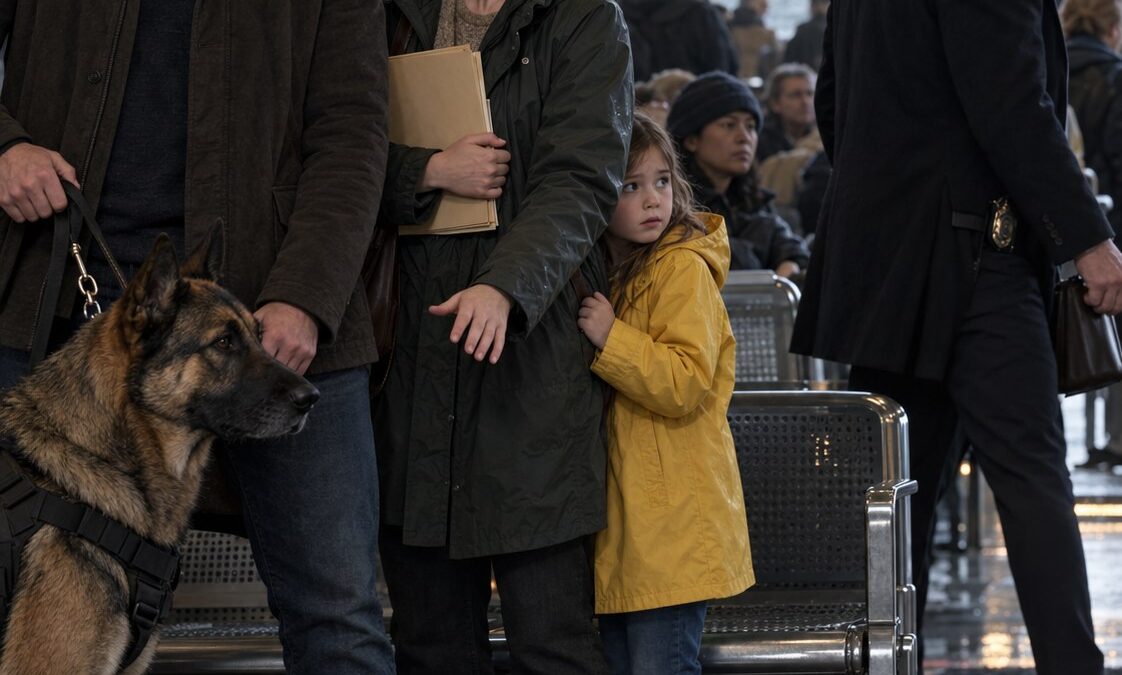
Atlas kept his weight on either side of her.
He was holding her in place, but his mouth stayed clear of her.
Tessa lay flat beside the bench.
“Can you move her?” she asked.
“I can try.”
“Then do it.”
I checked the space behind them.
The tin was close to Wren’s feet.
Atlas stood between her and it.
I slid two fingers under his collar.
“Back with me.”
He glanced at me.
The tin clicked.
He turned back.
I had one choice left.
“Wren, can you crawl toward your mom?”
“The dog’s on me.”
“I’ll make room.”
I guided Atlas’s shoulder an inch to the side.
He resisted.
“Please,” I whispered.
Wren tucked one arm beneath herself.
Tessa reached for her.
The man with the tire iron lowered it.
He stepped closer with his other hand open.
“Take her wrist,” I told him.
He did.
Wren slid out from under Atlas.
Tessa pulled her behind the ticket counter.
Only then did Atlas let me draw him back.
The green light stayed on.
“Everybody outside,” I called.
People moved.
Some pushed.
A security guard held the east door open.
The canceled boat had left the terminal crowded, but the waiting room emptied quickly.
Voss spoke into his radio.
He told staff to shut the dock entrance.
That was the right order.
I noticed how carefully he watched the tin while he gave it.
The bomb squad arrived eleven minutes later.
They sent us well beyond the building.
A medic checked Wren in the back of an ambulance.
She had a red mark on one shoulder and a scraped palm.
Atlas sat beside me in the rain.
His broken harness strap hung against his leg.
The medic came over when she finished.
“Her breathing’s fine,” she said.
“She’ll be sore.”
Tessa followed her.
Wren held a foil blanket around her shoulders.
Atlas rose.
Wren hid behind her mother.
I told him to sit.
He did.
Tessa looked at the broken strap.
“Did he bite her?”
“No.”
“The medic checked.”
“I heard.”
“I thought he would.”
I could barely hear her over the rain.
“I did too,” I said.
That seemed to surprise her.
She took Wren’s hand.
“Then why did you trust him?”
I looked at the terminal doors.
“Because he kept watching the tin.”
Behind the glass, officers carried equipment toward the waiting room.
Voss was speaking to a police captain near the entrance.
He pointed at me.
Wren stepped out from behind Tessa.
“He wanted my cookies,” she said.
Atlas’s ears lifted at the word.
For the first time that afternoon, Tessa almost smiled.
A detective came over and introduced herself as Priya Shah.
She asked Wren about the lunch tin.
Wren gave a child’s account.
Her mother had packed it.
She had carried it to the memorial table.
Mr. Voss had picked it up after she dropped it.
He had given it back.
Shah wrote down her exact words.
“Did it look different?” she asked.
Wren considered that.
“The tag was on it.”
Tessa looked up.
“What tag?”
“The number.”
She held up four fingers.
“I asked him if it was for a game.”
“What did he say?” Shah asked.
“He said I could keep it.”
Shah went inside.
The rain grew harder.
Tessa pulled the foil blanket around Wren’s chin.
“I’d never seen that tag,” she said.
“I recognized the number.”
“From where?”
“An incident sheet.”
Her grip tightened on the blanket.
“Eli’s incident?”
I nodded.
She waited for me to explain.
I told her about Atlas’s alert three years earlier.
I told her what my supervisor had said.
I told her that I had followed his order.
“I should have put it in my report,” I said.
“Did you?”
“I wrote that Atlas alerted.”
“Then why wasn’t it in the records?”
“I don’t know.”
Tessa looked at the terminal.
For three years, she had been told her husband was alone in the service corridor because he had ignored a warning.
She had believed there was nothing to dispute.
Shah returned before either of us spoke.
The squad had found a powered device inside the lunch tin.
It had not been part of Tessa’s packed meal.
They were still assessing it.
The orange tag was a current authority tag for locker 418.
Then Shah told us what the first officers had found in the old incident file.
Locker 418 had not been empty when Eli died.
It had been assigned to him.
* * *
The police drove us to a station outside the ferry district.
Wren slept against Tessa in the back seat.
Atlas traveled in my vehicle with another officer.
I wanted to go with him.
I wanted to stay with Wren too.
Shah settled the question by asking me to make a formal statement first.
She kept Tessa and me in separate rooms.
That mattered.
If our memories later agreed, nobody could say we had built them together.
I described each click.
I described the green light.
I described Voss picking the dock doors for the evacuation.
I also described the glance he gave the tin when he entered.
“Can you be certain what it meant?” Shah asked.
“No.”
She wrote that down.
“I can be certain he saw it,” I said.
She wrote that down too.
I gave her the name of my retired dispatcher.
June Mercer had called me that morning.
She said she had found the original duty log while clearing a storage cabinet.
Shah called June in.
June arrived with a canvas bag and a raincoat buttoned wrong.
She was sixty-eight and angry at everyone who had ever filed a report without a page number.
The bag held her copy of the duty log.
It also held a note from the authority’s lawyer.
The note said the copy was unnecessary because the case was closed.
“I kept it because they asked me to throw it out,” June said.
Shah photographed each page.
Then she sent for the official file.
The official version listed my arrival at 4:19 p.m.
June’s copy listed 4:09.
The official version showed no canine alert.
June’s copy had my radio message in capital letters.
K9 ALERT, SERVICE CORRIDOR, NORTH END.
I sat very still.
Tessa read the words twice.
June pointed to the line beneath them.
At 4:12, a maintenance supervisor had asked to open locker 418.
His name was Eli Calder.
At 4:13, control told him to wait.
At 4:16, the log recorded smoke.
“That’s three minutes,” Tessa said.
June nodded.
“He was waiting for an answer.”
The version Tessa had received said Eli entered a closed corridor without permission.
That finding had followed her through every appeal.
Shah asked who could alter the authority’s archived file.
June named the records administrator and the executive office.
The administrator had retired.
The executive office belonged to Voss.
That alone proved little.
June knew that.
She gave Shah the original dispatch backup number and the name of the vendor that stored the radio audio.
Those records needed legal requests.
Shah began them.
A technician brought in the lunch tin’s first inventory photographs.
Its usual contents were still inside.
A sandwich.
An apple.
A paper napkin with Wren’s name.
The added device sat in a fitted compartment beneath them.
Shah kept the images away from Wren.
Tessa recognized the napkin.
She recognized a scratch beside the tin’s latch.
The tag had been attached afterward.
Its adhesive was clean.
The tin had not been switched for another one.
Someone had opened Tessa’s tin and altered it.
Shah had the terminal video copied before the authority could overwrite it.
The first camera showed Tessa at the customer window.
The second showed Wren near the memorial table.
Voss passed through the frame.
Wren’s tin fell.
He stooped, lifted it, and returned it.
His body blocked the camera for four seconds.
Four seconds was enough to attach a tag.
It was not enough to prove he had installed the device.
He might have known it was there.
He might have seen only a child dropping her lunch.
I kept returning to the number.
“Why mark it 418?” I asked.
Shah spread out June’s log.
“Maybe someone wanted you to notice.”
“How would they know I’d be here?”
June looked embarrassed.
“I told the authority desk I was meeting you.”
She had called to ask whether the memorial area would be open.
The clerk had taken her name.
My name too.
One coincidence had brought us there together.
After that, someone could have made a plan.
Tessa left the room to check on Wren.
I asked June whether she remembered the alert.
“I remember you asking twice for access,” she said.
“Your supervisor said maintenance would handle it.”
“He told me to leave.”
“You stayed at the door.”
“Not long enough.”
June closed her bag.
“I heard your voice on that tape.”
She did not tell me I had done enough.
I was grateful for that.
A records officer entered with a printout from the authority’s access system.
A police request had made the authority preserve its current locker records.
Locker 418 had been reopened six weeks earlier.
The request carried Tessa’s name.
Tessa had never requested a locker.
* * *
Shah let Tessa see the access form.
The signature was a typed name.
The attached identification was a scan of Tessa’s driver’s license.
She had given that scan to the authority’s claims office the previous spring.
The request had been filed through an internal account.
“Who used the account?” Tessa asked.
“We’re finding out,” Shah said.
Wren slept in the family room down the hall.
A volunteer sat with her.
Tessa kept the door in sight.
Shah explained what the bomb squad knew so far.
The device in the lunch tin contained a small commercial signaling charge and a battery.
It could have produced smoke and intense heat.
The squad had made it safe.
They would test it before making any claims about who built it.
“It was near her food,” Tessa said.
“Yes.”
Tessa put a hand over her mouth.
I thought she might leave.
Instead, she asked for the video again.
On the screen, Voss stooped beside Wren.
He passed the tin back.
Wren walked toward the benches.
Tessa was still arguing at the window.
“Play it from before he enters,” she said.
Shah did.
A security employee crossed the background carrying a gray supply tote.
He paused at the memorial table.
He left the tote behind the table’s cloth.
Voss arrived a minute later.
The video did not show the tin being opened.
There were cameras on the entrance and the ticket line.
None faced behind the memorial display.
Tessa leaned forward.
“That guard came to our house.”
“When?” Shah asked.
“Last week.”
“He gave a name?”
“Darren Pike.”
Pike had told her the authority was reviewing her latest request.
He wanted to collect the original letter Eli had sent her on the morning of the fire.
Tessa refused.
The letter was at her sister’s house.
She had brought only a copy to the terminal.
Voss knew that because his lawyer had asked for the original at the hearing.
Shah sent officers to Tessa’s sister.
They found the letter where she said it was.
Eli had written it during his lunch break.
He told Tessa he had discovered a problem with the dock’s safety system.
He said he was placing his notes in locker 418 until an outside inspector could see them.
He did not describe the problem in the letter.
Tessa had shown it to the authority.
They called it a worried man’s misunderstanding.
She had kept asking for the locker inventory.
They said it was empty.
Now a locker in her name had been opened.
The guard who visited her home had been at the table.
And someone had placed a dangerous device in her daughter’s lunch.
Shah asked Tessa to stay with her sister for a few days.
The police could arrange patrols.
Tessa agreed.
I asked whether an officer could look at the original letter before she moved it again.
Shah already had someone on the way.
My phone buzzed.
It was the police canine supervisor.
He wanted Atlas back at the kennel for a veterinary check.
He also wanted my harness and my report.
A child had been hurt, even if Atlas had saved her from something worse.
There would be a review.
I signed the transfer form when the handler arrived.
Atlas walked toward the van.
Then he turned to look at me.
His broken strap dragged along the pavement.
“He didn’t bite her,” I told my supervisor.
“I know what the medic said.”
“I need him checked.”
“That’s where he’s going.”
I watched the van leave.
The cost of my decision was arriving in ordinary forms.
A missed shift.
An inquiry.
My dog going home with someone else.
I could live with those forms.
Wren was alive to complain about a sore shoulder.
That night, Shah called me back to the station.
She had obtained the internal account name used for the locker request.
It belonged to Darren Pike.
The request included instructions to move locker 418’s contents to an offsite authority archive.
There was no receipt for the transfer.
Pike had signed for a box that had apparently vanished.
* * *
Police found Pike at his apartment before dawn.
He agreed to speak with a lawyer present.
I was not in the room.
Shah called me afterward because she needed to check something I had said.
Pike claimed the lunch tin had been planted by someone else.
He admitted attaching the orange tag.
He said Voss had told him it was part of a plan to bring attention to the old locker.
His lawyer stopped him before he explained further.
Shah did not assume he was telling the truth.
She asked whether I had seen Pike near Wren.
I had seen a guard with a gray tote only on video.
I could not identify his face from where I had stood.
That answer disappointed her.
It was also the answer I could defend later.
The police searched Pike’s locker at the terminal under a warrant.
They found a roll of orange tags.
They found a matching supply tote.
They found gloves with adhesive matching residue on one finger.
The device itself would need laboratory comparison.
Nothing there identified who had ordered it.
Meanwhile, the original letter from Tessa’s sister had yielded a detail we had missed.
Eli had drawn a small square beside the locker number.
Inside the square were two initials.
M.V.
Tessa insisted those letters referred to Voss.
Shah said they might.
They might also refer to a vessel or a maintenance code.
She requested Eli’s notebooks.
Tessa had none.
His workbench had been cleared after the fire.
The authority said those belongings were disposed of.
At noon, June called me.
She had remembered a second copy of the dispatch log.
During the fire investigation, the city fire inspector had requested one.
Shah found the inspector, now retired.
He still had a scanned case packet.
His copy matched June’s.
It also included a photograph of the service corridor.
The locker door stood open.
A box sat on the floor beside Eli’s tool bag.
On its side, someone had written two words.
MANUAL VALVE.
That mattered more than the initials.
The terminal’s dock gates used a powered closing system.
A manual valve let crews close the gates when power failed.
Eli had been testing whether the backup worked.
An independent engineer would need to assess what his notes meant.
First, police had to find them.
Shah traced the offsite archive request.
No box had arrived there.
The authority’s inventory showed it had been checked out by the director’s office six weeks earlier.
Voss’s lawyer called that routine.
He also called the tag on Wren’s tin a cruel attempt to frame his client.
By late afternoon, local news had the video of Atlas standing over Wren.
A stranger had filmed the worst seconds.
The clip ended before she crawled away.
The caption called Atlas dangerous.
My supervisor asked me to make no public statement during the review.
I obeyed.
I watched people argue about my dog from a hospital corridor while a nurse changed Wren’s shoulder dressing.
Tessa had asked me to come.
Wren wanted to know whether Atlas was in trouble.
“He’s being checked,” I said.
“Because he pushed me?”
“Because we check dogs after they work hard.”
She thought about that.
“He was shaking.”
“He knew something was wrong.”
“I was shaking too.”
“I saw.”
She held out half a cookie.
“Can you give him this?”
Tessa looked at the cookie.
Then at me.
“Please check if he can have it first,” she said.
It was the first thing she had asked me to do for Atlas.
I folded the cookie into a napkin.
That evening, Shah called with a name.
The authority’s records administrator had identified the handwriting on the old box request.
Malcolm Voss had signed it himself.
* * *
The confrontation happened two days later.
Tessa had already scheduled a public authority hearing about Eli’s records.
Voss refused to postpone it.
His lawyer said the board needed to hear the allegations before rumors spread further.
Shah attended with a prosecutor.
They had warrants and an ongoing investigation.
They could not make every finding public.
Tessa could.
She had brought her own letter.
June brought her copy of the log.
I brought the report I had written three years earlier.
Atlas stayed at the kennel.
His veterinary check had found a strained shoulder and no other injury.
He was resting.
The meeting room held the authority board, terminal workers, reporters, and families from the ferry district.
Wren sat with Tessa’s sister in the second row.
She wore a green sweater.
There was no lunch tin in sight.
Voss spoke first.
He looked tired.
He sounded reasonable.
He said the authority had reopened the old case when Tessa requested it.
He said records from a fire scene could contain honest mistakes.
He said an employee might have abused a locker number to frighten a child.
He called for patience.
Several board members nodded.
Then Tessa stood.
She read Eli’s letter.
Her voice caught once.
She waited and began the sentence again.
Eli had expected an outside inspection.
He had placed notes in locker 418.
The authority had told her the locker was empty.
Voss’s lawyer rose.
He said the letter proved only Eli’s belief.
Tessa agreed.
“That’s why I kept asking for the records,” she said.
June presented the dispatch log.
Voss’s lawyer asked why she had kept a private copy.
“It was my assigned log,” June said.
“I kept a copy for the investigation.”
He suggested she had edited it after retirement.
The retired fire inspector stood in the back.
His scanned copy had already been given to the prosecutor.
The entries matched.
The board chair asked the lawyer to sit down.
I read my original report.
I had written the alert in the first paragraph.
A later authority summary had omitted it.
Voss said the summary had been prepared by staff.
He had not written every line.
That could have been true.
The case against him had room for doubt, and he used every inch.
He said the locker request in Tessa’s name might have been an effort to retrieve items for her.
He said his signature on the old box request meant he had approved ordinary storage.
He said Pike acted alone with Wren’s tin.
He had no reason, he said, to put a child at risk.
Tessa gripped the lectern.
I watched Wren swing her feet above the floor.
Then Shah entered with a sealed evidence envelope.
She had waited for the judge’s authorization to release a narrow set of records at the hearing.
Inside the envelope was the orange tag.
418.
At the terminal, I had thought it marked the place Eli hid his notes.
The tag was newer.
Its reverse carried a printed asset code.
The code belonged to a box the director’s office had removed from storage six weeks earlier.
Shah placed a photograph of that box on the screen.
The writing on its side matched the old fire photograph.
MANUAL VALVE.
Voss leaned toward his lawyer.
The lawyer whispered something back.
Shah continued.
Police had found the box in a locked cabinet at Voss’s private office.
His attorney had been present for the search.
Eli’s notebook was inside.
So was the test sheet for the manual gate system.
An independent engineer had reviewed copies.
Eli’s entries showed repeated failures.
His last note said the system had been bypassed for a planned inspection visit.
The authority had reported it working.
A board member asked who signed that report.
Shah did not answer for the engineer.
She displayed the report.
Malcolm Voss’s signature sat below the certification.
Voss stood.
“I relied on my staff.”
“Then why was the notebook in your office?” Tessa asked.
“I was reviewing it.”
“For six weeks?”
His lawyer touched his sleeve.
Voss sat down.
Shah showed one more document.
The authority’s electronic records preserved an audit trail.
Someone using Voss’s account had opened Eli’s file after hours the night before the original summary was issued.
The same account approved its replacement.
The account required a physical access card.
The card assigned to Voss had entered the building at that time.
He said it could have been borrowed.
The prosecutor would examine that claim.
The hearing could not decide a criminal case.
It could decide whether Voss should keep directing the ferry authority.
The board voted to place him on leave.
The prosecutor said Voss had agreed to surrender his passport while the investigation continued.
Pike was already facing charges connected to the device.
No one declared the case finished in that room.
Voss passed me on his way out.
He stopped close enough that I could hear him without a microphone.
“You let them go into that corridor.”
I looked at him.
“I reported what Atlas found,” I said.
“You removed that report.”
He kept walking.
Months later, Pike pleaded guilty to charges arising from the device and his false locker request.
He testified that Voss had ordered him to create an incident that would make Tessa appear responsible for a terminal scare.
Pike said he had been told the device would only produce smoke.
He admitted he never checked that claim.
The laboratory found the device could have caused a fire in the waiting room.
The prosecutor corroborated Pike’s account with messages, access records, and the box from Voss’s office.
Voss was convicted of evidence tampering and conspiracy connected to the staged incident.
The authority settled Tessa’s records lawsuit.
A separate public review corrected the finding about Eli.
He had not entered the corridor in defiance of an order.
He had been waiting for permission to inspect the failed system when the fire began.
The review did not pretend to know every moment of his last minutes.
It named the records that had been hidden.
It named the warnings he had made.
* * *
Atlas returned to duty in January.
The review found that he had used force to move Wren away from the tin.
It also found he had held his position until she could be pulled clear.
The mark on her shoulder healed.
My supervisor made me attend two sessions on controlling a dog when a child was close to a suspected hazard.
I attended them.
I kept the broken harness ring in my desk drawer.
Some days I touched it before a shift.
It reminded me how quickly strength could become frightening to someone who needed help.
Tessa called in February.
She asked whether Wren could see Atlas without a crowd around them.
I chose the training yard on a quiet Saturday.
Wren arrived with a new lunch tin.
It had a cartoon ferry painted on the lid.
I saw the tin and stopped.
Tessa saw my face.
“She picked it,” she said.
“I’m okay.”
Wren set it on a picnic table.
“Atlas isn’t allowed my cookies, right?”
“He can have one small dog biscuit.”
She opened a paper bag and counted them.
There were twelve.
She looked disappointed by the rule, but she chose the smallest.
Atlas sat beside me.
I let Wren hold out her flat palm.
He took the biscuit gently.
“He has a very big head,” she said.
“He does.”
“Does he know that?”
“He gets reminded.”
Tessa laughed.
It startled all three of us.
Afterward, Wren asked to walk him.
I said she could hold a second leash while I held the first.
She accepted the terms.
They made one careful circuit of the yard.
At the gate, she asked to do it again.
Tessa and I watched Atlas slow his steps to match hers.
“He never apologized,” Tessa said.
She meant Voss.
“I know.”
“I don’t need him to.”
I waited.
“I spent three years asking people to read one letter,” she said.
“Now strangers keep telling me what Eli would want.”
“What did he want?”
“He wanted somebody to check the gate.”
The answer was so plain that I had to look away.
Tessa touched the top of the picnic table.
“I blamed you after the fire.”
“You had reason.”
“I blamed you for things Voss hid.”
“I still left when my supervisor told me to.”
“Yes,” she said.
She did not soften the word.
“I’m sorry I said Atlas was attacking Wren.”
“I thought it too for a second.”
“That’s what I can’t forget.”
I watched her daughter guide my dog around a puddle.
“You don’t have to forget it.”
Tessa nodded.
Then she asked whether I would attend the authority’s next safety meeting.
“I’ll come if they let me speak honestly,” I said.
“They will.”
The authority offered Eli’s family a payment as part of the settlement.
Tessa used some of it to clear the debts that had built up while she pursued the records.
She put some aside for Wren.
With the rest, she funded an independent review of the terminal’s emergency systems.
She asked that the review be published.
I had been offered paid appearances after the video of Atlas spread online.
A company wanted to put his face on a line of dog gear.
I turned it down.
They sent a second offer with more money.
I asked whether they would fund safety training for local K9 teams and emergency staff instead.
They agreed to fund a year.
I insisted the sessions include practice with crowded public spaces.
The agreement was written down.
That spring, the ferry authority invited Wren to unveil a new plaque for Eli.
Tessa asked her first.
Wren said yes if she could bring Atlas.
I told her Atlas could come if she still wanted him there on the day.
She said she did.
We practiced standing beside the plaque in the training yard.
A folding chair served as the plaque.
Wren draped a towel over it and pulled the towel away.
Atlas sat through the whole rehearsal.
When she bowed, he sneezed.
At the real ceremony, nobody asked Wren to speak.
She stood with her mother.
Atlas stood with me.
The new plaque said Eli had reported a safety failure before the fire.
It said the records of that report had been corrected.
That was enough.
After the crowd left, Tessa asked me to wait.
She held out an envelope.
Inside was a copy of Eli’s first letter.
I recognized the small square beside 418.
M.V.
“We found out what the initials meant,” she said.
My stomach tightened.
Tessa pointed to the line above them.
Eli had written the date of the test.
Below it, he had written: MANUAL VALVE.
The initials were a reminder to himself.
For months, we had treated them as a possible accusation.
“They were just his work,” Tessa said.
“Careful work.”
She returned the letter to the envelope.
Then she asked if I wanted to join them for lunch.
I looked at Atlas.
“He’ll stare at the food.”
“Wren will stare back.”
We ate at a diner across from the terminal.
Wren gave Atlas none of her fries.
She told him all about them.
* * *
Four years later, the waiting room looked different.
The steel benches were still there.
The memorial table was gone.
A child’s artwork covered the wall beside the ticket windows.
One picture showed a ferry with three smokestacks.
Another showed a dog larger than the ferry.
Wren had painted that one.
She was ten now.
She had come with Tessa to meet me after Atlas’s retirement ceremony.
His muzzle had gone gray.
His shoulder stiffened in cold weather.
He still lifted his head whenever a metal tin clicked open.
We no longer asked him to work through that ache.
Wren knelt beside him.
“May I?”
“You may,” I said.
She wrapped both arms around his neck.
Atlas leaned against her.
Tessa handed me a small paper bag.
Inside was the broken harness ring.
It had been mounted in a wooden frame.
Beneath it, a brass plate read: HE HELD ON.
“I thought you kept this,” I said.
“I did.”
I remembered giving it to her after the review.
She had asked for it so she could show Wren what had broken.
“I wanted you to have it back,” she said.
Wren stood.
“Mom says you held on too.”
I looked at the ring.
I had held Atlas’s collar.
I had held the line in my report.
June had held a copy of a log.
Tessa had held Eli’s letter long after people told her to stop asking.
There were many ways to hold on.
Some took years to show their purpose.
A ferry horn sounded beyond the windows.
Atlas turned toward it.
Wren picked up his leash.
“Can I take him outside?”
I put my hand beside hers on the lead.
“Together.”
We crossed the waiting room at his pace.
Past the benches.
Past the plaque.
Through the doors where the rain had once driven everyone away.
Outside, the afternoon was cold and bright.
Atlas stopped in a patch of sun.
Wren waited beside him.
Tessa waited beside us.
And when he was ready, we walked home.
THE END








