Everyone Thought My Search Dog Attacked a Boy on a School Bus Lift—Until I Saw the Red Seal Beneath Him
Chapter 2: The Number on the Record
Dana asked Owen to repeat what he had heard.
He tucked his face against her neck.
I could not blame him.
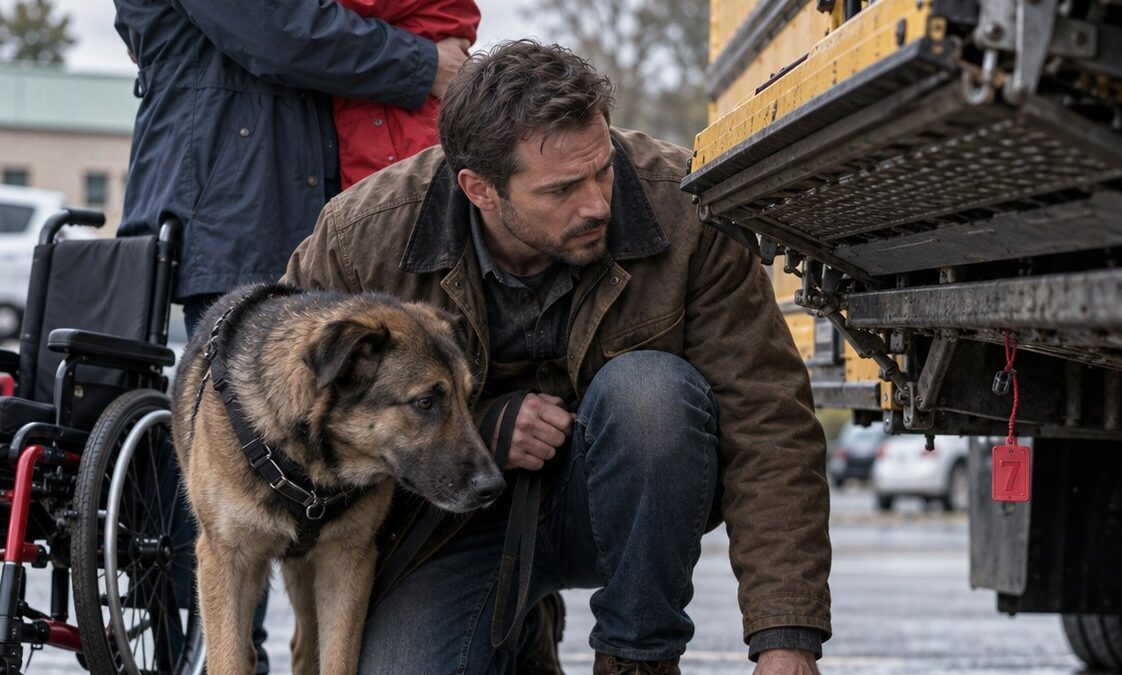
Finn lay at my feet, his leash looped around my wrist.
The strip of red plastic moved in the wind.
“Yesterday,” Owen said.
“The man was under the bus.”
“What did he say?” Dana asked.
“He told the other man the noise was normal.”
The driver cleared his throat.
He was old enough to have driven with Daniel.
His name was Morris Keene.
“I wasn’t there yesterday,” he said.
“Nobody said you were,” Dana replied.
She held Owen tighter.
I checked my phone.
“Dispatch sent fire and police?”
“Yes.”
“Ask for someone from fleet maintenance too.”
“I already did.”
“Not whoever cleared this lift.”
Dana looked at me.
“I heard you.”
An ambulance arrived first.
Owen allowed a paramedic to check him while Dana stayed close enough for him to hold her sleeve.
His coat had two neat tooth holes in the loose fabric below the hood.
His skin was untouched.
The paramedic checked his head, arms, and legs.
Owen wanted his chair.
The chair lay on its side near the broken lift.
I offered to retrieve it after the officers photographed it.
Dana nodded once.
It was the first thing she had let me do for him.
A police officer put cones around the bus.
Another photographed the seal where it lay.
A fire captain leaned beneath the lift without touching the cable.
“Do you see the old wear?” I asked.
“I see something,” she said.
The county would need its own examiner.
That was right.
I wanted the broken cable documented by someone with no reason to trust me.
Dana heard the officer ask for my name.
She gave it before I could.
“Eli Mercer,” she said.
“He used to maintain these buses.”
“Used to?” the officer asked.
Dana swallowed.
“I terminated his employment.”
The officer wrote that down.
Owen reached out for Finn.
I looked at Dana.
She gave a small nod.
Finn came when I called him and stopped a foot from the ambulance.
Owen touched the fur between his ears.
“He pulled too hard,” Owen whispered.
“He did.”
Finn stood still.
“He saved me?”
“The platform fell.”
Owen studied his torn coat.
“He knew.”
Dana’s phone rang.
I heard a man’s voice through the speaker before she moved it from her ear.
She looked toward the bus.
“Blake,” she said, “your inspector can speak to the officer.”
I felt my fingers close around the leash.
Blake Tolland had managed fleet contracts since before I was hired.
He had testified that I closed Bus Twelve’s work order without checking the lift.
He had stood beside Dana when she fired me.
I had not seen him at the depot that morning.
But I knew who Owen had heard under the bus.
Dana ended the call and faced me.
“Blake says the lift passed yesterday.”
“Who signed it?”
“He says you did.”
My stomach tightened.
“I haven’t worked for the county in three years.”
“He says the system logged your old credentials.”
“That account was closed.”
“That’s what I told him.”
I looked at the seal again.
The red plastic.
The black number.
A piece of evidence I had watched disappear once before.
“Dana,” I said, “somebody kept my login active.”
* * *
The officer photographed the seal, then placed it in a clear evidence bag.
He let me read the number through the plastic.
4418.
I gave him the date I had last seen it.
I gave him the work order number I remembered.
I did not ask him to believe my memory.
“Check the inventory ledger,” I said.
“Where would that be?” he asked.
“Fleet stores kept paper copies.”
Blake had pushed for electronic records.
The woman who ran the storeroom had never trusted a computer to tell her how many parts were on a shelf.
Her name was Pearl Ives.
She was sixty-eight and retired.
She also lived twenty minutes away.
I told the officer where to find her.
Dana heard me.
“Pearl left before the crash.”
“She worked her final week during my suspension.”
“She may remember nothing.”
“Then she’ll say that.”
The fire captain would not let the lift move.
A tow truck took the bus to a secured county yard.
An officer rode behind it.
Finn and I followed in my bakery van because the officer had asked for a statement.
I missed my delivery shift.
My supervisor called twice.
I told him I could bring the crates after noon.
He said the customers needed bread before then.
I gave him the keys to my van’s rear compartment and the route sheet.
He sent another driver.
That cost me the morning’s pay.
I stayed at the yard.
Dana arrived with Owen and a borrowed chair from the community center.
She had taken him to urgent care first.
The clinician found bruising from the pull and nothing more.
Owen held Finn’s leash for six steps across the parking lot.
I held its other end.
Dana watched every step.
Inside the yard office, an investigator from the county transportation unit opened the electronic inspection record.
It showed a lift check at 4:42 the previous afternoon.
The username was mine.
A photograph attached to the record showed the lift fully extended.
The photograph was too tight to show the bus number.
“Could be any lift,” I said.
The investigator enlarged it.
There was a scratch on the platform rail.
“I put that scratch there,” Morris said from the doorway.
Dana turned.
“Yesterday?”
“Last month.”
He looked embarrassed.
“I caught it on a loading dock.”
The investigator made a note.
“Did you report it?”
“Yes. Work order 8031.”
Blake had marked that work order complete.
The record said the damaged rail had been replaced.
The photograph proved it had not.
Dana asked to see the inspection signature.
There was none.
Only a login and a time.
“I signed off on that software,” she said.
“You signed off on the purchase,” I told her.
“You didn’t inspect every account.”
She looked at me.
“You’re defending me?”
“I’m telling the officer where the record is weak.”
The investigator printed the page and initialed it.
Then he called the technology office.
My old account was still active.
It had been used seven times in the past month.
Every login came from a terminal inside the fleet depot.
I had not been inside that building since my badge stopped working.
The investigator asked for the terminal logs to be preserved.
He asked the vendor to retain its backup records.
For the first time in three years, somebody was checking the dates.
Pearl answered the officer’s call that afternoon.
She asked whether I was in trouble again.
“No,” he told her.
“Then I’ll bring the books.”
She arrived carrying two ledgers in a grocery bag.
Her hands shook when she saw me.
“I wondered why nobody called,” she said.
“About what?”
“Your last work order.”
Pearl laid the ledger on the desk.
She had issued seal 4418 to me on the Monday before Daniel’s crash.
The number appeared beside my initials.
Three lines below it, she had written “returned unopened.”
I stared at the words.
“I didn’t return it.”
“I know,” Pearl said.
“That’s why I wrote the name.”
In the narrow comments column, her handwriting was cramped.
B. Tolland collected envelope.
The officer photographed the page.
Dana gripped the edge of the desk.
“What envelope?” she asked.
“The work order I locked in my toolbox,” I said.
Pearl shook her head.
“It was on my counter.”
“How did it get there?”
“I thought you left it for me.”
I remembered coming back from lunch to find my toolbox open.
I had blamed myself for forgetting the latch.
Pearl touched the ledger.
“Blake told me you had changed your mind.”
“About the bus?” I asked.
“He said you cleared it for service.”
The room felt smaller.
I had spent three years wondering whether I could have made my warning louder.
Whether one more call would have kept Daniel off that road.
Dana read Pearl’s note again.
“Did Blake open the envelope?”
“I didn’t see him open it,” Pearl said.
“I saw him take it.”
The investigator asked why she had kept the ledgers.
“County property,” Pearl said.
“They told me to store them until records approved disposal.”
“Did records approve it?”
“They never called.”
The investigator signed for both books.
Pearl watched him seal the bag.
Then she turned to Dana.
“I called your office that week.”
Dana frowned.
“I was at a conference.”
“I left a message.”
“With whom?”
Pearl’s eyes moved to the fleet record.
“With Blake.”
Dana sat down.
There had been a warning before Daniel drove.
And Blake had been standing between it and her.
* * *
That evening, the county placed Blake on administrative leave.
An officer collected his work phone and computer under the county’s preservation order.
His attorney called before sunset.
The attorney said Blake would cooperate through counsel.
I had no objection.
I wanted records that would hold up when he denied everything.
Finn lay beneath the table at my apartment while I made a list for the investigator.
The list had no accusations.
It had work orders, dates, and people who could explain them.
Morris could describe the lift’s noise.
Pearl could explain the seal ledger.
The vendor could identify the terminal that used my account.
The fire captain could document the cable.
Dana could provide the notice that kept me out of the depot.
I stopped when I reached Daniel.
His name was on the crash report.
He could not answer questions now.
I took his old voicemail off my phone and played it.
He had called me the night before the crash.
“Light came on again,” he had said.
“Same hill, same speed.”
“I’ll bring her in after the morning run.”
I had saved it because it was one of the last times I heard his voice.
I had never given it to the original investigator.
Nobody had asked whether Daniel had reported the light.
I called the new investigator.
He told me to keep the phone charged and stop handling the file.
He would arrange to copy it properly.
At nine, someone knocked on my door.
Dana stood outside with Owen’s red raincoat folded over one arm.
Finn rose.
Owen was home with his aunt.
“I should have called,” Dana said.
“You’re here.”
She held up the coat.
“The clinic asked whether we wanted it cleaned.”
“I’d keep it as it is.”
“I thought you’d say that.”
I let her into the kitchen.
She placed the coat on the table.
For a minute, neither of us sat.
“I read your file,” she said.
“I know.”
“I read it again tonight.”
“That must have been unpleasant.”
“It was.”
Finn settled beside her shoe.
Dana looked down.
“Three years ago, Blake told me the warning came after the crash.”
“It came before.”
“I signed your termination because the file said you altered the date.”
“I didn’t.”
“I know that now.”
She reached toward Finn.
He waited.
She scratched the side of his neck.
“I had one question,” she said.
“Ask it.”
“Why didn’t you bring me the voicemail?”
“I tried to bring you the work order.”
Her hand stopped.
“My office said you refused a meeting.”
“I asked for one twice.”
Dana looked at the coat.
“I had a son who needed surgery that month.”
“I remember.”
“I let Blake handle the fleet investigation.”
“You still signed the letter.”
“Yes.”
The word stayed between us.
A car passed outside.
Finn raised his head at the sound and put it down again.
Dana told me Owen had asked whether Finn would lose his job.
“Finn doesn’t get paid,” I said.
“He meant the search team.”
“They’ll review what happened.”
“Will they take him off calls?”
“I don’t know.”
I meant it.
Finn had saved a child by doing the one thing every handler fears seeing on a public video.
There were already videos.
One began with his jaws on Owen’s coat.
A shorter clip ended before the lift fell.
Dana had asked the community center to preserve its security recording.
It showed the whole scene.
She gave the file to the police and the search team supervisor.
That helped.
It did not stop my phone from filling with messages.
At midnight, the investigator called.
A technician had opened the lift’s access panel.
The cable had worn against a bracket for months.
Someone had filed the sharp edge of the bracket smooth after the wear began.
The repair made the damage harder to see from outside.
The technician had found red plastic beneath the new panel seal.
Two layers.
The inner fragment matched the torn end of 4418.
The outer seal bore a current number.
Someone had put a new seal over an old broken one.
Dana heard the call through the speaker.
“Why keep the old one?” she asked.
The investigator said the fragment was trapped under a mounting screw.
The person replacing the cover either missed it or did not care.
I thought of the old bus.
Of my envelope.
Of Daniel’s voice.
Then the investigator told us the bracket on Bus Twenty-Six had a stamped part number.
It came from Bus Twelve.
* * *
The county canceled the first ride event.
It also grounded every bus whose lift had been serviced under Blake’s contract.
Dana stood before the school board the next morning and explained why.
She did not name me.
She named the inspection gaps.
She named the reused component.
She named the account that should have been disabled.
Parents filled the room.
Some had children who used lifts every day.
They wanted to know whether those children had been safe yesterday.
Dana did not promise what she could not prove.
She said each lift would be checked by an independent shop before carrying a student again.
It took four days.
The county borrowed accessible vehicles from neighboring districts.
Some routes ran late.
Nobody suggested putting the grounded buses back on the road.
The district’s insurer brought in an engineering firm.
Its staff examined Bus Twenty-Six and the old records for Bus Twelve.
The stamped bracket belonged to the lift removed after Daniel’s crash.
It should have been held as evidence, then scrapped.
The paperwork said it had been destroyed.
The invoice for the replacement bracket had been paid.
So had invoices for four other replacement parts nobody could find.
Blake’s company had supplied them.
The county had paid Blake’s company to remove unsafe parts.
The same company had billed the county to install new ones.
At the depot, its crew had reused what it could.
A detective asked me to identify markings on the old bracket.
I recognized a blue paint stripe near one bolt.
I had made it when I marked the wear for repair.
The detective photographed it beside my original maintenance notes.
Pearl had kept a copy of those too.
She had filed carbon sheets by bus number in a drawer the electronic conversion never touched.
That was the second piece of luck the records office had failed to destroy.
Or maybe it was simply Pearl doing her job.
When I saw the copy, I put both hands on the table.
The warning date was there.
The brake light was there.
The lift bracket was there.
Daniel had not imagined the warning.
I had not imagined filing it.
The detective asked whether I needed a break.
“I need you to read the next line,” I said.
It said the bus was out of service pending repair.
My signature sat beneath it.
Blake’s later clearance was written on a separate form.
The form used my employee number.
The handwriting was not mine.
A document examiner would decide what that meant.
The detective would not call it a forgery in front of me.
I appreciated that.
The evidence was doing enough without a dramatic word.
Owen came to the search team building that Saturday.
Dana asked whether he could meet Finn somewhere quiet.
Our supervisor agreed.
She wanted to see Finn with Owen before deciding when he could return to public calls.
I sat on the floor.
Owen sat on a bench with his borrowed chair beside him.
Finn crossed the room slowly.
No leash pull.
No sudden leap.
He stopped when Owen raised his hand.
Owen offered him a biscuit.
Finn took it softly.
“I thought he was mad,” Owen said.
“He was scared,” I told him.
“Dogs get scared?”
“Everybody does.”
Dana stood by the door.
Owen scratched Finn’s shoulder.
“I heard that clicking noise at school,” he said.
“I told the man.”
“What man?” I asked.
“The one with the silver watch.”
Dana looked at me.
Blake wore a silver watch with a square face.
“What did he say?” she asked.
“He said it was the chair.”
Owen touched his own wheel.
“It wasn’t my chair.”
“I believe you,” Dana said.
The search team supervisor wrote down his words.
She asked no more questions.
A detective would speak with him properly, once, with someone trained to interview children.
We did not need to make him tell it over and over.
After he left, my supervisor showed me the full community center video.
The camera caught Finn turning toward the bus before Owen rolled onto the lift.
It caught me pointing at the cable.
It caught Dana releasing the switch.
Then it caught the empty chair falling.
She paused the video.
“He didn’t go for Owen,” she said.
“He went for the coat.”
“He got him clear.”
I looked at Finn.
He was sleeping beneath the bench.
“Will he be cleared?”
“Yes.”
She touched the screen.
“This saved him.”
I thought of the red seal.
A thing made to show whether anyone had opened a panel.
It had failed to keep a bus safe.
But its number had survived.
On Monday, the detective called with the vendor’s account records.
Blake had ordered five replacement brackets.
All five were billed as installed.
The vendor’s shipping record showed that none had reached the depot.
The deliveries had been redirected to a storage unit rented in Blake’s name.
The detective found four unopened boxes there.
He found the fifth box empty.
Inside it was the original bracket from Bus Twelve, still bearing my blue stripe.
Blake had kept the evidence that cleared me.
He had kept it because selling new parts and reusing old ones had become his business.
* * *
The board called a public hearing before deciding whether to end Blake’s contract.
Its attorney warned everyone that the criminal investigation was separate.
Dana had to put the contracting failures on the public record.
Blake came with a lawyer and a folder thick enough to look reassuring from the back row.
He sat beneath the school seal as if he still worked there.
I sat with Pearl and Morris.
Finn stayed home.
I wanted him there.
I wanted Owen nowhere near that room.
Dana opened with the bus lift.
She showed the full video.
Parents watched Finn pull Owen from the platform.
They watched the chair fall.
No one spoke when the screen went dark.
Blake’s lawyer stood.
He said the clip proved a mechanical failure.
It did not prove who had caused it.
That was true.
He said old parts sometimes remained in use while new parts waited for installation.
That could be true too.
He said an employee login could be misused by anyone with a password.
I agreed with that.
Then Blake spoke.
He had spent years learning how to sound calm while other people looked worried.
“I made the decision to ground our lifts,” he said.
“You objected to it,” Dana replied.
“I asked for a measured response.”
“You asked to run the routes.”
“I asked to serve children who need transportation.”
Several parents shifted in their seats.
Blake looked at them.
“I know how much a missed bus costs a family.”
It was his best argument.
For some families, a late accessible ride meant a lost day of work.
He knew their schedules.
He had signed their service reports.
Then he held up a photograph of my search team uniform.
“Mr. Mercer has wanted this county to admit fault for three years.”
My face grew hot.
Pearl touched my sleeve.
Blake continued.
“He has every reason to see a conspiracy in a damaged part.”
Dana did not interrupt him.
The board chair asked whether Blake disputed the invoice records.
His lawyer answered.
“Those records are under review.”
The chair asked whether he disputed the storage unit.
Again, the lawyer answered.
“My client has provided access.”
There were enough gaps to make a careful person wait.
I wanted careful people making the decision.
I also wanted them to see the whole record.
Dana called Pearl.
Pearl carried her ledger to the table.
She read the entry for seal 4418.
She read the note beside it.
B. Tolland collected envelope.
Blake’s lawyer asked whether she had seen him open the envelope.
“No,” Pearl said.
“Then you cannot say what was inside.”
“I can say what Eli gave me.”
“You told the detective you thought Eli left it on your counter.”
“I did.”
“And memories change.”
“Numbers don’t,” Pearl said.
She turned the ledger toward the board.
Every seal before 4418 had an assigned bus.
Every seal after it did too.
4418 had gone to Bus Twelve.
That morning, it had fallen from Bus Twenty-Six.
The chair asked how it could have moved between buses.
Blake said the store may have reused a number.
Pearl turned another page.
The manufacturer’s packaging list showed numbers issued only once.
The chair asked whether Blake had another explanation.
He looked down at his folder.
I was called next.
I had thought I would be angry.
Instead, I felt Daniel’s voicemail in the pocket of my jacket.
The detective had copied it already.
The board had permission to hear it.
Daniel’s voice filled the room.
“Light came on again.”
“Same hill, same speed.”
“I’ll bring her in after the morning run.”
When the recording ended, I waited for the chair’s question.
“What did you do after that message, Mr. Mercer?”
“I filed a work order.”
“Did you clear the bus?”
“No.”
“Is that your signature on the clearance?”
“No.”
Blake stared at the table.
His lawyer stood again.
He said the board could not treat an old voicemail as proof of a current contract breach.
That was also true.
Dana brought up the current inspection photograph.
Morris identified the scratch on the rail.
He identified his unfinished repair ticket.
The vendor’s technician appeared by video.
She explained that the photograph attached to my account had been uploaded from Blake’s depot terminal.
The file had been created six months before the inspection date.
The chair leaned forward.
“Can you verify that?”
“Yes,” the technician said.
“The original creation date is in our backup.”
Blake’s lawyer asked whether someone could have copied the file.
“Yes,” she said.
“From the depot terminal.”
The room stayed quiet.
The board voted to terminate the contract and refer its records to the county prosecutor.
Dana recused herself from decisions about her own role in the old investigation.
She requested an outside review.
The police did not arrest Blake in the hearing room.
They already had his records.
They interviewed him through his lawyer that week.
Months passed before charges were filed.
The prosecutor charged him with fraud involving county payments and falsified records.
Blake pleaded not guilty.
Later, he entered a plea agreement after the vendor backups and bank records were admitted.
He repaid what the court ordered.
He was barred from county contracts.
The court imposed a sentence under the agreement.
I went to the hearing where the judge accepted it.
Afterward, Blake crossed the hall between two attorneys.
He stopped when he saw me.
“You cost your brother his job too,” he said.
He wanted me to answer with something ugly.
I thought of Daniel’s voice.
Then I thought of Owen on the pavement, frightened and alive.
“I wrote the warning,” I said.
“The record shows it now.”
I walked past him.
* * *
The county corrected Daniel’s crash report.
It took longer than the headlines.
An independent reviewer compared the maintenance records, the warning light history, and the road report.
Daniel had driven a bus the fleet had marked out of service.
He had not been told that.
The report no longer called him careless.
I carried a copy to his grave.
I read the first page aloud.
I could not get through the second.
Finn sat beside me until I folded it away.
The county offered to reinstate me.
The offer came with back pay for the wages I could document losing.
I accepted the back pay.
I had rent to catch up on, and Daniel’s family had paid bills that should never have fallen to them.
I did not return to the fleet.
A regional rescue unit had asked me to help train volunteer handlers.
They could pay for three days a week.
I kept two bakery mornings.
I liked knowing which doors opened before sunrise.
Dana asked to meet me outside the community center.
The bus bay was empty.
New lifts had been installed on the grounded vehicles.
An outside shop had inspected each one.
The district had changed its records system too.
Two people now had to approve a bus’s return to service after a safety repair.
One had to see the vehicle.
One had to review the record.
Dana told me those facts without asking me to praise her.
Then she apologized.
“I signed a letter that ended your job,” she said.
“I believed Blake because he had the file.”
“You could have asked me.”
“I could have.”
She did not explain it away.
“I’m sorry, Eli.”
I looked across the lot.
A driver practiced loading an empty chair on a new lift.
I could hear its motor from where we stood.
“I accept the apology,” I said.
“That doesn’t make us friends.”
“I know.”
“If a warning reaches your desk again, read it yourself.”
“I will.”
She nodded.
That was enough.
Owen came from the community center with his aunt.
His new coat was blue.
He stopped when he saw Finn.
“Can I say hello?”
I looked at Dana.
She looked at Owen.
“It’s up to you,” she told him.
“It’s up to Finn too,” I said.
I called Finn over.
He walked to Owen and rested his head against the boy’s knee.
Owen laughed.
It was a small sound.
I had not heard him make it before.
His aunt brought out the red raincoat in a clear bag.
The police had released it after the case closed.
Owen wanted me to have it.
“I don’t need your coat,” I said.
“You could show people the holes.”
“I could.”
“Then they’d know he was careful.”
I glanced at Finn.
He was watching Owen’s hands.
“May I keep a photograph instead?”
Owen considered that.
“Yes.”
Dana took the picture.
The two tooth holes looked small against the bright fabric.
Later, the search team placed the photograph beside the full video in Finn’s training record.
New handlers studied both.
They learned what he had done.
They also learned why I still practiced recall with him every week.
Trust had to include the work.
Owen visited the training yard that spring.
He helped hide a cloth pouch for Finn to find.
Then he asked whether he could help again.
Dana waited for my answer.
I waited for Owen to finish explaining what he wanted.
He wanted to mark the search area on a map.
He wanted to learn what Finn smelled.
He wanted to know why a cable could sound wrong before it broke.
I found a clean sheet of paper.
We drew the bus lift from memory.
I marked the motor and the cable.
Owen marked the place where Finn had stood.
He drew the platform higher than the bus.
I left it that way.
When he was done, he asked if dogs could be mechanics.
“No,” I said.
“Then Finn needs you.”
I looked at the drawing.
“That day,” I said, “I needed him.”
Owen took the pencil back.
He drew a line from Finn to me.
* * *
Four years later, the community center replaced its old bus bay with a covered entrance.
The county invited the search team to a safety day there.
Finn was gray around the muzzle.
He still found every hidden volunteer before the younger dogs did.
Owen was eleven.
He could explain a lift inspection better than most adults in the parking lot.
He had brought a copy of the red seal’s evidence photograph for the display.
The original remained with the case records.
In the photograph, 4418 lay on the rubber mat.
A small thing.
A clear number.
Owen set it beside the picture of his torn coat.
Then he wheeled out to meet Finn.
“Ready?” he asked.
Finn touched his hand.
A new handler started the demonstration.
She called for Finn to wait.
He waited.
The lift rose behind us, empty and steady.
I listened to its motor.
Old habits stayed useful.
Dana stood near the entrance with Daniel’s corrected report folded in her bag.
She had brought it because Owen wanted to show a visitor how a record could be fixed.
I thought about the words from that morning.
Keep him away from it.
I had said them to Dana while the lift was failing.
Now Owen pointed visitors toward the display and asked them to look closely.
At the seal.
At the coat.
At the work order that said the bus had been unsafe.
Finn rested his head in Owen’s lap while the children gathered around them.
This time, nobody pulled him away.
THE END








