Five Years After My Divorce, I Was About to Sign Away a Fortune When a Boy With My Old Lunchbox Called Me Dad
Chapter 2: The Letters Inside
The ballroom clock read 5:42.
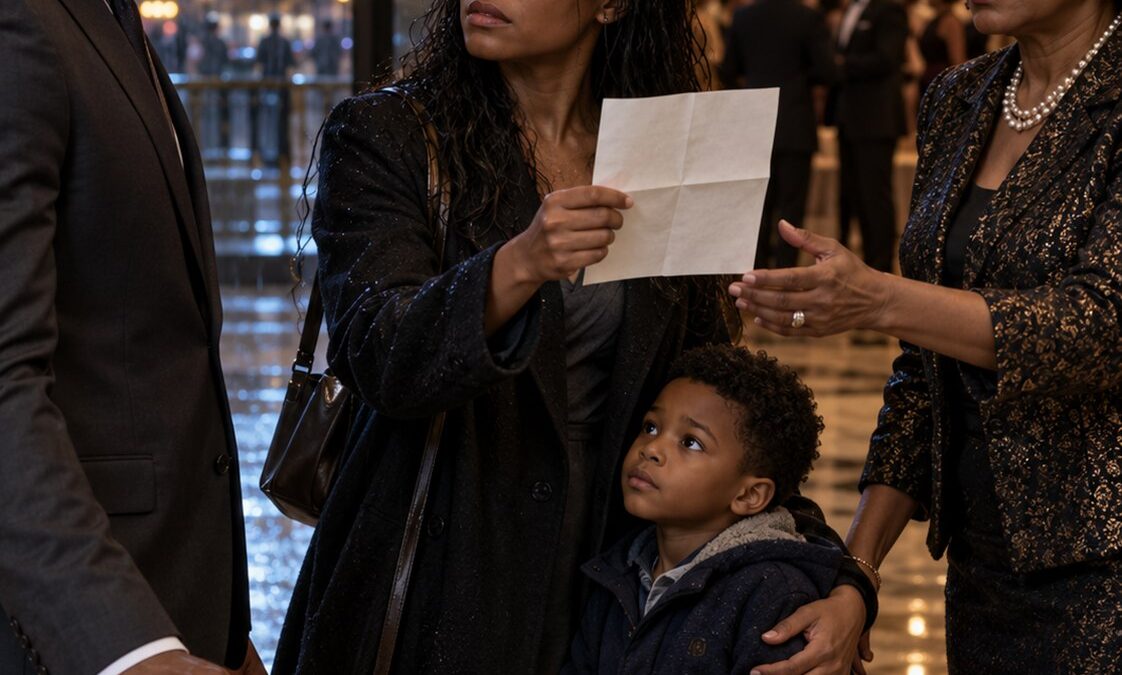
Tessa held the notice between us.
My mother reached for her phone.
I asked her to wait.
She did not.
“Postpone the program,” she told someone.
“Do not cancel the closing.”
Then she walked away.
The boy watched her go.
“What’s his name?” I asked.
“Nolan,” Tessa said.
Nolan offered me the lunchbox.
His hands shook.
I took it carefully.
The handle still had the scratch from my first day of school.
My father had given it to Tessa when we married.
She had loved the painted moon.
I looked at the notice.
It named Nolan Mercer as a possible beneficiary under my grandfather’s family trust.
A hearing was scheduled for the following week.
A temporary order was being requested.
The lawyer warned that tonight’s sale could move trust property beyond the court’s easy reach.
“Who gave you this?” I asked.
“An attorney at legal aid.”
“Why today?”
“Because she found the closing date this morning.”
A server opened the ballroom door.
I could see my place card at the head table.
My signature page waited beneath a glass paperweight.
The server recognized me and stopped.
“Please tell them there’s a delay,” I said.
He glanced toward my mother.
“Tell them I said it.”
He went back inside.
Nolan rubbed his eyes.
Tessa noticed immediately.
“He missed his nap.”
“There’s a quiet room upstairs,” I said.
“I don’t need your permission to leave.”
“You’re right.”
I took off my jacket and offered it to Nolan.
He looked at Tessa first.
She nodded.
He put it around his shoulders.
My sleeves swallowed his hands.
The guard returned.
I asked him to bring water and show us to an empty meeting room.
My mother had sent him to escort them out.
He brought the water.
Upstairs, Tessa sat Nolan on a sofa.
I stayed by the door until she invited me closer.
“You said you called,” I told her.
“Seven times.”
“I called once.”
“I know.”
I stared at her.
“I received an email.”
“I never sent one.”
Nolan drank his water.
Tessa untied the string around the envelopes.
The first was dated six weeks after our divorce.
I recognized the address.
I had already moved out of that apartment.
The family office handled my forwarded mail.
Tessa laid a second envelope beside it.
Then a third.
Each had come back to her with a typed refusal.
I opened the first letter.
She had written that she was pregnant.
She had written that she was scared.
She had written that I deserved to know.
I read the date again.
Five years of Nolan’s life fit beneath it.
The page shook in my hand.
I set it down before I bent it.
Tessa straightened one corner with her fingertip.
“I waited outside your office once,” she said.
“When?”
“That winter.”
I tried to remember that winter.
There had been a merger.
There had been a week I slept in my office.
I could remember the numbers.
I could not remember seeing her.
“Did anyone tell you I was there?” she asked.
“No.”
“I thought you’d sent them.”
I looked toward Nolan.
He had curled beneath my jacket.
I understood why she had believed it.
“I didn’t see this,” I said.
“I believe you now.”
“Why now?”
“Because your mother tried to take it.”
Nolan had fallen asleep against my jacket.
Tessa lowered her voice.
“She answered me, Owen.”
I looked at the typed refusals.
“Every one.”
* * *
At 6:03, I called my attorney.
I told her to suspend the signing.
I told her why.
She asked me to preserve every document and avoid confronting anyone alone.
Her name was Priya Shah.
She had represented me for eleven years.
She had never heard me sound like that.
Priya arrived twenty minutes later with an associate.
By then, the buyers had left.
My mother had told them a family emergency had delayed us.
For once, she had spoken the truth.
Priya examined the envelopes without opening the remaining ones.
She photographed both sides.
She noted the dates, the addresses, and the printed labels.
“These are evidence,” she told Tessa.
“I know.”
“Have you kept them together?”
“In the lunchbox.”
“Since when?”
“Since each one came back.”
Priya asked whether anyone else had handled them.
“My sister saw the last one,” Tessa said.
“She was there when I opened it.”
“Would she speak with us?”
“She’s been waiting five years.”
Nolan woke and reached for it.
Tessa explained that Priya needed to look.
He considered her face.
“Will I get it back?”
“Yes,” Priya said.
That mattered to him.
It mattered to me.
The lunchbox had once held sandwiches my father made before dawn.
Now it held proof that I had missed my son’s first five years.
Priya asked how Tessa had found the trust.
“An eviction notice,” Tessa said.
She rented a rowhouse from a Mercer subsidiary.
Last month, the subsidiary announced that the block would be cleared.
A neighborhood legal clinic reviewed the notice.
Its attorney discovered that the same trust owned Mercer Pier and held an interest in the subsidiary.
She found a clause requiring an independent trustee when one of my grandfather’s grandchildren had a child.
No one had named Nolan.
The clause had been drafted decades before he was born.
It was meant to protect younger generations from decisions made solely by the people running the business.
My mother had continued voting the trust’s shares.
Tonight’s agreement would have transferred the pier to a buyer whose ownership I had not fully questioned.
I knew that buyer’s paperwork.
Or I thought I did.
I asked Priya for the closing file.
Then I opened the latest ownership chart on my laptop.
The purchaser was Harbor Vale Development.
Three companies sat between Harbor Vale and its controlling investor.
That structure was ordinary enough.
The mailing address was not.
I had seen it on an invoice for another Mercer property.
I searched the files.
The invoice belonged to a private holding company.
My mother’s private holding company.
Priya leaned over my shoulder.
“Keep going.”
The address appeared again on a lender certificate.
The certificate was dated eight months earlier.
My mother had told our board that Harbor Vale was independent.
I copied the file to Priya through the secure board portal.
She asked her associate to preserve the access logs.
Tessa watched us from beside Nolan.
“You can stop the sale?” she asked.
“I already have.”
“That doesn’t stop an eviction.”
“No.”
I looked at the notice.
“I’ll deal with the property company.”
“Use the lawyer,” Priya said.
She was right.
A private promise from me would not protect Tessa’s home.
Priya called the legal clinic.
Its attorney, Elise Moreno, joined us by video.
She confirmed the trust clause from a certified copy.
She had filed notice of Nolan’s possible interest that afternoon.
She had also requested emergency review of the pending sale.
“The court hasn’t ruled,” Elise said.
“But everyone is on notice now.”
Elise held up Tessa’s rent ledger.
Each month had a receipt.
Each payment had cleared.
Tessa watched me read it.
“She’s kept every one,” Elise said.
“I had to,” Tessa replied.
I thought of the grocery bags in the lobby.
I had mistaken them for something she had bought.
They held her documents and Nolan’s dinner.
Nolan climbed off the sofa.
He carried his apple to me.
“Mom says you like these.”
“I do.”
He put it in my hand.
I had no idea what to say.
He went back to Tessa.
She brushed his hair away from his eyes.
For a moment, I remembered her doing that to me when I worked too late.
Then Priya found another page.
It was a family office mail log.
My forwarded letters had been entered there.
All three.
Each entry was marked “redirected by principal.”
The initials beside the instruction were C.M.
Celeste Mercer.
* * *
The next morning, Tessa’s landlord sent a new notice.
It offered to forgive two months’ rent if she vacated within forty-eight hours.
The offer was signed by a manager who reported to my mother’s office.
Tessa brought it straight to Elise.
Elise sent a preservation demand and sought a temporary order.
I called the property company’s chief executive.
I said I would follow the court’s process.
I also told him that any decision about Tessa’s lease required independent review.
He sounded relieved.
By noon, the company had withdrawn the offer.
The original eviction dispute remained.
Elise kept working on it.
Tessa hated needing that help.
“I paid the rent,” she told me.
“I know.”
“I don’t want a favor.”
“Then let the records show that you paid.”
She gave me a long look.
“That sounds more like you used to.”
I wanted to ask which version of me she meant.
I did not.
We met that afternoon at the legal clinic.
Nolan sat on the floor with colored pencils.
He drew a row of houses beneath a crooked moon.
I asked whether he liked the lunchbox because of its picture.
“Because it belongs to Mom,” he said.
“She lets me carry it when I’m brave.”
“What makes you brave?”
He thought hard.
“Taking it anyway.”
Tessa turned her face toward the window.
I understood then how much courage it had cost her to walk into my lobby.
Priya arrived with a former family office employee.
Her name was Ruth Bell.
Ruth had retired two years earlier.
She recognized the mail log at once.
She had entered the letters herself.
“My instructions came from Mrs. Mercer,” she said.
“Did you return them?” Priya asked.
“I passed them to her assistant.”
“Did you ever show Owen?”
“No.”
Ruth looked at me.
“I should have.”
She folded her hands on the table.
“I knew the letters were personal.”
“Did you know what they said?” Tessa asked.
“No.”
“Did you ask?”
Ruth shook her head.
Tessa looked down at Nolan’s drawing.
Ruth waited while she did.
“I’m sorry,” Ruth said.
Tessa nodded once.
It was all she could give.
The assistant had left the country.
Priya said records could still be obtained through counsel and court orders.
We did not need a dramatic confession.
We needed documents that would stand up when my mother denied Ruth’s account.
Ruth remembered something else.
She had questioned the third refusal letter.
It was printed on my personal stationery.
At that time, my stationery had been redesigned.
The reply used the old crest.
I asked why she remembered.
“I ordered the new paper,” she said.
“Your mother told us to use the leftovers.”
Priya photographed the letter.
Then she retrieved a dated invoice for the stationery change.
An ordinary purchasing record.
A small, stubborn fact.
Priya spread both pages on the table.
The invoice showed delivery three weeks before the refusal.
I had approved the new crest myself.
There was no reason for me to choose the old paper.
I had not even been in the office that week.
Our calendar placed me at a conference in Denver.
Priya copied the calendar entry.
“Keep the original,” she told me.
I wanted to call my mother.
Instead, I gave Priya my phone.
“Help me keep this clean,” I said.
“That’s why I’m here.”
That evening, our board secretary sent Priya the complete buyer file.
The controlling investor was disclosed in a sealed schedule.
It named Bellwether Holdings.
My mother owned Bellwether.
Her argument would be that she had disclosed it to counsel.
She had kept it from the board members voting on the sale.
The price was also below an independent appraisal.
A later resale agreement promised Bellwether a much larger return.
I sat with those papers until their numbers stopped swimming.
Priya spoke first.
“She expected you to sign.”
“She expected me to trust her.”
Tessa stood beside Nolan’s drawing.
“Why hide him?” she asked.
Priya opened the trust document.
“If Nolan’s interest is confirmed, an independent trustee must review this transaction.”
My mother had needed the sale finished first.
* * *
Three days later, the board convened in the same ballroom.
The portrait of me was gone.
A plain screen showed the agenda.
My mother sat at the head of the table.
She looked rested.
I had not slept well.
Tessa came with Elise.
Nolan stayed with Tessa’s sister.
That had been Tessa’s choice.
The board’s outside counsel attended.
So did the independent appraiser.
Priya had advised us to keep the family dispute separate from the board’s decision where possible.
My mother made that difficult.
She began with a polished account of the sale.
The pier required major investment.
Harbor Vale had financing.
Delay could cost jobs.
Every point deserved an answer.
Then she turned toward Tessa.
“A claim about a child has been introduced at the last possible hour.”
Tessa’s hands tightened around her folder.
I spoke before my mother could continue.
“The child’s identity will be established through the proper process.”
“And until then?” my mother asked.
“Until then, we examine the transaction on its own terms.”
Priya displayed the ownership chart.
Bellwether appeared at the bottom.
One director leaned forward.
My mother did not move.
“The interest was disclosed to counsel,” she said.
“Not to this board,” the secretary replied.
“Counsel advised me the structure was permissible.”
Counsel shook his head.
“I advised you to disclose it before any vote.”
My mother’s eyes narrowed.
“Was that advice written?”
“It was.”
Counsel passed a copy to the secretary.
My mother read the date.
She placed the page facedown.
The appraiser explained the gap between the offer and his valuation.
She challenged his assumptions.
He answered each question.
She argued that waiting would expose the trust to risk.
For several minutes, I could see how she had held power so long.
She was prepared.
She was calm.
She knew exactly which fears to name.
She asked the chief financial officer to describe the pier’s repairs.
He listed the seawall, the wiring, and the vacant warehouses.
I had walked through them myself.
His concerns were real.
Then Priya showed the board a competing financing proposal.
It had arrived before the closing date.
My mother’s office had never put it on the agenda.
The director beside me turned its pages.
“Why didn’t we see this?” she asked.
My mother looked at the chief financial officer.
He shook his head.
The question stayed in the room.
Then Priya placed the lunchbox on the table.
My mother looked at it as though it had arrived by itself.
Tessa opened the lid.
Inside lay the letters.
Priya showed the board the mail log, the refusal replies, and Ruth’s signed statement.
Outside counsel had already verified the log against archived records.
The printer record showed the replies came from the family office.
The old stationery invoice dated the paper.
My mother watched each page appear.
“They prove an administrative mistake,” she said.
“Three times?” I asked.
“I protected you from disruption.”
Tessa stood.
“You told me he wanted no part of our son.”
“I told you what I believed.”
“You wrote it on his paper.”
My mother looked directly at me.
“I built this company while your father wasted it.”
My father had died when I was twenty-four.
He had been generous and careless with money.
Both things were true.
“I know what you built,” I said.
“You benefited from it.”
“Yes.”
“And now you would throw it away over a woman who left you?”
The room went still.
I looked at Tessa.
I had let myself believe she had walked away without trying.
The letters were lying open in front of me.
“She tried to reach me,” I said.
My mother’s gaze flicked to the lunchbox.
For a second, she looked older.
Then she straightened.
“I was trying to spare you.”
“You were trying to finish the sale.”
She said nothing.
The secretary asked her one last question.
“Did you instruct the office to return these letters?”
My mother lifted her pen.
She set it down again.
“I handled a family matter,” she said.
Priya wrote down her words.
My mother saw her do it.
The board voted to suspend it.
They appointed independent counsel to review the transaction and my mother’s disclosures.
My mother resigned her role as trustee that afternoon.
She called it temporary.
It became permanent.
There was no arrest in the ballroom.
There was an investigation.
There were records to collect and people to question.
Months later, the state attorney general’s office brought a civil action concerning the trust.
My mother settled without admitting every allegation.
She surrendered control, repaid fees, and accepted a court order barring her from serving as a fiduciary.
Bellwether lost its purchase agreement.
The board later sold the pier through an open process at a higher price.
The eviction against Tessa’s block was dismissed after the property company’s records showed improper notices.
The families there kept their leases.
Elise called Tessa when the dismissal was entered.
I was at the clinic to sign a witness statement.
Tessa listened without speaking.
Then she asked Elise to repeat the part about the leases.
She wrote it down on the back of an envelope.
That evening, she showed the paper to her neighbors.
I stood across the street with Nolan.
He counted the porch lights coming on.
My mother sent me one final letter.
It said I had chosen strangers over family.
I wrote back once.
Nolan was my family.
So was the truth.
* * *
The paternity test came back in October.
Nolan was my son.
Tessa read the result beside me in Elise’s office.
We had both agreed to the test.
Nolan already knew what it might mean.
We had told him in simple words.
When Tessa explained the result, he asked whether it changed his last name.
“No,” she told him.
“Good,” he said.
Then he wanted a snack.
I laughed.
It surprised all three of us.
I had imagined that a test would make me feel like a father.
It made me understand how much I had to learn.
I asked Tessa what Nolan liked for breakfast.
I asked which stories he wanted twice.
I learned that he disliked wet socks.
I learned that he counted the stairs to their front door.
I learned to carry a spare pair of socks.
At first, I visited on Saturday afternoons.
Tessa stayed nearby.
That was her boundary.
I accepted it.
Nolan showed me his drawings.
We built a cardboard city across the kitchen floor.
He assigned me a tiny grocery store.
Mine collapsed twice.
“Your buildings are bad,” he said.
“I’ve heard that before.”
Tessa smiled into her coffee.
The next week, I brought stronger tape.
Nolan inspected it solemnly.
“You’re learning.”
I was.
There were harder afternoons.
Nolan once asked why I had not come when he was a baby.
I told him the truth he could carry.
“I didn’t know where you were.”
“Mom did.”
“Yes.”
“I wish you knew.”
“So do I.”
Tessa heard us from the doorway.
Later, she asked me to avoid blaming my mother when Nolan wanted a simple answer.
“He needs time to be a kid,” she said.
“You’re right.”
“And I need you to keep telling the truth.”
“I will.”
I apologized to her without asking her to forgive me.
I had worked through our marriage as though every late night could be repaid later.
When she said she was lonely, I had offered vacations and missed them.
My mother’s lies had stolen years.
My choices had weakened us first.
Tessa listened.
She did not excuse either one.
“I won’t build a life around waiting for you again,” she said.
“I understand.”
“I hope you do.”
I changed my schedule.
I kept the school pickup time I had promised.
When a meeting ran long, I called before I was late.
Those things sounded small.
Nolan noticed every one.
One Thursday, traffic stopped on the bridge.
I called Tessa from the car.
She passed the phone to Nolan.
“I’m going to be late,” I said.
“How late?”
“About ten minutes.”
He considered that.
“I’ll wait inside.”
“That’s a good idea.”
When I arrived, he was sitting beside the school secretary.
He held his backpack on his knees.
“You called,” he said.
“Yes.”
He took my hand on the walk home.
I had to turn my face away.
The board offered me a larger share of the pier sale proceeds for steering the company through the crisis.
I declined the bonus.
Instead, I asked them to fund an independent housing partnership with part of the company’s gain.
The board approved it after outside review.
Tessa checked that the families on her block had a voice in it.
She would not let my name turn their homes into a publicity campaign.
I liked that about her.
I always had.
At the first neighborhood meeting, she sat beside an older tenant named Mrs. Keene.
Mrs. Keene wanted the repair schedule in writing.
The partnership director offered her a brochure.
Tessa handed it back.
“She asked for dates,” she said.
The director returned the next week with dates.
Mrs. Keene pinned them to her refrigerator.
Tessa told me about it over coffee.
She was pleased.
She was also watching whether I would keep showing up.
In December, Nolan invited me to his school concert.
He wore a paper star taped to his sweater.
I sat beside Tessa in the third row.
He spotted us together and nearly missed his first line.
Afterward, he asked if I could come for breakfast on Sunday.
I looked at Tessa.
She gave him a nod.
“Yes,” I said.
He took my hand.
It was the first time.
Tessa walked beside us to the car.
Snow caught in her hair.
For a moment, we looked like a family.
I did not say it aloud.
I wanted to earn the word.
* * *
Three years later, the ballroom had become a public library.
The pier sale had paid for its renovation.
I had argued for bookshelves where my portrait once hung.
Nolan argued for a better children’s section.
He won.
On opening day, he carried the blue lunchbox through the same marble lobby.
The planter was still there.
He stopped beside it.
“Is this where I met you?”
“Yes.”
“I was really nervous.”
“So was I.”
He opened the lunchbox.
Inside was an apple, a sandwich, and a drawing.
This moon had no bare patch.
He had painted it himself.
Tessa joined us near the library doors.
She and I were together again.
Slowly.
With promises we kept in ordinary ways.
My mother had seen Nolan only after Tessa and I agreed he was ready.
Their visits were brief.
Nolan decided when they happened.
Some wounds had healed.
Some required care.
Ruth came to the opening.
Elise brought her family.
The tenants from Tessa’s block brought photographs of their houses.
Mrs. Keene pointed out the repaired steps in hers.
Nolan studied the photograph.
“Those look safer,” he said.
“They are,” she told him.
Ruth asked whether she could see the moon he had painted.
Nolan held the drawing up for her.
She admired its crooked edge.
He told her he had meant to make it that way.
The doors opened to the public.
Children went straight toward the low shelves.
Nobody looked for my portrait.
Nolan asked me to carry his lunchbox while he went to see the new books.
I took it.
Its handle felt smaller than I remembered.
Tessa slipped her hand into mine.
Across the lobby, Nolan turned.
“Are you coming, Dad?”
I remembered the first time he had asked.
I remembered how little I could promise then.
“Yes,” I said.
We followed him inside.
THE END








