Five Years After Our Divorce, I Was About to Marry an Heiress When a Little Girl Raised the Letter That Destroyed Us
Chapter 2: The Date Beneath the Fold
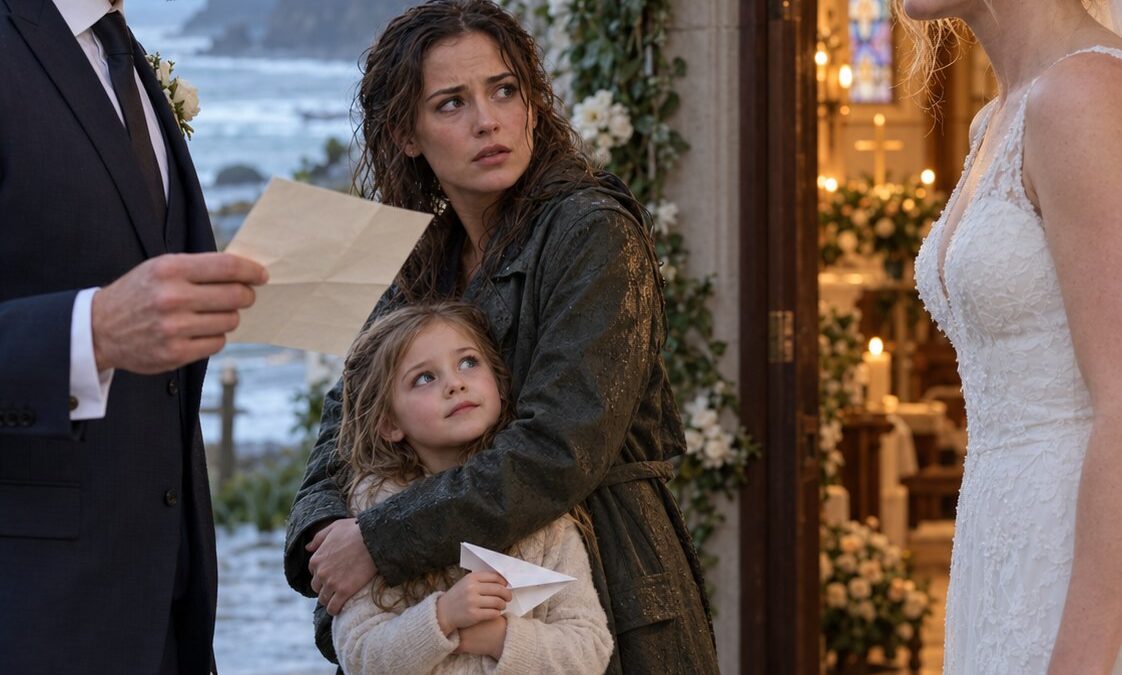
The paramedics came through the chapel doors.
Maisie let go of my jacket.
I wanted her to keep it.
Tessa gave them the name of her clinic.
She listed Maisie’s medicine.
She described the episodes.
One paramedic listened to Maisie’s breathing.
The other asked about family history.
Tessa looked at me.
“I don’t know his,” she said.
“I’ll come with you.”
Celeste stepped into the aisle.
“Julian.”
I turned.
“The ceremony can wait,” she said.
“There won’t be a ceremony.”
Someone shifted in the front row.
Celeste heard it.
She lowered her voice.
“Don’t decide that in front of everyone.”
“My daughter needs a doctor.”
The word landed between us.
Daughter.
Maisie was lifted onto a stretcher.
She reached for Tessa.
Then she looked at me.
“Can he come too?”
“If he wants to,” Tessa said.
I followed them outside.
The paper airplane was still in my hand.
At the hospital, a nurse led Maisie through a set of double doors.
Tessa and I stopped beneath a clock that was eight minutes slow.
“I should have known,” I said.
“How?”
“I should have found you.”
“You didn’t know where to look.”
“Someone did.”
Tessa held my gaze.
She looked tired enough to fall.
I found a chair for her.
She refused it once.
Then she sat.
I sat beside her.
Neither of us spoke until a doctor came out.
Maisie was awake.
They were monitoring her heart rhythm.
The doctor asked about illness in my family.
My father had needed treatment for an irregular heartbeat in his thirties.
I gave the doctor his diagnosis as best I remembered it.
I offered to get the records.
“That would help,” she said.
She also explained that Maisie’s symptoms could have several causes.
They would run tests.
They would not guess.
Tessa nodded at every word.
When the doctor left, she put her face in her hands.
“I didn’t come for money,” she said.
“I know.”
“You don’t.”
“Then tell me.”
She showed me her phone.
Six calls to my office this week.
Two messages left with reception.
A photograph of a letter sent by registered mail.
My office had signed for it.
“Who took the calls?” I asked.
“Celeste’s assistant.”
Celeste had combined our executive offices that spring.
I had called it efficient.
Tessa scrolled farther.
Four years earlier, she’d sent news of the pregnancy to my old apartment.
Then to my office.
Then she had gone there herself.
A security guard turned her away.
Two weeks later, the cream envelope arrived.
Inside was the letter.
There was also a payment offer she had rejected.
“I thought you wanted her gone,” Tessa said.
“That wasn’t me.”
“I know that now.”
“Why?”
“Because you came outside.”
She said it without warmth.
It was simply the fact that had changed her mind.
The doctor allowed us into Maisie’s room.
She lay beneath a pale blanket.
My jacket was folded beside her.
Tessa brushed her hair back.
Maisie looked at me.
“Did you catch my airplane?”
“Yes.”
“Good.”
She closed her eyes again.
I laid the letter on the bedside table.
Tessa noticed the date on its back.
“I never saw that,” she said.
“Who wrote it?”
She leaned closer.
The numbers were small.
So was the notation beneath them.
DRAFT FOR C.V.
Tessa read it twice.
Then she looked up.
“Celeste knew about Maisie before I told you.”
* * *
I called my attorney from the hospital corridor.
Nina Calder had handled my company contracts for twelve years.
I asked her to preserve our office records.
Then I sent her photographs of both sides of the letter.
She called back within minutes.
“Keep the original flat,” she said.
“I can do that.”
“Who gave it to Tessa?”
“A courier.”
“Find the envelope.”
Tessa had kept it.
She had kept everything.
The envelope lived in a storage box under her bed, along with Maisie’s first drawings and the clinic bills.
She gave Nina permission to collect it.
I asked Tessa before I gave anyone her address.
That surprised her.
I deserved that.
Maisie spent the afternoon having tests.
A nurse brought her colored pencils.
She drew a boat with a chimney.
I sat in the corner, trying not to make promises I had not earned.
At five, the doctor told us Maisie’s rhythm had settled.
They wanted to keep her overnight.
They also wanted my father’s records before making a plan for follow-up care.
I called him.
He answered on the second ring.
“Julian, aren’t you supposed to be married?”
“I have a daughter.”
The line stayed quiet.
“Her name is Maisie,” I said.
“She needs your heart records.”
He gave me the name of his cardiologist.
Then he asked where we were.
He arrived with the records and no questions.
He stood at Maisie’s door for a long time.
“She has your mother’s eyes,” he said.
“So do I.”
“I know.”
He gave the records to the nurse.
Only afterward did he ask what had happened.
I showed him the letter.
He stared at the signature.
“You never made that stroke,” he said.
My father was seventy-one.
He had taught me to write my name.
“I know.”
He turned the page over.
“Vale Maritime?”
“We’re checking.”
He handed it back carefully.
Later that evening, Nina came to the hospital.
Tessa gave her written permission to review the material she had saved.
Nina had already asked my office to preserve call logs, visitor records, email archives, and access logs.
She had also told Celeste’s company to preserve its records.
That request had gone to its counsel.
Celeste was no longer answering my calls.
I didn’t need her to.
Nina spread copies across a small table in the family room.
Tessa’s first letter had arrived at my office on March 8.
The courier receipt carried a signature from the reception desk.
Tessa had learned she was pregnant six days earlier.
The forged reply carried a draft date of March 5.
“That date could mean anything,” Nina said.
“Unless someone prepared it in advance.”
She pointed to the stationery.
A printer mark sat near the bottom edge.
The paper had come from a short run ordered for Vale Maritime’s executive office.
Nina had an invoice.
She knew because our companies had shared purchasing records during the merger.
Celeste had approved the order.
The invoice alone proved little.
The next page mattered more.
My office visitor log showed Tessa arriving on March 10.
The guard’s note said she had asked to see me.
A second note said she had left at Celeste’s direction.
“I was in London,” I said.
“Yes,” Nina replied.
Celeste had been using my office during the merger talks.
She told staff we were not to be disturbed.
I remembered the week.
Our first joint contract had nearly collapsed.
Celeste took charge while I negotiated abroad.
I’d thanked her.
Tessa studied the visitor log.
“So she saw me.”
“The guard did,” Nina said.
“We still need to learn what Celeste knew.”
I looked at the date under the fold.
DRAFT FOR C.V.
Nina turned another page.
My office call log showed one call from Tessa’s number on March 12.
It had been forwarded to Celeste’s desk.
No message reached mine.
“Who else could forward it?” I asked.
“Your assistant at the time,” Nina said.
“He left the company.”
“He lives in Fresno.”
Nina had already found him.
His name was Owen Price.
He agreed to speak with her in the morning.
Tessa watched me collect the papers.
“You believe me now?”
“I believe the records.”
She pulled away.
I set them down.
“And I believe you.”
“That should have come first.”
“Yes.”
She went back to Maisie’s room.
I stayed with the letter.
The last time I’d seen Tessa before that morning, she had asked me to miss one meeting and have dinner with her.
I had called the meeting essential.
I could not blame Celeste for every mile I’d put between us.
But someone had built a wall there.
The following morning, Owen spoke to Nina and me by video.
He remembered Tessa’s visit.
“She had an envelope,” he said.
“What happened to it?”
“Celeste took it.”
“Why?”
“She said you already knew.”
Owen looked down.
“I should have checked.”
“What did she ask you to do?” Nina said.
“Route any further calls to her office.”
“Did she say why?”
He swallowed.
“She said it was a legal matter.”
Nina asked whether he would put that in writing.
He agreed.
Then he added one more detail.
“She asked me to print a draft letter from her account.”
My stomach tightened.
“Do you remember when?”
“Before the woman came in.”
* * *
Maisie was discharged two days later.
The doctor gave Tessa a follow-up plan and told us which symptoms would need urgent care.
The tests had not produced one simple answer.
She would see a specialist.
My father’s records would help.
Tessa and I stood outside the hospital with Maisie between us.
I wanted to drive them home.
Tessa said she had a ride.
“Can I call?” I asked.
“Call me,” she said.
“Don’t call her directly yet.”
I saved her number.
Then I asked the question I had avoided.
“Can we have a paternity test?”
Tessa nodded.
“I expected that.”
“I don’t want Maisie to hear me doubt her.”
“She won’t.”
We arranged it through a clinic recommended by both our attorneys.
I paid for the test.
Tessa chose the appointment.
Maisie thought the cheek swab tickled.
Afterward, she asked whether she could have pancakes.
Tessa took her for pancakes.
I was invited to come.
I sat across from a child whose face I already knew.
She told me the names of her stuffed animals.
I learned that she disliked blueberries.
I learned she loved boats.
When the result arrived, I did not feel surprised.
I felt four years.
Nina called while I was standing in my kitchen.
“The result confirms you’re Maisie’s father.”
I sat on the floor.
I called Tessa.
She was quiet when I told her.
“I know,” she said.
“I wanted you to know I know.”
“All right.”
“How’s she doing?”
“She asked about your jacket.”
“She can keep it.”
“Julian.”
“I know it’s too big.”
Tessa laughed once.
It was the first sound from our old life I had heard since Monterey.
Then her voice changed.
“Someone came to my building.”
“Who?”
“A man I don’t know.”
“He asked the manager whether I still lived there.”
I told Nina.
She told us to write down the time and ask the manager to keep the camera footage.
She also advised Tessa not to speak with anyone claiming to represent Celeste without calling her attorney.
Tessa had found one.
I covered the cost only after her attorney confirmed that I would have no say in her advice.
Two days later, Celeste’s lawyer sent Tessa a proposed settlement.
It offered money.
It demanded that she stop making public claims about the forged letter.
It also asked her to agree that Maisie’s contact with me would be arranged only through lawyers.
Tessa sent it to Nina.
I called Celeste.
She answered at last.
“You’ve turned a private matter into an attack,” she said.
“You wrote the letter.”
“You have no proof.”
“I have a daughter.”
“That doesn’t prove I did anything.”
“Why did you keep her from me?”
A pause.
Then Celeste said, “You were building a life.”
“So was she.”
“With what?”
I looked through the kitchen window.
Maisie’s drawing of a boat lay on the counter.
Tessa had let me bring it home.
“With a child,” I said.
Celeste ended the call.
Nina told me to document what had been said.
I did.
That night, I went to Tessa’s apartment.
I brought no gifts.
She opened the door only after seeing me through the peephole.
Maisie was sitting on the rug with wooden blocks.
She held up a crooked tower.
“It’s a lighthouse.”
“I can see it.”
“It tells boats where to go.”
Tessa stood beside the door.
“You can stay an hour.”
“Thank you.”
Maisie asked me to build a boat.
I made something that looked like a shoe.
She fixed it without making fun of me.
For an hour, I learned what she wanted from me.
She wanted me to hold a block steady.
She wanted me to listen when she changed the rules.
When I left, she waved from behind Tessa’s legs.
Outside, Nina called.
Owen had found an old email he’d forwarded to his personal account when he left my company.
He had saved it because Celeste later blamed him for mishandling Tessa’s visit.
The email contained instructions from Celeste’s account.
Hold all contact from Tessa until after the merger vote.
Nina had also obtained a preliminary record from our company’s archive.
Celeste had used my executive account to send the forged reply.
The office merger had given her access.
We still needed independent confirmation of who typed it.
But we knew why she’d hidden the pregnancy.
The merger vote had made Celeste rich.
* * *
The board meeting took place nine days after the wedding that hadn’t happened.
We needed to decide whether the merger could proceed.
Celeste remained chief executive of her company.
Our lawyers had advised both boards to preserve records.
An outside firm was reviewing access to my account.
Tessa did not want to attend.
Then Celeste’s lawyer suggested she had invented the letter for money.
Tessa changed her mind.
“I’ll speak for myself,” she said.
She brought her attorney.
I brought the paper airplane.
Nina had kept the original in a document sleeve.
The folds were still sharp.
The boardroom overlooked the harbor.
Celeste arrived with counsel.
She wore the same calm expression she’d worn outside the chapel.
I had once mistaken that calm for honesty.
Our chair, Martin Eames, began with the proposed merger pause.
Celeste objected.
“You’re allowing a private accusation to damage two companies,” she said.
Martin asked her to address the records.
“I will.”
She turned toward me.
“Julian was absent from his marriage long before I knew Tessa was pregnant.”
I let her finish.
“He told me they were separating.”
“He told me he wanted a clean start.”
“That much is true,” I said.
Celeste faced the board.
“The letter was prepared because Tessa’s contact threatened a transaction involving thousands of employees.”
Tessa gripped the arms of her chair.
Her attorney touched a page in front of her.
Celeste continued.
“I believed Julian had a right to decide when to engage.”
“You decided for him,” Tessa said.
“I protected an agreement.”
“You sent me his answer before he knew my question.”
Celeste looked at her.
“You arrived at his office demanding access.”
“I brought him a letter.”
“You had already sold your story to the press.”
Tessa’s attorney stood.
“There is no evidence of that.”
Celeste’s counsel asked her to stop.
She didn’t.
“There was a photographer outside the chapel,” she said.
“At our wedding,” I replied.
Martin called for order.
Celeste had made her best argument.
I had failed Tessa before Celeste interfered.
Our marriage had been weak enough for the lie to hold.
None of that gave Celeste the right to forge my voice.
Nina presented the courier receipt.
Then the visitor log.
Then Owen’s signed statement.
Celeste’s lawyer challenged his memory.
Nina agreed that memory alone was insufficient.
She handed Martin the outside firm’s report.
Our account archive had preserved the original file.
It was created on Celeste’s assigned computer.
The revision history showed her user account changing the sentence about the child.
The letter was printed from her office queue.
Five minutes later, someone used my account to approve the final copy.
The access record placed that login on Celeste’s computer too.
Celeste looked at the report.
“People used that workstation.”
“The building access log says you were there,” Nina said.
“Others had access.”
“That’s why we asked for an independent review.”
Nina gave Martin the firm’s signed findings.
I unfolded the airplane.
The date showed on the back.
DRAFT FOR C.V.
Celeste had argued that the notation could refer to anyone.
The file history used her full name.
Celeste Vale.
Martin looked up.
“Do you dispute the file history?”
Celeste’s lawyer placed a hand on her arm.
For the first time that morning, her face changed.
“I knew Julian would send Tessa away eventually,” she said.
Tessa stood.
“You didn’t know him well enough.”
“No,” Celeste said.
“Apparently I didn’t.”
The board suspended the merger vote.
Both companies referred the findings to their counsel and insurers.
Nina sent the records to investigators.
No one was arrested in the boardroom.
No one applauded.
Tessa picked up her bag.
Celeste looked at me.
“You’ll never know whether she would have come back without the child.”
I folded the letter along its old creases.
“Tessa doesn’t owe me an answer to that.”
Celeste looked away.
Months passed before the legal matters ended.
Celeste resigned from her company.
She admitted in a settlement that she had created and sent the forged letter.
The companies unwound the merger and paid the costs caused by the fraud.
A criminal investigation led to a plea on charges tied to her unauthorized use of my account and signature.
The sentence was decided in court.
Tessa attended once.
I sat beside her only after she asked me to.
When Celeste left the courthouse, she did not look at us.
Tessa watched the doors close.
“She took years,” she said.
“I know.”
“You can’t give them back.”
“I know.”
It was the one thing I could say without trying to defend myself.
* * *
Maisie turned five in June.
By then, I knew how she liked her pancakes.
I knew which stuffed animal had to travel to the clinic.
I knew she hated the sound of the hand dryer in public bathrooms.
I learned those things because Tessa let me spend time with her.
The visits started short.
Sometimes Tessa stayed.
Sometimes she went upstairs while Maisie and I played in the courtyard.
We signed a parenting agreement with help from our attorneys.
It gave Maisie a steady schedule.
It left room to change that schedule when she needed us to.
The specialist kept checking her heart.
The treatment plan was manageable.
We followed it.
My father took Maisie to see the boats after one appointment.
He brought a folder of his old medical records every time, as if a nurse might have misplaced them.
Maisie called him Grandpa Ben.
He cried in his car the first time she did.
I saw him through the window.
I never told him.
Tessa and I spoke often.
At first, every conversation felt like stepping across a damaged floor.
We discussed medicine.
Then school.
Then whether Maisie could keep a small turtle.
I said turtles needed careful care.
Tessa said that was an impressive speech from a man who had killed three office plants.
Maisie got a toy turtle.
I bought a fourth plant.
It lasted eleven weeks.
Tessa noticed.
“You’re improving,” she said.
“I’m following instructions.”
“That’s new.”
She was right.
One evening, after Maisie fell asleep, Tessa found me washing dishes in her kitchen.
“You don’t have to do that,” she said.
“I used the plates.”
“You used one plate.”
“I also used a fork.”
She took the towel from me.
For a moment, we stood close.
I wanted to tell her I missed her.
I wanted to ask whether she had missed me.
Instead, I said, “I’m sorry I made it easy for Celeste.”
Tessa leaned against the counter.
“What do you mean?”
“You asked for more time with me.”
“Yes.”
“I gave you whatever was left.”
“Until there wasn’t any.”
“I should have answered when you said you were unhappy.”
“You did answer.”
I looked at her.
“You said we’d talk after London.”
I remembered.
There had always been another city after London.
“I can’t change that.”
“No.”
“I can listen now.”
She folded the towel.
“Then hear this.”
I waited.
“Being Maisie’s father doesn’t put you back in my life as my husband.”
“I understand.”
“And I won’t let her carry a hope we haven’t earned.”
“I won’t ask her to.”
Tessa studied me.
“Good.”
She did not ask me to leave.
We finished the dishes together.
The next week, my father offered to buy Tessa a house.
She thanked him.
She declined.
He was hurt.
I told him to respect her answer.
I had already made sure Maisie’s support was handled through our parenting agreement.
Beyond that, I wanted to give her everything I had missed.
Tessa wanted something harder.
She wanted me to arrive when I said I would.
I learned that at a school concert.
A shipping emergency began an hour before Maisie went onstage.
My staff called.
I told them who had authority to handle it.
Then I turned off my phone.
Maisie played a tree.
She held up two green paper leaves.
When she spotted me, she smiled so widely that she forgot to sway.
Afterward, she asked, “Were you busy?”
“Yes.”
“But you came.”
“Yes.”
She gave me one leaf.
I kept it in my wallet until it tore.
That autumn, Tessa started an after-school program at the library where she worked.
Some children needed a place to wait until their parents finished late shifts.
She knew what that wait felt like.
I offered funding.
She asked for time to think.
A month later, she accepted a small grant from a foundation I had established with independent trustees.
Her library chose the staff and set the rules.
My name did not go on the door.
On opening day, Maisie showed me the reading corner.
“It’s shaped like a boat.”
“This one looks better than mine.”
“Most boats do.”
Tessa heard her.
She laughed without covering her mouth.
It had been years since I’d seen that.
Later, as we stacked chairs, she touched my sleeve.
“Would you like to have dinner with us on Friday?”
“I’d like that.”
“It’s just dinner.”
“I know.”
She nodded.
Then she added, “You can bring your plant.”
“It has a name?”
“Maisie named it Captain.”
Captain had lost two leaves.
I brought it anyway.
We ate pasta at Tessa’s small table.
Maisie corrected the way I wound mine around the fork.
After dessert, she went to bed.
Tessa walked me to the door.
“I need you to know something,” she said.
“I can’t promise what happens with us.”
“I’m not asking you to.”
“You’re allowed to ask someday.”
I took that in.
“Would you tell me when someday comes?”
“If it does.”
“All right.”
She opened the door.
I stepped into the hall.
Then she called my name.
“Julian.”
I turned.
“Next Friday is open too.”
* * *
Three years later, Maisie stood outside the Monterey chapel again.
She wore a green sweater instead of rain boots.
The doors were open to the sea.
No guests filled the pews.
The building now hosted children’s art classes on Saturdays.
Maisie had made a paper boat there.
She insisted I come see it.
Tessa came with us.
By then, the three of us had our own life.
Maisie was eight.
She still loved boats.
Her heart checkups were part of our calendar, along with school plays and library days.
My father kept bringing his records.
Captain the plant had finally died.
Maisie said the plant had enjoyed a long voyage.
Tessa and I had married the year before.
It happened at the courthouse, with Maisie holding both our hands.
We had taken our time getting there.
We had spoken about the old marriage plainly.
We had built the new one in ordinary days.
Inside the chapel, Maisie placed her paper boat on a table.
“It’s for the class display,” she said.
“What’s its name?”
“The Airplane.”
“That’s a confusing name for a boat.”
“It found us,” she said.
Tessa looked at me.
We had kept the original letter.
Nina had returned it when the case ended.
It lived in a sleeve at home with the records Maisie might ask to see when she was older.
We would tell her the truth.
We would also tell her about everyone who helped us find it.
Maisie took our hands and led us toward the glass wall.
Sunlight turned her eyes green.
Tessa squeezed my fingers.
“Your mother would have loved that boat,” she said.
“She would have loved its name.”
Outside, the sea was calm.
I remembered a frightened child holding paper against the glass.
I remembered how little I knew about her.
Maisie pressed her palm to mine.
“Come on, Dad.”
This time, I went where she led me.
THE END








