Four Years After My Divorce, I Was About to Sign a $280 Million Deal When a Little Girl Collapsed Beside My Ex-Wife
Chapter 2: What the Letter Hid
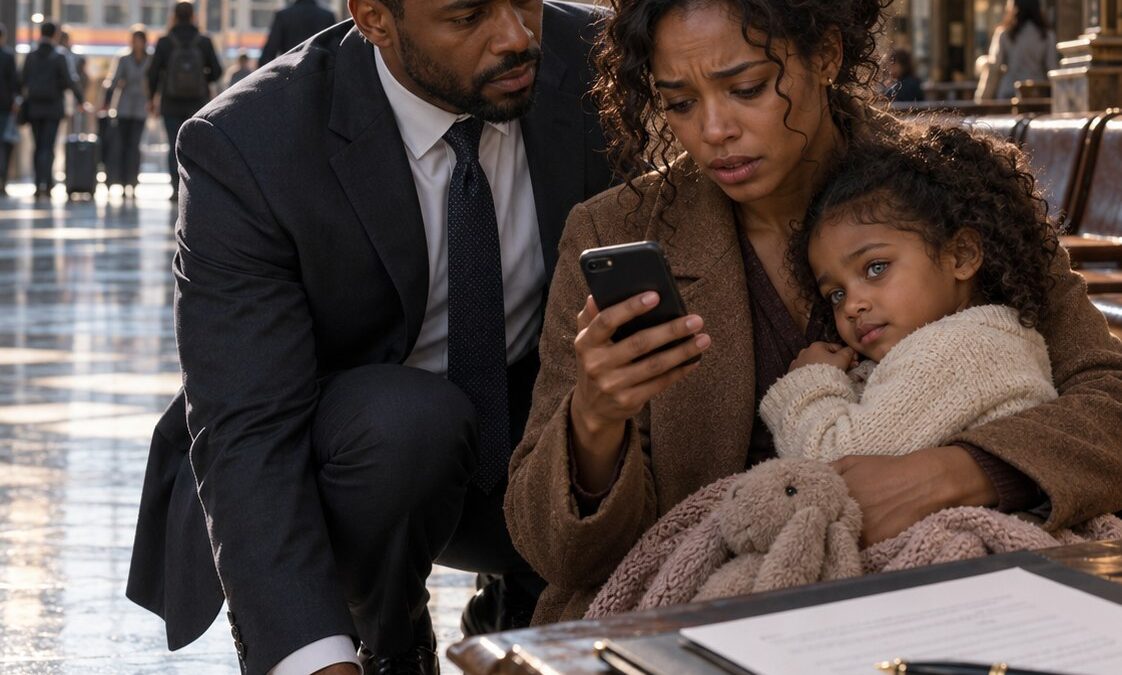
The siren stopped outside Harbor Station.
Nora answered her phone.
I watched her face.
“Yes,” she said.
“She collapsed again.”
The voice on the line was too faint for me to hear.
Nora closed her eyes.
“We’re coming now.”
The call ended.
“What did they say?” I asked.
“They want her monitored.”
“Did they find something?”
“They need more tests.”
Paramedics came through the public entrance.
I moved aside while Nora answered their questions.
Wren had been awake again for less than a minute.
She held Nora’s sleeve and watched the stretcher approach.
“Does it have wheels?” she asked.
“It does,” a paramedic said.
“Can Mom come?”
“All the way.”
I handed Nora the paper boat.
She stared at it.
“Keep it,” she said.
Then she climbed into the ambulance.
I followed in my own car.
Grant called six times before I left the station.
On the seventh, I answered.
“The mayor has gone,” he said.
“Good.”
“The buyers are still here.”
“Tell them why I left.”
“That isn’t their business.”
“It will be if I choose to tell them.”
He paused.
“Who is the child?”
I looked at the boat on the passenger seat.
“You already asked Nora that.”
“She hasn’t contacted you in years.”
“That doesn’t answer my question.”
“Evan, think before you make this public.”
The light changed.
I ended the call.
At the hospital, a nurse led me to a waiting room.
Nora sat there with Wren’s brown coat across her knees.
Her hands shook beneath it.
“She asked for you,” she said.
I stopped.
“She knows who I am?”
“I told her your name.”
“Nothing else?”
“No.”
The answer hurt.
I had earned it.
A doctor came to speak with us.
She said Wren was stable.
They had seen a possible heart rhythm problem on an initial test.
More tests would help them understand it.
The fainting made prompt care important.
“Your father’s death?” she asked me.
“Sudden,” I said.
“He was forty-three.”
“Were you ever screened?”
“Once, years ago.”
I could not remember who had ordered it.
The doctor made a note.
She asked Nora about Wren’s earlier symptoms.
She asked me for anything else I knew.
Then she returned to Wren.
Nora stood to follow.
“I should have come sooner,” she said.
“You came today.”
“I tried before.”
I held up the boat.
“Is that the letter?”
“Yes.”
“Why turn it into this?”
“Wren folded it this morning.”
“She can do that?”
“Badly.”
One corner stuck out like a broken wing.
Nora touched it.
“She found it when I was looking for your address.”
“You knew where I worked.”
“I wanted somewhere the mail wouldn’t vanish.”
She walked into Wren’s room.
I stayed beside the door.
The boat rested in my palm.
Four years earlier, I had told myself Nora wanted a different life.
I had never asked whether I was right.
She had written to me when she was pregnant.
* * *
Wren was asleep when I unfolded the boat.
I photographed each crease first.
Then I opened it slowly.
The letter bore my company stationery.
It was dated four years earlier, two months after our divorce.
It said Nora’s pregnancy changed nothing.
It offered money through a lawyer.
It instructed her to make no further contact.
A printed version of my signature sat at the bottom.
I read it twice.
I had said cruel things during our marriage.
This was not one of them.
Nora came out of Wren’s room.
“You see why I believed it.”
“Yes.”
“You always had someone speak for you.”
“Yes.”
She took the letter back.
“I called your office first.”
“Who answered?”
“Your assistant.”
“Which one?”
“A woman named Beth.”
Beth had worked for Grant.
I remembered her leaving abruptly that spring.
“She said she’d pass my message along,” Nora said.
“Did you speak to her again?”
“No.”
“Did Grant contact you?”
Nora looked up.
“He brought the letter.”
The hallway seemed to narrow.
“In person?”
“At my apartment.”
“Why?”
“He said you didn’t want the staff involved.”
I remembered Grant meeting me after the Lisbon trip.
He had said Nora was leaving the city.
He had said she wanted privacy.
I had accepted both claims.
“Did you ask him about the baby?” I said.
“He told me you knew.”
“What did he say?”
“That you didn’t believe it was yours.”
I put a hand against the wall.
Nora’s expression hardened.
“Don’t make me comfort you for that.”
“I won’t.”
A nurse approached with consent forms for Wren’s care.
Nora signed them.
I asked what would help right now.
“The doctor wanted records,” Nora said.
“My old screening?”
“If you can get it.”
I called my physician’s office.
They located a report from years earlier.
The clinic would send it directly to Wren’s care team with my permission.
I gave it.
Then I called my lawyer, Priya Shah.
I told her about the letter.
I told her Wren might be my daughter.
“I’ll find an independent lab,” she said.
“Do it.”
“Ask Nora first.”
“I will.”
Priya also told me to preserve the original letter.
She would arrange for an examiner if Nora agreed.
No one should crease it further.
I looked at its tired folds.
“It may be late for that.”
“Keep every piece.”
Nora listened without interrupting.
When I hung up, I explained the plan.
“A paternity test?” she said.
“Yes.”
“You don’t believe me?”
“I believe you.”
“Then why?”
“Because Wren deserves an answer neither of us has to defend.”
Nora studied me.
“And the letter?”
“I want to know who made it.”
“So do I.”
She agreed to the test.
Wren’s doctor later told us the father’s old screening report did not settle anything.
It gave the specialists a useful starting point.
I went to the hospital’s records desk.
I signed another release.
Then I returned to Wren’s room.
She was awake, drawing circles on a sheet of paper.
Nora had placed the boat on the windowsill.
“It doesn’t float anymore,” Wren told me.
“It might with repairs.”
“Mom says paper can surprise you.”
“She says a lot of smart things.”
Wren smiled.
I sat in the chair Nora offered.
She did not leave us alone.
I was grateful.
The next morning, Priya sent me copies of my travel itinerary.
Lisbon.
Departure, meetings, hotel receipts.
She also found something I had forgotten.
I had approved a new stationery order just before that trip.
The old letterhead had been retired.
Nora’s letter was printed on the new stock.
Only the executive office had received it that week.
Priya had obtained the delivery record.
Grant signed for the boxes himself.
* * *
I did not call Grant.
Priya had warned me to preserve what we could first.
Our company’s records were still available to him.
If he knew we were looking, he could make that harder.
By afternoon, Wren had undergone more tests.
The specialists explained what they knew and what remained uncertain.
They planned treatment and close follow-up.
I was screened too.
My first result gave them a reason to look further.
Nora waited while I spoke with the doctor.
When I returned, she held out a paper cup of coffee.
“Drink it.”
“You don’t have to take care of me.”
“I got two.”
She handed me the better one.
I remembered her doing that when we were married.
I had rarely noticed.
Priya arrived with a sealed folder.
She had contacted the company that supplied our office printers.
Its service records showed which machines had been installed that spring.
The letter’s printing might be traceable.
An examiner would need the original to say more.
Nora placed it in a clear sleeve.
Priya signed a receipt before taking it.
“What about Beth?” I asked.
“I found her,” Priya said.
“She left town.”
“Does she know we’re looking?”
“She knows I want to ask about the office.”
Beth agreed to speak that evening.
First, Priya wanted the company to preserve its records.
She sent a formal notice to our legal department.
Copies went to outside counsel.
Grant could read it.
He did.
Twenty minutes later, my phone rang.
“You’ve brought a lawyer into this?” he asked.
“Yes.”
“Over a four-year-old letter?”
“Over whoever wrote it.”
“I thought you were at the hospital.”
“I am.”
“Then stay with the child.”
His voice had changed on the last word.
“Grant, who sent Nora away?”
Silence.
“I tried to protect you,” he said.
The line went dead.
Priya had heard enough to tell me to write down his exact words.
I did.
Then an email arrived from the buyers.
They were invoking a clause that could end the station deal.
The company might lose its deposit.
Grant, as CFO, had copied every board member.
His note blamed my “personal disruption.”
For six years, Grant had handled the figures I trusted.
I opened the board packet myself.
There were payments to a vendor I did not recognize.
The same vendor had billed our family foundation.
Nora saw the name on my screen.
She went still.
“That was in my old payroll files,” she said.
“You worked for the foundation.”
“Until Grant let me go.”
“What did the vendor do?”
“I couldn’t tell.”
She had asked Grant about duplicate charges before she left.
He had called them an accounting mistake.
She had copied one page because she wanted to check his answer.
That page was still in a folder at her apartment.
Priya called an accountant outside the company.
She also advised me to tell the foundation’s independent board members.
I sent them the records I had found.
No private meeting with Grant.
No offer to make anything disappear.
That evening, Beth spoke to us by video.
She remembered Nora’s call.
She remembered taking a message.
“Did you give it to me?” I asked.
“No.”
Beth gripped the edge of her desk.
“Grant came into my office before I could.”
“What did he say?”
“He said he would tell you himself.”
“Did you see him do it?”
“No.”
She had made a note in the office log.
Priya asked if it still existed.
Beth had a photograph of the page.
She had taken it when Grant accused her of losing messages.
She sent it to Priya.
Nora’s name was there.
Beside it, Beth had written one word.
Pregnant.
Priya looked from the log to the letter.
Grant had known before I did.
* * *
The next morning, Grant came to the hospital.
He stopped when he saw Priya beside me.
“I thought we could speak as brothers,” he said.
“We can speak here.”
Nora stayed near Wren’s door.
Grant glanced at her.
“I owe you an explanation.”
“You owe her one,” I said.
“I was keeping a collapsing marriage from becoming a lawsuit.”
Nora’s face did not move.
“You knew I was pregnant,” she said.
“I knew what you claimed.”
“You delivered that letter.”
“I delivered a letter from Evan’s office.”
Priya opened her notebook.
“Who asked you to?”
Grant looked at her.
“This is a hospital.”
“Yes,” Priya said.
“I’d like it to remain peaceful.”
Grant stepped closer to me.
“The buyers want an answer by five.”
“I’ll give them one.”
“You’re about to lose millions.”
“Wren is in that room.”
“I can see that.”
He lowered his voice.
“You don’t know that she’s yours.”
“Neither did you.”
He held my gaze.
“You should be careful what you say publicly.”
I heard the threat.
I also heard how little Wren mattered to him.
“Leave,” I said.
Grant’s jaw tightened.
“You’re choosing a stranger’s accusation over your brother.”
I pointed toward the elevators.
He went.
Wren’s door opened behind us.
She stood there holding Nora’s hand.
“Was he angry?” she asked.
“Yes,” I said.
“Did I do it?”
“No.”
Nora knelt beside her.
“Adults can be wrong on their own.”
Wren considered that.
“Can I have my boat?”
Priya had taken the letter for examination.
I told Wren it was being repaired.
She accepted this with more trust than I deserved.
At five, the buyers withdrew.
The deposit dispute would take months.
I went home long enough to collect clean clothes.
On my way back, Priya called.
The foundation’s accountant had traced payments to the mystery vendor.
Its listed address belonged to an office Grant controlled.
That established a serious question.
Bank records and an independent investigation would have to answer the rest.
I asked Priya to send the findings to the foundation board.
They had already called a meeting.
“Why hide Nora?” I asked.
“She might have recognized the charges,” Priya said.
“Four years ago, she had.”
Grant had not merely kept a pregnancy from me.
He had kept the person who spotted his invoices away.
* * *
The foundation board met three days later.
Nora chose to attend.
I told her she did not owe them her life story.
“I know,” she said.
“I want to tell them what I saw.”
Wren was home with Nora’s sister.
The doctors had made a treatment plan.
She was frightened by new routines.
She was also arguing over which stickers belonged on her medicine chart.
The boardroom overlooked Harbor Station.
Through the window, I could see its motionless clock.
Grant sat at the far end of the table.
His attorney sat beside him.
The independent board members had brought their own counsel.
Priya laid out what we could document.
Nora had found duplicate vendor charges.
She had raised them with Grant.
Grant had ended her foundation job.
Weeks later, she called my office about her pregnancy.
Beth recorded the call.
Grant took the message.
Nora then received the letter.
Grant watched without expression.
His attorney spoke first.
“Those events don’t prove my client fabricated anything.”
“He’s right,” Priya said.
“They are why we kept looking.”
An independent accountant described the vendor payments.
Several million dollars had left the foundation over four years.
The invoices claimed to fund family support programs.
The accountant could not find evidence that those services were delivered.
Grant leaned forward.
“The programs were confidential.”
“Then give us their records,” a board member said.
“I’m gathering them.”
He turned to me.
“You knew how much pressure we were under.”
“I knew the foundation had a budget.”
“You wanted the good it could do.”
“I still do.”
Grant spread his hands.
“We expanded too fast.”
For a moment, he sounded like the brother who had sat with me after our father’s funeral.
He said he’d moved money to keep the company stable.
He said he intended to return it.
He said Nora had misunderstood the books.
Then he looked directly at her.
“You could have asked again.”
“I did,” she said.
“You fired me.”
“I didn’t want an argument with my brother’s ex-wife.”
Nora put both hands flat on the table.
“You came to my apartment with a letter.”
“You say I did.”
“Wren was inside me.”
Grant looked away.
Priya lifted the clear sleeve.
An independent document examiner had inspected the paper boat.
The letter was printed on our new office stock.
Its signature was an image placed into the document.
It had not been signed by hand.
Grant’s attorney objected to what that could prove.
Priya agreed with the limit.
The examiner could not identify the person at the keyboard.
She could identify an unusual mark from a damaged printer roller.
The same mark appeared on documents produced by Grant’s office printer that spring.
Grant said others used his printer.
They had.
Then Priya showed the board Beth’s office log.
It had Nora’s message, the date, and Grant’s initials beside a note that he had taken it.
Beth joined by video and confirmed the photograph.
She also confirmed that I had never received the message from her.
The room held still.
Grant’s attorney asked for a break.
The board chair refused until one final question was answered.
“Grant,” she said, “did you tell Evan Nora had called?”
He looked at me.
“I told you she wanted privacy.”
“Did you tell me she was pregnant?”
“No.”
“Why?”
He rubbed his forehead.
“I had already dealt with her.”
Nora pushed back her chair.
I thought she would leave.
Instead, she stayed standing.
“You dealt with a woman,” she said.
“You never asked about the child.”
Grant stared at the table.
The board voted to place him on leave.
They referred the financial findings to the appropriate authorities.
Outside counsel took charge of preserving the company records.
I did not ask anyone to arrest my brother in that room.
The evidence would have its own process.
Grant stood as we gathered our papers.
“You’ll lose the station,” he said to me.
“Maybe.”
“You’ll lose the company if this spreads.”
“Then I’ll tell the truth while I still can.”
He looked at Nora.
“She could have found you.”
“She did,” I said.
Grant had no answer.
Six months later, the financial case ended in a plea.
The foundation recovered part of its money.
Its board pursued the rest.
Grant admitted using the vendor to divert funds.
He also acknowledged creating the letter in a statement given through his attorney.
The court dealt with the financial crimes.
Nora kept the letter.
I kept my responsibility.
* * *
The paternity results had come back long before Grant’s case ended.
Wren was my daughter.
Nora read the report first.
Then she handed it to me across her kitchen table.
Wren sat on the floor building a crooked tower.
I looked at the result.
“I’d like to tell her,” I said.
“When she’s ready,” Nora answered.
“I can wait.”
“You can show up.”
She watched me closely.
“Those are different things.”
I began with Tuesday afternoons.
Nora stayed for every visit.
Wren taught me the names of her stuffed animals.
I learned which cup she wanted after a medical appointment.
I learned that she hated the sound of tape being pulled from a roll.
Some visits lasted an hour.
Some ended early.
I came back the next Tuesday.
My own screening led to follow-up care.
Wren and I sometimes had appointments in the same building.
Afterward, we compared the stickers we’d been given.
She always won.
One afternoon, she asked why I hadn’t known her as a baby.
Nora was beside us.
I told Wren the truth she could carry.
“I didn’t know you were here,” I said.
“Now you do,” she said.
“Yes.”
“Okay.”
She went back to coloring.
Nora looked down at her hands.
Later, when Wren slept, I apologized.
I told Nora about the years before the letter.
The late nights I chose.
The promises I missed.
The way I let Grant speak for me even when our marriage was ending.
“I can’t give those years back,” I said.
“No,” she answered.
“I won’t ask you to pretend they didn’t happen.”
“Good.”
She sat across from me in her small kitchen.
“I want you in Wren’s life,” she said.
“I need you to respect the life she already has.”
“I will.”
“If you disagree with me, we talk.”
“Yes.”
“You don’t send someone from your office.”
“I won’t.”
Money came up because it had to.
I asked Priya to arrange child support properly.
Nora brought her own lawyer.
They agreed on support, medical costs, and a gradual parenting schedule.
I offered to buy Nora a larger house.
She refused.
“I like my neighbors,” she said.
I offered to pay for repairs to her roof.
She gave me the contractor’s estimate for my share of Wren’s expenses instead.
I paid it.
The hotel deal at Harbor Station was gone.
After the investigation, the city sought new proposals.
I stepped away from the bid.
The foundation’s new board used recovered funds to restart the family support programs Grant had billed for and never provided.
Nora helped them review the applications.
They paid her for the work.
She insisted on that.
For Wren’s fifth birthday, I bought a small kit of colored paper.
Nora laughed when she saw it.
“You can’t fold one.”
“I’ve been practicing.”
I had.
Mine still listed to one side.
Wren set three boats along the kitchen table.
“One for Mom,” she said.
“One for you.”
“And the third?”
“For Granddad.”
She knew my father had died before she was born.
She knew he had gray eyes too.
We put his boat between ours.
That evening, after the candles were out, Nora handed me the original letter.
The examiner had returned it.
Its folds would never lie flat.
“I don’t want Wren to find it again,” she said.
“I can keep it.”
“Somewhere safe.”
I placed it in a folder at home.
It was evidence of what Grant had done.
It also reminded me of the chance I’d missed to ask Nora one more question before we parted.
A year later, I asked Nora something carefully.
Wren wanted me at her school concert.
It fell on a night I was due to take her home.
“I can bring her back afterward,” I said.
“You already can.”
“I meant all of us.”
Nora looked at me.
“I’d like to sit with you,” I said.
She considered it.
“Ask Wren.”
Wren wanted us both in the front row.
We went.
* * *
Three years later, Harbor Station reopened.
The city had kept the public hall.
There were shops along one wall and benches beneath the clock.
Its hands worked again.
Wren was eight.
She ran ahead of Nora and me, then stopped beneath them.
“It’s on time,” she announced.
“For once,” Nora said.
Wren carried a paper boat in her pocket.
She had made it from a page of plain blue paper.
She would leave it on the dry windowsill until we went home.
Nora and I had come together from Wren’s school.
We still lived in separate homes.
We still spoke before changing her plans.
On good days, that felt ordinary.
On difficult days, we spoke anyway.
Wren pulled out the boat.
Its folds were neat.
“Remember my first one?” she asked.
“I do.”
“It was squashed.”
“It was,” I said.
She held this one up to the light.
The old letter stayed in my folder.
Wren knew what had happened in words she could understand.
She knew Grant had lied.
She knew her mother had tried to reach me.
Most of all, she knew she could reach me now.
The clock struck noon.
Wren took my hand.
“Will you sit with us?”
“Yes.”
We sat beside Nora beneath the moving hands.
Wren placed the blue boat between us, safe from anyone’s shoes.
THE END








