He Came Home to Find His Daughter Giving Away Her Mother’s Coat—Then One Note in the Auction Ledger Put Everything at Risk
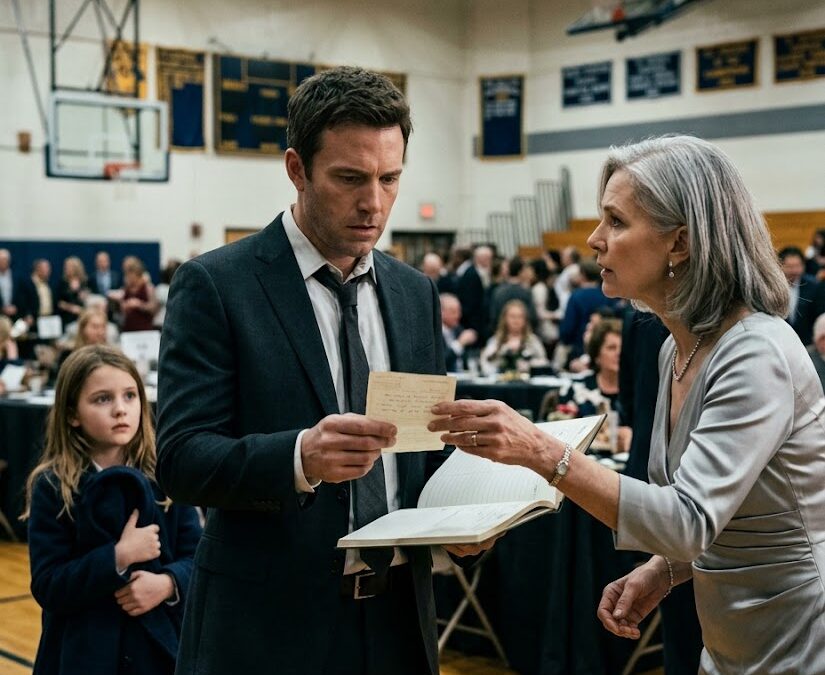
Chapter 2: The Ledger’s Second Page
Celeste did not look at the note.
She looked at Wren.
“Give me the coat, sweetheart.”
Wren stepped behind Miles.
The teacher lowered the ledger.
No one moved closer.
The auction microphone hummed behind them.
Miles held out his hand. “I need the deposit slip.”
“It’s a school record,” the teacher said.
“Then keep it here.”
Celeste’s jaw tightened.
“I can explain this privately.”
“You can explain it with the records.”
“I was trying to spare you.”
“From what?”
She glanced at Wren.
“Not here.”
“Then you should have thought of that before.”
Miles took the coat from Wren only when she offered it. He folded it over his arm, careful not to crease the collar.
“Come with me,” he said.
“Where?” Wren asked.
“Somewhere quiet.”
Celeste nodded toward the side hallway. “The office is open.”
“Not with you.”
His mother’s face went blank.
“You’re making this ugly.”
“It was ugly before I arrived.”
“Your daughter is upset.”
“She was upset before I arrived too.”
“You don’t know what she’s been told.”
“I know what you just told her.”
“I said sweetheart.”
“She flinched.”
Celeste stopped.
For a moment, she looked older.
Then she smoothed her dress.
“You’ve been gone too much,” she said. “Someone had to parent her.”
“I know I’ve been gone.”
“You chose your company over her.”
“I did.”
The admission slowed her.
Miles opened the hallway door. Wren stepped through first. The door shut behind them, cutting off the auction and the microphone’s low hum.
The hall smelled of floor wax and wet coats.
Wren kept a hand on the navy wool.
“Are we in trouble?”
“No.”
“Grandma said the school could get in trouble if people saw the ledger.”
“The school needs to know where its money came from.”
“Will they ask me questions?”
“They may.”
“Will I have to say I donated the coat?”
“Only if that’s what happened.”
“I didn’t.”
“Then you don’t say that.”
She touched the lapel card.
“Can we take this off?”
“Yes.”
Miles eased the pin free and put the card in his pocket.
Wren watched him.
“Are you mad at me?”
“No.”
“Are you mad at Grandma?”
“I’m concerned about what she did.”
“That sounds like mad.”
“It may be both.”
She looked down at the coat.
“Mom wore this to the winter concert.”
“I remember.”
“She let me hide in it when I got scared.”
Miles pictured the auditorium: Elise in the front row, Wren’s face tucked into the coat collar, the lights shining on her mother’s dark hair.
“I remember that too.”
“Can I keep it?”
“It’s yours.”
“Even if it smells like an old closet?”
“That wasn’t kind.”
“Grandma said it should go to a child who needed it.”
“You needed it.”
Wren rubbed the wool between her fingers.
Celeste pushed through the hallway door.
“Are you taking her home without letting me speak?”
“We’ve heard enough tonight,” Miles said.
“You don’t get to decide that.”
“I do.”
“You have no idea what I’ve done for this school.”
“I’m sure they’ll appreciate hearing your explanation.”
“You’re threatening me.”
“I’m asking for records.”
“What records?”
“The memorial account. The auction deposits. The coat entry. Anything that connects them.”
“Don’t contact the board yet,” Celeste said to the teacher, who had followed her into the hall. “We can correct this ourselves.”
The teacher held up her phone.
“I photographed the ledger page and the slip. I’ve also emailed the board treasurer.”
“You had no right.”
“I’m the auction secretary.”
“You’re a substitute teacher.”
“I’m also responsible for reconciling donations.”
The teacher’s voice shook, but she did not back down.
Miles nodded. “Thank you.”
Celeste stared at the phone.
“You’re all making assumptions.”
“Then the records can clear it up.”
His mother walked back toward the gym.
Wren watched her go.
“Can we leave now?”
“Yes.”
They went out the rear entrance. Cold air hit them beside the school’s band trailer. Miles unlocked the car, but Wren stayed outside.
“Could we sit for a minute?”
“Of course.”
They sat in the back seat with the coat between them. The interior lights faded.
“Dad?”
“Yeah?”
“Did Grandma take Mom’s money?”
“I don’t know yet.”
“Is it bad that I hope she did?”
Miles turned toward her.
“Why would you hope that?”
“Because then you’d stop believing her.”
He closed his eyes briefly.
“You shouldn’t have had to solve that.”
“But I knew she was lying.”
“How long?”
“Since winter.”
“What happened?”
“Grandma said you were too busy for school calls. She said I shouldn’t keep asking to call you.”
“I never told her that.”
“I know that now.”
“What did you know then?”
“That she said it.”
Miles tightened his hands around the steering wheel.
“Did she tell you to stay upstairs?”
“She said people needed to talk downstairs.”
“Did she say Mom would be disappointed if you bothered me?”
Wren’s eyes filled.
“Yes.”
He turned away long enough to steady himself.
“Let’s go home,” he said.
“Is Grandma coming?”
“No.”
“Is she still staying with us?”
“Not tonight.”
“Are you sure?”
“Yes.”
The drive took twelve minutes. Miles left the radio off.
At home, he took the coat to the den and laid it on the sofa. Wren followed with her backpack.
“Can I keep it here?”
“Wherever you want.”
“I want it near me.”
“Then it stays here.”
Miles removed the auction tag. On its back, in small blue ink, was a notation: M.R. ESTATE, HOLD FOR TRANSFER.
“What does that mean?” Wren asked.
“I’m not sure.”
He put the tag beside the other papers.
Then he called Evelyn Park, the attorney who had helped settle Elise’s estate.
“I need your help with a suspicious donation,” he said.
“What kind?”
“A school auction item and a deposit credited to Elise’s memorial account.”
“Is the money missing?”
“I don’t know.”
“Is Wren safe?”
“She’s with me.”
“Good. Don’t confront anyone else tonight.”
“I already confronted my mother.”
“Then don’t do it again. Can she leave your house?”
“She’s at the school.”
“Keep it that way. Send me the ledger and slip when you have them.”
“What do you need?”
“Bank statements, the charity account paperwork, any authority you gave your mother, and the date you closed the memorial fund.”
“Why does the authority matter?”
“A deposit doesn’t tell us who moved the money before it reached the school.”
Miles looked at the tag.
“She helped with Elise’s estate. I signed something after the funeral.”
“What?”
“I don’t remember.”
“Find it. Don’t guess.”
He found the estate binder in his office. The power of attorney sat behind the trust certificate.
Elise had established an education trust for Wren, funded by life insurance and savings. A separate memorial fund had received the remaining balance after the trust was funded. Miles had signed a limited administrative authorization for Celeste after the funeral. It let her deliver school forms, request balance statements, and coordinate approved withdrawals.
It did not let her change beneficiaries or transfer the trust.
The authorization had expired eighteen months after he signed it.
That was years ago.
He photographed the documents for Evelyn.
“The school deposit is one piece,” she replied. “The authority is another. We need the bank’s records.”
The next morning, he kept Wren home and went to Evelyn’s office. She had requested the school’s records and a review from the trust administrator.
“The auction deposit was eight hundred dollars,” she said. “The school’s slip lists an account ending in 4401. It isn’t the memorial account.”
“Whose account?”
“We need the bank to confirm.”
“Could it be the trust?”
“We need the original records before we know.”
Miles recognized the trust name on the summary. It remained open. But the linked custodial savings account held only $19,200. It had held $42,600 when Elise died.
The summary showed three withdrawals: $6,500, $8,700, and $8,200. Each was labeled FAMILY EDUCATION ADVANCE.
“Did Wren have expenses like this?” Evelyn asked.
“Not that I know of.”
“Did your mother?”
“She paid tuition once while the estate accounts were being transferred.”
“How much?”
“About six thousand.”
“Was that reimbursed?”
“I don’t know.”
The receiving account ended in 4401.
Miles’s accounts did not.
“Do we know who owns it?” he asked.
“Not from this summary. The bank will tell us after its review.”
The first withdrawal had occurred two days after Celeste moved into his house. The second came during Wren’s winter concert. The third was three weeks before the auction.
Evelyn pointed at the dates.
“We need the original instructions. We also need the bank to preserve the file.”
“I’ll authorize that.”
“Don’t contact your mother again until we know what the records say.”
“I won’t.”
The school principal called that afternoon. He said Celeste had described the coat as a freely offered donation and the eight-hundred-dollar entry as a family gift.
Miles asked the school to preserve its records and make no changes until the treasurer reviewed them.
“Can I speak with Wren?” the principal asked.
Miles asked Evelyn. She advised him to request the questions in writing and make sure Wren could speak with him present, without anyone from the family.
The principal agreed. Wren chose to answer.
She sat in the office with Miles beside her and the auction secretary across the table.
“Did you want to donate the coat?” the principal asked.
“No.”
“Did anyone ask you?”
“Grandma told me the auction needed it.”
“Did you say yes?”
“I said I didn’t want it in the hall.”
“Did you understand that meant it would be sold?”
“No.”
“Did your grandmother tell you it had to be sold?”
“She said I was selfish if I kept it.”
The secretary wrote that down.
“Did she tell you the money would go to the school?”
“Yes.”
“Did she say it came from your mother’s memorial fund?”
“She said the coat was part of Mom’s legacy.”
The principal paused.
“Did she tell you anything else?”
Wren rubbed a pencil with her thumb.
“She said Dad wouldn’t want to hear about it.”
Miles stayed still.
“Thank you for telling us,” the principal said.
Outside the office, Wren tugged his sleeve.
“Did I do it right?”
“You told the truth.”
“That’s what right means?”
“Yes.”
At home, Wren drew on the back of a grocery receipt while Miles called the bank. The review would take several days.
“What are you drawing?” he asked.
“A house.”
“Is it ours?”
“No. People live there who don’t have to be quiet.”
“That sounds like a good house.”
She turned the receipt over and drew stars.
The next morning, the school called again. Celeste had come before classes and asked to take the coat, claiming it belonged to Elise’s estate.
“We told her the board has to decide,” the principal said. “She left without speaking to Wren.”
Miles thanked him.
A text arrived from Celeste: I’m trying to protect your daughter from this.
Then another: You’re letting strangers turn a family misunderstanding into a scandal.
He saved both and forwarded them to Evelyn.
The bank called that afternoon. It had confirmed the account ending 4401 belonged to Celeste.
“Can they prove it?” Miles asked Evelyn.
“They have the receiving-account instructions and the transfer records.”
“Who signed?”
“The file is incomplete. The scan is cropped.”
“Could she say I approved it?”
“She could point to a verification note.”
“What does it say?”
“The bank says someone verified you by telephone. The note doesn’t identify who spoke.”
Miles remembered he had been in Denver during the first transfer.
“Can they prove I answered?”
“Not yet.”
The following evening, someone entered Miles’s house. Nothing valuable was missing, but his office door stood open and the estate binder was gone. The front door showed no damage. Celeste still had a key.
The responding officer took a report and advised Miles to change the locks. Miles did so that night.
Wren asked whether the coat was safe.
“Yes.”
“Did they touch it?”
“No.”
“Can I put it in my room?”
“Of course.”
She carried it upstairs herself. Miles waited on the landing until her door closed.
The next morning, Evelyn called.
“The bank found another form in its archive,” she said. “It asked to add your mother as an authorized signer and change the description of the trust distributions.”
“To what?”
“School support and family expenses. The bank marked it incomplete.”
“Who submitted it?”
“There’s a courier receipt with your mother’s name.”
Miles looked at the empty space where the binder had been.
“Is that enough to report?”
“It’s enough to ask a financial crimes investigator for guidance. It isn’t proof of who signed the transfer.”
Evelyn arranged a meeting with Daniel Hsu, an investigator who had worked in bank fraud before joining the state attorney’s office.
He asked for documents, not Miles’s conclusions: the bank records, school ledger, tag, deposit slip, police report, and texts.
“Why did your mother need the money?” Daniel asked.
“I don’t know.”
“Did she have debts?”
“I don’t know.”
“Did she pay for anything for Wren?”
“She paid some tuition, perhaps.”
“Then we need invoices.”
Miles found an email from Celeste titled Wren’s school costs. It listed uniforms, tutoring, and transportation, totaling $4,860. He had transferred the amount to her account that same day.
The school confirmed receiving $3,120. The tutoring service had no record of Wren, and the transportation company had no account under her name.
“Could she have paid cash?” Miles asked.
“Maybe,” Daniel said. “We need receipts.”
Celeste refused an interview. Her lawyer sent a letter saying she had permission to reimburse herself for household expenses and that Wren had freely offered the coat.
The school board kept the donation question separate. It found that the coat was entered without Wren’s consent. The item had not sold, and the school removed it from the auction record. The eight-hundred-dollar contribution had come from Celeste’s personal account, but she had labeled it Elise’s memorial fund.
The money was hers.
The description was false.
One afternoon, Wren asked whether she could invite her friend Becca over.
“Of course,” Miles said.
“Can I tell her what happened?”
“You can tell her what you want.”
“Can I say Grandma made me put Mom’s coat in the auction?”
“Yes.”
“Can I say the money might be missing?”
“Only if you want to.”
“I don’t want everyone asking if I’m sad.”
“Then you don’t have to tell them.”
Becca came over after school. They built a fort under the kitchen table with two blankets. Miles brought apple slices. Wren reached for the plate and knocked over a glass.
She froze.
“Sorry,” she whispered.
“You’re okay.”
“I’ll clean it.”
“I know.”
He handed her a towel. They wiped the table together. Becca picked up her story where she had left off, and the moment passed.
That night, Wren asked to leave a glass of water beside the coat in her room.
“Why?”
“Mom used to keep one there when she was sick.”
“All right.”
“Is that strange?”
“No.”
“Good.”
The bank’s full file arrived three weeks later. The transfer request bore Miles’s printed name and a signature that resembled his from a distance. The bank’s examiner compared it with six verified signatures.
The loops were wrong.
The pressure was wrong.
The final letter crossed back instead of forward.
The examiner concluded it was not Miles’s signature but could not identify the writer.
The bank’s call note was worse. It listed a call to the house landline, which had been disconnected two years earlier. The forty-two-second entry came from a branch phone to a voicemail system, not a person. The supervisor had marked Miles verified without reaching him.
The trust administrator confirmed the withdrawals were not approved education expenses. The school records supported only the tuition Miles already knew about. Daniel reviewed the file with the district attorney and said it supported a civil claim and a criminal referral.
“We can’t promise an outcome,” he said.
“I understand.”
“Your mother may argue you authorized the payments.”
“I didn’t.”
“She may call them reimbursements.”
“I have the invoices.”
“She may say someone else signed.”
“The examiner says I didn’t.”
“That matters.”
Miles filed a civil petition to restore the trust funds. Celeste’s response said the money had supported the household and Miles had benefited from her help.
She was right about one thing: she had helped. She had cooked meals, attended school events, and stayed with Wren while Miles traveled.
Her attorney called it a family arrangement.
Evelyn called the transfers unauthorized.
The school board scheduled a public meeting about the auction record and the memorial-fund entry. Wren asked to stay home with Becca’s mother. Miles told her that was fine.
Celeste arrived in a gray suit with two binders. The meeting was held in the school library, with the board, principal, treasurer, auction secretary, and several parents present. Evelyn sat beside Miles. Daniel sat near the back as an observer.
The chair began with the coat.
“Ms. Rowan, did Wren agree to donate it?”
“I understood that she did.”
“Did you ask her directly?”
“She told me she was willing to part with it.”
“That is not the same question.”
“She did not say no.”
“Did she say yes?”
“I don’t recall her exact words.”
“Why was the item entered under W. Rowan?”
“Because Wren was the donor.”
“She denies that.”
“She is a child. She may not understand what she agreed to.”
“Did you pin the auction card to the coat?”
“Yes.”
“Did you write the donor value?”
“Yes.”
“Did you write the notation on the back?”
Celeste looked at the tag sealed in a clear evidence sleeve.
“I don’t remember.”
The chair moved to the deposit.
“Why was the eight-hundred-dollar payment described as Elise’s memorial fund?”
“It was a family contribution in her memory.”
“Was there a memorial account at that time?”
“No.”
“Then what did the description mean?”
“It was an affectionate note.”
The treasurer adjusted his glasses.
“The system treated it as a restricted donation.”
“I didn’t know that.”
“You were on the committee.”
“I wasn’t the treasurer.”
“You approved the entry.”
“I didn’t enter it.”
The auction secretary opened her folder.
“The initials on the entry are yours.”
Celeste’s attorney stood. “Let’s keep this focused on the school’s books.”
“We are,” the chair said.
“I gave the school eight hundred dollars,” Celeste said. “That money was mine.”
“Correct,” said the treasurer.
“I gave the coat because it would help the fundraiser.”
“Wren did not authorize that,” the secretary said.
“Wren cannot fully understand these decisions.”
“That is why we required a parent’s permission,” the chair said.
Celeste looked at Miles.
“You were absent.”
“I was,” he said.
“You were absent while Wren grew up.”
“I worked too much.”
The room shifted. Her attorney sat down.
“I don’t dispute that,” Miles continued. “But my absence did not authorize anyone to use her mother’s property or speak for her.”
Celeste turned back to the board.
“I kept the house running.”
The chair asked, “Who approved the memorial-fund notation?”
“I did.”
“Why?”
“I thought the family had established that connection.”
“Did you transfer money from Wren’s trust?”
Celeste’s attorney stood again.
“That question is outside the board’s scope.”
“Then answer through counsel,” said the chair.
“I did not steal from Wren,” Celeste said.
Her voice sounded firm, but she did not look at Miles.
The chair clarified that the board was not deciding whether a crime occurred. Celeste’s attorney objected to the trust documents being discussed. He argued the matter was private and unrelated.
The chair agreed that the board could not decide the financial case.
Then the auction secretary opened the ledger’s back pocket and removed a folded receipt.
“I found this attached to the original tag,” she said. “It was behind the auction page.”
Celeste went still.
The receipt showed a transfer from the trust account to Celeste’s checking account. The date matched the second withdrawal. The memo read WREN—WINTER PROGRAM.
Celeste’s lawyer asked for a recess.
The chair granted five minutes.
“Don’t speak to her,” Evelyn murmured.
“I won’t.”
Daniel asked the chair to preserve the receipt and call the school’s records custodian.
The custodian brought the original ledger from the locked office. The receipt’s torn edge matched a blank page behind the auction entry.
The chair asked the secretary when she had found it.
“Yesterday afternoon.”
“Who had access to the ledger?”
“Committee members, the principal, and the treasurer.”
“Did you tell Ms. Rowan?”
“No.”
The receipt alone could not establish a transfer. It had no bank stamp. But Evelyn placed a certified bank record beside it. The date, amount, and destination account matched.
Celeste’s attorney read it.
His expression changed.
Daniel asked the board to preserve the original for the investigation. The chair agreed.
“You cannot take private documents,” Celeste said.
“They are school records,” the chair replied.
“They prove nothing.”
“They match the bank’s certified record,” Evelyn said.
“They show a transfer under a valid arrangement.”
“The authorization had expired.”
“That is disputed.”
“The bank’s file shows the transfer form carried Miles’s forged signature.”
“You cannot prove who signed it.”
“No,” Evelyn said. “The examiner cannot identify the writer. But we know Miles did not sign it.”
Celeste turned to her son.
“Did you pay me back for your daughter’s care?”
“I repaid the tuition invoice.”
“And everything else I did?”
“Send the receipts.”
“You’ve been using me for years.”
“I relied on you. That was my mistake.”
“You think you can erase what I gave this family?”
“No.”
“Then what do you want?”
“The money returned to Wren’s trust.”
“That money went to the household.”
“Show the expenses.”
“I will.”
“You had months.”
“I will.”
Her attorney put a hand on her arm. She shook him off.
“You’re asking the school to destroy my reputation.”
“The school is correcting its records,” Miles said.
“You want me exiled.”
“I want you away from Wren until she feels safe.”
“She’s a child. She doesn’t decide family access.”
“She decides whether she wants to see you.”
Celeste looked at the board.
“You’re going to let him do this?”
“Ms. Rowan,” the chair said, “the board is reviewing the auction record. It isn’t deciding family access.”
“Then why am I sitting here?”
“Because you chaired the committee.”
Celeste fixed her eyes on Miles.
“You always make yourself look noble after someone else cleans up your mess.”
He stood.
“Maybe I was absent,” he said. “Maybe I should have seen what Wren needed sooner. That remains mine to answer for.”
Celeste’s expression softened slightly.
“But it doesn’t make Wren responsible for your choices,” he continued. “No one is asking you to confess. The records can speak.”
The board removed Celeste from the committee, suspended her access to school events in an official capacity, and referred the donation entry for an audit. It did not declare her guilty of a crime.
The bank continued its review. The state investigator interviewed the branch supervisor, who admitted he had entered the verification note without completing a call. The bank acknowledged an internal control failure.
The district attorney filed a complaint against Celeste for unauthorized transfers and document fraud. She pleaded not guilty.
The civil case continued for four months.
Celeste offered to return $12,000 and call the rest household reimbursement. Evelyn declined. The bank records showed $23,400 transferred. The school records supported $3,120 in legitimate expenses. Miles’s separate payment covered another $4,860, though only part had reached the school. The records could not establish where every dollar had gone.
The court ordered Celeste to repay $20,280 to Wren’s trust, subtracting the tuition expenses it accepted. The bank covered part of Miles’s investigation costs under a separate settlement.
The criminal case ended with Celeste pleading guilty to one count of fraud involving the forged transfer form. The judge ordered probation, restitution, and no contact with Wren unless Wren’s therapist and Miles agreed it was appropriate.
There was no courtroom speech.
There was no applause.
A clerk read the terms while Celeste stood beside her attorney.
After the hearing, she approached Miles in the corridor.
“You got what you wanted.”
“I got the money restored.”
“You got me convicted.”
“You signed the plea.”
“You could have stopped this.”
“I couldn’t undo the transfers by pretending they didn’t happen.”
“You could have kept it in the family.”
“Wren is the family.”
Celeste lifted her chin.
“She’ll understand someday.”
“Maybe.”
“You don’t know what she’ll want.”
“That’s why I’m not deciding for her.”
She looked toward the elevator.
“Tell her I’m sorry.”
“You can write a letter.”
“Will you give it to her?”
“If she asks.”
“You’re still punishing me.”
“I’m giving her a choice.”
Celeste turned away.
Miles didn’t follow.
At home, Wren sat at the kitchen table with a glass of water.
“Did the court decide?”
“Yes.”
“Is the money coming back?”
“Yes.”
“How much?”
“Twenty thousand, two hundred eighty dollars.”
“Does that mean I can go to college?”
“It means the money set aside for you will be there.”
“Even if I don’t go to college?”
“Yes. It can support your education and other things the trust allows.”
“Can I choose?”
“When you’re old enough.”
Wren nodded.
“Is Grandma going to jail?”
“No. She got probation and has to repay the money.”
“Can she call?”
“Not unless we agree it’s appropriate.”
“What if I don’t want her to?”
“Then she doesn’t.”
“What if I change my mind?”
“Then we talk about it.”
Wren looked at the coat hanging on the chair.
“I don’t want to see her.”
“Okay.”
“Is that mean?”
“No.”
“Does she know?”
“She knows the court’s order.”
“Does she know I’m the one who said no?”
“I didn’t tell her what you said.”
“Good.”
He sat across from her. She moved her glass away from the edge.
“Can we have dinner?”
“We can.”
“Can you make the noodles Mom made?”
“I can try.”
“They were better.”
“I know.”
“Can you try anyway?”
“I can try.”
They made dinner together. The noodles were too soft. Wren ate two bowls.
For a while, the house was ordinary.
Miles cut his travel schedule in half. He turned down a promotion that would have required three days a week in Boston. His company remained profitable; it did not collapse because he came home for dinner.
Wren returned to school. The coat stayed in her room. She wore it once when the temperature dropped below freezing.
“It’s too big,” she said.
“Your mother bought it that way.”
Wren turned up the collar.
“It’s warm.”
“Your mother would tell you to wear a scarf.”
“She’d be right.”
The school asked whether Miles wanted to donate the framed beach photograph he had brought for Wren on auction night.
He said no. Wren had it on her desk and didn’t want strangers bidding on it.
That summer, the district attorney’s office asked whether Wren would provide a written victim statement. Evelyn explained it was optional and would not require her to attend court.
Wren thought about it for a week, then wrote three sentences.
I did not give away my mother’s coat.
I was afraid people would be upset if I said no.
I want grown-ups to ask me what I mean.
She signed her name.
The statement went into the court record. It was hers, in her words.
Celeste sent a letter that winter. Evelyn reviewed it first. It said she regretted using Wren’s coat and making her feel responsible for adult problems. It did not mention the transfers. Celeste hoped she might see Wren someday.
Miles read it without answering. He showed it to Wren only after she asked if anything had arrived.
“Do you want me to read it to you?”
“No. I’ll read it.”
She read it twice.
“Do you want to write back?” he asked.
“No.”
“Do you want me to tell her?”
“Tell her I read it.”
“All right.”
“Tell her I’m not ready.”
“I will.”
“Don’t say maybe.”
“I won’t.”
He sent the reply through counsel. No answer came.
Months later, Celeste asked permission to attend Wren’s school orchestra concert.
Wren said no.
Miles sent the answer.
Celeste did not come.
The boundary held.
One year after the auction, the school invited Wren to help choose a charity for its fundraiser. She chose a program providing winter coats to children in temporary housing.
The school asked whether she wanted to donate Elise’s coat.
“No,” Wren said.
“Would you like to display it?” the secretary asked.
Wren considered that.
“Maybe on a mannequin with a sign.”
“What would it say?”
“A coat belongs to the person wearing it. Ask before you give it away.”
The school agreed to display the sign. The coat stayed home.
The fundraiser bought 112 coats. Miles matched the amount through his company’s giving program. Wren helped unload boxes and taped a paper star to each one.
They had a new Thursday routine. Miles left work at five. They ate at the kitchen table and talked about school, books, or clouds over the highway. They did not discuss Celeste unless Wren brought her up.
Wren stopped asking whether her grandmother was angry. She started asking whether the leftovers would fit in the green container.
A year later, she asked about Elise’s memorial fund.
“Why was it created?”
“Your mother wanted the school library to have money for books.”
“Why did Grandma call the other account by that name?”
“I don’t know.”
“Did she want people to think Mom approved?”
“Maybe.”
“Did she want you to stop asking questions?”
“Possibly.”
“Do you think she loved Mom?”
“Yes.”
“Do you think she loved me?”
“Yes.”
“Can someone love you and still do something bad?”
“Yes.”
“Can they do something bad and still be family?”
“Yes.”
“Do you have to forgive them?”
“No.”
She seemed relieved.
“You can decide what you want,” he said.
“Even if I never decide?”
“Even then.”
Wren leaned her head against his shoulder.
Two years after the auction, Miles received an offer for the company. The buyer wanted him to stay three years and travel every week. The money would change his life.
He read the offer at home. Wren came downstairs in pajamas.
“Is it good?” she asked.
“Very.”
“Would you have to go away?”
“More than now.”
“How much more?”
“Four nights a week.”
“Do you want to?”
“I’m not sure.”
“Could you say no?”
“Yes.”
“Would you be mad if you did?”
“Maybe disappointed. I worked hard to build it.”
“Does selling mean you didn’t build it?”
“No.”
“Does staying mean you’re scared?”
“No.”
She glanced at the pages.
“You could ask me what I want.”
“I could.”
“What do you want?”
He didn’t want to make her carry the decision.
“I want to choose for myself,” he said. “But I want to know how the schedule affects you.”
“I want Thursdays.”
“I’ll keep Thursdays.”
“And I want you at my orchestra concert.”
“I’ll be there.”
“Even if there’s a meeting?”
“I’ll leave.”
She nodded.
“That’s what I want.”
He declined the offer the next morning. He told the company the schedule did not suit him.
That spring, Wren’s orchestra teacher invited her to conduct the final piece. Miles arrived early and sat in the front row. Wren walked onto the small stage with her hair pinned back and a baton in her hand.
She looked toward him once, then turned to the orchestra.
The first note came softly.
Afterward, she ran to him.
“How was it?”
“You were clear.”
“Was I too slow?”
“Not at all.”
“You’re supposed to say I was amazing.”
“You were amazing.”
“That was better.”
She carried the baton under one arm.
At the next school fundraiser, Wren volunteered to sort donations. A child brought in a red jacket and asked whether it belonged in the donation bin.
“Do you want to give it away?” Wren asked.
“I think so.”
“Then we can put it here.”
“What if I change my mind?”
“Then you can take it back.”
The child smiled and set it on the table.
Miles watched from the doorway. Wren saw him and raised her hand. He raised his.
They left together after the boxes were counted.
The navy coat hung at home. The auction tag sat framed on Wren’s desk, its starting bid crossed out. Beside it was the paper star she had taped to the first box.
The coat smelled of cedar and wool.
Wren wore it to the library opening when she was fourteen. The school had named a reading corner for Elise and filled it with books bought through the memorial fund. Miles had rebuilt the fund under the school’s oversight. Wren chose the books: mysteries, science fiction, and novels with maps inside.
No one asked her to donate anything.
She stood beneath the library sign with the coat around her shoulders.
“Do I look cold?” she asked.
“You look like your mother.”
“That wasn’t the question.”
“No. You look warm.”
“Good.”
She touched the lapel.
“Do you remember when I tried to give this away?”
“I do.”
“I thought it was my job to make everybody happy.”
“You were never responsible for that.”
“I know.”
“Do you?”
“Most days.”
“That’s honest.”
She pointed to the framed tag.
“Do you still want to keep that?”
“Yes.”
“What does it mean now?”
She turned the tag over beneath the glass.
M.R. ESTATE, HOLD FOR TRANSFER.
“I think Grandma meant to turn Mom’s things into something people could approve of,” Wren said.
“And what do you think it means?”
“That things can be transferred without being taken.”
The coat had moved from Elise’s closet to Wren’s room, then to the library opening. It had gone where Wren chose to take it.
The tag had once marked a transaction. Now it marked the moment Wren learned she could say no.
When Wren turned sixteen, she asked whether Celeste could attend her birthday dinner.
“Do you want her there?” Miles asked.
“I want her to apologize in person.”
“Would you feel safe?”
“Yes, if we meet in public and you stay.”
“Then we can arrange that.”
“Can she come to the house?”
“That’s your choice.”
“I don’t want her in the house.”
They met at the café instead. Celeste arrived early. Wren placed the coat over the chair beside her.
“Is this the coat from the auction?” Celeste asked.
“Yes.”
“I’m sorry I put it up for sale.”
“You should be.”
Celeste swallowed.
“I was trying to help the school.”
“You were trying to control what I kept.”
“I thought you were old enough to understand.”
“I understood. I didn’t want to.”
Celeste looked down.
“You’re right.”
Wren waited.
“I was wrong to tell you your father was too busy to hear you,” Celeste said. “I was wrong to use your mother’s name on the school ledger. I was wrong to take money from your account.”
“Why did you take it?”
“I was afraid I couldn’t keep up with my bills.”
“Why didn’t you ask Dad?”
“I was ashamed.”
“So you used my money?”
“Yes.”
“Did you think I wouldn’t notice?”
“I thought you wouldn’t understand the records.”
“Did you think Dad wouldn’t notice?”
“I thought I could replace it before he did.”
“You didn’t.”
“No.”
Wren rested her fingertips on the coat.
“I don’t want you to come to my house.”
“I understand.”
“I don’t want you to tell me what I should give away.”
“I won’t.”
“I don’t want you to call me sweetheart.”
Celeste nodded.
“All right.”
“I might want to see you again.”
“I’ll wait.”
“You don’t get to decide when.”
“I know.”
Wren looked at Miles. He did not answer for her.
“Thank you for saying it,” she told Celeste.
“Thank you for hearing me.”
Wren stood. The meeting was over.
Outside, Miles asked, “Do you feel okay?”
“I feel tired.”
“That makes sense.”
“Can we get noodles?”
“Yes.”
“Not yours.”
“I know a place.”
They walked to the restaurant Elise had liked. Wren ordered the same dish and talked about a new book. The conversation did not fix the past. It made room for the next hour.
At seventeen, Wren began volunteering with the coat program each winter. She helped families pick sizes and never asked why they needed a coat. She told them they could take one or leave one.
One boy refused a bright blue parka. His sister said it was the warmest one. Wren found a charcoal coat in the next box.
He chose it.
She wrote his size on the list.
At eighteen, she received the remaining trust balance under Elise’s plan. She used part for college and left part invested. She chose a school four hours away.
Miles drove her there with the coat folded in the back seat.
“Do you want to hang it in the dorm?” he asked.
“No. It smells like home.”
He carried it upstairs and hung it behind the door. Her roommate met them in the doorway. The room was small and bright, with a desk beside the window.
Wren ran her hand over the sleeve.
“Don’t let anyone bid on it,” she said.
“I won’t.”
“Good.”
He hugged her. She hugged him back.
He returned to a quiet house. The quiet no longer meant he had missed something. It meant Wren was safe enough to be somewhere else.
Two years later, she brought the coat home for winter break. The elbows had softened. The lining had a small repair near the pocket.
“Can I borrow your car tomorrow?” she asked.
“Yes.”
“I want to help with the coat program.”
“I’ll come with you.”
“You don’t have to.”
“I know.”
She studied him.
“Do you want to?”
“Yes.”
The school gym looked smaller than it had on auction night. The basketball hoop had been replaced. A new sign stood by the entrance: TAKE WHAT YOU NEED. GIVE WHAT YOU CAN.
Wren carried two boxes inside. Miles carried the rest.
The secretary greeted them.
“Your mother’s coat is famous around here.”
“It isn’t a donation,” Wren said.
“I know.”
“It’s just a coat.”
“Sometimes that’s enough.”
Wren hung it on a hook near the entrance, separate from the donation line. She sorted the new coats. At the end of the day, she put the navy wool on.
For a moment, she stood beneath the basketball hoop.
Miles remembered her holding the coat above the donation box. He remembered the ledger opening, the note on the slip, and the long months when the truth came in pieces.
Wren buttoned the coat.
“Ready?”
“Ready.”
They stepped into the cold afternoon together.
The coat was hers to carry.
THE END








