He Hid His Wife Behind the Opera Curtain for His Mistress—Then the City’s Most Feared Owner Stopped the Show for Her
Chapter 2: The Number on Brass
The curtain moved again.
Only an inch.
Tessa heard the cable take weight.
“Clear the stage,” she said.
The stagehand backed away.
Celeste followed him.
Nolan stayed where he was.
Dorian took the microphone.
“The house manager will guide you out,” he told the audience.
Nobody stood at first.
They had paid for an opening night.
They were waiting for the illusion to resume.
Dorian lowered the microphone.
“Now, please.”
The front row rose.
The others followed.
Tessa watched the balconies empty in orderly streams.
An usher held open the aisle doors.
The orchestra remained in the pit until the conductor waved them out.
The curtain hung crooked behind Nolan.
He would not look at it.
“Shut down the motor,” Tessa told the lighting operator.
“It already is.”
“Cut power at the panel.”
He did.
The faint hum inside the housing stopped.
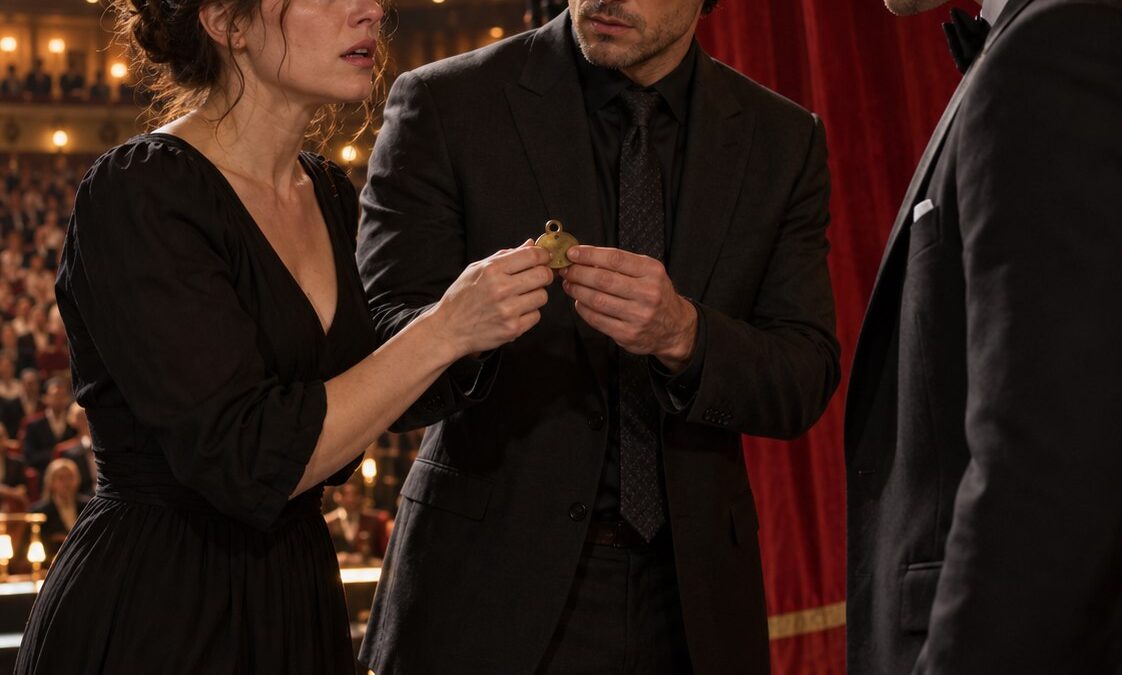
Dorian handed Tessa the brass tag.
She curled her fingers around it.
“You recognized the number,” he said.
“I should have recognized it sooner.”
“Tell me what it means.”
“A failed assembly was removed in February.”
“February of this year?”
“Yes.”
“This is October.”
“I know.”
The theater engineer arrived carrying a tool case.
Tessa knew him.
Gus Bell had worked at the Rook before Nolan was born.
He stopped when he saw the rail.
“Who ran the curtain at full speed?”
“Nobody was supposed to,” Tessa said.
Gus studied Nolan.
Nolan lifted both hands.
“It was in the approved program.”
“The program isn’t an inspection,” Gus said.
Tessa showed him the tag.
He read the number once.
Then again.
His eyebrows drew together.
“I watched them take this off.”
“So did I,” Tessa said.
“Who put it back?”
“That’s what we’re finding out.”
Gus examined the housing without touching it.
He photographed the padlock.
Then the brake.
Then the rail.
He asked the lighting operator for the cue sheet.
The sheet listed a slow demonstration.
Someone had crossed out slow and written full.
The change bore Nolan’s initials.
“Those aren’t mine,” Nolan said.
Tessa looked at the letters.
They were his.
She had seen him initial grocery lists when he wanted her to know he had read them.
“I didn’t write the change,” she said.
Nolan turned toward her.
“I wasn’t talking to you.”
Gus closed the cue sheet.
“Everyone can settle that later.”
Dorian called the city fire department’s nonemergency line.
He gave the dispatcher the theater address.
He described a failed safety curtain and an evacuated audience.
Then he asked for the on-call fire inspector.
Nolan stared at him.
“You’re closing your own theater.”
“For tonight.”
“We’ll lose the premiere.”
“Yes.”
“Millions of dollars are attached to this.”
Dorian put away his phone.
“So are twelve hundred seats.”
Tessa’s hands began to shake.
She hid them behind the fold of her dress.
Dorian saw anyway.
He took off his jacket and offered it.
“I’m not cold,” she said.
“I know.”
She looked down at the grease across her chest.
His jacket was probably worth more than her monthly rent.
She took it.
Nolan watched that exchange with open disbelief.
Tessa almost laughed.
Her husband had stood beside Celeste beneath a spotlight.
He still seemed shocked that Tessa could accept a coat.
Gus called her to the control housing.
He pointed at the brake bracket.
“See the machining?”
Tessa leaned closer.
A shallow groove ran along its edge.
“The February unit had that mark.”
“It did.”
“The supplier scratched it during removal.”
“Yes.”
Gus stepped back.
“We need the city to document this before we open it.”
Tessa agreed.
The proof was there.
So was the danger.
Nolan came closer.
“Tess.”
She had not heard that name from him in months.
“Don’t.”
“I was trying to keep the opening together.”
“You knew the unit had failed.”
“I knew it had been tested.”
“You said the tag was supposed to be destroyed.”
He glanced at Dorian.
Then at Gus.
“I meant the old paperwork.”
“That isn’t what you said.”
Celeste returned from the wings.
The empty auditorium magnified her heels.
“Reporters are outside,” she told Nolan.
“Tell them it was a technical pause.”
Dorian shook his head.
“Tell them the building is closed pending inspection.”
Celeste’s mouth tightened.
“That sounds terrible.”
“It’s accurate.”
She looked at Tessa’s jacket.
“Are we really taking her word over the paperwork?”
Tessa removed the signed work log from her bag.
She had brought it to the opening because Nolan had promised final payment.
She opened to the February entry.
The failed assembly number sat beneath her handwriting.
Next to it were three words.
REMOVE. DO NOT REINSTALL.
Gus read them.
Dorian read them.
Nolan did not need to.
Tessa had made two copies that day.
One for the theater office.
One for the folder she kept at home.
The page in her hands was the third.
“Where is the completion packet?” Dorian asked Nolan.
“At my office.”
“Have your assistant send a copy.”
“It’s late.”
“Then wake him.”
Nolan’s phone rang before he could answer.
He looked at the screen and declined the call.
Tessa caught only the first name.
Simon.
Dorian saw it too.
The color drained from his face this time.
He stepped away to call his own office.
Tessa turned back to the tag.
“Why did you expect it destroyed?” she asked Nolan.
He rubbed his forehead.
“Because Simon told me the replacement had been scrapped.”
Dorian ended his call.
“Simon told you that?”
Nolan’s eyes moved between them.
“He approved the purchase.”
Dorian held very still.
Simon Mercer was his younger brother.
And Simon had overseen the Rook restoration from the first contract onward.
* * *
The fire inspector arrived with a colleague.
They examined the curtain before anyone loosened a bolt.
They photographed the damaged rail.
They copied the cue sheet.
Gus walked them through the original repair plan.
Tessa showed them her February work log.
The inspectors did not announce a crime.
They ordered the curtain kept out of service.
They also kept the theater closed until a qualified repair team could test the system.
Nobody argued with that.
Not even Nolan.
By midnight, the audience was gone.
The reporters had published photographs of Tessa in Dorian’s jacket.
One headline called her a backstage worker.
Another called her a mysterious woman.
Her name appeared in neither.
She sat on a folding chair while Gus finished his statement.
Her phone showed seven messages from her mother.
The last one read: Are you safe?
Tessa called.
“I’m safe,” she said.
“Your face is on the news.”
“Is it a good picture?”
“You look ready to hit somebody with a wrench.”
“That sounds like me.”
Her mother paused.
“Was Nolan beside that woman?”
“Yes.”
“Oh, honey.”
Tessa stared at the empty rows.
“I don’t want to discuss him tonight.”
“Then come here when you’re done.”
“I will.”
Dorian waited until she hung up.
“You can leave your statement for tomorrow.”
“I want to finish it.”
“Gus can confirm the mechanics.”
“He wasn’t there when I signed the work log.”
Dorian accepted that.
He sat two chairs away.
It was enough distance to let her breathe.
Tessa had spent the previous year calling him Mr. Mercer.
The newspapers called him colder things.
None of them had mentioned how quietly he waited.
“I owe you an apology,” he said.
“For tonight?”
“For February.”
She turned.
“I approved Simon’s decision to put Nolan over contractor payments.”
“You couldn’t know Nolan would hold mine.”
“I should have checked.”
“He’s my husband.”
“That makes it worse.”
Tessa looked down at his jacket.
“You don’t owe me responsibility for my marriage.”
“I owe you responsibility for the building.”
“That part, yes.”
His mouth moved, almost a smile.
Gus came over with a copied statement.
Tessa read each line before signing it.
The inspector gave her a receipt for the materials she had provided.
That small piece of paper steadied her.
Her work log had entered a record Nolan could not edit.
The next morning, Tessa visited her workshop.
Her assistant, Mina, had already seen the news.
She handed Tessa coffee without asking what happened.
There were three unfinished chairs on the workbench.
None belonged to the theater.
Tessa ran a thumb along one stripped wooden arm.
“I can cover payroll Friday,” she said.
“I know.”
“You shouldn’t have to trust that.”
“I trust the invoices.”
Mina took a folder from the cabinet.
“Also, I saved the delivery photographs.”
Tessa looked up.
“Why?”
“Because Nolan kept saying parts arrived when nobody signed for them.”
Mina spread six printed photographs across the table.
Each showed crates outside the workshop.
Tessa recognized the supplier’s green labels.
On February 14, two replacement brake assemblies had arrived.
On February 16, Nolan’s office had collected one.
The other was still at the workshop.
It was the approved unit.
Unopened.
Tessa remembered the afternoon.
Nolan had said the part was needed at the theater immediately.
She had been out buying a smaller spring.
Mina had handed the crate to a driver with a company badge.
“Do you have his name?” Tessa asked.
Mina flipped over the delivery form.
The driver had signed as P. Haskell.
A van registration appeared beneath.
Tessa photographed the form.
She called Gus.
He told her not to move the remaining crate.
The inspectors would want to see it.
By noon, Dorian’s lawyer had arranged for an independent engineering firm to examine the theater.
A city inspector observed the work.
Tessa stayed nearby.
She did not touch the mechanism.
The engineers compared the installed brake with her photographs.
It matched the failed February unit.
The part Nolan claimed had been scrapped was back above the stage.
The approved replacement had never been installed.
That explained the danger.
It did not explain the money.
Dorian’s lawyer, Priya Shah, asked Tessa for every invoice from the Rook.
Tessa gave her the copies she kept.
Priya compared them with the theater’s payment ledger.
The amounts did not match.
Tessa had billed $18,400 for her final phase.
The ledger showed $43,900 paid to her workshop.
She blinked at the screen.
“That money never reached us.”
Priya pointed to the routing number.
It was not Tessa’s business account.
It belonged to an account opened under a similar name.
Quinn Restoration Group.
Tessa’s business was Quinn Restoration Studio.
Nolan had suggested the original name years ago.
She had added Studio because she worked alone then.
“Who opened the other account?” she asked.
“We have to get the bank records,” Priya said.
Dorian stood at the window.
He had been quiet during the comparison.
“How many contractors?” he asked.
“Four so far,” Priya said.
“Same pattern?”
“Each has a near-match account.”
Tessa looked at the payment ledger.
The false invoices had been approved through the theater office.
Nolan had entered them.
Simon had countersigned them.
She called her mother again.
“Did Nolan ever ask you to sign anything for my shop?”
Her mother thought for a moment.
“He brought a form in July.”
“What kind?”
“He said you needed a witness for a bank update.”
Tessa gripped the phone.
“Did you sign it?”
“No.”
“Why not?”
“Your name was spelled wrong.”
Tessa closed her eyes.
Her mother had written that spelling on birthday cakes for thirty years.
A bank would not know the difference.
Her mother had.
“What did Nolan do?”
“He took it back.”
“Did you keep anything?”
“An envelope.”
There was a silence.
“I wrote the date on it because I thought you’d ask.”
Tessa thanked her.
When she ended the call, Priya was watching.
“Can she bring it in?”
“Yes.”
Dorian’s phone rang.
He looked at the screen.
Simon.
He let it ring out.
Priya’s next search produced a list of vendors.
One stood out.
Wren Foundry.
Tessa knew that name.
Her father had run Wren Foundry until a stroke ended his work.
The shop closed five years earlier.
Her father had died the following spring.
Wren Foundry had billed the Rook for new steel this August.
More than ninety thousand dollars.
Tessa touched the line on the screen.
“My father’s shop has been closed for five years.”
Priya leaned closer.
“Are you certain nobody bought the name?”
“I packed the sign myself.”
The false invoices carried her family’s old address.
Nolan had spent Christmas dinners at that address.
He knew exactly whose name he was using.
* * *
By evening, the Rook’s front doors had been chained.
The closure notice hung inside the glass.
Tessa returned to collect her tools.
Gus met her at the stage entrance.
“Someone tried to get into the control room,” he said.
“When?”
“An hour ago.”
“Did they?”
“No.”
“The lock?”
“Scratched.”
He had already photographed it.
Security had preserved the camera footage.
A person in a dark coat had entered through the side corridor.
The camera caught a face when they turned.
Celeste.
Tessa watched the clip twice.
Celeste had been carrying a narrow document tube.
“She works in publicity,” Gus said.
“What would she need there?”
“She wouldn’t.”
They sent the footage to Priya.
They did not chase Celeste.
Tessa collected her tool case and the spare brake assembly still sealed at her workshop.
The inspectors had documented it that afternoon.
Mina watched them open the crate.
The serial number matched the approved purchase order.
The part was real.
Someone had paid for it.
Someone had paid again for a counterfeit installation.
The theft sat between those two facts.
Outside, Nolan leaned against his car.
Tessa stopped under the stage light by the door.
Gus stayed inside, within sight.
“You could have called,” she said.
“You blocked me.”
“You can email.”
“I didn’t want this in writing.”
“That makes one of us.”
Nolan glanced at Gus.
“Can we talk alone?”
“No.”
He looked exhausted.
It was the first sincere thing she had seen on his face in weeks.
“I can explain the accounts.”
“Explain them to the investigators.”
“It wasn’t supposed to reach you.”
“It used my business name.”
“Simon set that up.”
“You approved the invoices.”
“I did what I was told.”
“You also wore a wedding ring.”
Nolan looked down at his hand.
He had taken it off.
Tessa had not noticed until then.
“Celeste has nothing to do with the money,” he said.
“Good for her.”
“Don’t be cruel.”
Tessa stared at him.
He seemed genuinely offended.
She thought of the program without her name.
The spotlight around Celeste.
The padlock on the release guard.
“Did you know the curtain would fall that hard?”
“No.”
“Did you know the failed assembly went back?”
“I knew Simon had changed the order.”
“That isn’t an answer.”
Nolan rubbed his jaw.
“He said the old assembly could be repaired.”
“And you believed him?”
“I believed his engineer.”
“Who was that?”
“I don’t know.”
Tessa let the answer sit.
Nolan took a step closer.
“I never wanted anybody hurt.”
“You accepted the risk.”
He looked away.
She had known him when he waited tables at night.
She had helped him study accounting between shifts.
He used to celebrate a paid utility bill by bringing home oranges.
She could still picture him at twenty-seven, peeling one over the sink.
That man had wanted a bigger life.
She did not know when he decided other people could pay for it.
“Simon promised the theater would close,” Nolan said.
“Because of the curtain?”
“Eventually.”
“Why?”
“He has a buyer for the block.”
Tessa felt the cold in the stone beneath her shoes.
Dorian had bought the Rook to preserve it.
Simon had managed its restoration.
A safety failure could make the building expensive to keep.
It could also make a sale sound sensible.
“Nolan, who is the buyer?”
“I don’t know the company name.”
“Find out.”
“I’m trying to help you.”
“Then tell the truth to Priya.”
He reached toward her.
She moved back.
Gus opened the door wider.
Nolan dropped his hand.
“Dorian will bury me,” he said.
“He hasn’t.”
“His brother will.”
Tessa looked at the scratched lock behind Gus.
“Tell the police that too.”
She walked inside.
Dorian was waiting by the orchestra pit.
He had come to review the engineer’s report.
Tessa told him what Nolan had said.
Dorian listened without interrupting.
Then he went very still.
“I asked Simon to oversee the restoration,” he said.
“You trusted him.”
“Yes.”
“I trusted Nolan.”
That was all either of them needed to say.
Priya arrived twenty minutes later.
She brought a copy of a corporate filing.
A holding company had offered to buy three properties beside the Rook.
Its directors were hidden behind another company.
Its registered agent was a lawyer who had handled Simon’s personal purchases.
That was a lead, not proof.
Priya was careful about the difference.
The security footage gave them something firmer.
Celeste had tried to enter a restricted control room after the closure.
The cameras showed her leaving when the lock resisted.
They gave the footage to the investigators.
Then Priya suggested a board meeting.
Dorian had the authority to call one.
The board had the authority to suspend Simon’s spending access.
The meeting would be recorded.
Simon would have to answer questions while the records were preserved.
Tessa sat on the stage edge after Priya left.
The house was empty again.
Dorian sat beside her, leaving space between them.
“My father loved this place,” he said.
“Was he an opera man?”
“No.”
“Then why?”
“He proposed to my mother in the cheap seats.”
Tessa glanced at the upper balcony.
“Which ones?”
“He never told me.”
“Convenient.”
“He liked making people search.”
Her mouth lifted.
Dorian noticed.
“You have grease on your cheek,” he said.
“I’ve had it there since yesterday.”
“I was deciding whether to mention it.”
“Terrible judgment.”
He offered her a clean handkerchief.
She took it.
For a moment, the theater was just a theater.
Not a fraud.
Not a marriage ending in public.
A beautiful room with bad wiring and too many memories.
Then her phone buzzed.
Mina had sent a picture of the envelope from Tessa’s mother.
Nolan’s handwriting covered the front.
Inside was a copy of a bank authorization.
It named Tessa as owner of Quinn Restoration Group.
The signature at the bottom was false.
Tessa could see why her mother had hesitated.
Nolan had spelled her middle name wrong.
Dorian read it over her shoulder.
“We can have the bank verify its records.”
“We should.”
Another message arrived from Mina.
She had found the delivery driver, P. Haskell.
He was a subcontractor.
He had kept a receipt for his records.
The crate had gone to a storage unit rented by Simon Mercer’s office.
Tessa showed Dorian.
His expression closed.
Priya called a few minutes later with the remaining corporate records.
The proposed buyer of the Rook block belonged to Simon.
The false vendors had supplied his spending money.
The failed curtain was meant to turn Dorian’s beloved theater into a liability.
Simon Mercer had built the crisis he planned to solve.
* * *
The board met the next morning in a private dining room across from the Rook.
Five directors attended in person.
Two joined by video.
A secretary recorded the meeting.
Priya sat beside Dorian.
Tessa sat opposite Simon.
She had been invited to explain the mechanical findings.
Nolan was present as restoration finance manager.
Celeste had arrived with him.
She wore a navy suit and looked at everyone except Tessa.
Simon came last.
He had Dorian’s dark eyes and none of his patience.
He kissed an elderly director on the cheek.
Then he saw the brass tag on the table.
His stride slowed.
“Are we conducting inspections at breakfast?” he asked.
“We’re reviewing the closure,” Dorian said.
“A temporary setback.”
“The fire department disagrees.”
Simon took his seat.
“Fire departments are paid to be cautious.”
“So are boards,” Priya said.
She began with the engineers’ findings.
The installed brake matched the failed February assembly.
The approved replacement remained in its shipping crate.
The cue sheet had been altered.
The emergency release had been padlocked.
Simon interrupted only once.
“Can anyone prove who put the old brake back?”
“Not yet,” Priya said.
“Then I’d appreciate less theater.”
A director near the window frowned.
“We are discussing an actual theater.”
Simon offered her a smile.
Tessa had seen Nolan use that smile.
It was a request to stop asking.
Priya moved to the invoices.
Four vendors had been paid through accounts with names resembling real contractors.
Wren Foundry was among them.
Simon leaned back.
“Administrative fraud,” he said.
“On my project, perhaps.”
“You countersigned the payments,” Priya replied.
“I countersigned hundreds.”
“That is why we are asking.”
Nolan stared at the table.
Tessa waited for him to speak.
He did not.
Simon turned to Dorian.
“You know why I wanted to sell.”
“I know you said the restoration was becoming expensive.”
“Because it was.”
“You approved the costs.”
“I was trying to save you from sentiment.”
His voice had warmth now.
He addressed the directors.
“The Rook is lovely.”
“It also loses money.”
“The block is worth more to the city as housing and offices.”
Dorian’s fingers rested beside the tag.
“That case could have been made openly.”
“You would never have heard it.”
“I heard it every quarter.”
“You never listened.”
For a moment, Tessa understood why Simon thought he could win.
The building did cost money.
Dorian did love it for reasons a balance sheet could not hold.
A director might believe Simon had made bad choices while pursuing a reasonable sale.
Priya needed more than an ugly motive.
Simon knew it.
He pointed at Tessa.
“The technician signed the completion packet.”
“No, I didn’t,” Tessa said.
“I’ve seen your signature.”
“Then show it.”
Nolan lifted his head.
“Simon.”
Simon ignored him.
Priya placed the packet before Tessa.
The signature resembled hers.
The date was March 3.
Tessa examined it.
Then she turned to the attached inspection page.
“This page wasn’t in my work log.”
“Documents are assembled,” Simon said.
“The inspection says I tested the installed brake on March 3.”
“Yes.”
“I was at the hospital with my mother.”
Simon folded his arms.
“People can work and visit family on the same day.”
Tessa looked at him.
“That’s true.”
She pushed the packet toward the secretary.
“The test photograph is dated March 3.”
“Also true,” Simon said.
“The assembly shown has a brass tag.”
She held up the one from the stage.
“The retired unit had this tag when I removed it.”
“Perhaps you put it back.”
“Perhaps.”
The word tasted sour.
Tessa had heard it too many times.
“But the picture shows the tag on the left side.”
“So?”
“I moved it to the right in February.”
She turned over the metal.
A small scratch crossed one corner.
“That scratch came from my screwdriver.”
The directors leaned closer.
Simon shrugged.
“You could have moved it again.”
“I could have.”
Tessa pointed to the picture.
“The brake housing behind it has the supplier’s inspection seal.”
“The seal was placed on the approved replacement in April.”
The room went quiet.
“The photograph can’t be from March,” Tessa said.
“It shows a part we didn’t receive until April.”
Priya slid a supplier certificate across the table.
The seal number appeared beside its issue date.
April 11.
The bank had also produced account-opening records that morning under subpoena in an investigation already begun.
The Quinn Restoration Group account had been opened with a copy of Tessa’s identification.
The form carried her misspelled middle name.
Its listed contact email belonged to Nolan.
The payments from Wren Foundry went through another false account.
That account’s records named a company controlled by Simon.
Priya laid out the documents one at a time.
No dramatic music.
No speech.
Paper.
Dates.
Names.
Simon studied the supplier certificate.
Then he looked at Nolan.
“You gave them the accounts?”
“The bank did,” Priya said.
Nolan rubbed both hands over his face.
Celeste spoke for the first time.
“I was told to collect a file last night.”
“By whom?” Priya asked.
“Simon.”
“What file?”
“The original cue sheets.”
Simon turned toward her.
“Be careful.”
She met his stare.
“I am.”
She took a document tube from beside her chair.
Inside were photocopies of the original cue sheets.
The full-speed instruction appeared only on the version distributed the night before the opening.
Celeste had been told to swap them.
She had tried to enter the control room after the theater closed.
The lock had stopped her.
“Why bring them here?” Simon asked.
“Because the cameras saw me.”
It was not noble.
It was enough.
Priya took the tube.
She asked the secretary to note who had supplied it.
Simon’s lawyer requested a recess.
The board granted one.
During it, two directors spoke quietly in the hall.
Dorian stayed seated.
He looked older than he had onstage.
Tessa touched the brass tag.
“It wasn’t your fault to trust him,” she said.
“I gave him the keys.”
“He chose what to do with them.”
When the board returned, it suspended Simon’s authority over the theater and ordered an outside review of every restoration payment.
It also preserved the records for investigators.
No one pretended a board vote was a criminal conviction.
The city investigators and prosecutors would decide what charges the evidence supported.
Nolan stood as soon as the meeting ended.
He came around the table.
“Tessa.”
She stayed seated.
“I’ll cooperate,” he said.
“Do that.”
“I can fix the money.”
“You can repay it.”
“That’s what I mean.”
“It isn’t everything you broke.”
His face tightened.
He glanced at Dorian.
“This is what he wants.”
Tessa rose.
“No.”
She picked up her own work log.
“This is what I asked for.”
Nolan had called her dramatic in front of twelve hundred people.
Now the room was small.
Her voice did not need to be loud.
“You told me to stay behind the curtain,” she said.
“I came out when it fell.”
Six months passed before the criminal cases were resolved.
Simon pleaded guilty to fraud and records offenses tied to the false vendors.
The judge ordered restitution and imposed a sentence that included prison time.
Nolan pleaded guilty to his part in the false accounts and forged documents.
His sentence included supervised release, community service, and repayment.
Investigators found no evidence that Celeste had handled the stolen money.
She gave a statement about the cue sheets.
The theater remained closed until an independent crew installed the correct brake and passed a witnessed test.
Tessa attended that test.
She watched the red curtain descend slowly.
It stopped exactly where it should.
Only then did she let herself cry.
* * *
By spring, the workshop smelled of varnish again.
Mina was arguing with an old chair.
The chair had won the first round.
Tessa brought her a sandwich.
“You look married to that thing,” she said.
“At least it has honest joints.”
They ate beside the open door.
Traffic hissed along the wet street.
The restitution payments came slowly.
Tessa expected that.
The theater’s board had paid the legitimate invoices in full after the audit.
She used the first check to settle Mina’s wages.
The second replaced the workshop heater.
Her mother called the heater the most romantic object in the building.
Tessa did not disagree.
Dorian visited on Thursdays.
At first, he came with theater questions.
A cracked balcony rail.
A dressing room latch.
The stubborn stair that still complained in damp weather.
Then the questions became less urgent.
One Thursday, he brought an orange in his coat pocket.
“Is this a meeting?” Tessa asked.
“It could be.”
“About fruit?”
“About dinner.”
She considered him over the workbench.
“You own restaurants.”
“I know.”
“Are you asking me to sit in one?”
“Yes.”
“As a contractor?”
“No.”
“Good.”
He waited.
She had grown fond of that.
“I’d like dinner,” she said.
His smile arrived slowly.
The first dinner lasted two hours.
They talked about terrible opening nights.
They talked about families who loved buildings too much.
They did not talk about Nolan until Tessa brought him up.
“He wrote me a letter,” she said.
“Do you want to tell me what it says?”
“He apologized.”
“Did you believe him?”
“I believe he understands what he did.”
“That isn’t the same.”
“No.”
She had filed for divorce in November.
Nolan had not contested it.
She had sent him one reply.
She accepted the apology.
She would not resume contact beyond the legal and financial matters still open.
It was a boundary she could live inside.
Dorian asked nothing more.
The theater reopened in June with a modest concert.
No red carpet.
No speech from Dorian.
The board gave the first tickets to the contractors and their families.
Tessa’s mother sat beside Mina in the balcony.
Gus wore a tie that looked as though it hurt him.
Dorian found Tessa in the aisle before the lights went down.
“The board has an offer,” he said.
“That sounds suspiciously like work.”
“It is.”
They wanted her to lead a new apprenticeship for stage mechanics.
The theater would fund training for people who could not afford traditional programs.
Tessa read the proposal the next day.
The salary was generous.
The title was impressive.
The program, however, placed every decision in the board’s hands.
She marked it up in red.
Dorian read her changes.
“You removed your salary.”
“I put in a smaller one.”
“You doubled the trainee budget.”
“There are more trainees than me.”
“You added independent safety reviews.”
“Yes.”
“You crossed out the portrait.”
“The what?”
“The board wanted your picture in the lobby.”
Tessa stared at him.
“You let them put that in writing?”
“I wanted to see your face.”
She threw a clean rag at him.
He caught it.
The board accepted her revisions.
The first class began that autumn.
Eight apprentices learned to read old plans.
They learned to ask where a replacement part had come from.
They learned that a signature meant somebody had actually checked.
Gus taught them how to hear a bad bearing.
Mina taught them to keep copies.
Tessa taught them to stop a demonstration when something felt wrong.
None of it made her famous.
That suited her.
People still recognized her occasionally.
A woman at the grocery store once asked if she was the woman from the curtain video.
Tessa said yes.
The woman thanked her for making the audience leave safely.
Then she asked where the canned peaches were.
Tessa showed her.
Life had room for both things.
One evening, Dorian came to the workshop after the apprentices left.
He carried a small wooden box.
Tessa raised an eyebrow.
“Please tell me that isn’t another theater part.”
“It isn’t.”
He set it on the bench.
Inside lay the brass tag.
The city had released it after the case closed.
Gus had cleaned the grease from its edges.
The scratch from Tessa’s screwdriver remained.
“I thought you should have it,” Dorian said.
“I’m not putting it back on anything.”
“I hoped you wouldn’t.”
She lifted it.
It was heavier than it looked.
For months, that little piece of metal had meant fraud.
Before that, it had meant a failed test.
Now it meant she had noticed.
She had spoken.
People had listened.
“I want to ask you something,” Dorian said.
She looked at the box.
“That sounds dangerous.”
“Would you come away with me for a weekend?”
“Where?”
“Somewhere with no inspection reports.”
“That narrows it down.”
“It’s your choice.”
She studied him.
He had offered help without buying her decisions.
He had stood beside her without standing in front of her.
That was rarer than his money.
“Yes,” she said.
“Provided there are no surprise demonstrations.”
“I’ll put it in writing.”
“Have Priya check the wording.”
“I expected you to say that.”
He held out his hand.
She took it because she wanted to.
* * *
Five years later, the red curtain fell again.
Slowly.
Silently.
Exactly on its marks.
Tessa watched from the center aisle.
Beside her stood a girl named Jules, the youngest apprentice in that year’s class.
Jules held a clipboard against her chest.
“Why do you always watch the whole test?” she asked.
“Because the last inch matters.”
Jules wrote that down.
“You don’t have to record everything I say.”
“Gus says you’ll deny saying it later.”
“He knows me too well.”
The Rook had changed.
Its ceiling had been repaired.
The seats had been restored in sections.
The cheap balcony seats still filled first.
Tonight’s audience would hear an orchestra from three neighborhoods away.
The apprenticeship program had helped keep the building running.
It had also sent graduates to theaters across the city.
Mina ran the workshop now.
Tessa still came in when a chair defeated her.
Her mother had a reliable heater.
Gus had retired three times.
Dorian was waiting near the stage.
He wore an old coat over his suit.
Their daughter, eight months old, slept against his shoulder.
Jules glanced at the baby.
“Does she sleep through every test?”
“Only the important ones,” Dorian said.
The curtain rose.
Jules went to check the control log.
Tessa walked to the stage.
Dorian held out their daughter.
“Your turn,” he said.
“You said you had her.”
“I did.”
“For how long?”
“Sixteen magnificent minutes.”
Tessa took the sleeping child.
Dorian kissed her forehead.
The brass tag hung beside the control board now.
Not as a decoration.
It was mounted beside a simple instruction:
CHECK THE NUMBER.
Tessa had argued against putting her name beneath it.
The apprentices knew whose screwdriver had made the scratch anyway.
Dorian looked toward the red velvet.
“Still safe?”
“She passed.”
“And the curtain?”
“That too.”
He laughed softly.
Beyond the doors, the evening audience began to arrive.
Shoes crossed the lobby stone.
Programs opened.
Someone called for an usher.
Once, Tessa had stood behind that curtain while Nolan told her to stay there.
Tonight, she walked beneath it with her daughter in her arms.
Dorian held the door for them.
Jules called from the control board.
“Everything ready?”
Tessa looked back at the brass tag.
At the curtain.
At the people who knew how to keep it safe.
“Yes,” she said.
“Let them in.”
THE END








