He Made His Wife Wear a Staff Badge at His Waterfront Gala—Then the City’s Most Feared Investor Asked Her to Stand Beside Him
Chapter 2: The Name on the Page
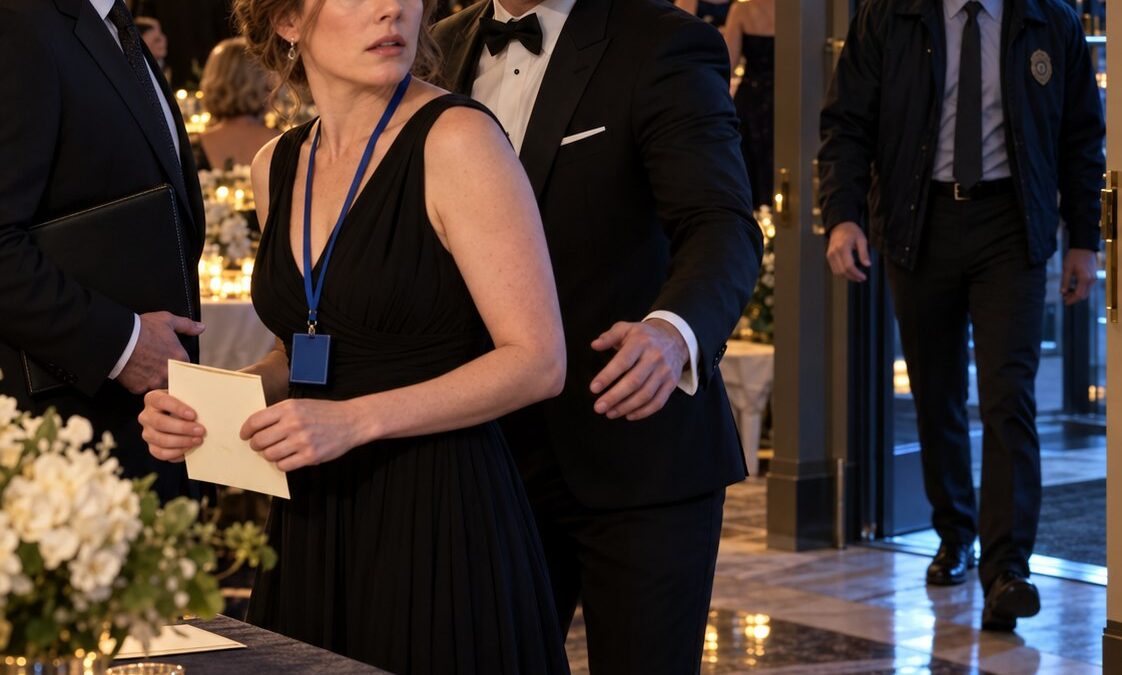
The investigator stopped beside the registration table.
Nora stayed where she was.
Pierce moved first.
“I can explain everything,” he said.
“I’d prefer that you don’t,” the investigator replied.
He showed Nora his identification.
His name was Owen Bell.
He worked in the county’s financial crimes unit.
“We need to speak with you about Harbor Homes,” he said.
Nora looked at Pierce.
He had mentioned the account minutes ago.
“Here?” she asked.
“There’s a conference room off this hall.”
“Am I under arrest?”
“No.”
“Then I’d like a lawyer present.”
Bell nodded.
“That’s sensible.”
Pierce gave a strained laugh.
“Nora, this is unnecessary.”
“It’s necessary to me.”
Rourke offered her his phone.
She used her own.
Her friend Della was an attorney who handled property disputes.
Nora had sent her records office customers to Della for years.
Della answered on the second ring.
“I need you at the Harrow,” Nora said.
Della asked one question.
“Are you safe?”
“Yes.”
“Stay in a public place.”
The call ended.
Bell stood back from the folder.
Rourke kept it on the registration table, under the gala chair’s eye.
He did not open it again.
“You can ask that it be preserved,” he told Nora.
“I am asking.”
The chair nodded too quickly.
Pierce rubbed his thumb along the edge of his cuff.
“Gideon, surely you see what’s happening.”
“I see your wife requested counsel.”
“It’s a family matter.”
Bell said, “It isn’t.”
The two words brought nearby conversations to a halt.
Nora wished they had stayed loud.
She could manage Pierce in a quiet kitchen.
This was different.
The people who had just seen her beneath the velvet rope were looking at her again.
Rourke moved an empty chair beside the table.
Nora sat because her knees had begun to ache.
He set a glass of water within reach.
He did not touch her.
She appreciated that more than the water.
“Why were you expecting me?” she asked Bell.
“A report listed you as the records custodian for Harbor Homes.”
“I work for the county.”
“Your name appeared on its donation ledger.”
“I helped Pierce sort old receipts once.”
“When?”
“Last December.”
Bell wrote it down.
“Did you have access after that?”
“No.”
“Do you have records of the work?”
“A calendar entry.”
“Anything else?”
She looked at the badge.
“Apparently I have this.”
Rourke followed her gaze.
Bell did too.
“May I photograph it?” Bell asked.
“After my lawyer gets here.”
“Of course.”
Pierce made a sound under his breath.
Nora finally met his eyes.
“Why did you bring me here?”
“To support me.”
“Try again.”
“I didn’t know investigators were coming.”
“But you knew about the transfer.”
“I thought you signed it.”
“When?”
Pierce hesitated.
Celeste answered for him.
“Last Tuesday.”
Nora turned to her.
“I was at work last Tuesday.”
“The signature was electronic,” Celeste said.
“On what system?”
Celeste glanced at Pierce.
Neither spoke.
Della arrived twenty minutes later, carrying a coat over her arm and the expression she wore when a client tried to tell only half the truth.
The gala had continued around them.
Glasses clinked.
A singer began a slow song.
Nora could see the reflected chandeliers in the glass.
She told Della everything in the hallway while Bell waited at a distance.
The badge.
The photograph.
Pierce’s warning about receipts.
The page with her signature.
Della listened without interrupting.
Then she looked at Nora’s invitation.
“May I?”
Nora handed it over.
Della read the note inside.
“That chair invited you personally.”
“So it seems.”
“That matters.”
“How much?”
“We’ll find out.”
She spoke with Bell first.
There was an open inquiry into missing donations from Harbor Homes, the nonprofit Pierce directed.
The investigator had come to ask Nora about payment records bearing her name.
He had not come with an arrest warrant.
Bell wanted an interview and access to any documents she kept.
Della arranged an appointment at her office for the next morning.
Nora would bring her calendar and the receipts from her day helping Pierce.
She would answer with counsel present.
Then Della asked the gala chair to show them the transfer page.
The chair’s name was Imogen Ward.
She laid the folder on a clear part of the table.
“We received it from Pierce’s office yesterday,” she said.
Nora read.
The page proposed transferring her mother’s four-story building to Harbor Homes as a charitable gift.
It listed all twelve apartments.
The signature block carried Nora’s name.
The initials beside each paragraph resembled hers.
At the bottom was a date.
Tuesday, October 14.
“That’s impossible,” Nora said.
Pierce seized on the word.
“Why?”
“You know why.”
“Tell everyone.”
She could see what he wanted.
A confused wife.
A private argument.
A signature she might have forgotten placing on a screen.
Nora made herself look at the page again.
Her mother had left the building to her five years earlier.
Nora had promised to keep the apartments affordable.
It was a promise that cost money every month.
The roof needed work.
Two tenants had been late with rent since the flood.
She worked full time at the county and managed repairs on weekends.
Pierce had called the building a burden.
Last spring, he had offered to take it off her hands.
She had refused.
The initials on the page sat slightly too high.
That alone meant nothing.
Then she saw the date beside her name.
“Tuesday the fourteenth,” she said.
Della followed her finger.
“That’s what it says.”
“My mother died on a fourteenth.”
Pierce’s face showed irritation.
Nora kept going.
“Every October fourteenth, I take the day off.”
“You said you were at work,” Celeste said.
“I was at work last Tuesday.”
“The fourteenth was Wednesday.”
Bell checked his phone.
Nora looked at the printed page.
The date had been typed.
Not selected from a signing platform.
Whoever had prepared it had chosen a Tuesday that did not exist.
Pierce leaned over her shoulder.
“That could be a clerical error.”
“It could,” Della said.
Nora stepped away from him.
“There’s something else.”
She pointed to the typed address.
Her mother’s building had two street entrances.
The front door was on Mercer Street.
The service door faced the alley.
For years, county files had carried the alley number as the legal address.
Nora had found the error during the flood review and corrected it in the property index in August.
The transfer page used the corrected number.
Pierce had always used the old one.
“He asked me for the address,” Nora said.
“When?” Della asked.
“Three weeks ago.”
Pierce stared at her.
“You gave it to me.”
“I wrote it on a sticky note.”
“Exactly.”
“For a contractor’s estimate.”
Bell wrote again.
Nora could not yet prove what had happened.
She could prove what she had told Pierce and why.
Della closed the folder.
“Imogen, please don’t announce this.”
“I won’t.”
“We’ll need the file as you received it.”
“I’ll preserve it.”
Rourke, who had remained nearby, spoke for the first time in several minutes.
“I asked Imogen to invite Nora.”
Pierce looked at him sharply.
“Why?”
Rourke answered Nora.
“Your building is beside the land in the housing proposal.”
“I know where it is.”
“I wanted the owner in the room.”
“You could have called.”
“I did.”
She searched her memory.
There had been a call from an unfamiliar number last week.
She had been knee-deep in damaged permit boxes.
Her voice mail was full.
“I didn’t get a message.”
“I left one with your husband.”
Pierce looked toward the river.
Rourke’s expression did not change.
“Pierce told me you wanted to donate the property,” he said.
Nora gripped the back of her chair.
The room seemed to tilt around the simple sentence.
Rourke had placed her at his table because he meant to thank her.
Pierce had placed her at registration so she would miss the announcement.
* * *
Della’s office smelled faintly of coffee and printer paper.
Nora preferred it to orchids.
At nine the next morning, she sat beside Della while Bell laid copies across a conference table.
No one asked her to guess what had happened.
They began with records.
The transfer document had been prepared by an outside legal service hired by Harbor Homes.
Its files showed a request from Pierce’s office.
The electronic signature request had gone to an email address resembling Nora’s personal one.
One letter differed.
The account had been created in September.
Its recovery number belonged to a prepaid phone.
Bell said a warrant would be needed for more.
Della did not ask him to skip that step.
Nora read the address three times.
At a glance, she might have believed it was hers.
Pierce had spent years seeing that address on grocery deliveries and repair quotes.
“He could make this,” she said.
“He could,” Bell replied.
“We’ll follow the evidence.”
The Harbor Homes ledger raised a separate problem.
It showed Nora as a records custodian for the first nine months of the year.
Transactions had been approved with her initials.
Money from several donor funds had moved into a vendor account and then out again.
Bell could not yet say where it went.
“How much?” Nora asked.
“About eight hundred thousand dollars.”
She looked at Della.
The figure was larger than every repair she had deferred on her mother’s building.
“Did any come to me?”
“Not that we’ve found.”
“Why put my name there?”
“That’s what we’re investigating.”
She opened the calendar on her phone.
December 12, last year.
Sort receipts at Pierce’s office.
Six to eight p.m.
There was a photograph too.
Pierce had taken it while she sat on the floor between cardboard boxes.
She was holding a paper cup and laughing at a receipt for twelve thousand cocktail napkins.
She had forgotten the picture.
Bell asked for a copy.
Nora sent it to Della first.
Della forwarded it with a note recording how Nora had found it.
They worked through the rest of Nora’s records.
She had never used the nonprofit’s accounting software.
She had no login.
Her county timesheets placed her at work on several days the ledger claimed she had approved payments.
That did not settle everything.
An approval could be entered later.
A password could be shared.
Della made certain Nora understood the difference between helpful facts and proof.
Nora appreciated her for it.
At noon, Pierce called.
Della put the phone on speaker.
“Where are you?” he asked.
“With counsel.”
He exhaled.
“You always loved making me sound like a criminal.”
“No,” Nora said.
“I loved being married to you.”
He was quiet.
Then he said, “Come home.”
“Have you changed the locks?”
“What kind of question is that?”
“One I need answered.”
“I haven’t.”
“I’ll collect clothes this afternoon.”
“I’ll be there.”
“Please don’t.”
He said her name again.
Della ended the call at Nora’s nod.
For a moment, Nora stared at the dark phone.
Then she returned to the documents.
At the records office, she spent her days comparing old entries with newer copies.
People trusted a file because it looked official.
She had learned to look for the order in which things appeared.
The forged transfer used the corrected address.
The donation ledger used her married name.
But the earliest payment approvals used a middle initial she never wrote.
“N. L. Quinn,” she said.
Bell looked up.
“What about it?”
“My middle name is Beatrice.”
Della leaned over the page.
The letters were printed in the ledger export, not written by hand.
“Could it be another person?” she asked.
“No,” Bell said. “The profile lists Nora’s date of birth.”
Nora turned another page.
The same initials appeared beside approvals from January.
Someone had made the profile long before the current transfer.
“What does the L stand for?” Bell asked.
“I don’t know.”
She did know one person whose middle name began with L.
Celeste Voss had introduced herself years ago at a fundraiser as Celeste Lane Voss.
Nora had remembered because her mother’s first name was Lane.
She said so.
Bell made a note, but his expression stayed cautious.
“Initials aren’t identification.”
“I know.”
Nora kept reading.
A vendor named Breakwater Consulting had received monthly payments.
The amounts varied.
The descriptions did not.
Community outreach.
Community outreach.
Community outreach.
One payment had an attachment number.
The corresponding attachment was missing.
“Can you request it?” she asked.
“We already have.”
Bell’s phone buzzed.
He read the message without comment.
“The bank is preserving records,” he said.
“Preserving isn’t producing.”
“No.”
Nora turned the ledger over.
On the back of the last page, a line of small print named the software account that generated the export.
It was not Nora’s name.
It read CALDER ADMIN.
“Who’s Calder?” she asked.
Della’s eyes lifted.
“Judith Calder chairs Harbor Homes.”
Nora knew Judith.
Judith had visited their apartment twice, leaving behind expensive flowers and praise for Pierce’s ambition.
She had also insisted the housing project would give Nora’s building a future.
Nora had declined her offer of a meeting.
“Judith chose the software?” Bell asked.
“She chose nearly everything,” Nora said.
Della drew the ledger closer.
The name on the back did not prove Judith entered the payments.
It showed whose administrator account produced the report sent to investigators.
Bell would seek the system audit log.
Nora returned to her phone.
She found the text Pierce had sent when asking for the corrected address.
Judith needs it for the site map.
She showed Della.
Della showed Bell.
Outside, a truck backed toward the building with three polite beeps.
Nora had spent the morning imagining Pierce alone at his desk, copying her name.
He had not been alone.
* * *
Nora went home with Della that afternoon.
The apartment door opened with her key.
Pierce was there anyway.
He stood beside the kitchen island, still wearing yesterday’s watch.
A vase of white orchids sat on the counter.
Nora stopped inside the doorway.
“Did you buy those?” she asked.
“Judith sent them.”
Della photographed the card before Nora touched it.
It read, For a difficult day.
There was no signature.
Nora set her overnight bag down.
“What do you want?” Pierce asked Della.
“To accompany my client.”
“I’m her husband.”
“Nora asked me to come.”
He looked at Nora.
“Are we really doing this?”
“Yes.”
Pierce leaned against the counter.
“You spoke to investigators.”
“I did.”
“You should have spoken to me.”
“I tried last night.”
“You accused me in front of half the city.”
“You brought my building to a gala.”
“I thought Judith had cleared it with you.”
Nora held still.
“Judith told you I’d signed?”
“She said her people had the documents.”
“And you believed her.”
“She’s the chair.”
“You wanted the contract.”
“I wanted the project.”
“You wanted to stand beside Celeste.”
Pierce’s eyes flicked toward Della.
“Celeste was helping.”
“She knew the date on the document.”
“She handles the fund.”
“That wasn’t my question.”
Pierce looked down.
Nora knew the answer before he gave it.
“Yes,” he said. “We’ve been seeing each other.”
The orchids filled the room with a sweet, stale smell.
Della moved toward the bedroom with Nora.
They packed clothes, Nora’s work laptop, a small box of her mother’s photographs, and the envelope holding her building’s latest tax bill.
Pierce stayed in the kitchen.
He did not try to stop her.
At the front door, he said, “I didn’t create that ledger.”
Nora turned.
“Then tell Bell what you know.”
“I can’t.”
“Why?”
“Judith can ruin me.”
“You’ve already done that yourself.”
His face changed.
For the first time since the gala, she saw fear without anger over it.
“She said the money would come back,” he said.
“What money?”
“The deposits.”
“Where did they go?”
“I don’t know.”
“You signed off.”
“I signed what she put in front of me.”
It was the same answer he had wanted from Nora for years.
She could not help noticing.
Della touched her elbow lightly.
Nora left.
By evening, someone had called three tenants in her mother’s building to say the property was changing hands.
None of the callers gave a name.
Nora went there with the original deed in her bag.
The oldest tenant, Mrs. Bellamy, met her in the vestibule.
“Are we moving?” she asked.
“No.”
Nora could promise that much today.
She showed Mrs. Bellamy the deed.
“I own the building.”
“The woman on the phone said a charity did.”
“She was wrong.”
Mrs. Bellamy searched her face.
“Will you tell everyone?”
“I’ll knock on every door.”
She did.
She told each household the transfer was disputed, that nobody had given notice, and that she would put any real changes in writing herself.
Most people thanked her.
One asked whether the rent would go up.
“No,” Nora said.
That answer cost something.
She knew what the roof estimate said.
She gave it anyway.
Rourke called while she stood on the third-floor landing.
Della had given him her number with permission.
“I heard people were contacting your tenants,” he said.
“Who told you?”
“Mrs. Bellamy’s son works at my terminal.”
“She has my number.”
“I’m glad.”
Nora leaned against the cool plaster.
“Did you call to offer guards?”
“No.”
“What, then?”
“A contractor who repaired another old building for me.”
“I can’t afford a favor.”
“He can give you an estimate.”
She considered it.
“An estimate is fine.”
He paused.
“I owe you an apology.”
“For what?”
“I believed Pierce when he said you had agreed.”
“You had no reason to know me.”
“I had a reason to ask you directly.”
That was true.
It was also more than Pierce had managed to say.
“Accepted,” Nora said.
“Thank you.”
The next day, an envelope appeared beneath her apartment door.
Della told her to leave it where it lay.
Police collected it.
Inside was a copy of the forged transfer and a note printed in block letters.
People lose homes when owners get stubborn.
Nora spent that night at Della’s house.
Della’s spare room had a narrow bed and a lamp shaped like a duck.
Nora laughed when she saw it.
“An old client made that,” Della said.
“Did you win?”
“His case? Yes.”
“I meant the duck.”
Della smiled.
“It has survived three moves.”
Nora slept for four hours.
In the morning, Bell called.
The legal service had provided its intake file.
The transfer request came from Harbor Homes.
The person who sent it had attached a scan of Nora’s driver’s license.
Pierce had a copy in their home filing cabinet.
The email submitting the request came from Judith Calder’s office network.
That still did not identify the person at the keyboard.
Bell had requested access logs and camera footage.
The investigators also had a statement from Pierce.
He had told them Judith said Nora’s building was the final parcel needed to secure a private investment.
Nora knew the phrase.
Final parcel.
It sounded like a small thing.
Her mother’s building held twelve kitchens, twelve sets of keys, and Mrs. Bellamy’s stubborn plants on the landing.
Rourke’s contractor arrived that afternoon.
He inspected the roof and sent a written estimate to Nora.
It was less than the first one.
He explained the difference: the earlier contractor had priced full replacement, though two sections could be repaired.
Nora asked whether Rourke had told him to discount anything.
“No,” he said. “He told me to tell you the truth.”
She kept both estimates.
Bell called again at six.
The bank records had arrived under legal process.
Breakwater Consulting was controlled through a company that listed Celeste as manager.
But the instructions for its monthly payments had originated from Judith’s administrator account.
Investigators would need more to determine who actually directed them.
Then Bell told Nora what the bank had found at the other end.
The money had not been sitting idle.
It had been used to buy options on nearby riverfront parcels.
If the housing project moved forward, those options would become valuable.
Pierce had wanted his development contract.
Celeste had taken the payments.
Judith had been buying the ground beneath everyone’s feet.
* * *
The Harbor Homes board met on Friday afternoon.
Della had asked Nora whether she wanted to attend.
“Yes,” Nora said.
It was her building.
It was her name on the false records.
She wanted to be in the room when both were discussed.
The meeting took place in a municipal conference hall, not at the hotel.
Board members sat around a long table.
Rourke had a seat because his company pledged land for the housing project.
Pierce sat three chairs from Judith Calder.
Celeste was there as an adviser.
Bell and a county prosecutor attended to observe and receive any records offered voluntarily.
No one promised Nora an arrest.
Della had explained how much work still lay between suspicion and charges.
Nora preferred knowing.
Judith stood when she entered.
“My dear,” she said.
Nora took the empty chair beside Della.
Judith sat again.
The board chair was sixty-two, immaculate, and accustomed to speaking last.
She opened with concern for the project.
Donors had been frightened by news of the investigation.
Families needed homes.
A dispute over one building should not destroy years of work.
Nora heard every word.
Judith had built a good argument around a real need.
When Della was invited to speak, she kept her tone even.
“My client did not authorize a transfer.”
“The service has her signature,” Judith said.
“The service received a request bearing her name.”
“We can spend all afternoon on phrasing.”
“We may need to.”
Pierce studied his folded hands.
Celeste watched the prosecutor.
Della submitted Nora’s original deed, property index history, and the legal service’s intake records.
The board secretary copied them for the minutes.
Judith objected to using an incorrect weekday as proof of forgery.
Della agreed it was one discrepancy among several.
Judith pointed out that Nora had discussed the building with Pierce.
Nora agreed to that too.
It did not mean she had given it away.
The discussion lasted nearly an hour.
At one point, a board member asked whether Nora had considered donating the building anyway.
Rourke set down his pen.
Della answered first.
“The question before you is whether she already did.”
Nora appreciated the correction.
Judith smiled as if everyone could be reasonable again.
“Of course,” she said.
Then she presented a printed message.
It appeared to be from Nora’s near-matching email address.
I understand the transfer will be announced Friday.
Please keep my name out of the program until then.
Judith let the paper lie in the center of the table.
“You see the difficulty,” she said.
Nora looked at the false address.
She had seen it in Bell’s file.
The board had not.
For a moment, Judith almost had them.
The message made Nora look secretive.
It made the staff badge look like Nora’s own request.
Nora took the invitation from her bag.
The cream envelope had bent at one corner.
She laid it beside Judith’s printout.
“Imogen sent this to my real email and home address,” she said.
Imogen Ward, the gala chair, sat near the end of the table.
“I did,” she confirmed.
“I answered from my real address.”
Imogen opened her tablet.
With Della’s permission, she showed the board the invitation thread.
Nora had written: Pierce and I would be pleased to attend.
No request for secrecy.
No mention of a donation.
Judith did not yield.
“People use more than one email account.”
“I don’t use that one,” Nora said.
“Perhaps someone in your household did.”
“Perhaps.”
Judith leaned back.
“You see how uncertain this is.”
Nora turned the blue badge over in her hand.
She had brought it because Bell had photographed it at the hotel.
At the time, it had felt like proof of Pierce’s cruelty.
Now she saw the small order number printed beneath the plastic sleeve.
The registration worker had shown her where to look when Nora asked about it.
“The badge was ordered Monday,” she said.
Judith’s smile remained.
“And?”
“Two days before the false email says I asked to stay out of the program.”
“An event office prepares badges early.”
“It does.”
Nora looked at Imogen.
“Could you tell them who ordered mine?”
Imogen had brought the event files.
She found the vendor invoice.
“Pierce’s office requested it,” she said.
Pierce lifted his head.
“I asked for extra staff badges.”
“One badge,” Imogen said. “For Nora.”
Judith reached for the paper.
Imogen kept it in front of her.
“There’s an attached message,” she added.
The room waited.
Imogen read it.
Please position her at registration before the announcement so she cannot interrupt the donor photograph.
Pierce’s signature appeared below.
He shut his eyes.
Nora felt the weight of the badge in her palm.
A piece of blue paper had told her where Pierce wanted her.
The invoice told everyone else.
Judith recovered quickly.
“That speaks to a marital dispute,” she said.
“It doesn’t settle ownership.”
“No,” Della said. “The deed does.”
She placed the county-certified ownership record before the board.
No transfer had been recorded.
The legal service’s document was unsigned by any witness and had never become a completed conveyance.
Whatever Judith had planned to announce, Nora still owned the building.
The prosecutor asked for a copy.
Della supplied one.
Then Bell asked Celeste about Breakwater Consulting.
Celeste’s lawyer, seated behind her, advised her not to answer.
She followed that advice.
Judith said the vendor payments were separate from the property issue.
Bell asked the board secretary to preserve the organization’s accounting records.
The secretary agreed.
Nothing dramatic happened.
No handcuffs appeared.
The board voted to suspend the proposed transfer, put Pierce and Judith on leave from Harbor Homes, and commission an independent review.
Rourke voted for the review.
He did not speak to Nora until the meeting ended.
Judith caught her near the door.
“You may have saved your building,” she said.
“You’ve made it harder to build homes for everyone else.”
Nora looked back at the table.
Pierce was speaking quietly with Della.
Imogen was gathering copies for the secretary.
The work would continue, though Judith would no longer decide its terms.
“My tenants already live in homes,” Nora said.
She walked past Judith.
The legal process took months.
Forensic records from the signing service showed the false account had been accessed from Judith’s office and from Celeste’s apartment.
A security recording placed Celeste at Judith’s desk when one transfer request was sent.
The bank’s audit trail matched several payment approvals to Judith’s administrator login.
An independent accountant traced the diverted donations through Breakwater Consulting to the parcel options.
Pierce admitted he had approved false expense descriptions after Judith promised the money would be replaced.
He had also given Celeste the scan of Nora’s license.
He claimed he believed Nora would eventually consent to the building transfer.
Nora did not have to debate what he believed.
She filed for divorce.
Pierce later pleaded guilty to charges connected with the false records and misuse of funds.
Celeste entered her own plea over the vendor account.
Judith fought the case, then pleaded guilty after the financial records and messages from her office were admitted.
Restitution orders followed.
The court could not make every donor whole at once.
It could stop Judith from directing Harbor Homes.
Nora attended the last hearing.
Judith spoke to her only once.
“You could have had a seat at any table in this city.”
Nora thought of the tenants waiting for the roof repair.
“I had one,” she said.
* * *
By spring, the roof no longer leaked.
Mrs. Bellamy inspected the finished work from her top-floor window and announced that the new flashing looked respectable.
Nora passed that verdict to the contractor.
He said he had been more nervous about Mrs. Bellamy than the building inspector.
Della laughed for nearly a minute.
The divorce was final in April.
Pierce sent a letter afterward.
It was short.
He apologized for the affair, for taking Nora’s license, and for letting other people use her name.
He did not ask her to write back.
Nora did anyway.
She told him she had read the apology.
She would not visit or resume contact while he was serving his sentence.
If he wanted to make amends, he could keep cooperating with the restitution process.
She mailed the letter.
Then she went to work.
At the county records office, flood-damaged files still arrived in gray boxes.
She still spent her lunch break eating soup beside the scanner.
Her life did not become glamorous because Gideon Rourke began calling her.
Sometimes he called about the housing project.
Sometimes he called because Mrs. Bellamy had told her son that Gideon needed a better haircut.
On a Tuesday in May, he asked Nora to dinner.
“Is this about the project?” she asked.
“No.”
“Are you sure?”
“I’ve checked my calendar.”
“That sounds dangerously thorough.”
“I was hoping for a yes.”
Nora looked through her kitchen window at the building across the alley.
The divorce papers sat in a drawer.
She had signed them weeks ago.
Still, being ready belonged to her.
“Ask me Friday,” she said.
“I will.”
He did.
She said yes.
They ate at a small restaurant where the tables were close together and nobody recognized him until dessert.
He asked about her work.
She told him about a century-old map that had been folded so many times the river seemed to have three bends.
He told her about his first job checking cargo seals in the rain.
Neither mentioned Pierce.
When they left, Gideon asked if he could walk her home.
“Yes.”
He offered his arm.
She took it because she wanted to.
The housing project continued under a new board.
The stolen funds remained part of a restitution case.
New grants came with independent oversight and published accounts.
Rourke offered to buy Nora’s building at a generous price.
She declined.
He offered again as a long-term lease to the nonprofit.
She declined that too.
“You might think I’m being difficult,” she said.
“I think you know your tenants.”
“I also know the roof bill.”
“I’ve seen it.”
“Then you know why I’m tempted.”
She had brought a proposal of her own.
A small fund from the project’s new donations could help owners repair older affordable buildings nearby, provided they kept rents stable under clear agreements.
Her building would not receive special treatment.
An independent committee could review applications.
Rourke read the pages carefully.
“This could keep more homes available than one purchase,” he said.
“That’s the idea.”
“The board will want numbers.”
“I have them.”
He looked up.
“You usually do.”
The board approved a pilot program that summer.
Mrs. Bellamy called it Nora’s roof club.
Nora kept telling her the name would never appear in official documents.
Mrs. Bellamy kept using it.
There were harder days.
A tenant lost work and fell behind.
A repair exposed damaged wiring in two apartments.
Nora sat at her kitchen table with bills spread around her and wondered whether keeping her promise had been foolish.
Gideon came by with takeout.
He did not offer to pay the bills.
He helped her call an electrician recommended by three different landlords.
Then he washed the forks.
One evening, after the dishes were done, he noticed the blue badge on a shelf.
Nora had removed it from its plastic sleeve.
The paper had faded at the edges.
“Why keep it?” he asked.
“It reminds me to read the whole invitation.”
He smiled.
“Does it?”
“It also reminds me to check order numbers.”
He picked it up only after she nodded.
“I’m sorry that happened to you,” he said.
“You apologized for your part.”
“I should have asked sooner.”
“Yes.”
She took the badge back.
“And you did ask after.”
He stood close enough to touch.
“May I kiss you?”
Nora looked at the man who had asked her whether she wanted to enter a room, then waited for the answer.
“Yes,” she said.
He kissed her gently.
Mrs. Bellamy called from upstairs before they could do it again.
Her kitchen light had gone out.
Gideon took the flashlight.
Nora took the spare bulb.
They climbed the stairs together.
* * *
Three years later, the Harrow Hotel opened its doors for a different gathering.
The chandeliers remained.
So did the dark windows above the river.
This time, folding tables held photographs of repaired buildings, new apartments, and the people who lived in them.
No one had asked Nora to pose beneath orchids.
She had been invited to speak.
Her mother’s building appeared in one photograph.
Mrs. Bellamy stood outside it holding a watering can, looking skeptical of the photographer.
Nora stopped to show Gideon.
“She asked him to retake it four times,” she said.
“She looks pleased.”
“She’ll deny that.”
He wore a dark suit.
His hair still failed Mrs. Bellamy’s standards.
They had married the previous autumn in the building’s small courtyard.
Della had signed as a witness.
Mrs. Bellamy had supplied a cake and insisted she had made it herself.
Nora had found the bakery box afterward.
She never told.
Near the registration table, a young volunteer struggled with a jammed badge printer.
Nora went over to help.
The volunteer handed her a paper badge while the printer warmed up.
It was blue.
Nora laughed.
Gideon looked over her shoulder.
“What does it say?”
She showed him.
SPEAKER.
The volunteer apologized for the delay.
“There’s another one coming,” she said.
“This one’s fine,” Nora replied.
She pinned it to her dress.
Across the hall, Della waved from a table crowded with tenants, contractors, and people who had fought to make the project honest.
Nora could see room beside them.
She could see room at several tables.
Gideon offered his arm.
“Are you ready?”
Nora looked once at the velvet rope, rolled against the wall.
Then she looked at the people waiting for her.
“I’m here as a guest,” she said.
“And as the speaker,” he reminded her.
“And,” she said, taking his arm, “I have something useful to do.”
They walked in together.
THE END








