He Put His Wife’s Father’s Star Atlas on the Auction Block—Then the City’s Most Feared Financier Raised His Paddle for Her
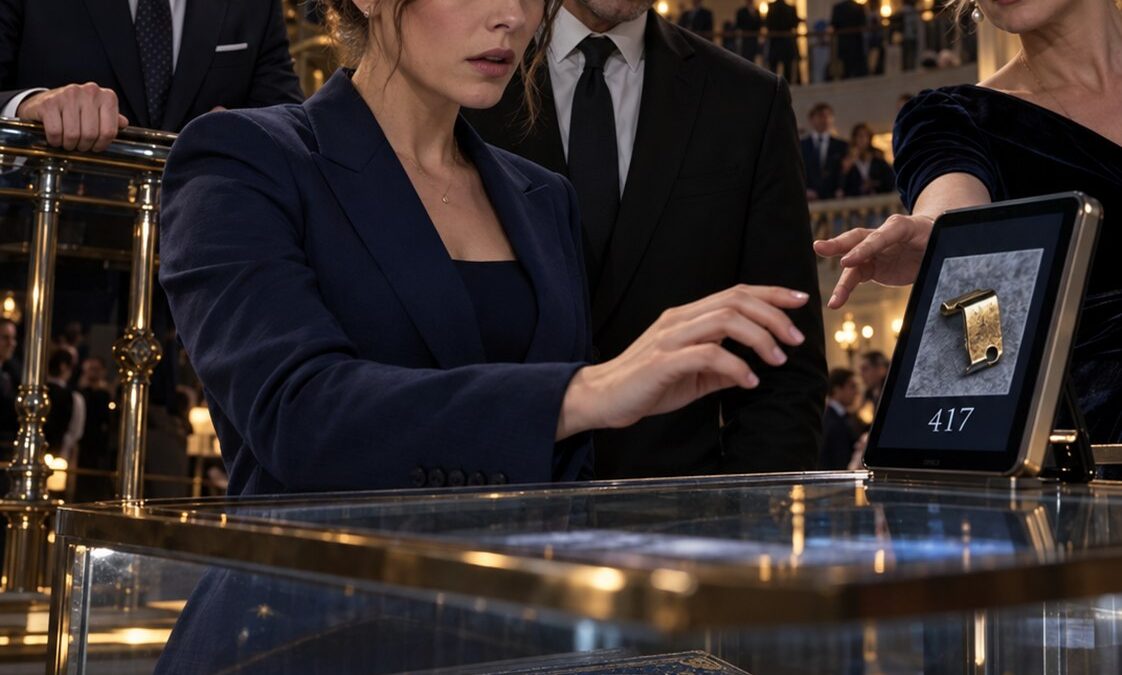
Chapter 2: The Number Beneath
For a moment, Tessa heard only the projector.
A small fan turned above the crowd.
Her father’s photograph remained on the catalog page.
Simon Ward, smiling under borrowed stars.
“The observatory fire?” she asked.
Mercer nodded.
“Twenty years ago.”
Tessa knew the public version.
A heater had failed inside an off-site archive.
Her father had been the last person there.
Several collections were destroyed.
No one had charged him, but the foundation stopped hiring him.
He had spent years repairing books for universities instead.
“Why was the atlas in that unit?”
“I don’t know yet.”
Mercer turned to the assistant.
“Please preserve that file exactly as it is.”
Celeste recovered first.
“We can discuss provenance tomorrow.”
“We’re discussing it now,” Tessa said.
“The sale is suspended,” the trustee announced.
The auctioneer nodded quickly.
Nolan came up beside Tessa.
“We should go.”
She looked at his hand.
He let it fall.
“You knew about Unit 417,” she said.
“I knew Celeste was reviewing old inventory.”
“That isn’t what I asked.”
His eyes moved to Mercer.
“Whatever he thinks, he has his own reasons.”
“Tell me yours.”
Nolan’s jaw worked.
Celeste called his name.
He went to her without answering.
That answered something else.
Mercer held out his hand toward Tessa.
She expected him to ask for the catalog proof.
Instead, he offered a folded white handkerchief.
She looked down.
Red pencil had rubbed onto her fingers.
“I’m fine,” she said.
“I believe you.”
He placed the handkerchief on the railing and stepped back.
It was an awkward gesture.
It was also the first one that night that demanded nothing.
The trustee introduced himself as Peter Halloran.
He promised the atlas would remain in the locked display until the foundation’s lawyer arrived.
Tessa asked for a written inventory.
Halloran called the auctioneer’s assistant back.
Together they listed the atlas, its case, its brass clip, and the condition of its cover.
Tessa checked every word.
The screw in the clip had a small nick.
The last chart had no visible pencil number while the clip was attached.
The assistant photographed both facts in front of them.
Celeste objected to the delay.
Halloran kept writing.
Mercer stood near the bottom step.
He did not speak for Tessa.
Nolan watched from across the dome.
She could feel his gaze when she signed the inventory.
Her signature looked nothing like the one on the tablet.
Halloran noticed.
He asked the assistant to photograph both.
Then he asked everyone to leave the display untouched overnight.
“Tomorrow morning,” he said, “we get the records.”
“Which records?” Tessa asked.
Mercer answered.
“Everything from Unit 417.”
Celeste’s eyes flashed.
“That facility is privately owned.”
“By one of my companies.”
Tessa looked at him.
The coincidence seemed almost too convenient.
Mercer read her expression.
“I had the unit sealed after an insurance dispute,” he said.
“The foundation requested access last month.”
“Did you grant it?”
“I granted supervised access.”
“Who went in?”
“Celeste and her lawyer.”
Nolan made a small sound.
Tessa turned.
He was staring at Celeste.
For the first time, he looked afraid of her.
* * *
Tessa did not go home with Nolan.
She went to her aunt’s apartment above a pharmacy, where the radiators knocked all night.
Aunt June listened without interrupting.
Then she opened the cupboard and took down two mugs.
“Tea?” she asked.
“Something stronger.”
“All I have is bad tea.”
“That qualifies.”
June had been Simon’s older sister.
She knew the fire had wounded him more deeply than the foundation’s public statement suggested.
“He never thought it was an accident,” she said.
“He didn’t tell me that.”
“He wanted you to study without carrying his fights.”
“He should have told me.”
“He should have done many things.”
June set the mugs down.
“He loved you while getting several things wrong.”
Tessa held the hot tea between her palms.
At two in the morning, Nolan called.
She let it ring.
He sent a message.
Please don’t speak to Mercer alone.
Then another.
Celeste says this can still be fixed.
Tessa showed June.
June read both messages.
“She sounds like his supervisor.”
Tessa almost laughed.
The next morning, Halloran arranged a meeting at a law firm downtown.
He brought the auction file.
Tessa brought the marked catalog, her father’s will, and the conservator’s report she had written two weeks earlier.
Mercer brought a lawyer named Priya Desai.
Nolan arrived with Celeste.
He sat beside her.
Tessa sat beside June.
That simple division made Nolan look at the table.
Priya began with the electronic signature.
The auction file contained an image of Tessa’s signature copied from a 2022 insurance request.
Its letters had been resized and placed on a 2017 transfer agreement.
The software’s document history recorded the change.
“Who had the original?” Priya asked.
“The foundation,” Celeste said.
“And Nolan’s office,” Tessa added.
Nolan raised his eyes.
She remembered him asking for her insurance paperwork last spring.
He had said a lender needed to value their household assets.
She had sent him a scan.
“The date matters,” Priya said.
Simon had died in 2017.
The forged agreement claimed he transferred the atlas to Tessa the following day.
But his will left it to her three months later, after probate.
Someone had created a false chain of ownership to make an older foundation claim disappear.
Halloran opened a second folder.
“The foundation’s own inventory lists the atlas as donated in 2006.”
Tessa leaned forward.
“By whom?”
He turned the page.
“Simon Ward.”
She stared.
Her father had kept the atlas at home.
He had spoken of it as hers.
If he donated it, why leave it to her?
June shook her head.
“Simon wouldn’t do both.”
Celeste spread her hands.
“People change their minds.”
“The inventory is a photocopy,” Tessa said.
“I want the original.”
“It was lost in the fire,” Celeste said.
The room went quiet.
Tessa looked at the date.
The inventory claimed a donation in 2006.
The fire had happened in 2006.
“What month?” she asked.
Celeste blinked.
“The donation?”
“Yes.”
“September.”
“The fire was in March.”
“No one said the original inventory burned in that fire.”
“You just did.”
Celeste’s face cooled.
“I said it was lost.”
Tessa looked at Priya.
Priya made a note.
They turned to the photograph taken inside Unit 417.
It showed the atlas lying open on a metal worktable.
A gloved hand held the brass clip beside it.
The penciled number was visible beneath.
Priya asked Mercer for the access log.
Celeste and her lawyer had entered the unit on September third.
A storage employee had remained in the corridor.
The log showed no other recent visitors.
Mercer had not seen the photograph until the auction assistant opened it.
“It came from Celeste’s donor packet,” Halloran said.
Tessa studied the picture.
The number was written in soft graphite.
Its four had an open top.
Her father wrote his fours with a closed triangle.
Nolan wrote open fours.
So did half the city.
That observation alone proved little.
But Tessa noticed something else.
The brass clip’s screw was missing its nick.
She enlarged the photograph.
“It’s a different clip.”
Nolan looked up.
Tessa put her recent condition report beside the image.
Her photograph showed the old screw, marked when she was seven.
The clip in the storage photograph had a smooth screw head.
“Someone substituted it,” she said.
“For what reason?” Celeste asked.
“That’s what I want to know.”
Mercer called his storage manager from the conference room.
The manager pulled the unit’s original intake photographs.
Those images had been taken when the unit was sealed, twenty years earlier.
The atlas was visible in an open crate.
Its brass clip had the nick.
Tessa looked from image to image.
Same atlas.
Same old clip.
No pencil number could be seen beneath it.
The clip had been removed and replaced during Celeste’s visit.
“Maybe the screw was repaired,” Celeste said.
“Who authorized a repair?” Halloran asked.
“I don’t have that information with me.”
Priya asked for the original clip.
Celeste said she did not know where it was.
Nolan rubbed his forehead.
Tessa watched him.
He had held the atlas at their apartment before the gala.
Had he noticed the substitute?
Had he helped place it?
The question hurt more than she expected.
Priya turned to the fire report.
The investigator had found an electrical fault near a space heater.
Simon had admitted he was the last person to use the room.
The foundation had then stated publicly that his “carelessness” contributed to the loss.
The investigator’s actual conclusion was narrower.
He could not determine whether the heater caused the fire.
“There’s more,” Mercer said.
He slid over an old insurance letter.
His father’s freight company had leased the warehouse that housed the archive.
The insurer had denied the foundation’s claim because the inventory submitted after the fire included items photographed elsewhere after the fire.
June read the letter twice.
“Simon said they were blaming him to cover missing books.”
“Was he right?” Tessa asked.
Mercer met her eyes.
“I think he was.”
The foundation had never shown the letter to its trustees.
Celeste sat very still.
Nolan stopped rubbing his forehead.
Priya spoke carefully.
“The insurer’s letter raises questions.”
“It doesn’t answer all of them.”
Tessa nodded.
Her father deserved an answer that would survive more than an angry room.
She turned back to the atlas photographs.
On the intake image, a narrow paper tab projected from the back cover.
It was missing in the new image.
She tapped the screen.
“What was here?”
Halloran leaned closer.
“A label?”
“Not quite.”
Her father had taught her how to recognize old repair materials.
The tab had the color and edge of a folded linen guard.
It could hold a loose leaf without adhesive.
She remembered touching it years ago.
Her father had told her not to pull it.
She had obeyed.
“I need to inspect the atlas,” she said.
Priya looked at Halloran.
Halloran agreed.
They returned to the observatory with a university archivist and a camera operator hired by the trustees.
Celeste refused to attend.
Nolan came anyway.
Under the dome, Tessa opened the back cover with clean hands.
The linen guard had been cut flush.
A bright sliver remained.
Someone had removed whatever it held.
The cut was recent.
Tessa recognized the fibers.
She did not need to guess who had made it.
Nolan used that kind of narrow knife in his office.
She looked at him.
His face gave nothing away.
Then June pointed to a tiny pencil mark inside the cover.
Three letters.
S.W.
Simon Ward.
Below them was a date.
March seventeenth, 2006.
Two days before the fire.
And beneath the date, a word written so faintly that Tessa had to angle the lamp.
Duplicate.
* * *
The missing leaf became the center of the investigation.
Tessa knew her father’s habits.
He made duplicates when a document might be lost to handling.
He also recorded where he stored them.
At June’s apartment, Tessa opened the metal file box Simon had left behind.
She had looked through it before.
Bills.
Photographs.
Letters from institutions that had rejected his applications after the fire.
This time she searched for the date.
March seventeenth.
She found a receipt from a copy service.
Two oversized scans.
One paper print.
A storage sleeve.
The receipt listed a job number.
June recognized the shop.
It had closed years earlier.
Priya’s investigator located the former owner, a woman named Doreen Voss who now lived thirty miles away.
Doreen remembered Simon because he had brought in an old document and insisted she keep its folds visible.
She had copied it on a flatbed scanner.
The shop’s original files were gone, but Doreen had kept invoices for taxes.
Her invoice matched Simon’s receipt.
It described the item as “foundation gift terms.”
Tessa read the phrase aloud.
Nolan had told her the atlas was simply valuable.
Celeste had told the trustees it had been privately donated.
Neither had mentioned gift terms.
Priya sought the foundation’s 2006 board minutes.
Halloran had access as a trustee, but the minutes were incomplete.
Several pages around March were missing from the bound volume.
The secretary who had kept them, now retired, had a box of working copies.
She agreed to meet at her kitchen table.
Her name was Miriam Bell.
She had known Simon.
“He was the only person who read every footnote,” Miriam said.
Tessa smiled despite herself.
“That sounds right.”
Miriam found the March minutes.
The foundation had discussed a gift from Mercer’s father.
He had offered to fund restoration of the old observatory wing.
In return, the foundation agreed to keep its historical collection available to the public and to seek donor approval before selling any object from it.
The star atlas was listed as part of that collection.
Simon had been asked to prepare an inventory.
“The atlas belonged to him,” Tessa said.
“Yes,” Miriam said.
“He loaned it to us for the exhibition.”
She turned another page.
A handwritten note identified it as a loan, returnable at Simon’s request.
The foundation’s later inventory had changed loan to donation.
Tessa looked up at Mercer.
He stood near the kitchen window.
“My father knew Simon?” she asked.
“They worked together on the restoration.”
“Did you?”
“I was eighteen.”
“That wasn’t my question.”
Mercer gave a brief nod.
“I met him twice.”
Tessa waited.
“He thought the dome needed repairs before the opening gala,” Mercer said.
“My father thought the same.”
“But the foundation went ahead.”
“Yes.”
Tessa could see why he had studied the atlas at the auction.
He had not recognized its owner by chance.
He knew it belonged in a larger history.
“Why didn’t you tell me?” she asked.
“I had minutes, not proof of what happened to your father.”
“You could have told me the minutes existed.”
“You’re right.”
He did not defend himself.
That made her angrier for a moment.
Then it made room for an honest question.
“Are you trying to save the collection,” she asked, “or your father’s reputation?”
“Both.”
“At least that’s clear.”
Miriam kept searching.
The April minutes recorded an emergency meeting after the fire.
Celeste’s father had chaired the foundation then.
The foundation blamed Simon before receiving the investigator’s final report.
A second item had been added to the loss list: a set of original donor agreements.
Mercer read the list.
“My father kept copies.”
“Where?” Priya asked.
“In company records.”
“Then why are we here?”
“Because the copies have no attachments.”
The agreement referred to a schedule of protected objects.
The schedule was the missing leaf Simon had duplicated.
Without it, the foundation could argue that the atlas was not covered.
Tessa remembered the cut linen guard.
Her father had hidden a paper copy in his own atlas after discovering records were disappearing.
He had marked it Duplicate because the original remained somewhere else.
The question was where.
That evening, someone entered June’s apartment while they were out.
Nothing valuable disappeared.
The metal file box was open.
Its papers had been scattered across the floor.
June stood in the doorway with her keys in hand.
Tessa called the police.
An officer took photographs and a report.
She told them about the auction, the forged signature, and the missing leaf.
The officer did not promise arrests.
He gave them a case number and advised them to keep the documents elsewhere.
Mercer offered a suite in a hotel he owned.
June declined.
“My neighbors know when somebody sneezes,” she said.
“Tonight they missed a burglar,” Mercer replied.
“They’ll be furious when they find out.”
Tessa almost smiled.
Priya arranged for copies of the papers to be secured at her office.
The originals stayed with June under a better lock.
Tessa slept in the next room.
In the morning, Nolan appeared outside the pharmacy.
He stood across the street, holding a paper cup.
Tessa went down because she wanted answers.
June watched from the upstairs window.
Nolan looked tired.
“I heard about the break-in,” he said.
“From whom?”
“Celeste.”
Tessa waited.
“She heard from a trustee.”
“No, she didn’t.”
Nolan stared into his coffee.
He knew he had said too much.
“Did you send someone?” she asked.
“No.”
“Did you know someone was coming?”
His silence was answer enough.
“I told her to leave your aunt alone,” he said.
“When?”
“Last night.”
“Before or after the police arrived?”
He did not answer.
Tessa crossed her arms.
“You put my signature on that agreement.”
“I didn’t build the document.”
“You used it.”
“Yes.”
The word struck harder than his excuses would have.
He looked across the street, toward the pharmacy window.
“I owed money,” he said.
“To Celeste?”
“To people she introduced me to.”
“For what?”
“A project that failed.”
He spoke as though failure had happened to him.
Tessa remembered canceled vacations, her second job, the months he said they had to be careful.
She had been careful.
He had been borrowing against their future.
“Celeste said the sale would cover it,” he continued.
“She said the atlas was already foundation property.”
“Then why forge my signature?”
“She needed clean paperwork.”
“Did you hear yourself?”
He rubbed his face.
“I know.”
“No, you know you were caught.”
Nolan looked wounded.
She let him.
“Where is the leaf?” she asked.
“I never saw it.”
“Who cut it out?”
“Celeste’s lawyer, I think.”
“Who replaced the clip?”
“I don’t know.”
This time, she believed he might be telling the truth.
It did not make him safe.
He took a step closer.
“I can give Priya the messages.”
“Do that.”
“Will you come home?”
“No.”
“Tessa.”
“You can speak through my lawyer.”
His mouth opened.
She went back upstairs before he found another promise.
June had watched everything.
“He looks smaller from up here,” she said.
“He was always that size.”
Tessa said it without triumph.
She had to live with what it meant.
That afternoon, Priya received Nolan’s messages.
One thread showed Celeste instructing him to obtain Tessa’s insurance signature.
Another said, “The page must stay out of the sale packet.”
The next message named the person who had removed it.
Celeste had written, “I cut it myself.”
* * *
Priya gave the messages to the police.
She also sent them to the foundation’s independent counsel.
The trustees called an emergency meeting for Friday.
Celeste’s lawyer demanded time to examine the messages.
Priya agreed.
Every copied file had to survive scrutiny.
Tessa spent Thursday with the university archivist, comparing photographs of the atlas.
They traced the original clip from the old storage intake image to her report two weeks earlier.
After that, the trail broke.
The substituted clip had appeared in Celeste’s September photograph.
Halloran arranged for the storage unit to remain sealed.
Mercer’s company provided the access log and camera recordings to investigators.
The corridor camera showed Celeste entering with a slim document case.
She left carrying the same case.
Its contents were invisible.
It proved access, not theft.
Tessa kept studying the old intake photograph.
The atlas sat in an open crate.
Behind it was a blue folder.
A strip of white paper projected from the folder’s top.
She enlarged the image until the letters blurred.
“Why are you looking at that?” Mercer asked.
“Because my father labeled everything.”
“Can you read it?”
“No.”
Tessa turned the photograph sideways.
The strip’s length mattered more than its letters.
Simon used different tabs for originals and copies.
A short tab meant a working copy.
A long tab meant a signed original.
This one was long.
The foundation had claimed the donor agreements were destroyed in the fire.
Yet the atlas and blue folder had been photographed when Unit 417 was sealed after the fire.
“Was that crate ever inventoried?” she asked.
Mercer called the storage manager.
The crate’s contents had been logged twenty years ago.
Atlas.
Folder.
Loose papers.
The folder had later been removed by the foundation under a property claim.
“Who signed for it?” Priya asked.
The manager found the receipt.
Celeste’s father.
He had taken the folder eleven days after the fire.
The signed original might have survived.
He had died six years ago.
His daughter had inherited his papers.
Priya requested them.
Celeste refused, saying the folder contained personal family records.
The refusal gave the trustees another reason to suspend her access.
It did not give them the folder.
At Friday’s meeting, Tessa sat with June and Priya.
Mercer sat three chairs away.
Nolan sat alone at the far end.
Celeste arrived in a cream suit and carried a binder.
She looked composed.
Halloran opened with the auction.
He read Tessa’s denial of the signature.
Celeste offered a different explanation.
“The foundation relied on documents supplied by Nolan Pike,” she said.
“If he forged his wife’s signature, he deceived us.”
Nolan looked up sharply.
“Celeste.”
She did not turn.
“Our staff used the ordinary verification process.”
Priya asked who created the electronic file.
Celeste said she did not remember.
The document history showed a foundation account.
She said many employees shared access.
Halloran asked about the missing leaf.
“It was deteriorated,” Celeste said.
“I removed it to protect the atlas.”
“Where is it now?”
“In a secure location.”
“Which location?”
“I will provide that to counsel.”
She had prepared her answers.
Some were almost convincing.
Tessa watched the trustees.
Several wanted to believe a clerical mistake had grown into a family dispute.
It would have been easier for them.
Celeste understood that.
She opened her binder.
It contained photographs of Simon at the observatory, copies of invoices, and a letter in which he thanked the foundation for exhibiting the atlas.
“He was proud of this institution,” she said.
“His daughter is understandably grieving.”
Tessa’s hands went still in her lap.
Nine years was a long time.
Celeste made grief sound like a defect with no expiration date.
“Dr. Ward’s relationship with this collection was complicated,” Celeste continued.
“After the fire, he made accusations he could never substantiate.”
June shifted beside Tessa.
Mercer looked at Celeste with an expression Tessa could not read.
Then Celeste turned toward him.
“Mr. Mercer also has a financial interest in redevelopment of the property.”
Halloran looked surprised.
Mercer answered.
“My company owns the warehouse next door.”
“A renovated observatory limits your options.”
“Yes,” he said.
“It does.”
For a second, Celeste had the room.
She had exposed a reason to question him.
Tessa admired the move even while hating it.
Mercer did not pretend the conflict was imaginary.
“That is why I gave the records to independent counsel,” he said.
“And why I’m not voting here.”
Celeste pressed on.
“Mr. Mercer’s family has spent years trying to control this foundation.”
“My father funded repairs,” he said.
“Your father attached conditions.”
“He did.”
“Conditions that could bankrupt us.”
“That depends on what you sold.”
A trustee asked Celeste about the auction proceeds.
She said they were needed for operating expenses.
Priya placed the draft sale agreement on the table.
The money was scheduled to pass through a new subsidiary that Celeste controlled.
Its address matched a development company owned by her brother.
Celeste did not flinch.
“The subsidiary manages restricted gifts.”
Priya showed a second record.
The company had offered to buy the observatory’s adjacent parking lot at a steep discount.
The offer depended on the foundation selling its historical collection.
Celeste’s father had built his reputation on that collection.
His daughter was planning to strip it.
“Your real motive wasn’t operating expenses,” Tessa said.
Celeste faced her.
“You’ve never had to keep a building open.”
“I keep paper alive for a living.”
“Paper does not pay heating bills.”
“Neither does hiding it.”
Celeste’s mouth tightened.
Halloran asked for the missing leaf again.
This time, Celeste took a plain envelope from her binder.
She slid out a folded page.
The archivist examined it without unfolding it.
The paper matched the linen guard’s size.
Its edge had been freshly cut.
Tessa recognized her father’s handwriting on the back.
Duplicate.
Celeste had brought it because she thought she could explain it.
“May we photograph and unfold it?” the archivist asked.
Celeste looked at her lawyer.
He nodded.
The page held the schedule of protected objects.
The star atlas appeared on the third line.
It was signed by Simon and Mercer’s father as witnesses to the schedule.
Celeste leaned forward.
“That proves the atlas was included in the exhibition.”
“It proves more,” Priya said.
The schedule stated that loaned objects remained the property of their lenders.
It also barred the foundation from selling them.
Celeste argued that a later agreement had changed the terms.
She produced a copy.
Simon’s signature appeared at the bottom.
Tessa did not need a handwriting expert to see the problem.
The signature came from a letter Simon had written in 2004.
She knew because she had kept that letter.
It was his apology for missing her college graduation.
She carried it folded inside her wallet.
The day had hurt.
The letter still mattered.
Tessa took it out.
The archivist laid the two signatures side by side.
Same tilt.
Same ink break in the W.
Same tiny blot after the final d.
One was a scan of the other.
Celeste looked at Nolan.
He shook his head.
He had not known about this forgery.
That did not absolve him of his own.
Priya asked the trustees to suspend Celeste and secure the foundation’s records.
Halloran called for a vote.
It passed.
Celeste stood.
“You’re trusting a woman who kept an old apology in her wallet as legal evidence.”
Tessa looked at the letter.
“No,” she said.
“They’re checking your records.”
The trustees did exactly that.
They secured the files and commissioned an independent review.
The police obtained the original donor agreement from Celeste’s father’s papers through legal process.
The signed schedule matched the page from the atlas.
The insurer’s old photographs confirmed several objects listed as fire losses had been removed before the fire.
Investigators did not claim Celeste had started it.
She had been a teenager then.
Her father’s records showed he had manipulated the inventory and blamed Simon to hide earlier sales.
Celeste had found those records years later.
Instead of correcting them, she had used the false ownership claims to plan another sale.
Months passed before prosecutors filed charges.
The case included forgery, fraud, and records tied to the proposed sale.
Nolan faced charges for the signature and his part in the auction paperwork.
He cooperated after giving investigators his messages and financial records.
No one walked out of the meeting in handcuffs.
The law moved through subpoenas, interviews, and hearings.
Tessa learned patience could be an active thing.
She answered questions.
She checked dates.
She corrected one investigator who had copied her father’s death date from the auction catalog.
At the final trustee meeting that year, the foundation issued a public correction.
Simon had not caused the archive fire.
The old accusation had rested on a statement stronger than the investigator’s findings.
The foundation apologized to Tessa and June.
Tessa accepted the correction.
She did not thank them for finally reading their own files.
* * *
By winter, Tessa had moved into a small apartment above a bakery.
The floor slanted toward the kitchen.
The windows stuck in damp weather.
She liked both facts.
June visited every Sunday with bad tea.
Tessa bought better tea and hid it in the cupboard.
June found it immediately.
“Is this what prosperity looks like?” she asked.
“It was on sale.”
“Then I withdraw my accusation.”
The atlas returned to Tessa after the investigation.
She kept it at the university archive in a secure room until her apartment could be made safe for it.
She visited on lunch breaks.
Some days, she opened it to a chart her father had colored by hand.
Other days, she only checked the brass clip.
The original clip was recovered from Celeste’s office safe.
Its nick was still there.
Tessa had expected to feel furious when she saw it.
Instead, she felt seven years old.
Her father’s hand over hers.
“Gentle,” he had said.
She had not been gentle.
He had kept the mistake.
Mercer visited the archive once to sign a grant agreement.
His company would fund the observatory’s repairs under the original terms.
The trustees had asked Tessa to help design public access to the historical collection.
She accepted a paid contract with clear limits.
She would not work under the old executive staff.
She would not give up ownership of the atlas.
The trustees agreed.
Mercer stopped by her worktable afterward.
“June tells me you have a new apartment.”
“June tells everyone.”
“She told the bakery owner to lower the music.”
“The bakery owner raised it.”
“Who won?”
“They negotiated.”
“That sounds unlike June.”
“She got free bread.”
Mercer smiled.
He had visited her several times during the investigation.
Usually, he brought a document that needed her attention.
Sometimes, he brought coffee.
Once, he brought nothing and admitted he wanted to see her.
Tessa had told him she was still married.
He had said he knew.
They had walked around the block anyway.
Now the divorce was final.
Nolan had signed without contesting the atlas or the small savings account that was hers.
It had taken him longer to sign a written apology.
He sent it through their lawyers.
It was plain and specific.
He had forged her name.
He had treated her work as less important than his ambitions.
He had let Celeste threaten her family.
Tessa read it twice.
She did not write back.
When Nolan later asked to speak in person, she agreed to meet in a public café for twenty minutes.
He looked older than he had at the gala.
He was working for a legal aid office while his case moved forward.
His license had been suspended.
None of that made him a different person yet.
“I’m sorry about Simon,” he said.
“You owe him more than that.”
“I know.”
“Tell the investigators everything you know about the fire records.”
“I have.”
“Then keep doing it.”
He nodded.
“I hoped we could eventually be friends.”
Tessa stirred her coffee.
“No.”
He looked down.
“I understand.”
“I hope you do.”
When she left, she did not feel brave.
She felt sad.
There was room for both.
In March, Mercer invited her to dinner.
He called instead of sending an assistant or a car.
“Would you like to go somewhere with me?” he asked.
“What kind of somewhere?”
“A restaurant.”
“That narrows it down.”
“A quiet one.”
“People say you own half of them.”
“I own one.”
“Which one?”
“The noisy one.”
She laughed.
He waited.
“Yes,” she said.
Dinner was pleasant.
Then another dinner was awkward.
On their third, he admitted he hated olives but had eaten them twice because she seemed to like them.
“I don’t,” she said.
“I thought you ordered them.”
“They came with the bread.”
He looked genuinely offended by the misunderstanding.
She liked him more for it.
The city still called him feared.
Tessa saw why.
In meetings, he listened until someone lied.
Then he asked a question they could not dodge.
He did not use that skill on her.
When he offered to pay for the atlas’s permanent conservation, she considered it.
Then she gave him a different answer.
“Fund a public training place,” she said.
“For conservators?”
“For people who can’t afford unpaid internships.”
“How much?”
She showed him a budget.
He read every line.
“You priced your own time too low.”
“I priced it fairly.”
“You priced everyone else higher.”
“They’re specialists.”
“So are you.”
Tessa took back the page.
She revised it.
Mercer signed the grant.
The first trainee started in June.
Her name was Imani Brooks.
She had repaired family photographs on her kitchen table because no school near her offered conservation classes.
Tessa taught her how to test a paper fiber without damaging it.
Imani learned quickly.
She also asked the questions Tessa used to be afraid of asking.
“Why does this institution have so many objects with incomplete records?”
“Because people preferred the objects to the paperwork.”
“Are we fixing that?”
“Yes.”
“Good.”
On a rainy afternoon, Tessa found Mercer waiting outside the archive with two umbrellas.
He offered her one.
“What’s the second for?” she asked.
“In case you refuse mine.”
“I could still refuse both.”
“I know.”
She took one.
They walked without touching.
At the corner, she stopped.
“Nolan apologized,” she said.
Mercer nodded.
“I saw him.”
“I don’t forgive him yet.”
“You don’t owe me a timetable.”
“I know.”
She looked at the rain running along the curb.
“I need you to tell me when your interests touch my work.”
“I should have done that sooner.”
“Yes.”
“I will.”
“And I get to say no to your help.”
“Yes.”
“Even expensive help.”
He looked at the umbrella.
“Especially expensive help.”
She stepped closer.
“Good.”
He did not kiss her.
He asked first.
She said yes.
* * *
Three years later, the observatory reopened its restored reading room.
The trustees had offered to name it after Simon Ward.
Tessa asked them to name the public conservation lab after him instead.
He had spent his life working at tables.
A room full of careful hands suited him better.
The old dome still smelled faintly of dust and warm metal.
On opening night, children lined up to look through the telescope.
June complained that the stairs had grown steeper.
Imani, now a staff conservator, offered her an arm.
June accepted it after pretending to consider other bids.
Tessa arrived carrying the atlas in a secure case.
It was returning for a six-month exhibition.
The loan agreement named her as owner.
Every condition had been reviewed with her.
She set the case in the center of the dome.
The velvet cradle beneath it was new.
The old one had disappeared after the auction.
Tessa did not miss it.
Mercer came to stand beside her.
He wore the same plain black suit.
She wore her navy one.
It fit more comfortably now.
“Do you want me here?” he asked.
“Yes.”
He stayed.
They were engaged, though no date had been set.
Tessa liked that the question remained open.
Across the room, a museum student read the exhibit label.
It told the truth plainly.
Simon had loaned the atlas.
The foundation had misrepresented its ownership.
His records had helped restore the collection to public use.
The label did not make him perfect.
It made him visible.
Tessa opened the case for the scheduled viewing.
The brass clip held the last chart in place.
Its small nick faced outward.
A girl near the front pointed to it.
“Is that part broken?”
Tessa smiled.
“No.”
She told her how the mark happened.
The girl examined it through the glass.
“Your dad kept it?”
“He did.”
“Why?”
Tessa looked at the tiny screw.
For years, she had thought her father kept the nick because he loved her.
That was true.
It was also too small an answer.
“He knew mistakes could be kept without being repeated,” she said.
The girl considered that.
Then she asked whether she could see the moon through the telescope.
Imani led her to the line.
Mercer touched Tessa’s hand.
Around them, the room filled with ordinary voices.
June arguing cheerfully about tea.
Imani explaining how to turn a page.
Children naming stars they could barely see.
The atlas belonged to Tessa.
The record belonged to everyone.
The brass clip held.
And when Mercer asked whether she was ready to go outside, Tessa looked once more at the cradle.
It was no longer empty.
“Yes,” she said.
They went together.
THE END








