He Roped Off His Wife Beside a Museum Clock—Then the City’s Most Feared Patron Asked Who Had Really Repaired It
Chapter 2: The Missing Hour
The bell struck again.
June felt it through the stone.
The sound was deep and uneven.
A narrow door above the clock face swung inward.
It had been concealed by the painted sky.
Something pale showed behind it.
Paper.
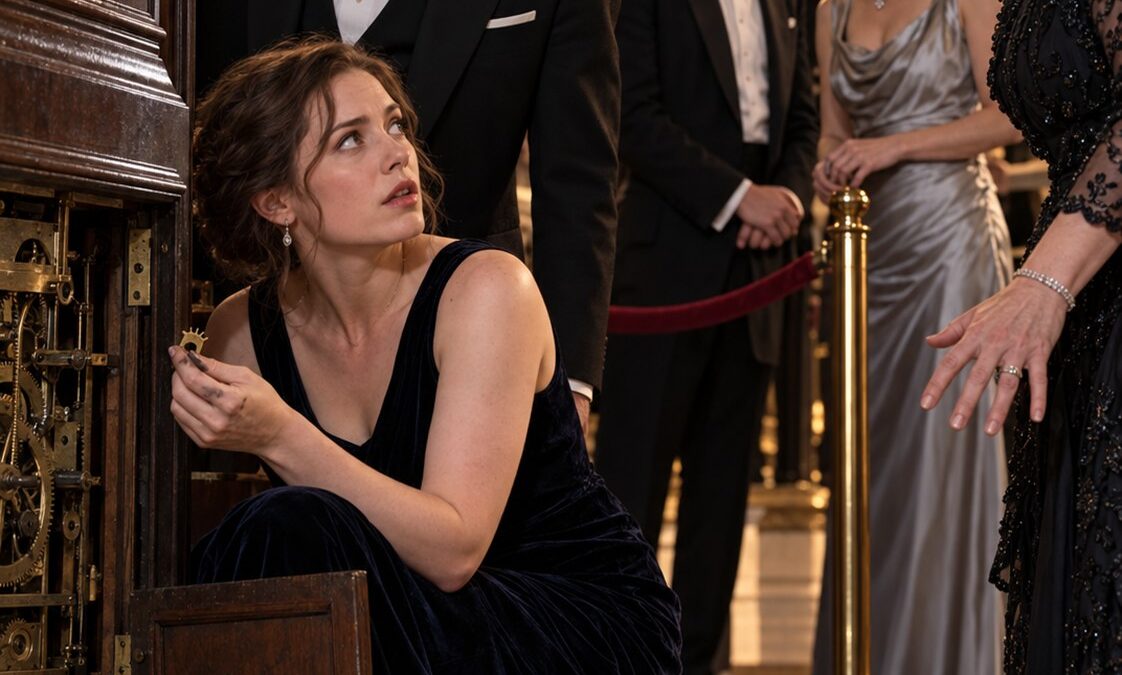
June climbed the maintenance ladder.
Nathaniel held its base.
Graham told the guests to remain calm.
Nobody had suggested panic.
June reached the opening as the fourth stroke sounded.
Inside sat a flat metal box.
Its handle had been tied with old linen tape.
The letter H was scratched beside the latch.
June stared at it.
“Can you lift it?” Nathaniel asked.
“Yes.”
“Then take your time.”
She brought the box down against her chest.
The last bell sounded.
The clock kept ticking.
June almost laughed.
She had feared the wheel would slip.
Instead, the notched tooth in her palm had released a hidden catch when the chime train engaged.
Whoever had cut it had designed the clock to expose the compartment.
But only if the right tooth was installed.
Graham reached for the box.
June stepped away.
“It’s museum property,” he said.
“It’s evidence,” Nathaniel replied.
Evelyn moved closer.
“The compartment was part of an obsolete maintenance system.”
“You recognized it,” June said.
“I recognized the tower.”
“You recognized the letter.”
Evelyn looked at the guests.
The museum’s counsel, a woman June knew as Ms. Bell, came forward.
She asked everyone to move into the adjoining reception room.
She asked the staff to close the gallery.
Nathaniel called the museum’s head of security.
June put the box on a table beneath the founder’s portrait.
She did not open it.
Her hands were steady until she saw the date stamped on its lid.
October 14, thirty-one years earlier.
Her father had been fired from the museum on October 15.
The official story said he had stolen six small objects during a repair shift.
He had denied it until the day he died.
June had been nine when he lost the job.
She remembered him leaving at dawn to find work.
She remembered her mother selling their dining table.
She remembered the neighbors lowering their voices when he came into the grocery store.
Graham knew all of it.
He had once sat beside her father’s hospital bed and promised they would clear his name someday.
Now he stared at the box as though it might speak.
Nathaniel noticed.
“Graham,” he said, “what did you expect to find here?”
“Nothing.”
“Then why were you afraid she’d start the chime?”
“I wasn’t.”
“You taped the release.”
Graham glanced at Evelyn.
June followed the glance.
There was her first honest answer.
Nathaniel quietly asked if her father had worked on the clock.
“Yes,” June said.
“Did anyone tell you about this compartment?”
“No.”
He looked at her hand.
The little brass tooth had left a print in her palm.
“I should have asked why the notch mattered,” he said.
“I should have asked who changed it.”
“That sounds like something you can still do.”
For a moment, his voice held no command.
Only room for her to think.
June looked at the date again.
Her father had not hidden the box from the museum.
He had hidden it inside the museum.
* * *
Security sealed the gallery.
Ms. Bell photographed the box from every side.
She recorded who had handled it.
June showed her the replacement tooth and the photograph she had taken of the original.
The original had vanished from a labeled bag in the workroom.
Bell asked June to email the photograph directly to her office.
June did.
Then Bell called the city’s cultural property investigator.
The museum had reported a theft thirty-one years earlier.
A concealed box bearing that date deserved an independent record.
Graham objected to the word investigator.
Bell ignored him.
The guests left in hired cars and black coats.
Tessa left with them.
Nathaniel saw her pass the security desk.
“She hasn’t been accused of anything,” Bell said.
“I know.”
June heard the restraint in his answer.
It surprised her.
The papers liked to describe Nathaniel Rook as a man who settled every dispute by making people disappear from business.
Here he was, waiting for a lawyer to photograph a latch.
The investigator arrived at one in the morning.
Her name was Celia Park.
She brought an evidence technician and a patient expression.
June explained how she had found the original tooth.
She showed the dated image on her phone.
The notch was visible.
Celia compared it with June’s replacement.
“A copied part opened a concealed door,” she said.
“That’s my best account.”
“And you did not know the door existed?”
“No.”
Celia opened the box after the technician recorded the linen tie.
Inside lay a folded inventory sheet.
A slim notebook.
And six empty padded sleeves.
The inventory listed six objects removed from display for repair.
Each line carried an initial.
H.
The notebook belonged to June’s father.
She recognized his block printing.
He had recorded the clock’s repair measurements.
Then, on the last two pages, he had written names.
Dates.
A delivery van number.
A note beside the final entry read: Ask E.H. why the sleeves returned empty.
E.H.
Evelyn Harrow had been the assistant collections manager then.
She had been twenty-six.
June had seen old photographs of her accepting the museum’s first leadership award a year later.
Celia read the page twice.
“Did your father ever mention this notebook?”
“He said he kept proof.”
“Did he say where?”
“He said the clock would tell us when it was ready.”
June looked down.
For years, she had thought those were a tired man’s comforting words.
He had tried to explain the mechanism.
She had been a child.
He had died before she was old enough to ask properly.
Nathaniel stood beside the table.
“He tried to protect it,” he said.
June nodded.
“And they called it theft.”
Celia closed the notebook carefully.
“His notes are a lead,” she said.
“We still need records from outside this box.”
June welcomed the caution.
Her father had lived beneath one accusation.
She would not build another from a pair of initials.
Bell gave Celia access to the museum’s digital archive.
The original theft file had been scanned five years earlier.
It contained a report signed by Evelyn.
Her report said June’s father had held the only tower key.
June shook her head.
“There were two.”
She remembered a key with a blue cloth loop.
Her father had kept it on a hook at home.
The museum held the other.
Celia asked why he would keep a museum key.
“After-hours maintenance,” June said.
“He was on call when the clock ran.”
The file also said all six objects had been discovered missing at eight the next morning.
June knew the clock’s old maintenance schedule.
She had worked from photocopies of it for fourteen months.
“The tower door was sealed at six,” she said.
“How could anyone inspect it at eight?”
Celia looked up.
June opened a photograph of the schedule.
There was her father’s handwriting in the margin.
Tower to be locked after evening winding.
Celia asked Bell for the original lock records.
They were not in the archive.
Graham said they had probably been discarded.
He said it too quickly.
June noticed him touch his jacket pocket.
He stopped when Nathaniel looked at him.
Bell called the museum’s outside records warehouse.
Its overnight staff could locate the relevant storage boxes by morning.
Celia made copies of the scanned file.
She requested the original from storage.
At three, June finally sat.
Her feet hurt.
Her mouth tasted of cold coffee.
Nathaniel placed a paper cup beside her.
“Tea,” he said.
“You guessed?”
“You turned down coffee twice.”
She took the cup.
“People tell you everything you need?”
“Usually less.”
He sat across from her.
“I was wrong about Graham.”
June gave a tired smile.
“You barely knew him.”
“I recommended him for the development job.”
“That makes you responsible for the recommendation.”
“I thought you’d say more.”
“I’m saving it.”
He smiled once.
Then he took a folded document from his inside pocket.
“Bell sent me this tonight.”
It was a board memo.
Graham had requested a private opening ceremony three weeks earlier.
He had claimed the clock’s restorer preferred anonymity.
Evelyn had approved the request.
Below both signatures lay a third name.
Tessa Wynn.
Her title was not publicist.
It was provenance consultant.
June looked at Nathaniel.
“What provenance did a clock need?”
“That is what I intend to ask.”
Bell came back from the archive terminal.
“The grant files,” she said, “show a new collection transfer.”
Six objects had been scheduled to enter a private exhibition after the gala.
Their descriptions matched the items in her father’s notebook.
Their owner of record was a holding company.
Its registered contact was Tessa.
And the person who had certified their history was Graham Mercer.
* * *
By morning, the museum’s entrance was crowded with reporters.
June went home through a staff exit.
Graham did not come with her.
He called seven times before she reached the apartment.
She let the calls ring.
Inside, she packed a change of clothes and her father’s old repair manual.
Then she found the envelope beneath the hall mirror.
It contained a copy of her restoration contract.
Someone had slid it under the door.
Across the last page, in thick black ink, were four words.
Stop opening old doors.
June photographed it.
She called Celia.
Celia asked her to leave the envelope in place until an officer could collect it.
June sat at the kitchen table.
Her wedding photograph faced her from the shelf.
Graham looked young in it.
Hungry for a future.
She had mistaken hunger for hope.
A knock came.
She checked the peephole.
Nathaniel stood outside, alone.
Celia had asked him to pick June up for a scheduled interview.
He waited while the officer arrived and bagged the envelope.
Then he carried June’s overnight case down the stairs.
“You didn’t have to come,” she said.
“I know.”
“You own a car service.”
“I know that too.”
At the curb, he opened the back door of a modest sedan.
There was a bag of breakfast sandwiches on the seat.
June looked at him.
“Have you started ordering for me?”
“I bought two kinds.”
“That is a careful answer.”
“I’m learning.”
She chose the one with eggs.
He took the other.
The drive to Celia’s office took twenty minutes.
They spent most of it in silence.
At a red light, June’s phone lit up.
Graham.
She turned it face down.
Nathaniel said nothing.
That helped.
Celia had obtained the warehouse boxes.
The old lock log showed the tower door had been opened at 7:42 the morning after her father’s last shift.
Evelyn had signed out the key.
Her theft report said she had not entered until eight.
Celia had also found the delivery van number.
It belonged to a company once owned by Evelyn’s father.
That company had since dissolved.
Its archived invoices remained in a tax file supplied under lawful request.
An invoice dated the same week listed six padded sleeves.
Destination: private storage.
The storage address now belonged to a firm connected to the holding company Tessa represented.
June stared at the dates.
Her father had seen the sleeves leave.
He had not known where the objects went.
Celia agreed.
Then she turned to Graham’s recent certification.
It claimed a private collector had owned the six objects continuously for thirty years.
It included photographs.
June recognized one at once.
“That clock is wrong,” she said.
Celia leaned closer.
In the background of a supposedly old collection photograph stood the Beaumont Clock.
Its moon dial showed a face June had painted six months earlier.
A tiny silver crescent.
The original crescent had been dark blue.
“Could someone have altered the image?” Celia asked.
“Yes.”
“Can you prove when?”
June opened her work photographs.
There was the bare dial before repainting.
There was the finished crescent.
Both images had metadata and had been emailed to the museum during the restoration.
Bell confirmed the emails on the museum server.
The supposedly thirty-year-old photograph had been made after June restored the clock.
Graham had known that.
He had asked to use her progress images in donor materials.
She had given him access.
Celia said the forged photograph could show a recent attempt to create false ownership.
It did not yet prove who had made it.
Nathaniel looked at June.
“You found the flaw because you painted it.”
“She used the wrong shade,” June said.
Celia raised an eyebrow.
“The color in the photograph is yours.”
“I know.”
“Then who is she?”
“Tessa.”
June enlarged another image from the certification packet.
Tessa’s reflection showed faintly in the clock’s glass.
The room went still.
Celia made a copy.
She asked Bell to preserve the original digital file and its upload history.
The file had entered the museum’s system from Graham’s account.
Hours before the gala.
Graham had spent fourteen months praising June’s attention to detail.
He had used it to restore the clock.
Then he had counted on the room overlooking a painted moon.
Celia’s phone rang.
She listened.
Her expression changed.
A museum employee had found the original notched tooth.
It lay beneath a workbench in the restoration room.
The evidence bag June had labeled was gone.
On the workbench sat a fresh bag bearing June’s initials.
Someone had tried to make it look as though June had never secured the piece.
“Who had access?” June asked.
“Four staff members,” Celia said.
“And Evelyn.”
Nathaniel’s phone rang next.
It was Bell.
The museum board had called an emergency meeting that afternoon.
Evelyn intended to recommend suspending June’s restoration contract.
She had also prepared a statement.
It accused June of planting the box to revive her father’s discredited claim.
June stood so abruptly her chair moved backward.
Nathaniel rose.
“I can stop the meeting,” he said.
“No.”
“June.”
“They’re going to hear what happened.”
“We need the investigator’s work first.”
“Then ask Celia what she can share.”
Celia regarded her for a moment.
“Facts from public records,” she said.
“And records the museum owns.”
“What about my father’s notebook?”
“It is being examined.”
June nodded.
She could wait for evidence.
She would not wait behind another rope.
Celia handed her a copy of the old lock log.
“There’s one more thing,” she said.
Evelyn’s father had owned the delivery company.
But the invoice had been approved by someone at the museum.
The signature belonged to Evelyn.
The objects had left through her family’s van.
And Graham had been hired to make their return look legitimate.
* * *
The board met in the gallery.
June had asked for that room.
Evelyn had objected.
Nathaniel had reminded the board that its own clock stood there.
By four, the red velvet rope had been rolled away.
The clock ticked above twelve people seated in folding chairs.
Bell attended as counsel.
Celia attended to explain which records investigators had obtained.
Tessa arrived with her own lawyer.
Graham arrived alone.
June wondered whether he expected her to sit beside him.
She took the chair nearest the clock.
Nathaniel sat two seats away.
Evelyn opened the meeting.
She spoke well.
June had heard her raise millions of dollars with that voice.
She called the discovery in the tower “distressing.”
She called June’s conduct “irregular.”
She said the museum could not permit a contractor to open sealed compartments without authorization.
June waited until Evelyn finished.
Then she asked one question.
“Who authorized the chime?”
Evelyn paused.
“The restoration plan did.”
“The approved plan required a final load test.”
“That was technical language.”
“It was a condition.”
Bell confirmed it from the contract.
June looked at Graham.
“You told the guests it would ring.”
“Yes.”
“Before I signed the test.”
“You said the time train was ready.”
“I said the chime was not.”
Graham’s jaw worked.
“It rang.”
“Because I repaired what you changed.”
Evelyn leaned forward.
“Can you prove anyone changed it?”
June laid her photographs on the table.
One showed the release lever three days earlier.
The next showed the clear tape she had removed at midnight.
She had photographed it before handing it to Celia.
A security camera in the gallery showed Graham opening the lower panel an hour before the gala.
He said he had checked the presentation lighting.
The panel contained no lights.
He looked at Evelyn again.
Nathaniel saw it.
So did the board.
Evelyn turned to the bigger accusation.
“The box may be authentic,” she said.
“That does not make its contents reliable.”
She argued that June’s father had feared discovery.
He could have hidden a self-serving notebook.
He could have invented entries blaming a young colleague.
It was an ugly argument.
It also had a shape people could follow.
June felt its old weight settle on her shoulders.
She had carried it through school.
Through job interviews.
Through conversations that ended when she gave her last name.
Celia spoke next.
She explained the lock log.
She explained the delivery invoice.
She said investigators were verifying where the six objects had been kept.
She did not call Evelyn a thief.
She did not need to.
Tessa’s lawyer asked whether the documents could have another explanation.
“Yes,” Celia said.
“We are examining that.”
Evelyn seized on the answer.
“Then this board should avoid conclusions.”
June agreed.
“We should.”
The room turned toward her.
“I want to show you one thing my father made.”
She placed the replacement tooth on a white cloth.
“The original was found under a workbench this morning.”
“It appears small,” one trustee said.
“It is.”
June described its purpose.
The notch engaged a latch in the chime train.
At midnight, the hidden door opened.
Her father had made the original tooth.
June had copied it because a standard part did not run cleanly.
He had left a way for the box to be found by someone who repaired the clock properly.
Evelyn folded her arms.
“Or you built an elaborate trick.”
June took a second photograph from her folder.
It showed the original tooth in place before she had removed it.
The image dated from the first week of her work.
Bell had the museum server record of June emailing it that day.
Evelyn said nothing.
June did not stop.
“My father’s maintenance notes gave the tooth’s dimensions.”
She held up a photocopy from an old city trade journal.
The journal had published his clock repair method thirty-two years earlier.
Its drawing showed the same notched profile.
A year before the objects vanished.
A year before any accusation.
The tooth had not been invented for last night.
Nathaniel watched Evelyn.
Her face remained composed.
But her fingers pressed hard against the edge of the table.
Celia added one more record.
The private storage firm had supplied its own entry log under request.
Evelyn had visited the unit six times over three decades.
The latest visit was two months earlier.
Graham had accompanied her.
Evelyn turned to him.
“You said those records were destroyed.”
Everyone heard her.
Graham closed his eyes.
Tessa pushed her chair back.
Her lawyer touched her arm.
The board chair, a retired judge, asked Evelyn whether she wished to continue.
Evelyn sat very straight.
“The museum faced closure,” she said.
“Thirty-one years ago, our principal donor withdrew.”
She said the six objects had been moved to secure storage to prevent their sale during a financial crisis.
She said the decision had been temporary.
She said June’s father had misunderstood.
June looked at the empty sleeves in the evidence photograph.
“Then why report them stolen?”
Evelyn’s answer came slowly.
“He threatened to go public.”
“You fired him.”
“I believed the museum mattered more than one man’s reputation.”
The clock ticked above them.
June waited for Evelyn to hear herself.
She did not.
Evelyn turned to the trustees.
“I kept this institution alive.”
Celia asked why the objects were being brought back now under a false ownership history.
Evelyn said the private collection story would allow a donor-funded acquisition without exposing the old transfer.
That was the elegant version.
Graham supplied the rest.
Evelyn had promised him the museum’s top development post when she retired.
He had certified the forged provenance.
Tessa had arranged the holding company and the publicity.
The planned acquisition would move donor money to that company.
Graham insisted he had not known the original accusation against June’s father was false until recently.
June looked at him.
“When?”
He could not meet her eyes.
“Last spring.”
She counted backward.
Last spring, she had accepted the clock job.
Last spring, he had brought flowers home and said this project could change their lives.
She had thought he meant her work.
The board chair ended the meeting.
Evelyn and Graham were placed on leave.
The museum referred its records to investigators and froze the acquisition.
Bell began a separate review of past files and donor payments.
Tessa left with her lawyer.
No one stopped her at the door.
June was glad the room had learned the difference between suspicion and a verdict.
Three months later, the legal picture was clearer.
The six objects were recovered from storage.
Experts confirmed their identities from old inventory photographs.
Evelyn admitted making the false theft report and arranging the new sale.
She entered a plea to offenses tied to the false records and the attempted transaction.
Graham admitted signing the false provenance certification and helping prepare the transaction.
Tessa returned the fees she had received and provided records of who had directed her work.
Her lawyer said she had believed the collection history Graham gave her.
Investigators found messages showing she knew the recent photographs were being presented as old.
That question would be answered in court.
June’s father’s personnel file was corrected.
The museum published the correction where his accusation had once appeared.
At a short public meeting, the board apologized to June and her family.
Evelyn attended only through a written statement.
Its last line said the museum might not have survived without her choices.
June was asked to respond.
She stood beneath the clock.
“My father kept this running,” she said.
“He also kept a record.”
She touched the table holding his notebook.
“The museum survived him.”
Then she sat down.
* * *
By the end of winter, June had moved out of the apartment.
She kept the repair manual.
She left the wedding photograph.
Graham sent a letter from his lawyer’s office.
It began with an apology.
It explained too much.
June read it once.
Then she put it in a drawer with the signed separation papers.
She did not answer.
On Tuesdays, she repaired public clocks.
On Thursdays, she taught apprentices how to cut replacement teeth by hand.
The class met at a small workshop near the river.
Its windows rattled whenever a freight train passed.
June liked that.
Machines should admit they were moving.
The museum offered to make her head of restoration.
The salary was more than twice what she earned at the city shop.
She declined.
Then she proposed something else.
The museum still owed her for the Beaumont work.
Its board had also established a fund to address harm caused by the false accusation.
June asked them to pay for apprenticeships for people who could not afford the tools.
She chose a modest fee for her work.
She kept her city job.
Nathaniel called the arrangement stubborn.
June called it a budget.
He began visiting the workshop with coffee.
At first he stayed near the door.
The apprentices knew who he was.
They became suspicious when he struggled to set a simple clock hand.
June let them teach him.
He was a poor student.
He asked precise questions and moved too fast.
“You can’t negotiate with a spring,” June told him.
“I’ve noticed.”
“You tried.”
“I’m revising my approach.”
One evening, after the others left, he found June sorting brass scraps.
The room smelled of oil and toast from the bakery downstairs.
He placed a small box on the bench.
She gave him a look.
“I have accepted all the donated tools I can store.”
“It isn’t a tool.”
“Then I’m even more suspicious.”
Inside lay her father’s blue-looped tower key.
The museum had found it in an archived personal effects envelope.
Nathaniel had collected it after Bell cleared its return.
June lifted it.
The cloth was worn soft.
Her father had tied that loop himself.
“I thought it was lost,” she said.
“So did they.”
“Thank you.”
He waited while she set it beside the brass scraps.
Then he said, “I owe you an apology.”
She leaned against the bench.
“For the clock?”
“For the job I helped Graham get.”
“You said that before.”
“I said I was wrong.”
“That is an apology in some families.”
“It was an observation.”
June smiled despite herself.
Nathaniel did not.
“I knew he cared about status,” he said.
“I treated that as ambition.”
“He was ambitious.”
“He was also willing to use you.”
“You couldn’t have known that from a recommendation.”
“I could have looked harder when he tried to keep you out of the gala.”
June held his gaze.
“Yes,” she said.
“You could have.”
He nodded.
No defense followed.
That mattered more than the apology.
Outside, the freight train passed.
The windows shook.
Nathaniel glanced at the key.
“May I ask you something?”
“You generally do.”
“Would you have dinner with me on Saturday?”
June looked at him for a long moment.
“Are you inviting me because you feel responsible?”
“No.”
“Because I fixed your museum’s clock?”
“No.”
“Because I’m difficult?”
He considered.
“That may be part of it.”
She laughed.
Then she grew serious.
“My life is busy.”
“I know.”
“I won’t become a project.”
“I know that too.”
“And you can’t make my decisions for me.”
“I wouldn’t want to.”
She believed he meant it.
She also knew belief was something people earned over time.
“Saturday,” she said.
“At seven?”
“At six.”
He blinked.
“I have an early shift Sunday.”
“Six it is.”
Their first dinner lasted two hours.
They argued about whether the restaurant’s wall clock was slow.
June was right.
Nathaniel paid, after asking.
She chose the next place and paid the next time.
Spring came.
They walked along the river.
He learned to arrive at her workshop without bringing a solution to every problem.
She learned that he could sit through an entire difficult story without trying to buy its ending.
Graham’s case concluded in summer.
The legal outcome did not give June back the years she had spent trusting him.
It did give her room to stop waiting for his next explanation.
She signed the final divorce papers on a Wednesday.
That evening, Nathaniel met her outside the courthouse.
He had brought no flowers.
He had brought a sandwich.
“You look hungry,” he said.
“I am.”
They ate on a bench beneath a tree.
After a while, June took off her old wedding ring.
It had been loose for months.
She put it in her coat pocket.
Nathaniel looked away to give her privacy.
She touched his sleeve.
“You can look.”
He did.
“What do you want to do now?” he asked.
“Finish lunch.”
“And after that?”
“I haven’t decided.”
“Good.”
She rested her shoulder against his.
For once, that answer felt like enough.
* * *
Four years later, the Beaumont Clock stopped at 11:59.
June stood beneath it with a tool case.
The museum had called her before breakfast.
Its new director sounded embarrassed.
June told her clocks were allowed to need repair.
Nathaniel met her in the gallery.
He wore a visitor badge crookedly.
She straightened it.
“You’re not on the board anymore,” she said.
“I know.”
“You can wait with everyone else.”
“I’m excellent at waiting.”
“You improved.”
The red velvet rope had returned.
It kept visitors clear of the open access panel.
This time, June had placed it herself.
Her apprentice, a young man named Ellis, climbed the ladder while she watched.
He found a loose pin near the chime train.
June asked him what else he saw.
He checked the wheel.
Then the latch.
Then the narrow hidden door.
“Someone maintained this well,” he said.
“Someone did.”
The original notched tooth had been returned to the clock after the investigation.
The museum kept a replica in its new exhibit.
Beside it hung a photograph of June’s father at work.
His name appeared in full.
No accusation followed it.
Ellis secured the pin.
The hands moved.
At noon, the bell rang cleanly.
Visitors looked up.
A little girl counted the strokes with her fingers.
June closed her tool case.
Nathaniel stood on the other side of the rope.
“May I come through?” he asked.
She unhooked it.
He stepped beside her.
They watched Ellis explain the mechanism to the girl.
A working clock.
A corrected record.
A workshop full of apprentices.
Her father’s key on June’s ring.
And a man who still asked.
Nathaniel took her hand.
The clock began another minute.
THE END








