He Threw His Wife’s Floodgate Design Into a Gala Fountain—Then the City’s Most Feared Investor Stepped Into the Water
Chapter 2: The Missing Opening
The inspector asked for the phone.
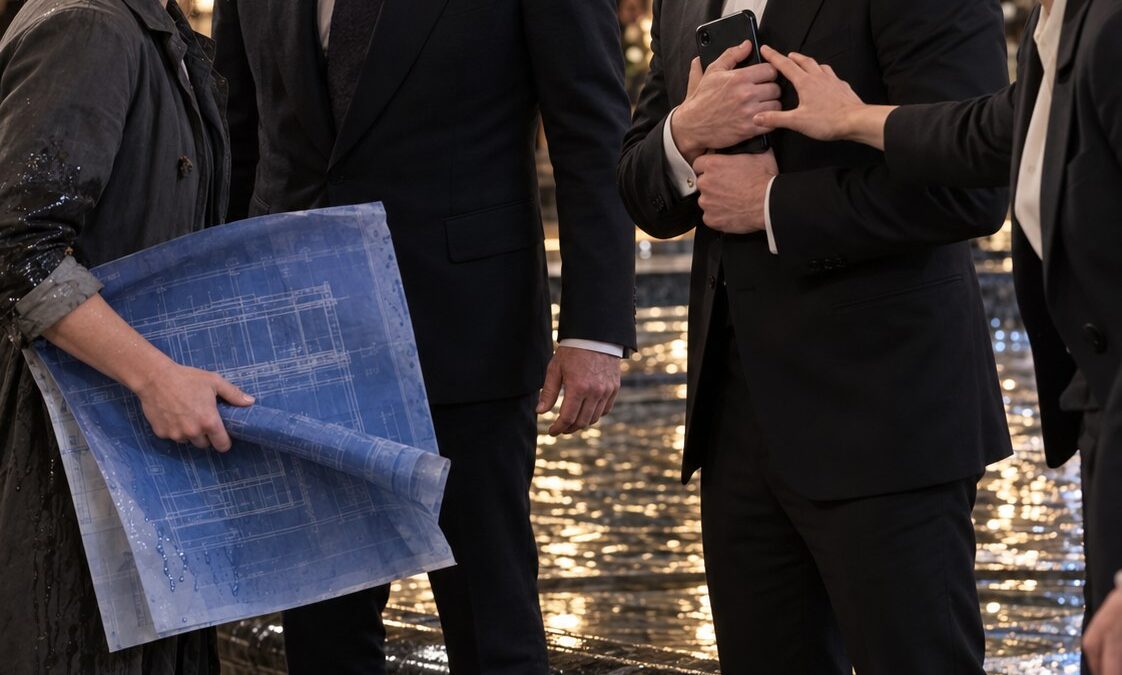
Elliot held it closer to his chest.
“It’s a copy,” he said.
“Then I’ll check the original,” she replied.
Maren knew the inspector’s name.
Dina Mercer had signed the permits for two garage expansions.
She had rejected both on the first attempt.
Maren had respected her ever since.
Cyrus looked at Maren.
“Did you approve the installation?”
“No.”
“Did you sign that?”
“No.”
Dina took out her own phone.
She asked for the certificate number.
Elliot read it aloud.
Around them, guests continued moving into the ballroom.
The violinist began another song.
Maren held the damp acetate away from her coat.
One corner dripped steadily onto the floor.
“You shouldn’t have seen that screen,” Elliot told her.
“You showed it to me.”
“I meant before I explained.”
“Start explaining.”
His eyes flicked to Cyrus.
“It’s a routine form.”
“It has my signature.”
“A digital signature.”
“I never authorized one.”
Cyrus turned to Dina.
“Can you suspend Monday’s test?”
“I can put a hold on the city’s participation while I check what was certified.”
“The equipment belongs to Rook Works,” Cyrus said.
“I can stop our test as well.”
The engineer had been studying the acetate.
She introduced herself as Imani Cho.
Then she pointed to the crescent.
“I’ve never seen this version.”
Maren looked at her.
“Elliot said your team evaluated it.”
“We evaluated a drawing without that opening.”
“Did you test it under a fast rise?”
“Our contract covered a slower rise.”
Maren felt the fountain water cooling against her wrist.
Her father’s final report had described a fast rise.
She had read it until the folds split.
“Who set the test conditions?” she asked.
Imani looked at Elliot.
He spread his hands.
“The city’s original scope.”
Dina frowned.
“The city asked your firm to recommend the conditions.”
Cyrus put his watch back on.
“Let’s go somewhere quieter.”
Maren didn’t move.
“If we leave, does the announcement go ahead?”
“No,” Cyrus said.
“You can decide that alone?”
“I can stop my company from making it.”
He said it without looking at Elliot.
Maren rolled the acetate carefully.
The edges still lined up.
The ink had held.
Elliot noticed her checking it.
“That’s why I tossed it,” he said.
“I knew it wouldn’t be damaged.”
“You didn’t know where it would land.”
“Maren.”
Dina asked Elliot to send the certificate to her official address.
He hesitated.
Then he did.
Cyrus took Maren toward a small meeting room off the lobby.
Imani and Dina followed.
Elliot came last.
A server brought towels at Cyrus’s request.
Maren dried the acetate first.
Cyrus noticed and passed her a second towel.
She rubbed her sleeve.
“I thought you’d seen my revision,” she told Imani.
“Your name was on the first presentation.”
“I was told it wasn’t.”
Imani opened her tablet.
She found a meeting record from nineteen months earlier.
The title read HOLT PRESSURE GATE: ORIGINAL CONCEPT.
Under contributors were Elliot Holt and Maren Holt.
Maren stared at her name.
Elliot looked away.
“I asked for it to be removed from the later deck,” he said.
“Why?” Cyrus asked.
“The investors wanted one person responsible.”
Cyrus’s expression hardened.
“I was one of those investors.”
“You wanted a clean presentation.”
“I wanted a working gate.”
Maren remembered the night Elliot had told her the board found her background distracting.
She had been sitting at the kitchen table, labeling test containers.
He had said she could still help at home.
Now she understood the remark differently.
“They knew I made it,” she said.
Imani nodded.
“At the beginning, yes.”
Elliot gripped the back of a chair.
“It got complicated.”
Maren placed the blue sheet on the table.
“No,” she said.
“You made it complicated.”
Imani zoomed in on the first presentation.
There was Maren’s model.
There was the crescent.
Beneath the image, in smaller type, was her name.
Elliot had not hidden her from the project at first.
He had erased her after her design became valuable.
* * *
By nine the next morning, the test was on hold.
The gala’s announcement had been reduced to a statement that the barrier required further review.
Nobody had mentioned a cause.
That restraint was Dina’s idea.
She wanted the records preserved before anybody built a public defense around them.
Maren approved.
She had spent the night at her sister Tessa’s apartment.
Elliot had called eleven times.
She had answered none.
At seven, he sent a message.
We can fix this privately.
Maren saved it.
Then she turned off notifications.
Cyrus had offered a car.
She took the bus.
The driver recognized her from the garage and asked why her sleeve was still damp.
“Long story,” she said.
“Does it end well?”
“I’m working on that.”
Tessa had insisted on coming.
She waited outside Rook Works with two coffees and an expression that discouraged conversation.
Tessa was a school librarian.
She had never liked Elliot.
Maren had often treated that as a flaw in her sister’s judgment.
“This is terrible coffee,” Tessa said.
“You bought it.”
“I’m making sure you feel at home.”
Maren managed a laugh.
Inside, a lawyer named Priya Shah explained the next steps.
Priya represented Rook Works.
She made clear that Maren could bring her own lawyer before answering detailed questions.
Maren appreciated hearing it.
Tessa found a legal aid referral through a friend.
By lunch, Maren had retained an attorney experienced with design ownership and contract disputes.
His name was Arthur Bell.
He had a quiet voice and a stack of questions.
He asked when she first drew the crescent.
Maren gave him a date.
She knew it because the fourth model had jammed on the night Tessa’s oldest child learned to ride a bicycle.
Tessa had sent a video while Maren scraped grit from the model.
Arthur asked for the video.
“The gate isn’t in it,” Maren said.
“Your table might be.”
It was.
In the corner of Tessa’s video, behind a delighted child in a helmet, stood Maren’s kitchen table.
The blue acetate lay across it.
The crescent showed clearly beneath a jar of bolts.
The video file carried its original date.
It proved the opening existed before Elliot’s firm filed its revised drawing.
Arthur wanted more.
Maren went to the bus garage.
Her supervisor, Wes, let her into the locked storage cage where she kept tools.
She retrieved a plastic bin of models and notebooks.
Wes lifted one small gate from the top.
“This thing again,” he said.
“You remember it?”
“I remember asking you to stop testing it in my wash bay.”
“You let me finish.”
“You fixed three buses that month.”
He found the maintenance log.
Maren’s name appeared beside after-hours use of the wash bay.
The entries lined up with her notebook tests.
Wes signed a statement describing what he had seen.
He did not claim to understand the design.
He claimed to know who had brought it to work.
That was enough.
In the afternoon, Maren sat with Imani over the installation drawings.
The blue acetate rested beside them.
Imani had printed every revision.
Maren checked the lower plate first.
The installed version had no crescent.
It also had a thicker hinge cover.
“What’s this for?” she asked.
“Reducing debris buildup.”
“It closes the space where grit can escape.”
Imani leaned in.
The change had seemed sensible on its own.
Together with the missing opening, it could make the gate harder to release after a surge.
They called in a second engineer from outside the project.
He asked for the test data before offering an opinion.
Maren liked him immediately.
She gave him her notebooks.
He read them slowly.
At one point he asked why her notes listed a bus part beside a flow reading.
“I used the part as a weight,” she said.
He nodded and continued.
Dina arrived with the certificate records.
The signature was an electronic image.
Someone had uploaded it through Elliot’s firm account at 8:14 that morning.
The image itself looked like Maren’s signature.
Arthur placed it beside a consent form Maren had signed the previous spring.
The shape matched exactly.
Even the small break in the ink below her final letter was identical.
“Where was this consent form?” Arthur asked.
“At Elliot’s office.”
“What did it authorize?”
“Use of my drawings for an initial demonstration.”
Arthur looked at the date.
“It expired before construction.”
Maren rubbed her forehead.
She remembered signing it after a late shift.
Elliot had brought dinner.
He had said it would help them move faster.
“What does the certificate say I approved?” she asked.
“Installation according to the final plans,” Dina said.
“Could they hold me responsible?”
“They may try,” Arthur replied.
“I’d rather tell you that plainly.”
Tessa reached across the table and squeezed Maren’s hand.
Maren did not pull away.
Cyrus came in near sunset.
He had changed into a plain gray sweater.
His shoes were dry.
“I’ve frozen the next payment to Elliot’s firm,” he said.
“Will that help preserve records?” Arthur asked.
“It should.”
“Tell them in writing to keep everything.”
“Our counsel did.”
Maren studied him.
“You could lose the contract schedule.”
“We will.”
“And money.”
“Yes.”
She waited for him to make the sacrifice sound noble.
He didn’t.
“Why did you invest in this gate?” she asked.
“My company owns warehouses behind the river wall.”
“That’s the whole reason?”
“It’s a good reason.”
He paused.
“My mother ran a clinic there for twenty years.”
Maren had passed that clinic on her way to school.
It was now a neighborhood health center.
She had never connected it to him.
“My father worked that river,” she said.
“I know.”
She stiffened.
Cyrus noticed.
“I read the old incident report after I saw your name.”
The report had blamed sudden weather and a jammed mechanism.
Maren had always thought the explanation was incomplete.
“I built the crescent because of that gate,” she said.
“Then I want it tested properly.”
Arthur’s phone buzzed.
He read the message twice.
“What?” Maren asked.
“Your old consent form was scanned into the project archive.”
“Elliot had it.”
“The scan was uploaded from your home internet connection.”
Maren pictured the desk in the spare room.
Elliot kept his work laptop there.
Her drawings had sat in that same room for years.
The forged signature had been prepared at home.
* * *
That evening, somebody changed the locks on Maren’s apartment.
Elliot sent her a photograph of a locksmith’s receipt.
He wrote that she could collect her things by appointment.
Arthur called him.
Within an hour, Elliot’s attorney agreed to give Maren access the next morning.
Tessa offered to accompany her.
Maren said yes.
She had once called the apartment their place.
Now she needed a witness to enter it.
Cyrus learned about the locks when Arthur requested copies of photographs Maren had stored on their shared computer.
He called her once.
She answered because his number was saved.
“Are you safe?” he asked.
“I’m at Tessa’s.”
“Good.”
“I’m angry.”
“That also sounds reasonable.”
“He changed the locks before I did anything to him.”
“You told the truth about the design.”
“That’s all.”
“It may be enough.”
Maren sat on Tessa’s back porch.
Rain tapped the railing.
She could smell onions from the kitchen.
“Did you ever see the project file before last night?” she asked.
“I saw the investment summary.”
“And my name?”
“On an early contributor list.”
“You didn’t ask where I went?”
“I was told you withdrew.”
“By Elliot?”
“By the person managing the deal.”
He said the name.
Verity Lane.
Maren knew Verity as Cyrus’s chief operating officer.
She also knew Verity as Celeste’s mother.
At the gala, Celeste had been standing beside Elliot.
The connection settled heavily.
“Did she approve the revised drawings?” Maren asked.
“She approved the contract packet.”
“Why would she remove me?”
“I’m finding out.”
Maren heard Tessa call everyone to dinner.
“I have to go,” she said.
“Maren.”
“What?”
“I’m sorry I didn’t ask you myself.”
She looked at the rain.
“That would have been a useful question.”
“I know.”
She ended the call.
The next morning, Arthur, Tessa, and Maren entered the apartment together.
The locksmith had left a new key with Elliot’s attorney.
Elliot was absent.
Maren collected her notebooks, work clothes, and her father’s old tool chest.
The good shoes under the hall bench had mildew on one heel.
She took them anyway.
In the spare room, the shared computer was gone.
Its cables remained.
Arthur photographed the desk.
Tessa pointed to an empty patch on the wall.
“Wasn’t there a calendar?”
“Elliot took it.”
Maren opened the desk drawer.
A folder held copies of household bills.
Beneath them lay a glossy brochure for a planned riverside development.
The map showed buildings behind the new barrier.
Some occupied lots currently leased by small businesses.
The brochure promised a launch after the barrier’s first successful test.
Celeste’s public affairs firm appeared on the back page.
So did a company Maren didn’t recognize.
LANE HARBOR PARTNERS.
Arthur took a photograph.
“Does that belong to Verity?” Maren asked.
“We’ll check.”
At Rook Works, Cyrus already had investigators reviewing the procurement file.
He had also told his board about the hold.
Verity had called the delay an overreaction.
She argued the gate could be modified after testing.
Imani opposed that.
A fast-rise test with a possible release problem was an unacceptable way to learn whether Maren was right.
The outside engineer agreed after reviewing the records.
Dina’s office kept the city hold in place.
The decision was documented.
It could withstand a press release.
Maren spent the afternoon explaining her notebooks to the engineer.
He challenged her assumptions.
She corrected one measurement.
He found another she had recorded twice.
It embarrassed her.
Then he told her the error made the next test easier to design.
That was what she had wanted from Elliot.
A person who would look closely enough to disagree.
At five, Wes called.
“Someone came asking about your wash bay entries.”
“Who?”
“A man who said he worked for a records company.”
“Did he see them?”
“No.”
Wes sounded offended.
“He wanted originals.”
Maren told Arthur.
Arthur asked Wes to preserve the security footage and any written request.
Wes agreed.
By six, Celeste had issued a public statement.
It described Maren as a former contributor who misunderstood the current design.
It said the project was safe.
It mentioned the certificate bearing her signature.
Maren read it twice.
Her face stayed still.
Tessa read it once and swore.
Arthur advised a short response through counsel.
Maren wanted to say more.
She also wanted every word supported.
She let him draft it.
That night, Cyrus came to Tessa’s porch carrying takeout containers.
Tessa had invited him without telling Maren.
“I thought he might bring dessert,” she said.
“I did,” Cyrus replied.
He held up a small paper bag.
Maren looked from one to the other.
“This is a conspiracy.”
“It began in the kitchen,” Tessa said.
Cyrus set the food down.
He asked before sitting beside Maren.
She made room.
For ten minutes, they ate noodles and discussed the bus heater that had failed again.
Cyrus seemed interested in how it worked.
Maren showed him a drawing on a napkin.
He turned it over twice.
“Your lines are better than our presentation slides,” he said.
“They should be.”
She pointed with a chopstick.
“This one actually leads somewhere.”
He laughed.
It surprised her.
She had heard his voice in conference rooms and on television.
She had never heard him laugh without guarding it.
After dinner, he told her what his investigators had found.
Lane Harbor Partners owned an option to buy several riverfront lots.
The option became more valuable if the barrier passed its first public test on schedule.
Verity had approved Cyrus’s investment while failing to disclose her interest in the company.
Celeste’s firm stood to receive a large fee for the development campaign.
“And Elliot?” Maren asked.
“His firm had a bonus tied to the test date.”
Maren thought of his urgent texts.
His insistence that the board vote tonight.
The locks.
“He knew about the missing opening,” she said.
“We don’t have proof of that yet.”
“He took my sheet.”
“We have proof of that.”
Cyrus glanced at the damp edge she had hung to dry over a chair.
“Why would Verity risk a dangerous gate?” Maren asked.
“The danger might not have seemed real to her.”
“It should have.”
“Yes.”
He did not soften the answer.
Arthur called before Cyrus left.
A company filing showed Verity was the sole owner of Lane Harbor Partners.
There was no distant investor to blame.
The architect of the deadline was Verity Lane.
* * *
Verity requested an emergency board meeting on Friday.
She claimed Cyrus had halted a civic project based on an unverified accusation from the wife of a contractor.
She asked the board to restore the test schedule.
The board invited Maren to speak.
Arthur prepared her for questions.
He also warned her that Verity was good at turning facts into doubt.
Maren had seen that already.
At the Rook Exchange, the fountain had been drained for cleaning.
The black basin looked smaller without water.
Maren stopped beside it.
Cyrus joined her.
“I can ask them to fill it,” he said.
“It won’t help my speech.”
“I wasn’t thinking about the speech.”
She smiled despite herself.
He did not touch her.
After a moment, they went inside.
The meeting room held nine board members, Dina, Imani, the outside engineer, two attorneys, and Verity.
Elliot sat near Verity.
Celeste sat behind them with a folder on her lap.
Maren took a seat beside Arthur.
Cyrus chaired the meeting.
Verity began politely.
She acknowledged Maren’s early contribution.
She praised the care behind the original model.
Then she described the installed gate as the product of a larger engineering process.
No single drawing, she argued, could decide whether it was safe.
The outside engineer agreed with that narrow point.
Verity looked pleased.
He continued.
The combined changes to the lower plate and hinge cover created a release risk under conditions that had not been tested.
He recommended a new controlled test before any public demonstration.
Verity asked whether he could prove a failure would occur.
“No,” he said.
“Then you’re delaying a needed project over a possibility.”
“I’m delaying a public test until we know its limits.”
“Every machine has limits.”
“Which is why we measure them.”
The board listened.
Maren studied Elliot.
He avoided her eyes.
When it was her turn, Arthur placed her notebooks on the table.
Maren described the four models.
She explained how grit accumulated.
She showed the board the crescent on the acetate.
The blue sheet had dried with a faint waterline.
It looked battered beside the polished presentation screens.
“It lets pressure ease before the gate is released,” she said.
Verity held up one hand.
“Isn’t that an opinion?”
“It’s what my tests showed.”
“Small tests in a bus garage.”
“Yes.”
“You aren’t a licensed engineer.”
“No.”
“Yet you’re asking this board to prefer your kitchen model to the work of qualified professionals.”
Maren glanced at Imani.
“I’m asking them to run the test their own engineer recommends.”
Verity’s expression barely changed.
She moved to the certificate.
It bore Maren’s signature.
Maren said she had never signed it.
Verity asked whether she had given Elliot permission to use her drawings.
“Yes,” Maren said.
“For an initial demonstration.”
“Did you read the form?”
“Yes.”
“Carefully?”
Arthur started to object.
Maren answered first.
“I read the part that ended permission before construction.”
A board member asked to see the form.
Arthur provided it.
The expiration date was clear.
Verity changed direction.
She said the certificate might be a clerical error.
It did not affect the engineering judgment.
Dina spoke.
“The certificate is part of the city’s approval record.”
“Then correct it,” Verity said.
“We are investigating how it entered the record.”
Verity leaned back.
For a moment, Maren thought the discussion might end there.
Then Elliot stood.
He apologized for the argument at the gala.
He said he had mishandled Maren’s concerns.
He described their marriage as strained.
Maren looked down at the blue sheet.
“The project became personal,” he said.
“I should have kept those issues apart.”
He sounded sincere.
She had heard that voice after forgotten birthdays and broken promises.
He had always been best at apologies made before anyone knew what he had done.
“Did you upload her signature?” Cyrus asked.
Elliot looked at him.
“I sent the certificate through our office.”
“Did you create the signature image?”
“I relied on my staff.”
“Which staff member?”
“I’m reviewing that.”
Verity interjected.
“We can investigate paperwork without abandoning the schedule.”
Arthur passed a note to Maren.
She read it.
Then she asked Cyrus if she could show one more thing.
She unrolled the acetate fully.
In the lower corner, beside her father’s old drafting mark, was a shallow circular stain.
She had made it with a hot washer during the fourth test.
The washer melted a tiny raised rim into the plastic.
When Elliot scanned the sheet for the first presentation, the mark appeared as a dark circle.
In the later project drawing, the crescent had been removed.
The circle remained.
Maren laid the early and late drawings side by side.
“That mark doesn’t belong to the gate,” she said.
“It belongs to my sheet.”
Imani leaned forward.
Maren traced the circle without touching the paper.
“The later drawing was made from my original scan.”
“You said the team redesigned it,” she told Elliot.
“They removed one feature and called the rest theirs.”
Elliot looked at Verity.
The motion was small.
Everyone near him saw it.
Verity recovered first.
“A drafting mark proves a document history,” she said.
“It does not prove bad intent.”
“No,” Maren said.
“It proves where the drawing came from.”
“Who can confirm the date?” a board member asked.
Arthur played Tessa’s old video.
The room watched a child wobble down a sidewalk.
Behind him, through a kitchen window, lay the blue acetate.
The crescent and the circular stain were both visible.
Tessa had kept the original file.
The metadata showed it had been recorded six months before Elliot’s revised drawing.
The board member asked Arthur to pause the image.
Nobody spoke for several seconds.
Verity remained calm.
“Then credit Maren,” she said.
“Pay her for her contribution.”
“And test the gate,” Maren replied.
“Of course, eventually.”
“Before Monday.”
Verity turned to the board.
“You are risking financing and city confidence on a delay that may achieve nothing.”
Cyrus looked at each member.
“We’re voting on whether to keep the test hold.”
The vote was eight to one.
The hold remained.
Verity cast the single opposing vote.
Cyrus then disclosed Lane Harbor Partners.
He had the company filing.
He had the option agreement.
Verity said her investment was private and lawful.
She argued it had never influenced a technical decision.
Dina requested copies for the city’s investigators.
Rook Works’ outside counsel advised the board to preserve all communications and place Verity on leave while an independent review proceeded.
The board voted unanimously.
Verity stood.
Her chair rolled back against the wall.
“You think a garage mechanic can run your company?” she asked Cyrus.
Maren answered before he could.
“I came to keep a gate from jamming.”
“That’s a convenient story.”
“It’s the reason I’m here.”
Verity gathered her papers.
Celeste followed her out.
Elliot stayed seated.
The independent review took six weeks.
Investigators obtained project messages, drafts, and payment records.
An outside engineer ran controlled tests on the installed gate.
Under a fast rise with grit present, its release mechanism stuck twice.
The gate was taken out of service.
The review found that Elliot had asked staff to remove Maren’s name from later presentations.
It also found a message from Verity directing Elliot to keep the first test conditions narrow enough to meet the launch date.
Elliot admitted he had copied Maren’s signature from the old consent form and uploaded it to the certificate.
He said Verity had told him the form was only temporary.
The records did not support that claim.
Verity denied ordering the forgery.
She acknowledged she should have disclosed her financial interest.
Her own messages showed she knew the opening had been removed before she approved the contract packet.
The city referred the forged certificate and procurement records to prosecutors.
Civil claims followed.
Months later, Elliot pleaded guilty to falsifying the certificate and agreed to repay his project bonus.
Verity resolved the procurement case with the authorities after admitting she had concealed her interest in Lane Harbor Partners.
She lost her position and paid a substantial penalty.
Celeste’s firm lost the development campaign when the underlying option expired.
Maren did not attend every hearing.
Arthur sent her the records.
The pages were easier to read than Elliot’s face.
At the last civil conference, Elliot asked to speak to her.
Arthur stayed nearby.
“I did love you,” Elliot said.
Maren believed he wanted that sentence to excuse the rest.
She held the blue sheet under one arm.
“You could have loved me and still chosen badly,” she said.
“You chose badly for a long time.”
He looked at the floor.
There was nothing more she needed him to say.
* * *
In spring, the buses needed their air conditioners repaired.
Maren worked overtime again.
This time, her pay went into an account only she could use.
She rented a small apartment above a bakery.
At six each morning, the ovens warmed her kitchen floor.
Tessa called it a luxury.
Maren called it an accident of plumbing.
The divorce was finalized in May.
She kept her tools, her notebooks, and her father’s tool chest.
Elliot kept the apartment with the crooked shelf.
Maren missed the shelf for two days.
Then she bought a better one.
The gate project restarted under a new team.
Imani led the engineering work.
The outside engineer stayed on for testing.
Maren joined as a paid design adviser after Arthur reviewed the agreement.
Her name appeared on every drawing that used her work.
The contract did not make her rich.
It paid fairly.
That mattered more than Elliot had understood.
Cyrus offered her a senior position at Rook Works.
She thanked him.
Then she declined.
“I already have a job,” she said.
“You could have two.”
“I do.”
“You repair buses and teach our engineers what they missed.”
“That’s a full week.”
He smiled.
She suggested a different use for the position’s budget.
The neighborhood technical school needed equipment and paid training placements.
Several students already helped at the bus garage.
Cyrus reviewed the proposal with his board.
Rook Works funded three years of placements.
Maren insisted the school choose the students.
She helped teach the first group how to read a drawing and when to question one.
On the first morning, a student found an error in Maren’s sample plan.
She had put it there deliberately.
The student looked terrified.
“Tell me,” Maren said.
He did.
She gave him the marker.
Cyrus visited once and stayed out of the way.
Afterward, he waited by her car with two coffees.
“You missed the best part,” she told him.
“I saw enough.”
“You should have stayed for the pressure demonstration.”
“I was told the garage supervisor would make me wear safety glasses.”
“He would.”
“I had a meeting.”
“Convenient.”
Cyrus handed her a coffee.
They had been seeing each other for three months.
At first, they had chosen public places.
Then dinners at Tessa’s became easier.
Tessa liked him more than she admitted.
She liked that he washed dishes.
She liked that he asked before offering help.
Maren liked those things too.
She also liked his dry remarks about terrible architecture.
Once, after a difficult meeting, he brought her a sandwich and sat beside her without asking for the whole story.
She told him when she was ready.
Some evenings they discussed the gate.
Others, they argued about which bakery sold the best cinnamon roll.
Neither of them had won.
The project’s first full test took place in late summer.
The barrier lowered.
Water rose in the controlled channel.
Grit moved against the lower plate.
Imani gave the release command.
The gate lifted.
Maren watched the pressure gauges.
They returned to normal.
The team repeated the test under three more conditions.
The gate worked each time.
Dina signed the updated inspection after reviewing the results.
Maren read her name on the final drawing.
She could hear her father telling her to check the measurements once more.
She did.
That night, Cyrus took her to dinner.
They ate at a small place with paper menus.
He had once reserved entire restaurants for business meetings.
Maren liked watching him wait for a table.
When he reached across it, he stopped short of her hand.
“Can I ask you something?” he said.
“You just did.”
“I can ask another thing.”
“You usually do.”
He took the joke.
Then he grew serious.
“I’d like you to meet my mother.”
Maren blinked.
“The woman who ran the clinic?”
“She’s retired from that.”
“Does she know about me?”
“She knows you corrected a gate.”
“That’s a professional introduction.”
“She also knows I talk about you.”
“How much?”
“Enough to have opinions.”
Maren considered him.
Meeting his mother felt different from a board meeting.
It also felt like something she wanted.
“Yes,” she said.
“Ask her when.”
He looked relieved.
Then she pointed her fork at him.
“If she calls me a genius, I’m leaving.”
“She’ll probably ask why the buses keep breaking.”
“She may like me.”
His mother did.
She asked about the buses.
She also asked whether Cyrus remembered to eat lunch.
Maren answered honestly.
Forgiveness came more slowly elsewhere.
Elliot sent an apology through Arthur.
It named the stolen credit, the forged signature, and the way he had tried to make Maren doubt herself.
She read it once.
She did not reply.
A month later, he wrote again to ask whether they might talk.
Maren told Arthur to answer.
She accepted the apology.
She did not want contact.
The boundary brought her more peace than the apology had.
In October, Cyrus invited her back to the Exchange.
Rook Works was opening an exhibit about the river barrier.
He told her she could skip the reception.
“I know where the side entrance is,” she said.
He frowned.
“I shouldn’t have said that.”
“You didn’t.”
“You still had to hear it.”
Maren touched his hand.
“I can go through the front.”
“I’d like that.”
She looked at him.
“Are you asking me to attend a company event?”
“I’m asking you to come with me.”
“Then yes.”
He leaned closer.
“Can I kiss you?”
Maren smiled.
“Yes.”
He did.
Across the table, Tessa’s youngest child loudly asked whether dessert was coming.
They broke apart laughing.
* * *
Four years later, the fountain ran again.
Its water fell over black stone beneath the same chandelier.
Maren stood beside it in work boots.
She had come from a school workshop, where a student had assembled a model gate that refused to move.
The student found a bent pin and fixed it.
Maren had been proud enough to forget changing shoes.
Cyrus arrived carrying two paper cups of coffee.
Their daughter walked between them, holding one of his fingers and one of Maren’s.
She was old enough to ask why the fountain was indoors.
She was also old enough to reach for it.
Maren caught her sleeve.
“Can I touch the water?” the girl asked.
“Yes,” Maren said.
“Just the water.”
Cyrus set down the coffees.
The girl dipped one finger.
“It’s cold.”
“It was colder before,” Maren said.
“Before what?”
Maren looked at Cyrus.
He waited.
She told their daughter that she had once lost an important drawing in this fountain.
“Did you get it back?”
“I did.”
“Who got it?”
“Your dad.”
The girl looked at his dry shoes.
“You went in?”
“I did.”
“Were you allowed?”
Maren laughed.
Cyrus considered the question.
“I owned the building,” he said.
“That’s not an answer,” their daughter replied.
“She gets that from you,” he told Maren.
“Of course she does.”
Maren opened the flat case she had brought from the workshop.
Inside lay the blue acetate.
Its edges had been repaired.
The waterline still crossed the corner.
The circular stain still marked the place where a hot washer had touched it years before.
Beside it, a newer drawing showed the gate that now protected the neighborhood.
The crescent remained.
Maren showed her daughter how water moved through it.
Their daughter listened for a moment.
Then she asked for her coffee cup, which held warm milk.
Cyrus gave it to her.
Maren closed the case.
Her father’s notes had been preserved.
The students had tools.
The buses still needed fixing.
The river barrier worked.
At home, the kitchen shelf was straight.
Cyrus took her free hand.
“Ready?” he asked.
Maren looked once more at the fountain.
She remembered standing there with a wet sleeve, waiting for her drawing to drift close enough to reach.
Now their daughter was between them, impatient to see the rest of the exhibit.
“Yes,” Maren said.
Together, they walked through the ballroom doors.
THE END








