Her Husband Left Her at the Gala’s Loading Door—Then the City’s Most Feared Landlord Recognized the Key Around Her Neck
Chapter 2: What the Key Opened
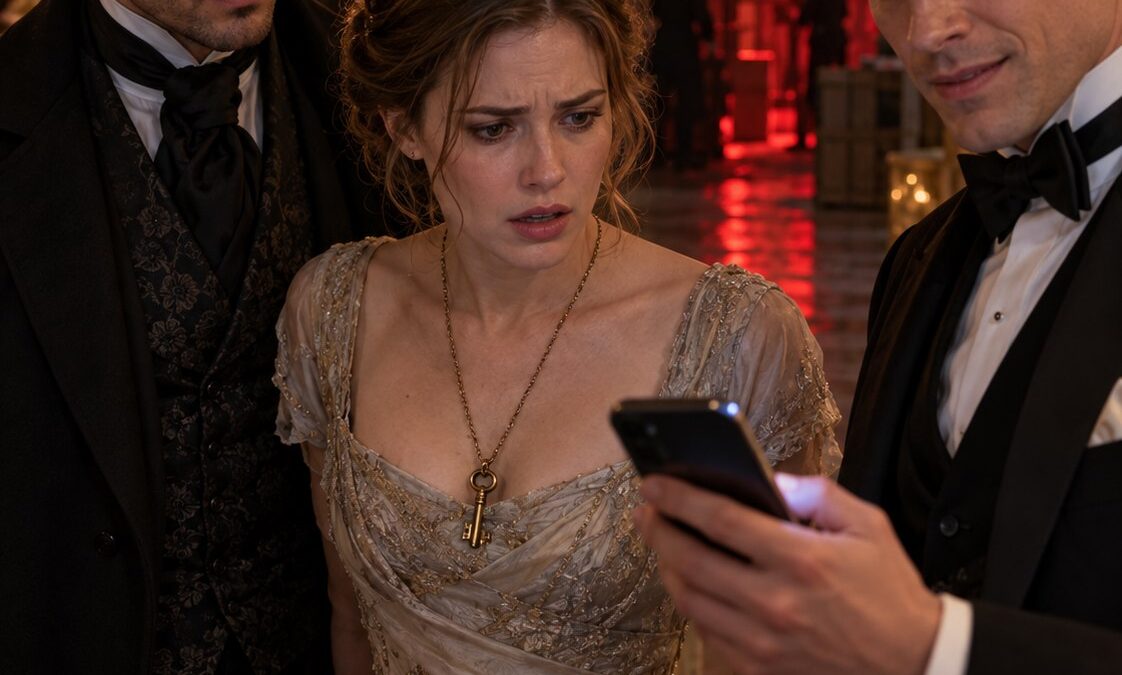
Rhea stopped beneath the ballroom lights.
Nolan slipped his phone into his pocket.
Cassian saw where she was looking.
“What happened?”
“My name is on a transfer.”
“Did you approve one?”
“No.”
Nolan approached with his practiced smile.
“Rhea, we need to talk privately.”
“We are,” she said.
He glanced at Cassian.
“That’s not what private means.”
“Your phone says I authorized something.”
“It’s an account notice.”
“Which account?”
“Our project account.”
“I’m not on that account.”
Nolan’s smile failed.
Cassian took one step nearer.
“Show her.”
“It contains confidential figures.”
“Then tell her the amount.”
Helena appeared beside Nolan.
“Financial matters can wait until after the ceremony.”
Rhea thought of the time on the screen.
They could wait until after the ceremony.
Someone had chosen midnight for a reason.
“My mother’s key matters to both of you,” she said.
Helena looked at Cassian.
“Your father dealt with June directly.”
“He did,” Cassian said.
“We found no evidence of wrongdoing.”
Rhea turned toward him.
“Why did you say she was cleared?”
“Because she was.”
“Then why did she believe she wasn’t?”
Cassian’s expression changed.
“Because somebody made sure she never received the letter.”
Helena opened her mouth.
A woman at the end of the corridor announced the ceremony’s first speaker.
Guests began moving toward the main hall.
Cassian reached into his coat and gave Rhea a card.
On the back, he wrote a name and a number.
“Mara Ellison,” he said.
“She’s an attorney.”
“Yours?”
“The trust’s former counsel.”
Helena’s face tightened.
“She retired.”
“Her license didn’t.”
Nolan checked his watch.
“I need to introduce the donors.”
“No,” Rhea said.
He stared at her.
“I need to see the transfer.”
“You can’t understand it from a phone screen.”
“Try me.”
He held her gaze for a moment.
Then he looked down.
“It isn’t final.”
“Show me.”
He took out the phone.
His thumb hovered over the screen.
Before he could turn it, Helena touched his sleeve.
“Mr. Fenwick.”
It was a tiny gesture.
Rhea might have missed it if she hadn’t spent eleven years learning when Nolan was about to change his answer.
He put the phone away.
Cassian saw it too.
“There’s a records room upstairs,” he told Rhea.
“We can ask Mara to meet us there.”
Helena gave a short laugh.
“You intend to turn an opening night into an audit?”
“If the paperwork is sound, it’ll be brief.”
“Your guests are waiting.”
“They can eat the expensive fish.”
Rhea almost smiled.
Then her phone vibrated.
A message from an unfamiliar number showed a photograph of her apartment door.
Beneath it were four words.
LEAVE THE KEY HERE.
She tilted the screen toward Cassian.
He read it without taking the phone.
Nolan was watching her.
For the first time, Rhea could not tell whether he had sent the message.
Cassian called someone and asked for the building manager at Rhea’s address.
He spoke plainly.
There had been a threatening message.
He wanted the manager to preserve lobby footage and contact the police.
He did not promise to make anything disappear.
Rhea was grateful for that.
“My mother lived in fear of what people could make disappear,” she said.
Cassian’s gaze moved to the key.
“She didn’t trust me with it.”
“You were a child.”
“I was seventeen.”
“She trusted someone else?”
“She may have been trying to protect us both.”
Rhea looked at him.
He answered the question before she asked.
“My father asked June to keep the original trust instructions safe.”
“What instructions?”
“The ones that kept this waterfront open to the public.”
Behind them, applause rose from the main hall.
Helena was being introduced.
Cassian looked toward the sound.
“The trust didn’t just employ your mother,” he said.
“June helped my father write its protections.”
* * *
The records room smelled of paper and fresh paint.
Someone had preserved the old cabinets and replaced every lock.
Mara Ellison arrived in a raincoat over her black dress.
She was seventy, brisk, and visibly irritated.
“You have terrible timing, Cassian.”
“I inherited it.”
Mara looked at Rhea.
“June’s daughter.”
“Yes.”
“You have her eyes.”
Rhea had heard that before.
Mara seemed to know she had.
“I should have called you years ago,” Mara said.
“Why didn’t you?”
“I was told you wanted no contact.”
“Who told you?”
“Helena.”
Mara put her bag on the table.
Cassian drew out a chair for Rhea.
She remained standing.
“I don’t want another story someone heard from Helena.”
“Fair.”
Mara opened her bag and took out a folder.
“These are copies of the original trust filing.”
Rhea studied the first page.
The trust had been created in 2004, the year Cassian’s father died.
It protected four blocks of waterfront property.
The old customs house could host private events, but the adjoining warehouses had to remain available for public workshops, emergency shelter, and small businesses at controlled rents.
Her mother’s name appeared near the end.
Not as an owner.
Not as a thief.
June Bell had witnessed the signing.
Beside her name was a familiar looping J.
Rhea had seen it on birthday cards and notes tucked into school lunches.
Her throat tightened.
“What was she accused of taking?”
“A key and a file,” Mara said.
Cassian stood by the cabinet.
“The file went missing before my father’s memorial.”
“Who reported it?” Rhea asked.
Mara hesitated.
“Helena.”
“Who had access?”
“Board members and records staff.”
“Why was my mother cleared?”
“Two staff members saw her leave empty-handed,” Mara said.
“We also found the key listed as transferred to her custody before the memorial.”
Rhea looked down at the brass in her palm.
The notch had worn smooth against her thumb.
“Why wasn’t the letter delivered?”
“I signed it and sent it to the trust office.”
“Who handled mail?”
“Helena’s staff.”
Mara’s mouth hardened.
“I should have sent another copy myself.”
Rhea wanted to ask why she hadn’t.
Mara had already answered.
People with power made it easy for everyone else to assume a matter was handled.
Cassian turned to the old cabinets.
“Would the key fit one of these?”
“Those locks were replaced,” Mara said.
“Your father kept a private archive.”
“Where?”
“Downstairs, in the original vault.”
Rhea looked at the filing again.
A small notation ran along the bottom margin.
She had spent eight years repairing maps and ledgers for a historical society.
Damaged paper taught her to notice what newer ink tried to cover.
“This copy was made later,” she said.
“Yes,” Mara replied.
“But the page number wasn’t.”
She pointed to a faint mark beneath the final line.
A printed seven sat under a handwritten nine.
“Someone copied a longer document and numbered it as if pages eight and nine never existed.”
Mara bent over the page.
“I remember seven pages.”
“The copy says nine,” Rhea said.
Cassian came beside her.
“Can you tell when they changed it?”
“Not from this.”
Mara took off her glasses.
“The original filing went to the county clerk.”
“Would it include all nine pages?” Rhea asked.
“If June filed what we signed.”
Cassian looked at Mara.
“Can we get a certified copy?”
“Tomorrow morning.”
Rhea glanced at the clock.
Tonight’s transfer was still coming.
Mara called the county’s overnight records line and left a request under her license number.
Then she called a colleague who handled emergency injunctions.
Cassian called his bank’s fraud department.
As a trustee, he could ask them to hold any trust transfer pending a board review.
He could not freeze an account he did not control.
Nolan’s project account might be one of those.
Rhea wanted to do something more than watch phones light up.
She took out her own.
The transfer notification had arrived from an address she did not recognize.
Nolan had once asked her to sign access forms for the project’s online portal.
He had told her it was so she could see how much of their savings went into the business.
She had never received login details.
She searched her email.
The forms were attached to an old message.
Mara read them.
“This gives you viewing access.”
“Could it authorize a transfer?”
“No.”
Rhea found a second attachment.
It had been added six weeks later.
The signature at the bottom looked like hers.
It wasn’t.
Her R crossed its stem at the top.
This one crossed at the middle, the way Nolan drew it when he signed birthday cards from both of them.
“That isn’t mine,” she said.
Mara checked the file details.
“The upload account belongs to Fenwick Development.”
“Can you prove which person used it?”
“Not from this copy.”
Cassian’s phone rang.
He listened.
“The trust bank put a temporary review hold on any release from its accounts,” he said when he hung up.
Rhea felt one knot loosen.
“What if the money has already left?”
“That’s what we’re checking.”
A message arrived from the building manager.
The lobby camera showed a man in a dark cap outside Rhea’s apartment.
He had not entered.
The manager had called the police.
Rhea watched the blurred figure leave the frame.
She did not know him.
Nolan knew where she lived.
So did half the people at the gala.
Cassian showed Mara the threat.
“Keep the original message,” Mara said.
“Don’t answer it.”
Rhea nodded.
She looked again at the false signature.
Nolan had lived with her for eleven years.
He knew how she wrote.
He had still copied it badly.
“I think he counted on me staying at the loading door,” she said.
Mara met her eyes.
“There’s something else you need to see.”
She pulled a second document from the folder.
It was an authorization to move June Bell’s archived papers out of the customs house vault.
Rhea’s name was printed beneath June’s.
A signature appeared beside it.
Rhea had never seen the form.
The date was three months after her mother died.
Nolan had signed her name then, too.
* * *
By ten forty-five, Nolan had finished his speech.
A photograph of the proposed waterfront development appeared on the main hall’s enormous screen.
Glass apartments rose where the public workshops stood.
The emergency shelter was gone.
Rhea watched from the records room doorway.
People applauded the bright lawns in the rendering.
They could not see the businesses already paying rent inside those old buildings.
They could not see the woman who repaired fishing nets in the second warehouse or the volunteers who opened the shelter when winter storms flooded the low streets.
June had known those people.
She had helped write protections for them.
Nolan came off the stage smiling.
Then he saw Rhea beside Mara.
His smile stayed in place, though nothing behind it did.
“You’ve been busy,” he said.
“So have you.”
“I was looking for you.”
“We found each other.”
Mara stepped forward.
“I need a copy of the transfer authorization.”
Nolan recognized her.
“You’re no longer counsel to the trust.”
“Rhea can ask for her own records.”
“Tomorrow.”
“Now,” Rhea said.
He glanced at Cassian.
“This is becoming a spectacle because you enjoy making one.”
Cassian’s voice was quiet.
“Show her what bears her signature.”
Nolan led them to a small office off the hall.
Helena followed.
Celeste waited near the door.
Rhea had almost forgotten her.
Now the silver dress seemed less important than the folder Celeste carried.
Nolan opened his laptop.
He turned the screen toward Rhea.
A transfer request listed $8.6 million from a development escrow account to a newly formed property company.
Rhea was named as an approving officer of that company.
She had never heard of it.
The company’s mailing address was a rented office two floors below Nolan’s.
“Why am I an officer?” she asked.
“It’s a standard holding structure.”
“Whose idea?”
“Mine.”
“Who signed for me?”
“You did, in March.”
“In March I was in Portland for work.”
“You signed electronically.”
“Show me the email.”
“I don’t have it here.”
“You have everything else.”
Helena stepped closer.
“The transfer is part of an approved purchase.”
Mara said, “The trust’s rules don’t allow sale of those warehouses.”
“The trust amended its purpose.”
“That requires the full board and public notice.”
“We satisfied both.”
Cassian turned to her.
“I was never asked to vote.”
“You were traveling.”
“I can read from an airport.”
Helena’s jaw tightened.
Rhea looked at the screen.
The beneficiary account did not belong to her.
But her name would be on the approval trail.
Nolan could tell investigators his wife handled the paperwork.
He had already forged her signature twice.
“What happens to me if this transfer goes through?” she asked.
Nolan shut the laptop halfway.
“Nothing, if you stop treating this like a crime.”
“That’s not an answer.”
“It’s a legitimate project.”
“Then why did you need my name?”
He said nothing.
Celeste shifted beside the door.
Helena turned on her.
“Go back to the hall.”
Celeste stayed.
“I was told Rhea approved the partnership,” she said.
Nolan stared at her.
“You weren’t part of this conversation.”
“I became part of it when you introduced me to the investors as the person who’d replace your wife on the project.”
Rhea felt the sentence land.
Celeste had known about the marriage.
She had also been promised a place in Nolan’s future.
Rhea could not tell whether that promise included knowledge of the forgery.
Celeste set her folder on the desk.
“I have emails from Nolan saying the signatures were cleared by Helena.”
Helena laughed once.
“He would say that.”
Nolan’s eyes darted between them.
The elegant alliance was coming apart under a desk lamp.
Rhea looked at Celeste.
“Did you know my name was on the transfer?”
“Tonight was the first I saw it.”
“I need you to preserve those emails.”
“I already forwarded them to my lawyer.”
That was the first thing Rhea had liked about her.
Cassian’s phone rang.
He stepped into the corridor and returned with a grave face.
“The bank can hold the trust’s outgoing payment until morning.”
Nolan looked relieved.
“Then we can all get some sleep.”
“The development escrow isn’t with that bank,” Cassian said.
“The request on your laptop can still settle at midnight.”
Mara called her colleague again.
She asked for the emergency judge’s number, then read out the company names.
Rhea heard terms she understood only in pieces.
A temporary order.
Preserve records.
Disputed authority.
Nolan began pacing.
Helena stood absolutely still.
Cassian watched his aunt.
“You knew June had the original pages,” he said.
“June knew many things.”
“You removed them after she died.”
Helena glanced at the key.
“June kept what was not hers.”
Rhea held the brass in her fist.
“Someone came to my apartment for it tonight.”
“I have no idea who sent that message.”
Rhea believed the words had been chosen carefully.
Mara finished her call.
“The judge will review our filing once I send the declarations.”
“I’ll sign,” Rhea said.
Nolan stepped toward her.
“You would swear I forged your name?”
“I can swear I didn’t sign.”
“After everything I’ve done for us?”
The old version of Rhea would have named the watch.
She would have listed dinners and rent payments.
Tonight, she did not offer her marriage as evidence in an argument about a signature.
“I’ll swear to what happened,” she said.
Cassian moved beside the desk.
“There’s one question you haven’t answered, Helena.”
“Only one?”
“Who benefits from the company receiving the money?”
Helena looked at Nolan.
He looked away.
Mara searched the company registration on her phone.
The first owner was another company.
Its public filing listed a manager.
Helena’s longtime attorney.
Cassian’s face changed slowly.
“The development was yours,” he said.
Helena did not deny it.
“I spent thirty years keeping this waterfront solvent.”
“By selling the protections my father put on it?”
“By correcting his mistake.”
Rhea understood why Helena had feared the key.
It led to proof that the supposed mistake was a promise.
Helena turned toward her.
“Your mother agreed with me until she saw how much she could demand.”
Rhea shook her head.
“That’s why you kept the accusation alive.”
Helena’s gaze remained steady.
“If people believe a records clerk wanted money, they stop asking what she found.”
* * *
The old vault was one floor below the ballroom.
A security officer accompanied them.
Mara had called the building manager for access.
Nobody broke a lock.
Nobody asked Cassian to make an exception because the building bore his family’s name.
The manager recorded each person who entered.
Rhea appreciated the small ceremony of signatures.
For years, her mother’s name had been moved through rooms without her consent.
Tonight, at least, everyone put theirs on a page.
The vault held empty shelving and one waist-high cabinet.
Its brass lock was dull with age.
Rhea took off the chain.
The key slid in.
For a second, she could not turn it.
Her hand was shaking.
Cassian put his palm on the cabinet beside hers.
“You can stop,” he said.
“I don’t want to.”
She turned the key.
The lock opened.
Inside were three flat document boxes.
The first contained photographs of the waterfront.
The second held tenant lists, old rent schedules, and minutes from trust meetings.
The third contained an envelope addressed to Cassian’s father.
June’s handwriting covered the front.
Mara photographed the envelope before Rhea touched it.
The building manager signed as a witness.
Rhea opened it.
Inside was the nine-page original trust agreement.
Pages eight and nine carried the public-use protections in full.
A separate sheet recorded the board’s vote.
Cassian’s father had signed it.
So had Helena.
Mara made a sound under her breath.
“You remember?” Rhea asked.
“I remember arguing over the wording.”
“Then why did you recall only seven pages?”
“Because the copy I kept had seven.”
Mara looked at Helena.
“You asked me to send you the final version for filing.”
Helena stood by the door.
“I filed what the board approved.”
The building manager checked the envelope.
A county intake stamp crossed the back flap.
Rhea leaned closer.
Her job had taught her how folds lined up after years under pressure.
A stamp could be copied.
A crease carried its own history.
“This envelope was mailed to the county,” she said.
“And returned?”
Mara turned it over.
A note on the back read: DUPLICATE RETURNED TO RECORDS CUSTODIAN.
June had kept the duplicate in the trust vault.
The county should have the original.
Mara’s phone rang.
She answered immediately.
The county clerk had located the 2004 filing in storage.
It contained nine pages.
The clerk would send certified scans to Mara and the judge.
Helena looked at the floor.
Cassian looked at the page bearing her signature.
“You signed the protections.”
“I signed an impractical document.”
“Then you spent years telling people it had never existed.”
“It existed,” Helena said.
“The question is whether it still binds the trust.”
She had an answer ready.
A later amendment, approved in 2019, removed the restrictions.
Mara asked to see it.
Helena said it was upstairs.
Cassian had never voted on an amendment.
Helena replied that the trust rules allowed a vote without an absent member if enough others attended.
“Which others?” Mara asked.
“People who will confirm it.”
Rhea could feel Helena nearly winning.
A signed original proved the trust’s first promise.
It did not, by itself, prove every later change invalid.
Helena knew that.
Nolan knew it too.
He pulled himself upright.
“My company relied on the 2019 amendment in good faith.”
Mara’s phone received the clerk’s scans.
She compared the signatures.
Then she read the amendment Nolan had forwarded from his laptop.
“June witnessed this,” she said.
Rhea looked up.
Her mother’s name appeared at the bottom of the 2019 form.
June had still worked for the trust then.
She had also spent that entire week in a hospital recovering from surgery.
Rhea knew because she had slept in the stiff visitor’s chair for six nights.
“I have her discharge papers,” Rhea said.
Helena’s expression barely moved.
“She could have signed before she went in.”
“The date says Thursday.”
“She may have signed at the hospital.”
“She couldn’t hold a pen on Thursday.”
Rhea remembered feeding her soup.
She remembered June making a joke about the hospital’s terrible stationery.
Memory was not enough for a court.
“Her medical records can establish where she was,” Mara said.
“Even if she was there, a witness signature might not void the entire amendment,” Helena replied.
Mara agreed.
Helena seized on it.
“Thank you.”
“But the board vote still needs proof,” Mara said.
Cassian called two former trustees.
One answered.
She remembered receiving a notice for a 2019 meeting, then another canceling it.
The second trustee had died the previous year.
His papers were held by his son.
No one declared the matter solved.
They copied documents.
They photographed the cabinet.
They made a list of everyone who could speak to each page.
The security officer sealed the vault when they left.
Back upstairs, guests were gathering for the ceremonial unveiling of the waterfront plan.
Helena had meant to stand beside the rendering.
Instead, she asked Cassian to keep the dispute private until the lawyers could talk.
“You would embarrass the trust for a document from a cabinet?” she asked.
“I’m asking the board to pause a transfer.”
“In front of our donors.”
“They gave money to preserve a public waterfront.”
“They gave money because I made them believe the project could succeed.”
Rhea understood the danger in Helena’s argument.
People had jobs at the trust.
Tenants needed repairs.
A halted project could hurt people who had done nothing wrong.
Helena had spent years making every good thing depend on her deal.
Nolan came to Rhea’s side.
“I’m sorry about the door,” he said quietly.
She turned.
“That’s the apology you chose?”
“It’s the first thing I can fix.”
He reached for her hand.
She stepped away.
“I asked you who signed my name.”
His eyes reddened.
For a moment, she remembered the man who had sat on a kitchen floor with her after June’s funeral because neither of them could bear the quiet bedroom.
Then he glanced toward the ballroom, where the investors waited.
He made his choice with that glance.
“You signed things without reading them,” he said.
Rhea felt the last thread give.
“Then show the email where I signed this one.”
He couldn’t.
Mara’s colleague called back.
The judge had issued a temporary order preventing the disputed transfer until a hearing.
It also required preservation of the relevant records.
It was a pause, not a verdict.
That was enough for tonight.
Nolan’s phone buzzed.
He read the notice, then looked at Helena.
For once, she offered him nothing.
Cassian asked the building manager to bring the trust trustees into the hall.
He asked the event coordinator to leave the presentation screen on.
Rhea caught his sleeve.
“I don’t want to become tonight’s entertainment.”
“You don’t have to speak.”
“But I want them to hear about the warehouses.”
He studied her face.
“Then I’ll make sure you have the floor.”
“Ask me when we get there.”
Cassian nodded.
The main hall was full.
Helena reached the microphone first.
She spoke about legal uncertainty and old records.
She sounded reasonable.
She said the trust would review its history while continuing work that the community desperately needed.
Several guests nodded.
Rhea could see how easily the room might decide that Helena’s years of service outweighed a clerk’s papers.
Then Mara put the certified county scan on the screen.
She explained who filed it and when.
Cassian displayed the 2019 amendment beside it.
He said he had no record of a board vote.
Mara said the county filing and the vault copy would be examined by counsel, and the disputed transfer was on hold.
She did not claim the case was finished.
Rhea stepped to the microphone only after Cassian looked at her and waited.
“My mother worked in this building,” she said.
“She helped protect the warehouses next door.”
A few people turned toward the windows.
“You may disagree about what should happen there now,” she said.
“But please visit before you decide.”
Helena stood beside the screen.
“She knew those buildings were failing,” she said.
“She also knew who needed them,” Rhea replied.
A former tenant came forward.
Then a current one.
Neither had been invited to speak.
The event coordinator gave them the microphone anyway.
By the time the guests left, the rendering of glass apartments was gone from the screen.
The certified filing remained.
Three days later, the board suspended Helena pending an independent review.
The bank records showed her attorney’s company would have profited from the sale.
An audit found Nolan’s office had uploaded the authorization bearing Rhea’s forged signature.
A handwriting expert later examined the paper forms.
Investigators sought the account logs as well.
Nolan’s lawyer tried to argue that Rhea had approved the arrangement informally.
Her trip records, messages, and the absence of any email confirming approval told a different story.
Months passed.
The court voided the 2019 amendment after reviewing the false meeting record and the signatures.
The trust kept the warehouses.
Helena resigned and later pleaded guilty to fraud charges arising from the filings.
Nolan entered his own plea over the forged authorization.
Celeste’s emails helped establish what he had told prospective investors.
Her relationship with him ended before the hearing.
Rhea attended the final court date because she wanted to hear the facts spoken in a room where they would be recorded.
Outside, Nolan asked if she believed he had ever loved her.
She considered giving him the answer he wanted.
Then she gave him the one she knew.
“I believe you did,” she said.
“I also believe what you chose.”
* * *
In November, Rhea moved into an apartment above a bakery.
The rent was within her salary.
The windows stuck when it rained.
Every morning smelled like bread before she was ready to be awake.
She loved it.
Her divorce had been final for six weeks.
Nolan’s old messages still lived in a folder on her phone because her attorney advised her to keep records.
She no longer opened the folder to understand him.
At the historical society, she repaired a harbor map whose edges had spent a century curling toward the sea.
Her supervisor said she had never worked faster.
Rhea suspected that sleeping through the night helped.
Cassian visited on a Tuesday with a box of damaged photographs from the trust archive.
He set them on her worktable.
“You’re paying for this,” she said.
“I brought a purchase order.”
“That sounded almost cheerful.”
“I practiced in the elevator.”
He had become careful with her.
At first, she had mistaken it for distance.
Then he told her that he did not want gratitude to become a debt between them.
She had answered that she knew how to say no.
He had smiled.
“I noticed.”
They ate lunch together twice that week.
Once, Cassian brought soup.
Once, Rhea insisted on a diner where the coffee tasted like a difficult decision.
He drank two cups.
He never asked her to explain the divorce.
He asked about the map.
She showed him the tiny hand-drawn ferry routes hidden beneath a later ink layer.
“You see things the rest of us walk past,” he said.
“Usually because someone pays me to stare at paper.”
The trust invited her to advise on the new public archive.
The offer included a salary almost twice what she earned.
Rhea read the proposal with Mara.
She declined the staff role.
She accepted a paid, limited contract to organize June’s records and train local volunteers.
“I don’t want my mother’s work owned by the family that buried it,” she told Cassian.
He nodded.
“The archive won’t be.”
The board placed its oversight with a separate public committee.
Two tenants served on it.
So did a local historian and a city records officer.
Cassian gave up the seat his name would have guaranteed him.
Rhea did not thank him for doing what made sense.
She did ask whether it had hurt.
“Only at the board meeting,” he said.
“Helena taught them to interrupt beautifully.”
Rhea laughed harder than the joke deserved.
He looked pleased and a little surprised.
On the first cold evening of December, he helped her carry archive boxes into the customs house.
The loading dock light was still red.
A worker had proposed replacing it with something softer.
Rhea asked them to keep it.
“It warns people when the door is moving,” she said.
“It does its job.”
Cassian held an empty crate while she checked the cabinet inventory.
Inside one box was the letter clearing June.
It bore Mara’s signature and a date from twenty years earlier.
Rhea read it sitting on the floor.
No grand discovery waited at the bottom.
The letter said June had followed the trust’s instructions.
It said the missing file had been assigned to her custody.
It said the accusation should be withdrawn.
A few sentences her mother had needed to see.
Rhea folded the copy carefully.
“I wish she’d had this.”
Cassian sat beside her.
“I know.”
“You don’t have to carry the part Helena did.”
“I’m trying to carry my part.”
“You were seventeen.”
“I grew up and never looked again.”
Rhea thought about that.
“You should have,” she said.
“Yes.”
She rested her head against the cabinet.
It was an apology without a performance.
She could make room for it without making the past harmless.
“I don’t want anyone deciding what I need because they have more money than I do,” she said.
“I understand.”
“If we spend time together, ask me.”
“I will.”
He set the empty crate aside.
“Would you have dinner with me on Friday?”
“That depends.”
“On what?”
“Whether it’s another business meeting.”
“No.”
“Whether you’ll choose a place with decent coffee.”
“I can research.”
“You can ask.”
Cassian smiled.
“Where would you like to go?”
She named the diner.
He winced.
“You really do see what people can endure.”
“Is that a yes?”
“Yes.”
By spring, the archive had opened two rooms.
A school group visited every Thursday.
The children liked the old shipping stamps better than the legal papers.
Rhea understood.
A stamp made a satisfying sound.
A legal promise took years to prove and longer to keep.
She put both on display.
The watch she had sold to keep Nolan’s office open was gone for good.
She never tried to buy it back.
Instead, she bought herself a sturdy worktable.
It cost less and held more.
One evening, Cassian arrived as she was closing the archive.
He carried no flowers and no grand declaration.
He had brought two tickets to a concert in the old hall.
“Would you come with me?” he asked.
Rhea locked the cabinet.
“Yes.”
He offered his hand.
She took it because she wanted to.
* * *
Four years later, the loading door opened onto a bright October morning.
Rhea stood beneath the red light with June’s key in her hand.
The building was full of voices.
Volunteers were preparing the archive’s anniversary exhibit.
Next door, the workshop tenants had brought tables outside for a street fair.
The emergency shelter had new windows, a stocked kitchen, and a roof that no longer leaked over the cots.
The trust’s annual report listed every repair.
Rhea still checked it.
Cassian came through the door carrying a tray of coffee.
Their daughter, three years old and determined to help, walked behind him with a single napkin held in both hands.
She had insisted it was important.
Cassian agreed.
Rhea took a cup.
“Is that from the diner?”
“I negotiated.”
“You ordered.”
“Brutally.”
Their daughter presented the napkin.
Rhea thanked her with the seriousness it deserved.
Inside the archive, June’s photograph hung above the original nine-page agreement.
The brass key sat in a glass case beneath it most days.
Today, Rhea had taken it out for a demonstration.
She showed visitors the notch June had filed into the bow so she could identify it by touch in the dark.
Then she opened the old cabinet.
It no longer held secrets.
It held copies people were free to read.
A little later, Rhea stepped back onto the dock.
She could see the street fair from there.
A tenant waved from a table covered in repaired fishing nets.
Mara argued cheerfully with a baker about the correct price of a cinnamon roll.
Cassian lifted their daughter onto his shoulders.
Four years ago, Nolan had left Rhea at this door because he believed her mother’s name should stay outside.
Now that name stood above an open archive.
The warning light came on as a delivery cart approached.
Rhea waited for the door to clear.
Cassian turned toward her.
“There’s room for you,” he said.
There had always been room.
She walked inside with the key warm in her hand.
THE END








