I Came Home During the Winter Gala and Found My Daughter Serving Dinner From the Stairwell—Then Her Grandmother’s Guest Book Exposed the Lie
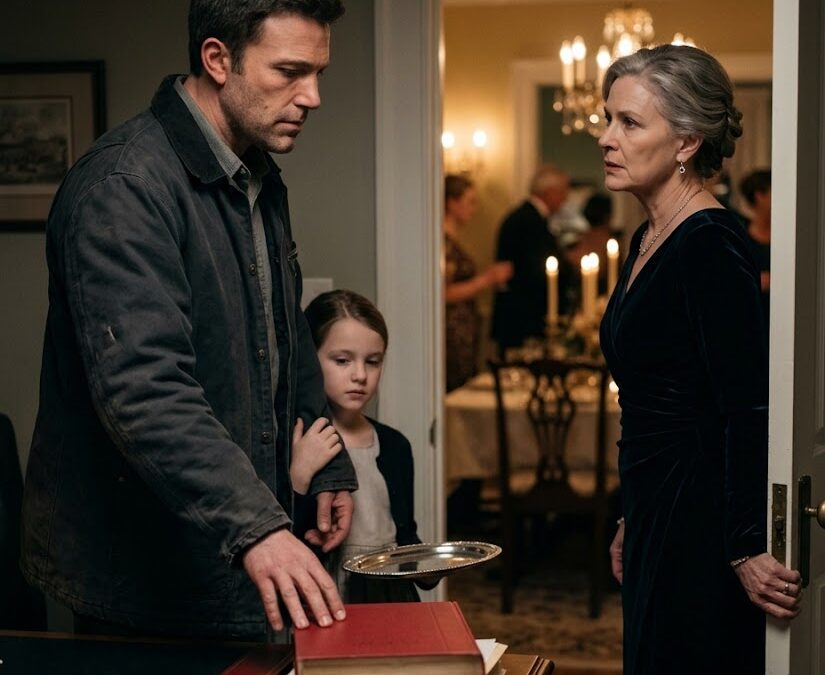
Chapter 2: What the Ledger Held
The catering manager lowered his clipboard.
Nobody moved toward the food.
The ledger waited beyond Celeste’s shoulder.
June stood beside Daniel, holding his sleeve.
“Is Mom in there?” she whispered.
“No,” Daniel said.
“Then what did Grandma mean?”
“I’m going to find out.”
Celeste kept one hand on the office door.
“Not with an audience.”
“You made the audience.”
“I hosted a dinner.”
“You put June on the stairs.”
“I gave her a task.”
“You made her collect money.”
“She wanted to help her mother.”
“Did Elise ask you to do this?”
Celeste’s eyes sharpened.
“You weren’t here.”
“I’m here now.”
“You’re always here after the damage.”
Daniel felt the truth in that sentence.
It did not make the rest acceptable.
He glanced at June.
“Would you like to sit with Peter?”
She looked to her grandfather.
Peter stood beside the chair, hands open.
“You can sit by me,” he said.
June went to him.
Daniel turned back to Celeste.
“Move.”
She let go of the door.
The guests had begun to gather their coats.
The woman from the museum board came forward.
“I’m sorry,” she said to June.
June nodded without looking up.
Daniel entered the office.
The red ledger sat on the desk.
Beside it lay a stack of white envelopes, each marked with a donor’s name.
A second stack held pledge cards.
The top card listed a total of $137,500.
Daniel did not touch anything.
He photographed the page.
Then the envelopes.
Then the ledger cover.
His attorney answered on the third ring.
“Daniel?”
“I need you here.”
“What happened?”
“Someone collected money in Elise’s name.”
“Who?”
“My mother.”
“Is the money still there?”
“I don’t know.”
“Don’t move it. Don’t take anything.”
“I won’t.”
“Call the police if you believe a crime is underway.”
Daniel looked through the office doorway.
His mother stood at the end of the hall.
June sat beside Peter at the table.
“People have already left,” he said.
“Keep the evidence in place. I’m coming.”
“Bring someone who handles trusts.”
“I will.”
The attorney’s name was Meredith Sloan.
She had handled Elise’s trust from the beginning.
Daniel had chosen her because she had corrected a bank officer who called the fund “family money.”
The trust belonged to June.
No one else could direct it.
Daniel ended the call.
Celeste stood in the doorway.
“You called Meredith.”
“Yes.”
“She doesn’t understand this family.”
“She understands the trust.”
“Your wife wanted me to guide June.”
“Guide her how?”
“By teaching her generosity.”
“From the stairs?”
“She was not being punished.”
“Why did you tell people Elise promised them money?”
“I did not say that.”
“June says you did.”
“June misunderstood.”
“She wrote the names.”
“She helped with a guest book.”
“With amounts beside them.”
“Those were pledges.”
“Pledges to what?”
“My charitable project.”
“What project?”
“The Mercer House education fund.”
Daniel stared at her.
“That doesn’t exist.”
“It exists in my plans.”
“You took pledges in my wife’s name for a fund that doesn’t exist?”
“I intended to establish it.”
“With Elise’s trust?”
“No.”
“Then why use her name?”
Celeste’s chin lifted.
“Because people cared about Elise.”
“They cared about June’s mother.”
“And I’m keeping her memory alive.”
“You used a child to collect money.”
Celeste’s mouth pressed thin.
“People gave willingly.”
“Did you tell them the money was for June?”
“I said it would benefit children.”
“Which children?”
“I had not chosen yet.”
“Did you deposit anything?”
“Not yet.”
“Where is the money?”
“In the envelopes.”
“Are all of them here?”
“Of course.”
Daniel looked at the stacks.
There were eleven envelopes.
The page listed fourteen donors.
“Where are the other three?”
“Some gave checks directly.”
“Where are those checks?”
“Being held.”
“By whom?”
She crossed her arms.
“You’re treating me like a criminal.”
“I’m asking where the money is.”
“Your daughter has been grieving.”
“She was four when Elise died.”
“She misses her mother.”
“Then she deserves comfort, not a job.”
“Don’t lecture me about what she deserves.”
“I’m her father.”
“You’re her absentee father.”
The sentence came easily.
It had been rehearsed.
Daniel did not answer it.
He walked back to the dining room.
June had folded her hands in front of her.
The paper card was still on the table.
“Can I take her home?” he asked Peter.
“Of course.”
Peter stood.
Celeste’s voice followed them.
“She has a room here.”
“She has a home with me.”
“She has had a home with me for three years.”
“You’ve helped with after-school care.”
“I raised her while you traveled.”
“I paid you.”
“You never wanted to know what happened here.”
That struck close enough to hurt.
Daniel had watched his calendar fill with travel.
He had chosen conference rooms over parent meetings.
He had let Celeste’s reports replace his own attention.
June had never complained.
Now he understood that silence had not been proof of peace.
“June,” he said, “we’re going.”
She looked at the half-set place.
“Can I bring my card?”
“Yes.”
She folded it in half and put it in her pocket.
On the way out, Daniel stopped beside the guest who had asked about donations.
“Did you give money tonight?”
“Yes. Fifteen hundred dollars.”
“Did you write a check?”
“I paid by transfer.”
“Do you know where it went?”
“She told us it was for Elise’s scholarship fund.”
“Did she call it June’s fund?”
“Yes.”
The guest looked uneasy.
“I can send you the transfer receipt.”
“Please do.”
Celeste came up behind them.
“They gave voluntarily.”
“We’ll let the records explain it.”
The catering manager spoke up.
“I have the event invoice and the payment list.”
“Could you preserve them?”
“Certainly.”
“Please send copies to Meredith Sloan.”
Celeste’s head turned.
“You’re involving people who don’t belong in this.”
“Those people gave money.”
“They are my friends.”
“They’re evidence.”
She looked toward June.
“You are frightening her.”
Daniel crouched beside his daughter.
“Do you want to leave now?”
“Yes.”
“Are you afraid of Grandma?”
June’s eyes filled.
“I’m afraid you’ll be mad at me.”
“I’m not mad at you.”
“Because I told?”
“Because you told the truth.”
He offered his hand.
She took it.
They left the house without the suitcase.
Outside, the air smelled of wet leaves and wood smoke.
Daniel’s driver had gone to park.
He called for a car himself.
June stayed close to him on the porch.
“Did Grandma say Mom wanted the money?”
“Yes.”
“Did Mom?”
“No.”
“Did she tell Grandma?”
“I don’t know yet.”
“Will we find out?”
“We’ll find out what we can.”
The car arrived.
June climbed into the back seat.
Daniel sat beside her.
At home, he made cocoa from the packet he had bought at the airport.
He had to ask a neighbor to find milk.
June held the mug between both hands.
“You can sleep in my room,” he told her.
“I’m not little.”
“I know.”
“Can I have the guest room?”
“Of course.”
“I want the door open.”
He left it open.
At midnight, he sat outside the room with the red card on his knee.
The ledger remained at Celeste’s house.
Meredith was coming in the morning.
June’s voice came from the bed.
“Dad?”
“Yeah?”
“Does that mean Grandma stole from me?”
“I don’t know yet.”
“She said it was for Mom.”
“I heard.”
“Maybe Mom would have wanted it.”
“Maybe she would have wanted a real fund.”
“But not dinner stairs?”
“No.”
June rolled onto her side.
“Can you stay until I fall asleep?”
“I’m staying.”
She closed her eyes.
Daniel sat beside the door until morning.
* * *
Meredith arrived at nine with a trust specialist named Aaron Patel.
They went first to Celeste’s house.
The dining room had been cleared.
The red ledger remained on the office desk.
Celeste waited in the living room with Peter.
“You brought a banker,” she said.
“A trust officer,” Meredith corrected.
“Same thing.”
“Not quite.”
Meredith wore a gray coat and carried a document case.
She had met Celeste years earlier.
They had never been close.
“Daniel says there were collections made in Elise’s name,” she said.
“Guests pledged to a future charitable project.”
“Were they told the project existed?”
“They understood the intention.”
“Did they sign an agreement?”
“No.”
“Did you deposit the funds?”
“Some.”
The room shifted.
Daniel looked at her.
“Where?”
Celeste’s gaze flicked to Peter.
“In my personal account.”
“Why?” Meredith asked.
“To keep it separate.”
“Separate from what?”
“From household expenses.”
“Was there a written fund?”
“I was about to create one.”
“Under what legal entity?”
“I hadn’t decided.”
“Who owns the account?”
“I do.”
“Did donors know that?”
Celeste’s face hardened.
“They trusted me.”
Meredith wrote something down.
“Can you provide the account statements?”
“I’m not handing over private banking records.”
“You collected money for a stated purpose.”
“I haven’t spent it.”
“Then the records will confirm that.”
Celeste looked at Daniel.
“You are humiliating me.”
“I’m asking you to return the money.”
“I haven’t taken anything from June.”
“We’ll see what the records show.”
Meredith asked to inspect the ledger.
Celeste hesitated.
Peter looked at her.
“Give it to them.”
She walked to the desk and brought back the book.
Meredith did not take it immediately.
“Did you alter any entries?”
“No.”
“Did you remove pages?”
“No.”
“Did you make this guest list?”
“I did.”
“Did June?”
“She wrote names.”
“Did you tell her what the numbers meant?”
“I told her they were donations.”
“Did you tell her they were for her mother’s scholarship fund?”
“I said that was my intention.”
“Did you tell the guests the money would go to that fund?”
“I said it would support children.”
“That was not my question.”
Celeste’s voice thinned.
“Some of them asked about Elise.”
Meredith examined the open ledger.
A blue tab marked the page June had copied.
The entries were arranged by donor, amount, and payment method.
The handwritten total matched the pledge cards.
The rightmost column included three initials.
C.M.
P.M.
D.M.
Daniel pointed at his own initials.
“Why is my name here?”
Celeste glanced down.
“Those are family approvals.”
“I didn’t approve this.”
“It was a draft.”
“Did you write D.M.?”
“I might have.”
“Why?”
“To show where the family stood.”
“You put my initials beside a donation plan.”
“Your support was assumed.”
“Your assumption is not my consent.”
Meredith turned a page.
The next entry was dated eleven months earlier.
An amount of $8,000 appeared beside “school materials.”
A second amount, $4,200, appeared beside “summer program.”
No donor names.
Meredith looked at Celeste.
“What are these?”
“Expenses.”
“For the proposed fund?”
“For June.”
“Did June receive these funds?”
“I paid for her activities.”
“What activities?”
“Lessons. Clothes. Travel.”
“What account did you use?”
“The family account.”
“Whose family account?”
“My account.”
Daniel looked at his mother.
“You told me the trust paid for her summer program.”
“I said the family was covering it.”
“You said the trustee had approved it.”
“I don’t remember.”
Meredith opened her laptop.
“Let’s clarify the trust structure.”
She explained the account’s history in plain language.
Elise had created it before her death.
Daniel was the trustee.
June was the sole beneficiary.
The money could pay for education, health, and other needs tied to her welfare.
The trust could not finance Celeste’s charitable plans.
It also could not be used as a family expense account without documentation.
Daniel had kept it invested through a regional bank.
The statements came to him by secure email.
He had reviewed them every quarter.
Or thought he had.
Meredith asked for his last review.
He checked his inbox.
The last message from the bank was dated sixteen months earlier.
He opened the attached statement.
There were no unexplained withdrawals.
He remembered seeing that.
The subsequent statements had gone to an address he no longer used.
“Why was the mailing address changed?” he asked.
Meredith checked the account history.
“The request was submitted online.”
“By whom?”
“It says the primary contact approved it.”
“I didn’t.”
She read the date.
“March third.”
“Where was I?”
Daniel searched his calendar.
“Denver. Three days.”
“Did you authorize anyone to change the address?”
“No.”
Celeste held still.
Peter had gone pale.
Meredith turned her screen toward Daniel.
The account request was signed electronically.
A security code had been sent to Daniel’s old phone number.
“Who had that phone?”
“Me. The number’s been disconnected.”
“Who had access to the family phone plan?”
“My mother.”
Celeste stood.
“That proves nothing.”
“It doesn’t prove anything by itself,” Meredith said.
“Then stop looking at me.”
“We’re tracing the change.”
“I handled the household calls.”
“You had access to the number.”
“I used it for emergencies.”
“Did you receive the verification code?”
“I don’t recall.”
“Did you ask the bank to change the address?”
“No.”
The answer came too quickly.
Daniel studied her.
“Where were statements sent?”
Celeste sat back down.
“To the house.”
“Which house?”
“Mine.”
“Where are they?”
“I don’t know.”
“Did you open them?”
“I handled mail.”
“That means yes.”
“I made sure nothing important was missed.”
“What was in the trust?”
“Money for June.”
“Did you move any?”
“I did not take money from that trust.”
“Then show us the statements.”
“I can’t.”
“Why not?”
“The bank records are mine.”
“They’re June’s.”
Celeste’s eyes snapped toward him.
“She has not earned a right to accuse me.”
“No one said she had to earn it.”
“She is a child.”
“Yes.”
“Then stop dragging her through adult matters.”
Daniel heard June’s voice in his head.
I’m afraid you’ll be mad at me.
He ended the conversation.
“Meredith, what happens now?”
“We preserve everything. We request the bank’s full transaction history. We document the charity pledges. We notify the donors. And we contact the trustee’s counsel.”
“I’m the trustee.”
“You may need independent representation. You’re also the father and a witness.”
“What about the account?”
“We can freeze outgoing transfers today.”
“Do it.”
Celeste laughed once without humor.
“You can freeze the fund, but you can’t freeze a family.”
Daniel did not answer.
A bank security officer joined the call.
He confirmed the account’s contact details and flagged the disputed address change.
The original trust funds had not been touched.
That relief lasted less than a minute.
“Mr. Mercer,” he said, “there’s a pending request to liquidate a certificate of deposit.”
“How much?”
“Eighty-six thousand dollars.”
“Who requested it?”
“The request came through the secondary online profile.”
“Who has that profile?”
The officer named Daniel.
Then he read the email address attached to it.
It was Celeste’s.
Daniel looked at her.
She shook her head.
“That was for household administration.”
“Did you submit the liquidation request?” Meredith asked.
“No.”
“The request was filed at 7:13 last night,” the officer said.
Daniel had arrived home at 6:18.
He remembered Celeste disappearing toward the office.
The bank had sent a two-factor code to her email.
It had not been approved yet.
Meredith asked them to cancel it and lock online access.
The officer did.
Celeste stood.
“You’re taking a clerical mistake and turning it into a criminal accusation.”
“You just said you didn’t submit it,” Daniel said.
“I didn’t.”
“Then you should welcome the records.”
She walked out of the room.
Peter stayed seated.
“I’m sorry,” he said.
Daniel kept his eyes on the bank screen.
“For what?”
“Not stopping her sooner.”
“You knew about the statements?”
“I knew she opened mail.”
“Did you know money was going into her account?”
“No.”
“Did you know June was serving dinner?”
“I knew she’d be at the event.”
“That’s not what I asked.”
Peter looked toward the doorway.
“I saw the tray.”
“Why didn’t you stop it?”
“I thought it would end.”
“It didn’t.”
“No.”
Daniel’s anger was quiet.
That made it harder to dismiss.
“You let her think she had to obey.”
“I know.”
“You let me think she was fine.”
“I’m sorry.”
“I don’t know what to do with that yet.”
Peter nodded.
“You don’t have to.”
The bank’s records arrived two days later.
Meredith called Daniel into her office.
She had printed the transfer history.
No funds had left the main trust.
But a linked education account had been created a year earlier.
The trust had transferred $18,000 into it.
The account was not in June’s name.
It was titled “Mercer Family Learning Fund.”
Celeste was the sole authorized user.
Daniel had never approved it.
A forged trustee authorization accompanied the request.
The signature looked close to his.
The electronic witness line belonged to Peter.
Peter stared at the paper.
“I didn’t sign this.”
“Do you recognize the login?” Daniel asked.
“It was at my house.”
“Did you see it?”
“No.”
Meredith examined the authorization.
“It was uploaded as a scan.”
“Can the bank identify the device?”
“They can provide the access record.”
The bank’s investigation showed the request came from Celeste’s home computer.
The code had been sent to Daniel’s old phone.
Its carrier had already closed the account.
The phone itself was missing from a drawer where he had left it during a trip.
He had thought he lost it in a hotel.
That was one way Celeste had gained access.
The other was the signature.
Meredith brought in a handwriting examiner recommended by the bank’s fraud team.
The examiner compared the authorization to verified signatures.
He found a close match in spacing.
The pen lifts were wrong.
So was the way Daniel crossed the M.
The signature had been copied from a school travel form.
Daniel remembered signing it at Celeste’s kitchen counter.
A week later, the examiner called with his conclusion.
The authorization was not written by Daniel.
The $18,000 had moved from the trust into Celeste’s education account.
From there, it had paid two private school invoices for June.
The remaining $4,200 had paid the travel program listed in the ledger.
The payments had benefited June.
That did not make the account legal.
It made the case more complicated.
Celeste had used the trust’s money for June while claiming it was her own.
She had also collected money from donors and held it under her name.
The ledger was not proof that she had stolen every dollar.
It was proof that she had lied about what she was doing.
Daniel went to see June after the call.
She was building a paper city on the living room floor.
“I have a question,” he said.
“Okay.”
“Did Grandma ever say school was paid for by your mother’s trust?”
“Yes.”
“Did she say that was a secret?”
“Sometimes.”
“Why?”
“She said you’d worry about money.”
“What else?”
“She said I should thank her for it.”
Daniel sat on the floor beside her.
“Did you think you owed her?”
“I thought everyone knew.”
“No.”
“Then why did she say it?”
“I don’t know.”
June pressed a paper roof into place.
“Was the money stolen?”
“Some was moved without my permission.”
“But it paid for school?”
“Some did.”
“So am I in trouble?”
“No.”
“Is Grandma?”
“The bank is still checking.”
“Do you hate her?”
Daniel considered the question.
“No.”
“Are you mad?”
“Yes.”
“Can you be both?”
“Yes.”
June pressed the roof down harder.
“Will I have to go back there?”
“No.”
“Even if the school money came from her?”
“The money was yours.”
“Then why did she say it was hers?”
“I don’t know yet.”
He learned the answer from Peter that evening.
Peter came alone.
He waited on the porch until Daniel invited him in.
June stayed in the living room with a movie.
Peter carried a small cardboard box.
“I found these in Celeste’s desk,” he said.
“What are they?”
“Copies of Elise’s letters.”
Daniel did not touch the box.
“She said she’d thrown them away.”
“Apparently not.”
Peter sat on the edge of the sofa.
“After Elise died, she asked Celeste to help with June.”
“That’s all?”
“That’s all.”
“What else did she ask?”
“Nothing.”
“Did Elise ask her to manage the money?”
“No.”
“Did she ask her to raise June?”
“No.”
“Why did you let Mother tell us otherwise?”
Peter rubbed his hands together.
“She said Elise had asked her to take charge.”
“And you believed her?”
“At first.”
“Then?”
“I saw a letter.”
“What did it say?”
“Celeste had written to the school. She said she was June’s guardian.”
“Was she?”
“No.”
“Why didn’t you tell me?”
“Celeste said you were barely holding together.”
“I was.”
“She said a fight would hurt June.”
“So you kept quiet.”
“Yes.”
“Did you know about the trust account?”
“No.”
“Did you know about the guest pledges?”
“I knew she was planning a fundraiser.”
“When?”
“Last spring.”
“Did you know she used Elise’s name?”
“I thought she was asking friends for donations to the library.”
“Why didn’t you ask?”
“I should have.”
Peter slid the box forward.
“Read the letters.”
Daniel waited until Peter left.
The letters were in date order.
Elise had written several short notes during the final year of her illness.
One was addressed to Celeste.
It thanked her for bringing soup.
Another asked her to pick June up after preschool.
A third thanked her for helping organize a memorial service.
None mentioned guardianship.
None mentioned money.
Then Daniel found a letter addressed to him.
It was dated three weeks before Elise died.
He read it once.
Then again.
Elise had written that June needed time with her grandmother.
She had asked Daniel to let them be close.
She had also written that no one should ever make June responsible for adults’ feelings.
The line was underlined.
Daniel looked at the handwriting.
He remembered Elise’s hand trembling near the end.
He had not known she wrote this.
Peter had said Celeste kept the copies.
A second envelope bore a date from after the funeral.
Inside was a letter Celeste had written to the school.
It claimed Elise had asked her to supervise June’s education and affairs.
At the bottom, Celeste had signed “temporary family guardian.”
She had no legal authority to do so.
The school had rejected the request.
But she had kept the copy.
Daniel called Meredith.
She came over the next morning.
The letters explained one piece of the past.
They did not explain the present fund.
That answer came from the guest list.
Meredith contacted the donors with a careful written notice.
She told them their payments had been received under a description that needed clarification.
She asked them to confirm the stated purpose.
Every donor replied.
Nine believed they had contributed to a scholarship for children at Elise’s former school.
Five believed they had contributed to a fund for June.
Three had not yet sent money.
Two had already transferred funds directly to Celeste.
A total of $28,500 sat in Celeste’s personal account.
Another $12,000 had been paid to a local tutoring center.
The tutoring center had provided no lessons.
The owner confirmed Celeste asked for a receipt in the name of “Mercer House Education.”
The owner had never heard of that entity.
Meredith recommended they report the matter to the authorities.
Daniel agreed.
Celeste learned about the complaint before the detective called.
She arrived at Daniel’s house the next afternoon.
He did not open the door.
He spoke through the glass.
“Give me the letters.”
“No.”
“They belong to the family.”
“They belong to whoever wrote them.”
“I’m their daughter.”
“You kept them.”
“Your father gave you things that were private.”
“Why did you tell June I was collecting for Mom?”
“I didn’t.”
“She said you did.”
“She misunderstood.”
“Did you take money from donors?”
“I haven’t spent it.”
“That wasn’t my question.”
“Those people gave to my project.”
“You told them it was Elise’s scholarship fund.”
“I told them I was preserving her legacy.”
“You told June she was helping her mother.”
“I wanted her to feel connected.”
“By putting her on a staircase?”
“You keep repeating that.”
“Because you keep avoiding it.”
Celeste looked past him.
“June should come see me.”
“She isn’t ready.”
“She’s being turned against me.”
“She heard what you said.”
“She’s a child.”
“She’s old enough to know when she’s being used.”
“You have always been bad at knowing what children need.”
Daniel’s fingers tightened on the door handle.
Celeste saw it.
She softened her voice.
“Let me fix this quietly.”
“How?”
“I’ll return the pledges.”
“You’ll return everything.”
“Fine.”
“You’ll stop contacting the donors.”
“I will.”
“You’ll give Meredith every trust record.”
“I don’t have them.”
“Then you’ll help the bank find them.”
“I will.”
“And you’ll stay away from June until she asks to see you.”
Celeste’s face changed.
“I will not be cut off from my granddaughter.”
“You are not entitled to her.”
“I am her grandmother.”
“Then act like it.”
She stepped away from the door.
“Your wife would be ashamed of you.”
Daniel did not answer.
Celeste walked toward her car.
That evening, Peter called.
“She went to the bank.”
“What did she say?”
“She said the trust move was a clerical correction.”
“Did she say she made it?”
“No.”
“Did she ask you to support that?”
“Yes.”
“Will you?”
“No.”
Peter’s voice broke on the last word.
“I should have said no years ago.”
“Yes,” Daniel said.
“Can I see June?”
“Not yet.”
“Can I write her a letter?”
“Send it to me first.”
“I understand.”
Daniel hung up.
The following morning, Meredith called.
“The detective wants to meet.”
“Who is handling it?”
“Officer Reyes. Financial crimes unit.”
“What do they need?”
“The original ledger, bank records, donor confirmations, and your statement.”
“Bring it all.”
Officer Reyes met them at the station.
She was calm, direct, and not impressed by family titles.
She asked Daniel to describe the dinner.
He gave the times.
He described the tray.
He described the card.
He did not embellish what he had not seen.
“Did you observe your mother force your daughter to serve?”
“I saw her on the staircase with a tray.”
“Did you see physical restraint?”
“I saw Celeste grab her wrist.”
“Was there an injury?”
“No.”
“Did your daughter tell you she was afraid?”
“She said she was afraid I’d be mad if she told me.”
“What did you do?”
“I left with her.”
“Has Celeste contacted her since?”
“She came to my door.”
“Did she attempt to enter?”
“No.”
Officer Reyes reviewed the ledger.
She asked how Daniel recognized the initials.
He explained the family approval notation.
He had not approved it.
She asked if the trust records supported that.
Meredith provided the bank’s file.
Officer Reyes looked at the forged authorization.
“Who had access to the old phone?”
“My mother had the family plan.”
“Who could enter her home?”
“Me. My father. A housekeeper.”
“Who could access this computer?”
“Celeste.”
“Has the bank preserved the login record?”
“Yes.”
“Who created the linked account?”
“The bank has the application. It was opened through an online request.”
“Any identity verification?”
“Two-factor code to the old phone.”
The officer wrote that down.
“Did your mother have permission to use it?”
“She had permission to help with errands. Not to alter my trust records.”
“Did you ever ask her to pay June’s tuition?”
“No.”
“Did you reimburse her?”
“No.”
“Did you know about the $18,000 transfer?”
“Not until the statements were recovered.”
“Do you believe she intended to benefit your daughter?”
“I believe she intended to control the money.”
“That is an inference.”
“Yes.”
“What evidence supports it?”
“The account was titled after our family. She was the only authorized user. The authorization had my forged signature. The remaining balance stayed under her control. The ledger also links donor funds to a project that did not exist.”
Officer Reyes nodded.
“Good. Keep separating what you know from what you suspect.”
Daniel did.
The investigation took six weeks.
The first bank audit confirmed the $18,000 transfer.
The second showed that Celeste had tried to liquidate the remaining certificate.
The request was canceled before funds moved.
The personal account statement showed the $28,500 in donor payments.
Celeste returned all of it after Meredith sent a formal demand.
She did not admit wrongdoing.
She wrote that she was “clarifying a family misunderstanding.”
The tutoring center returned $12,000.
Its owner gave the detective the invoice and the email chain.
No lessons had been provided.
Celeste claimed the money was a start-up deposit.
There was no signed contract.
There was no business registration.
There was no school.
The donor records mattered more.
Every donor had made a written statement.
They had been told the project supported children.
They had believed the fund existed.
The bank preserved the device record.
The login came from Celeste’s desktop computer.
The handwriting examiner confirmed the signature was traced.
Peter’s alleged witness signature had been copied from a medical consent form.
He said he had never witnessed it.
The detective called Daniel with the findings.
“Your mother has agreed to an interview.”
“Does that mean charges?”
“It means the prosecutor has enough evidence to review the case.”
“What do you think she’ll say?”
“People say many things.”
“Will you interview June?”
“Not unless we need to.”
“I don’t want her drawn into this.”
“We can use your statement and the records.”
“Thank you.”
“She may be asked to make a victim impact statement later.”
“I’ll let her choose.”
“Good.”
The prosecutor offered Celeste a chance to resolve the financial charges without trial.
She rejected the first proposal.
She insisted the donors had given voluntarily.
She insisted the trust transfer had paid for June’s education.
She insisted the ledger was a draft.
The prosecutor asked for a public review hearing.
Celeste agreed only after learning the bank’s examiner would testify.
The hearing took place in a small municipal courtroom.
Daniel sat in the front row.
June stayed at home with a family friend.
Peter sat several seats away.
Meredith sat beside Daniel.
Celeste arrived in a navy suit.
She carried no purse.
She kept her eyes on the judge.
The prosecutor laid out the case in order.
The donor solicitations.
The ledger.
The account statements.
The forged transfer form.
The canceled liquidation request.
The computer access record.
The handwriting analysis.
The tutoring center’s invoice.
Each fact came from a person or record.
No one needed to speculate.
Celeste’s attorney argued that the money had been intended for children.
He said she had acted in good faith.
He said the family’s structure was informal.
He said the trust transfer had paid legitimate school expenses.
He said the dinner had been a volunteer activity.
The judge listened.
Then the prosecutor brought out the red ledger.
It looked smaller under courtroom lights.
Meredith had given the original to the detective.
The detective testified that the handwriting matched Celeste’s work notes.
She also testified that the ledger’s entries matched the bank deposits.
The donor amounts matched the personal account.
The tutoring payment matched the nonexistent project.
Then she described the back of June’s card.
The card had been preserved in a sleeve.
The numbers corresponded to the service order.
The names corresponded to donors.
The card connected the event to the ledger.
Celeste’s attorney asked why a ten-year-old’s handwriting should be trusted.
The prosecutor called the catering manager.
He had seen June carrying the tray.
He had heard Celeste describe her as the “welcome volunteer.”
He had brought the event payment file.
The donors confirmed what they had been told.
The court did not decide criminal guilt that day.
It did rule that Celeste had no authority over June’s trust.
It ordered her to preserve all records and barred her from contacting donors about the case.
The prosecutor filed the formal financial charges afterward.
Celeste entered a no-contest plea to one count of attempted misuse of trust property and one count of deceptive charitable solicitation.
She repaid every dollar.
She paid the donor’s costs.
She received probation, a suspended sentence, and a five-year ban from managing charitable funds.
The trust regained the $18,000, with interest.
The bank closed the linked account.
Celeste’s attorney called it a family resolution.
The judge called it a legal outcome.
Daniel called it incomplete.
No one asked him to forgive her.
* * *
Three months passed.
June returned to school.
Her teacher moved her desk near the window because June said she liked seeing the courtyard.
She started eating lunch in the cafeteria again.
She did not ask to visit Celeste.
Daniel did not ask her to.
The trust now required two independent approvals for any large payment.
Daniel chose Meredith as the second reviewer.
The bank restored the monthly statements to his current email.
He reviewed every one.
He began leaving the office by five twice a week.
At first, he treated that promise like a work assignment.
Then June started keeping score.
“You’re late by four minutes,” she said one Thursday.
“I’m sorry.”
“Do you have a meeting?”
“I canceled it.”
“Did you cancel the meeting or move it?”
“Canceled.”
“Then you can make pancakes.”
“Can I make pancakes?”
“You can try.”
The first batch burned.
The second batch was shaped like a state that neither of them could identify.
June laughed hard enough to spill syrup.
Daniel froze.
She noticed.
“It’s okay,” she said.
“Are you sure?”
“It’s just syrup.”
He handed her a napkin.
She wiped the table herself.
No one asked her to serve.
The following week, June brought home a letter from Peter.
She did not open it immediately.
“Can I read it first?” Daniel asked.
“Why?”
“To check that it isn’t about the case.”
“You can read it after me.”
“Okay.”
The letter said Peter was sorry for being silent.
He did not ask her to visit.
He said she could decide when she wanted contact.
June folded it carefully.
“Can I send him a picture?”
“Of course.”
She chose a drawing of the paper city.
Peter wrote back that he liked the little bridge.
A month later, June asked if she could call him.
Daniel set the phone on the table.
She spoke for six minutes.
When she finished, she told Daniel Peter had said he was learning to cook.
“Did he say what?”
“Pasta.”
“Can he cook pasta?”
“I don’t know.”
“Neither do I.”
June grinned.
“That’s why he’s learning.”
Peter visited the next weekend.
He brought a small potted rosemary plant.
June showed him the paper city.
He asked before touching it.
She said yes.
He did not ask about the hearing.
They spent the afternoon making pasta.
The water boiled over.
Peter admitted he had not measured correctly.
June laughed.
Daniel watched them from the kitchen doorway.
Peter caught his eye.
There was no apology big enough to repair every missed moment.
There was a start.
Celeste sent three letters.
Daniel read each one before passing it to June.
The first contained excuses.
The second contained a demand to see her.
The third was an apology.
It said Celeste had acted as though love gave her authority.
It said she had used Elise’s name to make her choices sound noble.
It said she had made June carry a burden that belonged to adults.
The letter asked for nothing.
June read it twice.
“Do I have to write back?”
“No.”
“Do I have to forgive her?”
“No.”
“Will you?”
“I don’t know.”
June folded the paper.
“Can I keep it?”
“Yes.”
She placed it inside her school binder.
A week later, she asked Daniel if she could see Celeste in a public place.
“Do you want me to go with you?”
“Yes.”
“Would you like Peter there too?”
“Maybe.”
They arranged a short visit at a botanical garden.
Meredith recommended that Daniel keep the meeting calm and leave if June wanted.
Daniel set no rules for June’s feelings.
He set rules for Celeste’s behavior.
No discussion of money.
No discussion of court.
No claims that Elise had wanted anything.
No promises that June would visit again.
Celeste agreed.
At the garden, she wore a cream coat.
She looked smaller than Daniel remembered.
June walked beside her father.
Celeste did not reach for her.
“Thank you for coming,” she said.
June nodded.
“I read your letter.”
“I’m glad.”
“You said you used Mom’s name.”
“I did.”
“Why?”
“I wanted people to listen.”
“Why did you say I wanted to help?”
“I thought you would.”
“You didn’t ask me.”
“No.”
“I was scared you’d be mad if I said no.”
Celeste lowered her eyes.
“I’m sorry.”
June looked at the winter garden.
“Are you still mad at Dad?”
Celeste glanced at Daniel.
“I’m angry about what happened.”
“That isn’t what I asked.”
“No,” she said. “I’m not angry at your father.”
“Are you still saying Mom wanted the money?”
“No.”
“Did Mom tell you to be in charge of me?”
“No.”
“Did she say I should listen to you?”
“She trusted me to help.”
“That’s not the same.”
“No,” Celeste said. “It isn’t.”
June studied her.
“Can you say that again?”
Celeste’s face crumpled slightly.
“She trusted me to help. She did not give me the right to decide for you.”
June nodded once.
They walked through the greenhouse.
Celeste did not mention the next visit.
At the end, she asked, “Would you like me to send you a card sometime?”
June looked at Daniel.
He stayed quiet.
“Maybe,” she said.
Celeste accepted the answer.
“Thank you.”
The visit ended after twenty minutes.
In the car, June was quiet.
“Do you want to talk about it?”
“Not yet.”
“Okay.”
She looked out the window.
“Grandma didn’t say Mom told her.”
“No.”
“Maybe she can stop saying it.”
“Maybe.”
“What if she does?”
“We’ll handle it.”
June leaned against the seat.
“Can we get cocoa?”
“Yes.”
Daniel stopped at the same airport kiosk that had sold him the first packet.
The cocoa tasted too sweet.
June drank it anyway.
“You were right,” she said.
“About what?”
“This is ridiculous.”
He smiled.
She smiled back.
The donor money was fully returned.
The trust was restored.
Meredith arranged a new charitable account in Elise’s name, controlled by an independent foundation.
Daniel and June chose the school library as its first recipient.
The donation paid for new reading shelves and a quiet room.
June picked the color.
Blue.
At the opening, the principal thanked the Mercer family.
Daniel corrected her gently.
“It was June’s choice.”
June did not have to speak.
She did anyway.
“My mom liked books,” she said.
The students applauded.
She stood beside Daniel, not behind him.
* * *
Five years later, June was fifteen.
She kept the white card from the winter dinner in a drawer.
The lettering had faded.
The gold snowflake remained.
The red ledger sat sealed in an evidence box.
Daniel had asked whether she wanted it destroyed.
She said no.
“I want to remember what the numbers were.”
The card mattered more.
It had been the first time she had told the truth in a room full of adults.
It had also been the first time her father had believed her without asking her to prove she deserved belief.
Celeste had completed probation.
She had kept to the no-contact boundary unless June invited contact.
Their relationship grew by inches.
A text about a book.
A short call on a birthday.
A walk through the garden once a year.
Celeste never asked for the old authority back.
Peter visited more often.
He learned to make pasta.
He learned that June liked quiet birthdays.
Daniel’s job changed too.
He left the firm that kept him traveling.
He took a position in the city and came home before dark most evenings.
He still regretted the years when he mistook payments for presence.
He did not ask June to absolve him.
One winter, the family held a small dinner at Daniel’s house.
June chose the menu.
Peter brought the bread.
Celeste came only because June invited her.
She stood by the dining room doorway while June set plates.
“Would you like help?” Celeste asked.
June looked at her.
“Do you want to help?”
“If you want me to.”
“Please put the water glasses on the table.”
Celeste did.
June set down the last plate.
“Everyone sits before anyone serves,” she said.
Peter laughed softly.
“That sounds fair.”
They took their places.
Celeste sat at the end of the table.
No one had reserved the chair as a prize.
No one stood on the stairs.
The white card lay beside June’s plate.
She had written a new message on the blank side.
“Welcome,” it said.
Daniel picked it up.
“Are you keeping this?”
“I think so.”
“What does it mean now?”
June looked around the table.
“It means people can come in.”
She returned the card to its place.
Outside, snow rested on the garden walls.
Inside, the table held too many dishes.
Peter passed the bread.
Celeste asked before pouring the water.
June reached for the serving spoon herself.
Her father watched her take the first portion.
Then she passed it to the next person.
The card stayed beside her.
THE END








