I Came Home to Find My Daughter Tied to a Chair at Her Own Birthday Party—Then Her Stepmother Raised a Glass
Chapter 2: The Room Behind the Door
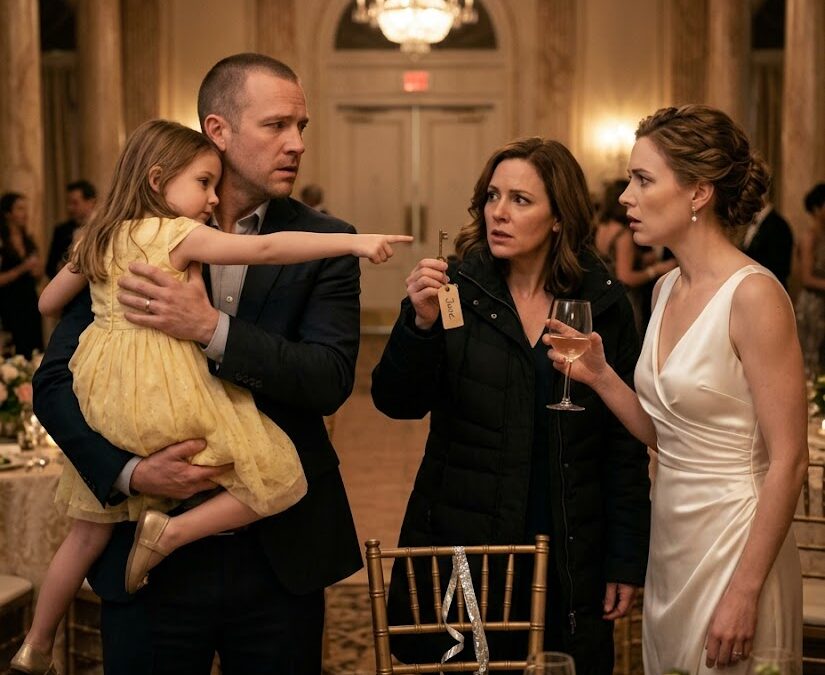
The third knock came while June held my shirt.
Nobody moved.
Evelyn set down her glass.
“Someone left a coat in there.”
“Then open it.”
“I don’t know what Nadine thinks that key is.”
Nadine kept both hands visible.
“I found it under June’s pillow.”
The guests started drifting toward the exits. A man raised his phone. I looked at him.
“Call the police.”
“I already did,” Nadine said. “I called when I saw the ribbon.”
Evelyn’s mouth tightened.
“You called the police to my house?”
“I called for a child.”
A chair creaked behind us.
June stiffened against me.
The service door stood at the end of a short corridor. Fresh scratches marked the latch. A new deadbolt gleamed against old paint.
I knew locks. I inspected bridges and industrial equipment for a living. This one had been installed in a hurry.
“Give me the key,” I said.
Evelyn moved toward the corridor.
“I’ll handle it.”
I stepped between her and June.
“Stay there.”
“This is my home.”
“June lives here.”
“She has a room.”
“Then there’s no reason to lock this one.”
“That is not your decision.”
“It became mine when she was tied to a chair.”
Nadine came closer.
“I found June in the pantry earlier. She was trying to get crackers.”
Evelyn turned on her.
“You were told to leave.”
“I was told not to interfere.”
“You have no authority here.”
“I had enough authority to hear her crying.”
June buried her face in my shoulder.
The knock came again, lower this time.
A child’s knock.
“Is someone in there?” I asked.
June nodded.
“Who?”
“I don’t know.”
Evelyn exhaled sharply.
“She’s confused.”
I looked at the deadbolt.
“Where’s the key?”
“In the flower arrangement,” Nadine said.
Evelyn reached for the nearest vase.
I caught her wrist, stopping her.
“Don’t.”
“You can’t keep grabbing me.”
I let go.
The guests had stopped moving. A woman in a navy dress was speaking to the dispatcher.
I picked up the brass key. June’s name was stamped on its aluminum tag. The edges were worn.
It didn’t match the new deadbolt.
I tried it anyway.
The old lock turned.
The door opened two inches, then stopped against a chain.
Stale air slipped through the gap, sharp with cleaning chemicals.
A small voice came from inside.
“Is it Dad?”
June made a sound that was almost a sob.
I looked at Evelyn.
“Who is in there?”
She said nothing.
“Open it.”
“The room is unsafe.”
“Then why is someone inside?”
Nadine leaned toward the gap.
“Call to them.”
I kept my eyes on June.
“Hey. It’s Dad. I’m right here.”
A pause.
Then the voice answered.
“June said you’d come.”
June’s fingers dug into my shirt.
“Who are you?” I asked.
“My name is Max.”
June’s lips parted.
“Do you know Max?” I asked.
“He’s my brother.”
The room shifted around us.
My daughter had no brother. Not according to me, not according to the forms I had signed, not according to the story Evelyn told at holidays and school meetings.
I unhooked the chain.
Behind me, Evelyn said my name.
I opened the door.
A boy sat on the floor beside folded blankets. He looked about nine, in gray sweatpants and a faded rocket-ship shirt. His hair had been cut unevenly. A nearly empty cup stood by his knee.
He had no shoes.
His eyes went to June.
“Are you okay?”
She nodded and reached toward him.
I stayed beside her as their fingertips touched through the doorway.
“Your party looks fancy,” Max said.
June glanced at the fallen cake.
“It was supposed to be a rocket cake.”
“It still can be.”
Evelyn came up behind us.
“Move away from him.”
I stepped into the doorway.
“No.”
“He’s not safe around her.”
Max flinched.
June’s expression changed.
“You said he was sick.”
“I said he might be dangerous.”
“You said he was dead.”
That was the second time the room changed.
I looked at Max.
“How long have you been here?”
“Since yesterday.”
“Where were you before that?”
He studied the floor.
“Lots of places.”
“Who brought you here?”
He didn’t answer.
Evelyn did.
“I brought him. He had nowhere else to go.”
“That’s not an answer.”
“He’s your son.”
My grip tightened on the doorframe.
“What did you say?”
“I said he’s your son.”
“My son died before he was born.”
The words came out too quickly. I had repeated them for years and never believed them.
Evelyn pressed her lips together.
“That’s what you were told.”
“By whom?”
“Your wife.”
Julia had died six years earlier. June was three months old when I lost her. I had spent two years learning to be a father alone, then let Evelyn close enough to share what I thought I remembered.
I turned to the boy.
“Max, what was your mother’s name?”
He looked down.
“Julia.”
Nadine gripped the edge of the table.
Evelyn had gone pale.
“Did your mother tell you I was your father?” I asked.
“She said you didn’t know.”
“Did she say why?”
He shook his head.
“She said she was going to tell you.”
“Do you have anything with her name on it?”
“Evelyn has it.”
“Where?”
“Upstairs.”
Evelyn moved toward the hall.
“Don’t go through my things.”
“Then bring it down.”
“There is nothing that proves anything.”
“Then you won’t mind.”
“I kept this family together.”
“By keeping a child locked in a room?”
“He wasn’t locked in when I was there.”
June wrapped her arms around herself.
“You said he had to stay until Dad went away.”
“That is not what I said.”
“You said Dad would get scared.”
Evelyn’s eyes snapped to her.
I kept my voice level.
“Evelyn, sit down.”
“I will not be ordered around.”
“Then stand there and answer.”
The front door opened. Two uniformed officers entered, followed by a paramedic with a medical bag.
“Who called?” the first officer asked.
Nadine raised her hand.
Officer Bell introduced himself. His partner, Officer Reyes, spoke gently to June and asked if she was hurt. The paramedic examined the red marks on her wrists.
“They’re superficial,” she said. “But she should be checked more fully.”
June grabbed my hand.
“I’m staying with Dad.”
“You can stay beside him while we talk,” the paramedic said.
Officer Bell took statements separately. Evelyn went first. She said June had been disruptive after eating too much sugar, and the ribbon was part of a party game. She described Max as a temporary placement through a private family service.
She said I had been away for work and was upset.
The story was polished.
Nadine’s was not. She said Evelyn had dismissed her after she refused to help move Max into the locked room. She had come back for a sweater, heard June crying, and seen her tied to the chair. Evelyn had ordered her to stay quiet until the guests left.
I told the officer what I knew: I had arrived early, found June tied up, and heard her say she had been locked out of the kitchen.
“Is there a custody agreement?” he asked.
“No.”
“Have you received any notice about a child named Max?”
“No.”
“Do you have a lawyer?”
“Yes.”
“Call before anyone leaves.”
I called Hannah Cho, my attorney. She answered on the second ring.
“Tell me what happened.”
I told her.
“Don’t sign anything,” she said. “Don’t agree to a private transport. Keep the children with the officers and medical staff.”
“Understood.”
“I’m coming.”
The paramedic brought June water. Max accepted a cup and held it with both hands. June sat beside him, their shoulders touching.
The officers spoke with the children separately, with a child advocate on speakerphone. They asked where the children had slept, whether they had been hurt, and who frightened them.
June said she was afraid Evelyn would send Max away.
Max said he was afraid Evelyn would accuse him of stealing something.
“What did you take?” Officer Reyes asked.
“I don’t know. She said I took the blue envelope.”
“What envelope?”
He glanced at Evelyn.
“She said it had my papers.”
Evelyn folded her arms.
“Children invent things when they’re frightened.”
“They can be frightened and still tell the truth,” Officer Reyes said.
Hannah arrived twenty minutes later. She spoke with the officers first, then joined me.
“Have they searched upstairs?” she asked.
“No,” Officer Bell said. “Not without consent or a warrant.”
“Good. Preserve the records and request them through the court.”
Evelyn scoffed.
“There are no records.”
“Then you have nothing to worry about,” Hannah said.
The officers asked Evelyn whether she would agree to the children leaving with me for medical evaluation and a safety review.
“They’re staying in my home.”
“That decision may not be yours tonight,” Officer Bell said.
Evelyn turned to me.
“You’ll destroy what we built.”
I looked at the fallen cake and the bent paper rocket beneath a guest’s shoe.
“We didn’t build a safe home.”
“You’re choosing strangers over your family.”
“I’m choosing the children.”
The children went to the hospital with a county worker. Hannah arranged for them to stay together with an approved emergency caregiver. I followed with Nadine.
At the hospital, staff checked June’s wrists, hydration, and blood sugar. They found no serious injury. Max was thin and tired, but stable. A social worker interviewed them and explained the next steps.
A temporary safety plan.
Separate interviews.
Medical records.
A family court review, if needed.
No one promised an easy answer.
June leaned against me in a blue plastic chair.
“Did Mom know?” she asked.
“I don’t know yet.”
“Did she know Max was alive?”
“I don’t know.”
“Did she leave him?”
“I don’t know.”
“You don’t know a lot.”
“I know.”
“I thought you knew everything about bridges.”
“I know where to look when a bridge is failing.”
“Is our family a bridge?”
“It might be.”
“Can we fix it?”
“We can make it safe.”
“That’s not the same.”
“No,” I said. “It isn’t.”
Max sat across from us, watching the vending machine.
“Do I have to go somewhere else?”
A county worker named Ms. Givens explained that he would stay with a licensed caregiver while they checked the records. I could visit him.
“Could I call you Dad until we know?” he asked.
“You can.”
Hannah arrived with a family-law specialist’s number and the first forms for an emergency review. We needed to find out where Max had come from.
“Evelyn said my papers were in her office,” Max told us.
“Did you see the envelope?” I asked.
“Blue. It had a silver star sticker.”
June lifted her head.
“She kept a box under her desk.”
We could not search the house without permission or legal authority. Hannah said that plainly. The investigator would request access and preserve anything relevant.
The officers documented the door, deadbolt, ribbon, and key. The brass key did not fit the new lock. It opened the old one.
At midnight, the children left with the caregiver. June asked if they could ride in the same car.
Hannah made a call. Ten minutes later she returned.
“They can stay together tonight.”
I hugged June before she left.
“I’ll see you in the morning.”
“You promise?”
“I promise.”
“Not just because you’re saying it?”
“I’m putting it on my calendar and setting three alarms.”
She gave me the smallest smile.
Max held out his hand.
“Can you come tomorrow?”
“Yes.”
“Before lunch?”
“Yes.”
He nodded.
The car pulled away.
Nadine stayed to finish her statement. She looked exhausted.
“You could have walked away,” I told her.
“I did. Two months ago.”
“You came back.”
“June asked me to.”
“Why didn’t you tell me?”
“I sent you a letter.”
“I never saw it.”
“Evelyn said she gave it to you.”
“What did it say?”
“That June was alone too much. That Evelyn had started locking the kitchen after school. I asked you to call me.”
“Do you have a copy?”
“I wrote a draft in my notebook first. I kept the notebook.”
“Give it to Hannah.”
“I will.”
She explained that June had called her that evening. Nadine had returned through the side entrance, heard her crying, and called the police when she saw the chair.
The party invitation was the note June had written before the guests arrived. Nadine had kept it because she sensed something was wrong.
The next morning, Evelyn’s side of the closet was empty. Her overnight bag was gone. I did not touch anything. Hannah advised me to stay elsewhere and let the officers know.
I slept at a hotel near the hospital.
I did not sleep much.
* * *
At seven, I returned to the emergency caregiver’s home.
Cereal, bananas, and toast sat on the table. June wore a blanket around her shoulders. Max stood by the window, watching every car that passed.
June ate half a banana.
Max ate two bowls of cereal.
Nobody commented.
“I’m sorry,” I said.
June lowered her spoon.
“For what?”
“For being away. For not seeing what was happening.”
“You were working.”
“I was also responsible.”
“I didn’t tell you.”
“You shouldn’t have had to.”
She looked at Max.
“Would you have believed me?”
“Yes.”
“Even if I said I had a brother?”
“Yes.”
The social worker came after breakfast. The initial check found no matching birth record for Max under the name Evelyn had supplied. It did not prove his identity, but it showed someone had hidden the trail.
The worker asked me for a DNA sample. I agreed. Max agreed after the process was explained. June also wanted to help.
Hannah filed emergency motions to keep either child from being moved without notice and to require Evelyn to disclose all records concerning Max. The county investigator requested service records from Evelyn’s preferred family placement agency.
The agency had no record of Max.
The business Evelyn named was a consulting firm, not a licensed placement provider. Its address was a rented mailbox. It had been incorporated eighteen months earlier.
The filing listed a registered agent named Owen Mercer.
I knew the name. Owen was Evelyn’s half brother. He worked in private wealth management and had helped arrange our renovation loan.
“He’s involved,” I said.
“Maybe,” Hannah replied. “We need documents.”
The investigator found a shipping record from Owen’s office. A set of replacement locks had been delivered to the house three weeks earlier. The invoice was marked “child safety hardware.”
The investigator also checked June’s school records. She had repeated absences, described by Evelyn as family travel days. Her contact information had been changed to an old work email of mine. School notices had gone to that address, including two I had never seen.
Evelyn had removed June from the school lunch program, citing food sensitivities. June had no documented allergies.
The school had tried to schedule a meeting. Evelyn declined.
A few days later, investigators photographed the service room and removed the deadbolt with my consent. Inside were blankets, a folding cot, a water pitcher, a plastic drawer, and three empty food wrappers. A ceiling vent had been covered with cardboard. The room had no window.
There was no evidence Max had been kept there for weeks.
Only that he had been there.
That distinction mattered to the investigation.
The brass key was returned to me after the officers finished photographing it. I recognized it from Julia’s apartment. She had kept a green tin box in a cabinet. After she died, I packed her things and gave the box to Evelyn for safekeeping. Evelyn later told me it was empty.
The aluminum tag with June’s name had been added later.
The key did not prove paternity. It did prove that someone had planned a reunion without telling me.
The DNA result came back five days later.
Hannah read the report in her office.
“Ninety-nine point nine nine percent.”
I sat still.
I had spent six years believing Julia had carried one child to term and lost another. Now a boy with Julia’s eyes was eating cereal in a borrowed kitchen.
I asked for a copy of the result.
Then I asked what happened next.
* * *
Hannah traced Julia’s pregnancy records through the hospital. Julia’s medical release gave me access, and a court order covered the records needed for the case.
The hospital confirmed she had delivered twins at thirty-five weeks: a girl and a boy. The boy had been transferred to neonatal care for breathing complications and survived.
There was no stillbirth record.
No death certificate.
No discharge paperwork naming another guardian.
The file included a form authorizing a temporary transfer to a relative. My signature appeared on it.
The date placed me at a bridge site in Nevada. Work logs, travel receipts, and inspection photographs confirmed I was there. I had signed the hospital’s standard paperwork two days earlier, in person.
The transfer form carried a signature that looked like mine.
It wasn’t.
A forensic document examiner compared it with signatures from my work contracts and hospital forms. The signature had signs of tracing, likely copied from a document I had signed at the hospital.
Someone had taken my consent without asking.
The hospital contact had changed that same day from me to Evelyn’s mother, Beatrice Mercer. The address on the form belonged to a private residential clinic outside Eugene, Oregon.
The clinic had closed, but its former operator, Bernadette Kyle, was alive. She agreed to speak with Hannah and the county investigator at her attorney’s office.
“I knew this day would come,” she said after seeing the DNA report.
“Did you know Max was alive?” I asked.
“Yes.”
“Why didn’t you tell me?”
“I thought you had agreed to the transfer. Beatrice told me you wanted the child placed with family.”
“I didn’t.”
“I understand that now.”
Bernadette had worked at the clinic as a caregiver. Beatrice arrived with Max and a signed form, saying the parents had consented to a temporary placement while I completed a dangerous work assignment.
The clinic was not an adoption agency. It provided short-term residential care for families in crisis. Beatrice paid cash.
Max stayed three weeks.
“Who took him afterward?” Hannah asked.
“Beatrice said a cousin.”
“Did you ever contact the parents?”
“I wrote a letter to the father. Beatrice said she would deliver it.”
It never reached me.
Bernadette had kept a file from the clinic after it closed. Through her lawyer, she gave it to the investigator. It contained an intake sheet, a note from Beatrice, and a carbon copy of the transfer authorization.
The forged signature matched.
Beatrice’s note read: “Father informed. Child to remain with family pending review.”
No family was named. No review was scheduled.
A bank record showed Owen’s company had paid the clinic’s remaining expenses through a trust account four months after Julia died. The payment memo read: “Second child, holding arrangement.”
Hannah requested the rest of the ledger. Owen’s lawyer objected, and the court ordered the records preserved.
His company had also received two transfers from an account associated with Evelyn’s family foundation: eighty thousand dollars, then forty-five thousand. The foundation described them as family stabilization grants.
Owen’s lawyer said the money had supported Beatrice’s caregiving and had nothing to do with the children’s later placement.
The records didn’t fit that explanation.
Owen wasn’t merely a distant helper.
He had been paid.
The county investigator traced the money further. Some of it paid Max’s expenses. The rest went to a loan on Evelyn’s townhouse and later to renovations at my home.
The investigator found another clue in Beatrice’s estate files: a scan of a letter Julia had written six months before her death.
Julia told Beatrice she believed the hospital records had been altered. She had been told Max died but had never seen a death certificate. She asked Beatrice to help locate him.
Evelyn had been copied on the email that transmitted the scan to the family attorney. The attorney said Evelyn had asked him to review it after Beatrice died. He advised her to tell me.
She didn’t.
I read the letter at Hannah’s office.
“If I am wrong, forgive me for frightening you,” Julia had written. “If I am right, please don’t let him grow up thinking he was unwanted.”
I placed the page down.
“She knew,” I said.
“She suspected,” Hannah replied.
“Evelyn knew she suspected.”
“Yes.”
“She could have told me.”
“Yes.”
“Could have told Max.”
“Yes.”
I kept my hands flat on the table.
“What does she want now?”
Hannah showed me a request from Owen’s company. He wanted the court to appoint his firm as neutral trustee for Max’s inheritance, claiming the money needed professional management until Max turned eighteen.
The proposed trust would cover education, health, and housing.
It would also give Owen control.
The amount was just over one million dollars. The original trust named both twins as beneficiaries. June’s share came through Julia’s estate; Max’s had been separated after his supposed death.
Owen had managed the funds for six years.
If the family stayed quiet, he would keep managing them. Evelyn would keep her home and foundation position. The children would remain under her influence.
The motive had been less a single scheme than years of preserving a comfortable arrangement built on a lie.
* * *
Evelyn refused to answer the investigator’s questions. Her lawyer said she was cooperating and asked for access to both children.
The county refused unsupervised contact.
The court allowed supervised visits only if the children agreed. Neither wanted one at first.
I did not pressure them.
June and Max each met with a child therapist. Their appointments became part of the week alongside school, medical visits, and court dates.
June carried crackers in her pockets. She apologized whenever she took another.
I told her there was no limit.
She asked if I meant it.
I showed her the pantry.
“No lock,” I said.
She checked the door twice, then chose pretzels and sat beside Max while they ate.
They joked about the hospital vending machine, which June said had a grudge against anyone who picked orange crackers. Max said it was hoarding them.
Their laughter came quietly.
I laughed with them.
Then the investigator called. Owen had filed for a restraining order, claiming I had harassed his office and threatened him in a voicemail.
I had called once.
“Call me. We need to talk about Max.”
Hannah got the audio from my phone and gave it to the court. The filing complicated matters anyway. Owen’s lawyer argued that the family should resolve everything privately through mediation.
Hannah said mediation could address civil issues, but child safety belonged in the county process.
The judge agreed.
Owen had to produce the trust records and appear for a deposition. He was not yet required to testify in open court.
The records disclosed a second entity, a family holding company that owned the guesthouse where Max had lived before Evelyn brought him to our home. Owen’s company paid the bills.
A neighbor remembered seeing a boy there over the years. She had assumed he belonged to a staff member. She had never seen him outside alone.
That wasn’t enough to establish who had raised him, but it led investigators to Celia Flores, a former caregiver for Beatrice.
Celia had cared for Max from toddlerhood until he was five. She had believed he was Beatrice’s grandson. Beatrice called him “the other baby.”
Celia had kept a birthday card Beatrice once asked her to deliver. She never mailed it because Beatrice changed her mind.
The card was addressed to “Matthew, for when he is old enough to know.”
Inside, Beatrice had written: “Your mother loved you. Your father was told you died. I was afraid the truth would break the family. I chose silence and called it protection.”
Celia remembered Evelyn visiting the guesthouse once, when Max was three. Evelyn left with Beatrice’s file box.
The investigator asked if she had seen it again.
“No,” Celia said. “But Beatrice told me Evelyn had everything under control.”
The family foundation’s payments had been coded as emergency care. A court accountant found money moved into Owen’s private account. Some paid the guesthouse and Max’s expenses. The rest helped with Evelyn’s loans and our renovation.
Owen’s records showed transfers from the children’s trust into his investment account. He later repaid part of the money, but not all.
The trust documents described the funds as “deferred pending family reunification.”
Owen signed them.
Evelyn witnessed them.
Beatrice signed the final page.
The reason the children had stayed apart was becoming clear. Their reunion might expose the way the money had been held and used. It might also force Evelyn to explain why she had hidden Julia’s letter.
The next threat was direct.
I was leaving the county office with the children when a black sedan pulled to the curb. Owen sat in the passenger seat. He lowered the window.
“Can I speak with you?”
“No,” Hannah said.
“I’m asking his father.”
I stood between the car and the children.
“Send questions through counsel.”
“You can make this harder than it needs to be,” Owen said.
“It’s already hard.”
“You don’t know what Evelyn did for that boy.”
“Then explain it to the investigator.”
“I did.”
“Do it again under oath.”
His expression tightened.
“You should think about June. All this could become public.”
“She was already part of it.”
“You want her name in court records?”
“I want her safe.”
Owen leaned toward the open window.
“Families don’t survive every truth.”
“Families don’t survive every lie either.”
Hannah touched my elbow.
“Let’s go.”
The sedan rolled away.
We reported the contact. The judge ordered all communication to go through lawyers or the county worker.
That afternoon, June’s school received an email claiming Max was dangerous and that June had been removed because of a custody dispute. It included the birthday invitation and called our household unstable.
The principal forwarded the message to me and the investigator. The account was new, created under a false name. The attachment had been exported from Evelyn’s cloud drive.
The school followed its safety policy and did not share the message with other families. The principal, Hannah, and the counselor met with me to make a plan. Staff would keep the children’s information private and direct questions to the principal.
June helped choose what she would tell classmates.
“Max is my brother,” she said. “We’re working things out.”
That evening, June found Max sitting by the pantry. He had opened the door but taken nothing.
“Are you hungry?” she asked.
He shrugged.
“You can get a snack.”
“I don’t know if I’m allowed.”
June looked at me.
I put apples on the counter.
“He means it,” she said.
Max watched my face.
“Anytime?” he asked.
“Anytime.”
He took a granola bar. June chose one too.
She reached for his wrapper.
“Why do you want that?”
“So I can throw it away.”
“I can throw it away.”
Max stood.
“Sorry.”
“You don’t have to be sorry for food,” June said.
The words were simple.
They felt like a door opening.
The placement review took place the following week. The county investigator, children’s advocate, Hannah, and a family court clinician attended. The clinician recommended that the children remain together in my care under a temporary order.
The judge approved it.
Evelyn received no direct contact for thirty days. Later visits would require the children’s agreement, a therapist’s recommendation, and supervision.
Evelyn appealed. The court denied an emergency stay.
Owen’s company withdrew its request to manage the trust after Hannah challenged the accounting. The withdrawal did not end the investigation. It confirmed there was reason to audit the funds.
The county accountant found transfers from the trust into Owen’s investment account. Some money had been repaid, but the final shortfall was two hundred and eighteen thousand dollars before fees and lost gains.
The judge ordered a full audit and set depositions for Evelyn and Owen.
* * *
Evelyn arrived for her deposition in a navy suit without jewelry. Hannah asked whether she had known Max was alive before marrying me.
“Yes.”
“Did you tell Mr. Vale?”
“No.”
“Did you tell June?”
“Not at first.”
“Why?”
“I was waiting for the right time.”
“When did the right time become June’s birthday party?”
“I didn’t plan what happened that night.”
“Did you tie June to the chair?”
“I secured her because she was trying to leave the house.”
“Did you install the deadbolt?”
“No.”
“Who did?”
“I don’t know.”
“Did you know June was afraid to ask for food?”
“No.”
“Did you know she was going into the pantry?”
“She had access to food.”
“Did you read Julia’s letter about Max?”
Evelyn paused.
“Yes.”
“Did you tell Mr. Vale?”
“No.”
“Why?”
“I thought it was speculative.”
“Did you verify it?”
“No.”
“Did you tell June her brother was dead?”
“I told her he was gone.”
“Did you tell her he was dangerous?”
“I said he might be.”
“Why?”
Evelyn pressed her fingertips together.
“Because I wanted her to stay away from the door.”
“Why did you need her to stay away?”
Evelyn looked at her lawyer. He objected.
Hannah repeated the question.
Evelyn’s jaw moved once.
“Because I was afraid.”
“Of what?”
“That he would change everything.”
“Was that the truth?”
“Yes.”
She admitted hiding Julia’s letter, preventing the children from meeting, and keeping the truth from me. She denied knowing the trust money had paid for her renovation loan.
The accounting would decide whether that denial held.
Owen’s deposition came three days later. He brought binders and a prepared chronology. He said Beatrice had asked him to manage the funds and that he believed I had consented to the arrangement.
Hannah showed him the forged signature report.
“Did you create the transfer form?”
“No.”
“Who did?”
“Beatrice.”
The hospital’s electronic records showed the upload came through Owen’s office network.
“I can’t explain that,” he said.
His company’s filing showed his login credentials had been used to create the private placement firm. He said his assistant handled filings.
The trust ledger showed money had entered his personal investment account.
“That was temporary accounting,” he said.
“Did the trust authorize you to invest the money in your personal account?”
“No.”
“Did you disclose that to the beneficiaries?”
“No.”
“Did you repay the full amount?”
“I believe so.”
Hannah placed the accountant’s report in front of him.
“It says you owe two hundred and eighteen thousand, including gains and fees.”
“I dispute the calculation.”
“Do you dispute that you used the funds?”
“I dispute the word used.”
“What word would you use?”
He said nothing.
Hannah asked whether he had arranged the locks.
“I approved a safety purchase.”
“What was the safety concern?”
“Evelyn said the boy had a history of running.”
“Did you speak to Max?”
“No.”
“Did you observe him?”
“No.”
“Then how did you decide locks were needed?”
“I relied on family information.”
“Did you know June was in the house?”
“Yes.”
“Did you know the lock would keep her out?”
“I assumed the door would remain unlocked.”
The invoice included installation. Owen had approved it.
He said he signed hundreds of approvals.
* * *
The hearing took place three weeks later. It covered temporary custody, trust preservation, and the protective order. June and Max stayed with their counselor and caregiver. Their identifying records had been sealed, though a local reporter sat in the courtroom with several of Evelyn’s charity board members.
The county investigator testified about the room, the ribbon, the officer’s report, the medical evaluations, the children’s statements, the deadbolt invoice, and the school records.
Evelyn’s lawyer argued the party scene had been misunderstood. He said June had tried to run outside and Evelyn used a temporary restraint to keep her safe. The ballroom had no street access.
He said the door had been secured to protect Max. The lock was a mistake. The ribbon had been an unfortunate response. The guests had arrived after the incident began.
The argument almost held.
Then Hannah introduced audio from Nadine’s emergency call. The call system had continued recording after Nadine set her phone down.
Evelyn’s voice came through.
“Keep the guests inside until he leaves.”
Then, later:
“Once he’s gone, I’ll put Max back.”
The judge listened twice.
Evelyn’s lawyer requested a recess.
When court resumed, Hannah introduced June’s invitation, with the message written on the back:
PLEASE DON’T LOCK THE DOOR.
A handwriting examiner had confirmed it was June’s.
The defense said the note could refer to any door.
Hannah placed the brass key beside it. The officers had photographed the key and its tag. The old key opened the service-room lock before the deadbolt was installed.
The key linked June to the room.
The room linked Max to the lock.
The recording linked Evelyn to the plan.
The contractor who had installed the deadbolt provided sworn testimony. Evelyn asked him to add a keyed bolt and said the younger boy needed privacy. He had not known a child would be inside. Owen’s company paid the invoice.
The contractor also provided Evelyn’s email:
“Install the keyed deadbolt and leave the old key with Nadine. The door should remain closed when guests are here. June is not to enter.”
That changed what the brass key meant.
It wasn’t a random key from an old cabinet. Evelyn had left it with Nadine as a backup. Nadine had kept it. When June needed help, it was the only way back into the room.
The courtroom turned toward Evelyn.
The judge asked if she wanted to respond.
“My client maintains that she acted to protect the children,” her lawyer said.
“Then why did she tell the guests to keep the father inside until he left?” the judge asked.
The lawyer sat.
Owen’s attorney argued the trust belonged in a separate civil case. The judge agreed, but froze the accounts and barred Owen’s firm from managing money for either child. She ordered the home preserved for inspection and Evelyn’s access restricted pending the safety review.
Temporary custody remained with me. Evelyn had no contact for sixty days. Any later visit would require the children’s agreement, a clinician’s recommendation, and supervision.
The judge referred the suspected forgery and trust transfers to the appropriate state offices. She made no criminal finding that day. She ordered the records preserved and the children protected.
Evelyn approached me in the courthouse hallway.
“Do you think this makes you a good father?”
Hannah stepped forward.
“Don’t.”
I raised a hand.
“It doesn’t make me good. It makes me responsible.”
“You were gone.”
“Yes.”
“You didn’t notice.”
“No.”
“You think the children will forget that?”
“No.”
“Then what did you win?”
I looked toward the exit.
“Time with them.”
She had no answer.
I didn’t ask for one.
* * *
The investigation took months.
The hospital corrected Max’s birth record. The court established parentage. The county completed its safety assessment.
The trust audit found that Owen had diverted two hundred and eighteen thousand dollars and later repaid part of it. With lost value and fees, the shortfall was two hundred and forty-six thousand dollars.
Owen settled the civil claim by repaying the full amount and surrendering his role as trustee. He agreed to cooperate with the state investigation. The settlement was not a criminal verdict, but it acknowledged that the money had been mishandled.
The state attorney’s office reviewed the forged form and trust records. It pursued charges against Owen for financial misconduct and document fraud. Evelyn was not charged because the evidence did not establish she created the signature or directed the transfers.
The county substantiated that she had restrained June unsafely and concealed Max’s presence. Evelyn lost her charity board position. The foundation suspended her during its internal review.
She did not go to prison. One ruling did not repair what had happened.
We finalized our separation six months after the party. Under our prenuptial agreement, the house remained mine. Evelyn received a negotiated settlement unrelated to the children’s trust and moved across town.
The children weren’t required to see her.
June chose to write a letter with help from her counselor.
I was scared.
I don’t want visits right now.
You cannot make me keep secrets.
I will decide later if I want to talk.
Evelyn wrote back with an apology and an explanation that she had felt under pressure. June read it with her counselor and did not reply.
Max asked if he had to forgive her.
“No,” I said.
“Could I?”
“Yes.”
“Could I not?”
“Yes.”
“Good.”
The trust was divided into two protected accounts. A court-appointed fiduciary with no connection to the family managed both until the children were adults. The settlement money went into Max’s account.
I did not offer the children a reward for forgiving anyone. Their inheritance belonged to them. It was not payment for what they had lived through.
The charity board eventually asked whether I would advise them on building access and child safety. I declined the position but suggested they fund independent advocates for children in temporary care.
They created a small grant program with external oversight. Its money came from the foundation’s reserves, not the children’s trust.
Nadine helped review the safety procedures. She preferred practical work: checking entrances, training volunteers, and making sure every child knew where to go for help.
“You don’t have to keep doing this,” I told her.
“I know.”
“Then why?”
“Because I can.”
She took a part-time coordinating role, kept her apartment and garden, and came to our home only when invited.
The first family dinner without a court appointment lasted eleven minutes before June asked if we could have dessert first.
Max voted yes.
I said dinner came first.
They both stared at me.
I changed my mind.
We ate birthday cake for breakfast the next morning instead. The ruined rocket cake had been thrown away. A bakery made a new one, but June didn’t want another party in that ballroom.
We held a small dinner at home.
No speeches.
No guests.
A blue paper rocket sat on the cake.
June wore the yellow dress with sneakers. Max wore a sweatshirt with a cartoon moon. Nadine sat at the island. Hannah joined by video call because June insisted she should see the cake.
No one tied a ribbon around anything.
* * *
A year passed, then another.
June joined a robotics club. She liked pieces that clicked together and ideas that either worked or didn’t. Max took piano lessons but preferred building small engines from discarded toys. He asked me to teach him how suspension worked.
I brought home a broken model bridge. He took it apart and put it back together wrong twice. June sat beside him with a notebook. Neither hurried the other.
Their counselors tapered visits when they were ready. They still had hard days.
A slammed door could stop Max mid-sentence.
A birthday invitation could make June check who would be there.
We made adjustments without calling those days failures.
We put a basket of snacks beside the pantry. We added a night-light to the hall. We let both children choose where the spare keys lived.
The brass key stayed in my desk until June asked for it.
She wanted to keep it. I gave it to her in a small wooden box.
“Does it still open the room?” she asked.
“The old lock, yes.”
“Are you keeping the room?”
“I thought I’d turn it into a reading room.”
“Can it have a window?”
“We can add one.”
“Can the door stay open?”
“Always.”
She put the key in the box.
“Then keep it.”
Eight years after the party, June was fifteen and Max was seventeen. We had moved to a smaller house near the river. The old house had held too many painful rooms. We sold it after the court released the preservation order.
The service room became an office before the sale. The contractor removed the deadbolt.
I kept the brass key.
On June’s fifteenth birthday, she asked to visit the old property before the new owners finished turning it into a community arts center. The agent let us walk through.
The ballroom had been repainted and the floor refinished. The chandelier was gone.
June stood in the middle of the empty room.
“Remember the cake?”
“I remember the frosting.”
“It landed like a blue crater.”
“You told everyone it was a new style.”
“It was.”
Max circled the room.
“Where was the chair?”
I pointed.
No one had to sit there.
We walked down the service hall. The door was gone. The room now had a small window, and sunlight reached the floor.
June stood in the doorway.
“Can we leave it open?”
The agent smiled.
“It’s a public space now.”
“Good.”
Max saw the key in my hand.
“You still have it.”
“I promised I’d keep it.”
“What does it open?”
“Nothing here anymore.”
June took it from me.
“It opened a door.”
She closed her fingers around the key.
“And then we walked through.”
The arts center used the ballroom for music classes and family events. The former service room became a reading nook. Children knew it for its books, cushions, window, and basket of snacks.
The grant program funded independent advocates in three counties. People who had witnessed the party helped support it. They had decided silence was not neutral.
Owen repaid the trust. He completed the court process and lost his financial license for several years. Evelyn moved away and sent letters through the children’s counselor.
June kept some.
Max returned all of them.
No one asked them to choose the same response.
June eventually agreed to one supervised meeting with Evelyn. It lasted forty minutes. Evelyn apologized without asking to be forgiven. June listened and said she did not want another meeting yet.
That boundary held.
Max never asked to meet.
Evelyn respected it.
It did not erase what she had done. It did let the children build lives beyond it.
On our last afternoon at the old house, June gave the brass key to the center’s director.
“Put it in the display case,” she said. “With the story.”
“Are you sure?” I asked.
“Yes.”
The director asked what the story should say.
June thought for a moment.
“Say a key can help someone get out,” she said. “Then say the door should never have been locked.”
The key went in the case beside the first photograph of the reading nook.
No lock.
A wide doorway.
Light across the floor.
Children ran through the old ballroom laughing, carrying books and paper rockets, while the door stayed open behind them.
THE END








