I Came Home to Find My Son Sleeping in the Garage—Then His Stepmother Asked Me to Sign the “Transfer” Form
Chapter 2: What the Key Opened
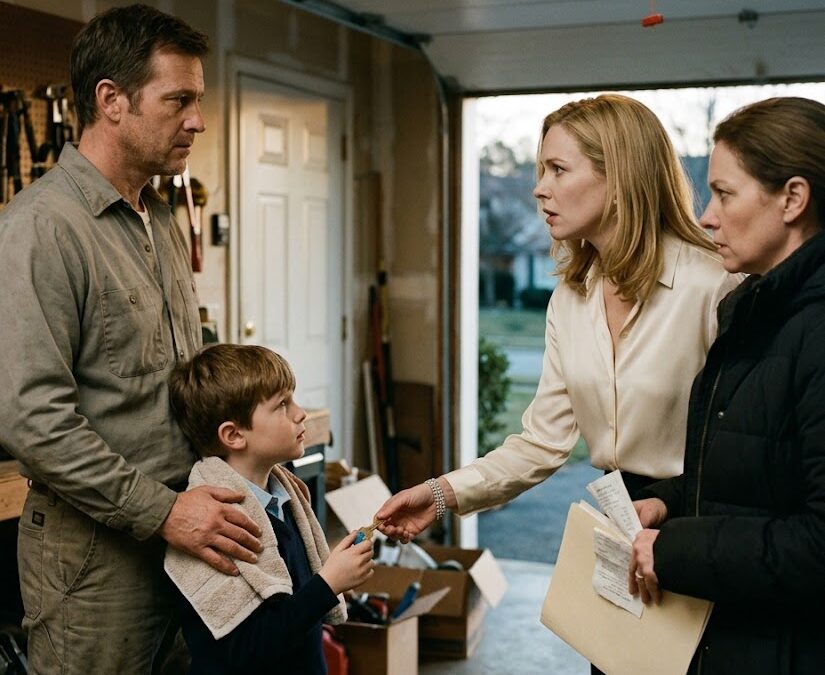
The garage door stopped halfway down.
Its motor clicked once.
Then the house went quiet.
Owen gripped the back of my jacket.
Nell stood between us and the doorway.
The folder hung from my hand.
The blue-taped key lay in my palm.
From inside came a soft scrape.
A chair moving across the kitchen floor.
I looked at Celeste.
“Who’s in there?”
“No one.”
“Then why did the side lock turn?”
“I don’t know.”
“You booked a truck.”
“I booked storage.”
“For an eight-year-old?”
“For his things.”
Owen’s fingers tightened.
I turned to him.
“Stay with Nell.”
He shook his head.
“Dad, don’t go.”
“I’ll be right inside.”
“No.”
His voice was small.
I crouched.
“I won’t let anyone take you.”
He pressed his forehead against mine.
Nell lowered her voice.
“Your phone is in your coat.”
I checked it.
Two missed calls from the school.
Then one from an unfamiliar number.
I called the school first.
“Stonebrook Elementary,” a woman answered.
“This is Daniel Voss. I’m Owen’s father.”
“Mr. Voss, I’ve been trying to reach you.”
“What’s happening?”
“Someone requested his records yesterday.”
“Who?”
“Mrs. Voss.”
“Did you release them?”
“No. She isn’t listed as an authorized guardian.”
I watched Celeste’s face.
“She also said Owen would be withdrawn today,” the woman continued.
“He won’t be.”
“I’m relieved to hear that.”
“Did she mention a placement?”
“She said she was arranging a school near her sister.”
“Does she have a sister?”
“I don’t know.”
“Please note that I called.”
“I already did.”
I ended the call.
Celeste held out her hand.
“Give me the folder.”
“No.”
“You’re making this worse.”
“For whom?”
“For Owen.”
“He’s sleeping in a garage.”
“He chose to.”
“He was waiting for a truck.”
“He misunderstands adults.”
Nell made a sound under her breath.
Celeste turned to her.
“Do you want to lose your job?”
“I already lost it,” Nell said. “You fired me yesterday.”
“I said you could leave.”
“You said I’d be escorted out if I spoke to Daniel.”
I looked at Celeste.
“You fired her?”
“She was careless.”
“What did she do?”
“Nothing that concerns you.”
Nell glanced at the brass key.
“May I tell him?”
“You may not.”
I took out my phone.
“I’m calling the police.”
Celeste laughed once.
“Over a misunderstanding?”
“Someone entered my house, and you arranged to move my child.”
“No one entered.”
Another scrape came from inside.
The dispatcher heard it through the phone.
“Officers are two minutes away,” she said. “Stay outside.”
Celeste stepped toward the garage.
“Let me get my coat.”
“Stay there.”
“Don’t order me around.”
“I’m asking you to stay where the dispatcher can see you.”
Nell picked up the grocery bag.
Inside were rolls, apples, and milk.
“I brought breakfast,” she said to Owen.
He took one step toward her.
Celeste raised her voice.
“He can eat inside.”
“Then why was he out here?” Nell asked.
“He was being difficult.”
“About what?” I asked.
“Bedtime.”
“What happened at bedtime?”
Owen stared at the floor.
“You can tell me,” I said.
“She said I had to pack.”
“Pack for where?”
“The school.”
“Did you want to go?”
He shook his head.
“Then I told her no.”
Celeste folded her arms.
“He threw things.”
“I folded my shirts,” Owen said.
“You refused to cooperate.”
“I wanted Dad.”
I put a hand on his shoulder.
Celeste’s eyes moved to the grocery bag.
“You’ve been feeding him in secret?”
“I’ve been making sure he eats,” Nell said.
“That’s a lie.”
“His lunch came back untouched three days in a row.”
“He needs simple meals.”
“He isn’t allergic to dairy,” I said.
“Your first wife told me he was.”
“My first wife is dead.”
Nell looked down.
Owen put the apple back in the bag.
“Can I eat it?”
“Yes,” I said.
He held it with both hands and took a bite.
The scrape came again.
This time, from the hall.
The dispatcher heard it too.
“Officers are almost there,” she said.
The unknown number called.
I answered on speaker.
“Mr. Voss?” a man asked.
“Yes.”
“This is Principal Ramirez at the school.”
“I’m listening.”
“A transport company called, asking whether Owen would be ready for pickup at five-thirty.”
“Who made the call?”
“They gave us your name.”
“I didn’t.”
“They sent an authorization. I’ll email it.”
My phone chimed.
I opened the attachment.
The signature at the bottom looked like mine.
It had the sharp angle on the V, the old signature I used before an accident at work damaged two fingers on my right hand.
I’d changed how I signed my name afterward.
The one on the form was old.
I had used it years ago on engineering drawings.
Celeste knew that.
The principal spoke again.
“Do you want the district notified?”
“Yes.”
“I’ll document your refusal.”
“Thank you.”
Celeste said, “You need to calm down.”
“I am calm.”
“You’re threatening my reputation over paperwork.”
“You forged my signature.”
“I didn’t.”
“You used the old version.”
“I used what was on file.”
“That isn’t consent.”
“You’re making accusations.”
Sirens approached.
A shadow crossed the kitchen window.
Someone stopped behind the curtain.
Nell noticed it.
“That’s not a chair,” she said.
The side door opened.
A man stepped onto the path in a gray moving-company jacket, clipboard under one arm.
“Mr. Voss?”
“Who are you?”
“Ray from Harborline Moving. I’m here for the pickup.”
“There’s no pickup.”
“I have the work order.”
“Who hired you?”
He looked at Celeste.
She didn’t answer.
“Mrs. Voss said you’d signed.”
“I didn’t.”
Ray lowered the clipboard.
“Then we’re not loading anything.”
“Did she give you my identification?”
“She sent a scan.”
“Did you verify it?”
He looked uncomfortable.
“She said it was her husband’s.”
“It wasn’t.”
“I’ll call the office.”
The police car stopped at the curb.
Two officers walked up.
I kept my phone visible.
“Daniel Voss,” I said. “My son is here. Nobody is injured.”
The taller officer looked at the cardboard bed.
“Is this where he slept?”
“Yes.”
Celeste spoke before I could.
“He chose that.”
“Ma’am, let me hear from you in a moment.”
The other officer crouched near Owen.
“Are you hurt?”
“No.”
“Are you afraid to go inside?”
Owen looked at me.
“I don’t want to go with the truck.”
“You won’t,” the officer said.
The officers took statements and asked Celeste for identification.
Ray showed them his order.
“I was hired to move a child’s belongings,” he said. “I didn’t know there was a dispute.”
A phone buzzed in Celeste’s hand.
She looked down.
Nell was close enough to read the message.
“Get the blue ledger before Daniel finds it.”
Celeste closed her hand over the screen.
“Ma’am, may I see your phone?” the officer asked.
“No.”
“Is someone else inside?”
“No.”
The taller officer spoke into his radio, then approached the side entrance with his partner.
They called out.
A voice answered from inside.
“Coming.”
Celeste shut her eyes.
A woman stepped into the doorway, about sixty, white-haired, and dressed in a long black coat.
I recognized her from old family photographs.
“Vivian?”
My first wife’s mother looked at me.
“You were never supposed to come home this early.”
Owen dropped the apple.
Vivian’s gaze moved to the key.
“Where did you get that?”
“He gave it to me,” I said.
She looked at Celeste.
“What did you do?”
“I tried to protect the boy,” Celeste said.
“From what?” I asked.
Vivian said nothing.
The officers separated us and took statements.
Ray’s dispatch log showed Celeste had messaged him the night before. Vivian’s phone held a text telling her to wait inside.
The officers cleared the house.
They found no one else and no forced entry.
The side door had been unlocked.
When they waved me in, Owen kept one hand wrapped around my belt.
The house looked ordinary.
A glass of water sat beside Celeste’s charger.
Two untouched pieces of toast rested on a plate.
At the end of the hall stood a narrow walnut cabinet.
Mara had bought it at a flea market when we were newly married.
I remembered carrying it upstairs.
It had a small brass keyhole.
The key fit.
Owen stood beside me.
“Mom kept her letters there.”
I turned it.
The cabinet opened with a quiet click.
Inside were three folders, a thick blue ledger, and envelopes tied with green thread.
The first folder held Owen’s birth certificate.
The second held financial statements.
The third bore Mara’s handwriting: If Daniel Comes Home.
My hands stopped.
Owen reached for the envelopes.
The top one had his name and a date from six weeks before Mara died.
I opened it carefully.
If Owen is old enough to ask where Vivian went, tell him the truth.
I looked at Vivian.
She stared at the floor.
The letter continued.
She did not leave because she stopped loving him.
She left because she found the account.
A page slipped free.
It showed a trust deposit, then withdrawals.
The account belonged to Owen.
Several withdrawals bore a signature matching Vivian’s.
The total was $184,000.
I looked at my mother-in-law.
“You took his money?”
“I borrowed it.”
“You signed as trustee.”
“I was going to replace it.”
“Did you?”
“No.”
Celeste made a quiet sound.
I opened the ledger.
Mara had recorded dates, amounts, and notes in narrow columns.
Several entries had red lines through them.
The last page said, If it happens again, look at the school.
I looked at Celeste.
“What does the school have to do with this?”
She said nothing.
Nell answered from the doorway.
“Her foundation has been paying tuition at his new school.”
Celeste turned on her.
“You don’t know that.”
“I saw the invoices.”
The placement form listed Northfield House, a residential program for children whose guardians requested “behavioral stabilization.”
The school’s payments had gone through Celeste’s family foundation.
Mara’s ledger named the school twice.
Beside it, she had written: They call it care when the bill is large enough.
Owen stared at the papers.
“Was Mom mad at me?”
“No,” I said.
“Did Grandma take my money?”
“Some of it was taken. You did nothing wrong.”
“Is it gone?”
“I don’t know yet.”
“Can we keep Mom’s letters?”
“Yes.”
He picked one up and held it like a book.
* * *
The county investigator arrived at eight-thirty.
Cora Bell carried a notebook and a phone recorder.
She asked us to remain where we were, then photographed the transfer form, the moving order, and the garage bed.
She interviewed me in the kitchen.
“Did you know Owen was sleeping here?”
“No.”
“Why were you away?”
“I was inspecting an industrial site in Toledo. I left yesterday and expected to return tonight.”
“Who knew your schedule?”
“Celeste. My assistant. The project team.”
She asked about the key and the cabinet.
I said I’d known it was there, but thought its key was lost.
Then she asked about the trust.
I knew Mara had set one up. I had not managed it. She was an accountant before she became ill, and I had trusted her to handle the paperwork.
After Mara died, I was drowning in hospital bills, work, and a six-year-old asking when his mother would come home.
I had not checked the statements.
That failure belonged to me.
“Did you give Vivian permission to withdraw funds?” Cora asked.
“No.”
“Did you give Celeste permission?”
“No.”
“Did you sign the school form?”
“No.”
“Do you want to press a complaint?”
“I want the investigation to proceed.”
“Would you support a fraud inquiry?”
“Yes.”
She wrote it down.
Vivian offered to explain.
“Not now,” I told her.
“You deserve to hear it.”
“I deserved the truth six years ago.”
Cora asked Vivian for an interview.
Vivian declined until she had spoken to me.
Celeste’s attorney arrived around ten.
He wore a charcoal suit and carried a leather case.
His name was Peter Halden.
I knew him from foundation events.
He had sat on the board for years and drafted the trust paperwork after Mara died.
Cora asked whether he had prepared the transfer form.
“I haven’t seen it,” he said.
“Mrs. Voss said you prepared it.”
“She’s mistaken.”
“Did you advise her about Northfield House?”
“I made a general referral.”
“Did you prepare trust documents?”
“I did.”
Cora asked him to preserve his files.
He consulted with Celeste, then led her outside.
The officers let her leave with her attorney.
She asked where Owen would stay.
“With me,” I said.
“You can’t keep him from his family.”
“He’s my son.”
“I am his stepmother.”
“You are not his guardian.”
Her attorney urged her to go.
She looked at Owen.
“Sweetheart, I was trying to make things easier.”
He stepped behind my leg.
She did not come closer.
After she left, I cancelled the rest of my workweek.
The plant inspection delay would cost the firm $38,000.
I authorized it anyway.
The district sent Owen’s attendance record that afternoon.
He had missed no classes.
His lunches, however, had gone unclaimed five times.
Nell’s small notebook recorded the dates.
Owen had complained of headaches after school and told her he was hungry.
Celeste told the school nurse that he had already eaten.
The nurse had called home twice.
The dates matched.
* * *
The district records showed Celeste had asked for Owen’s pickup history and behavior reports, then asked about remote learning and private residential placement.
The school counselor remembered a meeting request about “resistance to family integration.”
“She said he wasn’t bonding with her,” the counselor told me.
“Did Owen say that?”
“No. He said he missed his mother.”
“What did Celeste say?”
“That he was using grief to control the household.”
I ended the call and opened the blue ledger.
Mara had recorded three payments to Northlight Family Services, each marked “consultation.”
Their business address was a rented suite downtown.
The listed director was Peter Halden’s sister.
Cora asked me not to contact the company.
“I’ll request its records.”
The bank needed a court order to release the trust account history.
When the records arrived, three checks from Owen’s account went to Northlight.
Two were signed by Vivian.
The third carried a signature resembling Mara’s, dated four months after her death.
A document examiner’s preliminary report arrived days later.
“Your wife did not sign this,” Cora told me.
“Who did?”
“We can’t say yet.”
“Can you compare it to the transfer form?”
“Yes.”
The examiner had determined that someone copied Mara’s signature from an older document.
Vivian stood near the dining room window.
“I didn’t sign that check.”
“Who did?” I asked.
“I don’t know.”
“Did you know about the other payments?”
“I did.”
“Why didn’t you stop them?”
“I thought they were for his care.”
“Who told you that?”
“Celeste.”
“Did you see receipts?”
“No.”
“Did you ask?”
“I was afraid.”
“You thought she could keep you from Owen?”
“She said you planned to move. She said your work would pull you away.”
“I was there for him.”
“Not enough.”
The words landed between us.
They were partly true.
I had spent too many nights away, telling myself I was providing.
But my absence did not give Vivian permission to take Owen’s money or Celeste permission to remove him.
“Did you know she was putting him in a residential school?”
“No.”
“Did you know about the truck?”
“No.”
“Why did you come here?”
“Celeste called. She said you’d found the cabinet.”
“Then why were you inside?”
“She asked me to retrieve the ledger.”
“Before I found it?”
“Yes.”
“Why?”
“She said it belonged to her.”
“Did you believe that?”
“I wanted to.”
Vivian handed me an envelope.
It contained a bank receipt for a $20,000 repayment to Owen’s trust.
“How much did you take?” I asked.
“Forty thousand.”
“The ledger shows $184,000.”
“The rest wasn’t me.”
“Who was it?”
“I don’t know.”
The account records showed that some withdrawals came from Vivian. Others came from an online profile registered to Celeste, created two months after she married me.
I had never given her access.
The authorization form carried my old signature and Peter Halden’s witness signature.
The examiner compared it with other documents. My signature had been copied.
Peter’s witness signature appeared genuine.
The bank’s records showed the application had come from his office.
Cora froze the remaining balance, $11,700, and began tracing the transfers.
The money had gone to Northlight, Celeste’s foundation, and a shell company called Voss Property Holdings.
I had never heard of it.
Its mailing address was Peter’s law office.
I had learned to read small failures in machinery.
A clean surface could hide stress.
A weld could look sound until heat exposed the crack.
On the forged forms, the ink pressure changed halfway through my name. The V had been traced, then the rest had been copied from a scan.
I showed Cora where.
The examiner had noticed the same thing.
My observation went into the file as supporting evidence.
That night, Owen asked whether his mother had known about the money.
“She knew,” I said.
“Was she mad at Grandma?”
“She was hurt.”
“Was she mad at Celeste?”
“I don’t know.”
He looked at the cabinet.
“Can we read her letter?”
We sat in his room.
Mara wrote that she loved him more than she feared what adults might do with the money.
She was trying to make sure he would have choices when he grew up.
She did not blame him or ask him to keep a secret.
The letter ended: You are not a problem anyone gets to solve by sending you away.
Owen pressed the paper to his chest.
“Can I keep that?”
“Yes.”
He folded it carefully and put it inside a wooden box.
* * *
The first threat came in a plain envelope left between the storm door and the front door.
It had no return address.
The note warned that I was risking Owen’s privacy by involving the county.
A public investigation could leave him with “a permanent record of family dysfunction.”
Cora photographed it and told me not to respond.
The next day, Northfield House emailed the district, claiming Owen’s enrollment had been “preapproved.”
The district forwarded the message to Cora.
A caller from Northfield asked whether Owen was ready for transport.
I told her he was not enrolled.
She said Celeste had assured them the paperwork was signed.
I asked for her name.
She hung up.
Cora traced the call to Dana Pike, a Northlight consultant paid through Celeste’s foundation.
Northfield claimed the transport company had made a mistake.
Ray’s company confirmed Celeste had placed the order through her email account.
Cora advised me to change the locks.
A locksmith came that afternoon.
Owen watched him replace the side door cylinder.
“Will the old key work?” he asked.
“No.”
“Even the blue one?”
“Not on this door.”
He nodded.
“What does it open now?”
“The cabinet.”
“Can I keep it?”
“Of course.”
He tucked it into his jeans pocket.
The pantry and refrigerator were stocked again, but Nell explained that Celeste had kept food in a locked office refrigerator labeled “event supplies.”
Owen’s lunches had come from it.
When the event food ran out, he went without.
She had told him he could not stay in the house until he “learned to trust the adults.”
Nell had brought him a towel, but Celeste threatened to accuse her of trespassing if she let him inside.
“Why didn’t you call the police?” I asked.
“I did. The first call went to your old number. I called the company line too.”
My assistant had written down the message but missed its urgency.
I had changed phones and never updated the contact sheet.
I was angry that Nell had not done more.
I was also grateful she had stayed.
She had risked her job and called for help.
I told her that.
She cried for the first time.
“I thought he was going to be taken.”
“So did I.”
The threats stopped after Cora served Northlight with a records preservation request.
Celeste’s lawyer sent a letter accusing me of alienating Owen from his family and requesting temporary visitation.
Cora explained that the county could not decide custody.
I needed a family lawyer.
Amara Klein had represented two coworkers through difficult divorces.
She read the school records, transfer form, and county notice.
“The immediate question is whether Owen is safe and whether anyone can remove him without your consent,” she said.
“The answer to the second is no.”
“Can his grandmother take him?”
“Not without your consent or a court order.”
“Can Celeste?”
“She has no independent custody rights.”
“Can Vivian visit?”
“That depends on what Owen wants and what you decide.”
“I want him to have the choice.”
“Good. We keep it slow.”
Amara filed for temporary protective orders, asking that Owen’s placement remain stable, that no one remove him from school, and that contact be supervised until the county finished its review.
The court granted the order.
Vivian asked to see Owen.
He did not want to.
Amara said not to force him.
Vivian sent a letter. Owen asked me to read it aloud.
She apologized for lying about the money and telling him his father would send him away.
She said she had been afraid of losing her place in his life after Mara died.
“Do I have to write back?” he asked.
“No.”
“Do I have to forgive her?”
“No.”
“Will she be mad?”
“She can be disappointed.”
“Can I still love her?”
“Yes.”
He put the letter in his box.
The county’s investigation linked Celeste to $93,500 in foundation payments to Northlight.
The invoices were labeled tutoring, transport planning, and outreach grants.
One paid for a motel near Northfield.
An application drafted in Celeste’s name described Owen as requiring full-time structure because of “persistent behavioral noncompliance.”
He had never been evaluated.
The report cited Dana Pike as a family support consultant.
Cora checked Dana’s travel records. She had been out of state on two dates she claimed to have observed Owen.
The report also included an odd sentence: The kitchen is quiet when the child is absent.
Nell recognized it as something Celeste had said at a charity dinner.
An email draft from Celeste’s account read, “Make the report fit the placement.”
Cora told me the report changed the direction of the case.
The money supplied the motive.
The false assessment supplied the method.
The transport order supplied the deadline.
Then Vivian produced another envelope, one she had kept in a locked desk at her apartment.
It was a note from Peter, dated three years earlier, on his office letterhead.
The family could “resolve the issue quietly” if Vivian stopped discussing the trust.
She had believed he was protecting her.
Cora took the note.
It gave her a lead, not proof.
The foundation archive supplied the proof.
An accountant had saved old meeting packets and emails between Celeste and Peter.
Nine months before the truck was booked, Celeste wrote that Owen’s trust was large enough to “make a structured placement viable.”
Peter replied that any transfer had to look like an education expense.
Celeste asked whether the foundation could pay Northfield.
Peter said it could be documented as charitable outreach.
He mentioned that Vivian’s earlier withdrawal gave them a reason to call the account mismanaged.
The architect was Peter Halden.
The plan had begun years earlier.
Vivian’s $40,000 theft created leverage.
Peter helped route later withdrawals through Northlight, Celeste’s foundation, and his shell company.
Celeste arranged the false assessment and the attempted placement.
If Owen entered Northfield, he would be far from the house and the records.
The truck was the final step in an arrangement built to look like family administration.
* * *
The foundation board called an emergency meeting after Peter resigned.
The chair asked me to attend.
Amara advised me to go but keep my answers factual.
Nell came as a witness.
I carried the blue ledger in an evidence box.
Owen stayed home.
Peter sat at one end of the glass conference table, Celeste beside her lawyer.
The board chair and three trustees had their own counsel.
Peter opened the meeting.
“These are family matters.”
“The foundation paid for services tied to a child who wasn’t enrolled in them,” the chair said.
“That’s a characterization.”
“The school says no placement was approved.”
“There appears to be confusion.”
Cora asked about the trust access form.
“You submitted it,” she said.
“I don’t recall.”
“The bank’s file came from your office.”
“I was counsel.”
“You witnessed the signature.”
“I didn’t.”
“Your assistant says you told her the packet was complete.”
“My office handles routine filings.”
The board chair placed an archived email on the table.
Peter’s face did not change.
He called the ledger a private notebook.
I opened it to the account entries.
“This belonged to my late wife,” I said. “She tracked withdrawals from Owen’s trust.”
“An unauthenticated ledger proves nothing.”
“The bank confirmed the transaction numbers,” Cora said.
She placed Celeste’s email beside it.
“‘Make the report fit the placement.’”
Celeste’s face went pale.
“That is out of context.”
“What context?” I asked.
“I was trying to get him help.”
“You asked someone to fabricate an assessment.”
“I asked for an assessment.”
“The consultant had never met Owen.”
“She spoke to people who knew him.”
“Who?”
“His grandmother.”
Vivian stood at the far end of the room.
“I never told Dana Pike that Owen was dangerous,” she said. “I said he missed his mother.”
“You told me he needed structure,” Celeste replied.
“I told you I was worried about the money.”
Peter interrupted.
“I would ask that we keep statements relevant to the foundation.”
“They are relevant,” Cora said.
The board chair requested the school records.
I handed her Owen’s attendance report, the counselor’s notes, the garage photographs, and the transport order.
The documents showed he had attended every day, had not received the reported evaluation, and had been scheduled for pickup before dawn.
Celeste’s lawyer said no one had actually taken Owen anywhere.
The truck had not loaded.
The school had not enrolled him.
“So there’s no completed harm,” he said.
“He slept in the garage,” I said. “He thought a truck was coming.”
“You can’t prove intent.”
Cora placed the email on the table again.
“I can prove a request to fabricate an assessment.”
The board suspended Peter’s access to the foundation, froze Northlight payments, and ordered an external audit.
It referred the grants to the state charity bureau.
Peter’s lawyer told him to leave.
As Peter stood, he leaned toward me.
“You should think about what this does to Owen.”
“It already happened to Owen.”
“You’ll make him a case file.”
“He already was one.”
“You can still settle this privately.”
“No.”
“You’ll hurt your family.”
“My family is in that ledger.”
The investigation moved through records and interviews, not dramatic arrests.
The foundation accountant had noticed repeated invoice numbers and saved the emails after Peter told her to stop delaying approved payments.
Dana admitted she had written her report from Celeste’s notes without meeting Owen.
She said she believed the placement was authorized.
Her own emails showed she had asked whether a guardian’s signature was required.
Ray’s dispatch log confirmed Celeste had arranged the pickup and told the driver not to discuss details with Owen.
The school cooperated.
No charges were filed against it.
Vivian agreed to testify about her withdrawals and Peter’s letter.
She accepted a repayment schedule for the remaining $20,000 she owed.
The foundation repaid Owen’s trust from its reserves.
After four months, the county referred the case to the prosecutor.
The court froze Peter’s shell company accounts.
* * *
The criminal case took eleven months to reach trial.
Peter and Celeste pleaded not guilty.
I testified about my signature and my absence from home.
The defense attorney asked whether Celeste could have believed I agreed to the placement.
“No.”
“Could you have forgotten?”
“No.”
“Did she ever take good care of Owen?”
“Yes.”
“Did she attend school events?”
“Yes.”
“Buy him clothes?”
“Yes.”
“So your claim depends on one night.”
“No. It depends on the records.”
I listed the forged signatures, school calls, false assessment, transport order, emails, bank audit, and witness testimony.
The lawyer asked whether I was angry.
“Yes.”
“Could that affect your judgment?”
“Yes.”
“Could it make you want revenge?”
“I wanted Owen safe.”
“That wasn’t my question.”
“It is my answer.”
Nell testified about the garage bed, the towel, and the locked door.
The defense asked why she hadn’t brought Owen inside.
She said Celeste threatened to accuse her of trespassing.
She had called the company line and left a message.
The district’s call record confirmed it.
My assistant had written down the message and left it on her desk while I worked at the factory with ear protection on.
I testified that I had missed it.
The failure was mine.
The defense could not turn it into Nell’s.
Vivian testified last.
She admitted taking $40,000 from Owen’s trust after Mara died and hiding it from me.
Peter had found out while preparing an annual filing.
He told her it could be treated as an advance if she repaid it.
She repaid half.
Later, he helped her access the account through Celeste.
She said she believed those withdrawals were for Owen’s schooling.
“Did you know he was going to be sent away?” the prosecutor asked.
“No.”
“Did you ask whether he wanted to go?”
“No.”
“Why not?”
“I wanted to believe the adults had a plan.”
“Why did you stay silent?”
“Because I was ashamed.”
The defense asked if she wanted to repair her relationship with Owen.
“Yes.”
“Is that why you’re here?”
“No. I’m here because I did it.”
She turned toward the jury.
“I took money. I was ashamed. I let other people use that shame to control me.”
She told the jury she should have stopped them.
The bank examiner authenticated the account changes.
The foundation accountant explained the false invoices.
Dana admitted writing an assessment without meeting Owen.
Ray’s dispatch records showed the pickup order came through Celeste’s account.
Mara’s ledger was authenticated by her former employer, and its transaction numbers matched the bank records.
The jury deliberated for two days.
They found Peter guilty of fraud, forgery, and conspiracy.
They found Celeste guilty of fraud and conspiracy, while acquitting her on one count the records did not support.
Dana’s charges were dismissed after she completed her cooperation agreement.
The court ordered restitution.
Peter received eighteen months, partly suspended, with supervised release and repayment obligations.
The state bar later suspended his license.
Celeste received probation, community service, and a restriction against serving as a fiduciary while restitution remained unpaid.
The family court continued the protection order.
The district sealed Owen’s placement inquiry and corrected his records.
Outside the courthouse, Celeste approached me.
“I’m sorry.”
I waited.
“I got overwhelmed.”
“You planned it.”
“I thought I was helping.”
“You asked someone to fabricate a report.”
“I was afraid you’d take him away from me.”
“You tried to take him from me.”
She swallowed.
“I know.”
“You can’t contact him without permission.”
“I understand.”
“He gets to decide.”
“I understand.”
“You don’t get to ask him to comfort you.”
Her eyes filled.
“I won’t.”
That was the boundary.
She nodded and walked away with her lawyer.
Peter sent a letter through his attorney months later, regretting what he called a “misinterpretation of routine financial guidance.”
I returned it unopened.
* * *
Six months after the garage night, Owen started seeing a child therapist named Mr. Dorsey.
He liked the office because it had wooden animals.
He picked a fox.
“It’s too clever to trust anyone,” he said.
Mr. Dorsey asked if the fox was afraid.
“He’s careful.”
That became the word we used.
Careful.
Not broken.
Not difficult.
Vivian asked for supervised visits at a family center.
Owen chose the day and how long to stay.
At the first visit, he wanted me outside the room.
At the second, he wanted me in a chair.
At the third, he let Vivian read him a book.
She did not ask for a hug.
Afterward, she asked whether she could call him.
He said no.
“I understand,” she replied.
For a while, he did not want to see her.
Then he agreed to another visit.
He kept the door open.
We called it his choice, not forgiveness.
The trust was restored.
Amara recommended an independent trustee until Owen turned eighteen.
I agreed and asked for statements to go to both of us.
Owen asked what the money was for.
“Your future,” I said.
“What does that mean?”
“School. A house. Whatever you decide when you’re older.”
“Can I buy a giant robot?”
“If you can find one.”
He considered that.
“I want a library.”
“You can have a library.”
“For everyone?”
“If that’s what you want.”
“Then nobody needs to use my money.”
“That’s your decision.”
The foundation offered a scholarship in Mara’s name.
I turned it down and asked that the restitution go into Owen’s account.
I also asked the foundation to fund a district meal program for students whose families requested help.
The board agreed, without publicity or Owen’s name attached.
Nell took a job in the school library.
She said books were easier to keep track of than adults and the coffee was better.
Owen started bringing home two books at a time.
One was always about machines.
The other was usually about animals.
The garage stayed locked from the inside.
I turned the workbench into a repair table.
Owen helped me sort screws into jars.
He asked what would happen if the wrong bolt went into a machine.
“It might still run for a while,” I said.
“Then what?”
“Then it breaks when it matters.”
“Like people?”
“Sometimes.”
“Can you fix people?”
“You can listen. You can keep them safe. You can tell the truth.”
“Can you fix yourself?”
“Sometimes.”
“Are you fixing yourself?”
“I’m trying.”
He handed me a screw.
“Then use the right bolt.”
I did.
I still traveled sometimes.
Now I put my schedule on the refrigerator, and Owen could call me anytime without asking anyone’s permission.
He marked the calendar with blue squares when I was away and yellow ones when I was home.
If I missed a call, I called back.
If I was delayed, I told him.
The calendar slowly filled with yellow.
For a while, moving vans made him watch the window.
We told him what they were carrying and let him check.
His fear got smaller, but it did not vanish at once.
The first time he slept in his room alone, he left the door open.
The second time, he closed it halfway.
The third time, he put the brass key on his dresser.
It did not open his bedroom door.
That was why he liked it there.
It opened the cabinet with his mother’s letters.
* * *
Three years passed.
Owen was eleven, with broader shoulders and handwriting that leaned left.
He built a model bridge from scrap wood and insisted it could hold my toolbox.
It couldn’t.
He said the test was unfair.
The garage smelled of sawdust and coffee.
The boxes were gone.
The space heater was gone.
The workbench stayed, with a yellow stool beside it.
Owen liked taking things apart.
He was learning to put them back together.
The brass key hung on a hook above the bench.
The blue tape had faded.
The cabinet with Mara’s papers stood in Owen’s room, where he had chosen to put it.
He kept her letters in a fireproof box.
The ledger stayed in the county evidence room until the case closed.
When the prosecutor returned it, Owen asked if it was still evidence.
“It’s your mother’s record,” I told him.
He set it on the shelf beside her photograph.
“Then it belongs with her.”
The truck came on an ordinary day.
A moving van stopped outside the house across the street.
Owen went to the window and stared at it.
I waited.
He read the logo.
“Furniture company,” he said.
“Looks like it.”
“They’re moving the family with the red door.”
“Probably.”
He returned to the table and made himself a sandwich.
No alarm.
No call.
No one packing his clothes.
At thirteen, he asked if he could invite Vivian to his school play.
“She can sit near the back,” he said. “I want you in front.”
“I’ll be there.”
Vivian came.
She did not bring a gift or ask for a hug.
She watched him play a tree in a short environmental comedy.
He delivered his one line perfectly.
Afterward, he waved to me first.
Then, after a pause, to her.
She cried quietly.
She did not make him responsible for it.
The years did not erase what she had done.
They gave her time to show what she did next.
She repaid the money and kept the visits on Owen’s terms.
Celeste completed her service and restitution.
She sent a letter each year.
Owen read some and ignored others.
He never asked to see her.
I did not tell him he owed her a meeting.
At fifteen, he asked why I didn’t hate Celeste.
“I did for a while.”
“Why’d you stop?”
“I got tired of letting her take up space.”
“Do you forgive her?”
“I don’t know.”
“Is that bad?”
“No.”
He nodded.
“Can you be angry and still stop thinking about someone?”
“Yes.”
“Good.”
At eighteen, he framed the brass key beside a copy of Mara’s letter.
The line about not sending him away was underlined.
He used a small part of the trust for college and left the rest invested.
He also asked the district to keep funding student meals.
The program grew quietly.
No banner carried his name.
He liked it that way.
On the morning he left for college, he stood beside the old workbench with two bags and a toolbox.
He was taller than me.
“You know what I remember most?” he asked.
“The truck?”
“No.”
He touched the key.
“You came back.”
“I was supposed to.”
“You were late.”
“I was.”
“You’re better at coming back now.”
“I am.”
He looked toward the kitchen.
Nell had left cinnamon rolls on the counter.
The garage door stood open.
There was no bed on the floor, no cable across the refrigerator, no locked cabinet waiting for a child to understand it.
Only tools, a yellow stool, and the old key.
“I used to think the key meant I could get out,” he said.
“What do you think now?”
“That Mom knew I’d find it.”
“She wanted you to know.”
“I do.”
He stepped into the sunlight.
A moving truck passed at the end of the street.
He glanced at it, then kept walking.
* * *
Ten years after that first morning, Owen came home with his daughter asleep in the back seat.
He was twenty-eight and worked as a civil engineer.
His four-year-old wore a yellow raincoat.
He carried her into the garage because the kitchen was full of family.
She woke when the door groaned open.
“Where are we?”
“In the garage,” Owen said.
“Why?”
“To get the tools.”
She looked at the workbench.
“Is this where you slept?”
He sat beside her.
“No.”
“Did Dad sleep here?”
“No.”
“Then why do you always tell me about it?”
He looked at me.
He pointed to the yellow stool.
“Because this is where Grandma’s key brought the truth.”
She frowned.
“Keys bring truth?”
“Sometimes they open a door.”
He showed her the framed brass key.
The blue tape was gone.
The key rested beside Mara’s letter.
His daughter touched the glass.
“Can I hold it?”
“You can look at it,” Owen said.
“Can I hold it tomorrow?”
“Tomorrow, we can take it down together.”
She accepted that.
The garage smelled of rain and cedar.
Owen’s daughter climbed onto his knee.
He wrapped his arms around her.
“The kitchen is awake,” she announced.
“It is.”
He carried her toward the warm light.
Behind us, the brass key caught the sun.
Not a lock.
Not a threat.
A small piece of metal that had opened a cabinet, uncovered a lie, and brought a child back inside.
THE END








