I Found My Daughter Sleeping Beneath the Dining Table While Her Stepmother Sold Her Mother’s Last Keepsake
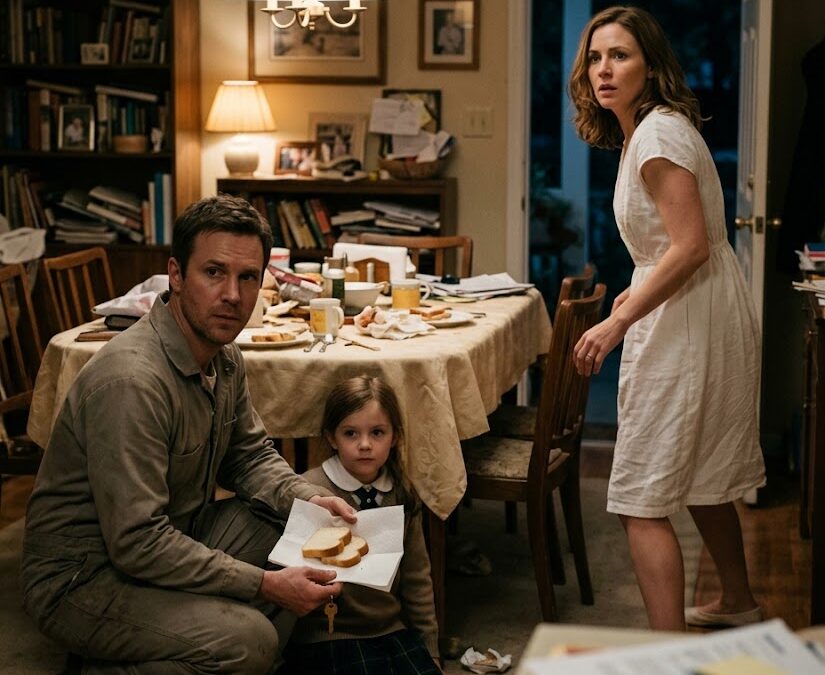
Chapter 2: The Place Setting
The bell rang again.
Willa moved toward the hall.
I kept one arm around Nora and blocked the doorway.
“Don’t answer it,” she said.
“Why?”
“She’s a former employee.”
The woman outside knocked once.
“Evan? It’s Ruth Bell.”
Nora held the brass key in both hands.
“Dad, that’s the wrong inventory.”
Willa looked at her.
Then I opened the door.
Ruth stood on the porch in a raincoat, carrying a document case. I remembered her from Mara’s memorial. She had worked for the foundation.
“I’m sorry to come unannounced,” she said. “I was told you’d be home.”
“Who told you?”
Ruth’s eyes moved past me to Willa.
“Mrs. Hale.”
Willa folded her arms. “I asked her to bring the auction list.”
Ruth glanced at Nora.
“Is she all right?”
“She’s fine,” Willa said.
Nora stiffened against me.
Ruth noticed.
“May I come in?”
I stepped aside.
Willa didn’t.
“Ruth, this isn’t a good time.”
“You said the sale closed at eight.”
“It does.”
Ruth looked toward the dining room, then at the key in Nora’s hand.
“Where did you get that?”
Nora hid it against her chest.
I set her down carefully, keeping my palm on her back.
“Show me what you hid.”
Willa’s voice went cold. “She hasn’t hidden anything.”
Nora looked up at me.
“You can tell me what it is,” I said.
“It’s in the piano bench.”
Mara had chosen the plain upright piano when Nora was a baby. One side still bore a scratch from the movers.
Willa stepped in front of the bench.
“That’s my property now.”
“No,” I said. “It isn’t.”
She laughed, but her face had gone pale.
Mara’s will had left the piano and everything in its bench to Nora. I had signed the inventory myself, thinking it was one more sentimental gesture.
I pulled the bench toward me.
Willa grabbed the other end.
“Stop.”
“Let go.”
“You can’t rummage through my house.”
“Our house,” I said.
“Your house,” she snapped. “You gave me authority.”
“Not over Nora’s inheritance.”
Ruth set down her case.
“Evan, I need to explain why I came.”
“First, we find what Nora hid.”
Willa yanked the bench. It tipped, but nothing fell out. Nora slipped between us, still holding the key.
“The loose board.”
A shallow compartment sat beneath the seat. It had a small brass lock.
Nora held up the key.
Willa lunged.
I caught her wrist, just enough to stop her.
She stared at my hand.
I let go.
“Don’t touch her.”
“I was stopping her from breaking it.”
Nora put the key in the lock.
It turned.
Inside lay a leather pouch wrapped in a faded blue scarf. Nora reached in and took out a silver locket, dented beside the clasp.
Mara’s locket.
The one Willa had told me was lost.
Nora held it out to me.
“I kept it safe.”
I opened it. Inside was a photograph of Mara holding newborn Nora. On the other side, in Mara’s handwriting, were three words:
For when you’re ready.
Ruth lowered her eyes.
“Where did you get the auction list?” I asked.
“From Willa’s office. She asked me to verify the items.”
“What was listed?”
“The locket. The piano. A set of letters.”
Willa’s mouth hardened. “There were two lockets.”
“Not this one,” Ruth said.
She took a printed inventory from her case. The locket was described as antique gold, with an estimated value of twelve thousand dollars. The piano was listed as a charitable donation. The letters were labeled “Mara Hale correspondence.”
I looked at Willa.
“Why were you selling Mara’s things?”
“The foundation needs money.”
“Then sell your things.”
“It’s a benefit auction. Those items were already in the house.”
“They belong to Nora.”
“Until she’s old enough, I’m her guardian.”
“You’re her stepmother.”
“And you’re always gone.”
The words landed because they were partly true.
After Mara died, I spent a year inspecting bridges across three states. I told myself the travel was temporary, a way to pay the bills and avoid the empty bedroom.
Willa had been there for breakfast, school pickup, and bedtime.
I had mistaken presence for care.
Nora held the locket against her sweater.
“Did you know she was hiding it?”
Willa stared at me.
“I knew she had it.”
“Did you lock up the food?”
“I locked the pantry.”
“And the refrigerator?”
“She was eating between meals.”
“She’s seven.”
“She was being impossible.”
Nora’s thumb moved over the dent.
“I only took bread.”
“Stop making her sound helpless,” Willa said. “She knows exactly what she’s doing.”
Ruth spoke quietly. “I heard that same phrase from your housekeeper.”
“We don’t have a housekeeper.”
“You did until last month. Mrs. Dorsey called after she quit.”
Willa’s eyes flashed. “That woman was unstable.”
“What did she tell you?” I asked.
“She said Nora was made to eat alone,” Ruth replied. “She said the pantry was locked. She was afraid to put it in writing and lose her reference.”
“Did you dismiss her?” I asked.
“She walked out.”
“Why?”
“She couldn’t manage a child.”
Nora looked down.
I carried her to the kitchen. Ruth followed, leaving Willa beside the piano.
Even the glasses were locked away. I found a bottle of water and filled a cup from the sink.
Nora drank in small, careful sips.
“Can I have bread?”
“You can have anything you need.”
She looked at Willa.
“I don’t want to get in trouble.”
“You won’t.”
Willa leaned against the doorway.
“You’re rewarding her for acting out.”
“I’m feeding her.”
“She ate at school.”
“She said the bread was for tomorrow.”
“She lies.”
“Then we’ll find out.”
I gave Nora two slices. She ate one slowly, then tucked the other into her pocket.
I didn’t stop her.
That was when I understood.
She wasn’t only hungry.
She expected to be hungry later.
* * *
Ruth sat at the island while I called my attorney, Dana Cho. She answered on the second ring.
“Is Nora safe?”
“She’s with me.”
“Is Willa there?”
“Yes.”
“Keep calm. Don’t threaten anyone. I’m calling a family attorney and a child welfare contact.”
“What can I do tonight?”
“Keep Nora with you. Document what you see. Don’t move or destroy anything.”
“I’m not trying to destroy anything.”
“I know. I’m telling you how this can look later.”
Willa stood three feet away, listening.
“The pantry has a padlock,” I said. “The refrigerator has a cable lock. There’s an auction tonight, and my daughter’s inheritance is listed.”
“I’m sending counsel to the house,” Dana said.
“Can we stop the auction?”
“We can seek an emergency order. I can’t promise a judge will issue one before eight. Notify the auctioneer that ownership is disputed and document anything that leaves.”
Ruth opened her case.
“I have the auction company’s contact information.”
“Send it to my attorney,” I said.
Willa filled a glass but didn’t drink.
“You’re turning a private family matter into a spectacle.”
“You put her things in a public auction.”
“The auction supports a good cause.”
“Then let it support the cause without Mara’s property.”
“You don’t know what the money was for.”
“Tell me.”
She looked away.
I photographed the locks and recorded their condition, naming the date and time.
Willa watched.
“This is ridiculous.”
“I’m documenting what’s here.”
“You’re trying to make me look cruel.”
“I’m trying to find out what happened.”
Nora sat at the far end of the island, her shoes not reaching the floor.
Ruth slid the auction list toward me.
“I noticed something on the last page.”
A folded note was tucked beneath it. I opened it.
It was a transfer authorization for the Hale Family Foundation account. The amount was $84,000, payable to a consulting company called Ellison Strategy Group. The authorization bore my electronic signature.
I had never seen it.
The date was six weeks earlier, while I was on a bridge project near Pittsburgh. Willa was listed as the second approving officer.
“Did you authorize this?” Ruth asked.
“No.”
Willa set down her glass.
“You signed the foundation’s annual forms.”
“Not this.”
“The money was for campaign outreach.”
“We don’t run a campaign.”
“It was donor engagement.”
“Who is Ellison Strategy Group?”
She didn’t answer.
Dana called back. I put her on speaker and described the transfer.
“Don’t confront her about the account,” Dana said. “Send me the document and let the bank confirm the authorization.”
Willa stepped toward the paper.
I covered it with my hand.
“You already made your call,” she said. “Let’s not pretend this is about Nora anymore.”
“It’s about what you’ve done.”
“I kept this family functioning while you traveled.”
“Did you use my signature?”
“You approved the spending.”
“I didn’t.”
“You’re impossible to work with when you’re angry.”
Nora had gone very still.
Ruth closed the case.
“I’ll send the inventory to your attorney.”
“Stay,” I said. “Please.”
She nodded.
Dana had me photograph the transfer form, then asked me to read the company’s registration number. She searched the foundation records while I read.
“Is Willa an officer?” Dana asked.
“Yes,” Ruth said. “She became interim treasurer after Mara died.”
“Who is the other director?”
I knew the answer.
Me.
“And the transfer requires two approvals,” Dana said.
“Correct.”
“I need the bank to confirm whether this came through your credentials or a delegated login.”
Willa gave a short, humorless laugh.
“By all means. Accuse me of fraud before you know anything.”
“That’s why we’re checking,” I said.
She raised her chin.
“You have no idea how much I’ve done for you.”
“Then tell me.”
Instead, she walked out of the kitchen.
Nora watched her go.
“Is she leaving?”
“I don’t know.”
“Can I stay with you?”
“Yes.”
“Even if she says I have to go upstairs?”
“Yes.”
Her shoulders released.
Ruth’s hand rested on the leather pouch.
“There’s something else in here.”
She reached into the compartment and pulled out an envelope folded behind the scarf. Mara’s handwriting was on the front.
Evan, if you’re reading this with Nora, then she kept it.
I opened it. The letter was dated four months before Mara died. She wrote that she had asked Ruth to keep the locket and a set of account papers until Nora was old enough to understand their purpose.
The locket was “proof of origin,” she wrote. The papers belonged with the foundation’s original deed.
I read the line twice.
“What does ‘proof of origin’ mean?”
Ruth’s face changed.
“She didn’t tell you?”
“Tell me what?”
Mara’s letter named a donor, trustee, and business partner. Someone who had visited after the funeral. Someone listed as an honorary sponsor of Willa’s auction.
My father.
Graham Hale.
* * *
Nora fell asleep in my room, curled beneath a blanket with the locket in her hand.
I sat beside her while Ruth and Dana worked downstairs. Willa stayed in the guest room, refusing to leave and refusing to speak.
My father arrived just after ten.
He came through the front door without knocking. He still had a key.
“Evan,” he said. “What is this about?”
I stood between him and the stairs.
“Why is your name on the auction sponsor list?”
“Because I supported Mara’s foundation.”
“You also consulted for Ellison Strategy Group.”
He glanced toward the kitchen.
“Who told you that?”
“Ruth.”
“She doesn’t understand the foundation’s finances.”
“Did you receive the $84,000?”
“Not personally.”
“That’s not an answer.”
He slipped off his gloves.
“Willa needed help keeping the foundation afloat.”
“With my signature?”
“You signed the yearly approvals.”
“Not this transfer.”
“It was a delegated account.”
“Did I approve it?”
He looked at me.
“You were away. The work needed doing.”
Ruth came into the hall holding the locket.
“Graham, did you ask Mara for the original deed?”
He looked at the locket.
“Where did you get that?”
“Nora kept it,” I said.
His expression tightened.
“That should have been sold.”
“Why?”
“It’s old jewelry.”
“It’s proof of origin, according to Mara’s letter.”
“That was sentimental language.”
“Was it?”
He turned to Ruth.
“You’re not helping.”
“Neither are you.”
He walked into the kitchen. I followed. The auction list and transfer form remained on the table.
“You have no idea what Mara’s foundation was worth,” he said. “The buildings were expensive to maintain. Willa was trying to save what could be saved.”
“By selling Nora’s property?”
“By making decisions.”
“Where did the money go?”
“Some went to Ellison.”
“Who owns it?”
He didn’t answer.
He sat at the table.
“Your mother left you too much to manage,” he said. “You weren’t in shape to do it.”
Mara had not been my mother. She was my wife. Graham had never liked that I built my life outside his company, but he tolerated it while Mara was alive.
After she died, he became a fixture in our house. He brought food, contractors, and papers for me to sign.
I had signed too many.
“Why did Willa lock Nora out of the pantry?”
“She was supposed to be upstairs tonight.”
“Why?”
“Because of the sale.”
“Why would Nora interfere with an auction?”
“She knows the locket matters.”
“Matters how?”
He leaned back.
“You’re not going to like the answer.”
“Say it anyway.”
“The foundation was created with land Mara inherited from her grandmother. The title was contested. The locket contains the old trust seal.”
Ruth lowered her eyes.
“What does the seal prove?” I asked.
“That Mara’s grandmother transferred the land into a family trust before she died.”
“And the foundation?”
“Never owned the land outright.”
“The foundation owns the buildings.”
“Some of them. Not the parcel under the old theater.”
My father’s company had spent three years negotiating to redevelop that block. The project was worth more than twenty million dollars.
“Your company wants the land.”
“My company wants clear title.”
“By selling the object that proves the trust owns it?”
“The sale would have brought in enough to settle the foundation’s debts.”
“Which you created?”
“Which Mara created.”
“Did she know?”
He didn’t answer.
I called Dana.
“Graham is here. He says the locket proves a trust interest in land his company wants.”
“Don’t let him take documents,” she said. “I’m sending a title lawyer and a forensic accountant.”
My father stood.
“This is a family conversation.”
“No,” I said. “It’s a transaction.”
“Evan, you have a child upstairs who needs stability.”
“Then explain why you helped lock her out of the food.”
“I didn’t know about the locks.”
“Did you know Willa planned to sell her locket?”
“I knew there was an auction.”
“Did you know it was hers?”
His silence answered.
Ruth lifted the letter.
“Mara knew you’d come after the land.”
He turned to her.
“She was confused by then.”
“She wrote this four months before she died.”
“She was ill.”
“She was clear.”
He looked toward the stairs.
“If you push this, you’ll hurt everyone.”
“Who is everyone?”
“You. Nora. Willa. The foundation. Me.”
“Who are you trying to protect?”
He took a slow breath.
“Do you remember the winter after your mother left?”
“I remember.”
“Your father kept this family together,” he said.
“You were the one who left.”
“I made the hard choices.”
“You made your choices.”
He looked at me with tired contempt.
“Mara thought she could make every wrong right with paperwork.”
“Maybe she knew paperwork was the only thing you respected.”
His jaw tightened.
Then he left without asking for the locket.
* * *
The next morning, Dana arranged for a family attorney to meet us and asked a local child welfare worker to check on Nora. The worker explained that this wasn’t a punishment and that Nora could speak privately.
Nora sat at the kitchen table in clean pajamas, her feet hooked around a chair rung.
The pantry lock was still there. I hadn’t touched it.
The worker photographed it and asked Nora about meals, bedtime, and where she felt safe.
“I ate lunch at school,” Nora said.
“What about dinner?”
“Sometimes I ate.”
“Did anyone tell you not to eat?”
Nora looked at me.
“You can tell her the truth,” I said.
“Willa said I had to wait for the bell.”
The worker wrote that down.
“What did the bell mean?”
“That I could bring the plates.”
“Did you get food then?”
“Sometimes.”
The worker thanked her and kept her tone calm.
Afterward, she spoke to me privately.
“I’m documenting a concern and making a follow-up visit. This isn’t a finding of abuse. It’s an assessment based on what we saw and what Nora reported.”
“What should I do?”
“Keep food accessible and routines predictable. Don’t coach her. Call us or the police if you need immediate help.”
Willa listened from the hall.
“She’s taking a child’s imagination as fact.”
The worker turned to her.
“I’m taking her words seriously and documenting them.”
“You’re ruining my life,” Willa said.
“I’m checking on a child.”
After the worker left, Willa came into the kitchen.
“You’re pleased with yourself.”
“No.”
“You made sure they saw the locks.”
“You installed them.”
“You could have asked me to remove them.”
“I did.”
“You asked in front of an audience.”
“I asked because Nora was right there.”
“You always make me the villain.”
“Did you tell her to wait for a bell before she could eat?”
Willa rubbed her thumb along her wedding ring.
“It was a routine.”
“Did you lock the refrigerator?”
“I told you why.”
“Did you tell my father about the auction?”
“He was a sponsor.”
“Did you know he wanted the locket sold?”
She looked at me, calculating.
“I knew he wanted the land deal completed.”
“Did he tell you about the trust seal?”
“He said the locket was an heirloom.”
“Why was it listed as gold jewelry?”
“Ask him.”
“I’m asking you.”
She didn’t answer. Her face turned toward the front windows.
Dana called around noon.
The bank had confirmed the transfer request came from Willa’s delegated credentials, not mine. The request was a printed copy of an internal transaction, not a completed transfer.
“Did the payment leave the account?” I asked.
“No,” Dana said. “The bank flagged it because the receiving company was newly added.”
“Can they tell us who owns it?”
“The public filing lists a registered agent. The bank is checking the beneficiary. We need the court to freeze the account and pending sales.”
“What about the auction?”
“The auctioneer has been notified that the listed items are disputed. He has agreed to pause those lots.”
Willa stood across the kitchen.
“You had no right to do that.”
Dana heard her.
“Mrs. Hale, you should speak through your attorney.”
“I have one.”
“Then call them.”
Willa turned away.
I asked Dana whether I could file for temporary custody.
“You already have custody,” she said. “The concern is whether Willa should have access to Nora while we investigate. I recommend no contact unless a court orders otherwise.”
“Can she come back to the house?”
“That’s your decision, unless there’s an order. I’d advise you not to leave Nora alone with her.”
I looked at the brass bell on the table.
“No,” I said. “She can’t.”
Nora came to the doorway with a folded paper.
“What is it?”
“A picture.”
It showed the dining table in blue crayon. Beneath it was a small figure in a yellow dress. A silver bell sat on top.
I knelt.
“Who’s that?”
“Me.”
“Why are you under the table?”
She shrugged.
“Willa said the chair was for grown-ups.”
I kept my voice steady.
“Do you want to stay here?”
“With you?”
“Yes.”
She nodded.
“Then that’s what we’ll do.”
Willa was gone. A note on the island said she had gone to her attorney.
Ruth read it and shook her head.
“She’ll try to get ahead of the story.”
“What story?”
“The one she can’t control.”
* * *
She did.
That evening, a society blog posted a photograph of Willa at the auction preview. The caption said she had rescued the foundation from mismanagement and suggested I was trying to cancel a charity event over a “private family dispute.”
It didn’t mention Nora.
By morning, donors had called the auction house and the foundation board. One board member asked whether the land dispute was real. Another asked whether I’d been drinking when I signed annual reports.
I didn’t answer online. Dana told me not to.
Instead, I met her at the bank with the title lawyer and a forensic accountant. We brought the foundation records, transfer request, auction inventory, and Mara’s letter.
The bank confirmed the request had been entered through Willa’s account and held for review because the new payee triggered a fraud alert. Its beneficial owner was Hale Urban Renewal.
My father’s company.
The accountant traced two earlier payments from the foundation to Ellison Strategy Group, both approved by Willa and followed by deposits into Hale Urban Renewal’s project account.
Twelve thousand.
Then twenty-one thousand.
The requested eighty-four thousand was the largest.
“Could those have been legitimate consulting fees?” I asked.
“They could,” the accountant said. “We need contracts, invoices, and board minutes. The invoices appear to describe services the foundation never received.”
“Who approved them?”
“Willa signed them. Your father countersigned two.”
“Did I?”
“No.”
The title lawyer examined the locket and the papers inside the pouch. The locket itself had no magical legal power. Its seal physically matched the wax marks on a signed trust deed Mara’s grandmother had deposited with the county recorder decades earlier.
The deed existed in the recorder’s archive and Mara’s foundation file. The recorded copy had a damaged attachment page. The original attachment identified the parcel beneath the old theater as trust property, with a right of first refusal granted to the foundation.
“Your father’s company would need that right cleared before redevelopment,” the lawyer said.
“Could they buy the land anyway?”
“They could try. They’d face a title challenge. The deed and seal help establish authenticity.”
“And if the locket had been sold?”
“The seal on the document would remain. But the locket helps show the seal was kept with the foundation papers and ties them to Mara’s family records.”
“Why did Mara leave it to Nora?”
“Nora is the next beneficiary under the trust.”
I stared at the papers.
The locket had been called a trinket because that was easier than admitting it was evidence.
Mara had trusted Nora to keep it safe, and Nora had done exactly that.
“This doesn’t prove your father’s company committed fraud,” the lawyer said. “It gives us grounds to ask for a full accounting and a court order.”
“Then we do that.”
The accountant nodded. “Preserve the records. Don’t contact your father about the financial findings.”
I thought of his words: You were away. The work needed doing.
I had wanted to believe he was helping.
Dana filed a notice with the foundation board, a petition to stop the sale of disputed items, and a request to restrict transfers from the foundation account.
The hearing was set for two days later.
That night, Willa’s attorney came to the house with a folder.
“Mrs. Hale wants to collect personal property,” he said. “She won’t enter without consent.”
“She can make a list through counsel.”
“She also wants to see Nora.”
“No.”
“She has been acting as a caregiver.”
“She’s been told not to contact Nora until the attorneys agree on a plan.”
“That’s a serious restriction.”
“So are locked food cabinets.”
He glanced toward the kitchen.
“I’m here to avoid unnecessary hostility.”
“Then help your client stay away.”
He handed me notice that Willa intended to seek access through court.
Nora watched from the staircase.
“Is she coming back?”
“Not tonight.”
“Will she ring the bell?”
“I put it away.”
“Where?”
“In a drawer.”
“Can it still ring?”
“It can.”
“Can we throw it out?”
“Not yet.”
“Why?”
“I might need it to show what happened.”
She nodded, accepting that as another kind of adult promise.
* * *
The hearing took place in a county courtroom with worn carpet and wooden benches. No photographers, donors, or chandeliers.
Just a judge, two attorneys, a clerk, and the people whose choices had brought us there.
Willa sat beside her lawyer in a gray suit, composed and wearing only her wedding ring. My father sat behind her and didn’t look at me.
Dana presented photographs of the locked pantry and refrigerator, the auction inventory, Ruth’s statement, the bank’s confirmation, and Nora’s interview summary.
Willa’s attorney called the locks temporary discipline and said Nora’s account was being used to force Willa out of the home.
Dana said the question wasn’t whether Willa was a bad person. It was whether Nora needed a safe, stable arrangement while the facts were examined.
The judge asked Willa whether she had locked the food.
“Yes,” she said. “As a response to repeated behavior.”
“What behavior?”
“She took snacks without permission.”
“Was she denied meals?”
“No.”
“Did you require her to wait for a bell before clearing plates?”
Willa hesitated.
“I used the bell to signal chores.”
“Was she allowed to eat before clearing plates?”
“She ate at school.”
“That wasn’t the question.”
Willa turned to her attorney, then back.
“Sometimes.”
The judge made a note.
Dana submitted the foundation records. The judge said the financial dispute was separate from custody but relevant to whether Willa had used authority over Nora’s property for personal or organizational purposes.
Willa’s attorney stood.
“She has no criminal charge. No agency has made a formal finding. Mr. Hale is using a disputed auction to punish his wife.”
The judge looked at Dana.
“Do you have anything else?”
Dana called Ruth.
Ruth explained that Mara had entrusted her with the locket and documents. Willa had asked her to verify the auction inventory but hadn’t told her Nora’s property was included.
Willa’s attorney challenged her memory. Ruth answered briefly.
Dana showed the original auction list beside the transfer request. Both carried the foundation’s internal tracking number. Willa had assembled them in one packet for the evening’s transactions. Ruth said she found the request folded beneath the inventory after Willa left the room.
The judge asked for the bank’s confirmation. Dana provided it.
The funds had not transferred, but the recipient account belonged to Hale Urban Renewal. Willa had initiated the request, which required a second approval the bank had not received.
The judge looked at Willa.
“Did you initiate this transfer?”
Her lawyer leaned toward her.
Willa spoke first.
“I authorized a payment.”
“For what services?”
“Consulting.”
“What services?”
“Communications and donor strategy.”
“Where is the contract?”
She looked toward my father.
He stood.
“Your Honor, I can clarify.”
The judge told him to wait until called.
Willa faced the bench again.
“The work was ongoing.”
“Where are the invoices?”
“They’re in the foundation office.”
“Are there board minutes approving the contract?”
“I believe so.”
Dana produced the minutes. No approval was recorded.
The judge froze nonroutine foundation transfers and stopped the sale of property identified as belonging to Nora or the trust. She also granted me temporary sole physical care of Nora, with no unsupervised contact between Nora and Willa pending further review.
The order didn’t decide the case or declare anyone guilty.
It gave Nora a stable place to sleep while the lawyers examined the evidence.
In the hallway, Willa caught up with me.
“You’ve won.”
“No.”
“You got the order.”
“I got time.”
“You got to make me look like a monster.”
“I didn’t make you lock the food.”
“I was trying to get her under control.”
“By making her afraid to ask for bread?”
She glanced at the courtroom doors.
“Your father will tell you what he thinks.”
“He already has.”
“Then you know how this ends.”
“I know how tonight ends. Nora comes home with me.”
Willa looked at the locket in my hand.
“She should have been mine to protect.”
“She wasn’t yours to sell.”
“I never wanted to sell her locket.”
“It was on your auction list.”
“I was told it was an estate item.”
“By whom?”
She didn’t answer.
Then she walked away.
* * *
The county recorder located the original trust deed the next week. Its wax seal matched the impression on Mara’s archive sheet. The trust held the theater parcel, and Nora was its next beneficiary.
The title lawyer sent formal notice to Hale Urban Renewal and the foundation board.
My father’s redevelopment proposal was suspended.
The board called an emergency meeting at the old theater. It was a brick building with a torn red curtain and dusty seats. Mara had loved it because it had survived floods and a failed renovation.
The meeting was public because the foundation’s bylaws required notice to donors before any sale involving trust property.
Willa arrived with her attorney. My father came separately. I brought Ruth, the title lawyer, and the accountant.
Nora stayed with a neighbor and the child welfare worker’s contact number. The meeting didn’t belong to her.
The board president opened with a statement about the foundation’s mission. The lawyer summarized the property dispute.
My father spoke first.
He said the trust was inactive, the land neglected, and the foundation needed capital. His company had advanced money to keep the theater standing and expected repayment.
He sounded reasonable.
He brought dates, estimates, roof-repair photos, and a list of emergency costs. He reminded the board he’d been a donor for twenty years. He said the foundation couldn’t keep a building it couldn’t afford to maintain.
Some members nodded.
Willa’s lawyer called the auction a fundraising effort and said the disputed items had been listed in good faith.
Then the accountant presented the payment records.
Three transfers to Ellison Strategy Group. No signed contracts. No work products. Two invoices issued months apart with the same description.
The money had flowed to Hale Urban Renewal through a consulting account.
The board president asked Willa whether she had approved the payments.
“I did.”
“On what authority?”
“Under my treasurer role.”
“Did the board approve the contract?”
“I believed I had delegated authority.”
“Where is that delegation?”
“I don’t have it with me.”
The accountant placed copies of the bank records on the table.
“Were these payments for legitimate services?”
“They were for strategy and outreach.”
“What strategy?”
“Donor communication.”
“Did the foundation receive a donor plan?”
“I don’t know.”
“A mailing list?”
“I don’t know.”
“Any deliverable?”
“I don’t know.”
My father leaned toward the microphone.
“Those questions make routine work sound suspicious.”
The title lawyer placed the recorded trust deed on the table, then the original attachment from Mara’s file. The documents matched.
She showed the locket’s seal beside the impressions on the papers. A ruler, a photograph, and the same small break in the wax pattern.
The board president looked from the deed to my father.
“Did your company know the trust held this parcel?”
“We believed the title was clear.”
“Did you see this deed?”
“I saw a later copy.”
“Did you know the original attachment existed?”
He hesitated.
My father had always used a pause to make others fill it.
This time, no one did.
Willa looked at him.
“You said there was no original.”
“I said the attachment was missing.”
“You told me Mara destroyed it.”
“I believed she had.”
Ruth stood.
“Mara told me where she’d placed it.”
“Why didn’t you come forward sooner?” a board member asked.
“I did what she asked. I kept the papers safe until they were needed.”
“You waited until after the auction was announced.”
“Yes.”
“Why?”
“I didn’t know the auction included the locket until I saw the list.”
My father’s hands tightened on the table.
The board president turned to him.
“Were you planning to buy the parcel?”
“My company was considering a proposal.”
“Would the foundation have received fair value?”
“I can’t answer a hypothetical.”
“Would your company have paid off its consulting invoices?”
“That was under discussion.”
“Were the invoices approved?”
“They were approved by Willa.”
She flinched at hearing her name used as a shield.
The board voted to cancel the auction pending a title review and financial audit. Then they suspended Willa from her treasurer role.
They asked my father to recuse himself from every discussion involving Hale Urban Renewal.
He refused.
The chair asked him to leave.
He stood slowly.
“This foundation is making a mistake.”
“Maybe,” the chair said. “But it will be made in the open.”
My father looked at me.
“You’ve chosen strangers over family.”
“No,” I said. “I’ve chosen the truth that can be checked.”
Willa remained seated.
When the meeting ended, she came to me in the lobby.
“You got what you wanted.”
“What did I want?”
“To take the house. The foundation. The land.”
“I wanted Nora to eat dinner.”
“You never understood how difficult she was.”
“I understand she was a child.”
“She wasn’t like other children.”
“She was grieving her mother.”
“She had everything.”
“Except a safe place to ask for food.”
Willa’s eyes filled, but she didn’t cry.
“Your father said she’d be fine.”
“Did you believe him?”
“I wanted to.”
It wasn’t an apology. Not yet.
But it was a crack in the story she’d built.
I let her stand with it.
* * *
The legal outcomes took months.
The financial review found that Willa had approved transfers without board authorization. My father’s company received the money through Ellison Strategy Group and classified it as project development expenses. After a civil claim, the foundation recovered it through a settlement.
No one went to prison.
The district attorney reviewed the records and declined criminal charges, citing the difficulty of proving intent beyond a reasonable doubt and the repayment agreement. The decision wasn’t an endorsement. The civil record remained public.
Willa resigned from the foundation and agreed to a no-contact order during the custody case. She also agreed not to seek custody of Nora.
My father’s company withdrew its purchase proposal. As part of the settlement, it paid for the theater’s roof repair without gaining ownership rights.
The judge finalized custody the following spring. I received sole legal and physical custody. Willa could request supervised visits after completing a parenting assessment and following the counselor’s recommendations.
She never requested them.
I sold the house a year later. I couldn’t look at the dining table without seeing Nora’s shoes beneath it.
Before the sale, I had the locks removed.
I kept the brass padlock and cable lock in the case file. Dana said I could discard them when the case closed.
I did.
I kept the small brass bell.
Not to remember Willa’s control.
I wanted Nora to decide what it meant.
* * *
Six months after the hearing, Nora and I moved into a smaller house near the river. The floors were crooked, the kitchen had yellow cabinets, and the back porch needed paint.
I started a local engineering job. I made less money, but I drove twenty minutes instead of flying out every Monday.
At first, Nora asked permission for everything.
“Can I open the fridge?”
“Yes.”
“Can I have a second apple?”
“Yes.”
“Can I keep this cracker for later?”
“You can.”
She kept it anyway.
I put a basket of snacks on the counter. She filled it with crackers, applesauce cups, and cereal bars.
Some days she ate them all.
Some days she lined them up by color.
I didn’t comment.
Ruth visited on Saturdays with bakery bread. She never asked Nora to finish her plate. She taught her to make jam and how to tell when the lid had sealed.
Nora liked the popping sound.
“Is it supposed to do that?” she asked.
“Yes,” Ruth said. “That sound means the jar is closed.”
Nora considered it.
“Closed is okay when it keeps the good stuff in.”
“Exactly,” Ruth said.
The locket stayed in a safe deposit box while the lawyers completed the trust transfer. Once the court confirmed Nora’s status as beneficiary, the title was recorded in her name through a protected trust.
The theater was repaired. The foundation turned it into a community arts center and kept Mara’s name over the entrance.
The locket wasn’t sold.
Neither was the piano.
I had the old upright moved to our new house. Nora began lessons with a teacher who didn’t mind wrong notes. The bench still had its hidden compartment.
One night, Nora asked whether she could open it.
“It’s your piano,” I said.
She took the brass key from a drawer.
“I want to put something in there.”
“What?”
She brought a folded paper from her room. It was the picture she’d drawn of herself beneath the table.
The drawing had changed. She had added a chair beside the table and a plate on top.
She placed it inside the bench.
“Do you want to keep the locket there too?”
“No. I want it somewhere safe.”
“It is.”
“Can the box open whenever I want?”
“Yes.”
She considered that.
“Then I want it in the box.”
We put the picture in the bench and returned the key to its drawer.
I didn’t ask her to explain the drawing.
* * *
A year after we moved, Willa sent a letter through her attorney.
She asked to meet Nora with a family counselor present. She wrote that she’d begun treatment for anxiety, left the foundation world, and understood the court’s boundaries.
The counselor met with Nora first, then with me.
The choice was Nora’s.
I told her no visit was required. She could say no, and I wouldn’t change how I felt about her.
“What would she say?” Nora asked.
“I don’t know.”
“Would she make me eat at the bell?”
“No.”
“Would you be there?”
“Yes.”
“Could we leave?”
“Whenever you want.”
She thought about it for a week.
Then she agreed to a brief meeting at the counselor’s office.
Willa arrived without jewelry or gifts. She sat across from Nora with her hands folded in her lap.
“Thank you for coming,” she said.
Nora stayed beside me.
Willa looked at her.
“I’m sorry I made you wait for food.”
Nora didn’t answer.
“I told myself I was teaching you rules,” Willa continued. “I was wrong.”
“You said I was bad,” Nora said.
“I did.”
“You said I lied.”
“I did.”
“You locked the fridge.”
“I did.”
Willa looked down.
“I can’t undo that.”
“No,” Nora said.
Willa started to speak, then stopped.
The counselor let the quiet sit.
Finally, Willa said, “You deserved to feel safe in that house.”
Nora leaned closer to me.
“Why did you do it?”
Willa looked at the floor.
“Because I wanted everything in the house to obey me.”
The answer was honest and ugly.
I respected it more than a polished apology.
Nora didn’t forgive her that day. She didn’t promise another visit.
After twelve minutes, she asked to leave.
Outside, she held my hand.
“Can she write again?”
“If you want.”
“Can I not answer?”
“Yes.”
“Okay.”
That was the boundary.
Not punishment.
Not reconciliation.
A choice that belonged to Nora.
* * *
Three years later, the theater hosted its first full season of children’s performances. The lobby smelled of fresh paint and popcorn. The old red curtain had been repaired, but one frayed corner remained because Nora liked it.
She was ten by then, taller, louder, and able to finish dinner without checking anyone’s face first.
The foundation invited us to opening night. Nora wore a navy dress and sneakers. She carried the locket in its cloth pouch.
“Do you want me to hold it?”
“No. I’ve got it.”
The theater’s new director welcomed us. Ruth sat in the first row. The board president stood near the back, speaking with donors.
My father wasn’t there. He had sold his company share to a partner and moved to Arizona. Every year, he mailed Nora a birthday card. She kept them unopened in a drawer, free to decide what to do with them later.
Willa sent a letter each birthday. Nora read them when she wanted. Sometimes she kept them. Sometimes she asked me to recycle them.
None asked for forgiveness.
The last one said, I hope your home feels like yours.
Nora tucked it into her desk.
The theater’s first show was a children’s folktale. During intermission, she climbed onto a step stool to see the stage.
The brass bell sat beside the programs.
I had brought it in a padded box. The foundation wanted an exhibit about the theater’s early history, and the bell had once belonged to its ticket desk. Willa had bought it at an antique shop.
The auction list had called it a dining-room service bell.
That part had been wrong too.
Nora turned it over in her hand.
“This is the same one.”
“Yes.”
“Does it still work?”
She tapped it once.
The clear ring filled the lobby. A few people looked over.
Nora smiled.
“Now it means the show is starting.”
The lights dimmed.
I watched her return to her seat, the locket safe in her pocket, her drawing resting inside the piano bench at home.
The table had become a place to eat.
The bell had become a sound she chose.
The house had become hers.
Nora reached for my hand when the curtain rose.
THE END








