“LET HER GET WET”: My CEO Husband Turned the Flood Test on Me, but the Orange Tag in My Hand Exposed His Entire Company
Chapter 2: The Signature Beneath the Seal
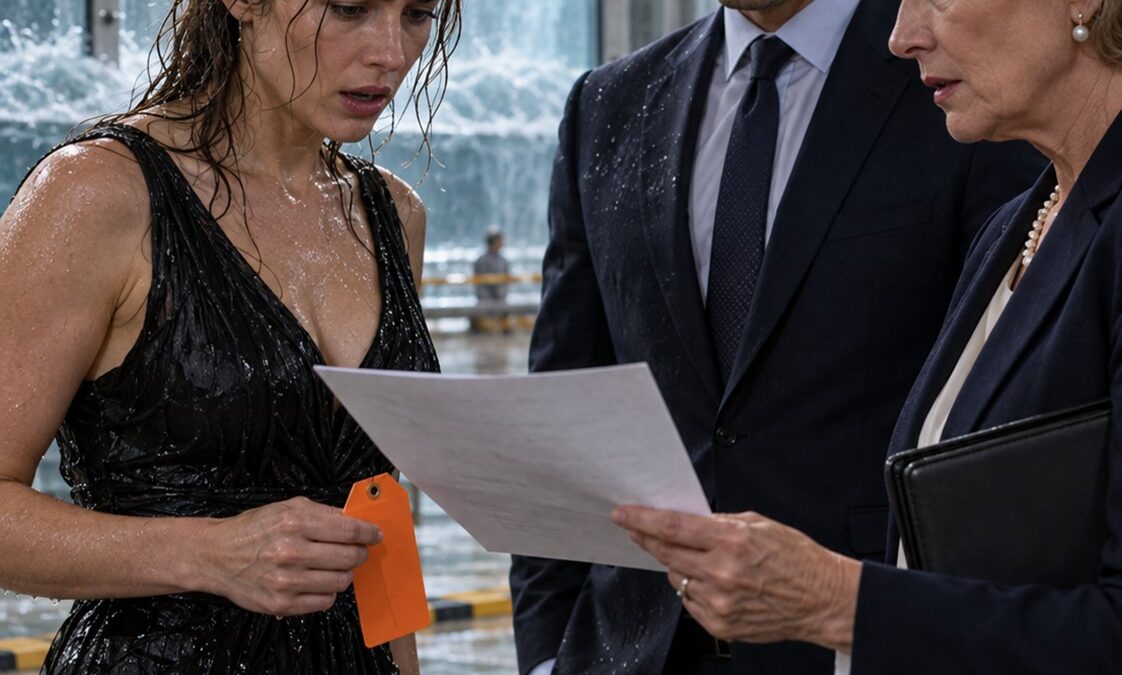
Judith did not hand me the document.
The floor was wet.
The cameras were running.
Nolan was watching her fingers.
“Clear the bay,” she told him.
“This is my event.”
“It’s a safety test,” she said.
“And you just activated it with a person beside the unit.”
Nolan looked toward the buyers.
“An unfortunate misunderstanding.”
“Then preserve the footage.”
Tessa stepped toward the camera crew.
“Let me handle the press.”
“No one touches those cameras,” Judith said.
One of the people with her introduced himself as Seabright’s outside counsel.
The other was a safety engineer from an independent testing firm.
Judith had brought both because I had called her at seven that morning.
I had asked them to come quietly.
I had expected an argument over paperwork.
I had not expected to need dry clothes.
Elias approached with a folded shop coat.
“You’re shaking,” he said.
“I’m cold.”
He held the coat open.
I put it on without lowering the tag.
Nolan saw that small kindness.
His face tightened.
“Elias has been suspended,” he said.
“Then he has time to speak,” Judith replied.
Nolan reached for his phone.
Counsel spoke before he unlocked it.
“Please leave all company devices connected to the network.”
“Am I under arrest?”
“No.”
“Then stop acting like I am.”
Judith looked at the wet floor.
“I am acting like a trustee whose property may have been misrepresented.”
My mother, Evelyn Hart, had founded Seabright in a rented workshop.
She built barriers after a flood reached the ground floor of the hospital where my grandmother worked.
She died ten years ago.
Judith had administered her trust ever since.
Nolan knew that much.
He did not know what the trust had said to me yesterday.
Neither had I until Judith called.
Nolan pointed at her case.
“What is that?”
“A copy of a purported waiver,” she said.
“I’ve seen it.”
“Have you?”
“Of course.”
“Then you know Ada’s signature is on it.”
My name appeared in neat black ink beneath a date six years earlier.
I stared at it.
Six years earlier, I had spent that week in a field trailer outside Pittsburgh.
I remembered because Elias had driven me home after I broke my wrist on a loading dock.
I had signed inspection notes with my left hand for a month.
The signature on Judith’s page was smooth.
“I didn’t sign that,” I said.
“I know,” Judith answered.
Nolan folded his arms.
“Memories are unreliable.”
“Medical records aren’t,” I said.
Elias looked from me to Judith.
“What waiver?”
Judith closed the case.
“A document claiming Ada surrendered her future voting rights.”
Tessa’s smile disappeared.
Nolan watched her, then looked away.
The outside lawyer asked everyone to move into the adjacent conference room.
Judith refused.
“First, isolate the test equipment.”
The independent engineer walked to the control panel and recorded its settings.
Elias pointed to the orange tag in my hand.
“That seal was on unit fourteen,” he said.
“It was,” I answered.
“I told them not to move it.”
“You told them twice.”
Nolan’s eyes flicked toward the barrier.
The painted number on its side was fourteen.
He had presented the rejected unit to three hundred people.
He had blamed the man who refused to approve it.
And until the cameras caught his hand on the release switch, he had believed the rest could be managed.
* * *
The first meeting lasted four hours.
It took place behind a glass wall overlooking the empty test bay.
My dress dried stiff beneath Elias’s coat.
Judith offered to send me home.
I stayed.
The orange tag lay inside a clear evidence sleeve on the table.
Its printed serial number matched the barcode on the barrier.
Elias explained how it worked.
When a unit failed inspection, the engineer printed two linked records.
One was an orange tag fixed to the unit.
The other went into the quality archive.
Removing the tag did not cancel the hold.
Only a new test, with its own date and measurements, could do that.
“I saw the tag yesterday,” I said.
“It was under the sales placard.”
Nolan leaned forward.
“So you took company property.”
“I photographed it in place.”
“Then you removed it.”
“After the placard came off.”
“That’s theft.”
Judith’s lawyer made a note.
“We can address the handling separately.”
Nolan sat back, satisfied.
I gave the lawyer my phone.
On the screen, the tag hung from the barrier’s frame.
The photograph included the placard, the unit number, and yesterday’s clock display.
“The sleeve was open,” I said.
“I took the tag because someone was about to cut it off.”
“Who?” the lawyer asked.
“I didn’t see.”
I would not invent a witness to make my case cleaner.
The independent engineer examined the unit after the bay was closed.
He found the broken end of the tag’s plastic tie beneath the placard mount.
The orange tag had been pulled free and hidden.
The failed test itself was less dramatic.
Under sustained pressure, water had passed through a seam.
For a hospital basement, a slow leak was enough to matter.
The engineer would need to repeat the test under controlled conditions before stating how much the design needed to change.
Nolan seized on that.
“You have no proof this batch is defective.”
“We have proof it wasn’t cleared,” Judith said.
“There was a retest.”
“Where?”
“Our quality system.”
I knew every folder in that system.
I had spent nine years retrieving records for engineers who forgot where they had filed them.
“The retest entry has no instrument file,” I said.
“You looked?”
“It was my job.”
“Accessing restricted material?”
“Answering a municipal auditor’s request last week.”
I opened the request on my phone.
A city buyer had asked for the underlying test data before signing an order.
The response had included a certificate and a summary.
I had been told the raw file would follow.
It never did.
Nolan looked at Tessa.
She looked down.
Judith called the testing lab directly while we sat there.
The lab director checked its appointment ledger.
Seabright had booked a retest.
Two hours before it began, someone from Seabright canceled it.
The lab had issued no passing result.
That was the first secret.
The retest had never happened.
Nolan blamed an administrative mistake.
He said the certificate must refer to an internal test.
I asked who had performed it.
He named a technician who had been on leave that week.
Elias knew because he had covered her shift.
Nolan changed the subject.
He wanted everyone to focus on how I had taken the tag.
Judith told him the tag would be held by outside counsel.
She also ordered the sale and shipment of that barrier model paused while the records were checked.
Nolan called the pause reckless.
“Cities are waiting for these units.”
“Then they need reliable ones,” Elias said.
Nolan turned on him.
“You’re suspended.”
“Judith already heard you.”
Elias’s voice was steady.
He had been afraid in the bay.
Now he was angry.
I had not seen him angry since a vendor sent us bolts with false grade markings.
He had made them collect every box.
Judith asked counsel to preserve emails, test records, and camera footage.
She did not announce guilt.
She did not fire anyone.
The board would need verified facts.
The city buyers would need notice of the pause.
The engineer needed time with the equipment.
That was slower than Nolan’s public accusation.
It also left him fewer places to hide.
Near evening, Judith took me into an empty office.
She spread my mother’s trust agreement beside the waiver.
“You knew about the trust?” I asked.
“I knew what Evelyn signed.”
“Then why did the lawyer tell me the shares went to her foundation?”
“He showed me this waiver.”
Judith tapped the second page.
It claimed I had exchanged my future voting rights for a cash settlement.
I had received no settlement.
The bank had received a copy certified by our family attorney.
Judith had questioned it at the time.
The attorney supplied a witness statement and a payment acknowledgment.
Both bore my name.
“Why didn’t you call me?”
“I did,” Judith said.
She placed three returned envelopes on the desk.
They had gone to an apartment Nolan and I had left months earlier.
Each bore a forwarding label to his office.
None had reached me.
I looked at the attorney’s name on the certification.
Daniel Quill had handled my mother’s estate.
He had sat beside me at her funeral.
When I asked about the company, he had taken my hand and told me to build a life of my own.
The forged waiver had come from him.
* * *
Nolan came home after midnight.
I was sitting at the kitchen table with my wrist records, a towel, and the lease for a small furnished apartment.
He stopped in the doorway.
“You’re moving out?”
“Yes.”
“You haven’t heard my side.”
“I heard it in front of three hundred people.”
“The kiss was a mistake.”
“The valve wasn’t.”
His gaze fell on the towel.
I had wrapped it around a glass of ice for my sore shoulder.
He took one step toward me.
I moved the chair back.
He stopped.
For a moment, he looked like the man who had once waited outside my night classes with coffee.
Then he looked at the lease.
“Judith is using you.”
“How?”
“She wants the board.”
“She already votes the trust.”
“Until now.”
I studied him.
Nolan had always known my birthday.
That morning, he had given me flowers.
He had never mentioned the shares.
“What did Daniel promise you?” I asked.
Nolan put down his keys.
“Daniel helped your mother.”
“He forged my name.”
“You don’t know that.”
“I know where I was.”
“That isn’t proof.”
“It’s a start.”
He rubbed his forehead.
“You’re going to ruin the company over a paperwork dispute.”
“The barrier was on hold.”
“That hold was supposed to be temporary.”
“It still existed.”
“Elias could have resolved it quietly.”
“He tried.”
Nolan’s phone lit up.
Tessa’s name crossed the screen.
He turned it over.
I had no interest in asking how long they had been together.
His public answer had been enough.
“The apartment is paid through the month,” I said.
“I’ll collect the rest of my things tomorrow.”
“You can’t take company files.”
“I’m taking my clothes.”
He stood aside.
I carried one suitcase past him.
Outside, my car windshield was covered with a fine cold rain.
I had lived beside Nolan for eleven years.
That night, the empty passenger seat felt like a fact I should have recognized sooner.
The next morning, my work account stopped accepting my password.
My building badge failed.
Human resources emailed a notice placing me on administrative leave while it reviewed my handling of the tag.
The notice was signed by Nolan.
Judith’s lawyer told me to keep the email.
I had already saved it.
At the apartment, Elias called.
“They sent a truck for the archived test drives.”
“Who?”
“Celia North’s office.”
Celia was Seabright’s chief financial officer.
She had worked for my mother.
She understood exactly what a missing test file could do.
“Did you let them take anything?”
“I called the lab manager.”
The drives were in a locked cabinet.
The lab manager had refused the truck and logged its plate number.
I sent that detail to counsel.
An hour later, Judith obtained a board order directing staff to preserve the archive under independent supervision.
The company’s regular work continued.
The suspect product stayed put.
No one was asked to choose between a paycheck and a story they could not verify.
By afternoon, another email reached me.
It came from Daniel Quill.
He offered to meet privately and “resolve the inheritance confusion.”
Judith advised me to bring my own lawyer.
I brought an attorney named Priya Shah.
Daniel chose a hotel lounge with soft chairs and loud music.
He looked older than he had at the funeral.
He ordered tea.
I kept the waiver in its sleeve.
“Your mother wanted peace,” he began.
“She signed the trust.”
“She also feared what controlling shares might do to you.”
“That explains the age requirement.”
“She might have changed her mind.”
“Did she?”
Daniel stirred his tea.
“The waiver was your decision.”
“Where was I when I signed it?”
“In my office.”
“Which office?”
He looked up.
“You remember.”
“I remember a loading dock in Pittsburgh.”
“That week was a difficult period.”
“My wrist was in a cast.”
His spoon touched the cup.
Priya slid over a photograph from that month.
My left hand held a pen awkwardly above a field report.
The date was printed on the report.
Daniel did not look at it long.
“The signatures were witnessed,” he said.
“By whom?”
“A member of my staff.”
“What was her name?”
“I’ll need the file.”
“You certified the file.”
“Records are not all in my head, Ada.”
Priya asked whether he had retained the original.
Daniel said it was in storage.
She asked him to preserve it and all correspondence concerning the waiver.
He agreed too quickly.
Then he leaned toward me.
“Your mother would hate this spectacle.”
I put the paper away.
“My mother made inspectors stop a production line for three crooked bolts.”
“She could afford principles.”
“She built the company on them.”
Daniel’s expression hardened.
“You don’t understand the obligations Nolan carries.”
“Tell me.”
“There are buyers waiting.”
“Then tell them the truth.”
He rose before his tea arrived.
That evening, Priya called with news from the bank.
The supposed cash settlement had been recorded as a transfer to an account opened in my name.
The bank had closed it six months later.
Every withdrawal had been authorized with an electronic token issued to Daniel’s office.
Priya had requested the underlying records.
She warned me they would take time.
An investigator retained by the board found something faster.
Celia had directed the canceled test appointment.
She had also circulated the passing certificate to sales.
Nolan had approved its use.
Daniel’s forgery looked like an inheritance crime.
The false certificate looked like a contract crime.
They met in Celia’s calendar.
Three weeks earlier, she had scheduled a confidential meeting with a private buyer.
The buyer wanted Seabright’s patents, contracts, and name.
The purchase price depended on clean test results.
The voting trust was the last obstacle.
Celia had built a sale that paid her a bonus large enough to retire on.
* * *
The special board meeting was held six days later.
It was not open to the public.
The people who mattered were there.
Directors.
Outside counsel.
The independent engineer.
The lab director.
The municipal buyer whose order had prompted my archive search.
Elias sat behind me.
Judith sat at the head of the table.
Nolan came with his attorney.
Celia came alone.
Tessa did not come.
Her lawyer had sent a written statement the night before.
The room overlooked the test bay.
The water chamber had been drained.
Unit fourteen stood beneath a plain canvas cover.
Judith began with the trust.
The bank’s original agreement placed fifty-one percent of Seabright’s voting shares in trust for me.
Judith had voted them until my thirty-sixth birthday.
The purported waiver had never been entered into the bank’s original trust records.
Its supporting documents had arrived later through Daniel.
Pending verification, Judith had declined to treat it as valid.
Nolan’s attorney objected.
“She exercised those votes for years.”
“Yes,” Judith said.
“While investigating the document.”
“You never told the board.”
“I told its counsel.”
Daniel had been the board’s counsel then.
His name stayed on the screen longer than any of us wanted.
Celia spoke for the first time.
“Even if Ada owns the shares, the safety question is separate.”
“She’s right,” I said.
Every face turned toward me.
“The barrier needs its own evidence.”
Celia nodded once.
She had expected me to argue from ownership.
I knew better than to ask a title to settle a test.
The independent engineer described his controlled retest.
Unit fourteen leaked through the same seam recorded in the original hold.
Two other units from the batch showed similar problems.
The engineer had not inspected every shipped unit.
He recommended notifying buyers and testing the affected production run.
Celia asked whether any hospital had reported a failure.
“No,” the engineer said.
“Then we are discussing a design issue caught before harm.”
“We’re discussing an unresolved issue,” he answered.
Nolan’s attorney pressed him on acceptable seepage rates.
He acknowledged that different installations used different specifications.
He also showed the contract specification Seabright had promised the city.
The units failed that measure.
Celia tried a narrower argument.
“The city’s planned installation may still be safe with added drainage.”
“Perhaps,” the engineer said.
“That would require a new design review.”
For a few minutes, she nearly won the room.
Directors had seen companies survive defective products.
They wanted to know whether a pause and repair would be enough.
Then Priya opened the sales certificate.
It said the unit had passed a witnessed retest on a Thursday.
The lab director took the table.
“No such test occurred,” she said.
Celia leaned forward.
“Could the date be wrong?”
“The appointment was canceled.”
“Could another lab have run it?”
“Then my name should not be on the certificate.”
It was printed beneath the pass result.
The lab director produced her appointment ledger and the cancellation email.
Celia had sent it.
She claimed she canceled only a preliminary session.
The director showed the booking number.
The certificate used the same number.
Nolan said sales might have attached the wrong template.
He asked the board to let him investigate his own department.
Judith turned to me.
“Show them the tag.”
Priya placed the orange sleeve beneath the document camera.
The torn corner filled the screen.
The serial number was clear.
I explained when I had found it, photographed it, and removed it.
Nolan’s attorney asked why I had waited until the demonstration.
“I reported the hold to my manager that morning,” I said.
“He told me the launch team knew.”
“Why didn’t you go straight to the board?”
“I did.”
Judith confirmed my seven o’clock call.
Then she displayed the photograph I had taken the day before.
The tag hung behind the sales placard on unit fourteen.
The time display and unit number were visible.
The orange paper had been there after the certificate was issued.
Celia said that proved nothing about her.
She was almost right.
A tag could remain after a valid retest if someone forgot to remove it.
That was why the paper mattered.
On its reverse, printed in small type, was the code for the archive entry that had placed the hold.
The independent engineer scanned it.
The original failed measurements appeared on the screen.
Beneath them was a later entry marked “cleared.”
It had no measurements attached.
It did have an audit trail.
The system recorded who entered it and when.
Celia’s account had entered the clearance.
Nolan’s account had approved it.
Celia folded her hands.
“Accounts can be shared.”
“Our security team checked that,” Priya said.
She did not claim a login proved who sat at a keyboard.
She showed the board two independent records.
Celia’s building badge had opened the quality office minutes before the entry.
Nolan’s phone had approved the clearance through a device registered to him.
His calendar placed him in the building.
Neither record alone proved intent.
Together with the canceled test and the false certificate, they demanded an answer.
Nolan gave one.
“Celia told me the retest was done.”
Celia looked at him.
“You signed the city letter.”
“On your assurance.”
“You approved the clearance.”
“I trusted the information I was given.”
“Then why blame Elias?” I asked.
He turned toward me.
“Because his tag was still there.”
“That meant the hold was still there.”
“It made the launch look bad.”
Elias shifted behind me.
The room heard what Nolan had said.
The hold mattered to him as an appearance.
The product mattered to the cities that had ordered it.
Judith let him speak.
He said the company employed seven hundred people.
He said the sale would keep the factory open.
He said delay could cost jobs.
Those were real fears.
Celia had used them in every private meeting.
Then the municipal buyer stood.
“We didn’t ask you to guarantee perfection,” she said.
“We asked for the test you said you performed.”
No one answered.
The board voted to remove Nolan as CEO pending the investigation.
It suspended Celia’s authority.
Independent counsel took control of the relevant records.
The city and other buyers received notice that afternoon.
The company offered inspection and replacement where needed.
Elias’s suspension was lifted.
My own leave was withdrawn.
I did not return to work that day.
I watched the votes appear on the screen.
Each one felt less like triumph than a door being unlocked.
Outside the room, Nolan tried to speak to me.
Priya remained nearby.
“I never wanted you hurt,” he said.
“You opened the valve.”
“I thought the spray would miss you.”
“You looked at me before you pressed it.”
He did not deny that.
“You’ll get the company now,” he said.
“I already had my mother’s shares.”
His face changed.
He finally understood that the forged waiver had never given him what he wanted.
Four months later, Daniel entered a guilty plea to charges arising from the forged settlement documents.
The bank recovered part of the money he had taken through the false account.
His license was suspended while the professional board completed its process.
The investigation into the false certificate took longer.
Nolan and Celia were charged after investigators reviewed the retained records, messages, and sales materials.
Both later pleaded guilty to offenses connected with the false submissions.
Their sentences included financial penalties and bans on serving as officers under the terms of their agreements.
Tessa’s statement had described who prepared the public accusation against Elias.
She had helped write it after seeing his hold notice.
She resigned.
Elias received a written apology from Seabright and every dollar withheld during his suspension.
Before Nolan signed his agreement, he sent one last message through his lawyer.
He claimed my mother would have chosen him to run the company.
Priya read it to me once.
Then she closed the folder.
My mother had chosen a trust.
* * *
By spring, the test bay smelled like fresh paint.
The damaged barrier model had been withdrawn.
Engineers worked through a replacement design.
Independent labs tested it before the sales team showed anyone a photograph.
Seabright paid for inspections at existing sites.
Where a buyer needed another product sooner, we helped arrange one.
The cost was substantial.
It was also smaller than asking a hospital to discover a weak seam during a flood.
I joined the board after the trust dispute ended.
I did not take Nolan’s old office.
For three months, I kept my apartment near the train station.
Its kitchen window faced a brick wall.
Elias said I had spent my inheritance on an excellent view of mortar.
He brought a plant anyway.
It survived longer than the first two he gave me.
On Fridays, I ate lunch with the engineers.
They argued about bolt spacing.
They argued about coffee.
They were gentle with neither subject.
Elias postponed retirement for six months to help train his replacement.
When the six months ended, he left.
The replacement knew how to stop a line.
That mattered more to him than a farewell speech.
Judith asked whether I wanted the CEO role.
I said no.
The board hired a leader who had spent twenty years manufacturing safety equipment.
I interviewed her with the other directors.
When I asked what she would do if a launch date conflicted with a failed test, she said, “Move the date.”
I asked for an example.
She gave me three.
I voted for her.
The private buyer returned with a new offer.
This time, the documents were open and the board had time to study them.
The price was generous.
Selling would have made my life simpler.
It would also have moved the factory away from the people who had protected its records when their jobs were at risk.
I voted against it.
The board agreed.
We used part of the recovered settlement money to create an independent testing budget.
No sales executive could redirect it.
The quality team could send a product outside Seabright for testing without seeking permission from the people responsible for selling it.
I also asked for a hardship fund for workers who reported serious concerns in good faith.
Elias called the name I proposed too grand.
He said my mother would have hated having her name on a form.
He was right.
We gave the fund a plain name.
My divorce became final that summer.
Nolan sent a letter.
He apologized for the affair, the accusation, and the water.
He wrote that he had mistaken my patience for permission.
I believed that sentence.
I did not believe it repaired eleven years.
I answered once.
I accepted that he had apologized.
I asked him to contact me only through our lawyers.
He did.
Tessa wrote too.
She said she had been afraid of losing her job.
I understood fear.
I remembered Elias standing beside the exit, waiting to lose his.
I wished her well and declined to meet.
Forgiveness did not require another conversation.
One evening, Judith came to the apartment carrying my mother’s old tool case.
It had sat in storage since her death.
Inside were calipers, a pencil worn almost flat, and a photograph of the rented workshop.
My mother stood beside the first barrier she ever sold.
Her sleeves were rolled up.
She looked tired.
She looked pleased.
Judith set the case on my table.
“Your mother meant you to have this.”
“I thought Daniel cleared everything.”
“He cleared what he could sell.”
I touched the pencil.
Judith waited while I looked through the case.
Then she asked whether she could visit the test bay with me the next week.
“You don’t need permission,” I said.
“I do if I’m going with you.”
I looked at her.
Judith had spent years trying to reach me through addresses that led back to Nolan.
She had questions of her own about what she could have done sooner.
She never made me comfort her with quick answers.
“Yes,” I said.
“We can go together.”
The next week, we stood beside the drained water chamber.
I showed her the new barrier frame.
She asked questions until the engineer answering them forgot she controlled the majority of the company’s votes.
I liked that.
Before we left, Elias arrived with his granddaughter.
She was twelve and wanted to see the pressure gauges.
He asked me first.
“Is it all right?”
“It’s your old test bay.”
“That wasn’t my question.”
I opened the gate for them.
Elias pointed out the safe side of the marked line.
His granddaughter listened closely.
Then she noticed the orange tag displayed inside a sealed evidence frame near the archive door.
“What’s that for?” she asked.
Elias looked at me.
I told her the simple truth.
“It means somebody found a problem.”
“Did they fix it?”
“They’re still making sure.”
She considered that.
“Good.”
* * *
Five years later, the water chamber was full again.
The test bay had newer cameras and brighter floor markings.
I stood behind the marked line with a group of apprentices.
The barrier under test was their design.
One of them had caught a weak joint two weeks earlier.
They had delayed the demonstration, rebuilt the frame, and tested it twice.
Now they were ready.
Elias sat in the front row.
He had retired for good.
He still wore his old work boots whenever Seabright invited him back.
Judith stood beside him.
Her hair had turned almost entirely white.
The test director checked every person’s position.
Then she reached for the control.
I thought of Nolan’s hand on that same kind of switch.
I thought of cold water and an orange tag held above a wet floor.
For years, I had imagined returning to this room without feeling any of it.
That never happened.
The memory had simply stopped deciding what I could do.
The valve opened.
Water pressed against the barrier.
The seam held.
The apprentices watched the gauges.
One wrote down the time.
Another watched the base for seepage.
Nobody kissed beneath the cameras.
Nobody blamed a worker to save a presentation.
When the test ended, the director waited for the independent engineer’s readings.
Only then did she announce a pass.
Elias applauded first.
I joined him.
Later, I took the apprentices to the archive.
The orange tag hung behind clear glass.
Its torn corner remained visible.
The print had faded, so a verified copy of the record sat beside it.
A young engineer asked why we displayed a failed inspection.
“Because the tag did its job,” I said.
“It stopped that unit from going out.”
She looked at the torn corner.
“Someone tried to hide it.”
“Yes.”
“And you found it.”
“I found it because Elias put it there.”
That was the part I wanted them to remember.
A worker had seen a problem.
He had recorded it.
When powerful people tried to erase his decision, the record remained.
Judith joined us at the case.
She carried my mother’s old pencil in her coat pocket.
We had started bringing it to important tests.
She offered it to me.
I shook my head.
“Keep it.”
“You’re sure?”
“She trusted you with the shares.”
Judith closed her fingers around the pencil.
From the bay came the sound of apprentices discussing the next design.
Elias’s granddaughter, now an engineering student, was among them.
She wanted a summer position.
She would apply like everyone else.
Elias insisted.
I watched her point to a gauge and ask a question nobody could answer quickly.
The test director opened her notebook.
They went looking for the answer together.
The orange tag stayed behind the glass.
The doors to the bay stood open.
THE END








