Mara Vance Was Only Seven, But She Left Her Father’s Watch Beneath the Hospital Crib
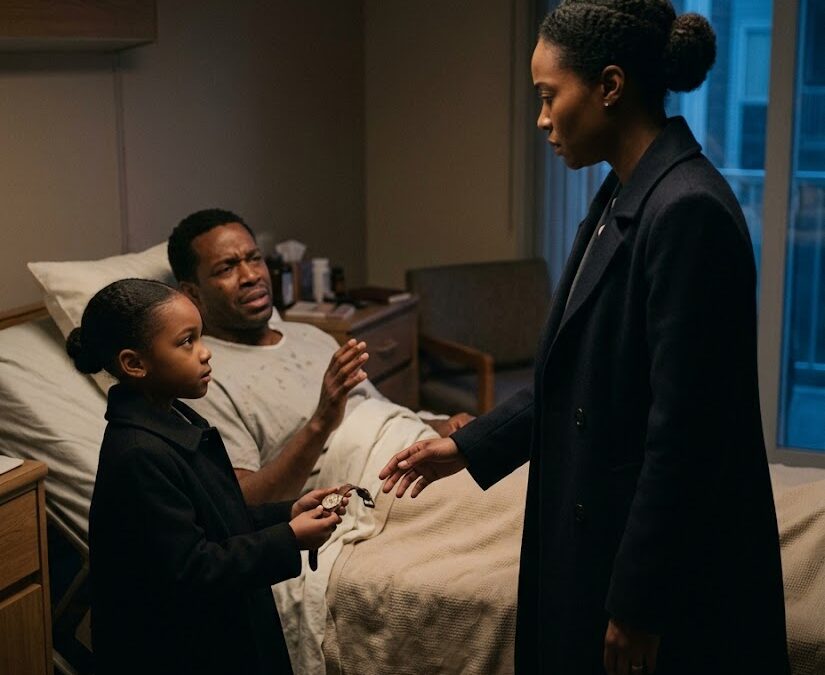
Chapter 2: The Minute Hand
“Call the police.”
Daniel’s voice barely crossed the room.
The nurse stopped beside the bed.
Celeste’s hand froze over the call button.
“Mr. Vance, can you tell me what’s wrong?”
Daniel tried to speak.
His mouth formed a word.
No sound followed.
The monitor beeped steadily beside him.
His eyes stayed on Celeste.
She moved toward the bed.
“He’s confused,” she said.
“Step away from him,” the nurse replied.
“I’m his wife.”
“And I’m responsible for his care.”
Celeste’s face tightened.
For one second, the room showed the woman beneath the flowers.
Then she became gentle again.
“Daniel, darling, you’re safe.”
His fingers curled against the sheet.
Mara watched his face.
She had seen that look before.
At dinner, when Celeste answered for him.
In the car, when she corrected him before he finished asking.
In the kitchen, when he reached for the wrong medicine bottle and Celeste took it away.
The nurse checked the lines at his arm.
“Please confirm his last medication dose.”
Celeste answered too quickly.
“Eight o’clock.”
“Eight in the morning?”
“Last night.”
“Which medication?”
“His blood pressure prescription.”
“Name?”
“I don’t remember.”
“You’ve been managing his care.”
“I’ve been managing everything.”
Daniel’s eyes moved toward Mara.
The nurse followed his gaze.
“Is this your daughter?”
“Yes,” Celeste said.
Mara spoke first.
“I’m Mara.”
“Can you wait outside with the other nurse?”
“No.”
Celeste stepped between them.
“Dad needs quiet.”
“He told you to call the police.”
“He didn’t.”
“I heard him.”
“He can barely speak.”
“He spoke.”
The nurse raised one palm.
“Mrs. Vance, give us room.”
“Of course.”
Celeste backed toward the wall.
Mara lowered her eyes to the watch.
The minute hand rested between two and three.
A crack ran near the six.
A small blue mark crossed the metal rim.
She had seen that mark on her mother’s jewelry box, then in Daniel’s hand, and later in Celeste’s room.
“Mr. Vance, can you squeeze my hand?”
Daniel’s fingers moved.
“Good. Again, please.”
His hand closed weakly.
The nurse nodded to her colleague.
“He’s more responsive.”
Celeste’s shoulders relaxed.
Mara noticed.
The relief looked practiced.
Daniel looked at the watch again.
She stepped beside the bed.
“Dad, I found it.”
His gaze held hers.
“Do you want it?”
He blinked once.
Mara placed the watch on the blanket.
Celeste leaned forward.
“Don’t.”
The nurse blocked her.
Daniel’s fingers reached toward the watch.
He could not lift his hand far.
Mara moved it closer.
His thumb brushed the cracked face.
A tear gathered at the corner of his eye.
“Please leave the room,” the nurse told Celeste.
“I’m not leaving my husband.”
“Security can help you.”
“You can’t exclude me from his care.”
“We can while we assess his safety.”
“His safety is why I’m here.”
Daniel made a sound.
This time, it was a name.
“Mara.”
She leaned close.
“I’m here.”
His lips moved again.
“Drawer.”
“What drawer?”
“Desk.”
Celeste turned toward the door.
“Mrs. Vance,” the nurse said.
Celeste stopped.
“Do not touch my things,” she said.
“Which things?” Mara asked.
Celeste stared at her.
“Your father is sick.”
“He said drawer.”
“There is nothing in the study.”
“Desk,” Daniel repeated.
Mara remembered the shallow drawer in her father’s study.
He kept insurance papers there, along with the things he called “the drawer of things grown-ups forget.”
The nurse helped him drink water.
His throat worked painfully.
The nurse called security.
Celeste looked back at Mara.
“You’ll be sorry you made this harder.”
Security escorted her to the family room.
Daniel shut his eyes.
The nurse lowered the bed rail.
“Can you tell us what happened?”
His lips moved.
“Not yet,” the nurse said. “Save your strength.”
Mara held the watch.
It was cold in her palm.
She had come to give it back.
Now her father was asking for a drawer.
* * *
Daniel was not allowed to speak for long.
His body needed time after surgery.
His blood pressure had dropped, and his breathing had weakened.
But he had not suffered a stroke.
The hospital neurologist ordered more tests.
Mara sat in the family room with a paper cup between her hands.
A hospital social worker named Ms. Patel spoke gently.
“Do you have another adult we can call?”
“Uncle Theo.”
“Is he your father’s brother?”
“His friend. He works with boats.”
“Does he have a last name?”
“Mercer.”
Mara gave the address.
She knew it by heart because Theo had taken her there for pancakes every Saturday after her mother died.
“Did you come here alone?” Ms. Patel asked.
Mara nodded.
“We’ll talk about that, but you’re safe right now.”
“Can I see Dad?”
“When the doctor says yes.”
“Can I keep the watch?”
“We’ll make sure it stays with you.”
Mara looked at its cracked face.
“Why did he ask for the police?”
“I don’t know yet.”
“Because of Celeste?”
“I don’t know that either.”
The answer sounded honest.
Mara trusted it more than a comforting lie.
Two detectives arrived without uniforms.
One introduced herself as Detective Hsu.
The other, Rourke, carried a small notebook.
They asked Mara to describe the watch.
She described the crack, the blue mark, and the cut strap.
“Who repaired it?” Detective Hsu asked.
“Mom.”
“Did you see her do it?”
“Yes. She used a needle.”
“How did the strap get cut?”
“She said it caught on the dock.”
“Before she died?”
“Yes.”
Detective Hsu asked where Mara had found the watch.
“In Celeste’s room.”
“Could you show us?”
Ms. Patel spoke first.
“We’ll arrange that with the right adult.”
“Is the watch important?” Mara asked.
“It may help us understand what happened,” Detective Hsu said.
“What happened?”
“First, your father needs to get stronger.”
Uncle Theo arrived just after nine.
He hugged Mara with one arm and kept the other around her shoulders.
“What happened?”
“I took Dad his watch.”
“And?”
“Dad told them to call the police.”
Theo looked toward Daniel’s room.
“Is he awake?”
“A little.”
“Good.”
“Celeste took Mom’s watch.”
Theo’s jaw tightened.
“Did you see her take it?”
“She wore it today.”
“Then we’ll let the detective handle it.”
Mara didn’t like waiting.
But facts had to be told to the adults who could check them.
The doctor finally allowed Theo to take her back to Daniel’s room.
Celeste was gone.
Daniel lay awake.
His eyes moved to Theo.
“Thank you,” Theo said.
Daniel tried to answer, but the words tangled.
“Don’t strain,” the doctor advised.
Daniel gave a small nod.
Theo leaned close.
“Do you know what happened?”
Daniel’s eyes returned to Mara.
She placed the watch on the blanket.
“Drawer,” he whispered.
“We’ll look,” Theo said.
“Police first.”
Detective Hsu had heard him.
“We’ll go together,” she said.
Daniel blinked once.
Then he looked at Mara.
“Not her.”
“Who?” Mara asked.
“Not Celeste.”
The nurse adjusted his oxygen.
“Let’s stop here for now.”
Outside, the doctor explained that Daniel needed rest.
His answers might be incomplete while he recovered.
The detective would not search without consent or legal authority.
They could visit the house with Theo once Daniel clearly authorized it.
Mara asked if that meant the hospital had done something wrong.
“No conclusion yet,” Detective Hsu said.
“Then why are you here?”
“Because your father asked us to come.”
It was simple.
It was enough.
Daniel signed permission to review his medication records.
He asked them to visit the study drawer with Theo.
The next day, he would be well enough to authorize the visit.
Mara needed somewhere safe to sleep.
Theo took her to his small house near the marina.
He made grilled cheese.
Mara ate half and left the rest.
“Do you think Celeste hurt him?” she asked.
“I think we have questions.”
“Mom said facts matter more than fear.”
“That sounds like your mom.”
“Do you think Celeste stole the watch?”
“I think you saw her wearing it.”
“That means she took it.”
“It means we need to find out how.”
Mara stared at the bread.
“She said Dad gave it to her.”
“Your father can tell us what he did.”
“He told me Mom had the watch.”
“Then we’ll see what the drawer says.”
Theo did not call Celeste evil.
He did not tell Mara she was wrong.
He let her keep the questions.
That night, the watch rested on the table beside the couch.
At two seventeen, Mara woke.
The room was dark.
A boat horn sounded across the water.
She touched the cracked face.
The watch still did not move.
She imagined her mother repairing the strap with a needle.
She remembered the dock.
The wet boards.
A towel around her shoulders.
Her mother’s hand gripping hers.
Then the memory broke.
She could not remember what happened after.
* * *
Theo drove them to the Vance house the following morning.
Detective Hsu came with another officer.
Celeste was not there.
The house sat on a bluff above a narrow inlet.
Mara knew every hallway.
She knew which floorboard squeaked outside the study.
She knew where her mother kept the tea.
The detective asked Theo to stay beside Mara.
“Do you feel safe here?” she asked.
Mara looked at the front door.
“Yes.”
They walked to the study.
Daniel’s desk had a shallow drawer with a brass pull.
Mara pointed.
“That one.”
The officer photographed it before touching anything.
Inside were receipts, folders, and a framed photograph.
Daniel and his first wife stood on a dock.
Mara had never seen that picture.
Her mother, Ruth, wore a yellow raincoat.
The detective opened a folder marked “Estate.”
It contained insurance statements, bank records, and a dated letter.
Daniel’s first wife’s policy had paid him six hundred thousand dollars.
A separate trust held money for Mara.
The trust had been funded by Daniel’s parents, not the policy.
The detective explained the difference.
“Your mother’s policy paid your father as the named beneficiary.”
“Did he spend it?” Mara asked.
“We’ll ask him.”
A bank statement showed transfers from Daniel’s account.
Some were ordinary.
Others were labeled “investment consulting.”
The first transfer happened six months after Celeste joined Daniel’s company.
The largest came the month before his surgery.
“Was this money used for the hospital?” Theo asked.
Detective Hsu turned the page.
“No.”
The deposits went to Northline Advisory.
Its address belonged to an office downtown.
Mara recognized the name.
Celeste had said Northline handled Daniel’s family investments.
A signed consulting agreement sat behind the statements.
Celeste’s initials appeared on every page.
The agreement promised Northline a fee equal to twenty percent of assets moved into its care.
The signature beneath Daniel’s name looked unlike his.
“Could this have been signed electronically?” Detective Hsu asked the officer.
“Possibly.”
“Does Daniel use electronic signatures?” Theo asked.
“Not for his main accounts,” Mara said. “He signs his checks by hand.”
The detective photographed the agreement.
At the back of the drawer sat a folded envelope.
It was addressed to Daniel.
The handwriting belonged to Ruth.
Mara had not seen it in years.
The detective asked Theo to call Daniel’s lawyer before opening it.
The lawyer authorized them to secure the document.
Inside was a short note.
Ruth had written shortly before she died.
She said she had left an audio recording in the family safety deposit box.
She had recorded a conversation with someone at the dock.
She did not say what it proved.
The note mentioned a phrase:
“Blue tide, second bell.”
Mara read the words twice.
“What does that mean?”
Theo stared at them.
The detective called the attorney again.
He confirmed the box existed at a local bank under Daniel’s name.
Access required Daniel’s authorization.
The lawyer could meet them that afternoon.
No one touched the other papers.
The detective sealed the folder and logged each item.
On the kitchen counter, Mara spotted a small blue dish her mother had used for keys.
The blue mark on the watch’s rim looked like its glaze.
A memory surfaced.
Her mother stood on the dock.
A hard sound.
The watch falling.
Her mother bending to retrieve it.
Celeste’s hand on the railing.
Then a splash.
Mara backed away from the counter.
Theo knelt beside her.
“What did you remember?”
“Mom dropped the watch.”
“When?”
“On the dock.”
“Was Celeste there?”
Mara nodded.
The detective crouched at a respectful distance.
“Do you remember anything else?”
Mara shook her head.
The old memory made her dizzy.
The detective did not push.
“Your mother’s note may help,” she said.
The second secret pointed toward someone close enough to know the family’s accounts.
* * *
Daniel signed the authorization at the hospital.
His attorney accompanied Detective Hsu and Theo to the bank.
Mara stayed with Ms. Patel.
They returned after an hour.
The safety deposit box contained a small recorder and two memory cards.
The bank’s access log showed no visit for three years.
The recorder had a dated label:
“Dock, August 14.”
The police sent it to a digital examiner.
They did not play it at the hospital.
The lawyer asked Daniel whether he wanted to hear it once it was recovered.
Daniel nodded.
He also asked Mara if she wanted to be present.
“I’ll decide when I know what’s on it,” she said.
“That’s fair,” he replied.
The hospital lab had additional results.
Daniel had received a medication that was not listed in his chart.
It was a sedative commonly used under medical supervision.
The dose was not high enough to identify a specific source.
It could explain some of his confusion.
It did not explain his collapse by itself.
The doctors were clear.
A medical examiner would need more information.
The detective requested the nurses’ notes and medication logs.
The hospital secured every record.
No one accused the staff.
They were treated as witnesses.
The next day, Daniel could speak more clearly.
He remembered taking two pills from a white paper packet.
Celeste had said they were supplements.
He had not questioned her.
He had also been exhausted.
His blood pressure medication was missing for several days.
His physician had never ordered him to stop taking it.
“Did Celeste have a key to your medicine cabinet?” Detective Hsu asked.
“Yes.”
“Did anyone else?”
“No.”
The detective wrote it down.
Daniel looked at Mara.
“I should have asked.”
“Why didn’t you?”
“I trusted her.”
“Mom trusted her too?”
“No.”
He stopped.
“Your mother knew something was wrong.”
“What?”
“I don’t know.”
“Then why did she leave the note?”
“She was afraid I’d forget.”
The room went quiet.
“Did you forget Mom?” Mara asked.
“No.”
“You forgot the watch.”
“I forgot what happened.”
“That’s different?”
“Yes.”
He reached for her hand.
She let him hold it.
“I’m sorry,” he said.
Mara wanted to forgive him.
She also wanted him to remember.
“I need you to listen next time,” she said.
“I will.”
“Even when Celeste says I’m confused.”
“Especially then.”
That afternoon, Detective Hsu received a call from Northline’s registered agent.
The company had closed its office two days earlier.
Its business filing listed Celeste as a director.
The second director was Martin Vale, Daniel’s accountant for twelve years.
Martin had resigned from Daniel’s company the week before the surgery.
The detective checked Northline’s registration.
It had been filed eight months earlier.
Its bank account had received transfers from Daniel’s estate funds.
The money had then moved to an offshore account.
The detective did not claim that offshore transfers were illegal.
But there was no clear investment report.
Bank records showed Celeste had used Daniel’s personal security token to approve several transfers.
Daniel said he had not authorized them.
The detective contacted the bank’s fraud unit.
They froze the remaining funds pending review.
Celeste’s lawyer called the hospital.
He said she denied wrongdoing and had acted under Daniel’s instructions.
He asked police to stop harassing a grieving spouse.
Detective Hsu replied that no one had been arrested.
They were verifying records.
The next morning, the digital examiner recovered the audio recording.
The file contained three minutes of conversation.
Ruth’s voice was clear.
Celeste’s was unmistakable.
Detective Hsu listened first.
Then the prosecutor’s investigator.
The recording began with wind against the microphone.
Ruth said, “The money stays in Mara’s trust.”
Celeste answered, “Daniel can change it.”
“Daniel doesn’t know you moved anything.”
“He signed the form.”
“He didn’t sign that form.”
“You can’t prove that.”
A pause followed.
Then Celeste said, “You should have stayed away from the account.”
“I’m his wife’s mother.”
“You are not his wife anymore.”
“That is not what I mean.”
“I know exactly what you mean.”
There was a scraping sound.
A sharp clatter.
Ruth said, “Give me the watch.”
“You lost it,” Celeste answered.
“I was wearing it.”
“You were reaching over the rail.”
“Give it back.”
The recording stopped.
The examiner replayed the final seconds.
A second sound followed the scrape.
Not a splash.
A door closing.
The file’s time stamp placed the recording at 2:17 p.m.
Ruth’s death certificate listed an accidental fall from the dock at 2:31.
The audio did not prove Celeste caused the fall.
It did prove she had been with Ruth.
It showed the financial argument and the demand for the watch.
The examiner found the original file had not been edited.
A forensic report documented its recovery and hash.
The detective took the evidence to Daniel.
He listened with the prosecutor’s investigator present.
He did not speak until the recording ended.
Then he turned toward the wall.
“That was my wife,” he said.
“She was your wife,” Theo replied.
“She told me Ruth slipped.”
“Did you see the fall?” Detective Hsu asked.
“No.”
“Were you there?”
“No.”
“Who told you?”
“Celeste.”
“Did you ask questions?”
Daniel could not answer.
Mara watched the truth land on him.
It had not changed what happened.
It changed the story he had accepted.
The old lie led into the family’s home.
* * *
Celeste asked to retrieve her clothes and personal documents.
The detective arranged a civil standby.
No one would enter the house alone.
Theo and Mara stayed with a family friend.
Daniel remained in the hospital.
Celeste arrived with her lawyer and a moving company.
She wore a cream coat and asked for her jewelry box.
The officer allowed her to collect personal items.
The detective watched.
Celeste’s lawyer objected to the search of the study.
The detective explained that the drawer had been searched with Daniel’s consent.
The documents were already secured.
Celeste looked at Mara.
“You told them things you don’t understand.”
“I told them what I saw.”
“Children remember what adults suggest.”
“No one told me about the watch.”
Celeste looked away.
The detective asked her to end the conversation.
Celeste did.
That evening, someone left a voicemail on Theo’s phone.
“Your niece’s imagination is making this dangerous,” a man said.
The voice was flat.
He did not identify himself.
Theo saved the message and sent it to Detective Hsu.
They traced the call to a prepaid phone bought with cash.
The store camera was too distant to identify the buyer.
The number had been active less than a day.
The police increased patrols near Theo’s home.
The school received a notice that only Theo or Daniel could pick Mara up.
Mara hated the change.
She hated that adults whispered when she entered rooms.
She hated that the watch stayed in an evidence bag.
At the hospital, Daniel apologized again.
“I should have protected you.”
“You didn’t know.”
“I should have looked.”
Mara looked out the window.
“Mom looked.”
“She did.”
“She wrote things down.”
“Yes.”
“You didn’t.”
“No.”
Daniel did not blame grief for what he had missed.
He let the shame stay his.
A week after surgery, Daniel moved to a rehabilitation room.
He could walk with a cane and speak without losing words.
He asked Detective Hsu to investigate the pill packet.
She explained that the lab could not identify the contents because the packets were gone.
But the hospital had preserved samples from his first blood draw.
The lab found a sedative in a concentration above what his doctor expected.
It could not identify the dose or when he had taken it.
The prosecutor said more evidence would be needed to charge anyone with poisoning.
Financial fraud was clearer.
Daniel’s bank authenticated its records.
The account signatures were inconsistent.
The security logs showed each transfer came from a device registered to Celeste.
A camera at the bank showed her entering with Daniel’s security token.
She said she was depositing paperwork.
Martin Vale appeared with her.
The investigator found Martin’s accounting firm had received consulting fees from Northline.
The money had moved through two companies.
The second was owned by Martin’s brother.
Police subpoenaed the business records.
Martin said Daniel had authorized everything.
When shown the signatures, he asked for a lawyer.
The prosecutor did not charge him that day.
She needed the full financial records.
Celeste’s lawyer asked Detective Hsu for a meeting.
The detective declined.
Any interview would be scheduled formally.
Then the threatening messages changed.
A second voicemail came to Theo.
“Tell the girl to stop making accusations about the woman who raised her.”
Theo forwarded it.
The police kept the recording.
Mara asked if someone could take her away.
Detective Hsu answered carefully.
“We don’t have evidence of that.”
“Then why is everyone worried?”
“Because we take unusual messages seriously.”
Theo added a lock to the front door and showed Mara how to use it.
Daniel’s physician approved his discharge to rehabilitation.
He would not return to the house alone.
The lawyer arranged a temporary order preventing Celeste from accessing family accounts.
A judge issued it after reviewing the bank evidence.
Celeste’s lawyer argued that she had permission to manage the money.
The judge required all parties to preserve records.
No one could transfer assets.
The order did not decide guilt.
It protected what remained.
The prosecutor named the architect of the money scheme: Martin Vale.
His motive was not a sudden rage.
He had been covering losses in his own investment fund.
He used Daniel’s assets to keep his firm afloat.
Celeste brought him access.
Martin designed the transfers and the fake consulting agreement.
He also advised Celeste to remove Ruth’s original paperwork.
His name came from messages obtained under a warrant after the bank report.
One read, “Move the money before the probate review.”
Another said, “If Ruth brings the original, keep her away from Daniel.”
The true plan had a name.
Martin Vale.
* * *
Mara’s school held a meeting with Theo, Daniel, and the counselor.
The adults explained that Mara would speak with a child interviewer.
The interviewer would not ask her to remember more than she could.
The detective would not sit in the room.
A trained specialist would.
Mara asked if she had to describe the dock.
“No,” the counselor said. “You can say you don’t remember.”
“What if I remember later?”
“Then you can tell a safe adult.”
Mara looked at Daniel.
“Will you believe me?”
“Yes.”
“Even if it’s about Celeste?”
“Yes.”
He did not hesitate.
The promise was small.
That made it believable.
The interview took place in a bright room with a small table.
Mara described the blue dish, the watch, and Celeste’s hand near the railing.
She remembered the watch hitting wood.
She could not say whether her mother fell or stepped back.
She could not say who touched whom.
The interviewer thanked her and stopped.
No one praised her for being brave.
They told her she had done enough.
A few days later, Daniel was cleared to leave rehabilitation.
He still needed physical therapy.
He used a cane and moved slowly.
He chose a furnished apartment near Theo’s house.
He did not go back to the bluff.
Mara asked why.
“Because I don’t want the house to decide things for us.”
“What does that mean?”
“It means we’ll choose where home is.”
Theo rented a two-bedroom place nearby.
Daniel paid his share.
Mara had her own room.
The watch remained with the police.
The prosecutor planned to use it as evidence of possession and as a link to the recording.
Mara hated that her mother’s watch was locked away.
Detective Hsu let her see it through a clear evidence sleeve.
The old stitches showed on the strap.
The blue glaze transfer marked the rim.
The watch was not proof by itself.
It supported the timeline.
A jeweler identified the cut in the strap as deliberate.
The repair used the same brown thread found in Ruth’s sewing basket.
That did not establish who cut it.
But Celeste had possessed the watch after Ruth’s death.
A photograph from the study showed Ruth wearing it during a family visit to the marina.
The time stamp came from the original camera file.
The watch’s minute hand stopped at 2:17 because its movement broke when it struck the dock.
A technician found a dent inside the casing.
The second confirmation came from a dock worker who had been twenty yards away that afternoon.
He saw two women arguing.
He heard something fall.
He saw Celeste leave alone.
He assumed Ruth was inside the house.
He did not know she had fallen into the inlet later.
His account matched the recording’s time and the marina photograph.
He could not say whether Celeste pushed Ruth.
He would not claim what he had not seen.
The prosecutor agreed.
The case did not need a story beyond the evidence.
The financial fraud was strong.
The recording placed Celeste at the argument.
The watch connected her to the missing object.
The witness corroborated the dispute.
The medical evidence showed Daniel had received an unrecorded sedative.
No one could prove when or by whom.
The prosecutor would not charge Celeste with attempted murder.
She would pursue fraud, evidence tampering, and unauthorized medication if pharmacy records supported it.
The pharmacy records raised questions.
Celeste had purchased a sedative under her own name three days before Daniel’s surgery.
She told the pharmacist it was for herself.
The quantity was small.
The pharmacist remembered her asking whether it could be mixed into tea.
He refused to advise her and gave her a printed warning.
His statement was documented.
The prosecutor filed charges related to the transfers and false consulting agreement.
Martin was charged with wire fraud and conspiracy.
Celeste was charged with fraud and tampering with evidence.
The medical allegation remained under investigation.
The family received a date for a public hearing on the temporary financial order.
Celeste’s lawyer requested a private settlement.
Daniel refused.
He wanted the court to hear the evidence.
* * *
The hearing room was smaller than Mara expected.
The judge sat behind a wood bench.
Martin Vale sat beside his lawyer.
Celeste sat across the aisle in navy blue, her hair pinned neatly.
Mara sat between Theo and Daniel.
The watch rested inside a clear evidence case on the table.
Daniel’s lawyer introduced the bank records.
The prosecutor explained the temporary order.
Celeste’s attorney argued that Daniel had authorized Northline.
He displayed an agreement with Daniel’s signature.
“Mr. Vance was capable of managing his business,” he said.
The judge examined the signature.
Daniel’s lawyer presented his usual signature from the same month.
The letters differed.
The digital examiner explained that the agreement had been uploaded from Martin’s office.
The bank token had been used from Celeste’s laptop.
Northline had never submitted an investment report.
The consulting fee went to Northline, then to Martin’s brother’s company.
The defense called it a bookkeeping error.
Martin’s lawyer said his client had only provided advice.
The prosecutor presented the messages.
Martin’s face changed when the message about Ruth appeared.
“Keep her away from Daniel.”
His lawyer objected to the context.
The judge reviewed the complete exchange.
The objection was denied.
Celeste’s attorney stood.
“My client was grieving too.”
The prosecutor did not disagree.
“Grief does not authorize a forged agreement.”
The attorney said Celeste had managed the family’s finances.
The prosecutor showed that she opened Northline eight months earlier.
The transfers began after its registration.
The judge asked Celeste whether she received compensation.
Her attorney told her not to answer.
The judge turned to Daniel.
“Did you authorize the transfers?”
“No.”
“Did you sign the consulting agreement?”
“No.”
“Did you know your wife was wearing the watch?”
“I saw it at the hospital.”
“Did you give it to her?”
“No.”
The judge looked at the evidence case.
“Why is the watch relevant?”
The prosecutor explained that Ruth had worn it at the dock.
The recording captured the demand for its return.
Celeste possessed it afterward.
Its strap had been cut and repaired.
Its case had an impact mark consistent with the dock worker’s account.
The defense called it a family keepsake with no clear chain of ownership.
The jeweler identified its serial number and customized details.
The number matched the purchase invoice in Ruth’s estate file.
The photograph showed Ruth wearing it.
The audio recording played.
The room heard Ruth’s voice.
“The money stays in Mara’s trust.”
Then Celeste.
“Daniel can change it.”
Ruth answered.
“Daniel doesn’t know you moved anything.”
The recording ended with the clatter.
The judge listened without moving.
The defense argued that the recording was incomplete.
The digital examiner explained the recovery process.
The file’s original time stamp had been validated.
No edits were found.
The defense said “give me the watch” could refer to another object.
The prosecutor showed the jeweler’s photograph.
The blue mark on the watch matched the dish from Ruth’s house.
The dock worker described seeing Celeste leave after the argument.
The defense asked whether he saw Ruth fall.
“No.”
“Did you see my client push her?”
“No.”
“Did you see anything go into the water?”
“No.”
“Then you can’t tell this court what happened.”
“I can tell you what I saw.”
That answer landed better than an accusation.
The judge asked the lawyers to address the financial order.
Celeste’s attorney argued that freezing the accounts harmed Daniel.
The judge said the disputed funds were already outside the family’s control.
A freeze would preserve what remained.
She granted the order and directed the bank to retain its records.
She barred Celeste and Martin from transferring assets.
The hearing did not decide whether Celeste caused Ruth’s death.
It did not decide the medical allegation.
It established that Daniel had not authorized the transfers.
Outside the room, reporters waited near the courthouse steps.
Theo guided Mara toward the car.
Celeste approached before they reached it.
“Daniel,” she said. “You know how this looks.”
Daniel stopped.
“I know what I heard.”
“You heard a damaged recording.”
“I heard Ruth.”
“You’re trusting a child’s memory.”
“I’m trusting the evidence.”
Celeste looked at Mara.
“You think this fixes anything?”
“No,” Mara said.
Celeste smiled faintly.
“Then why keep doing it?”
“Because it’s true.”
Celeste’s expression slipped.
Only for a moment.
Then her lawyer called her away.
Daniel did not follow.
He did not answer the last sting with anger.
He stood beside Mara.
That was enough.
* * *
The legal case took eleven months.
The bank examiner traced most of the money.
Some remained frozen.
Some had been spent on Martin’s business debts.
The court ordered restitution from the remaining assets.
Daniel did not recover everything.
The prosecutor filed a separate case over the false agreement and unauthorized transfers.
Martin pleaded guilty to conspiracy and financial fraud.
His plea included testimony about the plan.
He admitted designing Northline.
He admitted forging Daniel’s signature.
He said Celeste helped provide account access.
He denied knowing whether she had harmed Ruth.
The prosecutor did not need him to say more.
Celeste’s trial began three months later.
The nurses testified about Daniel’s care and the unlisted medication.
They did not claim to know who administered it.
The doctors explained how the sedative could have worsened his condition.
They said the evidence could not establish the dose or exact time.
The prosecutor did not overstate it.
The bank records told a clearer story.
The forensic examiner explained the signatures.
The digital logs showed the device and token.
The dock worker repeated what he had seen.
The jeweler identified the watch.
The recording played again.
Celeste’s attorney argued that she had acted under Daniel’s authority.
He argued the recording did not show a fall.
He argued possession of the watch did not explain why she had it.
The defense had real points.
The case was not simple.
The prosecutor answered with the chain of evidence.
The agreement came from Martin’s office.
The account token had been used by Celeste.
She had received money through Northline.
She told police Daniel had given her the watch.
Daniel denied it.
The recording showed Ruth demanding it back.
The dock worker saw Celeste leave.
The timeline supported the prosecution.
The jury deliberated for two days.
They found Celeste guilty of fraud and evidence tampering.
They did not convict her of causing Ruth’s death.
The jury could not agree on the medication charge.
The judge declared a mistrial on that count.
The prosecutor later dismissed it.
There was not enough evidence to prove who put the sedative in the packet.
Celeste was sentenced to prison.
Martin received a longer sentence.
The court ordered restitution.
Daniel sat in the hallway after sentencing.
“You okay?” Theo asked.
“No.”
Mara sat beside him.
“Are we safe?”
“Yes.”
“Can we go home?”
Daniel looked at Theo.
“We don’t have to go back to the bluff.”
“Good.”
They left the courthouse together.
Mara carried the watch in a sealed evidence envelope.
The court had released it to Daniel.
He let Mara decide where it belonged.
She chose the mantel in their apartment.
Not because it worked.
Because it had been seen.
* * *
Weeks passed.
Daniel returned to work part-time.
He sold the house above the inlet.
He did not sell it to punish Celeste.
He sold it because every hallway held a version of a story he no longer trusted.
The family moved into a smaller house near Mara’s school.
Theo lived three blocks away.
Mara had a garden bed by the front steps.
She planted rosemary because her mother used it on potatoes.
The first batch grew crooked.
Daniel cooked the potatoes anyway.
He burned them.
Theo called them “smoke-seasoned.”
Mara laughed so hard she hiccupped.
Daniel laughed too.
It was the first easy sound in months.
He did not tell her she was brave.
He asked if she wanted help with her math.
She did.
Every Sunday, he made breakfast.
Sometimes they talked about Ruth.
Sometimes they did not.
The watch stayed on the mantel.
A repair shop returned it in a small wooden box.
The watchmaker cleaned the case but left the dent.
He replaced the broken crystal.
He did not repair the movement.
Daniel asked whether it could run again.
The watchmaker said the gears were damaged beyond a reliable repair.
Mara wanted the hands to stay at 2:17.
That time belonged to the dock.
It also belonged to the moment she heard her father’s voice.
She did not want to erase either.
A settlement offered Daniel a large amount from the recovered funds.
He refused to take money from Mara’s trust.
He redirected his recovery share into a fund supporting children whose parents were involved in family court.
The fund paid for legal representation and trained interviewers.
He asked Mara if she wanted her name attached.
She said no.
“Then it won’t be,” he said.
The money went out under the name Harbor Light.
Mara chose the logo.
A small yellow window.
Daniel asked if she wanted Celeste to write a letter.
“No.”
“You don’t have to answer her.”
“Then don’t ask me again.”
“I won’t.”
An apology arrived through the lawyer anyway.
Celeste wrote that she had been afraid of losing her place in the family.
She said she had made choices that hurt people.
She did not mention the recording.
She did not admit anything about Ruth.
Mara read the letter once.
Then she handed it back.
Daniel did not ask if she forgave Celeste.
He put the letter away.
“Will she get out?” Mara asked.
“Eventually.”
“Can she come here?”
“No. There’s a court order.”
“And after that?”
“We’ll decide what boundaries we need.”
Mara touched the watch.
“I don’t want her here.”
“Then she won’t come.”
That was not forgiveness.
It was a boundary.
The house grew quiet at night.
Sometimes Daniel woke from a dream and sat at the kitchen table.
Sometimes Mara woke too.
They did not force each other to speak.
Theo brought pancakes on Saturdays.
They were lopsided.
Mara called one state-shaped.
Daniel said it looked like a sock.
Theo claimed it was an accurate map of breakfast.
The small jokes did not erase the past.
They made room beside it.
A year later, Mara’s class held a family night.
Daniel came early.
He stood by the display of drawings.
Mara had drawn three figures beneath a yellow porch light.
Her teacher asked whether she wanted to explain it.
“This is where I live now,” Mara said.
Daniel did not correct her.
At home, the watch still did not move.
Mara began learning to mend cloth.
She used a blunt needle and blue thread.
Her first stitches wandered.
She repaired a torn pocket on Daniel’s coat.
He wore it the next day.
“Does it look bad?” she asked.
“It looks like you fixed it.”
“Those aren’t the same thing.”
“No,” he said. “They aren’t.”
* * *
Four years later, Mara was eleven.
She visited the cemetery with Daniel on Ruth’s birthday.
They brought no flowers.
Mara brought a small paper boat.
Her mother used to fold boats from old receipts while waiting for ferry crossings.
Mara placed it at the foot of the headstone.
The watch rested in her jacket pocket.
The grass was dry.
There was no storm.
Daniel stood nearby but did not hover.
Mara looked at the name engraved in stone.
“Hi, Mom.”
She told Ruth about school, the garden, and the time Daniel burned the potatoes again.
She told her that the truth had been hard.
She told her it had stayed true anyway.
Daniel waited.
When Mara finished, he asked whether she wanted the watch back.
“Yes.”
He handed it over.
She held it in both hands.
The cracked glass had been replaced.
The dent remained.
The hands remained stopped.
Mara pressed the watch against the stone.
“Dad asked me to keep it,” she said.
Daniel looked at her.
“What did you say?”
“I said yes.”
The line returned with a new meaning.
She was not keeping it because the past had trapped her.
She was keeping it because it belonged to her.
They walked back together.
The paper boat stayed by the grave.
* * *
At sixteen, Mara learned basic restoration.
She repaired the watch strap herself.
She kept the original stitches beneath her own.
The repair technician taught her how to preserve the old work.
“How much should I replace?” she asked.
“Only what won’t hold.”
She thought about that answer for a long time.
Daniel’s hair had gone gray at the temples.
He still walked with a small hitch when it rained.
He told the truth more readily now.
He listened before he answered.
They talked about Ruth without lowering their voices.
They talked about Celeste when the court process required it.
They did not make Mara choose between love and anger.
At eighteen, Mara took the watch to college.
She kept it in a drawer.
She did not wear it.
At twenty-one, she brought it home for Daniel’s birthday.
The movement had never been repaired.
The hands stayed fixed at 2:17.
Daniel touched the glass.
“Your mother would have liked the stitching.”
“She would have told me to pull it tighter.”
“She would have been right.”
Mara smiled.
For years, she had thought the watch was a warning.
Then it became evidence.
Then it became a memory she could hold without needing it to explain everything.
Now it was simply her mother’s watch.
Daniel reached for her hand.
She let him take it.
“Are you okay?” he asked.
“Most days.”
“That’s good.”
“Some days are still hard.”
“I know.”
She leaned against his shoulder.
They sat together beneath the porch light.
* * *
At twenty-four, Mara returned to the cemetery alone.
The old headstone stood beneath a maple tree.
New grass covered the damp patch near its base.
She had brought white tulips.
She set them down carefully.
Then she placed the watch beside them.
The leather strap was still uneven.
Her stitches showed.
The stopped face caught the afternoon light.
Mara put her palm on the cold marble.
She remembered being seven.
A paper cup.
A hospital corridor.
Her father’s fingers moving against a blanket.
A woman saying the watch belonged to her.
Her father’s first clear words.
Call the police.
The memory no longer felt like a wound.
It felt like the first time someone listened.
Mara lifted the watch.
“Dad asked me to keep it.”
Now she understood why.
The watch did not carry the whole truth.
No object could.
It carried one person’s name, one choice, and one moment when a child refused to let a lie become the family story.
The people who hurt them faced the law.
The money that could be recovered came back.
The money that could not was answered with help for other families.
Daniel learned to listen.
Mara learned she could love him while remembering what he missed.
The yellow window of their childhood home glowed in her mind.
Warm potatoes.
Crooked pancakes.
Blue thread in a repaired pocket.
Her mother’s name spoken aloud.
The watch rested in Mara’s palm.
It had stopped at 2:17.
Their lives had not.
THE END








