My Brother Was Found Shivering at a Bus Shelter, and His Son Called Him Confused Until I Showed Him the Green Receipt
Chapter 2: The Signature on the Card
I kept the phone against my ear.
Garrett watched me.
“Is he safe?” I asked.
“For now,” the nurse said.
Her name was Priya Nair.
She had called that morning when the police brought Neal in.
Now her voice was careful.
“A representative from Cedar Gate says they have authorization to transfer him.”
“Who sent them?”
“They haven’t said.”
I looked at Garrett.
He was already reaching for his phone.
“Don’t move him,” I said.
“We’re assessing him,” Priya replied.
“He’s asking for you.”
“I’m coming.”
I ended the call.
Garrett slipped his phone away.
“Stay out of this,” he said.
“You said he wandered.”
“He does.”
“Then why did you say he was supposed to stay at Cedar Gate?”
His eyes went to the assistant.
She had gone still beside the light switch.
“I meant they were responsible for him.”
“Call them back.”
“I didn’t call anyone.”
“You knew they were coming.”
The guard took one step toward us.
Garrett lifted a hand.
“I can handle my aunt.”
He made the word sound charitable.
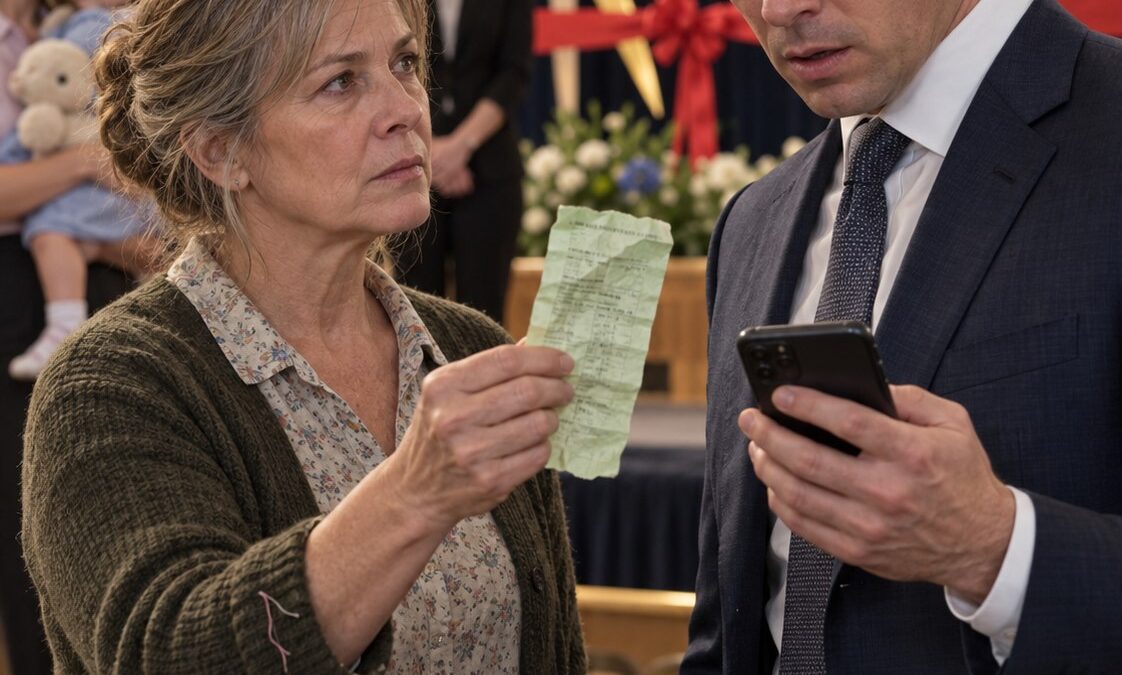
I folded the green card and put it away.
Garrett held out his hand.
“Give me that.”
“No.”
“It’s my father’s mail.”
“It’s his receipt.”
“He’s not able to make decisions.”
“Neal can tell a nurse his name.”
“That’s hardly the test.”
He was right about that much.
Neal’s stroke had slowed his speech two years earlier.
It had not taken his mind.
When people hurried him, he lost words.
When they waited, he usually found them.
Garrett had stopped waiting.
I walked toward the exit.
He came after me.
“June.”
The guard held the door open.
Garrett lowered his voice.
“You think you’re helping him.”
“I’m going to ask.”
“He signed papers.”
“Then he can tell me why.”
Garrett’s expression changed.
For a second, he looked less angry than frightened.
“He won’t understand what you’ve done,” he said.
I kept walking.
At the hospital, Priya met me outside Neal’s room.
A woman from Cedar Gate sat across the corridor with a folder on her lap.
She looked tired.
She also looked ready to leave.
“Is that the representative?” I asked.
Priya nodded.
“Neal told her he would not go.”
“Did she hear him?”
“She did.”
“What happens now?”
“The doctor is evaluating him.”
She led me inside.
Neal sat upright under a thin blanket.
His hair stuck up at the back.
He had borrowed hospital socks, and he kept rubbing one heel against the other.
When he saw me, his face tightened.
“Shop,” he said.
“Closed early.”
“You hate that.”
“I made an exception.”
He held out his hand.
I took it.
His fingers were cold.
“They said I wandered,” he told me.
“I know.”
“I went home.”
“I believe you.”
He stared at the blanket.
“I knew the code.”
“Garrett changed it.”
Neal nodded once.
“I told him I had the letter.”
“The one to the inspector?”
“I wrote it twice.”
I took a breath.
“Where’s the copy?”
His hand squeezed mine.
“Gone.”
“Did Garrett take it?”
“No.”
He struggled with the next words.
I waited.
Neal looked up.
“I gave it to him.”
“Why?”
“He said the inspector was coming for you.”
The heater clicked beneath the window.
Neal kept his eyes on mine.
“He said you had signed the claims.”
* * *
The doctor came in twenty minutes later.
She asked Neal ordinary questions.
Where had he lived?
Who had brought him to Cedar Gate?
What did he want to happen next?
She gave him time to answer.
He said he wanted to stay at the hospital until someone checked his house.
He said he did not want Garrett making arrangements for him.
The doctor wrote down his answers.
She explained that the team would assess his ability to make each decision at hand.
Neal nodded.
“I know what I want,” he said.
After she left, I asked Priya for the hospital social worker.
I also called Ellen Price.
Ellen had handled a property dispute for me six years earlier.
She charged by the hour.
I had enough in my business account for three.
She called back before I reached the vending machine.
“Tell me only what you know,” she said.
I told her about the bus shelter.
I told her about Cedar Gate.
I told her about the green card.
Then I told her what Neal had said.
“Do you have the letter?” she asked.
“No.”
“Do you have the envelope?”
“No.”
“Keep the receipt flat.”
“It’s folded.”
“Then don’t fold it again.”
I looked at my hand.
The card was warm from my pocket.
Ellen asked whether Garrett had power of attorney.
“He says he does.”
“Ask the social worker whether the hospital has a copy.”
“Can they show me?”
“Neal can decide what he wants shared if he’s able.”
She paused.
“June, call the state inspector’s office yourself.”
I did.
The general number took me through two menus.
A receptionist gave me an email address for complaints about recovery grants.
I read the tracking number aloud.
She would not discuss a complaint over the phone.
She did say I could send the receipt and a written account.
“Will someone answer today?”
“I can’t promise that.”
It was an honest answer.
I preferred it to Garrett’s certain ones.
Ellen arrived just after four.
She wore flat shoes and carried a legal pad.
Neal remembered her from my old property case.
“You won,” he said.
“We settled,” she corrected.
“You won the fence.”
“I did get the fence.”
That made him smile.
The social worker joined us.
Neal told her he wanted Ellen and me present.
A copy of Garrett’s power of attorney was in the hospital file.
Garrett had sent it that morning.
The document was signed fourteen months earlier.
Neal recognized his signature.
He looked ashamed.
Ellen put a hand near his, then drew it back.
“Can you tell me why you signed it?”
“For bills.”
“Which bills?”
“Cedar Gate.”
Garrett had told him the facility needed one person to manage payments.
That was plausible.
Then Garrett had told him a state review might put June in trouble.
The story came out slowly.
I had once let a storm recovery group use my shop’s address for two weeks.
Our town had flooded four summers earlier.
People needed a place to pick up clean clothes.
Garrett had organized contractors.
I had sewn name labels into donated coats.
Mail for the group had come through my shop until they opened their own office.
Garrett told Neal that my signature appeared on false housing claims.
“He said I could fix it,” Neal said.
“How?” Ellen asked.
“Give him my letter.”
Neal’s mouth trembled.
“He said he would take my name off.”
The letter Neal had written accused Garrett’s company of billing the county for repairs never made at three houses.
Neal knew those houses.
For forty years, he had repaired furnaces all over town.
After the flood, he volunteered to inspect damaged heaters.
He had seen photographs in Garrett’s public report.
One house had no basement.
Another had been demolished before the date of the alleged work.
Neal wrote those details to the state recovery inspector.
Then Garrett told him I was involved.
“He showed me papers,” Neal said.
“What papers?” I asked.
“Claims.”
“With my signature?”
“Yes.”
“I didn’t sign claims.”
“I know that now.”
Ellen asked him how he knew.
Neal looked toward me.
“June reads every page.”
I had not read every page.
I had signed a form when I lent the shop address.
I remembered doing it between two fittings, with Garrett standing at my counter.
I could not remember the form’s heading.
The memory sat badly in my stomach.
Ellen saw my face.
“We’ll get copies,” she said.
She asked Neal whether he wanted Garrett to keep acting under the power of attorney.
“No.”
She explained how he could revoke it if he had the capacity to do so.
The doctor had not finished her assessment.
Ellen would wait for that before preparing anything.
She also suggested that the hospital document Neal’s refusal to leave with Cedar Gate.
The social worker had already done it.
A police officer came to take Neal’s account of being locked out.
Neal told him he had left Cedar Gate after a disagreement with Garrett.
A driver had taken him to his house.
His usual code failed.
His key no longer fit.
He walked toward the bus stop because there was a phone there.
The phone had been removed years ago.
By then, he was too tired to go farther.
The officer asked for the address and the names of the driver and the person at the house.
Neal could not remember the driver’s name.
He did remember seeing Garrett’s car in the driveway.
The officer wrote that down without promising an arrest.
That night, I went back to my shop.
It smelled of steam and chalk.
I found the flood folder beneath old tax returns.
There was my form.
I had allowed the recovery group to receive donated clothing at the shop.
Nothing about claims.
Then I found nine returned envelopes.
I had kept them because each bore my address beneath a printed name I did not recognize.
Garrett had once told me to leave any group mail for him.
I had put these aside and forgotten them when the work moved out.
All nine were addressed to the same claims office.
All nine named different residents.
None of them had ever come to my shop for clothing.
On the back of one envelope, a sender had written, “Why does my claim say I moved?”
I spread the envelopes across my cutting table.
The letter had led me closer to home.
The false claims had been mailed through my shop.
* * *
I did not open the envelopes.
Ellen told me to photograph both sides and bring them to her office.
I photographed them where they lay.
The next morning, Neal called before I could leave.
“They found my coat,” he said.
“Good.”
“Check the cuff.”
I sat down.
“Is something in it?”
“Maybe.”
“I’ll ask Priya.”
The coat was in a sealed belongings bag.
With Neal’s permission, a nurse opened it in front of us.
The right cuff had been repaired twice.
I knew the stitches.
I had made both repairs.
Inside the fold was a narrow slip of paper.
It listed three street addresses and three dates.
Neal’s handwriting was cramped but clear.
Below them, he had written one question.
“Who approved these?”
Ellen took a photograph.
The paper stayed with Neal.
“Are these the houses?” she asked.
Neal nodded.
“I walked them.”
“When?”
“Before I wrote.”
The first house had lost its furnace in the flood.
Neal had gone there to see whether the replacement was working.
The owner told him no contractor had entered.
The second was the house without a basement.
At the third address, he found an empty lot.
He had written down the dates so he could check the public report again.
“Why hide the list?” I asked.
“Garrett looked through my room.”
He sounded embarrassed.
I wanted to go straight to Cedar Gate.
Ellen asked me to stay.
She called the facility administrator and requested Neal’s records with his consent.
She asked who had authorized a lock change at his house.
She also asked for a copy of the document under which Cedar Gate had kept him in its locked wing.
The administrator said she would review the file.
That afternoon, the hospital doctor told Neal she believed he understood the decisions about his immediate care and who could receive information.
Ellen prepared the revocation.
Neal read it with her.
He signed it himself.
Ellen notified Garrett and the places listed on the power of attorney.
Neal chose to remain at the hospital while a discharge plan was arranged.
He did not want to go back to Cedar Gate.
That was the first decision Garrett could no longer make for him.
The second came an hour later.
A county investigator called me.
Her name was Taryn Moss.
She had received my email to the state office, which had forwarded it because the county funded part of the work.
She asked where I had found the envelopes.
I told her.
She asked whether I had handled claims.
“No.”
“Did anyone else use your shop?”
“Customers.”
“Did Garrett have a key?”
“Not to the building.”
“Did he have access to your mail?”
I looked at the nine envelopes.
“He picked up mail there.”
“For how long?”
“Maybe six weeks.”
“Did you give him permission?”
“For the recovery group.”
Taryn did not make that sound better or worse.
She asked me to preserve everything.
She would arrange to receive the envelopes properly.
Ellen spoke with her before anything changed hands.
By evening, Garrett knew about the revocation.
He called my shop.
I let it ring.
He called again.
I answered on the third try.
“You took him out of care,” he said.
“He’s still in the hospital.”
“He needs supervision.”
“Then he can choose help with his doctors.”
“He cannot run a house alone.”
“He hasn’t decided to.”
“You’ve filled his head.”
I looked at the empty chair beside my sewing machine.
Garrett had sat there as a boy.
He used to bring me torn jacket pockets.
“Why did you change the lock?” I asked.
“Because he kept leaving.”
“Why didn’t he have a key?”
“He loses things.”
“Why was your car there?”
A pause.
“Who said it was?”
“Neal.”
“He sees every dark sedan and thinks it’s mine.”
“Garrett.”
“Stay out of the records, June.”
The line clicked dead.
Ten minutes later, someone tried the rear door.
The bell above it gave one weak jangle.
I stood still.
A shape moved across the frosted glass.
Then it passed.
I called the police.
An officer checked the alley and took a report.
He found no damage.
He advised me to make sure the back door latched.
I did.
After he left, I moved the envelopes into the metal cabinet beneath my counter.
I kept the photographs.
Then I called Neal.
He asked whether I had eaten.
I said yes.
He knew I was lying.
“Eggs,” he said.
“You’re ordering me around again.”
“Two.”
“I only have one.”
“Buy more.”
I laughed.
It hurt a little.
The next morning, Taryn met us at Ellen’s office.
She had obtained the public recovery report.
She also had copies of claims connected to my address.
The signatures that looked like mine were on cover sheets Garrett’s company had submitted.
My real signature appeared only on the clothing donation form.
Someone had cut its image and placed it beneath new text.
Taryn did not claim she could prove who had done it yet.
She showed us what the records showed.
My signature appeared on dates when I was no longer receiving recovery mail.
One claim listed my shop as a temporary residence for a family of five.
There was no bedroom there.
There was barely room for three fitting stalls.
Neal studied the page.
“They used you,” he said.
“They used my address.”
“They used both.”
Taryn turned to the three houses on Neal’s list.
Payment had gone to Bell Recovery for repairs at all three.
The first owner had already signed a statement saying the work never happened.
The second property’s plans showed no basement.
The third had been demolished four months before its claimed repair.
Taryn had checked the demolition permit.
I recognized the permit number format.
I had indexed thousands of them.
One digit on Garrett’s copy had been altered.
The original permit had been filed before the claimed work.
I pointed at the change.
Taryn photographed the page.
“Can you explain that in a statement?” she asked.
“Yes.”
I gave her my old job title and the years I had held it.
The difference was small.
It was also visible once you knew where to look.
Taryn closed the folder.
“There’s another reason for the timing,” she said.
Garrett’s company had borrowed against expected recovery payments.
A lender was reviewing those claims that week.
If they failed, Garrett could lose the contract and owe money he did not have.
Neal had seen the false repairs first.
Garrett had used my name to frighten him into handing over the complaint.
Then he had taken control of Neal’s mail and house.
Taryn said she still had to prove each step.
She would not guess for a report.
I could.
The man who built the fraud was Garrett.
He had trapped his father to keep the payments alive.
* * *
The ribbon cutting happened without him.
I saw a photograph online that evening.
A county employee held the scissors.
Garrett was nowhere in the frame.
Taryn had warned me that an investigation could take months.
The county could pause payments and review its contract.
It could not declare Garrett guilty from Neal’s list and my envelopes alone.
Garrett understood that.
Two days later, he asked for a meeting.
His lawyer contacted Ellen.
The request named Neal, Ellen, Garrett, and me.
Ellen asked Neal if he wanted to attend.
“Yes,” he said.
“Do you want June there?”
“Yes.”
“Do you want to speak?”
“Some.”
Nobody pushed him for more.
The meeting took place in a conference room at the county administration building.
A county contract officer attended.
So did Taryn.
Garrett arrived in a navy suit.
He brought a lawyer and a white folder.
He looked rested.
I resented that more than I expected.
His lawyer opened calmly.
Garrett had spent years coordinating emergency repairs, he said.
Documentation during a disaster was imperfect.
Addresses changed.
People moved.
Contractors made clerical mistakes.
Neal had suffered a stroke.
June had offered her shop as a collection point.
He presented each fact as a reason to slow down.
Some of them were.
He said Neal had asked Garrett to manage his affairs.
That was true.
He said Cedar Gate had been recommended after Neal twice left home without telling anyone.
Neal gripped the arms of his chair.
Ellen touched her pen.
He released them.
Garrett’s lawyer slid a copy of the power of attorney across the table.
Ellen slid back the revocation.
“The hospital has it,” she said.
“So do the banks.”
Garrett looked at his father.
“You know why I arranged care.”
Neal took his time.
“I know what you told me.”
“I kept you safe.”
“You changed my lock.”
“You went missing.”
“I went home.”
The contract officer asked for dates.
Taryn provided them.
Then Garrett opened his folder.
He had photographs of completed work.
New furnaces.
Dry basements.
Fresh walls.
For a moment, I could see the meeting turning.
A photograph was easier to understand than a permit digit.
The first owner might have forgotten a contractor.
The second photograph might belong to an addition.
The empty lot might once have held a house.
Garrett explained each one smoothly.
Then he looked at me.
“My aunt means well,” he said.
“She was overwhelmed when the flood mail came through her shop.”
“I was busy,” I said.
“That’s what I mean.”
“She keeps things.”
“She forgets why.”
I thought of the family that lost a house after I indexed the wrong date.
I had never forgotten why I kept papers.
Garrett continued.
“Neal found a few inconsistencies.”
“He thought June might be blamed.”
“I helped him contact the proper people.”
Taryn asked which people.
Garrett named a state office.
“Do you have proof?” she asked.
“My father mailed a letter.”
I took the green card from a clear sleeve.
Ellen had put it there.
The contract officer leaned forward.
Garrett’s lawyer asked to see it.
Ellen passed over a copy.
“The letter was addressed to the state recovery inspector,” she said.
“Garrett signed for its delivery.”
“That means I accepted mail at my father’s house,” Garrett replied.
“It doesn’t mean I concealed anything.”
“Why was it returned to Neal?”
“Ask the post office.”
Taryn did.
She had already obtained the tracking record.
The address printed on the label was the state office.
The delivery address entered into the postal system was Neal’s house.
Someone had placed a replacement label over the original after Neal mailed it.
The green card carried the tracking number that joined the two records.
Garrett could argue about who changed the label.
He could not argue the letter had reached the inspector.
It had come back to him.
“I didn’t prepare the envelope,” he said.
Neal looked down.
“I did.”
“Then maybe you wrote the wrong address.”
“I showed June’s friend.”
“Which friend?”
“Mr. Pell.”
Mr. Pell ran the shipping counter beside the grocery store.
He knew Neal and had helped him print the inspector’s address.
Taryn had spoken to him that morning.
He kept a routine counter record for certified mail.
The address in his record was the state office.
The replacement label had been generated later.
That was independent confirmation.
Garrett’s lawyer asked for a break.
The contract officer allowed ten minutes.
Garrett left with him.
Neal stayed seated.
He stared at the receipt inside its sleeve.
“I thought it went,” he said.
“You sent it,” I told him.
“I let him take the copy.”
“You were trying to protect me.”
“I should’ve asked you.”
“Yes,” I said.
He looked at me.
“I’m asking now.”
I put my hand over his.
“Then I’m staying.”
When Garrett returned, his lawyer changed the subject.
He said the county should avoid prejudging a contractor based on family conflict.
The contract officer agreed that family conflict was not proof.
She also said the county had its own records to review.
The demolished house was a public fact.
The payment was a public expense.
She placed a temporary hold on unpaid claims while the review continued.
She made no announcement about criminal charges.
Taryn asked for the original photographs and work orders through the contract process.
Garrett’s lawyer said they would respond.
Neal asked to speak once more.
The room waited.
“I know my house,” he said.
“I know the people in it.”
Garrett’s face hardened.
“Dad, please.”
“No.”
Neal turned to the contract officer.
“When I asked about the bills, he moved me.”
Garrett said Neal had been unsafe alone.
Neal nodded.
“Maybe I was.”
He swallowed.
“That didn’t make the bills true.”
Nobody answered immediately.
The meeting ended with instructions about documents and dates.
Outside, Garrett caught up to us in the corridor.
His lawyer called his name.
Garrett ignored him.
“You always wanted to be the one who saved him,” he said to me.
I could have listed everything Neal had done for us.
The electric bill.
The repairs.
The rides home when my car failed.
Instead, I looked at my brother.
“He asked me to come,” I said.
Garrett stepped back.
For once, he had no paper to speak for Neal.
The investigation continued through winter.
The county reviewed invoices against permits, owner statements, photographs, and contractor schedules.
A state office joined the review.
Records from the lender showed how much money Bell Recovery had expected.
A former employee produced the file used to paste my signature onto the cover sheets.
The employee had saved an earlier version after Garrett ordered changes.
She identified the instruction and the date.
The county ended Garrett’s contract.
Civil claims followed.
Months later, Garrett entered a guilty plea to fraud and related charges.
The court ordered restitution and imposed a sentence.
I did not attend every hearing.
Neal chose to attend the one where Garrett spoke.
Garrett said he had meant to keep the company running until the lender renewed its loan.
Neal listened without interrupting.
Afterward, Garrett asked him whether they could talk privately.
Neal said, “Not today.”
It was a complete answer.
* * *
Spring came late that year.
The first warm Saturday smelled of wet pavement.
Neal stood in my shop doorway with a bag of eggs.
“Two,” he said.
“There are twelve.”
“I planned ahead.”
He had moved into a small apartment three blocks away.
The building had an elevator.
He had chosen it himself.
A visiting aide came twice a week to help with tasks he found tiring.
He complained that she organized his tools.
She complained that he hid biscuits in the tool drawer.
They got along.
His house had sold after he decided he did not want to live there again.
Ellen made sure he understood the sale and the choices around it.
The proceeds stayed under his control.
He bought a new chair for his apartment.
It was ugly.
He loved it.
At the shop, he began coming by on Thursdays.
He fixed the loose hinge on my supply cabinet.
Then he fixed the lamp I had given up on.
He also rearranged my buttons by size.
That caused the first real argument we had had in months.
“You cannot improve a system you don’t understand,” I told him.
“They were in coffee cans.”
“Labeled coffee cans.”
“With the wrong labels.”
“Those were historical labels.”
He grinned.
I made him put half the buttons back.
The other half stayed where he had moved them.
We called it a settlement.
Money arrived in pieces.
The county recovered some payments.
Insurance disputes took longer.
The lender tried to recover its own loss.
None of that turned into a windfall for Neal or me.
A civil agreement covered the cost of replacing Neal’s locks, the hospital bills he owed, and some of Ellen’s fees.
The accounting took patience.
Taryn kept explaining which office handled what.
I stopped wishing one meeting could settle everything.
At the recovery center, the county removed Garrett’s name from a wall plaque.
The building stayed open.
People still needed help after floods.
The new manager called me about the donated clothing records.
She had found a box of unclaimed coats.
Would I help sort them?
I nearly said no.
Neal was sitting at my counter when she called.
He heard enough to understand.
“Good coats?” he asked.
“Probably.”
“Then sort them.”
“I was going to.”
“You were going to refuse first.”
I went the next Tuesday.
The coats smelled faintly of cardboard.
Two had my old name labels sewn inside.
The manager had a clean list of families still waiting for winter clothing.
We checked each coat against its label.
We contacted the people we could find.
What remained went to a local shelter.
I asked that my shop’s address stay off every form.
The manager agreed.
Later, a county representative asked if I would speak at a training session about documenting donated goods.
There was a small payment.
I took it.
I used half to replace the shop’s failing iron.
The other half went toward free alterations for people starting new jobs.
Neal said the iron was the better charity.
He had watched me fight the old one for years.
On quieter evenings, he talked about Garrett.
He did not excuse what had happened.
He also did not erase the years before it.
Garrett had once been a boy who waited at the window for Neal’s truck.
He had brought home injured birds.
He had cried when his mother died.
Those memories remained true.
So did the locked door.
One night, Neal asked if I hated him for believing the story about my signature.
“I was angry,” I said.
“I know.”
“I wanted you to ask me.”
“I should have.”
He rubbed his thumb over the table edge.
“I was scared.”
“I know that too.”
He looked up.
“I’m sorry, June.”
I let the words sit.
Then I said what I needed to say.
“If someone tells you I’ve done something wrong, come to me.”
“I will.”
“And if I think you’re in trouble, I’ll ask before I decide for you.”
He smiled faintly.
“That might take practice.”
“It will.”
We did practice.
He asked before fixing things in my shop.
I asked before telling his aide about appointments.
Sometimes we forgot.
Then we tried again.
Garrett wrote Neal a letter from custody.
Ellen delivered it sealed.
Neal left it on his kitchen table for a week.
I did not ask him to open it.
On Sunday, he did.
He told me Garrett apologized for changing the lock.
The letter said little about the false claims.
Neal wrote back with Ellen’s help.
He said he was willing to receive letters.
He was not ready for visits.
He would decide later.
Then he put the reply in an envelope.
“Will you take it?” he asked.
“Are you sure?”
“Yes.”
I took it to the post office.
At the counter, I paid for ordinary postage.
Neal had not asked me to track this one.
Summer brought a heat wave.
The shop’s air conditioner failed on a Friday.
Neal appeared with a fan under one arm.
He plugged it in beside my machine.
“You didn’t ask,” I said.
“May I leave it?”
“Yes.”
“May I sit down?”
“Yes.”
“May I move your buttons?”
“No.”
He sat down anyway.
We worked with the door open until the repair technician came.
People passed on the sidewalk.
Nobody stopped to tell us what we needed.
It was a small pleasure.
A month later, Neal asked whether I would come with him to see the old house.
The new owners had painted the porch.
He wanted to look from the street.
“Of course,” I said.
“I don’t want to go inside.”
“Then we won’t.”
We stood across from it for less than a minute.
A child’s bicycle lay on the lawn.
Neal noticed the basement window had been repaired.
He said the house looked cared for.
Then he asked to leave.
On the walk back, he stopped at the corner.
“I thought giving up the house meant he won,” he said.
“Do you still?”
“No.”
He looked toward his apartment building.
“I chose where to go.”
* * *
Three years later, the recovery center needed new lights.
A contractor set a ladder beneath the old ribbon display.
I had come to deliver a box of mended coats.
Neal had come because I asked him.
The giant gold scissors were still mounted above the entrance.
They looked smaller than I remembered.
Maybe the hall was brighter.
Maybe I had stopped seeing Garrett beneath them.
The center’s new manager met us inside.
She had started a weekly repair table where people could bring torn coats and broken small appliances.
Neal checked heaters when the season changed.
I taught volunteers to mend seams that would hold.
Neither of us ran it.
That mattered to Neal.
He liked going home when he was tired.
The manager showed him a new cabinet for the tools.
She asked where he wanted the shelves.
“Where would you put them?” he asked.
She showed him.
He studied the space.
“Good,” he said.
I stared at him.
He caught me.
“I can learn,” he said.
After the coats were sorted, I sat on a bench near the entrance.
The green receipt lay in a small clear sleeve inside my bag.
I had brought it because Taryn’s office had returned the original after the case closed.
For years, I had thought of it as the thing Garrett feared.
It was also proof that Neal had tried to tell someone.
A postal clerk had accepted his letter.
Mr. Pell had printed the right address.
Neal had kept the card.
Each small act had survived the lie placed between them.
Neal sat beside me.
“Still have it?” he asked.
I showed him.
He touched the sleeve, then handed it back.
“Do you want it?” I asked.
“No.”
“You kept it first.”
“You read it.”
He looked across the hall.
A woman was helping her father choose a winter coat.
She held up two.
She waited for him to point.
Neal watched until the man made his choice.
Then he nudged my shoulder.
“Shop’s open tomorrow?”
“At seven.”
“You still owe me eggs.”
“I bought twelve.”
“Plan ahead.”
I put the receipt away.
We carried the last box toward the repair table together.
THE END








