MY CEO HUSBAND CRUSHED MY TILE AT HIS HOSPITAL UNVEILING, BUT THE MARK INSIDE STOPPED HIS BIGGEST DEAL
Chapter 2: What the Wall Held
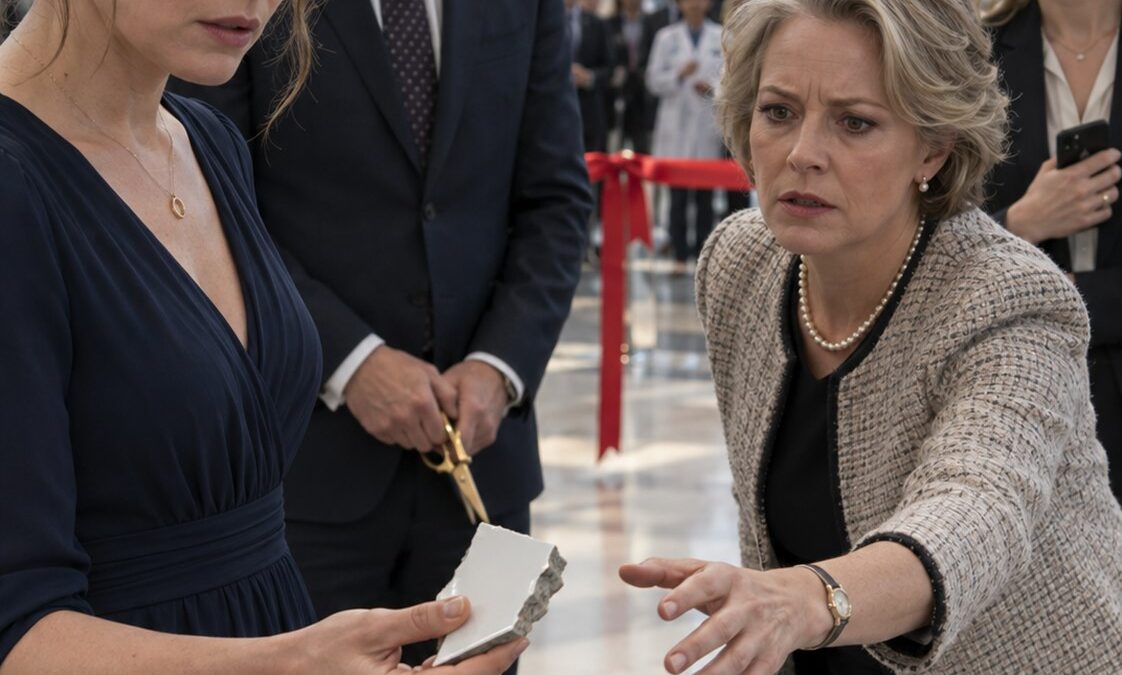
Dr. Calder held out her palm.
I put the shard in it.
Grant looked from her to me.
The ribbon hung untouched behind him.
“What do you mean, different?” he asked.
Dr. Calder examined the broken edge.
“The sample I tested was solid.”
She turned the shard beneath the atrium lights.
“This has a layered core.”
Paige slipped her phone into her jacket.
“Display pieces aren’t necessarily production pieces.”
“Then we’ll check the wall,” Dr. Calder said.
A hospital board member approached us.
Her name was Ruth Fenwick.
She chaired the committee overseeing the new wing.
“Is there a concern about the installed material?”
“Yes,” I said.
Paige answered at the same time.
“No.”
Ruth looked at Grant.
He still held the scissors.
“Stop the ceremony,” she said.
Grant closed the blades.
The small click carried farther than the applause had.
Ruth asked the guests to move toward the reception tables.
She told a staff member to keep the doors to the new wing closed.
Nobody ran.
Nobody shouted.
That made it worse for Grant.
He had prepared for a celebration.
He had no speech for a quiet room full of people waiting for facts.
Paige stepped close to him.
“Let me handle this.”
“You said she was doing it again,” he told her.
“I said we needed a clean sample.”
“That’s what she has.”
“It’s a broken display tile.”
“From the wall beside us,” I said.
Grant looked at me.
He seemed ready with an answer.
None came.
Four years of arguments stood between us.
The night I lost my job, he had asked why I signed a report I said I had never seen.
I had asked him why he trusted Paige’s copy over my word.
We had repeated those questions until neither sounded like a question anymore.
Dr. Calder placed the shard on a clean reception tray.
“Can someone secure the remaining pieces?”
Ruth waved over the hospital’s facilities director.
He photographed the floor first.
Then he collected each fragment with a witness beside him.
Paige watched every movement.
“Your lab tested a sample,” she told Dr. Calder.
“It didn’t test every tile in the building.”
“That’s correct.”
“Then you can’t make a public claim.”
“I haven’t.”
Dr. Calder looked at Ruth.
“I can tell you whether this matches what I certified.”
“Can you tell us today?”
“I can give you an initial comparison.”
Ruth nodded.
“Do that.”
Grant took a step toward me.
I took one back.
He stopped.
“You should have called me,” he said.
“I did.”
“When?”
“Tuesday.”
“I was in Rotterdam.”
“I called your office.”
Paige spoke quickly.
“I forwarded the message.”
“No,” I said.
“I heard nothing,” Grant said.
Paige met his eyes.
“There were hundreds of calls this week.”
My hand shook.
I folded it around my other wrist.
Grant saw it.
He reached toward me, then lowered his hand.
The gesture came four years late.
It still hurt to watch him stop.
Ruth asked where I had found the tile.
I pointed to the display wall.
A space near the bottom showed fresh adhesive.
I had removed the piece less than three minutes before Grant walked in.
I showed Ruth the photographs on my phone.
They showed the tile in place, then its back after I lifted it.
The back carried a batch code.
The broken center carried the gray layer.
“I needed a sample he couldn’t dismiss,” I said.
Grant glanced at the empty square.
“You took it from the wall?”
“Yes.”
“Why?”
“Because the same mark was on an installation cart this morning.”
He frowned.
“Who let you onto the site?”
“The public tour.”
Ruth answered for him.
“We opened the ground floor to families at nine.”
I had come because my mother wanted a photograph of the first hospital built with her tile.
She could no longer travel easily.
I had promised to bring one home.
Instead, I had sent her a picture of a cart labeled with a manufacturer she had refused to work with.
Grant knew that company’s name.
He had forgotten why it mattered.
Dr. Calder turned the shard over again.
“Where is your mother now?” she asked.
“At home.”
“Would she recognize this construction?”
“She rejected it.”
Paige laughed once.
“That was years ago.”
“Yes,” I said.
“It was.”
Grant’s face changed.
He remembered the rejected proposal.
He remembered calling it a routine disagreement over cost.
He did not yet remember who had brought the cheaper tile to us.
Paige had.
* * *
Ruth took us into a small conference room off the atrium.
The hospital’s facilities director, Ben Ortiz, brought the collected fragments.
He sealed them in a clear bag.
He signed the label.
Ruth signed beside him.
Dr. Calder photographed both signatures.
Paige objected to every step.
Ruth let her speak.
Then she asked Ben to continue.
Grant sat across from me.
He had taken off his celebration pin.
A pale hole remained in his lapel.
“Show me the cart,” he said.
I opened my photograph.
The code began with a G.
Our approved tile batches began with an H.
That alone proved little.
A delivery cart could carry materials for another job.
The installed wall could be a harmless display mistake.
I told them both things.
Paige gave me a sharp look.
She had expected certainty she could attack.
I had learned to be precise.
It had cost me my career once.
“I’m asking you to check,” I said.
Ruth asked for the procurement records.
Paige said they were at the main office.
Ben said the hospital kept copies of every delivery ticket.
Paige turned toward him.
“You keep scanned tickets.”
“And the receiving logs.”
“We’ll need both,” Ruth said.
Ben left the room.
Grant asked me about my mother.
“She remembers the rejected tile?”
“She remembers every sample.”
My mother, June Harlan, had spent thirty-two years making technical ceramics.
Her hands were bent from work she refused to call hard.
She designed a tile that could withstand repeated cleaning and heavy use without breaking down.
Hospitals liked its smooth face.
Installers liked that it arrived with a clear batch mark.
The mark was pressed through the material before firing.
It could not be peeled off.
That detail had seemed boring when I was twenty-six.
It was why I knew what the broken center meant.
“Why didn’t she contact me?” Grant asked.
“She did.”
“When?”
“After the first supplier change.”
Paige leaned back.
“June demanded a price increase.”
“She asked why her factory received no purchase orders.”
“She couldn’t meet the schedule.”
“She had three production lines waiting.”
Grant rubbed his forehead.
Four years earlier, Bell Building Systems had secured its first major hospital contract.
The approved design used my mother’s tile.
Then a test report appeared with my signature accepting a cheaper substitute.
I had never signed it.
I proved that months later through a handwriting review and access logs.
By then, Paige had told Grant the substitute was my idea.
She said I had tried to help my mother’s factory after it fell behind.
When I denied it, Grant believed I was protecting June.
Our marriage did not end that night.
It became a series of careful rooms.
I moved into the guest bedroom.
He worked longer hours.
Every family dinner required a subject neither of us had to defend.
Ben returned with a tablet.
“We have the logs.”
Ruth connected it to the room’s screen.
The delivery listed ceramic wall panels for the new wing.
The supplier was a company called Greyhaven Materials.
Its name matched the G on my photograph.
Grant sat forward.
“That’s not Harlan Ceramics.”
“Correct,” Ben said.
“Where’s the approved change order?”
Ben opened the next file.
There was a change order.
It carried Grant’s electronic approval.
He stared at it.
“I approved a backup supplier.”
Paige nodded.
“After June’s plant missed the schedule.”
“That’s what you told me.”
“It’s what happened.”
I asked Ben to open the attachment.
It was a letter on my mother’s stationery.
The letter said Harlan Ceramics could not fulfill the contract.
It bore June’s typed name.
Grant looked at me.
“She sent this.”
“No,” I said.
Paige folded her arms.
“You can’t know that.”
“I can.”
My mother used large type on company letters because her eyesight had worsened.
The attachment used the old template.
That still wasn’t proof.
I asked Ben for the file details.
He opened the document properties.
The letter had been created at 11:42 p.m. on a Sunday.
June’s plant had closed at noon that Saturday.
Again, not proof.
Someone could have worked late.
Then I asked him to enlarge the footer.
It listed a telephone number.
“That number was disconnected the previous winter,” I said.
Ruth wrote it down.
Paige looked bored.
She was good at looking bored.
“Old template,” she said.
“Maybe,” I answered.
Ben opened the receiving log.
Greyhaven had delivered twelve pallets three months earlier.
Its manager had signed the ticket.
Another signature appeared below his.
It was a Bell Building Systems acceptance.
Grant leaned closer.
“That’s mine.”
“No,” I said.
He studied it.
“It looks like mine.”
“It’s the same image from the change order.”
Ben enlarged both signatures.
The little break in the G was identical.
So was a faint gray dot beside the last letter.
Someone had pasted the same image twice.
Grant said nothing.
Paige finally sat down.
Ruth asked for copies of the original files and their access history.
Ben said the hospital’s system retained both.
Dr. Calder took the sealed fragments to her lab across town.
She promised a preliminary comparison by morning.
Ruth postponed the opening.
The donors were told only that a materials question required review.
That was enough to start rumors.
It was also the truth.
Outside, reporters waited near the glass doors.
Grant offered to drive me home.
“I have my car,” I said.
“Mara.”
“You can call me after you check the records.”
He looked toward Paige.
She was already speaking into her phone.
I had known her for six years.
I knew how quickly she could make a story sound settled.
I also knew something Grant did not.
Greyhaven’s first proposal had reached my mother’s factory before it reached Bell Building Systems.
June had kept it.
Paige had sent it herself.
* * *
I went to my mother’s house before sunset.
She lived forty minutes inland, above the old factory.
The kilns had been cold for eighteen months.
She still kept the office warm.
Her dog, Biscuit, barked at the door and then hid behind a chair.
June watched me set the photograph on her desk.
“Was it our tile?” she asked.
“No.”
She studied the G mark.
Her finger stopped at its curved edge.
“Greyhaven.”
“You remember?”
“I remember telling Paige no.”
June opened a filing cabinet.
She found the proposal in a folder marked HOSPITAL.
The first page offered to manufacture a cheaper layered tile under our name.
It promised better margins.
The last page warned that using our mark would require June’s written consent.
She had written one word across the offer.
Declined.
“She said everyone did it,” June told me.
“She told Grant you couldn’t deliver.”
“I know what she told him.”
June closed the folder.
“I should have gone to him myself.”
“You tried.”
“I let you go for me.”
I remembered the meeting.
I remembered carrying June’s production schedule into Grant’s office.
I remembered Paige taking it at the door.
Grant was traveling.
Paige promised to leave it on his desk.
He later told me he had never seen it.
At the time, that was one more argument.
Now it was a step in a plan.
I photographed the folder.
Then I called Ruth.
She gave me the number for the outside lawyer helping the hospital preserve records.
The lawyer asked me to bring the original proposal.
She also asked June to identify who had handed it to her.
June could do both.
Grant called while I was packing the folder.
I let it ring once.
Then I answered.
“Dr. Calder has the fragments,” he said.
“I know.”
“I asked for the vendor file.”
“Good.”
“Paige says Greyhaven met the written standard.”
“Ask who wrote it.”
He paused.
“Mara, I’m trying.”
“So am I.”
“She says your mother turned down the order.”
“My mother has the offer Paige made her.”
“What offer?”
I told him.
The line stayed quiet.
Then he said, “Can I come there?”
June watched my face.
“No,” I said.
“You need to see it.”
“I will,” he said.
“Tomorrow, with Ruth’s lawyer.”
He did not argue.
That was new.
At nine that night, the hospital lawyer called back.
Her name was Elise Ward.
She had checked the public company registry.
Greyhaven Materials had been formed five years earlier.
Its listed owner was a holding company.
Elise was still tracing that company.
She had also sent preservation notices to Bell Building Systems and Greyhaven.
“No one should delete anything now,” she said.
“Will they comply?”
“They have a legal reason to.”
I looked at June’s declined proposal.
Paige had not offered the substitute because of a late delivery.
She had offered it before the contract was awarded.
The next morning, someone left a box on June’s porch.
It held every family photograph from my desk at Bell Building Systems.
My office had been cleared the day I lost my job.
The pictures had been missing ever since.
A note lay on top.
Come get the rest.
There was no signature.
There was no need.
June read it once.
Then she put the box inside.
“We’re calling Elise,” she said.
We photographed the porch, the box, and the note.
Elise told us to keep the packaging.
She notified company counsel.
I wanted to drive to Bell Building Systems and put the note on Paige’s desk.
June took my keys.
“After breakfast,” she said.
She made toast.
I ate half a slice.
Biscuit sat beneath my chair, hopeful and useless.
I stroked his ears.
The factory outside had gone quiet because I refused to sign a lie.
For years, I had wondered whether that choice ruined June’s life.
She poured more coffee.
“I would make it again,” she said.
I looked up.
“The choice?”
“To lose the order.”
She set the pot down.
“I just wish it had been our choice.”
At noon, Elise called with the ownership records.
The holding company behind Greyhaven belonged to Paige’s brother.
His name was Nolan Voss.
The company had one major customer.
Bell Building Systems.
Elise found another filing.
It showed Paige held an option to buy Greyhaven for one dollar when Nolan stepped down.
She had arranged that option two years earlier.
Before a single tile entered the hospital.
* * *
The hospital board met three days later.
It was not a public hearing.
Ruth invited the people who could answer questions.
Grant came with company counsel.
Paige came with her own lawyer.
Dr. Calder came with a written report.
June came with the original proposal.
I came with the photographs from the atrium.
Elise had already arranged for the hospital to preserve wall samples from three places.
A technician had removed them while a facilities employee watched.
Each sample went into a separate labeled container.
The work took two days.
It left neat squares of exposed backing in the corridors.
The hospital kept those corridors closed.
Dr. Calder’s report compared the samples with the approved design.
The display shard had a layered core.
So did the three installed samples.
None matched the material she had certified.
She did not claim the whole wing was unsafe.
She said the installed material had not passed the required testing.
Ruth asked whether the wing could open.
“Not on my certification,” Dr. Calder said.
Paige’s lawyer leaned forward.
“The contract permits an equivalent product.”
“If it is tested and approved,” Elise replied.
“Greyhaven supplied its own results.”
“Those results came from a different laboratory.”
Paige opened a folder.
She had prepared for this.
“The hospital wanted the wing opened this month,” she said.
“We delivered despite a supplier failure.”
June placed her proposal on the table.
“I never failed to supply it.”
“You declined the quantity,” Paige said.
“I declined your substitute.”
Paige turned to Grant.
“June told us her kilns couldn’t keep pace.”
Grant looked at the paper.
“I was shown a letter.”
“A letter I didn’t write,” June said.
“Anyone can deny an old document,” Paige replied.
She sounded calm.
For a few minutes, she almost had the room.
Grant had signed the change order.
The hospital had accepted deliveries.
June’s factory was now closed.
My public confrontation looked personal.
Paige made each fact sound like another reason to distrust me.
“Mara has opposed this substitution for years,” she said.
“Because it was never approved,” I answered.
“You lost your position over this dispute.”
“I lost it over a report I didn’t sign.”
Paige spread her hands.
“Which is also what you say about June’s letter.”
Grant shifted in his chair.
I knew that movement.
He had made it when he wanted an argument to end.
This time he stayed.
Elise asked Paige’s lawyer whether Paige had disclosed her interest in Greyhaven.
He said Nolan owned the company.
Elise showed him the option filing.
Paige’s lawyer asked for time to review it.
Ruth gave him five minutes.
Nobody left the room.
Paige stared at the broken tile on the table.
Dr. Calder had brought it in a sealed bag.
Grant stared at Paige.
“Did you tell me Nolan was involved?”
“He wasn’t involved in our decision.”
“That’s not what I asked.”
“He knows suppliers.”
“Did you tell me?”
“No.”
Paige folded her hands.
“I didn’t want you rejecting a good product over a family connection.”
Ruth asked why the hospital had not been told.
Paige said she had relied on the company’s disclosure process.
The company’s counsel said the process required her to disclose it.
Paige looked away.
Her lawyer touched her arm.
He knew she should stop talking.
She kept going.
“Every day this wing stays closed costs money,” she said.
“Patients need rooms.”
Ruth’s expression tightened.
“Then we should have been given the material we approved.”
“We gave you a serviceable wall.”
“You gave us an unanswered question.”
Paige turned to Grant.
“Tell them how close the company came to missing payroll.”
It was a strong move.
Bell Building Systems employed four hundred people.
A costly delay could hurt them.
Grant had carried that fear for years.
He looked at Ruth.
Then at me.
“The delay matters,” he said.
Paige nodded.
“The contract matters too.”
Ruth leaned forward.
“Does this company have a plan to make the material right?”
Grant answered slowly.
“We will pay for independent testing.”
“And replacement, if required?”
“Yes.”
Paige’s chair scraped the floor.
“You can’t promise that without the board.”
“I can recommend it.”
“You’ll destroy the quarter.”
“I signed for a product we didn’t deliver.”
The words seemed to surprise him.
They surprised me too.
Elise brought up the receiving records.
Grant’s signature appeared on two documents.
The images matched exactly.
An outside digital examiner had confirmed the pasted image.
He had not yet determined who placed it there.
That limit mattered.
Elise said so.
Paige’s lawyer seized it.
“You have no evidence my client pasted anything.”
“We have access logs,” company counsel said.
He had been quiet until then.
The files were created under an account assigned to Paige’s office.
That did not prove she used the keyboard.
It did narrow the question.
Paige said her assistants shared files.
Then the door opened.
Ben Ortiz brought in a printout from the hospital’s receiving system.
He had found the original delivery scan on the hospital’s server.
It was not the version attached to the company file.
The handwritten acceptance line was blank.
Somebody had added Grant’s signature later.
Ben explained who had scanned it.
He named the server and the date.
He gave Elise the access record.
Ruth read the page.
Grant turned toward Paige.
She looked at the floor.
The tile shard lay between them.
I had picked it up because of the gray layer.
Now its broken edge had forced people to look at everything around it.
Paige finally spoke.
“I corrected the paperwork.”
Her lawyer closed his eyes.
“For a delivery you knew about?” Grant asked.
“For one you would have blocked.”
“Because Nolan owned it?”
“Because you listened to Mara whenever she frightened you.”
I felt heat rise in my face.
Grant’s voice stayed level.
“You told me not to listen to her.”
“You wanted someone else to make the hard decisions.”
He did not answer.
That accusation had enough truth in it to hurt him.
Ruth ended the meeting.
She said the hospital would keep the wing closed pending testing and a repair plan.
Its lawyers would review the contract.
Company counsel said Bell Building Systems would preserve relevant records and conduct an independent investigation.
Elise said the hospital would share its findings with the appropriate authorities.
Nobody declared Paige guilty of a crime in that room.
Nobody needed to.
Grant asked her to surrender company access while the investigation ran.
Her lawyer advised her to comply.
She stood at the door.
“You’ll ruin your own husband to win this,” she told me.
I looked at the shard.
Then at June.
Then at Grant.
“I asked you to use the right tile,” I said.
* * *
The first replacement tile came off the line seven weeks later.
It was made at a plant two states away.
June had inspected the specifications.
She had not taken the contract.
Her factory needed too much work to reopen quickly.
More than that, she wanted a choice.
The hospital needed a qualified supplier now.
She recommended one.
The new manufacturer gave her a consulting fee.
June spent part of it fixing her porch steps.
Biscuit approved immediately.
He liked sitting on the top step where everyone had to pass him.
I was still teaching evenings.
My students had heard about the unveiling.
They tried to act as if they had not.
One asked whether I really knew a tile was wrong from seeing its back.
“I suspected,” I said.
“How did you know?”
“I broke it.”
They laughed.
I let them.
It was the first time the sound had felt good.
Grant moved out of our house after the board meeting.
I asked him to.
He rented an apartment near his office.
We spoke about practical things at first.
Insurance.
Mail.
The mortgage.
Then about the investigation.
The outside review found that Paige had routed purchases through Greyhaven.
It found invoices above the amount Greyhaven paid its manufacturer.
It also found that she had used her office’s account to create the false supplier letter.
She had approved the copied signatures.
Nolan had handled the supplier company.
The review did not find that Grant knew who owned it.
It did find that he ignored warnings.
Mine.
June’s.
A junior procurement analyst’s.
The analyst had sent Grant a note about Greyhaven’s prices.
Paige marked it resolved.
Grant never opened the attachment.
He told me that himself.
I did not comfort him.
“You could have opened mine,” I said.
“I know.”
“You could have asked June.”
“I know.”
“I was your wife.”
He looked down.
“I know.”
The company board kept him as CEO through the repair.
They required outside oversight for procurement.
Grant gave up his annual bonus.
Some shareholders wanted him removed.
Others thought keeping him responsible for the work was fairer.
That argument belonged to them.
I declined an invitation to make it for them.
The hospital wing remained closed for four months.
Crews removed the unapproved tiles.
Independent inspectors checked the replacement work.
Dr. Calder tested samples from the new batches.
Ruth did not set an opening date until she had the results.
The company paid for the work.
Its insurer disputed part of the claim.
Lawyers handled that dispute.
I did not have to attend.
Paige and Nolan faced a civil lawsuit over the supplier arrangement.
Investigators also reviewed the altered records.
Months later, Paige accepted a settlement that required repayment and barred her from serving as an officer at the company.
Nolan’s company was dissolved after it paid what it could toward the claim.
The authorities continued their separate review.
I learned to let a process take the time it needed.
That did not mean forgetting what happened.
One Friday, Grant came to June’s house.
He brought no flowers.
He brought a folder.
Inside were letters from the company correcting the account of why I had left my job.
The company had also sent the licensing board the records behind the forged inspection report.
My license had never been formally taken away.
The public allegation had simply made it impossible to work.
The letters could help me return.
“I should have done this four years ago,” Grant said.
“Yes.”
“I’m sorry.”
June stayed in the kitchen.
Biscuit watched from under the table.
Grant looked at me.
“I believed the version that was easiest for me.”
“Yes,” I said.
“I let Paige be certain for both of us.”
I waited.
He did not ask me to excuse it.
That helped.
He asked whether I wanted the house.
I told him we would settle the property fairly.
He asked whether I wanted to try counseling.
I told him I wanted a divorce.
His face tightened.
But he nodded.
“Okay.”
I had spent years waiting for him to choose me over a convenient story.
By then, I needed to choose the life I could trust.
The divorce was final the following spring.
We divided what we had built together.
I used part of my share to start a small materials review practice.
I took jobs from schools, clinics, and public building projects.
I charged for the work.
I offered a few hours each month to community groups who needed help reading contracts.
June sometimes came along.
She asked the questions that made salespeople straighten their papers.
We made a good team again.
Ruth called when the hospital finally set its opening date.
She wanted me there.
I almost said no.
Then she told me there would be a wall in the new wing listing the people who had helped finish it.
June’s name was on it.
Mine was too.
June pretended not to care.
She asked three times what she should wear.
On opening day, Grant stood across the atrium.
He wore a plain dark suit.
No celebration pin.
No scissors.
We nodded to each other.
It was enough.
Ruth asked June to cut the ribbon.
June looked at me.
“Only if you hold the other end.”
“I can do that.”
The ribbon came apart cleanly.
People applauded.
Nobody had to be embarrassed for them to do it.
* * *
Five years later, I went back to the atrium on a Tuesday morning.
No cameras waited there.
A volunteer was helping visitors find the elevators.
The reception tables were gone.
The white wall remained.
Its tiles came from the approved batches.
I knew because I had reviewed the final records.
I also knew because June had insisted on keeping one spare.
She stored it in a box at home beside a photograph of us at the opening.
The old broken shard lived in my office.
Dr. Calder had returned it after the case ended.
I kept it on a shelf where students could see it.
They always asked why a tile had a gray line.
That was how the lesson began.
June had retired from consulting the year before.
Biscuit had grown old and slow.
He still guarded the porch.
My practice employed three people.
One was the junior analyst Grant had failed to hear.
She checked invoices better than anyone I knew.
The hospital had opened every room in the new wing.
Ruth had retired from its board.
Grant still ran his company.
He had sent a brief note when June turned seventy.
She sent one back.
That was the shape of peace we had found.
I crossed the atrium toward the wall.
A maintenance worker had removed one tile near a doorway.
He held the replacement in both hands.
“Mind giving me a little room?” he asked.
“Of course.”
I stepped aside.
He turned the tile over.
The batch mark ran cleanly through the back.
Then he fitted it into place.
Five years earlier, I had knelt on this floor gathering pieces while strangers applauded my husband.
Now I stood and watched a worker set one tile carefully.
He pressed it level.
He wiped away the excess adhesive.
Nothing dramatic happened.
That was the point.
The wall would hold.
I took a picture for June.
She replied before I reached the door.
Looks right this time.
I smiled and slipped the phone into my pocket.
THE END








