MY CEO HUSBAND PUT A VISITOR BAND ON ME AT HIS FACTORY LAUNCH, BUT THE COPPER CONTACT I CARRIED STOPPED THE DEMONSTRATION
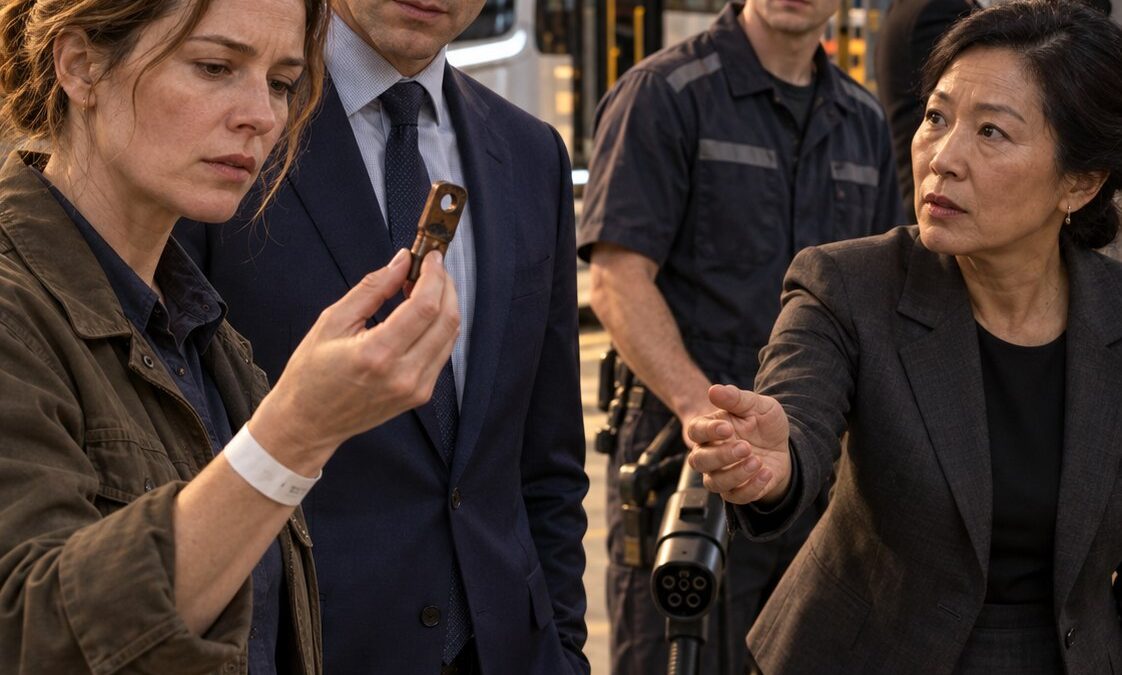
Chapter 2: The Signed Release
Celia removed her hand from the switch.
The bus stayed still.
Jun held out her palm.
I gave her the contact.
She turned it toward the light.
C17 was stamped along its rim.
A dark mark crossed the opposite edge.
Tomas set down the charging cable.
Peter looked from him to me.
“Where did you get that?”
“From the failed unit.”
“That unit was destroyed.”
“No,” Tomas said.
His voice carried farther than he intended.
Celia turned on him.
“Mr. Bell, return to your station.”
Jun lifted one finger.
“Stay here.”
The guard stopped beside the stage.
His name was Ellis.
He had worked factory security for eight years.
He looked deeply unhappy to be part of a launch.
“Ellis,” Jun said, “ask the driver to shut down.”
Peter took one step forward.
“Jun, our city partners are here.”
“So are our employees.”
“The report is signed.”
“Then we can read it.”
The bus engine went quiet.
Without its low hum, I could hear the adhesive visitor band catch against my cuff.
Jun noticed the band.
Her mouth tightened.
She did not ask me to explain it.
She called Alder Grid’s general counsel instead.
Elena Wu answered from somewhere upstairs.
Jun told her to come down with the original release, the test report, and the access log.
Celia folded her arms.
“This can wait twenty minutes.”
“The demonstration can wait longer,” Jun said.
Peter turned toward the audience.
“Please enjoy refreshments while we resolve a paperwork question.”
Nobody moved at first.
Then chairs scraped.
The investors drifted toward the doors.
Several technicians remained by the wall.
I wanted them to leave.
I wanted them to stay.
Peter approached me after the cameras lowered.
“You planned this.”
“I planned to inspect the units.”
“You could have called me last night.”
“I did.”
He blinked.
“You said you trusted Celia.”
“I trust the signed report.”
“You haven’t seen the original.”
He glanced at my wrist.
For a second, shame reached his face.
Then he looked away.
Tomas came down from the bus.
His gloves were still clipped to his belt.
“You okay?” he asked.
I nodded.
He saw the band.
His jaw worked once.
“I kept the failed housing,” he said.
Celia heard him.
“You were instructed to dispose of it.”
“I was instructed to retain failed test material.”
“By whom?”
“By Inez.”
I had signed that instruction on Monday.
It was ordinary work.
The kind that rarely drew an audience.
Jun asked Tomas to stay with Ellis until counsel arrived.
She handed the contact back to me.
“Don’t clean it,” she said.
“I wasn’t going to.”
Peter stared at its stamped edge.
“You said C17 was gone.”
“I said the failed unit was retained.”
“Celia told me production used C19.”
“That is what I tried to verify.”
His voice dropped.
“You think she lied?”
“I think that contact reached a test unit after you said the batch had been retired.”
He looked up sharply.
“That test was last week.”
“Thursday.”
“The release was Wednesday.”
I watched him understand the order.
If his release existed on Wednesday, it could not truthfully include Thursday’s result.
The copper had not appeared too late to stop me.
The approval had appeared too early.
* * *
Elena arrived carrying a laptop and a sealed document envelope.
She walked past Peter.
“Jun, I need a room.”
“Use the training office.”
“We need the floor secured first.”
Jun looked at Ellis.
He spoke into his radio.
The demonstration area closed to everyone except the review team.
No one tried to run a vehicle.
No one tried to seize my hand.
It would have been easier if the problem had been that simple.
We went upstairs.
I sat at a table where I had once taught new technicians how to document a failed test.
Peter sat across from me.
Celia chose the chair beside him.
Tomas stayed near the door.
Elena photographed the contact.
She placed it in a clean bag and wrote the time across the seal.
I signed where she asked.
So did Tomas.
Then she opened the envelope.
Inside was a one-page release bearing my electronic signature.
I read the date.
Wednesday, September seventeenth.
I read the scope.
Production batch C19.
I read my name.
It appeared exactly where I normally put it.
Peter watched me.
“Did you sign it?”
“No.”
Celia slid a printout across the table.
“The system recorded your credentials.”
“What system?”
“Quality release.”
“I know the system.”
“Then you know what the record says.”
I read the timestamp.
7:41 p.m.
I had been at my mother’s house.
That alone proved little.
I sometimes worked there.
The release cited a forty-eight-hour endurance test completed at 6:12 that evening.
I asked for the raw test file.
Celia tapped the printout.
“The result is attached.”
“That’s a summary.”
“It passed.”
“I asked for the raw file.”
Elena closed the envelope.
“We’ll obtain it directly from the test lab.”
Celia frowned.
“The lab already sent it.”
“Then they can confirm what they sent.”
Peter leaned back.
He looked tired now.
That angered me more than his stage smile.
He had slept well while I spent Thursday night checking photographs of damaged copper.
I pointed to the release date.
“Who requested this?”
Celia said, “The executive office.”
Peter looked at her.
“My office?”
“Your authorization was required for launch.”
“That wasn’t my question.”
Elena asked them both to stop.
She copied the release to a read-only drive.
She requested the access logs from Alder Grid’s outside software provider.
She called the independent testing lab from the office phone, with Jun beside her.
The lab supervisor agreed to preserve its records.
He would send authenticated copies to counsel, not to anyone in the room.
That was the right answer.
It was also slow.
I knew a faster check.
I asked Elena for the inspection photographs from Tuesday.
Each contact had been photographed before testing.
Tomas had taken the pictures against a measuring grid.
He found the folder in the quality archive.
Celia watched the screen.
There were twelve contacts.
Each bore C19.
Each was clean.
Then I opened the maintenance entry for the failed unit.
It had been rebuilt on Wednesday morning.
Tomas had recorded the serial number of its housing.
Inside the later photograph, beneath the charger cover, the contact showed a different stamp.
C17.
Peter leaned closer.
“Who changed it?”
Tomas swallowed.
“That’s what I tried to report.”
I turned to him.
He had left a note in the system.
Celia’s team had closed it as duplicate.
I had seen the closure and accepted it.
I felt heat rise in my face.
“I should have called you,” I said.
“I should have come to your desk.”
Jun looked between us.
“Tell me what happened.”
Tomas had found a bin of C17 contacts beside the assembly line.
That batch had failed a heat test in July.
Procurement had ordered replacements.
When Tomas asked why the old bin was back, his supervisor said it was awaiting disposal.
The bin was gone the next morning.
Tomas photographed one label.
He attached the picture to his note.
Celia’s operations team closed the note.
Then the failed unit turned up with a C17 contact inside it.
Peter looked at Celia.
She held his gaze.
“An old part in one test unit proves poor housekeeping.”
“It proves a question,” Elena said.
“We are asking it.”
The lab called back at noon.
Elena put the supervisor on speaker.
He identified the file he had sent Wednesday evening.
It was an incomplete test.
The forty-eight hours ended Thursday.
He had not issued a passing report on Wednesday.
No one spoke.
I looked at Peter.
He had defended a result that did not exist yet.
Elena asked one more question.
Had the lab sent any final report?
“Yes,” the supervisor said.
“Thursday at 6:12 p.m.”
“And the result?”
“Failed.”
* * *
Jun suspended the launch before lunch.
She called the city transit director herself.
She said Alder Grid had identified an unresolved quality issue.
She gave no theory.
She promised records.
The director thanked her and canceled the public demonstration.
By then, Peter’s photograph with my visitor band had begun traveling between employee phones.
I saw it once.
My wrist was lifted between us.
His hand covered mine.
From that angle, we almost looked affectionate.
I put the phone facedown.
Elena brought in outside counsel and a forensic accounting firm.
Their first job was preservation.
Email.
Purchase orders.
Test files.
Badge access.
Vendor messages.
No one had authority to erase them now.
Celia objected to being locked out of operations.
Jun said the lockout applied to everyone involved in the release.
That included Peter.
It included me.
He stared at the floor.
I had wanted him stopped.
I had not expected relief to feel so much like grief.
At four, my mother called.
Someone had sent her the photograph.
“Are you hurt?” she asked.
“No.”
“Come eat.”
“I can’t yet.”
“I’ll keep a plate.”
She did not ask whether Peter was coming.
She knew the answer before I did.
Tomas waited by the factory exit with his lunch bag.
“I’m sorry,” he said.
“For what?”
“For freezing downstairs.”
“You spoke.”
“After Jun did.”
“You spoke when it mattered.”
He shifted his bag.
“My supervisor says I might be written up.”
“Tell Elena.”
“I did.”
That was when I saw how young he looked.
Not because he was twenty-five.
Because he still believed one mistake at work could swallow his whole future.
I had believed it at twenty-five, too.
I gave him the number for my own lawyer.
“Call if they contact you outside the review.”
He tried to refuse it.
I made him take it.
Outside, Peter stood beside our car.
“Inez.”
“I’m going to my mother’s.”
“Can we talk at home?”
“I’m not going there tonight.”
He glanced at the visitor band still on my wrist.
“I shouldn’t have done that.”
“No.”
“Celia said you were trying to block the launch over an old disagreement.”
“And you believed her.”
“I believed the signed release.”
“You took my badge before asking me.”
He had no answer.
His phone rang.
He silenced it.
I wondered how many times I had done that for him.
Peter touched the car door.
“I didn’t know the test failed.”
“I believe you.”
His shoulders eased.
I pulled the band loose.
“That doesn’t tell me why you signed off on a result you hadn’t seen.”
The paper tore along its adhesive seam.
I held both pieces.
Peter looked away.
At my mother’s house, the kitchen smelled of onions and toast.
She had left the porch light on.
I washed my hands for a long time.
The red mark stayed around my wrist.
My mother set soup in front of me.
“Did he call?” she asked.
“He was there.”
“Did he listen?”
“Not until someone else spoke.”
She sat opposite me.
I ate three spoonfuls.
Then Elena called.
The outside firm had reviewed the release system’s first access records.
My account had been used from an executive office computer.
That office belonged to Peter.
He could have let Celia in.
He could have signed it himself.
The records did not yet say which.
But they brought the false release inside our marriage.
* * *
The next morning, I went to my lawyer before I went anywhere near Alder Grid.
Mara Finch had handled my mother’s house purchase.
She was steady, direct, and unimpressed by Peter.
I told her everything.
She told me to preserve my own messages and stop discussing the investigation with my husband.
She also told me a photograph on a stage was not the central problem.
“Whoever forged that release may try to make you answer for it,” she said.
“I know.”
“Then we answer with records.”
I showed her my calendar for Wednesday.
I had been at my mother’s house from five until nine.
We had ordered noodles.
The delivery receipt was in my email.
My mother could confirm I was there.
Mara wrote it down.
She did not pretend a family witness would settle a computer access question.
At eleven, Elena invited me to an interview with outside investigators.
Mara came.
So did a representative from the company that ran the quality system.
They showed us an access timeline.
My credentials had approved the release at 7:41 p.m.
The executive office computer had opened the document at 7:38.
A remote support session had begun at 7:36.
Peter’s assistant had scheduled that session for Celia.
Celia had told the support technician that I was unable to log in.
The technician helped reset a device prompt.
The reset used an executive exception allowed during a launch deadline.
I looked at the screen.
“Did they contact me?”
“No,” the investigator said.
“The exception requires the executive to certify the request.”
“Who certified it?”
“Peter.”
Mara wrote that down.
Peter entered the room twenty minutes later.
He looked at me, then at the timeline.
“I authorized a password reset,” he said.
“You authorized access to my account.”
“Celia said you had approved the release by phone.”
“I didn’t.”
“I know that now.”
“Did you speak to me?”
“No.”
The investigator asked if he had read the release.
Peter said he had skimmed it.
He had noticed my name.
He had not checked the lab attachment.
Mara asked him to say who pressed the final approval button.
“I don’t know.”
Celia had been in his office.
He had stepped out to take a call from the city.
When he returned, the screen showed the completed release.
He had thanked her.
I remembered that evening.
Peter had called to say we should celebrate.
I had told him the test was still running.
He had said I was always thinking about work.
Now he covered his face with one hand.
“I heard you say that,” he said.
“Yes.”
“I thought you meant another test.”
“You could have asked.”
He lowered his hand.
“I should have.”
The investigator paused the interview.
In the hall, Mara asked if I wanted to continue.
I did.
I wanted facts while they were still within reach.
We returned to find Elena with a second folder.
The purchasing records showed C17 contacts had been moved out of restricted storage.
The transfer had been approved by Celia’s operations account.
The destination was the production line.
The stated reason was “temporary stock adjustment.”
Nobody had filed a disposal record.
The numbers mattered.
Alder Grid had built sixty demonstration and pilot charging units.
Forty-two remained at the factory.
Eighteen had gone to city depots for stationary installation, with power still off.
All sixty needed inspection.
Jun ordered it.
The city agreed.
No passengers had used the system.
No driver had been asked to test it on a public route.
The danger was real.
So was the chance to stop it.
That afternoon, Celia sent a companywide message.
It said I had removed a test component without permission.
It said the review would determine whether I had disrupted launch preparations.
She did not name the failed report.
She did not name her own transfer order.
Mara forwarded the message to Elena.
By evening, the company had corrected it.
The correction was dry.
It was also public.
My removal of the contact had followed the written retention procedure.
The review remained open.
Tomas texted me a single word: Good.
I sat at my mother’s table, looking at it.
She set down two mugs of tea.
“Your friend?” she asked.
“My technician.”
“That means friend?”
“It might.”
She smiled.
For a few minutes, we talked about her tomatoes.
One plant had produced nothing but leaves.
She planned to argue with it in the morning.
It was the first ordinary conversation I had managed since the launch.
Then Mara called.
The investigators had found Celia’s draft presentation to the board.
It was dated three weeks earlier.
One slide recommended replacing me after the launch.
The reason was my “inability to align with commercial priorities.”
The slide included a proposed new reporting line.
Quality would report to operations.
Operations would report to Celia.
I stared at my mother’s kitchen wall.
Celia had planned my removal before the failed contact appeared.
The contact had only given her a reason to hurry.
* * *
Jun called a special board meeting for Monday.
Until then, Celia remained off the factory systems.
Peter was placed on leave.
I remained available to the investigation and away from the plant.
Mara helped me gather the records I was allowed to provide.
My notebooks stayed with company counsel.
My own calendar stayed with me.
The distinction mattered.
So did the people.
Tomas and his supervisor were interviewed separately.
The support technician gave a statement about the password reset.
The lab supplied its original files.
An independent materials lab received the copper contact and a sealed comparison sample.
Its technicians did not rely on the dark mark alone.
They checked the stamped batch number, dimensions, and metal composition.
C17 matched the restricted lot.
The failed unit’s housing matched Tomas’s maintenance entry.
By Friday, forty-two factory units had been inspected.
Twenty-six held C17 contacts.
The city’s eighteen units were inspected under city supervision.
Eleven held them.
No one called it a single stray part after that.
Peter came to my mother’s porch on Saturday.
She let me decide whether to open the door.
He carried no flowers.
I was grateful for that much.
“You shouldn’t be here,” I said.
“Mara said I could ask to speak to you personally.”
“She said you could ask.”
He stayed on the bottom step.
“I remembered something.”
“Tell the investigators.”
“I did.”
Celia had come to him in August with a sales offer from a larger company.
The offer depended on the city launch.
She would receive a substantial bonus if the sale closed.
Peter would receive more.
He had not told me because negotiations were confidential.
I folded my arms.
“What did you remember?”
“She said a failed test could be managed.”
“Managed how?”
“She said we could replace the parts after the demonstration.”
“The failed lot was already installed.”
“I didn’t know.”
“You knew she wanted to launch before replacing parts.”
He gripped the porch rail.
“I convinced myself she meant a minor issue.”
“You built the company with me.”
“I know.”
“You knew what a failed endurance test meant.”
He looked at the yard.
“I wanted the sale.”
There it was.
Not a complicated secret.
A choice.
He had let me stand alone so the deal could stand.
I asked him whether he and Celia were involved.
He looked startled.
“No.”
I believed him.
Their partnership had been about money and power.
That was enough.
“Why put the band on me?” I asked.
“She said a public suspension would reassure the buyers.”
His answer made my wrist ache.
“I asked you.”
“I was angry that you stopped it.”
“You could have said you were angry.”
“I should have said a lot of things.”
My mother opened the screen door behind me.
She held my coat.
The evening had turned cold.
I took it from her.
Peter watched the small exchange.
Then he stepped back.
“I’ll give the board everything,” he said.
“Do that.”
He waited.
I had nothing else for him.
Inside, my mother checked the soup.
She had made too much again.
I called Tomas.
He said his supervisor had apologized for the threatened write-up.
He also said the inspector had found C17 contacts in units assigned to two different assembly teams.
That removed one more chance to blame a single careless worker.
On Sunday, Elena sent Mara the board agenda.
The first item concerned the launch.
The second concerned executive conduct.
The third concerned a sale agreement I had never seen.
Celia’s bonus was tied to closing that sale before the end of the month.
She had moved the rejected contacts back into production because replacement stock would arrive too late.
* * *
Monday’s meeting took place in the factory training room.
Jun wanted board members near the equipment and the people who built it.
The city sent two observers.
The prospective buyer sent its compliance director.
Celia arrived with a lawyer.
Peter arrived alone.
Mara sat beside me.
Tomas had been asked to speak.
He wore a clean work shirt and looked miserable.
Jun opened the meeting without a speech.
Elena presented the timeline.
C17 failed its heat test in July.
The lot was restricted.
Procurement ordered C19.
C19 deliveries were delayed.
Celia’s office authorized moving C17 back to production.
The city launch date remained fixed.
The lab’s final test failed Thursday.
The release claimed a pass on Wednesday.
Celia’s lawyer stood.
“Alder Grid faced a supply interruption,” he said.
“My client approved temporary assembly pending replacement.”
He said no charging unit had entered public service.
That was true.
He said the test failure concerned one unit.
The inspection results answered him.
Thirty-seven of sixty units carried the restricted contact.
He said the dark mark could have come from handling.
The materials lab answered him.
The contact had been heated during electrical testing.
He said Celia had relied on quality approval.
I felt Peter shift across the room.
That was the argument that could still hurt me.
A document carried my signature.
A witness who had seen Celia press the final button did not exist.
Elena displayed the access log.
Celia had requested the reset.
Peter had certified it.
The executive computer had submitted the release.
Celia’s lawyer pointed to Peter.
“Then your chief executive authorized the process.”
Peter stood.
“I did.”
Jun asked him to sit until he was called.
He remained standing.
“I also heard Inez say the test was still running,” he said.
“I ignored her.”
Celia turned toward him.
“You knew we had a deadline.”
“I did.”
“You approved the exception.”
“I did.”
“You knew the buyer would walk if we missed launch.”
“I did.”
She had a strong argument.
Peter’s choices were his own.
If the board treated them as the entire story, Celia might leave with a severance agreement and a claim that she followed instructions.
Mara passed me a note.
Stay with what you know.
I stood.
I told the board how we retained failed parts.
I showed Tomas’s maintenance entry.
I explained the difference between a stamped lot number and a photograph of one.
Then Elena placed the bagged copper contact beneath the document camera.
C17 filled the screen.
I had carried it downstairs because I wanted someone to look.
Now every person in the room did.
“This contact came from the unit Celia said was an isolated failure,” I said.
“The factory found thirty-six more C17 contacts.”
Celia crossed her arms.
“I’ve never disputed the stock issue.”
“You closed Tomas’s report about the stock.”
“His report was a duplicate.”
“Of what?”
She looked at her lawyer.
He looked at the records.
There was no earlier report.
Tomas stood.
He described the bin beside the assembly line.
He described the label he had photographed.
He described seeing my instruction to retain failed material.
Celia’s lawyer asked whether he disliked his supervisor.
Tomas said no.
He asked whether Tomas had hoped for a promotion.
Tomas said he had hoped to finish the test.
The buyer’s compliance director asked for the purchasing order.
Elena provided it.
Celia had signed the order moving C17.
Her lawyer said that still did not prove she had forged my release.
Elena agreed.
Then she presented the support technician’s record.
The technician had received a message from Celia’s company phone.
It said I had approved by phone.
The phone records showed no call between us.
Celia said she had spoken to me on a different line.
Mara asked which line.
Celia could not name it.
Elena brought up one final item.
The outside firm had recovered an earlier draft of the false release from Celia’s work folder.
It contained the same mistaken file reference as the final version.
It was created Tuesday.
The lab had not yet completed its test.
Celia’s lawyer asked for a recess.
Jun granted ten minutes.
I walked into the hall.
Peter followed, stopping several feet away.
“You should have told me you had that draft,” he said.
“I learned about it this morning.”
“I could have helped.”
“You can help by answering for your part.”
He nodded.
For once, he did not argue.
When we returned, Celia’s lawyer said his client would not answer further questions.
That was her right.
Jun did not demand a confession.
The board voted to remove Celia from her role.
It accepted Peter’s resignation as chief executive.
It directed counsel to notify the city and appropriate regulators, preserve evidence, and pursue recovery under the sale agreement.
The buyer withdrew its offer that afternoon.
The factory stopped assembling the affected units.
No official put anyone in handcuffs.
The work of finding out what had happened continued.
As we left, Celia stepped close enough to speak softly.
“You cost them a fortune.”
I looked through the training room window.
Workers were tagging units for inspection.
“They built something worth checking,” I said.
I walked past her.
Six months later, Alder Grid settled the city’s contract claims and paid for every affected unit to be rebuilt or replaced.
The board’s independent review found that Peter had approved an improper account reset and ignored a known unresolved test.
Celia faced civil claims over her bonus and the false release.
Her attorney disputed the findings.
A criminal investigation remained with the authorities.
I did not need its outcome to know what had happened in that room.
The board published the corrected test record.
My name appeared only on the work I had actually signed.
* * *
In February, my mother’s tomato plant finally died.
She carried its empty pot into the kitchen like evidence.
“I want a second opinion,” she said.
I told her winter had made a clear finding.
She accused me of enjoying myself.
I was.
Only a little.
I had rented a small apartment three blocks away.
It had one good window and a kitchen drawer that stuck.
I fixed the drawer myself.
The divorce paperwork took longer.
Peter signed it without contest.
The house was sold.
My mother kept hers.
Her mortgage was paid from the share of our savings that was mine.
The first night she had no payment to make, she put the old mortgage statement in a folder instead of throwing it away.
“I want to remember,” she said.
Alder Grid’s board offered me the chief operating job after the review.
Jun made the offer in person.
The salary was large enough to make me read it twice.
“You’d have the authority you asked for,” she said.
“I asked for authority to stop a bad release.”
“You could make sure nobody loses it again.”
I thought about Tomas.
I thought about the people who had stayed beside those charging units, waiting for instructions.
Then I asked Jun how quality would report under the new structure.
“Directly to the board,” she said.
“Without me in operations?”
“Without anyone in operations between them.”
“That’s the part you should keep.”
I turned down the job.
Jun did not look pleased.
She did revise the reporting rules.
I spent that spring doing contract work for three manufacturers.
I reviewed testing records.
I taught supervisors how to document a stop without punishing the person who called it.
Tomas joined one session.
He brought a photograph of the C17 bin label to show the class.
He had grown more comfortable speaking in rooms.
He still checked every slide twice.
One afternoon, Peter asked to meet at a coffee shop.
Mara had no objection.
I went because I wanted to decide for myself.
He had taken a job teaching an evening business course.
He told me he was learning how often his students asked questions he used to dismiss at work.
“I’m sorry,” he said.
“For the band?”
“For that.”
He looked down at his cup.
“For the reset.”
He named the warning I had given him.
He named the test he had failed to read.
He did not say Celia had made him do those things.
I let him finish.
“I’m glad you understand it now,” I said.
“Could we try being friends?”
“No.”
He nodded once.
“You can be someone who tells the truth,” I said.
“I hope you are.”
“That isn’t friendship.”
“It’s where we are.”
We left separately.
I walked home slowly.
I did not feel triumphant.
I felt as if I had set down something heavy without needing him to carry it.
That summer, Jun invited me back to the factory.
Alder Grid had a new chief executive from outside the company.
The rebuilt chargers had completed a new test cycle.
The city had accepted the first units.
Jun wanted me to see them.
I asked whether Tomas had checked the records.
“He led the review,” she said.
“Then I’d like to.”
At the plant, Tomas met me near the loading doors.
His badge now read SENIOR QUALITY TECHNICIAN.
He tried to hide how often he looked at it.
He showed me the replacement contacts.
C21.
A new supplier.
A new test file.
Every approval had a named person and a date after the test.
I checked.
He expected me to.
At lunch, he asked if I would help design a training program for new hires.
“Only if they can question you,” I said.
“They already do.”
“Good.”
He grinned.
Jun offered to fund the program.
I agreed on one condition.
The lessons would be available to the city maintenance crews, too.
They had waited beside unpowered equipment while Alder Grid fixed its mistake.
Jun said yes.
By autumn, we had taught six classes.
The first exercise used a harmless connector with the wrong batch number.
Nobody had to know anything about my marriage to find the error.
They just had to look.
* * *
Three years after the launch, I returned to the demonstration floor with a group of apprentices.
The bus stood where it had stood that morning.
Now it charged on a regular schedule.
Its driver knew Tomas by name.
Alder Grid had painted new lines on the concrete.
The training room had better chairs.
I still remembered where my badge had fallen.
An apprentice pointed to the contact inside a clear case by the testing station.
“Is that the one?”
“Yes.”
A small label named its batch and the date of the failed test.
It named Tomas as the technician who retained the unit.
It named me as the engineer who stopped its release.
Nothing on the label mentioned Peter.
The apprentice studied the blackened edge.
“It’s so small.”
“That’s why we mark them.”
Tomas joined us carrying a box of fresh samples.
He had two new technicians with him.
One asked whether they were allowed to stop a test if a supervisor disagreed.
“Yes,” Tomas said.
“Tell me first.”
The apprentice looked at me.
“And if he disagrees?”
“Write down what you found,” I said.
“Then ask someone else to look.”
Tomas gave me an offended look.
I smiled.
The driver sounded the horn.
Everyone turned.
The charging arm settled into place.
A green light appeared.
This time, the test had finished before anyone called the bus forward.
The records were open.
The people who had done the work stood close enough to answer for it.
My mother arrived late with a tray of muffins for the class.
She blamed the traffic.
Tomas blamed her tomatoes.
She handed him the largest muffin anyway.
I held the empty sample box while the apprentices gathered around the case.
Copper.
A number.
A question someone had asked aloud.
That was what had brought us back to this floor.
When the driver opened the bus doors, the apprentices climbed aboard together.
I went with them.
THE END








