My Daughter Landed in the ER After Refusing Her Husband’s Order, and He Laughed at the Orange Tag I Brought to His Ceremony
Chapter 2: The Second Feed
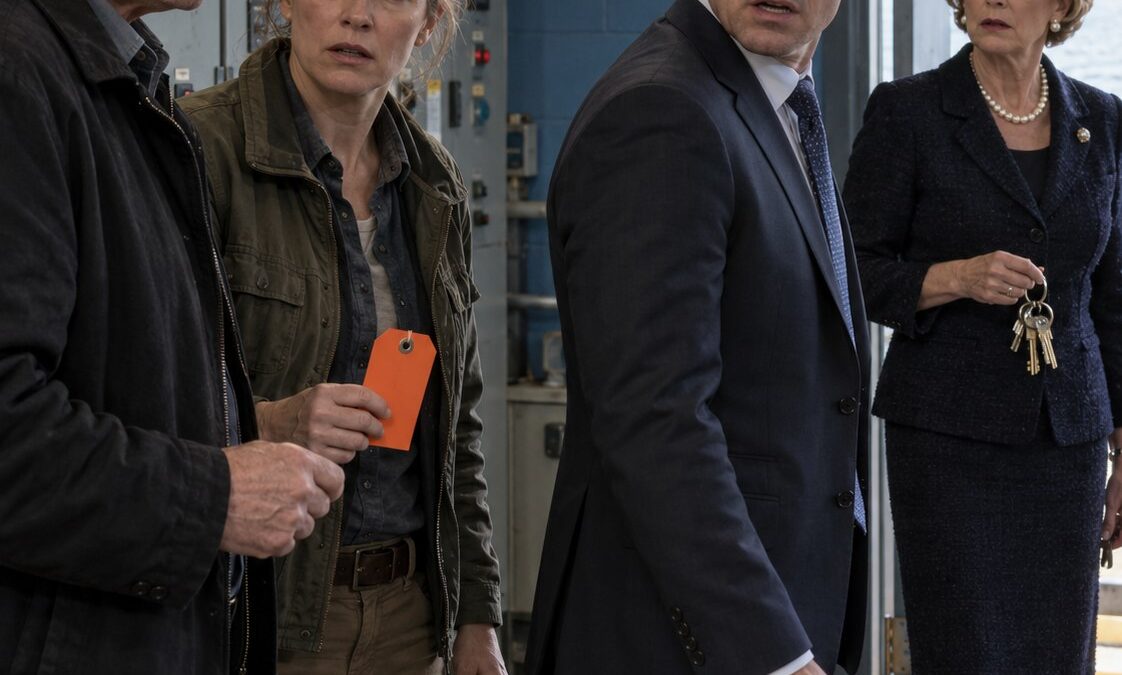
Vivian Voss came through the control-room door.
She was sixty, immaculate, and already angry.
The investigator introduced herself as Dana Keene.
Vivian barely looked at her.
“Why is this ceremony stopped?”
Dana raised the orange tag.
“I need to inspect the panel.”
“After the ceremony.”
“Now,” Dana said.
Cal stepped between them.
“My wife caused an accident.”
“That is what we’re examining.”
I watched Vivian’s face.
She had heard Cal’s story before.
She had not expected Dana to question it here.
The photographer backed toward the exit.
Dana asked him to stay.
He was not required to.
He stayed anyway.
The station had been renovated with county money.
Vivian chaired the company that held the contract.
Cal supervised the work.
Tessa had been hired to certify the electrical installation.
Those roles mattered.
So did the order of the signatures.
“Tessa can explain later,” Vivian said.
“She’s in the hospital,” I said.
“Then she should rest.”
Dana pointed toward the control room.
“Who has the panel keys?”
Cal took a ring from his pocket.
“I do.”
Vivian held out her hand.
He gave it to her.
Dana noticed.
So did I.
Vivian opened the door.
We followed her inside.
The room smelled of fresh paint and hot dust.
Two gray cabinets stood against the far wall.
A third had been concealed behind a removable panel.
It was painted the same blue as the wall.
Tessa would have seen the seam.
She noticed seams everywhere.
At twelve, she had found a loose board under our porch because rain dried around it differently.
At thirty-one, she had found this.
Dana photographed the cabinets.
The ordinary feed ran into the first.
The backup generator ran into the second.
The concealed cabinet held another line.
Its conduit entered through the floor.
“Where does that go?” Dana asked.
Vivian answered too quickly.
“Temporary construction power.”
“The work is finished.”
“It hasn’t been disconnected.”
Dana wrote that down.
Cal shifted beside me.
I wanted to grab him.
The wish was brief.
Tessa needed me useful.
I kept my hands at my sides.
Dana opened a small inspection window.
She did not touch the equipment.
“This line appears energized.”
Vivian’s voice cooled.
“You can’t know that from looking.”
“No,” Dana said.
“That’s why I’m calling the utility.”
Cal turned to me.
“You’ve made a spectacle.”
I looked at the orange tag.
Its wire had been cut cleanly.
“Tessa made a warning,” I said.
“You made the spectacle.”
Dana asked us to leave the room.
Vivian objected.
Dana said she could wait for the utility crew outside.
That was enough to end the ceremony.
Cal followed his mother into the corridor.
I remained near Dana.
She called for a technician.
Then she asked about Tessa’s condition.
I told her what the doctor had said.
I did not add guesses.
Dana asked when Tessa had placed the tag.
“Yesterday afternoon,” I said.
“How do you know?”
“She sent me a photograph.”
I showed her.
The message was stamped 4:38 p.m.
Tessa had photographed the tag attached to the hidden cabinet.
Its wire was intact.
The caption read: Found an undocumented feed. Waiting for the utility.
Dana enlarged the image.
There was something else in it.
A narrow white label sat below the cabinet handle.
I had missed it on my phone.
Dana read the number aloud.
It belonged to a separate work order.
Vivian had said the cabinet was temporary.
The label was dated six months earlier.
Dana saved the photograph through the agency’s evidence process.
She asked me to preserve my phone.
I agreed.
Cal stood at the far end of the corridor, speaking sharply to Vivian.
She put one hand on his arm.
He went quiet.
That gesture told me more about their company than the banner outside.
My phone rang.
It was my wife, June.
She drove a school bus and distrusted people who used words like unavoidable.
She was at the hospital with Tessa.
“How is she?”
“Awake.”
“Did she tell the police?”
“Some.”
June paused.
“She’s afraid you’ll fight him.”
“I haven’t.”
“Good.”
I heard Tessa ask for the phone.
Her voice came thin and steady.
“Dad?”
“I found your tag.”
“I know.”
“You knew where it was?”
“I left it where he’d find it.”
I leaned against the cool wall.
“Why?”
“He thought I only saw the cable.”
“What else did you see?”
Her breathing grew uneven.
A nurse spoke nearby.
Tessa asked for another minute.
“Listen carefully,” she said.
“The hidden cabinet feeds the old warehouse.”
“That building’s empty.”
“No,” she said.
“It’s been full for months.”
* * *
Dana could not investigate every claim at once.
She could inspect an unsafe electrical installation.
She could request records.
The police could investigate Tessa’s injuries.
A county attorney could review the contract.
I had spent years teaching crews where one person’s authority ended.
I had to remember those limits myself.
The utility crew arrived within an hour.
They confirmed the concealed line was live.
They shut it down under their own procedure.
Dana placed a notice on the cabinet.
Vivian called her lawyer.
Cal called someone at the county.
I drove to the hospital.
Tessa sat upright when I entered.
Her right wrist was braced.
A bruise showed above the collar of her gown.
June sat beside the bed, holding a paper cup of coffee she had forgotten to drink.
Nobody spoke for a moment.
Then Tessa looked at my hands.
“You didn’t hit him.”
“No.”
“Thank you.”
I sat down.
“I should have asked sooner.”
She shook her head.
“I kept changing the answer.”
“I still should have asked.”
Tessa looked toward June.
June gave her the cup.
It contained water.
Tessa took a careful sip.
The detective arrived twenty minutes later.
His name was Luis Ortega.
He asked Tessa if she wanted her parents present.
She said yes.
Then she changed her mind.
“Dad can wait outside.”
I stood.
That hurt.
I went anyway.
June came with me.
We sat beneath a television playing a cooking show.
I watched someone ice a cake without hearing a word.
After forty minutes, Ortega opened the door.
“Tessa asked me to speak with you.”
He kept his notebook closed.
“She reported an assault at home.”
I nodded.
“She also reported being pressured to sign a certificate.”
“What certificate?”
Ortega glanced back into the room.
“She can tell you herself.”
Tessa’s eyes were red.
Her voice was clearer.
Cal had come home carrying the station paperwork.
He wanted her signature on a statement saying the installation matched the plans.
She refused.
He said his mother would lose a major payment.
Then he took her phone.
She tried to leave.
He caught her by both arms.
She pulled away and fell against the stairs.
He grabbed her again when she reached the landing.
Tessa had given Ortega the details.
I would not make her repeat them for me.
“Where was her phone?” June asked.
“In Cal’s car,” Tessa said.
“He gave it back at the hospital.”
He had used it to call her employer.
He said she had been hurt at work.
He expected her to support that story.
At the hospital, Tessa had called me while Cal went to park.
Her first words had been about the tag.
Now I understood why.
It proved she had refused to sign off on the hidden feed.
It also placed the safety dispute before her injuries.
It did not, by itself, prove what happened at home.
Ortega explained that gently.
Tessa understood.
She had taken photographs of the certificate before Cal seized her phone.
Ortega had arranged to preserve them.
She had also given him the names of people who saw Cal bring her to the hospital.
He asked whether the house had cameras.
“No,” Tessa said.
“The front door has a camera,” June said.
“Cal disconnected it in July.”
Tessa looked down.
“He said it kept losing power.”
Ortega wrote that down.
There might be neighbors’ cameras.
There might be messages.
There might be records from the house alarm.
He would check.
Tessa reached for the water.
June steadied the cup without taking it away.
“What was in the warehouse?” I asked.
Tessa looked at Ortega.
“I told him.”
“You can tell your dad,” he said.
“It’s your choice.”
She turned to me.
“Battery units.”
“For the station?”
“No.”
The warehouse had once stored county snowplows.
Vivian’s company now leased it through a separate business.
Tessa had seen the equipment manifest.
Large backup battery units had been delivered there under purchase orders billed to the pump station.
The public contract paid for materials meant to keep the station running.
Those materials were being stored elsewhere.
Some were destined for a private development.
Tessa had not guessed.
She had checked serial numbers.
She had photographed two units through an open loading door.
Then she had compared the labels with the county’s delivery sheets.
“Who showed you the sheets?” I asked.
“My office had them.”
She worked for the electrical subcontractor.
Her company had been asked to sign the final certificate.
The delivery sheets were part of the closeout package.
Vivian had been counting on an ordinary signature.
Tessa was not ordinary.
The concealed feed mattered because it powered the warehouse.
The line had been billed as part of the station renovation.
It crossed the property boundary without appearing on the approved drawings.
I had taught Tessa to read a plan from the supply back to the load.
She had done exactly that.
Then she had asked Cal about it.
He had told her to sign.
She had refused.
“Why didn’t you call your boss?” I asked.
“I did.”
“What did he say?”
“He wanted to see the originals.”
She waited.
“Then he called Vivian.”
That landed harder than I expected.
Her boss, Martin Pike, had trained her when she was an apprentice.
He had eaten at our table.
Tessa saw my face.
“He told me Cal would straighten it out.”
A day later, her hours were reduced.
That evening, Cal apologized.
He brought dinner home.
He said Pike had misunderstood.
Tessa wanted to believe him.
Two weeks passed.
Then she found another charge.
A utility connection fee had been assigned to the county station, though it served Vivian’s warehouse.
Tessa copied the record.
She began sleeping with her work bag near the door.
June touched her shoulder.
“You could have come home.”
“I know.”
Tessa stared at her wrist.
“Cal said your mortgage was coming due.”
It was.
We had borrowed to repair the roof after a storm.
Vivian knew someone at the bank.
Cal told Tessa a late payment could become a problem.
He never said how.
He let her imagine it.
Ortega closed his notebook.
“We’ll pursue what we can prove.”
Tessa nodded.
That afternoon, Dana sent a preservation request for the station’s logs and plans.
The county attorney requested the billing records.
Ortega sought video near the Voss house.
We had made the right calls.
Still, Tessa looked frightened.
“Is Pike involved?” I asked.
She took a breath.
“He signed the revised drawing.”
“Did he know what it showed?”
“He drew it,” she said.
* * *
The first threat arrived as a courtesy.
Pike called my house that evening.
June answered.
He asked how Tessa was feeling.
Then he said the company would need her work laptop returned.
It held project files.
He offered to send a driver.
June said the detective had the laptop.
Pike fell quiet.
Then he wished Tessa a quick recovery.
June wrote down the time.
Ortega asked her to save the call log.
The next morning, a letter arrived by courier.
Vivian’s lawyer wanted Tessa to correct what he called misleading statements about the station.
He enclosed a proposed declaration.
It said she had inspected the hidden cabinet and approved it.
Her signature line waited at the bottom.
It was not a court order.
It was an invitation to lie.
We gave it to Ortega.
Tessa read it twice.
“She still thinks I’ll sign.”
“She needs you to,” I said.
That was the first time Tessa smiled.
It lasted a second.
Then she asked about our mortgage.
June brought the account statement to the kitchen table.
We owed $42,600.
The monthly payment was current.
I showed Tessa the bank’s name.
Vivian did not own it.
She knew a lender there.
That was different.
Tessa had lived for months inside Cal’s version of every fact.
We began checking them one by one.
The bank confirmed our loan was current.
A lawyer at a local legal aid office reviewed the courier letter.
She said Tessa had no reason to sign it.
She helped Tessa draft a short response through counsel.
The response preserved her right to speak.
It gave Vivian nothing else.
We changed the locks on our house.
Tessa stayed with us.
Ortega arranged for someone to collect her belongings with her present when she was ready.
He did not promise an arrest that afternoon.
He said he would follow the evidence.
I appreciated that more than a dramatic promise.
On Friday, I found an envelope beneath our windshield wiper.
It held a photograph of our house.
The roof was visible.
The kitchen window was visible.
Nothing was written on the back.
June looked at it.
“Somebody wants us looking over our shoulders.”
I called Ortega.
He took the photograph and checked nearby cameras.
One caught a company vehicle passing our street.
It did not show who left the envelope.
He said so.
We did not pretend it proved more.
That night, I repaired the loose kitchen ceiling panel.
Tessa sat at the table and watched me.
Her wrist made work difficult.
June measured a new piece of trim.
I held it in place.
Tessa said it was crooked.
“It has character,” I told her.
“It has a slope.”
“Your mother likes character.”
“I like level,” June said.
We took it down and tried again.
For half an hour, our house contained an ordinary argument.
Tessa laughed when I dropped the pencil.
Then she cried.
I climbed down from the stool.
She let me sit beside her.
“I kept thinking he would become the man I married.”
“What was he like then?”
“He listened.”
She rubbed her good hand over the table.
“Or he knew when to appear to.”
June set the pencil between us.
“You don’t have to settle that tonight.”
We finished the trim.
It was level.
The next day, Dana called.
The utility had traced the concealed feed to the warehouse.
The warehouse meter was registered to a company called North Quay Storage.
Vivian’s holding company owned North Quay.
The county had paid for the trench, cable, and connection.
The county had not approved power to a private warehouse.
Dana also found the inspection trail.
The original drawing showed no second feed.
A revised drawing had appeared in the contractor’s files after installation.
It carried Pike’s signature.
The county’s version did not have that revision.
Someone had tried to make an unauthorized line look approved in one set of records.
The billing trail was less tidy.
Invoices listed equipment that had not reached the pump station.
Serial numbers matched Tessa’s photographs.
The county attorney referred the matter for a financial investigation.
Pike called again.
This time he asked for me.
“I taught her to be careful,” he said.
“You did.”
“She should have talked to me first.”
“She did.”
He said nothing.
“You called Vivian,” I said.
“I called the prime contractor.”
“That was Vivian.”
He sounded tired.
“I thought she’d fix it.”
I looked at the new trim above the sink.
“Did you sign the drawing?”
Pike breathed through his nose.
“I need a lawyer.”
“Yes,” I said.
“You do.”
He ended the call.
I wrote down what we had said.
I gave the note to Ortega.
That evening, Pike’s lawyer contacted the county attorney.
He offered records.
We did not know what they showed yet.
Tessa slept through the night for the first time at our house.
I woke early anyway.
The kettle clicked off.
June came in wearing her bus-company jacket.
She had an early route.
“Ortega called,” she said.
“A neighbor had video.”
“Of the house?”
“Of Cal carrying Tessa out.”
I gripped the counter.
“Does it show what happened inside?”
“No.”
June held my eyes.
“It shows her walking into the house without an injury.”
Then she told me the second thing.
The porch camera had not lost power in July.
Cal had disconnected it the night Tessa first refused to sign.
* * *
The video came from across the street.
A neighbor’s camera faced the road and part of the Voss driveway.
Ortega collected the original file.
He checked its time against another camera on the same system.
Tessa arrived home at 7:52 p.m.
She walked from her car carrying a canvas work bag.
Her right hand held the keys.
Cal arrived at 8:19.
At 8:47, he carried her toward his car.
She was awake.
She held one arm close to her body.
The camera did not show the injury happen.
It did show there had been no ladder accident at the station that evening.
Cal’s workplace story had a time problem.
The station gate log showed Tessa leaving at 5:11.
Her message to me, sent at 4:38, showed the orange tag still on the cabinet.
At 5:06, the station camera caught Cal entering the control room.
He left four minutes later.
The tag was gone when Dana saw the cabinet.
The camera angle did not show his hands.
Dana documented that limit.
A technician later found the severed wire in a trash bin nearby.
Its color and diameter matched the piece still threaded through the tag.
The state lab could examine it.
Until then, nobody called it settled.
I wanted settled.
I had to accept solid steps instead.
Tessa gave a second statement.
She described Cal taking her phone, demanding the certificate, and grabbing her.
She described the fall.
She described his grip on her injured arm when she tried to stand.
The hospital records documented her injuries.
The doctor could describe what was observed.
The doctor could not tell a jury every movement in that house.
That was Ortega’s work.
The porch camera’s history helped.
Its service account showed a manual disconnection.
Cal had done it from his phone.
The date matched Tessa’s first dispute with him over the drawings.
Ortega obtained the records through legal process.
He also found messages.
Cal had written, Sign the paper and everything gets easier.
Later, after she refused, he wrote, Think about your parents’ house.
Tessa had never shown me those messages.
She had hidden them in an archived thread.
“I thought if you saw them, you’d go over there,” she said.
“I might have.”
“You would have.”
She was right.
“I’m here now,” I told her.
“That’s enough.”
It was not enough to repair everything.
It was enough for that afternoon.
Pike’s records arrived through his lawyer.
They included the revised drawing.
They also included an email from Vivian.
The subject was CLOSEOUT.
Her message told Pike the county file should remain unchanged until payment cleared.
She asked him to place the new drawing in the contractor archive.
Pike replied that Tessa would notice the difference.
Vivian wrote, Cal will handle his wife.
Those five words stayed with me.
Pike claimed he thought Vivian meant Cal would persuade Tessa.
He had no proof of that.
He also had no explanation for billing a county project for equipment in a private warehouse.
His lawyer began negotiating with investigators.
No one offered him immunity in a kitchen conversation.
No one declared him innocent because he finally handed over records.
He had helped create the lie.
He could help expose it.
Both things were true.
Cal’s lawyer called Tessa’s lawyer.
He offered to pay her medical expenses.
In exchange, he wanted a statement that their argument had been private and unrelated to work.
Tessa declined.
Her lawyer handled the answer.
The money worried me.
Tessa had missed work.
Our savings were thin.
June showed me the bills spread across the table.
“We’ll make payments,” she said.
“Tessa could use the help.”
“From Cal?”
“From someone.”
June folded one bill.
“Then we find a lawful way.”
A victims’ assistance advocate explained what support might be available.
Tessa’s union representative called.
Her employer could not make her sign the false certificate.
Pike was placed on leave while the company investigated.
A different supervisor took over the station files.
Tessa could return when medically cleared.
She could also seek another assignment.
For the first time, the next month held choices.
Then Vivian made hers.
She announced a special meeting of the county infrastructure committee.
The station’s opening had been delayed.
She wanted the committee to hear her explanation before suspending the contract.
Her lawyer submitted a packet.
It said the hidden feed was a temporary arrangement.
It called Tessa’s objections a misunderstanding.
It said Cal had taken her to the hospital after an unrelated fall at home.
Vivian had abandoned the ladder story.
Cal had not.
His earlier statements remained in the police file and the station incident report.
Two accounts from the same family.
Both designed to move blame away from Cal.
Tessa read the packet with her lawyer.
“She’ll say I’m confused.”
“She might,” I said.
“I’m not.”
“I know.”
Tessa tapped the packet.
“She knows the contract is lost if the county sees the equipment.”
“The investigators have the serial numbers.”
“She’ll say they were stored there temporarily.”
“Then they’ll check where they went.”
Tessa turned a page.
“The batteries were meant for her apartment project.”
“How do you know?”
“North Quay sent me a delivery schedule.”
She had requested it weeks earlier as part of her electrical review.
The schedule showed units leaving the warehouse for Vivian’s waterfront development.
They were assigned to specific buildings.
Tessa had saved the email.
The county had paid for them.
Vivian intended to use them privately.
The hidden feed kept the warehouse ready while she moved them.
The certificate would have closed the public job.
Once payment cleared, there would be less reason to inspect the station.
I looked at Vivian’s statement.
“She knew you would catch it.”
“She thought Cal could make me sign.”
That was the architect.
Cal had used his hands.
Vivian had built the room around him.
* * *
The committee met on a Tuesday afternoon.
The room held county staff, contractors, and residents who wanted the station opened before winter.
I sat beside June.
Tessa sat between us and her lawyer.
Her wrist was still braced.
She had chosen to attend.
Nobody had required it.
Vivian entered with two attorneys.
Cal followed.
He looked at Tessa.
She looked back until he turned away.
I felt June’s hand close around mine.
The county chair began with the project delay.
The utility had isolated the unauthorized feed.
The pump station could operate after a separate safety review.
That review would cost time and money.
Vivian’s lawyer stood.
He was measured.
He did not shout.
He said renovation work often required temporary arrangements.
He said North Quay Storage was near the station.
He said the disputed materials were being held securely.
He said the county had received substantial value.
Several committee members listened closely.
People wanted the station open.
People wanted the invoices to make sense.
Vivian understood both desires.
She offered a revised bill and a new completion schedule.
She offered to cover the inspection costs.
For a few minutes, it sounded reasonable.
Then a county attorney asked about the drawing.
Vivian’s lawyer said the contractor’s archive held the current version.
The county attorney held up the county’s version.
“Why was this one never submitted?”
Pike’s signature appeared on the contractor copy.
Vivian’s lawyer said Pike could answer that.
Pike was not there.
His lawyer had already supplied the email.
The county attorney had it.
Vivian took the microphone herself.
“An employee mishandled our records,” she said.
“We are correcting that.”
She did not say Pike’s name.
She did not need to.
The chair asked about the battery units.
Vivian said they had been stored off-site while space was cleared.
“The contract required delivery,” the chair said.
“They were available.”
“Where?”
“North Quay.”
“Were they assigned elsewhere?”
“No.”
Tessa’s lawyer passed a document to the clerk.
It was the delivery schedule.
Vivian glanced at it.
Her face did not change.
“That was a draft.”
The lawyer passed a second document.
It was a shipping request approved three days before Tessa’s injury.
Vivian’s own initials appeared beside six units.
She said the request had been canceled.
The county attorney asked for the cancellation.
Vivian’s lawyer asked for time to produce it.
The chair allowed him to continue later.
It was a fair decision.
I did not like it.
Then Dana Keene was called.
She described the concealed feed.
She described the original approved plan.
She described the orange tag.
The tag lay in a clear evidence sleeve.
Its cut wire was visible.
It looked small on the long table.
Vivian’s lawyer asked whether the tag proved who installed the feed.
“No,” Dana said.
“Does it prove who removed the tag?”
“Not by itself.”
“Does it prove my client knew?”
“No.”
He sat down.
Vivian folded her hands.
The room shifted toward her.
She had chosen the strongest limits in the evidence.
She expected those limits to carry the day.
The county attorney stood again.
He asked Dana why the tag mattered.
“Tessa Mercer placed it on the cabinet,” Dana said.
“She marked the installation unsafe for approval.”
“How do you know when?”
“Her photograph.”
Dana displayed the image Tessa had sent me.
The tag hung from the cabinet.
The white work-order label showed beneath it.
At the station, Dana had read the label number from that photograph.
Now the county attorney enlarged it.
The work order described a trench to North Quay Storage.
It had been paid from the pump station account.
Vivian’s lawyer objected that the image was too small to prove the number.
Dana had anticipated that.
The utility crew had photographed the label during its inspection.
Both images showed the same number.
The county’s payment ledger showed the same number again.
The tag had brought them to the hidden cabinet.
The label beneath it connected the cabinet to the private warehouse.
That was the tag’s second use.
Its first had been to warn workers away.
Its second was to show investigators where to look.
The county attorney then displayed a utility connection application.
Vivian had signed it personally.
The application named North Quay Storage as the destination.
The charge code belonged to the public station.
Vivian leaned toward her lawyer.
For the first time, she looked old.
Her lawyer asked for a recess.
The chair granted one.
We waited in the hall.
Cal approached Tessa.
Ortega was nearby.
So was Tessa’s lawyer.
Cal stopped several feet away.
“I never wanted this,” he said.
Tessa kept her voice level.
“You wanted my signature.”
“I wanted our life back.”
“You took my phone.”
“I panicked.”
“You told people I fell at work.”
Cal looked toward me.
I said nothing.
Tessa stepped beside her lawyer.
“You can speak to her.”
Cal went back into the room.
The meeting resumed.
Vivian’s lawyer said she had signed the application under an administrative mistake.
He argued that the county could recover any improper charge without destroying a company or delaying the station.
He was effective.
The chair asked whether the station could be completed by another contractor.
County staff said yes, though the transition would take weeks.
The utility could keep the unauthorized line disconnected.
The public equipment would be checked before reopening.
The chair then addressed Vivian.
“Did you know Ms. Mercer refused to certify the installation?”
Vivian looked at Tessa.
“I knew there was a disagreement.”
“What did you do?”
“I asked my son to resolve it.”
The county attorney read her email to Pike.
Cal will handle his wife.
Vivian’s expression hardened.
“I meant he should talk to her.”
“Did you ask her directly?”
“No.”
“Did you ask an independent engineer?”
“No.”
The chair waited.
Vivian had no more answer.
The committee suspended payments on the disputed work.
It directed staff to begin replacing Vivian’s company on the project.
It referred the billing records to investigators.
It did not sentence anyone.
It did not need to.
Vivian’s company had lost the contract in a public room.
Cal left before the meeting ended.
Vivian stayed.
As we gathered our papers, she approached me.
“You’ve made your daughter unemployable,” she said.
Tessa heard her.
So did June.
I looked at the orange tag in its sleeve.
“She did the job you paid her to do,” I said.
Then I walked out with my family.
The legal cases moved on their own clocks.
Cal was charged over Tessa’s assault and the false workplace report.
Months later, he pleaded guilty to an assault charge.
The court ordered probation, counseling, and no contact with Tessa.
His false report affected the agreement.
Vivian’s financial case took longer.
Pike testified and produced the original project files.
The utility application, invoices, delivery records, and bank transfers were checked independently.
Vivian eventually pleaded guilty to a fraud charge tied to the public contract.
She repaid money under the judgment and was barred from county contracting.
Pike lost his job and faced his own penalty for falsifying records.
Tessa did not have to carry the case alone.
Her photographs had opened it.
Other records finished it.
* * *
Spring came slowly.
Tessa’s wrist healed first.
Trust took longer.
She returned to electrical work on a different crew.
Her new supervisor asked her to inspect a school generator.
Tessa called me afterward.
“I found three loose connections.”
“That sounds like a full day.”
“It was.”
“Did they listen?”
“They fixed them.”
She sounded surprised.
Then she laughed at herself.
June heard the call from the kitchen.
“She’ll make that school nervous,” she said.
“She’ll make it safer.”
“We agree,” June said.
“That makes me nervous.”
Our ceiling stayed level.
I checked it whenever I wanted to avoid a harder conversation.
Tessa noticed.
“You can stop staring at the trim.”
“I’m admiring the workmanship.”
“You installed it twice.”
“The second one counts.”
She moved into a small apartment near her job.
June helped choose curtains.
I helped carry a table up two flights of stairs.
Neither of us asked for a key.
On move-in day, Tessa held one out.
“For emergencies,” she said.
I took it.
“Define emergency.”
“If the building floods.”
“What about a burnt-out bulb?”
“No.”
“A loose hinge?”
“No.”
“Bad coffee?”
“Especially no.”
I put the key on my ring.
I did not use it without calling.
That became a quiet promise between us.
Cal’s apology came by letter through his lawyer.
Tessa asked me to read it first.
I told her I would if she wanted.
She did.
The letter said he was sorry for hurting her.
It said he had lied about the cause of her injury.
It did not blame Vivian.
It did not ask Tessa to come back.
I gave it to her.
She read it once.
Then she put it in a drawer.
“Do you believe him?” I asked.
“I believe he wrote it.”
That was enough of an answer.
She kept the no-contact order.
Later, she filed for divorce.
Cal did not contest it.
Vivian tried to send money.
Her lawyer called it a gesture of goodwill.
Tessa’s lawyer checked the terms.
There were strings.
The proposed agreement included silence about the contract dispute.
Tessa declined.
The court-ordered repayment went to the county.
The county used part of it to finish the station correctly.
The rest returned to the public funds it had drawn from.
Tessa did not need Vivian’s private gift.
She accepted help that came without a leash.
The union’s assistance fund covered part of her lost wages.
Her coworkers held a Saturday repair clinic.
They fixed porch lights and unsafe outlets for older neighbors.
Tessa arrived wearing her orange work jacket.
She inspected every job before anyone closed a wall plate.
One apprentice called her strict.
She looked at me.
“Wonder where I got that.”
“From your mother.”
June handed the apprentice a checklist.
“From both of them.”
The apprentice stopped teasing.
By summer, the pump station reopened.
A new contractor finished the electrical work.
Dana returned for the final inspection.
Tessa did not certify her own disputed work.
An independent inspector did.
That mattered to her.
She wanted the station safe.
She also wanted the records clean.
On opening day, the county asked whether she would stand for a photograph.
She declined.
“I’ll come after everyone leaves,” she said.
I did not argue.
That evening, we drove to the river.
The banner was gone.
The ceremonial switch had been replaced with a plain control panel.
Water moved through the station as it should.
Tessa walked the corridor slowly.
“This conduit is new.”
“Looks straight.”
“It is.”
She smiled.
At the control-room door, she stopped.
“The old cabinet is gone.”
“The feed too.”
“I know.”
She looked at the wall where she had found the seam.
“I kept thinking I should have spoken sooner.”
“You spoke when you could.”
“I knew something was wrong for weeks.”
“You kept checking.”
She turned to me.
“I was scared at home before I was scared at work.”
I had no clever answer.
“I’m sorry I missed it,” I said.
“I worked hard to hide it.”
“I know.”
“Can we leave that there?”
“For tonight?”
“For now.”
“Yes.”
Forgiveness did not erase those months.
An apology did not make us experts in them.
We kept making ordinary choices.
We ate dinner together when schedules allowed.
We called before visiting.
When Tessa said no, we heard it.
One evening, she brought a man from her crew to our house.
His name was Ben.
He was quiet and had a laugh that arrived late.
I watched him carry a casserole.
Tessa caught me watching.
“Dad.”
“I’m looking at dinner.”
“You’re looking at his hands.”
“He’s holding dinner.”
June took the dish before either of us could say more.
Ben stayed for two hours.
He washed the plates without being asked.
That proved he was polite.
It proved nothing else.
I remembered that.
After he left, Tessa asked, “Well?”
“He knows where the hot water goes.”
“That’s your review?”
“That’s all I know.”
She nodded.
It was the answer she had wanted.
Months later, she told us they were seeing each other.
She said it without asking permission.
I was glad.
I was even gladder when she said she would take it slowly.
At Christmas, she gave me a small wooden box.
Inside was the orange tag.
The investigators had released it after the cases closed.
The cut wire had been kept with the file.
Tessa had threaded a fresh piece through the eyelet.
She had written a date on the back.
The date the station reopened.
“I don’t want it hanging over my head,” she said.
“Where do you want it?”
“Keep it for a while.”
I closed the box.
“I can do that.”
“You can give it back when I ask.”
“I can do that too.”
* * *
Five years later, Tessa asked.
We met at the river station on a cool Saturday morning.
The county had added a public walkway beside it.
People passed with dogs and bicycles.
Nobody knew why we were there.
Tessa had married Ben the previous year.
They lived in a house with a stubborn furnace and excellent coffee.
June brought coffee from their kitchen in a thermos.
I brought the wooden box.
Tessa was thirty-six.
She wore a plain work jacket.
There were no bruises beneath it.
We stopped beside the control-room window.
I handed her the box.
She opened it.
The orange tag lay inside.
Its edges had curled a little.
Her name was still clear.
“Do you remember what you said here?” she asked.
“I said a lot.”
“You told Cal the switch wasn’t his yet.”
“I remember.”
She lifted the tag.
“It wasn’t mine either.”
“No.”
“It belonged to everyone who needed this place to work.”
She slipped the tag back into the box.
The station hummed behind the wall.
The hidden feed was gone.
The warehouse held county maintenance supplies now.
Pike worked elsewhere.
Cal lived elsewhere.
Vivian no longer held a public contract.
Our mortgage had been paid off the year before.
June still drove her morning route because she liked the children’s jokes.
I still repaired generators.
Tessa still checked the work twice.
She closed the box.
“Can I put this in the training room?”
“At your shop?”
“Apprentices ask why tags matter.”
“It’s yours.”
“I wanted to ask.”
I nodded.
“You should tell them the whole story.”
“I will.”
“Especially the part where you called.”
She looked toward the water.
“That was the hardest part.”
“I know.”
Ben arrived carrying paper cups.
June waved him over.
He gave Tessa the one with extra cream.
She took it without checking the lid.
Then she held out her free hand to me.
I took it.
Behind the glass, a green light came on.
The pumps kept running.
THE END








