My Daughter Said Someone Turned Our Family Picture Around at Night—Then I Waited in the Dark to See Why
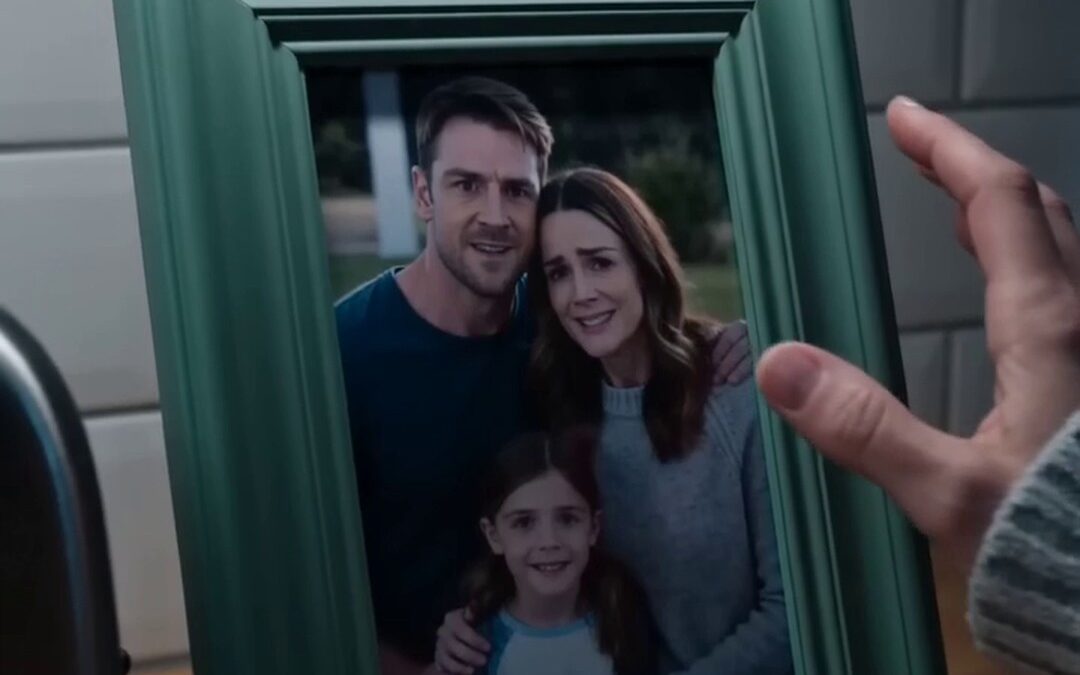
Chapter 2: What the Frame Held
The man turned slowly.
He was younger than me.
Forty, perhaps.
There was gray at his temples.
He kept both hands visible.
Beth gripped the counter.
“Jonah.”
“Who is he?”
“Please keep your voice down.”
“Then give me a reason.”
The man looked toward the stairs.
“Your daughter’s asleep?”
“My daughter is.”
His jaw tightened.
But he nodded.
“Good.”
I hated that answer.
I hated his concern.
I hated the fact that Beth looked frightened of what I might say.
“Move away from the picture.”
He did.
There were papers on the table.
A folded envelope.
Two mugs.
One remained empty.
“Is this an affair?”
“No,” Beth said.
The answer came immediately.
It should have helped.
It didn’t.
“Then who is he?”
The man spoke.
“My name’s Reed Mercer.”
I knew the surname.
Not from a face.
From a line in an adoption file.
I looked at Beth.
She started crying without making any sound.
“Mercer,” I repeated.
Reed pulled out a chair.
He didn’t sit.
“Celia was my wife.”
I felt the pantry door against my back.
“Celia wasn’t married.”
“She was.”
“Beth?”
“We thought the marriage was over.”
“That isn’t what I said.”
“No,” she whispered.
“It isn’t.”
Reed took a document from the envelope.
He placed it on the table.
Then he stepped back.
I didn’t touch it.
“My lawyer can send a certified copy.”
“Your lawyer.”
“Yes.”
“Why are you in my kitchen?”
“Because Beth called me.”
“When?”
“Three weeks ago.”
Beth wiped her cheeks.
“After my mother’s surgery.”
Lenora.
My mother-in-law.
The woman who remembered vaccination dates and brought extra napkins to birthday parties.
The woman who had guided us through Wren’s adoption.
I looked between them.
“What does her surgery have to do with this?”
“She asked me to find her insurance papers,” Beth said.
“I found something else.”
Footsteps sounded overhead.
All three of us stopped.
A small cough.
Then Wren called for water.
I moved first.
Beth caught my wrist.
I pulled free.
“Don’t.”
Her hand fell.
Reed moved away from the doorway.
Upstairs, Wren sat against her pillows.
Her hair stuck to her cheek.
“Is somebody here?”
“Yes.”
“The picture man?”
I sat beside her.
“Yes.”
“Are you mad?”
I could have answered about a dozen different things.
Instead, I answered her question.
“I’m upset with some adults.”
She watched my mouth.
“Not you.”
“Did you find out?”
“Some of it.”
She pushed her water glass toward me.
I filled it in the bathroom.
When I returned, she had moved her stuffed rabbit to my side of the bed.
An invitation.
I sat again.
“Do I have to go somewhere?”
“No one’s taking you anywhere tonight.”
That was a promise I could keep.
Her fingers loosened around the blanket.
I waited until her breathing settled.
Downstairs, Reed stood exactly where I had left him.
Beth had put a glass of water at my place.
I left it untouched.
“Tell me why you turn the photograph.”
Reed glanced at it.
“I asked her to move it.”
“Why?”
“Because I was angry with you.”
“You don’t know me.”
“I know.”
His eyes were wet.
“That’s what I was trying to learn.”
Beth pulled out the opposite chair.
“We were supposed to meet with someone Friday.”
“A counselor,” Reed said.
“Someone who works with adoptive families.”
“You planned everything except telling me?”
“I was afraid,” Beth said.
“Of me?”
“Of losing both of you.”
I finally picked up the document.
Two names.
A county seal.
A date before Wren’s birth.
Reed slid a second paper forward.
His release paperwork.
He had served time for burglary.
That much matched what we had been told.
“You signed away your rights,” I said.
His expression changed.
The hurt remained.
Something harder came beneath it.
“No.”
Beth covered her mouth.
Reed pointed at the adoption folder beside her elbow.
“I begged them to tell me where she was.”
I looked down at the signature I remembered trusting.
“I never gave my daughter away.”
* * *
We didn’t solve anything that night.
That mattered later.
There was no sudden agreement.
No handshake.
No generous speech.
I asked Reed to leave.
He left his lawyer’s number.
He took his empty mug to the sink.
The small courtesy nearly broke me.
I didn’t want him considerate.
I wanted someone easier to hate.
Beth sat at the table until dawn.
I stayed across from her.
“What did you find?”
“Letters.”
“From him?”
“Yes.”
“How many?”
“Seventeen.”
I looked toward the blue frame.
“And why all the secrecy?”
“Because the letters changed things.”
“That explains talking.”
I waited.
“It doesn’t explain hiding.”
She pressed her palms together.
“My mother said he was dangerous.”
“You let him into our house.”
“I met him somewhere public first.”
“And then?”
“He brought documents.”
“Why at night?”
“Because Wren was asleep.”
“And because I wasn’t supposed to know.”
She nodded.
There was no defense for that.
She knew it.
I asked about the medicine.
Her face crumpled.
“It was the regular dose.”
“I know what the bottle says.”
“I didn’t give you anything else.”
She held my gaze.
“I thought you were asleep.”
I believed her.
Trust didn’t return with belief.
Those were different things.
At seven, I made Wren toast.
Beth packed her lunch.
We moved around each other carefully.
Wren watched us.
“Did somebody die?”
I put down the butter knife.
“No.”
“Then why are you both talking like that?”
Beth knelt beside her chair.
“Because I kept something from Dad.”
“Something bad?”
“Something important.”
Wren looked at me.
“Did I make it happen?”
“No,” I said.
Beth answered with me.
“No.”
For the first time that morning, we sounded married.
After drop-off, I called an adoption attorney named Denise Harlow.
She was independent of Reed’s lawyer.
Independent of Lenora.
That suddenly seemed essential.
She made room for us that afternoon.
Beth brought the letters.
I brought our adoption papers.
Denise read silently.
Her office smelled of coffee and printer toner.
On the wall hung a photograph of two muddy dogs.
I stared at them while she examined the signature.
“Did you witness this being signed?”
“No.”
“Did your wife?”
Beth shook her head.
“My mother handled the contact.”
“Who represented you?”
“An attorney she recommended.”
Denise wrote the name down.
“Do you still have his correspondence?”
“I keep everything,” I said.
Beth looked at me.
For years, she had teased me about that.
Receipts.
Warranties.
Service records.
Every document had a place.
At work, a missing inspection sheet could close an operating room.
At home, I treated paperwork the same way.
Denise asked for the original file.
Then she explained what would happen.
Requests for records.
Contact between attorneys.
A careful review of what the court had received.
Nothing decided by a kitchen argument.
“Does he get to take her?”
The question came out badly.
Denise didn’t punish me for it.
“Your adoption is an existing court order.”
She folded her hands.
“An allegation doesn’t erase it overnight.”
“But it could change?”
“There are serious questions here.”
She looked directly at me.
“We answer them with records.”
Beth took the letters out.
Their envelopes were yellowed.
Most bore prison return addresses.
Each was addressed to Lenora.
Some included another line.
Please forward to Beth.
I hadn’t seen any of them.
Neither had Beth.
Denise put them in separate clear sleeves.
“Where exactly were these?”
“My mother’s locked office cabinet.”
“How did you open it?”
“She gave me the key.”
“For the insurance documents?”
“Yes.”
Denise recorded that too.
The first letter asked about Celia’s funeral.
The second asked for photographs.
The third asked whether Wren still rubbed her ear when tired.
She did.
She had done it in the car that morning.
I pushed back my chair.
Beth reached toward me.
I shook my head.
The fourth letter described a birthday card.
There had been ten dollars inside.
Lenora had told us Reed had never sent anything.
Denise let us sit with that.
Then she asked about Celia’s belongings.
“Anything with his handwriting?”
Beth looked at me.
“The frame.”
“What frame?”
“The blue one in our kitchen.”
Celia had bought it at a craft fair.
Beth had kept the frame after her sister died.
She had replaced the photograph years later.
I remembered doing the replacement myself.
The old print had stuck beneath the backing.
I had left it there.
I never threw out family photographs.
That evening, I opened the little metal tabs.
The lake picture lifted free.
Behind it lay Celia’s photograph.
A nursery.
A crib.
Reed holding a newborn.
Celia’s reflection in a mirror.
I had seen a cropped version before.
Just Wren.
Lenora had given it to us.
On the back, in Celia’s handwriting, were names and a date.
Reed and Wren, home at last.
Beth sat down.
She remembered the handwriting.
So did I.
Celia used to send postcards.
Her capital W looked like two small mountains.
I photographed the front and back without altering anything.
Then I called Denise.
The picture proved a relationship existed.
It didn’t prove a forgery.
Denise was careful about that.
The next evidence came from an uglier place.
Our old email archive.
I searched Lenora’s name.
Then Reed’s.
Then consent.
There were dozens of messages.
Arrangements.
Fees.
Appointments.
One included a scanned form Lenora had told us was ready to file.
I checked its date against my calendar.
Then against a work invoice.
Then against another email.
“Beth.”
She came to my desk.
I pointed at the screen.
Lenora had written that a mobile notary met Reed at her house.
The date was specific.
The time was specific.
I had installed her replacement water heater that day.
I had been there from eight until four.
No man had come.
No notary.
Lenora had served me soup.
She had asked whether I thought Wren should call me Daddy.
Denise requested the supporting custody records through counsel.
Those records arrived the following week.
Reed had been inside a state correctional facility.
There was no release or outside visit that day.
My mother-in-law had placed him in her dining room while he was behind a locked prison door.
* * *
Lenora arrived on Sunday carrying a lemon cake.
That was how she entered difficult conversations.
With something you were supposed to thank her for.
Wren was at a friend’s house.
Beth had arranged that.
We had learned at least one thing.
Our daughter didn’t need another doorway full of adult secrets.
Lenora looked from my face to Beth’s.
“What happened?”
Beth didn’t take the cake.
“I found Reed’s letters.”
Lenora blinked.
Only once.
Then she set the cake down herself.
“I wondered when this would come.”
No surprise.
No confusion.
She removed her gloves.
“Sit down.”
I stayed standing.
She turned toward me.
“Jonah, I understand how upsetting this must feel.”
“Did he sign the consent?”
Her eyes moved toward the kitchen.
Toward the blue frame.
“We all wanted Wren safe.”
“Did he sign?”
“Celia was dead.”
Beth flinched.
Lenora saw it.
She continued.
“You two were willing to raise that baby.”
“Answer him,” Beth said.
Her mother looked offended.
“He was in prison.”
“That isn’t an answer.”
“It should be.”
The cake smelled sweet.
I wanted it out of the house.
Instead, I put my hands on the back of a chair.
“What happened at your dining table?”
Lenora went still.
Then she looked at Beth.
“What have you given him?”
“The truth,” Beth said.
“No.”
Lenora’s voice sharpened.
“You’ve given him pieces.”
I had worked around enough failing machinery to recognize a changing sound.
Something under strain.
Something about to slip.
She smoothed her sleeve.
“You should both think before you continue.”
“About what?” I asked.
“About Wren.”
“We are.”
“Are you?”
She looked toward the stairs.
“She has a home.”
Beth moved between her mother and the hallway.
“She’s not here.”
For the first time, Lenora looked uncertain.
Only for a moment.
Then she picked up her gloves.
“If this becomes public, people will ask questions.”
“They should,” I said.
“About all of you.”
She left the cake.
Beth put it in the trash.
The next morning, Lenora called the school.
She said there was a family emergency.
The school called us before changing anything.
Lenora was still on Wren’s approved pickup list.
We removed her.
We explained the situation to the principal without making accusations we couldn’t prove.
Existing orders stayed in place.
Pickup instructions were updated.
Passwords changed.
Practical things.
Small protections.
Then Lenora contacted our old adoption attorney.
We learned that because his office contacted Denise.
He was retired.
His files were stored.
He wanted to cooperate.
That did not make the first phone call less frightening.
Beth listened beside me.
When it ended, she said, “She’s going to make this our fault.”
“She can try.”
“I should have told you immediately.”
“Yes.”
“I thought I could understand it first.”
“You made me the last person in my own family.”
She started to answer.
Then she stopped.
“I did.”
It was the first apology that didn’t contain an explanation.
I needed that.
I still moved into the guest room.
Reed’s lawyer proposed a meeting.
Daylight.
Neutral place.
No Wren.
No surprises.
We met in Denise’s conference room.
Reed wore the same jacket.
He had brought a folder.
This time, I knew what was inside before he opened it.
His conviction.
His sentence.
His release conditions.
Letters he had copied by hand before mailing.
“I’m not asking you to pretend I was a good husband,” he said.
“What happened?”
“I stole tools from a warehouse.”
“Why?”
“I owed money.”
He looked at Beth.
“Celia thought I was working nights.”
I waited.
He didn’t blame anyone else.
“I made a choice.”
“Yes, you did.”
“I know what it cost her.”
“Do you?”
His mouth tightened.
Then he nodded.
“I know I didn’t get to help when she got sick.”
Celia had died from a sudden illness while Reed was incarcerated.
Wren had been nearly two.
I remembered the funeral.
Lenora had said the child’s father couldn’t be located.
Later, she said he had signed everything.
One neat story after another.
Reed laid down a release letter.
“When I got out, I contacted her.”
“Lenora?”
“Yes.”
“She said Wren knew?”
He nodded.
“She said Wren didn’t want contact.”
“She was seven.”
“I know that now.”
“What did you know then?”
“That I had signed nothing.”
He looked down.
“And that I didn’t have money for a fight.”
A legal aid referral had eventually led him to an attorney.
Then Beth’s call had come.
He had agreed to secrecy because he feared losing the first opening he had been given.
“That doesn’t excuse entering your house,” he said.
“No.”
“I’m sorry.”
I watched him accept the word without bargaining.
That changed something.
Not everything.
Something.
We agreed there would be no direct approach to Wren.
No visits arranged behind anyone’s back.
No promises to her until we knew what we could keep.
A counselor would help us explain.
The attorneys would handle the records.
That night, Wren found me in the guest room.
She carried two pillowcases.
“Which one do you want?”
“Why?”
“If you’re sleeping here, this one’s scratchy.”
She held up the softer one.
I took it.
She climbed onto the bed.
“Is Mom still your wife?”
“Yes.”
“Are you still my dad?”
I turned toward her.
“Yes.”
She considered that.
“Then we’re doing a lot of weird sleeping.”
I laughed once.
It hurt.
Then I pulled her close.
She smelled of shampoo and school crayons.
“We are.”
“Can you fix it?”
“I’m working on my part.”
“Mom has a part?”
“Yes.”
“The picture man?”
“He does too.”
She leaned back.
“Does he have a name?”
“Reed.”
Her face changed.
“I thought it was Read.”
“What?”
“Mom said, ‘Reed, please.’”
She had tried to solve the mystery with the information available.
So had I.
We had both gotten things wrong.
The next revelation came from Celia’s estate documents.
Denise had asked who handled them.
Lenora had.
Who managed the money left for Wren?
Lenora.
We had been told there was almost nothing left after expenses.
A separate attorney reviewed the records.
Celia had named Wren as the beneficiary of a substantial insurance policy held through a trust.
Reed had asked about it in one of his letters.
Lenora had never forwarded that letter.
The preliminary accounting showed transfers requiring explanation.
Then the retired adoption attorney produced a message from Lenora.
She had urged him to hurry.
Reed, she claimed, wanted no further involvement.
But in an earlier email to her financial adviser, she had written something different.
If Reed is allowed back in, he will demand an accounting.
The obstacle hadn’t been Reed’s criminal record.
It had been Lenora’s missing money.
* * *
The meeting took place six weeks later.
Not in a courtroom.
Not beneath television lights.
In a conference room with a broken window blind.
Lenora came with an attorney.
We came with ours.
Reed sat beside his.
The estate attorney attended.
So did the retired lawyer who had handled our adoption.
His name was Victor Shaw.
He looked older than I remembered.
He carried a thin cardboard box.
Lenora wore navy.
She had always worn navy when she wanted to be believed.
At school meetings.
At bank appointments.
At Celia’s funeral.
She looked at me first.
Then Beth.
Neither of us moved.
The attorneys explained the purpose.
Records.
Disputed statements.
Preservation of documents.
No one was signing away anything that afternoon.
Lenora nodded patiently.
Then she began.
“Wren had nobody.”
Reed’s fingers curled against his knee.
His lawyer touched his arm.
Lenora continued.
“My daughter was dead.”
Beth stared at the table.
“My granddaughter needed stability.”
“She had relatives willing to provide it,” Denise said.
“She had two wonderful people,” Lenora replied.
She turned toward us.
“I have never denied that.”
It was well done.
I could feel the shape of it.
Praise us.
Make us defend the outcome.
Tie every lie to the child we loved.
“What did Reed actually tell you?” Denise asked.
“That he couldn’t raise her.”
“I couldn’t raise her in prison,” Reed said.
Lenora looked almost kind.
“Exactly.”
“That isn’t the same thing.”
“It was to a toddler.”
His lawyer spoke quietly.
“Let’s stay with the documents.”
Lenora folded her hands.
“I made difficult decisions.”
The estate attorney opened a binder.
“Did those decisions include transferring trust funds to your business?”
Lenora didn’t look at the binder.
“The money was invested.”
“In what?”
“A family property company.”
“Your company.”
“A company intended to support this family.”
The attorney laid out bank statements.
Dates.
Transfers.
Balances.
The records had come through formal requests and authorized account access.
They weren’t guesses.
The business had been failing.
The money had covered debts.
Some had paid Lenora’s household expenses.
Some had been returned.
Much had not.
“I intended to repay everything,” she said.
Beth lifted her head.
“With whose permission did you take it?”
“I was responsible for the account.”
“That wasn’t the question.”
Lenora’s face hardened.
“You had no interest in these details then.”
Beth went pale.
It was true.
We had been exhausted.
Grieving.
Learning how to raise a child.
We had accepted the older woman’s competence because it let us survive the week.
Lenora pressed.
“You wanted to know about preschools.”
She looked at me.
“You wanted medical forms.”
Then Reed.
“And you wanted sympathy.”
His lawyer interrupted.
“We have questions about the consent.”
Victor Shaw opened his box.
He laid down the file he had retained.
“I accepted this document through your office,” he told Lenora.
“You told me it had been properly executed.”
“It had.”
“The notary disputes that.”
Her attorney leaned toward her.
Lenora shook her head.
“After all these years?”
The retired lawyer’s mouth tightened.
“The notary retained her journal.”
There was no matching entry.
The stamp on the filed copy had been compared with another document from Lenora’s business records.
That alone would require further examination.
It wasn’t treated as magic.
It was one part of the record.
Then Denise placed the custody confirmation beside it.
Reed had not been at Lenora’s home.
He had not left the facility.
There was no authorized visitor matching the claimed notary appointment.
Lenora looked at the two pages.
“I may have confused the location.”
“Your email named your dining room,” Denise said.
“I was grieving.”
“So were we,” Beth said.
Her mother turned on her.
“And who carried you through it?”
Beth gripped the edge of the table.
For a second, I thought she would apologize.
Habit could be stronger than evidence.
Then she released the edge.
“You helped me.”
Lenora leaned back.
Beth continued.
“That doesn’t make this yours to decide.”
The room stayed quiet.
Lenora looked toward me again.
“Jonah understands what Reed is.”
I felt every eye shift.
There was the opening.
A frightened father.
A man with a conviction.
An easy enemy.
I looked at Reed.
He stared at the file.
I remembered him carrying his untouched mug to the sink.
“I understand he committed a crime,” I said.
Lenora nodded.
“And I understand you’re using it to avoid answering for yours.”
Her attorney spoke.
“My client disputes that characterization.”
“Then she can explain the records.”
Lenora’s voice became very soft.
“You would give your child to him?”
“No one’s being given away.”
“You don’t know what you’re inviting.”
“I know what you hid.”
Denise took the blue frame from a padded bag.
It looked small on that polished table.
A cheap, chipped household thing.
Lenora frowned.
“What is that supposed to prove?”
Denise removed the lake photograph.
Then she lifted the older print.
Reed reached for his water.
His hand shook.
We had shown him a scan before the meeting.
Seeing the original still hurt.
Celia’s reflection.
His daughter against his chest.
His own face before prison.
Denise put the photograph beside Lenora’s signed statement from the adoption file.
According to that statement, Reed had never lived with Celia and Wren.
He had never provided care.
He had abandoned them before the birth.
“This was taken in their apartment,” Denise said.
“A photograph proves a visit,” Lenora answered.
It was a reasonable objection.
That was why the photograph didn’t stand alone.
The estate attorney laid down a lease.
Both parents’ names.
Then employment records.
Then a statement from the photographer.
Not a professional.
Celia’s neighbor.
Beth had found her through the return address on an old condolence card preserved with Celia’s belongings.
The neighbor had been there that afternoon.
She still had the digital files.
The uncropped sequence showed Reed assembling the crib.
Feeding Wren.
Sleeping upright with her against his shoulder.
The dates matched.
So did the apartment.
Lenora stared at the picture.
Then she said, “She was ashamed of him.”
Beth’s chair scraped.
“Celia?”
“She would have wanted better.”
“You don’t get to speak for her anymore.”
The retired lawyer looked sick.
He said his office would provide the complete file to the appropriate authorities.
The estate attorney explained the accounting petition already filed.
Denise explained that the suspected falsified consent had been referred for investigation.
No one arrested Lenora in that room.
No one declared us the winners.
Her lawyer stopped the questioning.
The meeting ended with copies preserved and positions unmistakable.
In the parking lot, Lenora caught up with us.
Her lawyer was on the phone.
For once, she stood without an audience she could arrange.
“After everything I did,” she said.
Beth opened the car.
I stayed beside it.
“You have a daughter because of me.”
“No,” I said.
“I have a daughter because I raised her.”
Lenora looked past me toward Reed.
“And he’ll never forgive you for that.”
Reed stopped walking.
For a moment, I thought she had found one final place to cut.
Then he came toward us.
“I’m angry about what I lost,” he said.
He looked at me.
“That isn’t the same as being angry she was loved.”
Lenora had no answer.
The legal process took months.
The money records were examined.
The questioned signature was reviewed.
The notary cooperated.
So did the old law office.
Lenora’s business records provided the missing connections.
Eventually, she admitted authorizing the false submission.
The financial case ended with a plea and a restitution order.
The court overseeing Wren’s funds replaced her.
An insurer’s settlement and recovered assets restored much of the loss.
The remaining obligation stayed hers.
The adoption questions took longer.
There were separate lawyers, meetings, and careful consideration of Wren’s life.
Reed received advice of his own.
No one asked him to trust another family promise.
In the end, he chose a legally reviewed resolution that preserved our adoption and established a clear path for contact.
He signed only after every page had been explained.
This time, the signature was his.
* * *
We told Wren on a Saturday.
The counselor had helped us choose the words.
She had also warned us against bringing every adult feeling into the room.
Wren needed facts she could carry.
Not our whole weight.
Beth sat beside me on the couch.
Wren sat on the rug.
She was sorting buttons from a sewing tin.
“Celia was your first mother,” Beth began.
“I know.”
“And Reed was your first father.”
Wren’s hand stopped over a green button.
“The kitchen man?”
“Yes.”
She looked at me.
“You’re my father.”
“Yes.”
“How many can there be?”
“As many as are true,” I said.
She considered that.
Then she asked the question we had practiced answering.
“Why wasn’t he here?”
“He went to prison,” Beth said.
“Because he stole things.”
Wren looked down.
“From us?”
“No.”
“Did he say sorry?”
“Yes,” I said.
“He also served his sentence.”
“Why didn’t he come after?”
Beth took a breath.
“Grandma kept information from him.”
“What information?”
“Where you were.”
Wren dropped the button.
It clicked against the tin.
“She knew where I was.”
“Yes.”
“Was it a mistake?”
“No,” Beth said.
That cost her.
I saw it.
She said it anyway.
“Some of it was a choice.”
Wren sat very still.
Then she looked at Beth.
“Did you know?”
“Not until recently.”
“Then why didn’t you tell Dad?”
“I was scared.”
“Of getting in trouble?”
“Yes.”
Wren’s eyes filled.
“That’s what you tell me not to do.”
Beth nodded.
“You’re right.”
There was no graceful way through that moment.
No sentence that could make her a good example retroactively.
She had to sit there and be wrong.
Wren picked up the button.
“Does Reed want me to live somewhere else?”
“No,” I said.
“He wants to know you.”
“Do I have to?”
“You get a say.”
“Can I say not yet?”
“Yes.”
She leaned against my knees.
We sat like that until she asked for lunch.
The ordinary request felt enormous.
Three weeks later, she agreed to meet him.
A park.
Forty-five minutes.
Beth and me nearby.
The counselor helped prepare both of them.
Reed arrived early.
He brought nothing.
That had been Wren’s request.
“No presents,” she told us.
“I don’t know what he thinks I like.”
He sat at a picnic table.
Wren approached with her hands in her coat pockets.
I stayed beside her.
“Hi,” Reed said.
“Hi.”
“I’m glad to meet you.”
“You met me before.”
His throat moved.
“Yes.”
“When I was a baby.”
“Yes.”
“Did I cry a lot?”
“Mostly when I was trying to sleep.”
She examined him.
Then she smiled a little.
“That seems fair.”
I looked away.
Not because I resented it.
Because I suddenly understood what he had been turning the photograph to avoid.
There were joys a person could watch only so much of before they hurt.
Wren sat down.
I asked whether she wanted me beside her.
She nodded.
Reed accepted that.
He accepted a great many things.
Short visits.
Canceled visits when she was sick.
Questions repeated because the first answer hadn’t felt safe enough.
He never asked her to call him Dad.
He never asked what she said about him afterward.
When she was ready, he told her about Celia.
How she burned pancakes.
How she sang the wrong words.
How she kept emergency crackers in every coat.
Beth laughed at that.
Then she cried.
Reed handed her a napkin.
They had lost the same person.
For years, a lie had made their grief private.
Our marriage healed less neatly.
I stayed in the guest room for eleven weeks.
Some evenings, Beth and I talked well.
Other evenings, I heard her phone buzz and went cold.
She stopped defending her intentions.
She told me where she was going.
She answered questions without saying I had already asked.
I worked on asking instead of inventing.
That was my part.
One evening, she found me fixing the blue frame’s stand.
“I thought you might throw it out.”
“It needs a hinge.”
“Jonah.”
I put down the screwdriver.
“I’m sorry I made secrecy part of our home.”
I looked at her.
She didn’t move closer.
“I know you may keep remembering it.”
“I will.”
“I won’t ask you to stop.”
That was the boundary.
Forgiveness wouldn’t require pretending.
I finished tightening the hinge.
Then I asked whether she wanted to sit.
She sat.
We stayed in the kitchen until midnight.
Nobody came through the back door.
A letter from Lenora arrived through her attorney.
She admitted the false documents.
She admitted taking the money.
Then she wrote that fear had driven her.
Beth read it twice.
She wrote back once.
An apology could be received.
Contact would require honesty, respect for our decisions, and no private conversations with Wren.
For a long time, Lenora rejected those conditions.
That was her choice.
We stopped making it ours.
There was money to untangle too.
Our household had never been wealthy.
The transmission still needed replacing.
The estate attorney asked about reimbursing legitimate expenses from Wren’s restored funds where allowed.
I stared at the forms.
Six years of shoes.
School supplies.
Dentist visits.
Things we had paid because she was ours.
Beth touched my arm.
“What are you thinking?”
“That I don’t want an invoice for loving her.”
We left the recovered principal for Wren’s future.
We accepted reimbursement for the legal costs that protected it.
We used our own savings for the car.
It took longer.
That was all.
Reed offered to help with expenses.
We discussed it with the attorneys and made a transparent arrangement.
No envelopes slipped into pockets.
No money tied to affection.
When he offered to buy Wren a bicycle, we asked her.
She chose a used purple one.
Then she insisted all three adults watch her ride.
Reed held the seat.
Beth held the helmet straps.
I held the instructions, which nobody wanted.
“You can be the brakes,” Wren told me.
“I’m not running in front of a bicycle.”
“Then why do you have the instructions?”
Beth laughed.
Really laughed.
It startled all of us.
By autumn, Reed came to dinner twice a month.
He rang the front bell.
He waited to be invited in.
One evening, he stood beside the breadbox.
The lake photograph faced the room.
“I owe you something,” he said.
“You’ve apologized.”
“Not for that.”
He nodded at the picture.
“I made your happiness into something cruel.”
I waited.
“It wasn’t.”
“It hurt you.”
“Yes.”
“Both things can be true.”
He looked at the photograph a moment longer.
Then he asked, “Would you mind if I looked at Celia’s picture again?”
I opened the frame.
We set both photographs on the table.
Wren came in carrying three apples.
She looked between the pictures.
“Why does one have to go underneath?”
Neither of us answered.
She rolled an apple toward Reed.
“We could get another frame.”
* * *
Six years later, Wren asked me to teach her to drive.
She was fourteen.
I said no.
She said she meant in two years.
I said I appreciated the notice.
Then she handed me a calendar.
She had already circled a Saturday.
Beth said she got that from me.
Reed said the negotiation came from Celia.
Wren said we were all taking too much credit.
By then, the kitchen had changed.
New paint.
A different refrigerator.
The same crooked drawer that I kept meaning to repair.
The blue frame remained beside the breadbox.
Its hinge still worked.
Beside it stood a plain oak frame.
Celia’s nursery photograph faced the room.
Nothing hidden behind it.
Nothing cropped away.
Reed had a small apartment across town.
He repaired commercial kitchen equipment now.
Sometimes we argued over tools.
Usually because he borrowed mine and returned them cleaner.
It felt judgmental.
He claimed that was my problem.
Wren called him Reed.
Occasionally, when introducing us together, she said, “My dads.”
She chose the words.
We let her.
Her life had room for complications without being built around them.
She knew the truth about Lenora.
More of it as she grew older.
The details came when she asked.
No dramatic confession at sixteen.
No envelope waiting until adulthood.
Her money remained protected.
Annual statements arrived.
Beth and I read them.
So did an independent professional.
Reed received the information the agreement provided.
Wren learned what the columns meant.
She preferred the column that showed interest.
Lenora eventually accepted our boundaries.
It took almost three years.
Her first supervised visit lasted half an hour.
There were no speeches about sacrifice.
When she tried once to explain that everything had been for Wren, Wren interrupted.
“You could have asked somebody.”
Lenora went quiet.
After that, she spoke more carefully.
They saw each other sometimes.
They didn’t become close because a story required it.
Wren decided how much space there was.
Beth supported her.
That was one of the hardest things Beth ever learned.
It was also one of the best.
On the sixth anniversary of the night in the pantry, we had no ceremony.
I hadn’t noticed the date.
There were groceries on the counter.
Reed was replacing a loose cabinet handle.
Beth was arguing with a pasta recipe.
Wren came home from rehearsal wearing stage makeup on one eyebrow.
“What happened to the other one?” I asked.
“Art.”
She dropped her bag.
Then she noticed the blue frame lying facedown.
Her expression changed.
So did mine.
Just for a second.
Old fear could still arrive quickly.
Then Beth came in with a dust cloth.
“I’m cleaning.”
Wren exhaled.
Reed stood up.
None of us made a joke.
Beth set down the cloth.
“Sorry.”
Wren walked to the counter.
She picked up the frame.
The photograph inside was newer now.
All four of us at the lake.
Wren in the middle.
Beth beside me.
Reed holding the picnic blanket because someone had to carry something.
The old lake photograph lived in an album.
Celia’s picture stayed in its oak frame.
Wren studied the new one.
Then she turned it outward.
“Your face belongs this way, Dad.”
She meant me.
But she looked at Reed too.
He nodded.
Beth reached for my hand.
The kitchen smelled of garlic.
The cabinet handle stayed attached.
The pasta was slightly overcooked.
A father who knew.
A mother who told.
Another father who knocked.
A daughter who never again had to carry the secret upstairs.
Wren placed both photographs side by side.
Then she pulled out another chair.
THE END








