My Daughter Stood on a Frozen Pool Cover While Her Stepmother Held the Only Ladder
Chapter 2: What the Cover Held
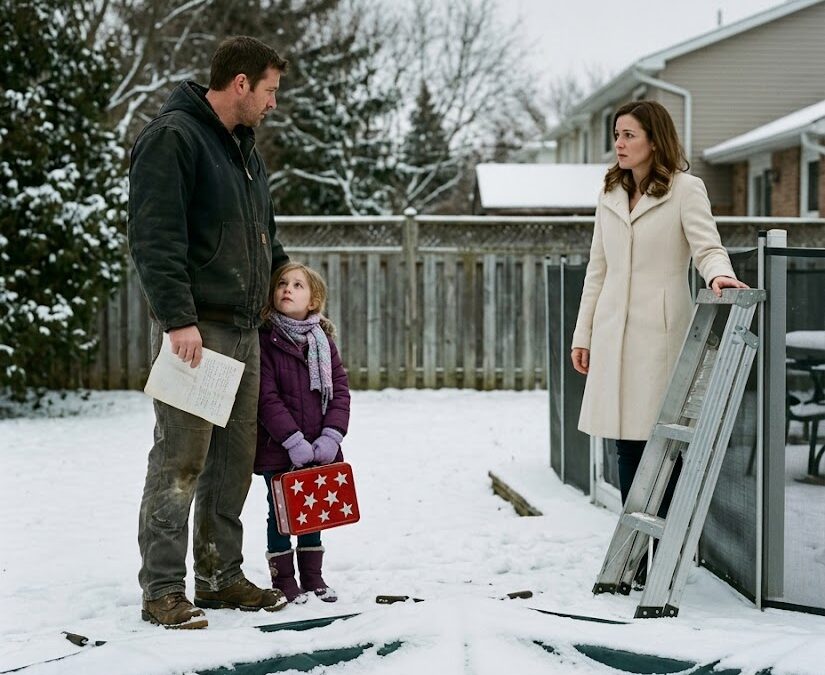
The pool cover groaned.
Nora clung to my coat.
The red tin pressed between us.
Sloane stood beside the ladder, pale beneath her makeup.
“Call nine-one-one,” I said.
“I already did.”
“Tell them a child fell through.”
“She didn’t fall.”
“Tell them the cover failed.”
“You’re making this worse.”
I carried Nora toward the house. One strap hung loose, its stitching torn where her weight had pulled it free.
“Can you walk?”
“My boots are wet.”
“I’ll carry you.”
“Don’t open the tin here.”
“I won’t.”
Sloane followed us.
“I have towels inside.”
“Stay there.”
“You can’t order me around in my own house.”
“It’s my house.”
Nora stiffened against my shoulder. I softened my voice.
“I’m taking you to the mudroom.”
She nodded.
I set her on the bench and wrapped her in towels. Her boots came off with a wet sucking sound.
“Can you feel your toes?”
“Yes.”
“Do they hurt?”
“No. They’re cold.”
I raised the thermostat and reached for my phone.
Sloane appeared in the doorway.
“Let me help.”
“Call the pool company.”
“That can wait.”
“Report the failed cover.”
“You’re upset.”
“I’m asking you to make a call.”
Her eyes dropped to the tin.
“You need to give me that.”
“Why?”
“It belongs to the household.”
“It belongs to Nora.”
The doorbell rang.
Sloane started toward it.
“Don’t,” I said.
She stopped.
A paramedic named Daria came in with a police officer, Bell. The dispatcher had sent them after hearing a child was on a pool cover. Daria knelt in front of Nora.
“I’m going to check your hands. You can keep holding the tin.”
Nora looked at me.
“It’s okay.”
Daria checked her fingers and toes, asked about pain, and wrapped a warming pack in a towel. Officer Bell glanced toward the pool.
“Did she go into the water?”
“No,” I said. “She was on the cover.”
“Did anyone see how she got there?”
“I did,” Sloane said. “She went out alone.”
Nora’s face tightened.
“I didn’t.”
“Let’s take statements separately,” Bell said.
“Of course,” Sloane replied. “I’m happy to explain.”
“Then you’ll have the chance.”
Daria asked if Nora had felt dizzy or cold before going outside. Nora looked toward Sloane.
“She locked the office.”
“Why were you in there?” Daria asked gently.
“Mom left something for Dad.”
“That isn’t true,” Sloane said.
Nora pressed the tin against her ribs.
“Can I see the paper?” I asked.
She nodded.
The lid bent at one corner. Inside was a folded sheet and a small brass key, its narrow head shaped like a shield. I knew the lock it fit: the fire box in Dana’s office.
I unfolded the paper.
It was a financial authorization for a custodial account in Nora’s name, dated three days before Dana died. It carried my name, an unfamiliar witness signature, and a handwritten note.
“Transfer remaining balance to Northlake Youth Residence,” I read.
Nora watched my face.
“Did Mom put that there?”
“I don’t know yet.”
The signature looked like mine at first. The capital M, the long tail on the last letter. But it was too neat. I signed inspection reports every day. My signature always had a break halfway through the last stroke.
This one didn’t.
“Where did you find it?”
“In Mom’s office.”
“Where exactly?”
“In the blue box behind the books.”
Sloane stepped forward.
“Dana had a lot of papers. That form was an old draft.”
“Why was it locked away?”
“You’ve never looked through her files.”
“I’m looking now.”
Sloane met my eyes.
“You’ve been gone half the week for work since she died.”
I felt the truth in that accusation. I had chosen a job where I could solve structures from drawings and reports. I had treated home like a building whose daily systems someone else could manage.
Nora’s wet hair clung to her cheek.
“I’m sorry you had to find that alone,” I told her.
“It’s okay.”
“It isn’t.”
“Mom said not to give it to Sloane.”
Sloane’s face hardened.
“That’s enough.”
Daria glanced between us.
“Mr. Hale, I recommend a pediatric check this afternoon. She’s cold, but alert and speaking clearly.”
“I’ll take her.”
“I’m her stepmother,” Sloane said.
“I know.”
“Then stop treating me like a stranger.”
“I’m trying to understand why the ladder was out of reach.”
“I moved it when I saw her going toward the cover.”
“Why didn’t you call me?”
“I didn’t know she’d get onto it.”
Officer Bell stepped closer.
“Did you put her outside?”
“No.”
“Did you know she was on the cover?”
“I saw her after she climbed onto it.”
“Where were you standing?”
“On the patio.”
“Why was the ladder between you and her?”
“I was keeping it stable.”
Sloane looked at me instead of answering the next question. The ladder’s rubber feet had been positioned parallel to the pool edge. Someone had lifted it and turned it away from the water. The pale marks on the patio showed where it had first stood.
I knew load paths and stress patterns.
The scene had its own.
Sloane hadn’t been holding the ladder to rescue Nora.
She had moved it away from her.
Officer Bell finished her notes.
“I’ll need statements from both of you. We’ll photograph the pool area.”
“Do it,” I said.
Sloane leaned close enough for only me to hear.
“You’re going to ruin everything over a paper you don’t understand.”
“I understand the signature.”
“You don’t know what Dana wanted.”
“I know what she wrote.”
“You’re not the only one who was there.”
The room went still.
“What does that mean?”
“Nothing.”
Nora reached for my hand.
“Dad?”
I took it.
Daria finished her check and left instructions to keep Nora warm and seek care if anything changed. Bell photographed the ladder and damaged strap, then asked me not to alter the scene.
“I won’t,” I said.
I took Nora upstairs to change. She chose the green sweater Dana had bought the previous winter. She winced as I helped her pull it on.
“Does your shoulder hurt?”
“No.”
“Then what was that?”
“The sweater tag.”
I cut it off with nail scissors. She smiled faintly when it fell into the wastebasket.
“Mom used to say tags were tiny monsters.”
“She did.”
At the office door, the brass key turned smoothly. A blue storage box sat behind an atlas, as Nora had said. It held medical records, tax papers, and an envelope addressed to me. The authorization wasn’t there. A copy of the account statement was.
The balance had been $118,420.
A withdrawal of $74,000 had been made eleven months earlier, two days after Sloane and I married.
“Are you going to find out what the paper means?” Nora asked.
“Yes.”
“Promise?”
“I promise.”
* * *
The next morning, I brought Nora to a pediatric clinic. She had no injury or lasting effects from the cold. The doctor recommended a quiet day and checked her again before we left.
The account papers waited in a folder on the passenger seat.
I had not slept. Sloane had spent the night in the guest room, saying she needed space. I let her have it. Nora slept in my room with the door locked and the red tin on the bedside table.
At the clinic, Nora drew a house with a black roof and four people in the windows.
“Who’s this?” I asked, pointing to a small figure near the pool.
“That’s me.”
“And this one?”
“Mom.”
“Where’s Sloane?”
Nora rubbed the crayon over the paper until the figure disappeared.
“You don’t have to talk about her,” I said.
“Are you mad?”
“I’m worried.”
“Is that the same?”
“No.”
“Sometimes you look mad when you’re worried.”
“I’ll try to do better.”
After the appointment, I called Priya Shah, my attorney. She had handled Dana’s final arrangements and still kept the trust documents. We met at her office that afternoon.
“You’re certain this isn’t your signature?” she asked.
“I’m certain enough to have it examined.”
“Good. Don’t accuse anyone in writing.”
“I’m not looking for a fight.”
“Then don’t give the other side a reason to make one.”
She reviewed the authorization and statement. The form had no bank stamp or notarization. It looked like a draft, but the withdrawal was real.
“Who could access the account?”
“Dana and me. After her death, I was custodian.”
“Was Sloane ever authorized?”
“Not by me.”
“Then we find out who initiated the withdrawal.”
Priya called the bank’s fraud department and submitted a formal request as Nora’s custodian. She also contacted a forensic document examiner.
“Do you know Northlake Youth Residence?” she asked.
“Only from the paper.”
“It’s a therapeutic boarding program in upstate New York.”
“Nora has no diagnosis.”
“Then the authorization raises a question.”
The name tugged at me. One of Dana’s appointment books had an entry from her last month: “Maren, Northlake, call back.”
Maren Vale was Dana’s cousin and a school counselor. We had lost touch after Dana died. Sloane had said Maren was too busy to visit.
I called her.
“Eli?”
“It’s been a while.”
“I heard about Dana’s service. I’m sorry I didn’t come.”
“Sloane said you were working out of state.”
“I was in Albany that week. I could have come.”
“Did Dana ever talk to you about Northlake?”
A pause.
“She called me about it once. She was looking for a short-term program for a student whose parents had lost their housing. She wanted to know if Northlake was reputable.”
“Did she mention Nora?”
“No.”
I read the authorization aloud.
“That isn’t Dana’s wording,” Maren said. “She wouldn’t call a six-year-old a ‘minor beneficiary.’ She’d say Nora.”
“Did she create a trust for Nora?”
“Yes. She wanted the money protected until Nora was older. She never said anything about transferring it to Northlake.”
Maren agreed to give a statement. Priya arranged a time, then checked the original trust paperwork.
“Dana’s co-trustee was a firm in Westport,” she said. “Hollis, Vale and Benton.”
“Vale?”
“Maren’s father. He retired years ago.”
The firm still had its old file. Priya requested a certified copy.
The following week, we met with a bank investigator named Cho. He brought the transaction history and an electronic withdrawal request. The money had gone to a new account in Nora’s name, with me listed as custodian. It had been moved out within six days, in three transfers.
“Where did it go?” I asked.
“Two payments went to Northlake,” Cho said. “Forty thousand and twenty-four thousand.”
“And the rest?”
“Ten thousand went to Vale Strategies.”
Priya’s pen stopped.
“Who owns it?”
Cho turned the page.
“Registered to Sloane’s brother, Quentin.”
Quentin had advised the town’s arts council on a renovation. Sloane had introduced him as a nonprofit finance consultant.
“Why would Nora’s trust pay him?”
“That’s what the investigation needs to establish,” Cho said.
“Can you tell if this authorization opened the account?”
“It was attached to the application.”
“Did anyone verify it?”
“The branch employee relied on the documents. We’re interviewing her and reviewing the call log.”
“Was my voice used?”
“There was a phone confirmation.”
The log showed a call from a number ending in 6138.
“That’s a house number?” Cho asked.
“We don’t have a landline,” I said. “That number belongs to Sloane’s office phone.”
“She used it for the charity and Quentin’s business calls,” Priya said.
“It doesn’t prove she made the call,” she added.
“I know.”
Cho said the recording was being retrieved.
At home, I searched the office again. The fire box beneath the desk held old tax returns and a sealed envelope addressed to Nora. Dana had given me the key years earlier and asked me to keep it safe.
The letter said Nora would receive the account at eighteen. If anything happened to Dana, I was to protect the money and never let anyone use it to buy affection or quiet.
The last line was one I had heard Dana say often.
“Let her be a child before you make her brave.”
I sat with the letter in my hand.
For months I had told myself Nora was adjusting. I had mistaken a quiet home and a competent stepmother for stability. I had been relieved someone else handled the routines, and stopped asking who was choosing them.
The bank called two days later. The account had been opened using a voice confirmation from Sloane’s office number. The speaker stated my full name and recited part of my old address.
It wasn’t my voice.
Priya brought the recording to the examiner and requested a formal signature comparison. She also asked the investigators to preserve the bank’s records.
When I told Sloane about the call, she didn’t deny it.
“You know that wasn’t me,” she said.
“I don’t.”
“I was at a board meeting.”
“Then we’ll check.”
“You’re treating me like a criminal.”
“I’m treating the evidence like evidence.”
She sat at the kitchen table.
“You think I wanted that money?”
“I don’t know what you wanted.”
“I wanted to help Nora.”
“By sending her to a residential program?”
“She was having trouble.”
“What trouble?”
“She was angry. She refused certain meals. She had tantrums.”
“She lost her mother.”
“And you were gone.”
That accusation landed. I didn’t look away.
“You’re right about that,” I said. “I let you make decisions because I was afraid I’d fail at all of them.”
“You still think I’m the villain.”
“I think the account needs an explanation.”
She looked down at the table.
“Quentin was in trouble. Vale Strategies had debts. He told me he could return the money before anyone noticed.”
“Did he ask you to move Nora’s trust?”
“He said it would be temporary.”
“You let him use her money.”
“I thought he’d replace it.”
“Did you put the paper in the blue box?”
“No.”
“Did you lock the office?”
“Yes.”
“Why?”
“Nora was going through things.”
“What did you tell her?”
“That she couldn’t be in there.”
“Why was she on the pool cover?”
“I didn’t put her there.”
“Why was the ladder moved?”
“I wanted her to come back toward the patio.”
“Did you move it away from her?”
Sloane’s face went still.
“I moved it because she was reaching for it.”
“That makes no sense.”
“I was scared.”
“Then why didn’t you call for help?”
“I thought she would step back.”
“She was six feet from the edge.”
“I know.”
She looked at me, fear beneath her practiced calm.
“I know what it looked like.”
“It looked like you left her there.”
“I didn’t mean to.”
“Meaning doesn’t change what happened.”
She began to cry.
“I don’t want Nora taken from me.”
“I haven’t made that decision.”
“You already have.”
I didn’t answer.
Priya arrived that evening with the examiner’s preliminary findings. The signature was likely not mine. It resembled a signature on one of Sloane’s nonprofit filings, but the examiner could not yet identify the writer.
The bank had frozen the receiving account. The attorney general’s office was reviewing the referral.
“Can we get Nora’s money back?” I asked.
“Some of it, perhaps,” Priya said. “The Northlake payments covered a deposit and tuition. The payment to Vale Strategies was withdrawn.”
“By Quentin?”
“We need records. Sloane had access too.”
Priya set down another page.
“The Northlake intake packet describes Nora as having ‘severe conduct concerns.’ Sloane is listed as the enrolling parent.”
“She isn’t her legal guardian.”
“The form carries your signature as well. The intake log says a car was scheduled to collect Nora Monday morning.”
The pool incident had been Friday.
“They planned to take her without telling me?”
“That’s what the paperwork suggests.”
“Was the enrollment real?”
“Provisional. Northlake is cooperating.”
The date was two days after Sloane had said Nora was difficult and needed structure. At the time, I thought it was ordinary frustration.
Now it had a destination.
* * *
The real danger arrived as a polite phone call.
Quentin asked to meet and explain the transfers. Priya told me not to go alone. We met him in her conference room with Cho and an investigator from the state financial crimes unit.
Quentin arrived in a navy suit and a leather folio. He was forty-one, polished in the tidy way of someone who presented competence before earning it. His company had appeared at town fundraisers. Sloane trusted him with donor lists, vendor bids, and grant applications.
He sat opposite me.
“Eli, I’m sorry this got tangled.”
“Why did you take money from Nora’s trust?”
“I didn’t take anything.”
“The bank traced sixty-four thousand dollars to Northlake and ten thousand to your company.”
“The payment to my company was reimbursement.”
“For what?”
“Administrative services.”
“For a child’s trust?”
“For work related to the trust.”
“What work?”
He glanced at the investigator.
“I’d prefer to discuss that with counsel.”
“Then you should have brought counsel.”
“I thought we could keep this within the family.”
“You moved my daughter’s money.”
“I didn’t know the authorization was false.”
“Who gave it to you?”
“Sloane.”
“Did you verify it?”
“She said you’d approved the arrangement.”
“What arrangement?”
“A placement program. She said Nora was struggling and you wanted her somewhere with more structure.”
“I never said that.”
“I didn’t know.”
“You wrote my name on a form.”
“I relied on what I was told.”
The investigator took notes.
“What was Vale Strategies paid to do?”
“Consulting.”
“Describe the service.”
“Financial planning and referral coordination.”
“Do you have an invoice?”
“I can provide one.”
“Was it created before the transfer?”
“I’d need to check.”
“Was the money repaid?”
“No.”
Priya slid over a copy of his company’s registration.
“You told the charity board Vale Strategies had no ownership relationship with Sloane.”
“It didn’t.”
“The state filing lists her as an organizer.”
“She helped me file the company.”
“And she approved the payment?”
“I don’t know.”
“Was she acting for you?” the investigator asked.
“No.”
“Then why did your business receive trust money?”
“She thought it was a fee.”
“I did not,” Sloane said from the doorway.
She had arrived with her attorney. She looked at Quentin.
“You told me it was an advance.”
“I said it would be reimbursed.”
“You said the account could be restored.”
“It could have been.”
“You told me Eli signed.”
“I believed he had.”
“You told me Northlake would handle everything.”
“They did.”
“They were going to take Nora from school.”
“They were going to provide care.”
“Without her father’s consent?”
Quentin’s jaw tightened.
“I was trying to help.”
“You were trying to keep the money.”
The investigator raised a hand.
“Let’s stay with the records.”
Quentin stopped speaking after his attorney whispered to him.
The meeting ended with more records requested and the bank’s freeze maintained. No one was arrested or confessed.
Outside, Sloane turned toward me.
“He set this up.”
“Did you know?”
“I knew he was moving money.”
“You told me you didn’t.”
“I thought it was temporary.”
“You had the school transfer forms.”
“I wanted options.”
“You had a car scheduled.”
“I didn’t want to surprise her.”
“You were going to send my daughter away.”
“I thought she needed help.”
“She needed her father.”
Sloane looked down.
“I know.”
That night, Nora asked if Sloane would leave.
“I don’t know yet.”
“Will I have to go with her?”
“No. You’ll stay with me while we work this out.”
“Promise?”
“I promise.”
Nora pressed her face against my shoulder.
“Can we put the tin somewhere safe?”
“Yes.”
“Not the office.”
She chose the shelf in her room, between her picture books and a jar of smooth stones.
The next morning, a padded envelope arrived from Northlake. The return address was handwritten. Inside was a copy of the intake packet and a note from the program director.
The packet included a photograph of Nora taken at school without my knowledge. A red circle marked the date of her proposed intake.
The director wrote that Quentin had made the referral, presenting himself as a family advocate and saying both parents had consented.
At the bottom was a typed note:
“Placement requested by Sloane Mercer for financial stabilization.”
Sloane stared at the page.
“Quentin wrote that.”
“How do you know?”
“I never used those words.”
The investigator called the program and listened. Then she looked at us.
“Northlake confirmed who submitted the referral.”
“Who?” I asked.
“Quentin.”
* * *
The state investigation moved slowly.
The bank preserved the recordings, applications, and transfer records. The financial crimes unit obtained subpoenas for emails tied to Vale Strategies and Sloane’s nonprofit. Priya asked the court to protect Nora’s trust while the investigation continued.
Sloane moved into the guest room. She agreed not to have unsupervised contact with Nora until the counselor and the court’s appointed advocate reviewed the situation.
Nora asked whether she had done something wrong.
“No,” I told her. “Adults made choices. None of them were your fault.”
“Even going on the cover?”
“You were looking for something your mother left.”
“That was bad.”
“It was dangerous. You’re allowed to make mistakes. It’s my job to keep you safe.”
“Can I still keep the tin?”
“Yes.”
We went to a counselor recommended by the pediatrician. Nora spoke when she was ready and played with wooden animals. I answered questions about my schedule, the marriage, and the years after Dana died.
The counselor asked what routines Nora needed to feel secure. Her list was simple: dinner together, me handling school pickup, and a night-light left on.
I changed my work assignments. I declined a promotion that required three weeks of travel each quarter. It cost me a large bonus and a path to partnership. I signed the refusal without hesitating.
I had thought time at home was a luxury I could buy back later.
Now I knew what later could cost.
Sloane sent Nora a note through Priya. I asked Nora if she wanted to read it.
“Will I have to answer?”
“No.”
“Then yes.”
The note said Sloane was sorry she had frightened her and made her feel unwelcome in the office. It did not mention the ladder or the money.
Nora placed it on the table.
“Does she mean it?”
“I don’t know.”
“Can I keep it?”
“Yes.”
She folded it and tucked it into the tin.
The examiner’s final report came three weeks later. The signature on the authorization had been traced from an earlier insurance form. Its pressure and line stops didn’t match my natural writing. The signature on the bank application came from the same source.
The examiner couldn’t identify who traced it.
The bank recording gave investigators another lead. A voice analyst compared the speaker’s cadence and vowels with recordings from a charity board meeting. The conclusion was cautious: the speaker was consistent with Sloane, but the sample was too short to be certain.
The branch employee gave a statement. Sloane had appeared with the account documents and introduced herself as my assistant. She said I was on a site visit and had asked her to complete the account opening. The employee didn’t know Sloane was my wife.
“Why didn’t the bank question it?” I asked.
“They should have,” Priya said. “But bad procedure doesn’t tell us who arranged the fraud.”
Investigators also found an email from Quentin to Sloane, sent the day the account opened.
“Your husband’s voice is easy to reproduce from the recorded voicemail. I’ll handle the rest.”
Sloane’s reply read:
“Do it only if the placement is approved. I won’t let him find out before Nora is settled.”
Priya set down the printout.
There it was.
Sloane hadn’t forged the signature, but she had known the authorization was false. She had accepted the plan and helped carry it forward.
“What was the plan?” I asked.
“To remove Nora from the home before you discovered the transfer,” Priya said. “The placement would make it appear that you approved a care arrangement. The money could be explained as program expenses.”
“Why?”
“We don’t yet know.”
The investigators got the answer from the nonprofit’s records. Quentin had been using donor funds to cover losses from his consulting business. Nora’s trust money was meant to keep Vale Strategies solvent until an expected grant arrived. The grant never came.
He chose a residential program because its fees created a plausible destination for the transfers. He needed a child’s name and a guardian’s signature to make the withdrawal look authorized.
Nora’s account was protected and rarely reviewed.
Sloane had let him use her access because she wanted the company to survive. Quentin promised to replace the money and secure a placement that would remove Nora while I remained unaware.
The pool had not been part of the financial scheme.
It was where the scheme became visible.
* * *
The confrontation took place at the conservatory’s winter benefit, where Sloane planned to introduce a new scholarship fund.
Priya advised me not to turn the event into a spectacle. The investigators had arranged to interview the board and collect records. Sloane wasn’t under arrest. Quentin hadn’t yet been charged.
But the benefit was where the stolen money had been discussed, and the board needed to know before accepting another grant.
I attended with Priya.
Nora stayed with Maren. She had chosen not to come.
The conservatory filled with donors beneath its glass roof. Sloane stood near the podium in a dark green dress. Quentin was beside her.
The board chair thanked Sloane for her work, then introduced the scholarship initiative.
Sloane stepped to the microphone.
“Tonight, we’re building a path for children who need stability.”
I stood.
The room quieted.
“I’d like to ask the board to pause the announcement.”
Sloane’s expression barely changed.
“Eli, this isn’t the place.”
“It’s the place where the money was discussed.”
The chair motioned for the microphone.
“Do you have documentation?”
“I do.”
Priya handed the chair a folder. I placed a second copy on the podium. The red tin was in my coat pocket. Nora had asked me to bring it but not open it unless the board needed to see what it held.
The chair opened the folder.
“Be specific.”
“Money from Nora’s custodial account went to Northlake Youth Residence and Vale Strategies. The authorization had a forged signature in my name.”
Murmurs passed through the room.
Quentin stepped forward.
“This is a private family dispute.”
“The bank and state are investigating the transfers.”
“Then let them investigate. There’s no reason to damage the scholarship.”
“Your company received ten thousand dollars.”
“For services rendered.”
“What service?”
“Placement coordination.”
“Do you have an invoice?”
“Of course.”
The chair scanned the paperwork.
“Was it dated before or after the transfer?”
Quentin hesitated.
“After.”
“Did the company return the funds?”
“I can’t discuss an active investigation.”
“That is not an answer,” the chair said.
Quentin turned toward the donors.
“This is a misunderstanding. The money went toward Nora’s care.”
“Was Nora enrolled?” the chair asked.
“The program reserved a place.”
“Did her father consent?”
Quentin opened his mouth.
Sloane answered first.
“No.”
Every face turned toward her.
“I signed the referral,” she said. “I told Quentin my husband had agreed. He had not.”
“You knew the signature was forged?” the chair asked.
“I knew it wasn’t Eli’s.”
“Did you tell the bank?”
“No.”
“Did you tell the board the account was involved?”
“No.”
Quentin’s face hardened.
“You’re leaving out the rest.”
“Then tell it,” Sloane said.
“You approved the plan.”
“I did.”
“You said the placement was best.”
“I was wrong.”
“You asked me to keep the money moving.”
“I did not.”
“You said we could replace it.”
“I believed you would.”
The chair raised a hand.
“Mr. Vale, we have the bank records and email correspondence.”
Quentin turned toward him.
“Those are confidential.”
“They were obtained by lawful request,” Priya said. “The board has been advised to preserve its records.”
The chair asked the independent auditor to confirm the findings. The auditor stood near the back and said the nonprofit ledger showed a reimbursement to Vale Strategies, described as youth outreach consulting. The invoice had been created eleven days after the transfer and backdated in the digital system.
The company had no supporting timesheets, client records, or proof of services.
Quentin looked at the auditor.
“You can’t prove I altered the date.”
The state investigator, seated beside the board’s counsel, stood.
“We have the system log and the account credentials used to change it.”
Quentin’s face drained of color.
The chair asked security to have him remain while investigators spoke with him. Quentin gathered his folio and walked with them toward a side room.
No handcuffs. No shouting.
Just a door closing.
Sloane stayed at the podium.
“I should have told the board,” she said. “I should have told Eli. I should have protected Nora’s account. I failed all three.”
A donor asked whether the scholarship was still happening.
The chair said it was suspended pending a full audit.
Sloane looked at me.
“You got what you wanted.”
“I wanted Nora safe.”
“You wanted everyone to know.”
“I wanted the records clear.”
“Is that what you tell yourself?”
“No. I tell myself I should have noticed sooner.”
She turned the accusation into a weapon: I had not been present enough to see the warning signs. It was true, and she meant it to make the rest less true.
I didn’t argue.
“I missed things,” I said. “That doesn’t give anyone permission to make a child disappear.”
The board accepted the documents. The investigator copied the tin’s contents and returned it. Dana’s letter stayed with me; the authorization became evidence.
The consequences came over the following weeks. The nonprofit paused spending and hired an outside auditor. Quentin’s contract was terminated. His company’s accounts were frozen during the investigation. The state charged him with fraud, identity theft, and misuse of charitable funds. Months later, he pleaded guilty to financial fraud and agreed to repay the diverted amounts.
The court ordered restitution. The bank recovered part of the money from the frozen account. Northlake refunded the unused placement deposit and confirmed it had never taken custody of Nora.
Sloane wasn’t charged with forging the signature. She hadn’t done that. She was named in the civil recovery action and agreed to repay her share. She resigned from the conservatory’s board.
The marriage ended.
I filed for divorce after the family court established temporary custody. Sloane could see Nora only with a professional supervisor present. The counselor recommended limited contact until Nora felt ready.
I didn’t ask Nora to forgive her. I didn’t tell her Sloane was beyond forgiveness.
I told her she could decide, one visit at a time.
The financial case closed eight months after the pool incident. The trust recovered most of its money. The remaining amount came from the sale of Quentin’s company equipment and restitution.
Nora’s account stayed protected, with Priya as an independent reviewer until Nora turned eighteen.
Sloane sent a letter after the divorce became final.
“I was afraid Eli would choose Nora over me,” she wrote. “I treated that fear like a reason to control her. It was not. I am sorry I let her feel unsafe. I am sorry I made her carry secrets. I am sorry I used your trust to protect my brother.”
Nora read it at the counselor’s office.
“Do I have to answer?”
“No.”
“Can I answer later?”
“Yes.”
“Can I say I don’t want to see her?”
“Yes.”
She folded the letter.
“I don’t want to see her now.”
“That’s okay.”
“Maybe when I’m bigger.”
“That can be your choice.”
Sloane honored the boundary. She sent no gifts and asked for no chances through the school. Her visits stopped.
* * *
The first ordinary spring brought muddy boots, late homework, and science fair supplies across the kitchen table.
Nora built a model bridge from craft sticks.
“Does this look strong?” she asked.
“It depends where the weight goes.”
She added a beam underneath.
“Like that?”
“Better.”
“How much can it hold?”
“We can test it.”
She stacked coins on the bridge. It bowed but held.
“Ten cents.”
“Try twenty.”
The bridge survived thirty cents and collapsed under a quarter.
“Your bridge broke,” she said, laughing.
“It did its job.”
“What job?”
“Showing us where it needed more support.”
“Can we fix it?”
“Absolutely.”
We rebuilt it with a wider base. She painted it yellow and wrote Mom’s name on one side.
At school, Nora started joining group activities again. She still avoided swimming lessons. I didn’t push.
The pool company replaced the cover, straps, and ladder. The new cover had a warning label larger than my hand. I added a locked fence around the deck and a second latch high enough that Nora couldn’t open it alone.
It cost more than I wanted, but I paid without complaint.
For months, I had believed safety came from hiring the right people.
Now I knew it also meant showing up and checking the door myself.
Nora began asking about Dana. She wanted to know what her mother sounded like when she sang, which books she reread, and what she’d been like as a child.
I told her Dana was stubborn, funny, and always late to dinner because she stopped to talk to neighbors. She hated cold coffee and loved terrible mystery novels. She believed every child deserved a place where no one asked them to earn affection.
“Did Mom know she was sick?”
“Yes.”
“Was she scared?”
“I think she was.”
“Did she tell you?”
“Some days.”
“Did you tell her you were scared too?”
“I should have.”
Nora took my hand.
“You can tell me now.”
“I’m scared sometimes.”
“Of what?”
“Missing something important again.”
She leaned against my shoulder.
“You don’t miss everything.”
“I’m glad.”
“Can we get ice cream?”
“That sounds important.”
When the divorce settlement offered me a reduced share of the home’s equity for a quick resolution, Priya advised me to consider it. Sloane wanted the house sold. The settlement also included a payment toward Nora’s trust.
I accepted and put part of it into a college account under Nora’s name. The rest went to a community program helping children whose families were grieving.
I didn’t put my name on it.
Nora chose the program’s first book donation: picture books about animals. She wrote a note for the box.
“For kids who need a quiet place.”
The counselor smiled when she read it.
“That’s a good gift.”
Nora’s relationship with Sloane changed slowly. At nine, she agreed to one supervised visit at a public garden, with Maren and the counselor present. Sloane brought no present. She asked if Nora wanted to walk.
Nora said yes.
I stayed back, close enough to be seen.
After twenty minutes, Nora came back.
“Was that okay?” I asked.
“Mostly.”
“Do you want to go again?”
“Not yet.”
“Then not yet.”
A year later, she chose another visit. Sloane apologized without asking Nora to comfort her.
“I should have kept you safe,” she said.
“You moved the ladder.”
“I did.”
“Why?”
“I was angry and scared. I made a cruel choice.”
“Were you going to send me away?”
“I signed papers that could have sent you away without your dad’s permission.”
“Did you want me gone?”
“No,” Sloane said. “I wanted you to stop being part of a problem I didn’t know how to face. That was wrong.”
Nora considered her.
“I don’t want to live with you.”
“I understand.”
“I might see you sometimes.”
“I’ll respect that.”
Nora walked back to me. She didn’t hug Sloane. She didn’t have to.
* * *
Eight years later, Nora was fourteen and taller than Dana’s old desk.
She had opinions about everything: the best pizza in town, the most overrated singer, and whether my habit of checking the weather before every drive counted as a personality.
“You’re a bridge engineer,” she said. “You check everything.”
“That’s why the bridges stay up.”
“That’s what you say.”
She had joined a robotics club and wanted to study civil engineering. I warned her she might change her mind.
“I can change my mind,” she said. “I don’t have to decide now.”
“That’s true.”
She kept the red tin on her desk. The brass key rested inside, tied to a paper tag that read: “Mom’s office.”
The tin was no longer locked. A metalworker had repaired its hinge. Nora painted over the worst scrape but kept the white stars.
On the anniversary of the pool incident, she asked to see the new cover.
We walked outside. The pool lay beneath clear winter light. Its cover was firm, its straps secure. The safety fence enclosed the deck. I tested the gate latch.
“Do you remember what you said?” Nora asked.
“Which part?”
“You told me to keep my feet apart.”
“I did.”
“I was trying.”
“I know.”
“And you said you were right there.”
“I was.”
She looked at the cover.
“I believed you.”
The words carried more now than they had then.
I swallowed.
“I’ll keep trying to deserve that.”
“You don’t have to be perfect.”
“I know.”
“You just have to show up.”
“I can do that.”
She walked to the far side of the deck and looked back. The cover reflected bare trees and pale sky. No one stood alone on it. No ladder waited out of reach. No locked office hid behind the house.
Nora returned and pressed the tin into my hands.
“Keep it for a while?”
“Of course.”
“Then I’ll take it back when I’m eighteen.”
“That’s the plan.”
She bumped my shoulder with hers.
We went inside for cocoa.
The tin sat on the kitchen table between us, its brass key catching the light.
A place for the truth.
A place for her mother’s words.
A place Nora could open whenever she chose.
THE END








