My Daughter Was Hospitalized After a “Parking Accident”; Her Husband Mocked My Age Until I Held Up the Dashcam He’d Torn Out
Chapter 2: What the Camera Kept
Lenora Mercer parked across the yard entrance.
For a moment, nobody moved.
Then her driver opened the rear door.
Lenora stepped out in a cream coat.
She looked at June’s car.
She looked at me.
Her eyes settled on the evidence sleeve.
“Everett,” she said.
“Lenora.”
“Where is my son taking the car?”
“He isn’t,” I said.
The tow driver killed his engine.
Reed walked toward his mother.
“Mom, the police called them.”
Lenora did not look at him.
“Did they see the footage?”
“I don’t know.”
She closed her eyes.
That answer interested me.
Detective Nia Calder arrived in an unmarked sedan.
She’d spoken to me by phone.
I’d sent her the first clip before leaving home.
She had asked the yard to hold the sedan while she arranged for it to be examined.
Now she looked at the flatbed.
“The car stays here,” she said.
Reed spread his hands.
“It’s my property.”
“It’s listed in a report concerning your wife’s injury.”
“I’m trying to keep it somewhere secure.”
“The yard is secure.”
Lenora stepped between them.
“My company can provide any records you need.”
Calder watched her.
“We’ll ask for them.”
Lenora’s smile held.
“I’d like to know where June is.”
“Her medical care is private,” Calder said.
Reed’s face tightened.
“She’s my wife.”
“June can decide whom the hospital updates,” I said.
Calder turned to me.
“May I see the camera?”
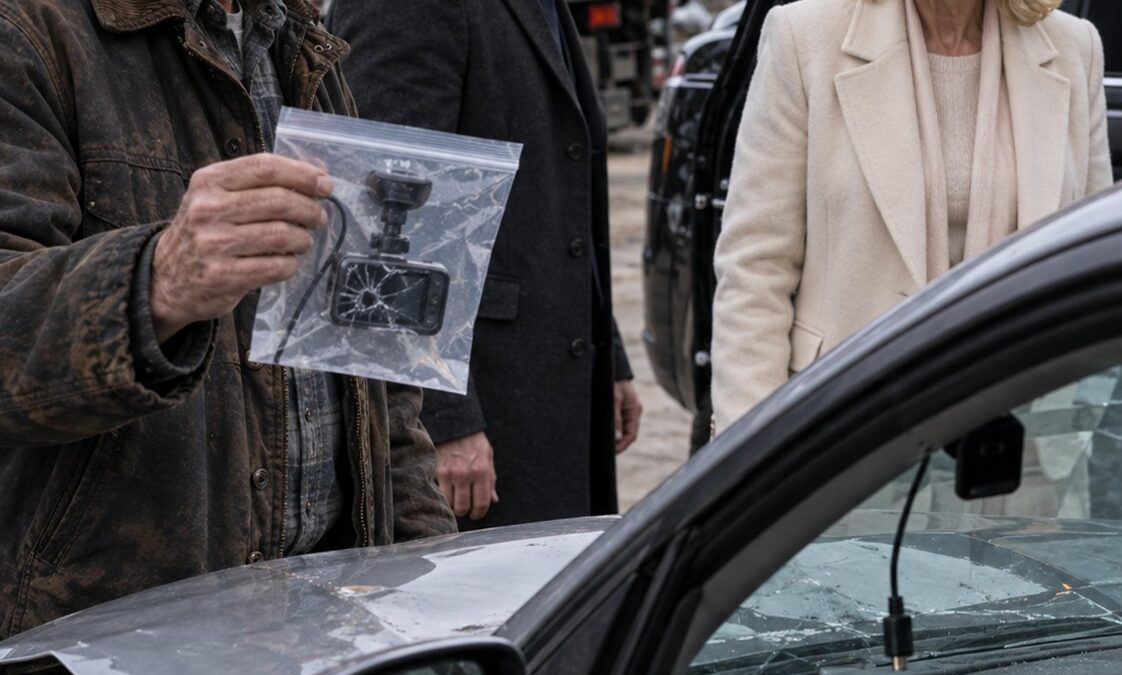
I handed her the sleeve.
She checked the broken mount.
Then she showed the attendant a form.
He led her toward the office.
I followed as far as the doorway.
Reed called after me.
“This is a misunderstanding.”
I stopped.
“Then let June explain it.”
Lenora touched his arm.
It was a small gesture.
He went quiet immediately.
Inside, the office smelled of burnt coffee.
Calder used her phone to call the hospital.
She asked whether June was awake.
Then she asked me to come with her.
We left the car under the yard’s locked gate.
Reed was still beside the flatbed when we drove away.
At the hospital, June lay propped against two pillows.
Her left arm rested in a sling.
She looked smaller than she had at dinner three nights earlier.
That dinner had lasted twenty minutes.
Reed had arrived halfway through it.
June had put down her fork before he spoke.
I remembered that now.
I should have understood it then.
Calder waited outside while I entered.
June saw my face.
“Did he take the car?”
“No.”
She nodded once.
Then she looked at my jacket.
“You wore the inspection coat.”
“It has pockets.”
“That’s why you keep everything.”
I pulled up a chair.
Her mother had died seven years before.
Since then, June and I had learned to talk around the missing place at our table.
That morning, I had no use for careful conversation.
“I’m sorry,” I said.
“For what?”
“For believing you were busy.”
June looked at the blanket.
“You were supposed to believe me.”
“I do now.”
Her mouth trembled.
She reached for my hand.
I took it gently.
“My camera?” she asked.
“Calder has it.”
“Did it save anything?”
“The account saved three clips.”
June shut her eyes.
“Good.”
“Did Reed hurt you?”
“Yes.”
The word came without hesitation.
I held her hand.
“Do you want to tell the detective?”
“Yes.”
Calder came in after a nurse checked June.
She introduced herself again.
She told June she could take her time.
June started with the apartment building.
The garage sat beneath Mercer House, the oldest property in Lenora’s portfolio.
June had gone there to meet someone.
Reed had followed her.
He’d reached her at the car.
She remembered him grabbing her arm.
She remembered the door striking her shoulder.
After that, pieces came and went.
“Did you drive?” Calder asked.
“No.”
“Did the car move?”
“Not while I was in it.”
Calder wrote that down.
June looked at me.
“The person I was meeting gave me something.”
“Who?”
“A tenant named Ada Flores.”
“Is Ada safe?”
“I don’t know.”
Calder asked for Ada’s number.
June gave it to her.
Then I told June what Reed had said at the yard.
A crash.
A pillar.
A fall while getting out.
She listened without moving.
“I knew he’d change it,” she said.
“Why meet in the garage?”
“Ada didn’t want to come upstairs.”
June looked at Calder.
“She was scared of Lenora.”
Calder asked why.
June’s grip tightened around mine.
“Because Ada had proof,” she said.
“Proof of what?”
June stared at the wall.
Then she answered.
“Reed wasn’t trying to hide a crash.”
She swallowed.
“He was trying to make me look like a thief.”
* * *
Ada Flores lived above a bakery on Vine Street.
Calder went to see her that afternoon.
I stayed at the hospital until June slept.
Then I went home and opened the dashcam account.
The three files were still there.
I did not download or alter them.
Calder had the link and the account details.
I watched the first clip again.
The camera faced forward from June’s windshield.
Her car stood in an underground parking space.
The time read 9:14 p.m.
June entered the frame at the far edge.
Reed appeared behind her.
There was no sound yet.
The camera saved short clips when it sensed movement.
It uploaded them over its own connection.
At 9:15, the next clip began.
I rested my finger above the keyboard.
For thirty-two years, I’d told families what cameras could prove.
I’d also told them what cameras could miss.
I made myself watch.
June reached the driver’s door.
Reed caught her wrist.
She pulled away.
The angle hid their faces.
I could see her open the door.
I could see him force it back.
The picture shook when something struck the car.
Then the clip ended.
I sat still.
The third clip began at 9:18.
The car remained in its space.
June was no longer visible.
A black SUV rolled past the camera.
Its brake lights filled the windshield.
The passenger door opened outside the frame.
A woman’s shoes appeared beneath the SUV.
Cream heels.
I thought of Lenora at the yard.
The image alone could not tell me what she’d done.
I sent Calder a message asking whether she had watched all three.
She called within a minute.
“Yes,” she said.
“Was Lenora there?”
“We’re checking the vehicle.”
“June said Ada gave her proof.”
“We found Ada.”
“Is she all right?”
“She’s frightened.”
Calder paused.
“She kept a copy of what she gave June.”
I heard paper move on Calder’s end.
I knew better than to ask her to read an open case to me.
I asked what I could do.
“Think about the car,” she said.
“Is there anything about Reed’s story we can test?”
“There’s no pillar transfer.”
“We have that.”
“The door damage happened while it was parked.”
“How can you tell?”
“The hinge folded inward.”
“That could happen in a collision.”
“Then there would be a matching impact.”
I stood and looked at my old work notes on the shelf.
“The garage has numbered pillars,” I said.
“I can tell you where she parked.”
“We already have the space.”
“Check the pillar across from it.”
“We will.”
“And the bay next to her.”
“Why?”
“The dent in her rear door sits too high for a pillar base.”
Calder was quiet.
“What height?”
“About the bumper of a large SUV.”
“We’ll compare it.”
After the call, I washed a plate I had not used.
Then I washed it again.
June had been an accountant for Mercer Residential for four years.
She’d liked making difficult numbers behave.
She had never liked working for Reed.
I had asked why she stayed.
She said the benefits were good.
I let that answer stand.
At dusk, Calder called again.
Ada had agreed to let an investigator copy her records.
For eleven months, Mercer Residential had sent notices to tenants about emergency repairs.
Rent had risen afterward.
So had fees charged to people whose leases were already tight.
Ada chaired a small tenants’ group.
She had collected invoices from five buildings.
Several showed identical work at different addresses on the same day.
June had noticed the same pattern in company accounts.
“She thought it was sloppy bookkeeping?” I asked.
“At first,” Calder said.
“Then she found a vendor.”
The vendor was Northline Response.
It billed for plumbing, electrical work, and emergency cleanup.
Ada had checked three apartments named on its invoices.
No one had entered those units.
June had checked the payment records.
The money had left Mercer Residential.
It had not gone to anyone doing repairs.
“Why would they call June a thief?” I asked.
“She was the employee who approved the batches.”
“Did she?”
“Her login did.”
I thought of the nights Reed called June back to the office.
I thought of the way she’d kept her phone facedown at dinner.
Calder said June had already reported suspicious access to her work account.
She’d made that report two weeks earlier.
To Lenora.
I went back to the hospital the next morning.
June sat up with a cup of tea.
She looked at my face.
“You found out about my login.”
“Calder told me.”
“I didn’t approve those invoices.”
“I know.”
“I told Lenora someone had my password.”
“What did she say?”
“She said she would bring in an outside auditor.”
June gave a tired laugh.
“She said I was brave.”
“Did Reed know you reported it?”
“Lenora told him.”
I waited.
June set down the cup.
“The next day, my access stopped working.”
She’d asked for a written explanation.
Reed told her the system was being upgraded.
He offered to help her remember her password.
She refused.
Three days later, he brought home a folder.
Inside was a statement saying she had approved the invoices herself.
He wanted her to sign it.
“I said I needed a lawyer,” June told me.
“He said a lawyer would take our savings.”
“Were the savings still there?”
She shook her head.
I felt a hard pressure in my chest.
“Why didn’t you call me?”
“I was trying to find out what happened first.”
“That wasn’t yours to carry alone.”
“I know.”
Calder entered with news from the garage.
Investigators had measured the marks.
The pillar opposite June’s space showed no fresh damage.
A neighboring SUV had a dent at the right height.
It belonged to Mercer Residential.
Its driver log named Reed.
Then Calder placed a printed image on June’s tray.
It was a still from the third clip.
The black SUV.
The passenger door.
The cream heels.
June stared at it.
“She wasn’t coming to help me,” June said.
“Who?”
“Lenora.”
June touched the edge of the page.
“She was waiting there before Reed arrived.”
* * *
For two days, Lenora sent flowers.
The first arrangement went back with the delivery driver.
The second came with a card.
June asked me to put it on the windowsill.
She wanted to read it herself.
It said, Come home when you’re ready.
No signature.
June turned the card over.
“Her handwriting,” she said.
Calder photographed it with June’s permission.
Later that afternoon, a hospital social worker helped June make a safety plan.
The hospital restricted information about her room.
A victim advocate explained how to request a protective order.
June listened carefully.
Then she asked whether Ada could get help too.
“Ada has people,” Calder said.
“We’re staying in touch.”
June gave a small nod.
She worried more about Ada than herself.
That was June.
It was also why Reed thought he could frighten her with other people’s troubles.
My phone rang while June slept.
Reed’s name filled the screen.
I let it ring.
A message followed.
Tell June the tenants will lose their homes if she keeps this up.
I showed Calder.
She asked me to save it.
Then she asked whether I wanted to answer.
“No.”
“Good.”
I went outside for coffee.
The hospital café had run out of lids.
I carried two hot cups upstairs at half speed.
June was awake when I returned.
“I can drink from a cup,” she said.
“An astonishing recovery.”
She smiled for the first time.
I set one cup near her good hand.
For a while, we watched rain mark the window.
Then June said, “He told me you’d be dragged into it.”
“How?”
“He said your old reports could be questioned.”
“My reports?”
“He knew I’d worry.”
I sat down.
“Did he name one?”
“No.”
“My last report was nine years ago.”
“I know that now.”
“He used what mattered to you.”
June looked at me.
“I kept thinking I could fix it quietly.”
“You were trying to protect people.”
“I still am.”
“Then let them help you.”
She lifted her coffee.
“I’m trying.”
That evening, I drove to my old office.
The county crash unit had moved buildings since I retired.
I wasn’t looking for a favor.
I wanted the notebook I’d left with a former colleague.
It contained diagrams of the older Mercer House garage.
I had investigated a delivery van collision there years before.
The garage had narrow turns and awkward camera sight lines.
I called ahead.
My former partner, Samir Patel, met me at reception.
He’d gone gray at the temples.
He had not slowed down.
“I heard about June,” he said.
“How?”
“Calder asked where you learned your measurements.”
“That sounds like her.”
Samir brought me a copy of my old diagram.
He’d found it in the archived case file.
We looked at the parking spaces.
June’s space sat behind a support wall.
The building camera could see cars entering the row.
It could not see the driver’s door.
“Anyone know about that blind spot?” he asked.
“Anyone who parked there twice.”
I tapped another mark on the plan.
“But this camera saw the exit.”
“That one belonged to the garage operator.”
“Does it still?”
“You’d have to ask them.”
Calder had already requested the garage operator’s recordings.
I called her from the parking lot.
She confirmed they were being preserved.
Then she told me Lenora’s lawyer had contacted June through the hospital.
The lawyer had offered to handle the “workplace misunderstanding.”
June had declined.
“She knows she can choose her own lawyer?” I asked.
“She does.”
I went home and found another message from Reed.
A photo this time.
It showed the outside of my house.
Nothing more.
My porch light.
My front steps.
I sent it to Calder.
She arranged for an officer to take a report.
I packed a bag and stayed with my sister that night.
It was June who insisted.
“Please don’t make me worry about your porch,” she said.
“All right.”
“Promise.”
“I promise.”
By morning, Ada had met with a lawyer from a tenants’ legal aid office.
She gave Calder copies of invoices and photographs of the apartments named on them.
The original paperwork stayed with her lawyer.
The investigators also contacted the repair companies whose names appeared on older, legitimate bills.
None had heard of Northline Response.
Calder explained the pace to us.
Bank records would take legal process.
Work computers needed proper handling.
People named on the invoices would have to be interviewed.
June listened.
“What about my login?”
“The company controls the system,” Calder said.
“We’re seeking its records.”
“They could change them.”
“We’ve sent preservation notices.”
June pressed her lips together.
I knew that expression.
She was doing arithmetic while everyone else spoke.
“Northline got paid every Friday,” she said.
“What happens this Friday?”
Calder leaned forward.
“What do you mean?”
“There’s a standing payment batch.”
“Can it be stopped?”
“If someone with authority chooses to stop it.”
“And who has that authority?”
“Lenora.”
June asked for a pen.
She wrote down the account ending she remembered.
Then she wrote the dates of three payments.
Calder checked each number with her.
June had kept none of the company records at home.
She had memorized the last four digits because the same account appeared so often.
I asked why she had not told me.
“I was afraid I’d get a digit wrong,” she said.
“You just got all three right.”
She gave me a look.
“I get that from you.”
Late that day, Calder returned.
The garage operator’s camera had recorded Lenora’s SUV entering at 9:07.
It had recorded Reed’s company SUV entering at 9:12.
At 9:21, Reed drove June’s car out of the row.
He parked it against a concrete pillar near the exit.
Then he moved it back.
The operator’s camera did not show June.
But it showed the car.
Calder had watched the full recording.
She spoke carefully.
“The movements contradict his account.”
June gripped her blanket.
“Did Lenora leave?”
“Her SUV left at 9:24.”
“With her driver?”
“Yes.”
“Was anyone else inside?”
“Not that we can tell.”
Calder also had a preliminary answer about Northline.
Public business records listed a registered agent.
The name meant nothing to me.
June knew it at once.
“Lenora’s bookkeeper,” she said.
“Is that proof Lenora owns it?” I asked.
“No,” Calder said.
“It’s a lead.”
June stared at her hands.
“Reed doesn’t understand our payment system.”
“Who does?” Calder asked.
“Lenora.”
“And the bookkeeper?”
“He follows whatever she tells him.”
Calder waited.
June looked up.
“She wanted my signature because I found her account.”
* * *
Lenora called a tenants’ meeting the following Tuesday.
The notice appeared in every Mercer building.
It promised answers about the emergency repair charges.
It also promised an independent review of accounting concerns.
Ada sent June a photograph of the notice.
June read it twice.
“She’s going to blame me,” she said.
Her lawyer, Priya Nair, agreed.
Priya had spent three days reviewing what June could document.
She had also explained what June could safely say in public.
June did not have to attend.
She chose to go.
“I want Ada to see I’m there,” she said.
I offered to drive.
She accepted.
At the community hall, folding chairs filled quickly.
Tenants came with envelopes and marked bills.
Ada sat near the front.
She rose when June entered.
They had met only once, in a garage.
Ada crossed the room and took June’s good hand.
“I kept my copy,” she said.
“I’m glad,” June answered.
Reed stood at the far wall.
A lawyer stood beside him.
He did not approach.
Lenora took the microphone at seven.
She spoke without notes.
She acknowledged billing mistakes.
She promised refunds where charges were wrong.
She said the company had been deceived by a trusted employee.
Then she looked directly at June.
My chair scraped the floor.
June put her hand on my arm.
I stayed seated.
Lenora continued.
“Because the review involves private records,” she said, “we cannot discuss names.”
Everyone in the room knew whom she meant.
A man behind us raised his bill.
“Then discuss this.”
Lenora invited him to speak.
She knew how to do that.
She let people describe broken pipes and rising fees.
She apologized for their frustration.
She promised a telephone line.
For twenty minutes, she sounded like someone fixing a company she had just discovered was broken.
Then Ada stood.
“I have five invoices for work no one did,” she said.
Lenora nodded.
“That is exactly why we hired reviewers.”
“I tried to tell your office months ago.”
“I regret that.”
“You told me I’d misunderstood my lease.”
“I cannot answer for every conversation.”
Ada held up a letter.
“You signed this one.”
Lenora glanced toward her lawyer.
He did not move.
She asked Ada to bring the letter forward.
Ada did.
Lenora read the first page.
“I remember your complaint,” she said.
“I do not remember seeing these invoices.”
June rose.
“You saw them.”
Lenora set down the letter.
“June, you should speak with counsel.”
“I have.”
Priya stood beside her.
Lenora gave the room a sad smile.
“I hoped we could spare this family more pain.”
June’s face drained.
I stood with her.
“You knew my account was being used,” June said.
“I told you two weeks before the garage.”
“You reported a password concern,” Lenora replied.
“That is under review.”
“You cut off my access.”
“To protect the records.”
“Then why did payments continue?”
“Because our employees continued working.”
“To Northline?”
Lenora’s lawyer leaned toward her.
She raised a hand.
“June, I understand why you want answers.”
“You have the account details.”
“Those are company matters.”
“They became tenant matters when you billed them.”
A few people murmured agreement.
Lenora waited them out.
Then she changed direction.
“You approved those payments.”
“My login did.”
“That distinction will be examined.”
“Reed asked me to sign a confession.”
Lenora looked wounded.
“My son tried to help you.”
I felt June stiffen.
Priya spoke quietly.
“June, you can stop.”
“I know.”
Reed pushed off the wall.
“You’ve said enough.”
June turned toward him.
“Then let me finish.”
He halted.
The door at the back opened.
Calder entered with another investigator.
They stayed near the exit.
They had not come at our request to perform for the room.
Priya had told Calder the meeting might include new claims about June.
Calder had come to observe and speak with people willing to provide records.
Lenora saw her.
Her voice remained steady.
“This matter belongs with investigators,” she said.
“I agree,” June replied.
Ada lifted her envelope.
“Mine are ready.”
Calder stepped forward.
“Anyone with documents can speak with us after the meeting.”
Lenora smiled at her.
“Of course.”
For a moment, I thought Lenora would walk away untouched.
She had conceded mistakes.
She had offered refunds.
She had made June sound uncertain.
Then June pointed to the photograph on the notice board.
It showed the garage entrance.
Mercer Residential had printed it beneath the meeting date.
“You chose that picture,” June said.
“It’s our building.”
“It shows the camera at the exit.”
Lenora glanced at it.
“I suppose it does.”
“You told me it had been broken for months.”
“I don’t recall saying that.”
“You said it after Reed brought me home.”
Lenora’s lawyer rose.
“I advise against discussing this.”
June looked at Calder.
“Can I say what I remember?”
“Yes,” Calder said.
“You can speak for yourself.”
June faced the room.
“Reed said I crashed into a pillar.”
“He told the hospital the same thing.”
“My car camera recorded him at my door.”
A chair creaked.
I kept my eyes on Reed.
He was looking at Lenora.
June went on.
“The garage exit camera recorded him driving my car after I was hurt.”
Lenora’s expression changed by almost nothing.
“I haven’t seen those recordings,” she said.
“You told me the exit camera was broken.”
“That may be what someone told me.”
“Your SUV drove past my camera.”
Lenora’s fingers closed around the microphone.
“Mine?”
“Your company vehicle,” June said.
“That does not mean I was in it.”
Calder had not confirmed the passenger’s identity.
June knew that.
She stopped there.
She had said what the video showed.
Nothing more.
Lenora handed the microphone to her lawyer.
The meeting broke into small, angry conversations.
Ada came to us.
“You did enough,” she told June.
June shook her head.
“I should have told you sooner.”
“You told me when you knew.”
That was generous.
June heard it.
So did I.
Calder asked Lenora’s lawyer for a private conversation.
He agreed to arrange one.
She did not announce an arrest.
There was no dramatic march through the hall.
There were tenants holding bills.
There were investigators collecting names.
There was June sitting down because her legs had begun to shake.
I put my coat around her shoulders.
“You want to leave?” I asked.
“After Ada gives them her envelope.”
“We can wait.”
Reed passed us on his way to the door.
He stopped.
“You think Dad’s going to stand beside you forever?”
June looked up.
“No.”
He gave a thin smile.
Then she finished.
“I’ll be able to stand on my own.”
His smile disappeared.
Calder heard him.
She asked him to remain available for an interview.
He called his lawyer over.
That night, the investigators received Ada’s original letter and copies of the invoices.
The next week, court-authorized records gave them more.
Northline’s account had sent money to a second account controlled by Lenora’s bookkeeper.
Payments from there covered Lenora’s private debts.
The company’s access records showed June’s login had been used after her access badge was disabled.
Investigators also found messages between Lenora and Reed.
Calder shared only what June needed to know as the case progressed.
One message told Reed to get June’s signature before the outside auditor arrived.
Another told him which story to give about the garage.
Lenora had arranged the meeting there.
She expected Ada’s paperwork to be taken from June.
Reed had carried out the threat.
He had also tried to turn June’s injury into an accident.
Months passed before either case reached court.
Reed pleaded guilty to charges arising from the assault and the false account he gave investigators.
The judge imposed a sentence and a no-contact order.
Lenora pleaded guilty to financial charges after the bank records and company records were reviewed.
Restitution was ordered for the affected tenants.
Mercer Residential went into outside management.
Some tenants received refunds quickly.
Others waited while the accounting continued.
June testified when she was asked.
She told the truth.
She went home afterward.
Lenora’s last message reached us through her lawyer.
It said June had destroyed the family business.
June read it at my kitchen table.
Then she put it down.
“Ada kept a business honest longer than Lenora did,” she said.
I made tea.
June called Priya and asked that no more personal messages be forwarded.
* * *
By spring, June could lift a grocery bag again.
She celebrated by buying too many oranges.
I carried the second bag anyway.
“You’re impossible,” she told me.
“I’m available.”
“You’re blocking the door.”
“That too.”
She had rented a small apartment across town.
The kitchen window faced a maple tree.
Her first purchase was a blue kettle.
Her second was a plant she insisted was impossible to kill.
It nearly died in three weeks.
Ada rescued it.
That became their running joke.
Ada had started a tenants’ committee separate from the Mercer company.
June helped its members read bills.
She charged nothing.
She also learned when to go home.
At first, she checked every email before bed.
Then she began leaving her laptop closed after dinner.
Some nights, that was difficult.
She did it anyway.
I returned to my house when Calder said the unwanted visits had stopped.
I changed the porch light.
June came over to watch me climb the ladder.
“You can hire someone,” she said.
“I can also climb six steps.”
“You taught me to count risks.”
“I taught you to hold the ladder.”
She did.
We ate sandwiches on the porch afterward.
For years, Reed had been invited to those dinners.
I found myself setting out three plates once.
June saw me notice.
Neither of us hid it.
I put one plate away.
She handed me the pickles.
Priya helped June settle the shared property Reed had tried to use as a leash.
June received her share of the car’s value and the money remaining in their joint account.
The amount was smaller than Reed had claimed.
It was enough to let her breathe while she found work.
A local credit union offered her an accounting position.
She visited twice.
She liked the people.
She asked for a week to decide.
“You don’t have to ask me,” I said.
“I’m telling you.”
“That I can handle.”
She took the job.
On her first morning, I left a coffee on her doorstep.
She texted a picture of it beside the blue kettle.
The caption said, One of us gets to worry.
I replied, Both of us get to leave on time.
She sent back a laughing face.
That afternoon, the restitution administrator called.
June had been approved for a small payment connected to wages and expenses she’d lost.
The administrator also explained a separate offer from the company’s insurer.
It required her to sign a broad release.
Priya reviewed it with her.
June declined the offer.
She accepted the payment she was entitled to.
With part of it, she replaced her winter coat.
With another part, she paid Ada’s committee to print a plain-language guide to rental charges.
She kept the rest.
I was glad.
For a long time, June had treated keeping money for herself as something she had to explain.
She no longer did.
One Sunday, she asked me to bring the dashcam to her apartment.
Calder had returned it after the case was resolved.
It still had a cracked case.
It no longer worked.
I took it from the evidence sleeve and placed it on her table.
She turned it in her hand.
“I hated that camera,” she said.
“I remember.”
“You kept paying for it.”
“I did.”
“I thought you didn’t trust my driving.”
“I trusted your driving.”
She traced the crack with a thumb.
“I know.”
We sat across from each other.
The plant leaned toward the window.
June looked at me.
“I need to apologize for something.”
“You don’t owe me an apology for Reed.”
“Not for him.”
She set down the camera.
“I told you not to come around as much.”
“You did.”
“I let you think I wanted space from you.”
“I thought you were building a life.”
“I was trying to keep him calm.”
I let that settle.
“I wish you’d told me,” I said.
“I know.”
“I also know telling me felt dangerous.”
She nodded.
“I’m sorry I shut you out.”
“Thank you.”
She waited.
I did not tell her it was forgotten.
She had asked for the truth.
I gave it to her.
“Next time something scares you,” I said, “tell me enough to help.”
“I can do that.”
“And if you want a quiet Sunday, say so.”
She laughed.
“That I can definitely do.”
A week later, Samir invited me to speak to a group of new crash investigators.
He wanted a short session about photographs taken before vehicles were moved.
I almost declined.
Then I thought of the flatbed.
I spoke for forty minutes.
I showed diagrams from old cases.
I never showed June’s footage.
Afterward, one young investigator asked what detail mattered most in a disputed report.
“The detail someone wants you to skip,” I said.
It sounded clever.
I wished I had said something simpler.
At home, June was waiting on my porch.
She had brought dinner.
“How was your lecture?”
“Too many slides.”
“Did you frighten them?”
“Only the ones who guessed.”
She handed me a container.
“Ada made rice.”
“That’s a good reason to lecture again.”
June smiled.
Then she grew serious.
“My new office has a volunteer program.”
“Go on.”
“They teach people how to read loan terms.”
“That sounds useful.”
“They asked whether you could come once.”
“To teach loans?”
“To talk about car purchases.”
I opened the door.
“I know very little about interest rates.”
“You know when a salesman calls old damage ‘a small scratch.’”
“That, I know.”
She stepped inside.
“Would you do it?”
“If they want me there.”
“They do.”
“You asked first?”
“Of course.”
That mattered.
For months, other people had made choices about June’s work, her car, and her voice.
Now she asked for mine.
I said yes.
* * *
Three years later, I returned to the storage yard.
The same gate still stuck halfway open.
The office had a new coat of paint.
The yard attendant recognized me.
“You here for another car?” he asked.
“For a class.”
He pointed toward the back lot.
June stood beside a donated sedan.
Six adults waited around her with clipboards.
The credit union ran a Saturday workshop for people buying their first used car.
I came once a month.
June had asked me to demonstrate what an old repair could look like.
She had brought the cracked dashcam.
It sat on the sedan’s hood.
When I joined them, she held it up.
“This used to belong to me,” she said.
“A camera?” someone asked.
“A very annoying present from my father.”
The group laughed.
I bowed my head.
“She complained for four years,” I said.
“I was consistent.”
“So was the bill.”
She placed the camera beside a tire gauge.
“We’re going to check what a seller tells us,” she said.
“Then we’ll check the car.”
I walked them around the sedan.
They looked for uneven paint.
They checked the tires.
They asked better questions with every pass.
At the end, June let everyone handle the broken camera.
It had once held the truth about the worst night of her life.
Now it helped her show strangers that they could ask to see the record for themselves.
The class left with their clipboards.
The tow trucks stood quiet.
June tucked the camera into its sleeve.
“Coffee?” she asked.
“Your treat?”
“I’m thirty-five.”
“I’m sixty-seven.”
“One of us gets to worry,” she said.
I opened the gate for her.
“Both of us get coffee.”
She walked through first.
THE END








