MY DAUGHTER’S GRANDMOTHER CALLED ME “UNFIT” AT FAMILY SERVICES—THEN MY EIGHT-YEAR-OLD PUT HER BEDTIME RECORDER ON THE TABLE
Chapter 2: What the Tape Remembered
“Then make her believe it,” the other voice said.
Nobody moved.
The recorder hissed softly.
It was an old machine.
The batteries never seated properly.
I had to tap the back before every bedtime story.
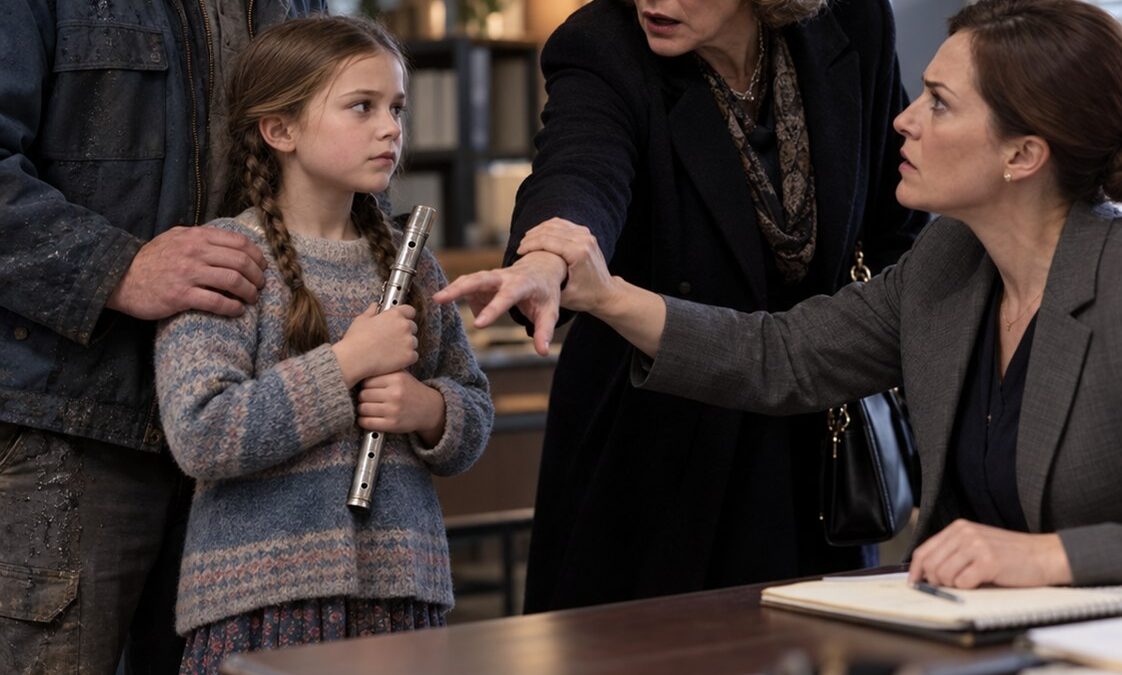
Now it sat beneath a county seal, playing a conversation I had never heard.
Judith stared at it.
Nell stared at her shoes.
The caseworker released Judith’s wrist.
“Whose voice was that?” she asked.
Judith straightened her coat.
“I have no idea.”
“You spoke to him.”
“That could be anyone.”
The caseworker turned to me.
“Mr. Mercer?”
“I’ve heard him before.”
Judith’s face changed.
Only a little.
But I saw it.
I knew how to watch a face while someone decided whether to lie.
I had spent nine years repairing elevators while building managers explained that a broken door had been fine yesterday.
“Where?” the caseworker asked.
“On a phone call.”
“About what?”
Judith pressed her palm flat against the table.
“This meeting concerns Nell’s safety.”
“It does,” I said.
The caseworker’s name was Denise Rowan.
She had introduced herself with a handshake and an apology for the delay.
Since then, she had asked careful questions and written careful answers.
Now she closed her notebook.
“Nell,” she said, “you don’t have to listen to this.”
Nell looked up.
“I want to.”
“You can tell me if you need a break.”
“I want Daddy to hear.”
My throat tightened.
I had spent three weeks trying not to make her choose between adults.
She had just chosen the truth.
Denise looked at the recorder.
“May I play the rest?”
Nell nodded.
Judith said, “I object.”
Denise waited.
Judith looked around the small office as if a lawyer might appear behind the filing cabinet.
There was only me, my daughter, and the woman whose job was to ask what had happened.
Denise pressed play.
A chair scraped on the recording.
Judith’s voice sounded farther away.
“She won’t say it.”
The man answered, “Then let the report speak for her.”
A door shut.
Nell’s breathing filled the speaker.
Then her small voice whispered, “I didn’t mean to leave it on.”
Denise stopped the tape.
“What report?” she asked.
Judith turned to Nell.
“Sweetheart, you’ve misunderstood a private conversation.”
Nell gripped the edge of her chair.
“You told me to practice.”
“That isn’t what happened.”
“You said I had to help Daddy.”
Judith glanced at me.
That was when I understood why Nell had seemed afraid to repeat the accusation.
She thought refusing Judith might hurt me.
I reached across the table.
My hand stopped halfway.
“Nell, you never have to help me by lying.”
Her eyes filled.
“I know now.”
Judith stood.
“This is enough.”
“No,” Denise said.
Judith sat again.
The word had been quiet.
It had also ended the argument.
Denise took out a clean evidence envelope.
“Nell, may I keep the recorder while we make a copy?”
“Will I get it back?”
“Yes.”
“It has the bear story.”
“We’ll preserve that too.”
Nell looked at me.
I nodded.
She pushed it toward Denise.
The aluminum was scratched near the speaker.
I had dropped it once in an elevator shaft and spent an hour fishing it out with a magnetic tool.
Nell had made me promise not to replace it.
She liked the click before my voice.
Denise wrote down who had handled the recorder.
Then she asked Judith about the night in her report.
Judith said Nell had been left at my apartment while I worked.
I gave Denise my shift sheet.
I had taken the night off.
My supervisor had signed the change three days beforehand.
Judith said a neighbor had heard Nell crying.
She would not name the neighbor.
Denise asked where Nell had slept.
“At my house,” Judith said.
“No,” Nell said.
Judith’s head turned sharply.
Nell held my hand.
“I slept at our house.”
I felt her fingers settle between mine.
“Daddy made eggs.”
“I burned them,” I said.
“You made toast after.”
Denise wrote that down too.
Judith’s report had said I left Nell alone from eight at night until after midnight.
At eight, I had been at home, burning eggs.
At nine, I had read the bear story into the recorder because Nell wanted to hear the funny voice again.
At ten, I had put her to bed.
The recording did not prove every minute.
It proved someone had tried to teach her a false account.
Denise understood the difference.
She made two calls from her desk.
The first was to her supervisor.
The second was to the attorney assigned to advise the department.
Judith watched her.
I watched Nell.
The room smelled of copier toner and wet coats.
Outside the window, a bus pulled away from the curb.
Nell leaned against my arm.
“You can be mad,” she whispered.
“I am.”
“Not at me?”
“Never at you.”
I meant it.
Denise returned with a question for Judith.
“Who was the man on the recording?”
Judith crossed her arms.
“My financial adviser.”
“What is his name?”
She looked at me.
Then at the recorder.
“Philip Dacre.”
I knew that name.
Philip had called me twice about Nell’s inheritance.
On the second call, he had asked me to sign something I had not understood.
He had said it was routine.
I had refused.
Now I knew why he had wanted my signature.
* * *
Three weeks earlier, Judith had arrived at my apartment with groceries.
She had brought the expensive strawberries Nell liked and a plastic bag full of coloring books.
I had let her in because Nell loved her grandmother.
That love was real.
It was one of the reasons the rest had taken me so long to see.
My wife, Tessa, had died two years before.
Judith was her mother.
After the funeral, Judith had helped with school pickups whenever a service call ran late.
She knew which cup Nell preferred.
She knew the bear story by heart.
She also knew how frightened I was of disappointing my daughter.
Philip Dacre came ten minutes after the groceries.
He carried a leather folder.
Inside was a form granting Judith temporary authority to manage some matters for Nell.
He said it would make school and medical appointments easier.
Judith said I was exhausted.
Both things were true.
I read the first page anyway.
The form referred to property.
I asked why a school pickup form needed property language.
Philip smiled.
“Standard wording.”
I put down the pen.
“Then the standard wording needs changing.”
His smile held.
Judith’s did not.
Tessa had left a small house to Nell.
It had belonged to Tessa’s father, and it was rented to a retired teacher.
There was also an investment account.
Tessa had arranged for both to be held for Nell until she was older.
Judith was trustee.
I had never asked to manage the money.
I wanted reports.
I wanted to know that the rent was being collected and the account was still there.
For months, Judith had sent me brief summaries.
They showed totals.
They did not show where the money had gone.
Philip said I worried too much.
I worked for a company that serviced elevators in old buildings.
If a manager gave me only a total and no repair history, I worried.
That was the whole job.
After the visit, I emailed Judith asking for the underlying statements.
She did not answer.
Four days later, the anonymous neglect report arrived.
Denise did not tell me who had made it.
She could tell me what it alleged.
Nell had supposedly spent a night alone while I worked.
There had been a second claim too.
The report said I kept her from Judith because I feared questions about her inheritance.
That part had felt almost funny.
I had been asking the questions.
Then Judith filed a petition seeking temporary guardianship.
My attorney told me not to ignore it.
Her name was Mae Calder.
She worked above a pharmacy and charged less than the lawyers Judith could call before breakfast.
I paid her from money I had set aside for new tires.
Mae read the petition twice.
“She hasn’t got enough here,” she said.
“Then why file it?”
“To put you on defense.”
She tapped one paragraph.
Judith had written that my old conviction made me unreliable.
When I was nineteen, I had stolen copper wire from a vacant construction site.
I pleaded guilty.
I repaid the contractor.
I completed probation.
It was ugly and stupid.
It was also eighteen years ago.
Mae asked me for everything.
Work records.
School attendance.
Medical appointment notes.
The calendar on my kitchen wall.
I brought her copies in a grocery bag.
Now, after the recording, I brought the bag again.
Denise had told me she would check the allegation and speak with her supervisor before closing anything.
She did not promise what the guardianship judge would do.
Mae did not pretend a recording ended the case.
“We need the original file,” she said.
“Denise has the machine.”
“Good.”
“I thought that was the proof.”
“It’s one piece.”
I sat opposite her while a delivery truck rattled the window.
Nell was at school.
I had taken two hours of unpaid leave.
“What else?”
“We find out who placed that report.”
“Can Denise tell us?”
“Maybe later, through the right process.”
Mae opened the petition.
“First, we answer what Judith filed.”
There was a declaration from Philip.
He described himself as a family financial adviser.
He said Judith had asked him to help after I became hostile about Nell’s assets.
He had attached an email.
It appeared to come from me.
In it, I wrote that I would stop asking for statements if Judith paid my debts.
I read it three times.
“I didn’t send this.”
Mae studied the printout.
“Do you have that email account?”
“Yes.”
“Could someone else?”
I thought of my kitchen table.
Judith had borrowed my laptop during a school pickup.
She said hers had died.
Philip had been at the apartment that afternoon.
I could not prove either man had touched the computer.
Mae did not ask me to guess.
She asked for the account records.
We requested a copy of the original email with its full technical information.
Then Mae called a lawyer she knew who handled trusts.
His name was Aaron Pike.
He met us the following evening.
I had brought my folder.
Aaron had brought the trust document.
“Tessa was careful,” he said.
I touched the signature at the bottom.
She had signed it when Nell was three.
Tessa had wanted the house and the account managed until Nell turned twenty-five.
Judith could pay for Nell’s needs.
She had to keep records.
Large transactions outside ordinary support required notice to me as Nell’s parent.
That was why Philip needed me to sign.
“Can she sell the house?” I asked.
“Not just because she wants to.”
“Can she borrow against it?”
Aaron turned a page.
“She would have to justify that.”
He looked at me.
“Has she tried?”
I told him about the form.
He asked for a copy.
I had kept one.
I kept paper whenever someone told me a signature was routine.
Aaron read it slowly.
It was more than temporary authority.
It included language saying I had received complete trust records and had no objection to a proposed loan secured by the house.
I felt my face grow hot.
“She never gave me records.”
“Then don’t sign it.”
“I didn’t.”
“That may matter a great deal.”
Aaron asked why Judith needed a loan.
I did not know.
He requested the trust statements and property records through the formal process available to him.
Mae prepared our response to the guardianship petition.
She included my shift sheet and a letter from my supervisor.
She included Nell’s school records showing I was the parent who signed her in most mornings.
She did not ask Nell to write a statement.
“She’s told Denise what she knows,” Mae said.
“We’ll let the adults collect the rest.”
That night, I picked Nell up from school.
She walked beside me with her backpack bouncing against her coat.
“Is Grandma in trouble?”
“I don’t know yet.”
“Did I make her trouble?”
“No.”
“She was good to me sometimes.”
“I know.”
Nell watched the cracks in the sidewalk.
“She said you would lose your job if I told.”
I stopped.
A cyclist passed us.
“Did she say why?”
“She said people would think you couldn’t take care of me.”
I crouched so she could see my face.
“Nobody gets to make you carry my job.”
“But you need it.”
“I do.”
“Then I should have stayed quiet.”
“No, Nell.”
My voice came out too hard.
I softened it.
“I need you more.”
She looked at me for a long time.
Then she reached for my hand.
We walked home.
The first statement arrived two days later.
Aaron called before I had finished reading it.
“Are you alone?”
“Nell’s doing homework.”
“Can you step outside?”
I went onto the landing.
The hall light flickered above me.
Aaron told me there had been repeated transfers from Nell’s trust to a company Philip controlled.
Judith had labeled them temporary investments.
The company had paid interest once.
Then it stopped.
“How much?”
“Enough that we need the full records.”
“Is it gone?”
“We don’t know.”
I heard Nell asking herself a spelling word inside.
Aaron turned a page.
“The first transfer was eight months ago.”
Judith had started hiding the statements eight months ago.
The lie had begun long before anyone called family services.
* * *
Mae filed our response on a Monday.
On Tuesday, Judith canceled Nell’s place at the after-school art program.
She had been paying the fee directly.
She sent me a message explaining that her lawyer had advised her to stop informal payments while we were in dispute.
The fee was eighty-six dollars a month.
I paid it.
I moved the new tires to next month.
On Wednesday, my supervisor called me into his office.
Someone had sent him a copy of Judith’s guardianship petition.
He knew about the old conviction.
The company had hired me with it on my application.
He also knew I repaired elevators other people could not diagnose.
“I’m not firing you,” he said.
“Okay.”
“But I need you to tell me if a hearing changes your schedule.”
“I will.”
He slid an envelope across the desk.
It contained a copy of the letter he had already sent Mae.
I had been where I said I was on every shift listed in the complaint.
He had included the night I took off.
“Thank you,” I said.
He shrugged.
“Those are the records.”
At lunch, I called Aaron.
Philip’s company was called Harbor Ridge Development.
Its public filings listed him as manager.
It had bought a vacant motel outside the city.
The property was tied to a loan coming due in six weeks.
I listened while Aaron explained what he knew.
Some of Nell’s trust money appeared to have gone into that purchase.
He could not yet tell whether Judith had known how it was used.
The records mattered.
Judith called me that afternoon.
I let it ring.
She left a message.
“Nell misses her grandmother.”
That was all.
She did miss her.
I could hear it when Nell asked if Judith still made cinnamon rolls on Sundays.
I told her I did not know.
I wanted to say more.
I wanted to tell Nell exactly how angry I was.
Instead, I tried to make the rolls.
They came out crooked and dry.
Nell ate two.
“Grandma puts more icing on them,” she said.
“She does.”
“You don’t have to be good at hers.”
I sat down beside her.
“That’s kind of you.”
“I meant I still want hers.”
“I know.”
She scraped icing from her plate.
“Can I see her?”
“I’m talking to people about that.”
“I don’t want to talk about the recording.”
“You shouldn’t have to.”
“Will she ask me?”
“I won’t let a visit happen unless we can make that clear.”
Nell nodded.
Then she offered me the last bite of her roll.
I took it.
The next morning, Denise called.
Her review of the neglect allegation was nearly complete.
She had checked my work schedule with my supervisor.
She had spoken to Nell’s teacher.
She had interviewed the neighbor named in a follow-up message.
The neighbor had heard crying.
It was from the apartment above mine, where a newborn lived.
She had never said it was Nell.
Denise had also listened to the original recorder with a department employee who handled digital evidence.
The file had not been spliced.
The batteries had run low near the end.
That was why the other voice sounded rougher.
“Can you identify him?” I asked.
“I can document what the recording contains.”
“What happens now?”
“I’ll make a recommendation to close the neglect finding as unsupported.”
I leaned against my service van.
“That doesn’t stop her petition.”
“No,” Denise said.
“But my report will be available through the legal process.”
She paused.
“How is Nell?”
“She wants cinnamon rolls.”
“That sounds reasonable.”
It was the closest Denise had come to a joke.
By Friday, Mae had the email information.
The message Judith submitted did not come from my account.
The sender had made the display name look like mine.
The underlying address was different by one letter.
Philip had received it at his business account.
Mae could not yet prove who had created it.
She could prove I had not sent it.
Aaron had more.
The trust had loaned Harbor Ridge money in three installments.
Judith had approved each one.
Philip had signed for the company.
The motel had not brought in the promised income.
The final installment came one week after I asked Judith for full statements.
Aaron believed they had needed my acknowledgment to protect the transactions from a challenge.
When I refused to sign, Judith tried to take the one thing that would let her speak for Nell without me in the way.
Temporary guardianship.
The thought sat in my stomach like a stone.
“She loves Nell,” I told Aaron.
“I think she does,” he said.
“How can both things be true?”
He did not answer for her.
That evening, I took Nell to the public library.
We returned a book about constellations.
She chose three more.
On the way out, she stopped at a display of handmade cards.
“Can I make one for Grandma?”
“Of course.”
“Would you give it to her?”
I thought about the recording.
Then I thought about Nell waiting beside me.
“If she can receive it without asking you for anything back.”
Nell considered that.
“Okay.”
She drew a cinnamon roll on the front.
Inside she wrote, I MISS YOU.
I sealed it in an envelope.
I gave it to Mae the next day.
Mae sent it through Judith’s attorney with a note asking Judith not to contact Nell directly while the investigation and petition were pending.
That night, someone left an envelope under our apartment door.
There was no message.
Inside was a copy of the same form Philip had brought to my kitchen.
A yellow tab marked my signature line.
I called Mae.
She told me to photograph it where I found it, then bring it to her office.
I did.
The hallway camera belonged to the building.
The landlord agreed to preserve the footage.
Mae watched it with him the next morning.
Philip had placed the envelope under my door.
He had not knocked.
He had stood there for less than ten seconds.
We did not go looking for him.
Mae sent the footage to the attorneys handling the petition and the trust matter.
Aaron requested an order protecting the trust records and preventing further large transfers while the accounts were reviewed.
I kept working.
Nell kept going to school.
At bedtime, she asked for the bear story.
The recorder was still with Denise.
I read it live.
I missed a line.
Nell corrected me.
On the next page, the bear walked through a forest by counting the sounds of home.
I looked at my daughter under her quilt.
“Daddy?”
“Yes?”
“Did Grandma need my money?”
I had not told her about the trust.
“She made choices about money that adults are checking.”
“That’s not what I asked.”
I closed the book.
“I think she did.”
Nell pulled the quilt to her chin.
“Couldn’t she ask me?”
“You’re eight.”
“I have seventeen dollars.”
I almost smiled.
“She needed much more than that.”
Nell was quiet.
“She could have asked you.”
“Yes.”
That was the tender, terrible center of it.
Judith had been in my kitchen.
She had seen the unpaid tire estimate on the counter.
She knew I would have listened if she said she was in trouble.
She had chosen a lie because she wanted control.
On Monday, Aaron received the motel loan file.
The lender had issued a final demand to Harbor Ridge.
The trust transfers had been used to keep Philip’s project alive.
Judith had guaranteed part of his debt with her own property.
She had been trying to save herself too.
* * *
The guardianship hearing took place six weeks after Nell set the recorder on Denise’s desk.
Nell was not required to attend.
Mae had arranged for her to stay at school.
She spent the morning making a clay bird.
I spent it in a room with dark wood benches and a clock that ran three minutes slow.
Judith arrived with two attorneys.
Philip arrived separately.
He sat behind her.
He did not look at me.
Mae sat on my left.
Aaron sat behind us with a box of trust records.
Denise waited near the aisle.
I had never been in a room where so many people knew Nell’s name and so few knew what she sounded like when she laughed.
Judith’s attorney spoke first.
He had a clean voice.
He said Judith was a devoted grandmother.
She was.
He said she had provided steady support after Tessa’s death.
She had.
He said I worked irregular hours and had struggled financially.
Both were true.
He said Nell needed stability while the department considered a serious report.
Mae stood.
“The department has completed that review.”
Denise’s written conclusion had been provided to the court.
The allegation that Nell had been left alone was unsupported.
The judge read from it.
Judith’s attorney shifted.
He argued that one disputed report did not answer the larger question.
My old conviction came up.
My rent came up.
The art program fee came up.
I could see how neatly those facts lined up on paper.
A poor father.
A rich grandmother.
A child between them.
Mae asked me questions I could answer plainly.
“What time do you leave for work?”
“Usually seven.”
“Who takes Nell to school?”
“I do.”
“What happens when you have an early call?”
“My neighbor, Mr. Cho, comes over.”
“Does he have her school’s approval?”
“Yes.”
“Does Judith?”
“She did.”
“Why did that change?”
I looked at Judith.
“Because she asked Nell to say something that wasn’t true.”
Her attorney rose.
He said I was overstating a confusing conversation.
He said the recording had been made without Judith knowing.
He said Nell might have misunderstood what was being discussed.
For a moment, I thought he might persuade the judge.
Judith had a way of looking wounded while other people spoke for her.
She looked that way now.
Mae played the recording.
My bear voice filled the room first.
A few people smiled before they could stop themselves.
Then Judith told Nell what to say.
The smile left every face.
The recording ended after Philip’s voice.
“Then let the report speak for her.”
Judith’s attorney argued that Philip had meant an honest report by another person.
Mae did not fight over the meaning of one sentence.
She called Denise.
Denise explained how she had obtained the recorder.
She described the file review.
She described the shift record, the neighbor interview, and Nell’s account.
She was careful.
She did not call Judith a criminal.
She did not call me a perfect father.
She said the allegation was unsupported and that Nell had given a consistent account without prompting during her interview.
Then Mae called Mr. Cho.
He described the night Judith said Nell had been alone.
He had knocked at eight fifteen to return a borrowed ladder.
I answered.
Nell came to the door to show him a picture of a bear.
He had later found the picture in his coat pocket because she had insisted he take it.
He brought it with him.
The judge examined it.
It had Nell’s name, the date, and three crooked stars.
The paper itself could not tell time.
Mr. Cho could.
His phone had a message from me at eight twelve asking him to bring the ladder down.
Mae showed the message record.
That was the independent proof of the ordinary night Judith had turned into a story.
Judith’s attorney asked whether Mr. Cho liked me.
“Yes,” he said.
“Would you lie to help him?”
“No.”
“How can you be sure of the exact time?”
“Because my wife was watching a cooking show that ended at eight.”
He looked embarrassed.
“And because he texted me.”
The judge thanked him.
Aaron then addressed the trust.
The guardianship petition did not decide every question about Nell’s inheritance.
The judge made that clear.
Aaron explained why the finances mattered to Judith’s request for control.
He showed the form Philip had asked me to sign.
He showed the trust provisions requiring notice.
He showed the transfers to Harbor Ridge.
Judith’s attorney said the investments had been made in good faith.
He argued that the motel could still succeed.
He said Tessa had chosen Judith as trustee because she trusted her judgment.
That landed.
Tessa had trusted her mother.
So had I.
Judith took the witness chair.
She spoke about Tessa as a little girl.
She spoke about helping Nell after the funeral.
She said she feared I might move away and cut her off.
She said Philip had assured her the investment was safe.
“Why ask Mr. Mercer to acknowledge receiving records he had not received?” Aaron asked.
“I thought he had them.”
“Who gave them to him?”
“I don’t remember.”
“Did you ask?”
“No.”
“Why ask Nell to say he left her alone?”
Judith looked at the judge.
“I was frightened.”
“That wasn’t my question.”
“I wanted someone to take my concern seriously.”
“Was your concern true?”
She pressed her lips together.
I waited.
I had waited through six weeks of strangers examining my home, my wages, and the worst thing I had done at nineteen.
I could wait ten more seconds.
“No,” she said.
The word was almost inaudible.
The judge asked her to repeat it.
“No.”
Her attorney sat down.
Philip was called next.
He said the false email was a misunderstanding.
He had received it and assumed it was mine.
Mae showed him the sender address.
He said he had not noticed the different letter.
Aaron asked about the three trust transfers.
Philip described them as loans.
“Where are the interest payments?”
“There was a delay.”
“Where is the security?”
“The property.”
“Was the trust given a recorded claim against the property?”
Philip asked to see the document.
He knew it was absent.
I could tell by the way he held the page.
The judge did not decide the financial case that day.
She denied Judith’s request for temporary guardianship.
She left Nell in my care.
She directed that Judith’s contact with Nell be arranged through counsel until the adults could agree on terms that protected her from pressure.
She also ordered that the trust matter proceed with full records.
I felt Mae’s hand touch my sleeve.
I had been holding the edge of the table so hard my fingers ached.
Judith stood as the judge left.
She looked at me across the aisle.
“You’ve taught Nell to fear me.”
I could have listed every reason Nell was afraid.
I could have told Judith what her recording sounded like when my daughter whispered that she had left it on.
Instead, I said, “She still drew you a cinnamon roll.”
Judith looked away.
That was all I had for her.
Outside, Mae told me to breathe.
“I am.”
“Try a deeper one.”
I did.
Aaron joined us on the steps.
He said the trust records would take time.
A temporary order already limited new large transactions.
An independent accountant would review what had happened.
Philip’s company might not repay everything.
“I can’t promise a clean ending,” he said.
“Nell’s with me.”
“Yes.”
“That’s the part I came for.”
There were still hearings.
There were bank records.
There was an investigation into the false email and the report.
Nothing ended because a single judge had spoken.
But when I collected Nell from school, she ran across the sidewalk carrying a clay bird with one enormous wing.
“Did I have to come?” she asked.
“No.”
“Do I have to go later?”
“I don’t expect so.”
She searched my face.
“Am I coming home?”
“With me.”
She handed me the bird.
“It’s for the window.”
I carried it carefully all the way there.
* * *
Winter arrived.
The old house that belonged to Nell kept its tenant.
Aaron found no reason to disturb her.
The accountant traced the trust transfers through Harbor Ridge and into the motel project.
Judith had approved them.
Philip had prepared the documents.
The trust had not received the protection those documents claimed it had.
Philip was removed from any role involving Nell’s money.
Judith resigned as trustee after the court considered the accountant’s report.
A professional trustee took over.
Insurance and the sale of Philip’s remaining interest in the motel recovered much of the money.
Judith agreed to repay the rest over time.
Her own lawyer made sure the promise was written where someone could enforce it.
The authorities also reviewed the false report and the email.
Philip admitted through his attorney that he had created the email.
He said he had intended to pressure me into settling the records dispute.
He accepted responsibility in the resulting case and was ordered to pay restitution and comply with its other terms.
I learned the details months later.
By then, the sound of his voice mattered less to me than the quiet in our apartment.
I worked.
Nell went to school.
Mr. Cho taught her to fold paper boats that never floated straight.
I bought the tires.
On Saturdays, Nell and I visited the library.
She started reading the bear story to me.
She gave every animal the same deep voice I had used for the bear.
It made me laugh so hard I lost my place.
One afternoon, Mae called with news about a proposal from Judith.
She wanted to pay for Nell’s future school expenses herself, outside the trust.
I listened.
Judith had money left.
She wanted to help.
I believed that part.
I also remembered the strawberries on my kitchen table and Philip’s folder arriving ten minutes later.
“Can she put anything she wants to give into an account she doesn’t control?” I asked.
Mae said she would ask.
Judith agreed.
The trustee could accept gifts for Nell under its rules.
Judith would receive statements about her own contributions.
She would not decide how those gifts were used.
The first deposit paid for a school trip Nell had wanted to take.
I paid for her lunch.
It mattered to me that I could.
Mae asked whether I would consider a supervised visit.
The family specialist who had met with Nell thought a short one might be appropriate if Nell wanted it.
I asked Nell.
She was at the kitchen table building a paper town.
“Do I have to decide today?”
“No.”
“What if I say no?”
“Then we wait.”
“What if I say yes and don’t like it?”
“We leave.”
She folded a roof.
“Will you be there?”
“Nearby.”
“Can she ask about the tape?”
“She’ll be told not to.”
Nell thought for another day.
Then she said she wanted to go.
The visit was at a family center with a room full of board games.
I sat down the hall.
Judith brought cinnamon rolls in a covered container.
The staff member checked them in.
Nell ate half of one.
They played cards.
Judith did not ask about the recording.
Afterward, Nell climbed into my van.
“Was it okay?” I asked.
“Mostly.”
“What wasn’t?”
“She cried when she saw me.”
“That can be hard.”
“I didn’t know what to do.”
“You didn’t have to do anything.”
Nell watched the center through the window.
“She said she was sorry.”
“How did that feel?”
“I wanted her to say it again without crying.”
I understood.
We went home and made grilled cheese.
The next visit was easier.
The third was not.
Judith brought Nell a photograph of Tessa at eight years old.
Nell loved it.
Then Judith said Tessa would have hated seeing the family divided.
Nell went quiet.
The staff member told Judith to stop.
Nell told me in the van.
I called Mae.
The visits paused.
Judith wrote an apology.
It was addressed to Nell.
She did not mention Tessa as a reason Nell owed her anything.
She wrote that she had said something unfair.
She wrote that Nell could keep the photograph whether she wanted another visit or not.
Nell pinned it above her desk.
She asked to see Judith again a month later.
That became the shape of things.
A visit.
A pause when needed.
An adult responsible for her own words.
A child allowed to choose.
Judith and I met once at Mae’s office.
It had been nearly a year since the recording.
Judith looked older.
I probably did too.
She said, “I told myself I was protecting what Tessa left.”
“You were protecting the motel.”
“Yes.”
“Why did you involve Nell?”
She looked down at her hands.
“I thought you’d sign if you were scared.”
“I was scared.”
“I know.”
“No,” I said.
“I don’t think you do.”
Mae stayed quiet.
Judith looked at me then.
“I’m sorry.”
I believed she meant it.
I also knew an apology could not give Nell back the night she had lain awake with the recorder running.
“You can see her when she wants to see you,” I said.
“You can love her.”
“You cannot ask her to carry a message, keep a secret, or choose a side.”
Judith nodded.
“If that happens again, the visits stop.”
“I understand.”
“I hope you do.”
On the way out, she asked whether Nell still liked astronomy.
“She knows more than I do.”
“She always did.”
It was the first easy thing either of us had said.
It did not fix the rest.
It was still true.
That spring, Nell’s class held a reading night.
Each child chose a story.
Nell chose the bear.
She brought the silver recorder in her backpack.
Denise had returned it after the department preserved its copy.
I had cleaned the battery contacts.
I had not erased anything.
The recording of Judith remained with the case file.
On our machine, I saved the bedtime story and then left the device alone.
Before reading night, Nell asked me to make her a new recording.
“Of the bear?”
“No.”
“What, then?”
“You saying what happened after.”
I looked at her.
She sat on the rug with a pencil in her hand.
“What do you mean?”
“After he wasn’t scared of the dark.”
“The book ends there.”
“I know.”
She waited.
I took the recorder.
I pressed the red button.
“The bear got home,” I said.
Nell rolled her eyes.
“That’s boring.”
“Most good days are.”
She thought about that.
“Try again.”
I pressed stop and started over.
“The bear got home.”
“He hung up his coat.”
“He made toast.”
“And the next night, when the forest got dark, he knew the way back.”
Nell considered it.
“Better.”
At reading night, she stood in front of her classmates and their families.
Her voice shook on the first page.
I sat in the back beside Mr. Cho.
Judith sat on the other side of the room.
She had asked Nell for permission to attend.
Nell had said yes.
Nobody made her sit between us.
By the last page, she was giving every animal that ridiculous deep voice.
The room laughed.
Nell looked up and found me.
Then she found Judith.
She kept reading.
* * *
Four years later, the county family services office moved to a new building.
I learned that because Nell and I went there on a Thursday afternoon.
She was twelve.
She carried a box of donated books against her hip.
I carried the second box.
Denise had asked whether Nell wanted to help choose titles for the waiting room.
Nell said yes on one condition.
“No sad books only.”
Denise promised nothing of the kind.
She said children deserved a choice.
The new waiting room had blue chairs and a window facing a small garden.
Nell set the books down.
Then she took the silver recorder from her jacket pocket.
The case was scratched.
The click still came before every sound.
“I found the bear story,” she said.
“You know it by heart.”
“I found the one after.”
She pressed play.
My voice, four years younger, filled the waiting room.
The bear got home.
He hung up his coat.
He made toast.
Nell smiled at the speaker.
“You were right,” she said.
“About what?”
“Good days being boring.”
I glanced at the boxes.
“You made me carry forty books.”
“That was the exciting part.”
Denise came out to meet us.
She shook my hand.
Then she asked Nell where the books should go.
Nell chose a low shelf beside the window.
A child could reach every title.
There was room for the bear.
Later, we walked back to the van.
Nell held the recorder.
Judith had sent her a birthday card that morning.
No request came with it.
Philip was no longer part of our lives.
The trust had a new set of records I could actually read.
Mr. Cho still brought ladders he forgot to take home.
I still burned eggs sometimes.
Nell still told me when I did.
At the curb, she stopped.
“Dad?”
“Yes?”
“Do you still get scared?”
“Sometimes.”
She slipped her hand into mine.
“Me too.”
A bus passed, stirring the leaves along the sidewalk.
We waited for it to clear.
Then Nell clicked off the recorder and led me home.
THE END








