MY EX SAID I HAD ABANDONED OUR DAUGHTER AT THE HOSPITAL—THEN SHE PINNED AN OLD VISITOR BADGE TO MY SHIRT
Chapter 2: What the Badge Remembered
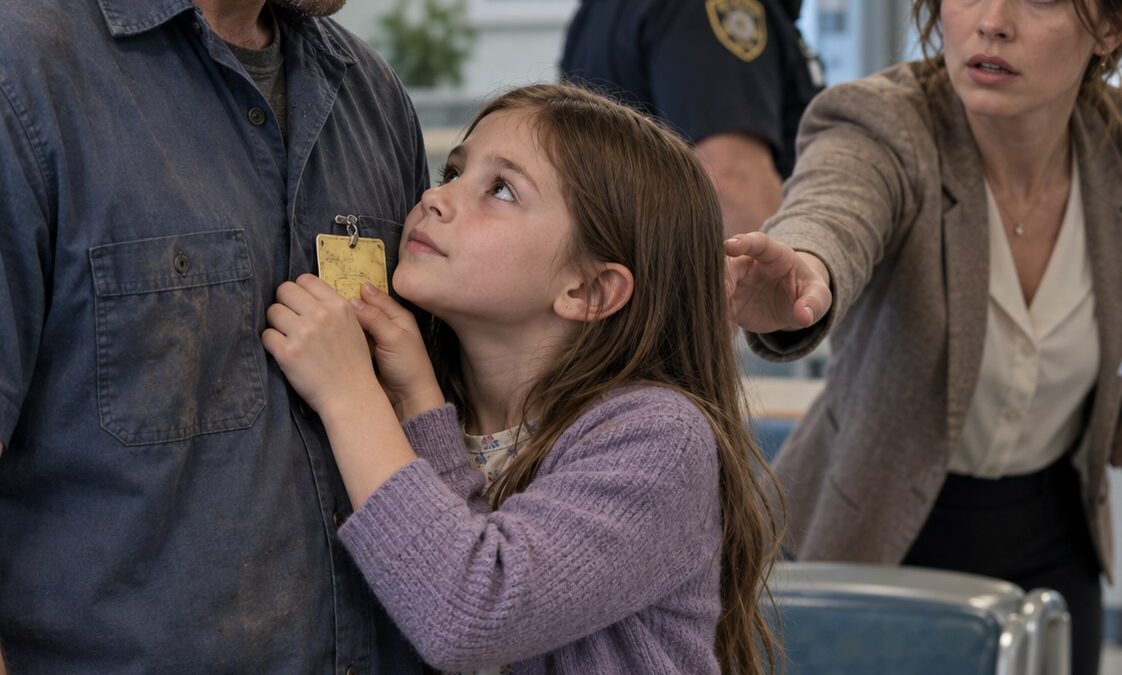
Celeste’s hand stayed in the air.
Wren kept both palms flat against my chest.
The badge crackled beneath them.
“Wren,” Celeste said, “come sit down.”
“I’m telling him.”
“I can hear you.”
“You didn’t before.”
Celeste lowered her hand.
The guard took one step back.
His name tag said MR. DUNN.
I had seen him twice that week, once at the entrance and once beside the elevators.
Today, he looked at the badge.
Then at Celeste.
“I need to call the discharge coordinator,” he said.
“Please do,” I told him.
My voice sounded steadier than I felt.
Wren had been admitted three days earlier after an asthma flare.
She was well enough to go home.
The question was whose home.
Celeste had told the hospital I was barred from seeing her.
She had told me the same thing for eight months.
Wren tugged my sleeve.
“Are you mad?”
“At you?”
She nodded.
“Never.”
“Even about the badge?”
“Especially not about the badge.”
I had wondered where it went.
That winter, a receptionist had printed it before anyone recognized my name.
I had made it through the first security door.
At the second, a man told me there was an order.
He took the badge.
Or I thought he had.
Wren must have seen more than I knew.
The discharge coordinator arrived with a folder hugged to her chest.
Maren Cho was brisk and tired.
I recognized her from my two unanswered calls.
“Mr. Pike,” she said.
“Ms. Cho.”
“Ms. Vale.”
Celeste folded her arms.
“Maren, he shouldn’t be here.”
“I have asked legal to review the restriction,” Maren said.
“There’s nothing to review.”
“There is now.”
Wren held out the badge.
Maren did not take it.
She crouched until she was level with my daughter.
“May I look?”
Wren glanced at me.
“That’s your decision,” I said.
She passed it over.
Maren read the front.
NOLAN PIKE.
VISITOR.
2:14 A.M.
Eight months and eleven days ago.
The date was burned into me.
Wren had been upstairs with pneumonia.
Celeste had called at midnight.
“She keeps asking for you,” she had said.
I left a city bus half disassembled.
My supervisor drove me across town.
By dawn, the hospital said I had no right to know which floor Wren was on.
Maren turned the badge over.
There were three uneven pencil words.
I SAW YOU.
Wren had written them on the paper backing.
My knees nearly gave.
Celeste stared at her.
“When did you write that?”
“The next morning.”
“Why didn’t you tell me?”
“I did.”
Celeste’s face changed.
I watched her search for a memory.
Wren moved closer to me.
“You said I was dreaming.”
Maren rose slowly.
“We need a private room.”
“No,” Celeste said.
“My daughter is being discharged.”
“Her discharge can wait twenty minutes.”
“She’s tired.”
“I am,” Wren said.
“Then we’ll bring you a chair.”
Maren pointed toward a small consultation room.
Dunn opened the door.
Celeste went first.
I waited for Wren.
She put her fingers through mine.
For eight months, I had imagined that moment.
I had imagined pulling her into my arms.
Instead, I walked at her pace.
The room smelled faintly of coffee.
Wren sat between us.
Maren set the badge on the table.
“Ms. Vale,” she said, “you gave us a copy of a protective order.”
“I gave it to admissions in January.”
“Who gave it to you?”
Celeste frowned.
“My father.”
I felt Wren’s fingers tighten.
“Graham handled the filing,” Celeste said.
Maren looked at me.
“Mr. Pike, have you seen the document?”
“No.”
“You’ve been told about it?”
“Every time I asked for my daughter.”
Celeste looked away.
“I didn’t know they wouldn’t show you.”
“Did you ask?”
She had no answer.
Maren opened her folder.
“I can’t decide custody here,” she said.
“I can decide what our staff rely on.”
Dunn stood by the door.
Maren read from a sheet.
“Legal checked the court number this morning.”
Celeste sat straighter.
“There’s a problem.”
“What problem?”
“The court says that case number belongs to a parking appeal.”
Nobody spoke.
The air unit clicked overhead.
Wren traced the edge of my thumbnail.
Celeste reached for the paper.
Maren kept it beside her folder.
“There was no protective order,” she said.
* * *
I took Wren home that afternoon.
Not because a hospital employee awarded me custody.
No one had that power.
Celeste agreed to let Wren leave with me after Maren spoke with both our lawyers.
My lawyer was a woman I had met six days earlier.
She worked at a family legal clinic above a pharmacy.
Her name was Priya Shah.
She had already filed a request for an urgent hearing.
Celeste’s lawyer told her to keep Wren’s routine stable until then.
Celeste said my apartment was unfamiliar.
Wren said she knew where every light switch was.
That settled the afternoon.
Nothing else was settled.
Celeste followed us to the parking garage.
“Her inhaler is in the blue case,” she said.
“I know.”
“The refill is due Tuesday.”
“I know that too.”
“Don’t make this difficult.”
I stopped beside my car.
It was a twelve-year-old sedan with a torn seat.
Wren was already fastening her belt.
“I’m taking her to the place she asked to go.”
Celeste looked through the window.
Wren watched us without waving.
“I thought the order was real,” Celeste said.
“Then we both need to find out who made it.”
“You know what this will do to my father.”
“I know what it did to Wren.”
Celeste flinched.
I got into the car.
For three blocks, Wren said nothing.
At the fourth light, she asked, “Did you come more than once?”
“Yes.”
“How many?”
“I lost count after ten.”
She considered that.
“I only saw you one time.”
“One time was enough to keep the badge.”
“The nurse gave it to me.”
That explained the missing paper.
“Which nurse?”
“Miss Inez.”
“She was kind to you?”
Wren nodded.
“She said people can get things wrong.”
I kept my eyes on the light.
“What did you think she meant?”
“I thought she meant me.”
I pulled over where the curb widened.
Wren looked frightened.
“I didn’t do anything bad,” she said.
“No, sweetheart.”
I turned to face her.
“Miss Inez meant the grown-ups.”
We ate soup at my kitchen table.
Wren inspected the apartment she already knew.
She had spent every other weekend there before January.
Her drawing pencils were still in a mug.
Her socks were still in the bottom dresser drawer.
I had washed the sheets that morning.
I had been afraid to hope.
She found a stuffed owl beneath the pillow.
“You kept him.”
“He had a lease.”
Wren smiled despite herself.
It was the first time I had heard that sound in months.
After she fell asleep, I called Priya.
She answered on the second ring.
“I heard from Celeste’s attorney,” she said.
“Is the hospital right?”
“There’s no matching order in this county.”
“Could Graham have filed somewhere else?”
“I’m checking.”
“Wren says a nurse gave her my badge.”
“That may help.”
Priya paused.
“Nolan, where did the trust papers go?”
My stomach tightened.
Wren’s grandmother had died two years earlier.
June Vale was Celeste’s mother.
She had taught Wren to grow tomatoes in coffee cans.
She had also left money for Wren’s care and education.
Celeste’s father, Graham, managed the trust.
June had named me as a second trustee.
I knew because she told me herself.
She had liked that I asked questions about receipts.
I had one letter from her lawyer confirming the appointment.
Graham kept the signed trust document.
For months before Wren’s winter hospital stay, I had asked for statements.
A payment labeled “adaptive transport” kept appearing on the summary he sent.
Wren had never used adaptive transport.
She walked to school with Celeste.
She took the city bus with me.
The amount grew every month.
When I pressed Graham, he said the payments covered future needs.
Then Celeste called to say Wren had pneumonia.
By morning, I was being kept away.
“The letter’s in my toolbox,” I told Priya.
“I need a clear photo.”
I sent it.
She called back ten minutes later.
“This names you as co-trustee.”
“Graham said June changed it.”
“Do you have that in writing?”
“No.”
“Then we request the full document from the lawyer who drafted it.”
“I tried.”
“She retired.”
“Her files didn’t.”
Priya gave me the name of the firm that held them.
She also told me to photograph the badge.
I placed it on the table beneath the kitchen light.
Wren’s pencil marks showed faintly on the back.
I took pictures of both sides.
Then I noticed something I had missed.
Across the bottom was a short visitor code.
At the bus depot, a code like that could lead to a time, a gate, and a person.
In the morning, I called Maren.
“I can ask security to preserve the old logs,” she said.
“Will they still have them?”
“I don’t know.”
“Please ask.”
“I already did.”
The next day, Priya obtained a certified copy of June’s trust.
Her office had saved it digitally.
The lawyer who drafted it sent an affidavit explaining the records.
June had named Graham and me.
Either trustee could ask for statements.
Both had to authorize payments above five thousand dollars.
Graham had sent me summaries.
He had not sent the bank statements.
Priya prepared a formal request.
I spent the afternoon at the depot.
My supervisor, Ellis, found me staring at a wheel assembly.
“You’re about to put that bearing in backward,” he said.
I set it down.
“Thanks.”
“Go drink something.”
“I’m fine.”
“Then drink something while you’re fine.”
I went to the break room.
On my phone was a message from Celeste.
Wren’s blue sweater is at my place.
I’ll bring it tomorrow.
I wrote back, Thank you.
A second message came.
I asked Dad about the order.
He says you’re lying about the court number.
I stared at that sentence.
Then I called Priya.
“Graham’s already pushing back.”
“That’s useful.”
“How?”
“He’s committed to the order being genuine.”
“He’s been saying that for eight months.”
“Now we have a certified court search.”
I thought of Celeste in the hospital room.
She had looked stunned.
I had wanted to believe her.
Wanting was easier than knowing.
Priya sent the trust request that afternoon.
The bank responded before Graham did.
It would provide records after verifying my identity.
A clerk asked why no one had contacted me when I stopped signing approvals.
“I never stopped,” I said.
There was a pause.
“Mr. Pike,” she said, “we have a resignation letter bearing your signature.”
* * *
I asked the clerk to send the letter to Priya.
She could not send it to my personal email.
I understood.
For the first time in months, a rule worked as it should.
Priya received a secure copy the next morning.
The signature resembled mine.
It had the loop I put on the N.
It had the long tail on the P.
It also had a date from a day I could prove I was somewhere else.
A mechanic remembers certain shifts.
That day, a bus had broken down beside the river bridge.
I stayed with it for eleven hours.
The depot recorded my clock-in.
The recovery truck recorded the tow.
Ellis had sent me a photograph afterward.
My face was black with grease.
I was holding a paper cup at 4:52 p.m.
The resignation letter said I signed it before a notary at 4:30.
Priya told me not to celebrate.
“Time sheets can be challenged,” she said.
“We’ll get the notary record too.”
The listed notary worked in Graham’s office.
Her name was Delia Moss.
I had met her once at June’s funeral.
She had brought Celeste a plate of food.
Now she had notarized a document I had never touched.
Priya sent her a preservation letter.
She sent another to Graham.
I wanted to drive to his office.
I knew exactly where it was.
A polished brick building near the train station.
His firm advised small businesses on debt and payroll.
He wore expensive coats and called me “the mechanic” when he thought Wren couldn’t hear.
Instead, I took Wren to a follow-up appointment.
Her doctor listened to her breathing.
She adjusted a prescription.
She asked Wren if she felt safe going home.
Wren looked at me.
“Yes.”
The doctor asked if she wanted me in the room for the rest.
“Yes,” Wren said again.
That word stayed with me all afternoon.
Back at my apartment, she sat on the floor sorting pencils.
I cooked rice.
She held up a green pencil.
“Grandma June said this was a money color.”
“She said that?”
“She said money should help things grow.”
June had planted herbs on her balcony.
Graham had called it a mess.
I glanced at the folder Priya had given me.
June’s trust had started with one hundred eighty thousand dollars.
The last summary Graham sent showed a balance of ninety-six thousand.
Wren’s actual care expenses could not explain the difference.
“Did Grandpa pay for your school bus?” I asked.
Wren looked confused.
“I don’t have a school bus.”
“I know.”
“Why would he?”
“That’s what I’m trying to learn.”
She put down the pencil.
“Is Grandpa in trouble?”
“I don’t know yet.”
“Will I have to pick?”
“Between people?”
She nodded.
“No one gets to make you solve this.”
I wished I could promise more.
My phone buzzed.
Celeste had brought the sweater.
She was downstairs.
I carried it up while Wren stayed inside.
Celeste stood in the hallway with the sweater folded over one arm.
There was a small stain near the cuff.
“She kept rubbing it when she was sick,” Celeste said.
“Thanks for bringing it.”
“How’s her breathing?”
“Better.”
“I called the doctor’s office.”
“I know.”
“They said you were there.”
“I was.”
Celeste touched the cuff.
“My father says you’ve hired someone to attack the trust.”
“Priya asked for records.”
“He says you’re trying to freeze Wren’s money.”
“I’m trying to find out where it went.”
“You think he took it?”
“I think someone charged for rides she never took.”
Celeste shook her head.
“He arranged those for later.”
“Why would a future ride have a date and a route?”
“He said they were reservations.”
“For a child who walks to school?”
Celeste stopped touching the sweater.
I had printed one of the summaries.
I showed her an entry.
The route code was a familiar pattern.
I had worked on transit vehicles for fifteen years.
Fleet numbers and service dates were ordinary to me.
The route claimed Wren had ridden thirty-one miles on a Tuesday morning.
She had been in class that day.
Her teacher had emailed us a photograph of a science project.
Celeste stared at the page.
“Maybe the date’s wrong.”
“Maybe.”
“You always think he’s looking down on you.”
“He does.”
“That doesn’t mean he stole from her.”
“I agree.”
She looked up.
“Then why are you doing this?”
“Because these aren’t guesses anymore.”
A door opened behind me.
Wren stood in her socks.
“Mom?”
Celeste’s whole face softened.
“I brought your sweater.”
Wren stepped forward.
Celeste waited.
Wren hugged her waist.
I looked away.
Whatever Graham had done, Celeste was still her mother.
Wren took the sweater inside.
Celeste watched her go.
Then her phone rang.
GRAHAM appeared on the screen.
She let it ring.
It stopped.
A message arrived.
Celeste read it.
Her color drained.
“What?” I asked.
“He says your lawyer is making threats.”
“Priya sent a request.”
“He says I should sign the relocation papers tonight.”
I had known she wanted to move.
Her employer had offered her a director’s position in Denver.
We had argued about it before Wren got sick.
“Why tonight?”
“He says the apartment deposit expires.”
“Celeste.”
“He says Wren will settle once she’s away from here.”
The words hung between us.
My daughter was eight.
She was not a problem to move out of sight.
Celeste turned her phone toward me.
A second message had arrived.
It was a photograph of a document.
The top line said EMERGENCY PROTECTIVE ORDER.
Beneath it was a court seal.
At the bottom, I saw my signature.
The same false signature as the resignation.
Celeste whispered, “He told me you signed an agreement to stay away.”
I read the last line.
Prepared by Graham Vale.
* * *
Priya told Celeste to preserve the messages.
Celeste listened.
For once, neither of us argued.
We stood in my hallway while she forwarded them.
Wren watched from the kitchen.
“Is everything okay?”
“We’re working on it,” I said.
Celeste lowered her phone.
“That’s true,” she told Wren.
It was the first honest sentence we had said together in months.
The family court hearing was four days away.
Priya asked the judge’s clerk for an earlier conference.
The hospital sent its counsel a copy of the false order.
Its legal team confirmed the seal had been lifted from an unrelated filing.
Maren arranged for the visitor records to be preserved.
The old system still held my badge code.
I had entered the building at 2:14 a.m.
A security officer had stopped me at the pediatric elevators at 2:21.
The entry said ACCESS DENIED PER G. VALE.
The security officer had recorded a phone call.
Graham had told him the hospital already possessed a court order.
The officer had not seen one.
Later that morning, Celeste had emailed a scan.
That sequence mattered.
Graham had ordered me kept away before he had a document to show.
Priya explained each step to me.
“Security made a mistake,” she said.
“Can we prove Graham lied?”
“We can prove what he said and when.”
“Is that enough?”
“It’s a start.”
The bank produced statements under the trust request.
There were fifty-four transport invoices.
They belonged to a company called North Reach Mobility.
Its address was a rented mailbox.
Its deposits went to an account controlled by Graham’s firm.
Some invoices listed rides on weekends Wren had spent with me.
One listed a pickup at 6:10 a.m.
At 6:10 that morning, Wren and I had been making pancakes.
I had a photograph of the disastrous first one.
I sent it to Priya.
She replied with a single line.
Keep the original file.
We gathered school attendance records.
We gathered appointment calendars.
Celeste gave Priya the travel dates she had saved.
Her calendar placed Wren with her on other billed mornings.
Evidence from both parents covered nearly every invoice.
I had never expected to work beside Celeste again.
We sat at opposite ends of Priya’s small table.
Between us lay a stack of dates.
“March ninth,” she said.
“She was with me,” I answered.
“April second?”
“School field trip.”
“April twenty-sixth?”
“She had a fever.”
Celeste looked up.
“I remember that.”
“You sent me a picture of her blanket fort.”
For a moment, we were simply Wren’s parents.
Then Priya read another invoice.
The moment passed.
On the third day, Graham came to my apartment.
He did not knock.
He rang the bell twice.
I saw him through the peephole.
Wren was at Celeste’s house for dinner.
I opened the door with my phone recording in my pocket.
“Graham.”
“Nolan.”
He carried no briefcase.
That unsettled me more than if he had brought one.
“You’ve made a serious mistake,” he said.
“Then the records will clear it up.”
“You don’t understand what you’re looking at.”
“Explain it.”
“This is family money.”
“It belongs to Wren.”
“June trusted me.”
“She trusted both of us.”
His mouth tightened.
“You weren’t even married to my daughter anymore.”
“June knew that.”
He stepped closer.
I did not move.
“Some men should be grateful for what they’re given.”
I thought of Wren pinning the badge to my shirt.
“I was given a daughter,” I said.
“She’s enough.”
Graham’s eyes went to the phone-shaped outline in my pocket.
“Recording me?”
“Yes.”
“At least you’ve learned something.”
He turned and walked away.
I sent the recording to Priya.
She told me it was useful but not decisive.
The documents mattered more.
So did Delia Moss.
The notary answered Priya’s preservation request through her own lawyer.
She had not witnessed my signature.
Graham had brought her a page already signed.
He had told her I had appeared earlier and forgotten my identification.
She had stamped it anyway.
Her lawyer said she would cooperate with investigators.
There was no need to guess what her testimony might be.
She had written Graham’s name in her journal.
Next to it were the words NOLAN NOT PRESENT.
Priya showed me a copy.
“Why would she write that?” I asked.
“She says she felt uneasy.”
“But she still stamped it.”
“She’ll have to answer for that.”
The bank froze new payments from the trust.
A separate accountant, appointed by agreement between the lawyers, reviewed the statements.
Graham’s firm had received sixty-eight thousand dollars.
Some had gone to payroll at a delivery business he owned.
The business was failing.
Without Wren’s money, he faced unpaid wages and creditors.
That was why the invoices existed.
That was why my questions mattered.
That was why he needed Celeste to believe I was dangerous.
I had been looking for a stolen ride.
Graham had been buying time with my daughter’s childhood.
* * *
The conference took place in a family court meeting room.
It was not a trial.
There was a rectangular table.
There were water bottles nobody opened.
Wren was at school.
Celeste and I had agreed she would not be brought into another room full of adults fighting over her.
Priya sat beside me.
Celeste sat with her attorney, a careful man named Robert Finn.
Graham sat at the far end with his own lawyer.
A court officer took notes.
The judge entered after reviewing the filed papers.
She wanted to address Wren’s living arrangement first.
Then she would consider the trust documents.
Graham’s lawyer asked to speak.
He said the hospital badge proved only that I had entered a building.
That was true.
He said the badge did not prove I had been a reliable father.
That was an opinion.
He said Celeste had believed the protective order was valid.
That was also true.
For one awful minute, the truths seemed to help him.
Then he argued the forged order had been a misunderstanding.
“A draft was circulated,” he said.
“It was not intended for use.”
The judge looked at the hospital’s filed copy.
“It has a seal,” she said.
“The seal was inserted during preparation.”
“Preparation for what?”
The lawyer glanced at Graham.
Graham leaned toward his microphone.
“To protect my granddaughter.”
The judge waited.
“Mr. Pike has a criminal record,” Graham said.
“I have reviewed the disclosure,” she replied.
“He took property from an employer.”
“When I was twenty-one,” I said.
Priya touched my wrist.
I let her speak.
“Mr. Pike pleaded guilty, paid restitution, and completed probation fifteen years ago.”
Graham held my gaze.
“People don’t always change.”
The judge looked at him.
“No one here is being asked to assume they do.”
She turned a page.
“We’re examining conduct in the present.”
Graham’s lawyer shifted his argument.
He said there had been confusion at the hospital.
He said an ill child’s memories could be uncertain.
Celeste sat very still.
I looked at the yellow badge inside Priya’s clear folder.
Wren had remembered the glass.
The system had remembered my entrance.
The officer had remembered Graham’s call.
None of those memories depended on the others.
Priya laid out the timeline.
At 2:14 a.m., my badge was printed.
At 2:21, I was denied access.
At 2:26, Graham called the security desk again.
At 9:08, Celeste sent the scanned order.
The court registry had no order.
The seal came from a parking appeal.
“The hospital has acknowledged its error,” Priya said.
“Mr. Pike has asked it to keep the underlying records.”
Graham’s lawyer objected to treating the security note as proof of a crime.
The judge agreed.
She would not decide a criminal case at a family conference.
She could consider the record when making temporary decisions for Wren.
That difference mattered.
Priya did not push past it.
She turned to the trust.
Graham’s lawyer said North Reach Mobility had supplied readiness services.
He described vehicle availability.
He described drivers kept on call.
He described specialized equipment.
For a moment, the numbers almost sounded reasonable.
Then Priya displayed a single invoice.
It billed Wren for a ride to school on May seventeenth.
It gave a vehicle number.
I recognized the pattern as soon as I saw it.
The number belonged to a city bus.
My depot had retired that bus three years earlier.
I had helped remove its engine.
I had kept the maintenance report because it was part of my work file.
Priya did not ask the judge to trust my memory.
She gave her the city’s certified disposal record.
The bus had been sold for parts.
It could not have carried Wren anywhere.
An independent accountant had found the same vehicle number on nineteen invoices.
Graham’s lawyer studied the page.
He did not say “readiness services” again.
The judge asked Graham whether he wished to answer.
His lawyer advised him not to.
Graham ignored the advice.
“June wanted that girl taken care of,” he said.
“We agree,” the judge replied.
“You don’t know what it costs to keep a family business alive.”
The room went still.
Graham looked at Celeste.
“I was going to put it back.”
Celeste pressed a hand to her mouth.
I had imagined hearing him admit it.
I had imagined feeling victorious.
Instead, I thought of June.
She had counted coins at a garden center while deciding which seedlings Wren would like.
She had saved that money for a child.
The judge called a short recess.
When she returned, she made temporary orders.
Wren would stay primarily with me until a fuller hearing.
Celeste would have regular time with her.
Neither parent could move Wren out of state without agreement or a court order.
Graham would have no role in arranging her care.
The trust would remain frozen except for verified expenses.
A neutral trustee would take over while the accounting continued.
The judge sent the apparent forged filings to the proper authorities.
She told us criminal questions would be handled separately.
It was a measured decision.
It let me take Wren home.
That was enough for that day.
Outside the room, Graham waited near the elevators.
His lawyer stood several feet away.
“You’ve made her mother look foolish,” Graham said.
Celeste heard him.
She had stopped behind me.
I looked at him.
“No,” I said.
“You counted on her trusting you.”
Celeste stepped beside me.
For once, Graham had no answer from either of us.
Seven weeks later, the temporary arrangement became a final parenting order.
It gave Wren a home base with me.
Celeste had scheduled time and a path to more after showing she would respect Wren’s contact with both parents.
The accountant’s final report traced sixty-eight thousand dollars from Wren’s trust into Graham’s businesses.
Graham’s lawyer arranged repayment from the sale of one of his properties.
The money went back under the neutral trustee’s control.
A criminal investigation followed the false documents and the trust withdrawals.
Months later, Graham entered a guilty plea to fraud and filing false records.
He was ordered to pay restitution, barred from managing the trust, and sentenced by the criminal court.
Delia lost her notary commission and accepted responsibility for the false acknowledgment.
The hospital changed its document check procedure.
It sent me a letter acknowledging that it had turned me away on a document it had never verified.
I kept the letter.
Wren kept the badge.
* * *
Spring came slowly.
Wren learned which floorboards creaked in my apartment.
She learned that Ellis called every bus “she,” even when he was angry at it.
I learned that an eight-year-old could use four towels after washing two dishes.
We learned how to live together again.
Some mornings were easy.
Some mornings, Wren asked whether I would still be there after school.
I answered every time.
“Yes.”
Then I showed up.
I changed my shift at the depot.
Ellis took the paperwork without a speech.
On Tuesdays, I left early to pick Wren up.
On Thursdays, Celeste did.
At first, Wren watched the handoffs like she expected one of us to vanish.
We kept them boring.
A backpack changed hands.
A forgotten library book followed.
Someone mentioned the weather.
Once, Celeste and I spent five minutes searching for Wren’s glasses.
They were on her head.
Wren laughed so hard she had to sit on the curb.
It was the first time Celeste laughed with me in more than a year.
Neither of us treated that laugh as a promise.
We had work to do separately.
Celeste gave a statement about Graham’s messages.
She did not claim she had been fooled in every detail.
She told the investigator she had never checked the court order herself.
She told him she had repeated Graham’s claim that I was refusing visits.
She told him she had dismissed Wren when Wren said she saw me.
That admission cost her.
It also gave Wren something she needed.
One afternoon, Celeste asked to speak with me after pickup.
Wren waited in the car with the window open.
“I apologized to her,” Celeste said.
“What did you say?”
“That she was right.”
I leaned against the fence.
“She needed to hear it.”
“I told her I should have listened.”
“Good.”
Celeste looked toward the car.
“I owe you an apology too.”
I waited.
“I called you absent when I knew you were trying to see her.”
“You believed the order.”
“I wanted it to be simple.”
“It never was.”
“No.”
She rubbed her thumb against her car key.
“I was angry about Denver.”
“We both were.”
“My father made your questions sound like an attack on me.”
“I know.”
“I should have checked.”
“Yes,” I said.
She nodded once.
There was no quick way back from eight months.
I did not offer one.
“You can be Wren’s mother,” I told her.
“You always will be.”
“I know.”
“But I need you to tell me directly if something concerns you.”
“I will.”
“And you don’t pass messages through Graham.”
“I haven’t spoken to him since the conference.”
“That’s your choice.”
“This is mine.”
She met my eyes.
“I won’t make Wren doubt what she saw again.”
We kept that boundary.
When Celeste had a question, she asked me.
When I had one, I asked her.
Sometimes the answer was uncomfortable.
It was still an answer.
In June, the neutral trustee called.
Graham had repaid the missing money.
The trust’s remaining funds were secure.
June had also left instructions about smaller grants.
They could pay for school supplies, medical needs, or activities Wren chose.
The trustee asked if Wren needed a private school.
I looked at the public school down the block.
Wren had friends there.
She liked her teacher.
She liked walking home past the bakery.
“No,” I said.
“What about summer programs?”
“She’s been asking about a garden club.”
June would have loved that.
We approved the modest fee.
We left the rest for Wren’s future.
A month later, my supervisor offered me a lead mechanic position.
It paid more.
It also meant nights again.
I asked if the role could be split between two day crews.
Ellis stared at me over his glasses.
“That’s inconvenient,” he said.
“I know.”
He looked at the schedule.
“It might also keep us from losing good people.”
The new arrangement took six weeks to approve.
I took the position.
I still picked Wren up on Tuesdays.
At the garden club, she grew a tomato plant in a dented coffee can.
She named it June.
Celeste sent me a photograph when it produced its first fruit.
Wren wore soil on both cheeks.
At the bottom, Celeste had written, She says Grandma would be proud.
I wrote back, She would.
Wren asked more questions as she grew comfortable asking them.
“Did Grandpa love me?” she asked one evening.
I dried a plate.
“I think he did.”
“Then why did he take my money?”
“I don’t know how he let himself do that.”
She considered the tomato on the windowsill.
“Can somebody love you and do something bad?”
“Yes.”
“Do I have to see him?”
“No.”
“Will he be angry?”
“That is for him to handle.”
She nodded.
Then she asked if we could make grilled cheese.
I burned the first sandwich.
She called it “the trial sandwich.”
The second was better.
Ordinary life came back in pieces.
A report card on the fridge.
A missing mitten.
A cough that sent us to the doctor and then home with sensible instructions.
Each small event made room for the next.
The badge lived in a clear sleeve on Wren’s desk.
I never asked her to put it away.
I never asked her to show anyone.
One day, Celeste came inside to help Wren pack for a trip.
Wren picked up the sleeve.
“Do you want to see it?” she asked her mother.
Celeste sat beside her.
“If you want me to.”
Wren turned the badge over.
The pencil words were fading.
Celeste read them carefully.
“I should have believed you,” she said.
“I know,” Wren replied.
Celeste’s eyes filled.
Wren put the sleeve back.
Then she held out a pair of socks.
“Will these match my sweater?”
Celeste wiped her face.
“Not even a little.”
“Good.”
I stayed in the kitchen.
They had a trip to pack for.
* * *
Three years later, Wren and I returned to the hospital.
She was eleven.
Her garden club had grown into a school project.
The students had made small planters for children staying on the pediatric floor.
The hospital invited them to deliver the planters in person.
Wren wanted both her parents there.
Celeste arrived carrying a box of painted cans.
I carried the heavier box of soil.
We signed in at the front desk.
The receptionist printed three visitor badges.
She checked our names against our identification.
Then she checked the approved visitor list.
She smiled at Wren.
“Your project is upstairs.”
Wren looked at the badge in my hand.
“You have a new one.”
“I do.”
“Keep it.”
“I plan to.”
We walked toward the elevators.
For a second, the old glass doors filled my view.
I remembered the guard.
I remembered the night I had stood outside.
Wren slipped her hand into mine.
Celeste walked on her other side.
Nobody stopped us.
Upstairs, the children chose planters.
One picked blue.
Another wanted the can with crooked yellow stars.
Wren explained how deep to place each seed.
She was patient with questions.
June would have recognized her.
Afterward, we sat near the windows while Celeste returned the empty boxes.
Wren took a clear sleeve from her backpack.
Inside was the old yellow badge.
“You brought it?”
“I wanted to compare them.”
She placed the old badge beside the new one.
The older paper had gone pale.
My name was still legible.
So was the hour.
On the back, her pencil words had nearly disappeared.
Wren traced them through the plastic.
“I saw you,” she said.
“You did.”
“I used to think that was the whole story.”
“What do you think now?”
She looked across the room.
Celeste was speaking with a nurse.
They were arranging to leave the extra planters for families who arrived later.
“Mom learned to listen,” Wren said.
“She did.”
“Grandma’s money is safe.”
“Yes.”
“And you got through the door.”
I looked at the new badge.
Then at my daughter.
“Because you opened it.”
Wren shook her head.
“I was eight.”
“You were eight,” I said.
“You told the truth.”
She slipped the old badge back into its sleeve.
Celeste came over and asked if we were ready.
Wren stood between us.
The elevator doors opened.
We carried the last planter home.
THE END








