My Niece Was Hospitalized After Questioning Her Landlord’s Papers, and He Mocked My Cleaning Cart Until I Held Up One Yellow Copy
Chapter 2: What the Copy Held
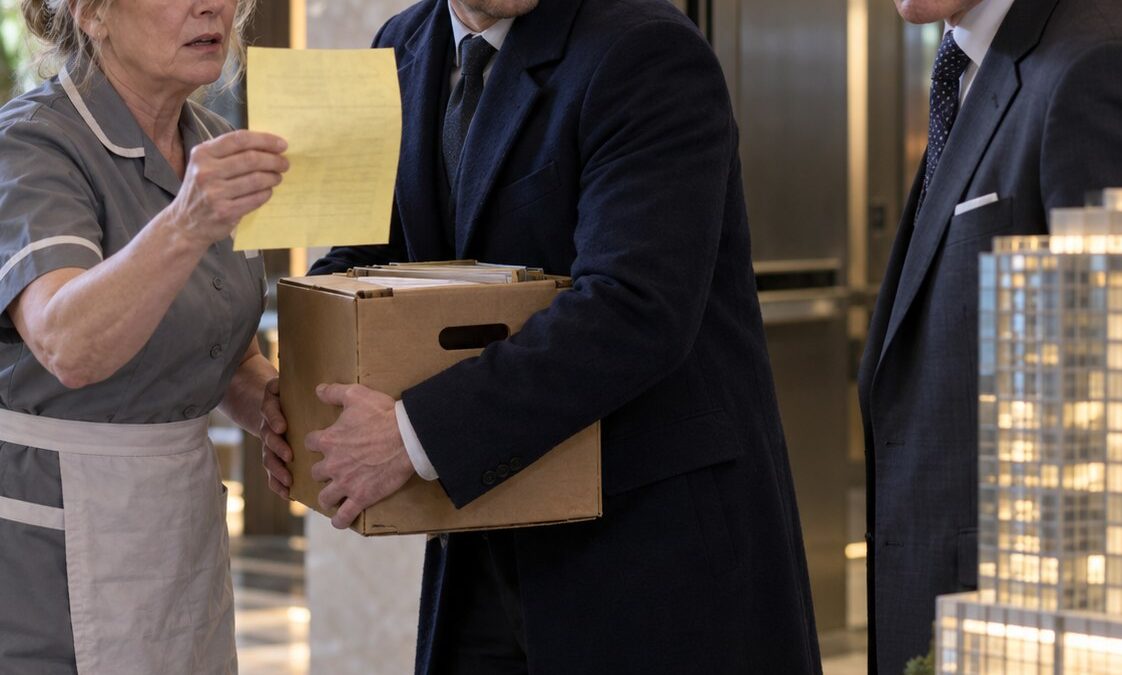
Miles stepped out carrying a cardboard file box.
He wore his good navy coat.
The one I had bought him for his first day at the housing office.
For a second, neither of us moved.
Then his eyes found the paper in my hand.
“Where did you get that?”
“Wren gave it to me.”
Grant turned toward him.
“You said she didn’t take anything.”
Miles put the box down.
The guard stepped away from the door.
That small movement told me more than Grant’s expression did.
He had expected trouble.
He had not expected Miles to recognize the sheet.
“Mom,” Miles said, “come outside.”
“Why?”
“Please.”
Grant spread his hands.
“You see what I’ve been dealing with?”
I looked at Miles.
He did not look at Grant.
“Wren is in the hospital,” I said.
“I know.”
“Did you see her?”
“Not yet.”
“Did you call her?”
“I tried.”
Her phone was in an evidence bag at the hospital.
I had watched a nurse give it to the police officer who took the first report.
Miles knew that.
I saw it in his face.
“Those files,” I said.
Miles touched the box handle.
“They’re routine.”
“Then open it.”
Grant laughed once.
“No one is opening confidential tenant files in my lobby.”
“Call the police,” I said.
The guard looked at him.
Grant did not make the call.
Miles picked up the box again.
“Mom, we can talk at the hospital.”
“We can talk here.”
He looked exhausted.
There was a pale line across his forehead where his glasses usually sat.
He had taken them off before coming down.
Miles had always done that when he needed to hide what he was feeling.
At twelve, he had removed them before telling me he had broken our kitchen window.
At thirty-six, he did it under Grant’s photograph.
“Wren called me,” he said.
“When?”
“Yesterday morning.”
“About the forms?”
“Yes.”
Grant took one step toward him.
Miles looked up.
“She said the signatures were wrong.”
Grant’s hand stopped in the air.
“Then why is she being called a thief?” I asked.
Miles swallowed.
“She copied a restricted file.”
“Which file?”
“The relocation packet.”
The building was due for renovation.
Grant had told residents they might need to move for several months.
The city had asked for proof that tenants received notice and information about help with the move.
Wren was supposed to hand out those notices.
She had told me some residents had never seen them.
“Did she copy it?” I asked.
“No.”
Miles rubbed his forehead.
“She asked me for it.”
“You gave it to her?”
“I told her I would check the originals.”
Grant’s voice came from behind the model.
“That is enough, Miles.”
Miles ignored him.
“I checked the file after she called.”
“What did you find?”
He looked at the yellow sheet.
“I found that copy missing.”
“Who took it?”
“I don’t know.”
“Did you ask Wren?”
“She stopped answering.”
Grant’s phone buzzed on the glass counter.
He glanced at it, then turned the screen down.
I thought of Wren waking confused in a hospital bed.
I thought of her saying she would bring me something.
Grant had called her a thief before anyone asked what she had seen.
I folded the yellow sheet along its old creases.
“Wren asked me to keep this,” I said.
Miles looked at me.
“No,” he said.
“She left it under my door.”
His face went still.
“That was Thursday.”
“Yes.”
“She called me Friday morning.”
Grant looked from one of us to the other.
For the first time, he seemed uncertain which conversation he was trying to stop.
Miles set the box on the floor.
“Friday,” he said, “she told me somebody had changed the file after she left it with me.”
* * *
I left Bellwether House with Miles beside me.
Grant stayed in the lobby.
He had offered to drive us.
Neither of us answered.
Outside, the river smelled of wet concrete.
Miles opened the passenger door of his car.
I walked past it.
My car was three blocks away, beside the courthouse where I had parked for work.
“Mom.”
“Bring the box to the hospital.”
“I can’t take tenant files there.”
“Then bring yourself.”
He followed me down the sidewalk.
At the corner, he caught up.
“I didn’t know she was hurt,” he said.
“You knew Grant was calling her a thief.”
“I heard that this morning.”
“And you came with his files.”
“I came because he ordered me to.”
Miles worked for Grant’s management company as a compliance coordinator.
He checked notices, tracked repairs, and sent packets to the city.
Two years earlier, he had been laid off from a bank.
Grant offered him steady pay and health coverage for his daughter.
I had celebrated when he got the job.
I remembered that as we stood at the crosswalk.
“I need you to tell me exactly what Wren said,” I told him.
The light changed.
We crossed without speaking.
At my car, Miles leaned against the hood.
“She called about four signatures,” he said.
“One belonged to Mrs. Bell.”
Mrs. Bell lived on the third floor.
She was seventy-eight and kept peppermints in a jar by her door.
“She said Mrs. Bell had been admitted to the hospital when the form was dated,” Miles continued.
“That’s one.”
“The others were people she couldn’t find.”
“What does that mean?”
“One moved out last winter.”
He glanced toward the river.
“Another died in January.”
I stared at him.
The city packet had been submitted in April.
“Did you tell Grant?”
“I asked his office for the paper originals.”
“What did they give you?”
“Scans.”
“Who uploaded them?”
“My login.”
The words landed hard.
Miles straightened.
“I didn’t upload those pages.”
“Could somebody use your password?”
“Only if I left my computer unlocked.”
“Did you?”
He looked away.
That was an answer.
I drove to the hospital alone.
Miles followed in his car.
Wren was awake when I reached her room.
She had a soft brace on her wrist and a purple bruise along her cheek.
I sat beside her.
“Aunt June,” she said.
“I have the yellow copy.”
Her eyes filled.
“Is it safe?”
“It is.”
“Did Grant see it?”
“Yes.”
She turned toward the window.
I waited.
The nurse had told me Wren might need time to put events in order.
I was not going to pull a story out of her just because I was frightened.
Miles appeared in the doorway.
Wren saw him.
Her hand closed around the blanket.
“I asked you to check,” she said.
“I did.”
“You told him.”
“No.”
“You told somebody.”
Miles did not step inside.
“I sent a question to the office about the missing originals,” he said.
“Grant answered it himself.”
Wren closed her eyes.
I put a cup of water near her good hand.
“Tell us what you remember,” I said.
“I was going upstairs.”
“From where?”
“The records room.”
“Why?”
“I wanted the sign-in log.”
Miles shifted.
“What log?”
“The staff log.”
Wren looked at him.
“Someone entered the records room after you checked the file.”
She remembered carrying her phone.
She remembered the service stair door opening.
After that, she remembered a man’s sleeve and the sound of her own keys striking a step.
She did not remember his face.
The police officer had taken a statement that morning.
He had told her the stairwell camera was broken.
Grant’s company controlled the camera system.
Miles knew it too.
Wren had kept the yellow copy because she thought it proved how the false signature was made.
But she had not been carrying it when she was hurt.
She had already given it to me.
“I thought Grant would come looking,” she said.
“Why give it to me?”
“Because you know printing.”
Her voice grew thinner.
“And because he knows where I live.”
I held her hand until she slept.
Then I walked with Miles to the family waiting room.
He called his supervisor and said he needed the afternoon off.
I called the officer whose card the nurse had given me.
Detective Anika Reed met us at the hospital an hour later.
She listened separately to Wren, Miles, and me.
She photographed the yellow sheet without taking it from my sight.
Then she put it in a clear sleeve and wrote down where Wren had found it and when she had left it with me.
Miles told her about the uploads.
He gave her the name of the city employee who received the packet.
Reed did not tell us Grant would be arrested.
She did not promise that the sheet proved a crime.
She said she would ask for the original file and the system records.
That was a smaller promise.
It was one she could keep.
The next morning, I called Mrs. Bell’s nephew.
I had his number because I had taken her groceries once when the elevator failed.
He said she was home from the hospital and willing to speak.
I asked if he could bring her a copy of the form before anyone questioned her memory.
He agreed.
By afternoon, Mrs. Bell had looked at the signature.
“That’s my name,” she told Reed by phone.
“It isn’t my writing.”
The dated hospital discharge papers confirmed where she had been.
The form was still a form.
The signature was still ink.
But somebody had placed her name on it while she lay in a hospital bed.
That evening, Miles called me.
He had finally opened his own work records.
“Mom,” he said, “the packet didn’t leave my account when I was at work.”
“It left at 2:14 in the morning.”
I gripped the phone.
“Were you there?”
“No.”
“Who had your login?”
He took a breath.
“I gave my password to Grant’s assistant last month.”
* * *
Grant’s assistant was named Celia Marsh.
I had met her twice at building meetings.
She spoke softly and remembered everyone’s apartment number.
That made the next part harder to believe.
It did not make it less true.
Miles said Celia had called him during a weekend repair emergency.
She needed to print a list of residents with mobility needs.
He was at home with his daughter, who had a fever.
He gave her the password because the list mattered.
He never changed it.
He told Reed that before I could tell him to.
Reed asked him to write down the date and the call number.
She asked the company to preserve its access logs.
Then she asked the city for its copy of the relocation packet.
The city attorney issued a hold on the pending renovation approval while staff checked the forms.
Grant heard about the hold within an hour.
At six that evening, a letter slid under my apartment door.
It came from his lawyer.
The letter demanded the return of company property and said Grant’s company was reviewing “financial irregularities” involving Wren.
I read it twice at my kitchen table.
There was no amount.
There was no missing check.
There was no description of what Wren had supposedly done.
I photographed it and sent it to Reed.
Then I put the original in a folder.
Wren was discharged the following morning.
She could stay with me until the dizziness eased.
Miles offered to pick her up.
She said no.
He did not argue.
On the drive home, Wren watched the storefronts pass.
She had lived at Bellwether House for four years.
Her apartment was small, but the window caught the afternoon sun.
She had painted one wall green.
Her plants would need water.
I asked whether I could get them.
“Take Miles,” she said.
“Why?”
“If Grant sees you alone, he’ll talk.”
“I can handle a conversation.”
“I know.”
She turned toward me.
“That’s why I’m asking.”
At my apartment, I made her toast and cut an apple.
She ate three bites.
Then she asked for the folder.
I showed her the lawyer’s letter.
Her cheeks reddened.
“He said that word before,” she said.
“Financial?”
“Irregularities.”
“When?”
“On Wednesday.”
Wren had brought Grant a list of residents whose forms looked wrong.
She had expected him to check.
Instead, he asked whether she had been using her office computer for personal matters.
She said no.
He mentioned a missing petty-cash envelope.
She had never handled petty cash.
“Why didn’t you tell me?”
“I thought I could fix it at work.”
She looked at her braced wrist.
“I didn’t want him to scare the tenants.”
That afternoon, Miles and I went to Bellwether House.
He stayed beside me while I watered the plants.
Grant was nowhere in sight.
Celia stood near Wren’s office.
She watched us carry out a sweater, a phone charger, and a bag of mail.
“You should let the company handle her things,” Celia said.
“Wren asked us,” I told her.
Celia’s face tightened.
“She has made this harder for everyone.”
Miles stopped.
“What happened to the staff log?” he asked.
“I don’t know.”
“Wren went to get it.”
“It’s probably in the records room.”
“The police asked for it.”
“Then they’ll have it.”
Celia went back into the office.
Miles waited until the door shut.
“She used to help Wren with tenant meetings,” he said.
“Did they fall out?”
“Not that I saw.”
We finished watering the plants.
As we left, Mrs. Bell opened her door.
She gave me a peppermint.
“I heard Wren’s home,” she said.
“She’s with me.”
“Tell her I remember what she said.”
“What was that?”
Mrs. Bell held the doorframe.
“She said I could take my time.”
Then she shut the door gently.
In the parking lot, Miles showed me a message from Grant.
He had been placed on leave.
Grant wanted his company laptop returned by five.
Reed had already told Miles to preserve work messages and let her know if the company asked to erase anything.
He called her before answering Grant.
That evening, she arranged for the laptop to be collected through the company’s lawyer.
I wanted to drive to Grant’s house.
I wanted him to feel, for one minute, what it was like to wait for news about someone you loved.
Instead, I washed Wren’s dishes.
There were four plates and a saucepan.
When I finished, she came into the kitchen wearing my old cardigan.
“You don’t have to stay awake,” she said.
“I know.”
I dried a plate.
“Mrs. Bell gave you a peppermint.”
Wren smiled.
“She thinks they cure everything.”
“She remembers what you told her.”
“That she could take her time?”
“Yes.”
Wren leaned against the counter.
“That was the whole job, really.”
Miles knocked at nine.
He had come to apologize.
Wren let him stand in the doorway.
“I should have changed the password,” he said.
“Yes.”
“I should have gone to Reed when I found the first bad form.”
“Yes.”
“I’m sorry.”
Wren looked at his shoes.
“You also let Grant say I stole.”
“I did.”
“I need you to understand that part.”
“I do.”
She stepped back.
It was not an invitation inside.
Miles understood.
After he left, Reed called.
The city had provided a record of every page in the packet.
The false forms had been uploaded through Miles’s account.
Their file names came from a scanner in Grant’s executive office.
Reed had also obtained the staff log.
One name appeared on the records-room entry before Wren was hurt.
Grant Voss.
* * *
The police interviewed Grant.
He told them he had entered the records room to collect documents for the city.
He said Wren was upset about a possible discipline meeting.
He said he had not seen her near the stairs.
Reed told us only what she was allowed to tell us.
She had requested the building’s camera records.
The service stair camera had stopped saving footage two weeks earlier.
A hallway camera still worked.
Its angle ended before the stair door.
Grant’s lawyer said the missing video proved nothing.
That was true by itself.
The city, however, had a different problem.
The packet carried signatures from people who said they had not signed.
One of those people had died three months before the stated date.
City staff suspended consideration of Grant’s relocation plan.
They notified the tenants directly.
They also asked a nonprofit housing lawyer to attend a meeting and explain what the notice meant.
No one had to move while the application was on hold.
Wren cried when she heard that.
Then she asked about Mrs. Bell.
Mrs. Bell had received her letter that morning.
She had called the lawyer herself.
I drove Wren to the tenant meeting a week later.
She wore her wrist brace and a blue coat.
I offered to walk in with her.
“Please,” she said.
The room was the public library’s meeting hall.
Folding chairs filled quickly.
People brought envelopes, photographs of leaks, and copies of letters they could not understand.
Wren sat in the front row.
I sat behind her.
Miles stood at the back.
Grant arrived with his lawyer.
Celia followed, carrying a neat stack of folders.
The city’s housing director, Paul Ennis, opened the meeting.
He said the city had not approved the relocation plan.
He said staff were checking whether residents had received accurate notices.
Then Grant asked to speak.
He stood beneath a fluorescent light that made his face look flat.
“Bellwether House needs repairs,” he said.
“No one here disputes that.”
He described an aging boiler, water damage, and apartments that needed new wiring.
Those things were real.
Wren had reported some of them herself.
Grant said a delay could cost the building its financing.
He said his company had offered temporary housing and moving help.
Some residents nodded.
Others watched Celia’s folders.
Grant turned toward Wren.
“Unfortunately, one employee chose to take sensitive documents home.”
Wren held still.
His lawyer touched his arm, but he continued.
“We are cooperating with the city.”
I felt Miles come down the aisle.
He stopped beside my chair.
“Let me answer,” he whispered.
“Wait,” I said.
The housing director reminded Grant that personnel accusations did not belong at the meeting.
Grant apologized without looking at Wren.
Then he held up a copy of a signed acknowledgment.
It carried Mrs. Bell’s name.
“People may not remember every form,” he said.
Mrs. Bell rose from the third row.
“I remember you,” she said.
Grant lowered the page.
“You visited me last year when the elevator broke.”
“I did.”
“You promised it would be fixed by Christmas.”
“It was.”
“In February.”
A few people murmured.
Mrs. Bell lifted her hospital bracelet from her purse.
Her nephew had asked her to keep it until the city finished checking the date.
“On the day your paper says I signed,” she said, “I was having my knee looked after.”
Grant’s lawyer stood.
“The document’s origin is under review.”
Mrs. Bell sat down.
The lawyer was right to avoid deciding the matter in that room.
But Grant had chosen to show the document to everyone.
Now everyone knew its date could be checked.
After the meeting, Celia approached me near the water fountain.
“You think he made those forms,” she said.
“I think somebody did.”
“You don’t know what would happen if the financing fell through.”
“Tell the city what you know.”
She looked toward Grant.
“He’ll ruin this place before he lets someone else run it.”
“Is that what he told you?”
Celia pressed her lips together.
Then she walked away.
Miles had heard the last sentence.
He told Reed that night.
Celia had given us a warning.
She had also told us why Grant cared about control.
The next day, the city released the public portion of Grant’s application.
Miles printed it at the library and brought it to my kitchen.
Grant wanted permission to move residents while the building was renovated.
A separate company had offered to buy the property after the work was finished.
That company shared an address with Grant’s brother.
The proposed sale price was far above what Grant had paid.
Wren read the pages slowly.
“The repairs are real,” she said.
“Yes,” Miles told her.
“But if he clears the building first, the buyer gets an empty property.”
“He said everyone could come back.”
“The offer letters say they can apply.”
Wren put the pages down.
Those were different promises.
Reed called that afternoon.
A technician hired by the city had recovered a copy of the working hallway camera’s footage from its recorder.
It showed Wren entering the service corridor.
Six minutes later, Grant entered.
He came back out alone.
There was still no view of the stairs.
Then the footage showed Celia entering with a set of keys.
She came out two minutes later carrying Wren’s tote bag.
Reed had already interviewed her.
Celia wanted a lawyer before saying more.
The name behind the false forms was becoming clearer.
So was the reason they had been made.
Grant had planned to sell an emptied building to a company his family controlled.
* * *
Celia called Reed the next morning.
Her lawyer went with her.
I did not hear her statement.
I learned its shape weeks later, when the city held a formal hearing and the records became part of the case.
Celia said Grant had ordered staff to finish the tenant packet before a financing deadline.
When she told him several tenants had not returned forms, he told her to “complete the file.”
She used an old list of names and apartment numbers.
She had Miles’s password.
She scanned the pages from Grant’s office.
Grant had seen the finished packet before it went to the city.
Celia said she did not push Wren.
She said she went into the service corridor after hearing a crash.
Grant was already there.
Wren was on the stairs.
Celia picked up Wren’s tote because Grant told her company files might be inside.
She took it to his office.
She did not call for help until Grant told her to.
The emergency call came eleven minutes after the hallway footage showed Grant entering the corridor.
Grant denied giving those instructions.
He said Celia had forged forms to conceal her own mistakes.
He said he had found Wren after she fell and had gone to fetch help.
His lawyer argued that the camera did not show an assault.
Reed agreed on that point.
She did not pretend the camera showed more than it did.
The city hearing concerned the application and the documents.
The police investigation concerned the injury and the false report.
The two processes moved at different speeds.
For Wren, they seemed to move at no speed at all.
She slept badly.
She forgot small words, then got angry at herself.
Her doctor told her recovery could be uneven.
On better mornings, she sat at my table and sorted the mail.
On worse ones, she watched the river from my window.
I went to work at ten each night.
At dawn, I came home and made oatmeal.
We learned a schedule that held us both.
Miles came by twice a week with groceries.
He stayed only when Wren asked him to.
Once, he brought pears because she had liked them as a child.
“They’re still hard,” she told him.
“They were the best ones.”
“They could hold up a shelf.”
He came back three days later with ripe pears.
That was how their conversations began again.
The city hearing took place six weeks after Wren was hurt.
Bellwether residents filled the back rows.
Grant sat with two lawyers.
Celia sat with hers.
Miles sat between Wren and me.
The housing director explained what the city needed to decide.
It had to determine whether the application contained reliable tenant acknowledgments.
It also had to decide whether work should proceed under Grant’s proposed relocation plan.
Grant’s lawyer argued that the city was punishing a building full of residents over paperwork errors.
He was persuasive.
The roof leaked.
The boiler had failed twice.
Delay had a cost.
Wren leaned toward me.
“He’s using what they need,” she whispered.
“I know.”
Grant testified that his company had invested in Bellwether when other buyers walked away.
He described repairs completed during his ownership.
He said he regretted relying too heavily on staff.
Then he said Wren had created confusion by removing a company form.
I felt her hand go cold in mine.
The city attorney asked what form he meant.
Grant described the yellow carbon sheet.
“Was it part of the packet?” the attorney asked.
“No.”
“Was it a tenant acknowledgment?”
“It was an unused copy.”
“Then why was its removal important?”
Grant paused.
“It shows she had access.”
The attorney asked me to come forward.
I gave my name, my former print-shop job, and the date Wren left the sheet under my door.
I did not claim to be an expert.
I said what I had seen.
The paper had pressure marks from writing on a sheet once placed above it.
Those marks did not line up with the printed spaces.
The name and apartment number matched a form Grant’s company had submitted.
An independent document examiner hired by the city had compared the sheets.
She had found that the pressure marks came from a different layout than the submitted form.
The company could not produce a matching yellow copy for the form it had filed.
That did not tell the city who wrote the false signature.
It did show why Wren had questioned the packet.
Grant’s lawyer asked whether I disliked his client.
“Yes,” I said.
A few heads turned.
“I disliked how he treated my niece after she was hurt.”
“Then your opinion is personal.”
“My opinion is.”
I looked at the yellow sheet in its clear sleeve.
“The marks are there whether I like him or not.”
The lawyer sat down.
Next, the city’s records specialist testified about the uploads.
Miles’s account had sent the packet at 2:14 a.m.
The scanner identified in the files belonged to Grant’s office.
The city’s copy had not been altered after receipt.
Mrs. Bell’s hospital record confirmed that she was a patient on the day her form said she signed in the Bellwether lobby.
A death certificate confirmed another supposed signer had died in January.
Celia testified after lunch.
She kept her eyes on the table.
She admitted creating signatures.
Her lawyer had arranged for her to give information to the investigators.
She said Grant directed her to finish the packet.
Grant’s lawyer pressed her hard.
He asked why she had used Miles’s account.
He asked why she waited until police interviewed her to tell the truth.
Celia answered both questions.
She had used the account because it worked.
She had waited because she was afraid of losing her job and facing charges.
The lawyer asked whether she hoped to avoid punishment by blaming Grant.
“Yes,” she said.
That answer made the room quiet.
Then she added, “I also signed people’s names.”
Grant stared straight ahead.
The hearing officer did not announce a verdict that day.
A week later, the city rejected the relocation packet and referred the false documents for criminal review.
It required new notices, direct contact with tenants, and independent oversight before considering any plan to move residents.
Emergency repairs could continue.
Grant’s proposed sale did not go through.
Two months after that, prosecutors filed charges connected to the forged submissions and the alleged interference with the investigation.
Grant pleaded not guilty.
The case took nearly a year.
Celia entered a plea and testified.
Grant eventually admitted ordering false acknowledgments as part of an agreement that included restitution, a ban from managing the property, and a sentence set by the court.
The injury case was narrower.
Prosecutors could prove he delayed the emergency call and tried to take Wren’s bag.
They could not prove beyond a reasonable doubt that he had pushed her.
Wren hated that limit.
So did I.
It remained the truth of what the evidence could show.
On the day Grant left court, he looked at me.
“You cost those people their renovation,” he said.
I thought of Mrs. Bell waiting months for an elevator repair.
I thought of Wren asking each tenant to take their time.
“They’ll get one,” I said.
“They’ll know what they’re signing.”
* * *
Bellwether House got its repairs.
A court-appointed manager kept the heat on while the owners and lenders sorted out who would take over.
The city approved a new plan the following spring.
A housing nonprofit bought the building with financing that kept its apartments affordable under a recorded agreement.
The residents received notices in plain language.
Some moved temporarily while their floors were repaired.
Mrs. Bell chose a first-floor apartment when she returned.
She said she liked the shorter walk to the mailbox.
Wren said she liked being able to find Mrs. Bell without waiting for the elevator.
Neither of them mentioned the stairs.
Wren did not go back to work for Grant’s company.
She took several months to recover.
When she was ready, the nonprofit offered her a resident-services job.
She asked for the offer in writing.
Then she asked whether residents could speak to someone outside management if they believed a form was wrong.
The director showed her the process.
Wren took the job.
Her first project was a table in the lobby where anyone could bring a notice and ask what it meant.
She stocked it with pens that actually worked.
Mrs. Bell stocked it with peppermints.
Miles found a different job too.
He applied to the county’s benefits office.
He told the hiring panel why he had left Bellwether.
They hired him after checking his references and his role in the investigation.
On his first day, he changed his password twice.
When he told us, Wren said, “That seems like enough for one morning.”
Miles laughed.
Then he stopped laughing and looked at her.
“I know one joke doesn’t fix it,” he said.
“I know.”
“I’m sorry I made you carry the risk alone.”
She turned a peppermint in its wrapper.
“You can help now,” she said.
“How?”
“When somebody tells you a document feels wrong, listen before you tell them the system is fine.”
“I will.”
She nodded.
That was the boundary.
They did not become close again overnight.
Some Sundays, he came to dinner.
Some Sundays, Wren declined.
He kept asking without acting entitled to yes.
I had my own choice to make.
Grant’s company agreed to pay Wren for wages it had withheld and to settle her claim over the false accusations.
The amount covered her medical bills and several months away from work.
She accepted it after talking with her lawyer.
I was offered a smaller payment for legal expenses and the time I had missed from work.
I used part of it to replace the tires on my car.
The rest went to a fund that helped Bellwether tenants pay for temporary moves during repairs.
I did not announce it at the building meeting.
Mrs. Bell found out anyway.
She handed me a peppermint and said, “You can keep one for yourself.”
“I bought tires.”
“Good.”
She inspected my shoes.
“Buy better ones next.”
I did.
They were black, plain, and comfortable enough for the courthouse halls.
I kept the old pair in a closet until Wren made me throw them away.
One evening, nearly a year after her fall, Wren asked me to meet her at Bellwether.
The lobby had new paint.
The glass building model was gone.
A long wooden table stood where it had been.
On the table lay forms for the next round of repairs.
Wren had put a sign beside them: TAKE A COPY HOME.
She watched me read it.
“Too bossy?” she asked.
“Clear.”
“I learned from somebody.”
“I hope you mean Mrs. Bell.”
“I do.”
Then she took a small envelope from her pocket.
Inside was a photograph of my sister and me in our print shop.
We were younger than Wren was now.
My sister held a stack of paper against her hip.
I had ink on my cheek.
Wren had found the picture while looking for her birth certificate in an old box at my apartment.
“I want it by my desk,” she said.
“It’s yours.”
“I wanted to ask.”
“You don’t need permission for a photograph of your mother.”
“I know.”
She looked toward the new table.
“I wanted to ask you something else.”
Wren wanted to start a free monthly session for tenants across the neighborhood.
People could bring notices from landlords, employers, or city offices.
Volunteers would help them find the right questions to ask and the right offices to call.
She wanted me there for the first one.
“You know how paper works,” she said.
“I know how old paper works.”
“And people.”
“I’m still learning that.”
She waited.
I thought of the courthouse bins, the midnight shifts, and every form I had assumed somebody else understood.
“Yes,” I said.
“For the first one?”
“For the first one.”
Wren smiled.
“After that, I’ll ask again.”
* * *
Five years later, I walked into Bellwether House with a box of clean pens.
I had retired from the courthouse in June.
The lobby table was still there.
Its corners were worn smooth.
A teenager sat beside Mrs. Bell, helping her read a letter from her insurance company.
Mrs. Bell was eighty-three and still carried peppermints.
Miles had brought his daughter to help arrange chairs.
She was twelve now and believed every folding chair had been designed by someone angry.
Wren agreed with her.
They set out eight anyway.
The monthly session had spread to three buildings.
Some people came with difficult notices.
Some came to help a neighbor.
No one had to explain why they needed time.
Wren met me at the table.
Her wrist had healed.
On damp mornings, it ached.
She had learned which tasks to hand to someone else.
That took longer than the bone had.
“Did you bring the good pens?” she asked.
“Every one.”
She opened the box and tested three.
Then she pointed to a small frame on the wall.
Inside it sat a copy of the yellow sheet.
The original had stayed with the case records until the legal work ended.
When it was returned, Wren chose to keep it at home.
The copy on the wall showed only the printed number and the blank signature line.
Beside it was a card she had written herself.
TAKE A COPY HOME.
I stood in front of it for a moment.
Five years earlier, I had held that sheet against the light while Grant looked down at my shoes.
I had thought I was carrying proof for one person.
Wren had known more.
She had left me a way to ask the next question.
A man entered the lobby holding an envelope.
He looked uncertain until Wren waved him over.
Mrs. Bell offered him a peppermint.
Miles’s daughter pulled out a chair.
I placed a pen beside it.
Wren asked the man what he needed.
He showed her the letter.
“Can I take my time?” he asked.
“Yes,” she said.
She moved the chair closer to the table.
“We have plenty.”
THE END








