My Seven-Year-Old Son Ordered the City’s Most Feared Don to Kneel—Then the Brass Key in My Hand Made Him Go Silent
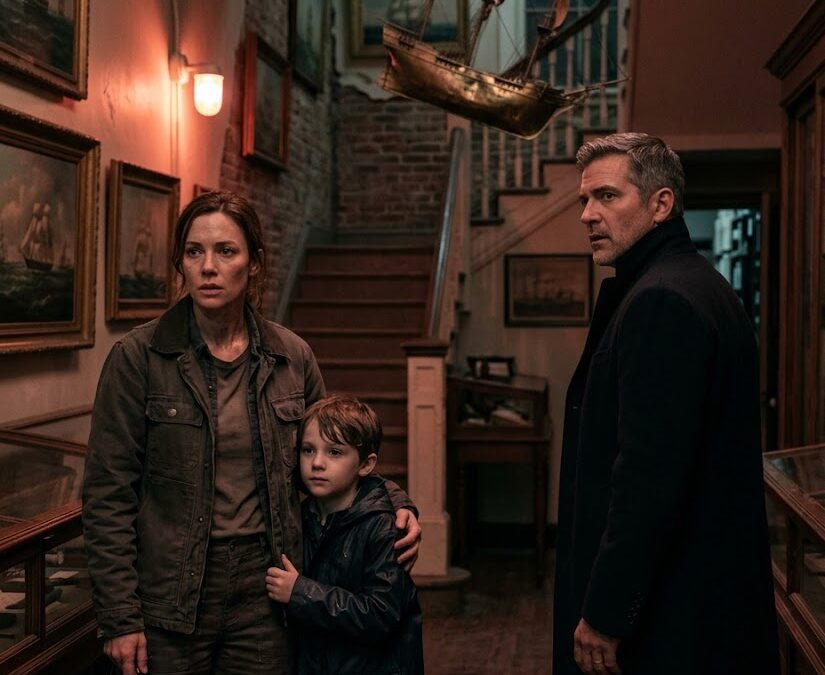
Chapter 2: What the Key Opened
The lock clicked again.
Rafe moved in front of Noah.
I pulled my son behind me.
The emergency lamp washed the gallery red.
The bronze ship hung crooked overhead.
The security officer lifted his radio.
“East corridor,” he said. “I need a response.”
Static answered.
Rafe’s guards drew no weapons. They watched the dark.
A door opened somewhere beyond the map room.
Then came footsteps.
Slow.
Measured.
Rafe looked at the key in my bloody palm.
“Put it away.”
“Why?”
“Because whoever is in there expects to find it.”
“Who?”
“Someone who shouldn’t know you have it.”
The security officer frowned. “You said the gallery was secure.”
“It was.”
“You own the building?”
“No.”
“Then stop giving orders.”
Rafe nodded toward the ceiling. “The ship’s rigging is compromised. If the power reset moves that brace, we have another problem.”
The officer glanced up.
Noah’s fingers tightened around my coat.
“Is the ship going to fall?”
“Not if everyone stays out from under it,” Rafe said.
“Then tell everyone.”
The officer began radioing the lobby.
Rafe’s nearest guard leaned toward him. “We should clear the building.”
“Quietly,” Rafe said.
The footsteps stopped.
Noah looked up at me.
“Mom, that’s the person from Tuesday.”
I felt my stomach turn.
“What person?”
“The man by the bus stop.”
Rafe looked at him. “You saw him?”
“He had a gray hat. He was looking at you.”
The footsteps started again.
Closer.
Rafe stepped to the side, shielding the corridor without crowding us.
“Can you take the service stairs?” he asked.
“I’m not leaving him.”
“I didn’t ask you to.”
That was the first thing he’d said that sounded like the truth.
The security officer found the light panel and opened its metal cover.
“Backup system’s down.”
“Then keep people away from the archive,” Rafe said.
“Why?”
“Because my name may be why someone is here.”
The footsteps reached the other side of the gallery door.
Noah whispered, “Is he bad?”
“I don’t know,” I said.
Rafe heard me.
“That’s fair.”
The door opened.
A museum conservator stepped into the red light, carrying a tool bag.
It was Hal Mercer, the night facilities manager. He’d been at the museum since before I started. He wore the same gray cap Noah had described.
His eyes went first to Rafe.
Then to the key.
“Mrs. Alvarez,” he said. “You’re supposed to be in the east wing.”
“Power’s out.”
“I know. I’m checking the archive.”
“Why?”
“Because the electronic lock failed.”
Rafe watched him. “You have a key.”
“Everyone knows I have a key.”
“Not that key.”
Hal glanced at my hand.
The tool bag slipped half an inch down his shoulder.
Noah stepped close to me.
“You were at the bus stop,” he said.
Hal’s face stayed calm. “I take the bus.”
“You were looking at Mr. Bellini.”
“I was looking at the museum.”
“You were looking at him.”
Rafe’s guard moved one step.
Rafe stopped him with a hand.
Hal breathed out. “This is getting ridiculous.”
The security officer raised his radio again.
“You’re not going into the archive,” Rafe said.
“I work here.”
“Not tonight.”
“You don’t employ me.”
“No,” Rafe said. “But I employ the person who signs your checks.”
Hal’s expression hardened.
“That sounds like a threat.”
“It’s a fact.”
The officer moved between them. “Nobody goes anywhere until the police arrive.”
Hal set down his tool bag.
“Fine.”
The footsteps stopped behind the door.
The room seemed to settle.
Then the emergency lights snapped back on.
Hal’s hand shot toward the bag.
The security officer caught his wrist.
“Don’t.”
A small metal object hit the marble and skittered beneath the exhibit bench.
A key.
Not mine.
Rafe looked toward the archive corridor.
“Call the police now,” he said.
The officer kept Hal’s wrist restrained. “Already did.”
“Call the fire department too. This ship’s rigging needs inspection.”
“You keep saying that like you’re in charge.”
“I keep saying it because you’re standing under a suspended boat.”
That got the officer moving.
Hal stared at me.
“You should leave,” he said.
“You just tried to open the archive.”
“I was doing my job.”
“You came here on your night off.”
He said nothing.
Rafe lowered himself enough to meet Noah’s eyes.
“Can you show the officer where you saw the man?”
“He’s right there.”
Noah pointed at Hal.
The officer looked at Hal’s cap.
“You saw him Tuesday?”
“I saw someone like him.”
“Why didn’t you tell me?”
“Because Mom was tired.”
I squeezed his shoulder.
“Good answer.”
Rafe glanced at Noah. “What did the man do?”
“He put something in the trash can.”
“What was it?”
“A white envelope.”
Rafe turned to the officer. “Check the bus stop camera.”
The officer stared. “We don’t have access to city cameras.”
“I do.”
“That won’t be admissible.”
“Then don’t use it as evidence. Use it to tell us where to look.”
The officer considered that.
Then nodded.
The sirens arrived twelve minutes later.
By then, Hal sat in the lobby with a uniformed officer beside him. The museum’s security staff had secured the archive corridor. A city fire inspector was examining the rigging.
Rafe remained in the gallery.
He had taken off his coat and folded it over a chair.
Noah sat beside me, eating the crackers a guard had found in his pocket.
“You can go,” I told Rafe.
“I know.”
“You knew Eli?”
“I did.”
“You didn’t answer me.”
“I met him three times.”
“Why?”
“He worked the docks.”
“Eli was an archivist.”
“He worked both places.”
I stared at him.
Eli had never told me about the docks.
Rafe sat on the opposite bench, leaving space between us.
“I’m not asking you to trust me,” he said.
“Good.”
“I’m asking you not to open that cabinet alone.”
“I’ve already tried.”
His expression shifted.
“When?”
“Three days after Eli’s funeral.”
“Did you turn the key?”
“No. Someone came down the hall.”
“Did you see who?”
“No.”
Rafe rubbed his thumb over a small scar on his knuckle.
“Then the person who interrupted you may have been watching the cabinet.”
“Or watching me.”
“Yes.”
“Why would they care about my husband?”
“Because he found something.”
“What?”
“I don’t know yet.”
“You knew him.”
“I knew he was careful.”
“That isn’t the same as knowing him.”
“No,” Rafe said. “It isn’t.”
The fire inspector approached the bench.
“Mr. Bellini, the suspension bracket didn’t fail from age.”
Rafe looked at the ceiling.
“Someone loosened it.”
The inspector lowered his voice. “We’ve secured the area. The police have the cable.”
I looked toward the ship.
Noah had been standing beneath it.
My knees went weak.
Rafe noticed.
He reached for the crackers and held them out to me.
It was a small gesture.
That somehow made it harder to refuse.
“Did Eli ask you for help?” I said.
“Once.”
“When?”
“Eleven months ago.”
The same month he died.
“What did he ask?”
“To keep a copy of something safe.”
“What thing?”
“A ledger.”
“What was in it?”
“Payments. Shell companies. Port contracts. Names of people who used the docks to move stolen medicine.”
“Who?”
“I don’t know all the names.”
“You expect me to believe that?”
“I expect you to check.”
The officer returned from the lobby.
“Hal Mercer says he was called to the museum by a supervisor. He won’t name the supervisor.”
“Was there a call?” I asked.
“His phone shows one.”
“From whom?”
“Blocked number.”
Rafe stood.
“Take the phone.”
“We need a warrant.”
“Then get one.”
The officer looked annoyed. “I know how to do my job.”
“I hope so.”
I moved between them.
“Stop.”
Both men looked at me.
“Eli is dead. My son was under that ship. This is not a contest over whose voice fills the room.”
Rafe’s jaw tightened.
Then he nodded.
“You’re right.”
That was the first time a powerful man had agreed with me without making me pay for the agreement.
The officer told me the police would want a statement.
I asked whether Noah had to give one.
“Not tonight,” he said.
The fire inspector was still there, so we waited in the lobby while the archive was secured.
Noah fell asleep with his head against my shoulder.
Rafe watched him.
“He looks like Eli,” he said.
“I know.”
“Eli didn’t know he’d have a son?”
“He knew.”
“Then why did he ask me to keep a ledger?”
“Maybe he thought he was protecting us.”
“From you?”
“Maybe.”
Rafe gave that answer room.
He didn’t defend himself.
The museum director arrived, breathless and furious about the power outage. He looked past me at Noah.
“Children aren’t permitted in the building after hours.”
“He’s with me.”
“That’s not the point.”
“It is tonight.”
The director lowered his voice. “Your employment is already under review, Mrs. Alvarez.”
I felt Noah stir against me.
Rafe stepped forward.
The director straightened. “Mr. Bellini—”
“Don’t.”
“Your foundation—”
“Does not employ her.”
“Your family has been a major donor.”
“And you’ve mistaken donation for ownership.”
The director glanced at me.
Rafe turned away from him.
“I’ll provide a lawyer if you want one,” he said quietly. “You can decline.”
“I might.”
“That’s your choice.”
“I know.”
He looked at the sleeping boy.
“Take him home. I’ll stay until the police finish.”
“You don’t have to.”
“No.”
It was the first time he’d answered without pretending duty and desire were the same thing.
The next morning, the police gave me a case number and asked me to return for a formal interview.
Rafe’s lawyer called once.
I declined the offer.
Then I called my sister, who watched Noah while I went to the precinct.
By noon, I had told a detective everything I knew.
Not what I feared.
What I knew.
The detective was named Anika Shaw. She wore reading glasses on a chain and wrote every detail down by hand.
“Your husband worked at the museum and the docks?”
“He cataloged shipping records for the maritime archive.”
“Was he employed by Bellini?”
“Not that I knew.”
“Did he ever say he was afraid?”
“No.”
“Did he change his routine?”
“He stopped taking the highway home.”
“For how long?”
“Two weeks.”
“Did he say why?”
“He said roadwork.”
Detective Shaw wrote it down.
“Did he have enemies?”
“Eli was a records clerk.”
“That doesn’t answer the question.”
“I don’t know.”
She turned to the brass key.
“Who gave you this?”
“Eli.”
“When?”
“On our last Sunday together.”
“What did he say?”
“He said, ‘Keep this where it can’t be found.’”
“Did you ask what it opened?”
“I did.”
“What did he say?”
“‘Something old.’”
The detective nodded.
“Why did you take it to the museum?”
“I saw the keyhole in the archive cabinet.”
“Did you open it?”
“No.”
“Why not?”
“I heard someone in the hallway.”
“What did that person sound like?”
“Like they didn’t want to be heard.”
Detective Shaw stopped writing.
“That may be important.”
The museum director insisted the cabinet belonged to the institution. The police obtained a warrant to inspect it.
The key fit.
I watched the detective turn it.
The lock gave with a heavy clunk.
Inside sat two archive boxes, a ledger, and a padded envelope with my name written on it.
My hands shook.
Detective Shaw opened the envelope first.
There was one letter.
“June,” it began.
I sat down.
Eli’s handwriting slanted hard to the right. His letters pressed so deep into the paper that some words had left grooves on the page.
“If you’re reading this, I didn’t get to explain.”
I stopped.
The detective waited.
I kept reading.
“I found duplicate invoices in the harbor records. The same shipment number appeared twice, once for medical supplies and once for freight that never reached the clinic.”
At the bottom, he’d written:
“Rafe knows the route. He doesn’t know who changed the books.”
The first truth landed quietly.
Rafe hadn’t asked Eli to keep the ledger.
Eli had asked Rafe to help him preserve it.
Detective Shaw looked at the rest of the papers.
“We’ll need to verify every entry.”
“Can you?”
“We can start.”
The ledger covered eighteen months of shipments. Each page included dates, container numbers, payment codes, and two sets of initials.
Eli had made careful notes in the margins.
The numbers were enough for a financial crimes unit to begin checking against port records.
The detective photographed every page before anyone moved it.
An analyst compared the listed container numbers to public shipping records.
Two shipments had been marked as medical equipment. Both had been redirected before they reached a rural clinic.
The clinic had later reported missing supplies.
The missing crates had been sold through private brokers.
Three initials appeared beside the changes.
One belonged to Hal Mercer.
One belonged to a shipping manager who had resigned six months earlier.
The third was unfamiliar.
Rafe Bellini came to the museum after the police called him.
He brought no guards into the archive.
He waited outside the door until Detective Shaw told him to enter.
“I knew Eli suspected stolen shipments,” he said. “I didn’t know they were medical supplies.”
“You could have told the police that,” I said.
“I did.”
“After my son was nearly crushed.”
“Yes.”
“You didn’t call me before tonight.”
“No.”
“Why?”
“Because I thought whoever was watching Eli might be watching you.”
“You thought leaving me in the dark was protection.”
“I thought it was safer.”
“You were wrong.”
“I was.”
The detective watched him.
“Mr. Bellini, did you keep any duplicate records?”
“No.”
“Did you transfer money to Eli?”
“No.”
“Did you know Hal Mercer?”
“Only through the museum.”
“Your foundation donated to the museum.”
“Yes.”
“Did that give you access to its records?”
“No.”
I looked at Rafe.
“You knew Eli was in danger.”
“I knew he was afraid.”
“What did he tell you?”
“He said he had found a pattern. He didn’t name the people involved.”
“Why not?”
“He said a name could put you at risk.”
“And you agreed?”
“Yes.”
The detective asked for his phone records.
Rafe gave consent.
The next morning, Noah and I met Detective Shaw at a small office away from the museum.
A port investigator had arrived with printed records.
He showed us the first shipment.
The clinic order had requested cardiac monitors, sterile tubing, and medication refrigerators.
The shipment manifest showed those items loaded onto a truck.
The clinic’s receiving log showed nothing arrived.
A second set of documents showed the same shipment redirected to a private warehouse.
“Who owns it?” I asked.
“The company is registered to a holding group,” the investigator said.
“Who owns the holding group?”
“We’re tracing it.”
“Can the ledger prove it?”
“Not by itself,” Detective Shaw said. “But it gives us dates and numbers to compare.”
I had cataloged museum shipping records for three years.
I knew where errors lived.
Not in the totals.
In the repeats.
I scanned the ledger’s notes and spread the pages across the table.
“Eli marked duplicates with a small slash,” I said.
The investigator leaned closer.
“These?”
“Yes.”
“They’re all shipments that were entered twice.”
“Not exactly.”
I pointed to the dates.
“Every duplicate was entered on a Monday, but the shipment had arrived on Friday.”
“Why does that matter?”
“The museum’s archive system imported port records on Monday mornings. Anything changed after Friday sat in a temporary batch until then.”
The investigator read the entries.
“You’re saying someone changed the records before they entered the system.”
“I’m saying the person had access to the temporary batch.”
“Who had that access?”
“Staff with archive credentials. The shipping office. And anyone whose badge could open the records room.”
The museum’s access logs showed five people had entered the records room during those windows.
Hal was one.
The director was another.
A donor-relations coordinator named Pauline Voss was a third.
The detective looked at me.
“Did you recognize her?”
“She signed my timesheets.”
“Was she close to your husband?”
“I saw them speak once.”
“When?”
“Two weeks before he died.”
“What about?”
“I don’t know.”
The detective pulled up a still image from the museum camera.
Eli stood beside Pauline near the archive door.
She held a folder.
He held a paper cup.
They weren’t smiling.
Pauline had told police she barely knew him.
The second truth came from the lie.
The person who had said she barely knew Eli had been meeting him privately.
Pauline Voss.
The detective requested another interview.
Pauline did not appear.
Her attorney called to say she had a family emergency.
The attorney also requested copies of the ledger.
Detective Shaw refused.
The following evening, someone left a white envelope on my apartment stair.
No name.
No stamp.
Just my address in block letters.
I didn’t touch it.
I called the police.
They came within twenty minutes.
The envelope contained a photocopy of Noah’s clinic appointment card.
On the back, someone had written:
“Stop opening things.”
Noah was at my sister’s house.
I sat in the kitchen until he came home.
He drew pictures at the table while I watched the front window.
“Are you scared?” he asked.
“Yes.”
“Are you going to let the person win?”
“I don’t know.”
He drew a ship with crooked lines.
“Then we’ll find out.”
I hugged him.
The police took the envelope.
The fingerprint report found a partial print, but no match.
The detective also checked the building cameras.
A figure in a hood had entered the stairwell, but the face was hidden.
There was no clear image.
Noah’s appointment card had been copied from his backpack, not the clinic’s system.
Someone had handled it.
Detective Shaw asked if I wanted a patrol car outside.
I said yes.
Rafe called that night.
“I heard about the envelope.”
“From whom?”
“The detective.”
“Did you ask her to call you?”
“No.”
“Did you ask someone else?”
“No.”
“Then how did you hear?”
“She asked me whether I recognized the handwriting.”
“Did you?”
“No.”
“Did Eli?”
“I don’t know.”
Rafe paused.
“June, I want to move you and Noah to a protected apartment.”
“No.”
“Not my house. A neutral place.”
“No.”
“I can have security outside.”
“The police already offered that.”
“Then take it.”
“I did.”
“Good.”
“I don’t want your people near my son.”
“I understand.”
“You keep saying that.”
“Because I’m trying to.”
“Try from farther away.”
A longer silence followed.
“I’ll stay available through Detective Shaw,” he said.
“That’s all.”
The next morning, a delivery truck stopped outside the museum.
It was unmarked.
A driver carried in two boxes of cleaning supplies.
The museum manager signed for them.
The first box contained supplies.
The second held a small black recorder and a note.
“Ask Bellini who ordered the west gallery inspection.”
Detective Shaw had the recorder examined.
It contained no usable audio.
The note had been typed on a museum office printer.
The printer log showed it came from the donor-relations office.
Pauline Voss still had access to the building.
The police went to her apartment.
She wasn’t there.
Her car was parked in the garage.
Her phone was off.
The third truth came from the records room.
Pauline had been copying Eli’s ledger entries for months.
But she hadn’t started the scheme.
Her credentials had been used to move the stolen shipments through the system. The financial accounts led to a shell company owned by a private logistics firm called Northline Recovery.
Northline’s largest client was Bellini Shipping.
Rafe had been telling the truth about one thing.
He had not known what the shipments contained.
But Northline’s owner was his cousin, Matteo Bellini.
Rafe read the name on the investigative report and went still.
“He handled the company’s accounts,” he said.
“Your cousin,” I said.
“Yes.”
“You didn’t know?”
“I knew he owned Northline.”
“You didn’t know what it did?”
“I knew it recovered delayed freight.”
“That’s what you called it?”
“That’s what the contracts said.”
The detective slid a second page across the desk.
“Northline received payments from three private brokers. Those brokers sold the missing medical supplies.”
Rafe read the details.
“Matteo would know.”
“Will you talk to him?”
“Yes.”
“Without contacting him privately,” Detective Shaw said.
“I’ll do it through counsel.”
“Good.”
I looked at the shell company’s address.
It was a warehouse on the river, two miles from the docks.
“Did Eli know Matteo was involved?”
“We don’t know,” the detective said.
“Maybe he found the name.”
She turned the ledger around.
A small notation sat beside the final shipment.
M.B.
Eli had underlined it twice.
Rafe stared at the initials.
“Matteo Bellini.”
Detective Shaw tapped the page.
“That’s evidence of suspicion. We need more.”
Rafe’s jaw worked.
“I’ll give you everything I have.”
“Documents, not promises.”
“Understood.”
The detective asked if he wanted counsel present.
“Yes.”
That answer mattered.
It meant he understood the next step would be public.
It also meant he was willing to take it.
The museum closed for three days while inspectors examined the ship’s support.
The city’s fire department documented the altered bracket.
The inspector found that one bolt had been loosened and replaced with a shorter one.
It hadn’t been an accident.
No one had been struck.
No one had fallen.
The danger had been real all the same.
The police connected the bolt to a hardware store purchase made on Pauline’s company card.
She had used the card to buy archive supplies.
The same receipt included a gray cap.
A clerk remembered selling it.
He described Pauline wearing it when she paid.
Detective Shaw found a second connection in Hal’s phone records.
He had received six calls from a prepaid number registered under a false name.
Two calls came shortly before the museum lights went out.
The police found a similar prepaid phone in his locker.
Hal said he had found it there.
The evidence did not prove he had loosened the cable.
It did prove he had helped someone enter the archive.
The police asked Rafe to meet Matteo at the shipping office, with Detective Shaw present.
Matteo arrived in a charcoal suit and a spotless white shirt.
He looked enough like Rafe to make my skin tighten.
The cousins had the same jaw.
The same dark brows.
But Matteo smiled more easily.
He glanced at me.
“I’m sorry about your husband.”
“You told police you didn’t know him.”
“I didn’t.”
“He wrote your initials in his ledger.”
“Then he was wrong.”
Rafe sat beside the detective.
Matteo did not sit.
“Why is she here?”
“Because the ledger was hers,” Detective Shaw said.
“Eli’s records belonged to the museum.”
“They were addressed to his wife.”
Matteo gave a small smile.
“You’ve become sentimental, Rafe.”
“I’ve become careful.”
“You always liked that word.”
Detective Shaw opened a folder.
“Northline Recovery received funds linked to shipments that never reached their destination.”
“Then investigate Northline.”
“We are.”
“Why am I here?”
“Because you own it.”
“I own a company. I don’t run every truck.”
“You signed the account authorizations.”
“I sign hundreds.”
The detective placed copies of the authorizations on the table.
Matteo glanced at them.
“These could be forged.”
“They were confirmed by the bank.”
“I’m not talking about the signatures. I’m talking about the purpose.”
Rafe said nothing.
Matteo turned toward him.
“You brought a detective into the family office.”
“I brought a detective to a meeting about stolen medical supplies.”
“Those supplies were insured.”
“People were waiting for them.”
“Clinics have procurement delays.”
“Not this many.”
Matteo’s smile fell away.
He looked at me.
“Your husband was a clerk. He saw numbers and built a story.”
“He found shipping records,” I said.
“He found nothing.”
“Then you can show us the original records.”
“Of course.”
“Where are they?”
“In storage.”
“Which storage?”
Matteo glanced at the detective.
“I’ll provide that through counsel.”
The detective closed the folder.
“Good.”
Matteo put on his coat.
“You should understand something, June. This family can make your life easier.”
“My life is not for sale.”
“I didn’t say it was.”
“You brought it up.”
“I’m offering help.”
“I already have help.”
“From Rafe?”
“From the police.”
He smiled at Rafe.
“Listen to her. She has you behaving like a witness.”
“I am a witness.”
“You’re a Bellini.”
“I know.”
“Your father built this organization.”
“And I’m not my father.”
“Then maybe you should stop acting like his judge.”
The detective stood.
“Meeting’s over.”
Matteo looked at me one last time.
“You’ll regret putting your son in the middle of this.”
“My son was in the middle before I knew your name.”
His eyes sharpened.
Then he left.
Detective Shaw watched through the glass until he reached the elevator.
“Did he threaten you?”
“He tried.”
“We’ll document it.”
Rafe leaned back.
“I’m sorry.”
“Don’t apologize for him.”
“I’m apologizing for the world he expects you to live in.”
“Then help the police.”
“I will.”
“Do it because people were robbed. Not because I’m watching.”
“I understand.”
The next day, the police found Pauline in a motel near the airport.
She had one suitcase and three burner phones.
She agreed to speak with an attorney present.
Her story came in pieces.
Matteo had hired her to redirect shipments.
He told her the goods were insured.
He said they were surplus.
He promised that the clinics had backup supplies.
She believed him at first.
Then she saw a shipment list marked for a children’s hospital.
She asked questions.
Matteo told her to stop asking.
She copied the ledger in case he turned on her.
Eli found the copied pages.
He confronted her.
She told him to leave it alone.
He refused.
She claimed she never told Matteo he had a wife and son.
Detective Shaw showed her the printout from the archive system.
An access log listed Noah’s medical appointment card in a scanned document folder.
Pauline’s credentials had been used.
She looked away.
“You accessed his personnel file,” the detective said.
“I had access to donor records.”
“That wasn’t the question.”
“I checked where Eli lived.”
“Why?”
“To see whether Matteo already knew.”
“He knew.”
“I didn’t know that.”
“Why did you go to the bus stop?”
“I wanted to talk to June.”
“Why didn’t you?”
“I was scared.”
“Then why leave the envelope?”
“To make her stop.”
The detective’s voice stayed calm.
“Why loosen the ship’s bracket?”
“I didn’t.”
“Who did?”
“I don’t know.”
“You had the tool receipt.”
“I bought tools.”
“Who entered the gallery?”
Pauline pressed her lips together.
“Matteo said he’d handle it.”
“Did you know what he meant?”
“I thought he’d scare her.”
“Did you see him?”
“No.”
Detective Shaw ended the interview.
The next morning, Pauline’s lawyer told police she wanted to cooperate.
Her testimony could prove the financial scheme.
It could not establish who had altered the bracket.
That evidence came from the museum’s loading dock camera.
The clip showed a person in a gray cap entering the west gallery after closing.
The person carried a maintenance bag.
The image was poor.
But the museum’s access log placed Hal’s badge at the gallery door.
He said he’d lent the badge to a contractor.
The contractor had a time-stamped work ticket showing he had been across town.
Hal’s story began to fall apart.
He eventually admitted that Matteo had paid him to let someone into the archive.
He did not admit loosening the cable.
He said he thought the person was only retrieving documents.
The police charged him with conspiracy and unauthorized entry.
Noah and I visited the museum after the gallery reopened.
The bronze ship hung level again.
A yellow line marked the area visitors couldn’t cross.
Noah stood outside it.
“Is it safe?”
“The inspectors say it is.”
“Did they check all the wires?”
“They checked every one.”
He pointed at the ship.
“Did someone make it fall?”
“Someone tried.”
“Why?”
“To scare me.”
“Did it work?”
“Yes.”
Noah nodded.
“Did you still come back?”
“Yes.”
He took my hand.
“Then it didn’t win.”
Rafe was waiting near the lobby, beside the donation wall.
He didn’t approach us until I nodded.
“May I say hello?”
Noah looked at me.
“You can.”
Rafe crouched several feet away.
“Hello, Noah.”
“Hello.”
“Your rescue was excellent.”
“I didn’t rescue you.”
“You moved me out of the way.”
“The ship was falling.”
“Still counts.”
Noah considered this.
“Are you the bad guy?”
Rafe didn’t look at me for help.
“I’ve done bad things,” he said. “I’m trying to tell the truth about them.”
“Are you still doing bad things?”
“I’m trying not to.”
Noah frowned.
“That’s not the same as stopping.”
“No,” Rafe said. “It isn’t.”
Noah took a bite from his granola bar.
“Then stop.”
“I’m working on it.”
“Work faster.”
Rafe smiled, but there was no mockery in it.
“I’ll try.”
The exposure hearing took place six weeks later.
It wasn’t a dramatic courtroom scene.
There were no cameras in the room.
There were lawyers, investigators, museum trustees, and representatives from three clinics whose shipments had gone missing.
The financial crimes unit had traced the payments from Northline to two brokers.
The brokers had sold the medical supplies to private buyers.
Those buyers had been identified through invoices and customs records.
Pauline testified about the instructions she received from Matteo.
Hal confirmed she had been granted temporary archive access.
Rafe provided Northline’s contract files.
Matteo’s lawyer argued the company was a legitimate freight recovery business.
He argued that delayed shipments were common.
He argued that no one could prove Matteo knew the supplies were medical.
He almost made the room believe him.
Then the detective presented the ledger.
Eli’s notes matched the port records, the clinic orders, and the bank transfers.
The transaction numbers were exact.
The dates were exact.
The account ending in 4418 belonged to Northline.
The money moved from Northline to a brokerage account controlled by Matteo’s assistant.
A clinic’s receiving manager confirmed the crates never arrived.
That confirmation came with a signed inventory report, completed on the day the shipment was due.
The brass key fit the archive cabinet.
The ledger had been preserved inside because Eli trusted the museum’s locked room more than a bank.
The key had not been a secret message.
It had been a safeguard.
A photograph taken from the museum’s west gallery showed the loosened cable bracket.
The image included a reflection in the glass display case.
A gray cap.
A face turned away.
The same cap was found in Pauline’s office.
A repair invoice from the museum’s printer logged her account number.
The office printer had produced the warning note left in my stairwell.
Pauline’s lawyer argued the note was meant to prevent further harm.
Detective Shaw played the recording of her interview.
Pauline had said she wanted me to stop because Matteo had started watching Noah.
The detail that almost saved Matteo was the lack of a direct order.
No message said, “Loosen the bracket.”
No witness saw him near the cable.
His lawyer called the danger accidental.
Then the fire inspector testified.
The bracket had been altered with a custom screw.
That screw came from a batch purchased by Northline for warehouse repairs.
The purchase order was signed by Matteo.
The invoice was confirmed by the supplier.
The inspector identified the unusual threading.
The screw matched the one recovered from the bracket.
It wasn’t a perfect answer.
It was a chain.
Matteo stood when his lawyer finished.
“This is a collection of assumptions,” he said.
The chair of the museum board told him to sit.
“I’ve invested millions in this institution.”
“You have donated money,” the chair said. “That does not give you control of the evidence.”
“You’re letting a grieving woman dictate policy.”
I felt every person in the room turn toward me.
I stood.
“My husband made the records. The police verified them. The clinics confirmed the missing supplies. I didn’t ask anyone to believe me. I asked them to read the documents.”
Matteo’s smile returned.
“Eli died because he became careless.”
The room stilled.
Rafe rose.
The detective raised one hand.
“Stay seated, Mr. Bellini.”
Rafe stayed seated.
I looked at Matteo.
“My husband died in a crash.”
“You think those are different things?”
“I think you don’t get to define his death.”
Matteo’s smile faltered.
I continued.
“He noticed the theft. He wrote down the truth. He gave me the key. You tried to frighten me with my son’s appointment card.”
“I didn’t touch that card.”
“Your employee did it for you.”
“She says whatever the prosecutor offers.”
“You can argue that to a judge.”
“You think a judge cares about your grief?”
“No. I think a judge cares about evidence.”
My voice shook once.
It did not break.
Matteo looked at the board again.
“They’ll all regret this.”
The chair closed the meeting.
The police arrested him outside the building, after his lawyer received the warrant.
No one dragged him.
No one shouted.
He was informed of the charges and taken in a city car.
His cousin didn’t move.
Rafe sat with his hands flat on the table.
The trial began four months later.
The judge admitted the ledger, the bank records, the shipment invoices, the fire inspector’s findings, and testimony from Pauline and Hal.
Matteo was convicted on fraud, conspiracy, and criminal endangerment charges.
The court ordered restitution to the clinics.
He received a prison sentence.
Northline was placed into receivership.
Hal pleaded guilty to conspiracy and unauthorized access. His sentence included community service and a ban from museum property.
Pauline pleaded guilty to fraud and evidence tampering. Her cooperation reduced her sentence, but it did not erase the harm she caused.
The museum replaced its director and installed new access controls.
The city opened a review of its shipping oversight.
Rafe testified about Bellini Shipping’s contracts.
He also disclosed a separate set of payments his company had made to obtain favors from port officials.
The investigation had begun with a key.
It grew into something larger.
Rafe sold his controlling share in the shipping company and placed the proceeds into a court-supervised restitution fund.
He did not become a saint.
He did not ask me to pretend he had.
At the hearing, a reporter asked whether he had changed.
Rafe answered, “That’s for other people to decide.”
The money recovered from Northline went first to the clinics.
The rest paid restitution to families who had spent months waiting for supplies.
My own case did not qualify.
I had not lost money to the scheme.
I had lost my husband.
No court could calculate that number.
My old apartment lease ended in May.
The museum offered me a permanent position in the archives.
I accepted.
I negotiated a regular schedule, health coverage, and a raise.
I asked them to fund a night shift for another parent who needed one.
They agreed.
Noah’s specialist found that his heart condition was stable.
The new tests were covered.
The doctor said we should keep watching it.
We did.
I took on more archival work because I was good at it.
I learned to read shipping manifests the way other people read menus.
I rebuilt the museum’s damaged records.
The director gave me an office with a real door.
The first day I moved in, I brought the brass key.
It still opened the old cabinet.
I placed it in a glass case in my office.
A small card beside it read:
“Property of Eli Alvarez. Preserved with his records.”
Rafe came to the museum once, three months after the verdict.
He asked to speak with me.
I agreed to meet him in the lobby.
He arrived alone.
“I want to apologize,” he said.
“For what?”
“For leaving you outside the truth because I thought it was kinder.”
“It wasn’t.”
“No.”
“For knowing Eli was scared and not finding out why.”
“I tried.”
“You stopped when he told you to.”
“I did.”
“Why?”
“Because I believed the worst thing I could do was expose him.”
“The worst thing was letting him handle it alone.”
Rafe lowered his eyes.
“I know that now.”
I held his gaze.
“I’m not giving you a clean slate.”
“I didn’t ask for one.”
“I won’t let your people near Noah.”
“I understand.”
“I won’t accept private security.”
“I won’t offer it again.”
“If you want to know him, you ask me first.”
“Yes.”
“And if I say no, you accept it.”
“Yes.”
I waited.
He didn’t argue.
That mattered more than the apology.
“Can I ask one question?” he said.
“You can ask.”
“Did Eli ever say he hated me?”
“No.”
“Did he say anything else?”
“He said you were useful.”
Rafe let out a quiet breath.
“That sounds like him.”
“He also said you listened when people stopped trying to impress you.”
“I wish I’d listened sooner.”
“So do I.”
We stood quietly in the lobby.
Rafe didn’t fill the space with a promise.
That was something I had learned to appreciate.
He asked permission to see Noah at the museum’s family day.
I told him I’d ask Noah.
Noah said yes.
He also said Rafe had to bring a snack.
“Not a fancy one,” he added. “A normal one.”
Rafe brought apple slices and crackers.
Noah accepted them.
“You brought too many crackers.”
“I didn’t know how many normal crackers you needed.”
“Four.”
“I’ll remember.”
“You have to remember by yourself.”
“I will.”
Noah showed him the model harbor.
Rafe listened while Noah explained which boats were too big and which ones needed better paint.
When Noah got tired, I took him home.
Rafe didn’t follow.
He waited for me to say goodbye.
In the months that followed, I saw him at museum events.
Sometimes he spoke to Noah.
Sometimes he only nodded.
He didn’t use money to hurry the relationship.
He didn’t use his name to get around my answer.
That was the difference.
A year passed.
The city’s ports began reporting shipments through a shared tracking system.
The museum held a small ceremony for Eli’s archive.
I stood beside the restored bronze ship.
Noah wore a blue jacket he’d chosen himself.
Rafe sat in the back row.
He had no title on the program.
No staff member introduced him as a benefactor.
When it was my turn to speak, I held the brass key.
“Eli believed records mattered because people could change a story by hiding one page,” I said.
“He kept this key because he wanted the truth to survive him.”
I looked at Noah.
“Someone tried to make us afraid of the truth.”
Noah lifted his chin.
“They didn’t win.”
The audience laughed softly.
Afterward, Rafe approached us.
“May I say hello?” he asked.
Noah looked at me.
“You can.”
Rafe gave him a small wooden ship.
It was handmade.
Noah inspected it carefully.
“Did you make this?”
“No. I bought it from a local craft worker.”
“Is it made from real wood?”
“It is.”
“Can it float?”
“I don’t know.”
“Then we’ll test it.”
“Only in a bathtub,” I said.
“Agreed.”
That evening, Noah and I stood beneath the bronze ship.
The gallery had been repaired.
The support bolts had been replaced.
The yellow line was gone.
Noah looked up at the vessel.
“Is it still dangerous?”
“Anything that big needs care.”
“Even when it’s safe?”
“Especially then.”
He looked at the key in my palm.
“What does it open now?”
“Whatever we decide.”
He thought about that.
Then he put his hand over mine.
The brass warmed between our palms.
A closed door.
A page kept safe.
A truth brought into daylight.
An apology with a boundary.
A boy who still trusted his mother to tell him what was real.
A man who finally learned to ask before stepping closer.
Outside, rain tapped the museum windows.
Noah rested his wooden ship against my coat.
“Stay right there,” he said.
This time, it was only a game.
And I stayed.
THE END








