MY SISTER-IN-LAW CALLED ME “DISPOSABLE” AT THE CUSTODY REVIEW—THEN MY SEVEN-YEAR-OLD DAUGHTER OPENED HER LUNCHBOX IN FRONT OF EVERYONE
Chapter 2: The Note Beneath the Lid
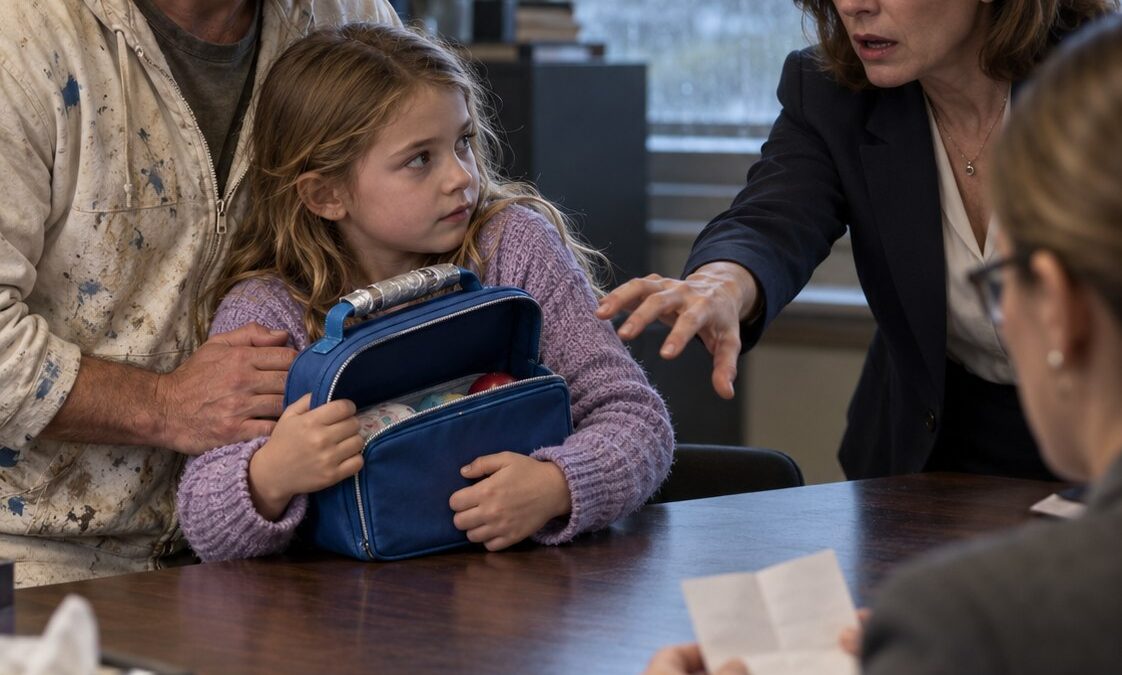
Valerie’s hand stayed open.
Tessa closed the lunchbox around her fingers.
“Please let go,” my daughter said.
Valerie let go.
Across the table, county worker Denise Ward set down her pen.
The review room smelled of coffee and damp coats.
Rain ticked against the window.
Nobody asked Tessa to sit.
Denise looked at the papers inside the box.
“May I see them?”
Tessa glanced at me.
I kept my hands in my lap.
“They’re yours,” I said.
She passed the lunchbox to Denise.
Valerie straightened her jacket.
“This is an upsetting situation for a child.”
“It is,” Denise said.
She lifted the first folded note.
I recognized the yellow paper.
It came from the pad beside my kitchen sink.
I had written it after my first Friday at the gate.
Tessa, I came today.
I’ll come again next week.
Love, Dad.
There were seventy-one notes in that box.
I knew because I had written seventy-one.
I didn’t know she had any of them.
For eighteen months, Valerie’s housekeeper had taken them from me through the side gate.
Valerie had always claimed she threw them away.
Denise unfolded another.
Then another.
The dates moved through winter.
Through spring.
Through the week Tessa turned seven.
Valerie pressed her thumb against a pearl.
“I allowed some letters,” she said.
“You told me none reached her,” I said.
“I said I didn’t deliver them.”
Tessa looked at her.
“You put them in the drawer.”
Valerie’s mouth tightened.
Denise raised her eyes.
“What drawer?”
“The one in your office,” Tessa said.
“I found them when you went away.”
“That was private.”
“They had my name on them.”
Tessa’s voice shook on the last word.
I wanted to go to her.
A temporary order kept me from touching her without the supervisor’s permission.
Even here.
Even while she stood three feet away.
Denise saw me looking.
“You may sit beside your father, Tessa.”
My daughter crossed the room.
She leaned against my arm.
I put my palm on the table where she could see it.
She took it.
Valerie turned toward Denise.
“This proves he wrote notes.”
“Yes,” Denise said.
“It doesn’t prove he was fit to take her home.”
“No,” Denise said again.
She lifted the lining of the lunchbox lid.
A small square of paper was tucked beneath it.
The corners had gone soft.
I couldn’t see the writing.
Tessa had been watching me.
“Mom put it there,” she whispered.
I looked at the paper.
Claire had died two years earlier.
The lunchbox had gone to Valerie’s house with Tessa.
I had never opened it after that.
Denise slipped the square free.
“Would you like me to read this?”
Tessa nodded.
Denise turned the paper toward the light.
Her expression changed.
“What does it say?” Valerie asked.
Denise read carefully.
“If Nolan cannot reach Tessa, call me before you believe he has left her.”
Under that sentence was a phone number.
And a name.
Marion Bell.
Claire’s closest friend.
For years, Marion had driven a school bus across our county.
I hadn’t spoken to her since Claire’s funeral.
Not for lack of trying.
After Tessa was taken, my calls went unanswered.
I thought Marion believed Valerie.
Tessa squeezed my hand.
“Mom said Marion would know where to find you.”
Valerie’s chair scraped the floor.
“That paper is years old.”
Denise looked at the date beneath Claire’s signature.
“It was written six weeks before Claire died.”
Valerie reached for her bag.
Denise laid one finger on the lunchbox.
“Please stay.”
Valerie stopped.
I stared at the number.
It was one digit different from the one saved in my phone.
Claire had written Marion’s new number.
I had been calling her old one.
Then Tessa spoke so quietly I almost missed it.
“Marion came to your house, Aunt Valerie.”
Valerie stared at her.
“When?”
“The day they said Dad didn’t want me.”
A car passed through a puddle outside.
I felt Tessa’s small fingers tighten around mine.
“What did Marion say?” I asked.
Tessa looked at the table.
“She said she had a letter from Mom.”
* * *
Denise ended the review without changing the custody order.
She did something more useful.
She stopped the recommendation for permanent guardianship.
She copied the note.
She photographed the lunchbox.
She recorded Tessa’s account in her file.
Then she called the attorney appointed to speak for Tessa.
Valerie objected to each step.
Denise wrote down the objections too.
I left the building with my lawyer, Priya Shah.
Tessa left with Valerie.
That was the hardest part.
She had walked across a room to sit beside me.
Twenty minutes later, I watched her climb into somebody else’s car.
Before the door closed, she held up the lunchbox.
I raised my hand.
Priya stood beside me in the rain.
“Marion Bell,” she said.
“I have her number now.”
“Call her from my office.”
I looked at Valerie’s car.
“What if she won’t answer?”
“Then we go to her.”
Priya had taken my case six months earlier.
Her fee was a flat amount I paid in pieces.
Some weeks, the pieces were forty dollars.
She never pretended that my job or my old record would disappear from the file.
When I was nineteen, I stole copper wire with two other men.
I pleaded guilty.
I paid restitution.
The conviction was still there whenever Valerie needed an opening sentence.
Priya knew every page of it.
She also knew my daughter’s favorite sandwich.
We called Marion from Priya’s office.
She answered on the second ring.
“Who is this?”
“Nolan Pike.”
For a moment, I heard only her television.
Then she said, “Where have you been?”
The question hit me harder than Valerie’s insults.
“At the gate,” I said.
Priya leaned closer to the phone.
“Ms. Bell, I’m Nolan’s attorney.”
Marion lowered the television.
“What happened to my letters?”
Priya and I looked at each other.
Marion had written to me.
I had written to her old address.
Neither of us had known.
“Can we meet you today?” Priya asked.
Marion lived twenty minutes outside town.
Her kitchen smelled of oranges.
Bus route maps hung beside the refrigerator.
She brought out a shoebox without offering us coffee.
“I kept copies,” she said.
Inside were three letters.
Each was addressed to the apartment Valerie’s petition listed as mine.
I had never lived there.
The envelopes had come back unopened.
Marion put another document beside them.
Claire had written it on lined paper.
It wasn’t a will.
It was a letter to Marion.
The ink grew uneven near the bottom.
Claire had been sick then, though neither of us knew how little time we had.
She asked Marion to help me if her family ever tried to separate Tessa and me.
She described the blue lunchbox.
She said the little note under its lid was there so Tessa would know whom to call.
I read that sentence twice.
“I went to Valerie’s house,” Marion said.
“I gave her a copy of this.”
“Did you tell her I was looking for Tessa?”
“Yes.”
Marion folded her arms.
“She said you had signed papers.”
“I didn’t.”
“She showed me a copy.”
Priya sat forward.
“What kind of papers?”
“A statement saying you wanted Tessa with Valerie.”
The room felt suddenly too warm.
Valerie had filed a sworn statement saying I had left Tessa with her and failed to return.
I had seen that statement.
It did not have my signature.
Priya opened her case file.
“Did it look like this?”
Marion studied the page.
“No.”
She tapped the bottom.
“Your name was signed here.”
Priya’s pen stopped moving.
“Do you still have the copy?”
Marion went to a drawer.
She brought back a folded sheet.
At the top, someone had typed VOLUNTARY CARE AGREEMENT.
At the bottom was my name in a hand that tried to be mine.
I knew where they had found the shape of it.
For years, I signed time sheets with a paint-stiff pen.
My N leaned left.
The N on that paper leaned left too.
But the rest of the signature flowed smoothly.
I had never signed my name that way.
Priya photographed the document.
“Who gave this to you?” she asked.
“Valerie.”
“Did you see Nolan sign?”
“No.”
Marion looked at me.
“I should have called your work.”
“You didn’t know.”
“Claire asked me to.”
Neither of us tried to make that feel better.
Priya asked about the day Tessa had gone to Valerie’s house.
It had started with a school pickup.
I was painting the underside of the west pedestrian bridge.
My crew had finished early because the wind came up.
At 2:41, I called the school.
The secretary told me Valerie had collected Tessa.
Valerie was on the approved pickup list.
I called Valerie seven times before she answered.
She said Tessa wanted to spend the night.
I said no.
She said we would talk in the morning.
By morning, she had stopped answering.
Two days later, a county worker came to my apartment.
Valerie claimed she had taken Tessa because I had missed pickup.
She said I had disappeared for the whole weekend.
My calls were still on my phone.
Priya had given the county screenshots.
Valerie said screenshots could be changed.
The first emergency order had been made while I was working a night shift.
Notice had been mailed to the address on her petition.
I learned about the order after it happened.
By then, Valerie had introduced my conviction.
She had also shown photographs of my apartment.
The kitchen ceiling had a water stain.
The bathroom tile was cracked.
Both had been repaired before the next visit.
But the photographs stayed in the file.
Marion listened without interrupting.
When I finished, she turned to Priya.
“Can you prove where those letters went?”
“We can trace the address.”
Priya already had her laptop open.
The street existed.
The apartment number existed.
The owner was listed through a company.
Priya searched the company registration.
She turned the screen toward us.
Rook Residential Holdings.
Valerie’s business.
The address where my notice had been sent belonged to Valerie.
* * *
The next morning, Priya filed a request to preserve the school’s pickup records.
She requested the original guardianship filings.
She asked for every notice envelope in the court file.
Denise interviewed Tessa again with her attorney present.
I wasn’t there.
Priya told me afterward that Tessa had described the drawer and the letters without being prompted.
She had also said Valerie told her not to mention Marion.
I went to work.
My crew was scraping old paint from the bridge railing.
By lunch, my phone had rung four times.
Two calls were from strangers.
One left a message about my conviction.
The other asked whether I enjoyed making children lie.
I gave both messages to Priya.
She told me to keep working.
At three, my supervisor called me into his trailer.
His name was Gus.
He had hired me after three contractors had turned me away.
A printed complaint lay on his desk.
It called me unstable.
It said I used city vehicles to stalk a child.
Gus pushed it across the table.
“Is that why you borrow the work truck on Fridays?”
“I don’t borrow it.”
“I know.”
I looked up.
“The gate has a public road,” Gus said.
“You drive your own car.”
He had already checked the vehicle log.
I felt my shoulders drop.
“I need copies,” I said.
“You’ll get them.”
He opened a cabinet.
Inside were the bridge crew’s daily sheets.
Gus had kept them because a contractor had disputed our hours.
On the day Tessa was picked up, my sheet showed I clocked out at 2:12.
The school was nine minutes away.
It didn’t prove I had arrived.
It proved I had been free to.
Gus found the radio dispatch record too.
At 2:47, I had called him from outside the school.
I remembered the call.
I had asked if he could cover my next morning’s shift.
I thought Tessa was with Valerie for one night.
Gus remembered because he had said no.
He handed me the record.
“Take it to your lawyer.”
I looked at the complaint again.
“Will this cause trouble for the crew?”
“Somebody sent a lie.”
He put the paper in the shred bin.
“That’s their trouble.”
That Friday, I went to the gate.
Priya had advised me to keep my routine.
I parked across the road.
I wrote my seventy-second note.
I brought a fresh sheet of yellow paper because Tessa had used the last one from the kitchen pad.
Valerie’s housekeeper didn’t come out.
A security camera followed me as I stood by the gate.
I left after three minutes.
Two blocks away, a car pulled beside mine at a stop sign.
Valerie was driving.
Her window came down.
“Tessa is embarrassed,” she said.
“She spoke clearly yesterday.”
“She’s seven.”
“She knew what the dates meant.”
“You want her to think every adult is against her?”
The light changed.
Cars waited behind us.
I kept both hands on the wheel.
“I want her to know I was there.”
Valerie looked past me.
“She was happy before you came back.”
“I never left.”
Her window rose.
The car behind her honked.
I drove on.
That evening, Priya called.
“Valerie’s lawyer wants a meeting.”
“What for?”
“He says she may agree to regular visits.”
“What does she want?”
“For you to stop challenging guardianship.”
I stood at the sink.
The yellow pad was still there.
A year earlier, I might have taken it.
Regular visits sounded enormous when I had none.
Then I thought of Tessa pulling the lunchbox away.
“She asked where I went,” I said.
“I know.”
“I’m going to answer her.”
Priya was quiet for a moment.
“Then we keep going.”
On Monday, Tessa’s attorney met me at Priya’s office.
Her name was Elin Park.
She asked what I would do if Tessa wanted to see Valerie after coming home.
“I’d listen.”
“Even now?”
“I’d still listen.”
Elin watched me.
“What if she wants to stay there?”
My throat tightened.
“I’d ask her why.”
“And if she means it?”
“I’d make sure she could tell you without me in the room.”
Elin wrote that down.
Before she left, she told us something Tessa had said.
“She didn’t ask me to punish her aunt.”
“What did she ask?”
“She asked if you could have her school picture.”
I had not seen a school picture since first grade.
Elin slid an envelope across the desk.
Tessa smiled against a blue background.
One front tooth was missing.
I put the photograph in my wallet.
The next day, Priya got the returned notice envelope.
The postal mark said UNDELIVERABLE.
The clerk had scanned it into the file four days after the emergency order.
Nobody had shown it to me.
Priya also found a second address on the petition.
It belonged to an old rooming house I had left five years earlier.
Valerie had signed the petition under oath.
She claimed both addresses had come from me.
Then Marion called.
She sounded angry.
“I went through Claire’s papers again.”
She had found the name of the person who witnessed Claire’s letter.
It was Valerie’s former office manager, Ruth Calder.
Ruth had been there because Claire asked her to make two copies at the office.
One went to Marion.
One stayed with Claire.
Ruth remembered Valerie finding Claire’s copy after the funeral.
Priya called Ruth that afternoon.
Ruth wouldn’t discuss the custody case by phone.
She agreed to meet the next morning.
We met at a diner beside the highway.
Ruth ordered tea.
She did not drink it.
“I liked my job,” she said.
Valerie managed property for three families.
Ruth handled rent deposits, invoices, and payroll.
Six months after Tessa moved in, Ruth had noticed a new client account.
Its name was the Claire Pike Family Trust.
Claire’s father had left money to Tessa years before.
I knew about the trust.
I had never touched it.
The trustee was an outside bank.
Valerie could request approved expenses for Tessa.
Ruth had seen more than expenses.
“There was a sale coming,” she said.
“What sale?” Priya asked.
“Claire owned a share of her father’s old warehouse.”
I knew the warehouse.
It sat near the river.
Claire had talked about fixing it up someday.
Her share had passed to Tessa.
A developer wanted all the owners to sell.
Valerie owned another share.
She needed someone authorized to speak for Tessa.
“A guardian still needs court approval,” Priya said.
“I know,” Ruth said.
“She was preparing that petition.”
Ruth slid a copy of an email across the table.
It was from the developer’s broker.
The subject line read AUTHORITY TO PROCEED.
The broker asked when Valerie expected the permanent guardianship order.
At the bottom was a sentence about a separate consulting fee.
Priya read it twice.
“How much?”
Ruth’s hands closed around the tea cup.
“One hundred eighty thousand dollars.”
“For what?”
“For bringing the remaining owners to the table.”
Ruth looked at me.
“She needed Tessa’s signature through a guardian.”
* * *
Priya didn’t take Ruth’s word as proof of a crime.
She asked where the email came from.
Ruth had printed it while she still worked for Valerie.
The company copied outgoing mail into a shared archive.
Ruth had kept the page because she feared the payment would be hidden from the trust.
Priya asked for the complete message.
Ruth no longer had access.
So Priya sent the copy to Tessa’s attorney.
Elin requested the underlying records through the guardianship case.
The developer produced the email.
The broker confirmed sending it.
The fee agreement was real.
It had not been disclosed in Valerie’s petition to sell the warehouse.
That fact changed the room at the next review.
We met in the same county building.
The blue lunchbox sat on the table.
Tessa was not there.
Elin had spoken with her separately that morning.
Denise sat beside the county attorney.
Valerie came with two lawyers.
She looked at the lunchbox once.
Then she looked away.
Priya began with the addresses.
She showed the petition.
She showed the returned envelope.
She showed the property record for the apartment I had never rented.
Valerie’s lawyer stood.
“A clerical error,” he said.
“Two errors?” Priya asked.
“Information can be outdated.”
“The apartment was owned by your client.”
Valerie leaned forward.
“I have many apartments.”
The county attorney asked who supplied the address.
Valerie said she had.
She claimed Claire had once given it to her.
Claire had never seen that apartment.
The company bought it after she died.
Priya produced the purchase record.
Valerie’s lawyer requested a moment.
His client whispered something sharp.
He shook his head.
Then Priya brought up the signed care agreement Marion had been shown.
Valerie said she did not remember giving it to Marion.
Marion sat behind us.
She raised her hand.
The county attorney invited her forward.
She described the visit to Valerie’s house.
The paper had been on Valerie’s desk.
Valerie had told her I signed it after leaving Tessa.
“I believed her,” Marion said.
Her voice broke.
“I stopped looking for him.”
Valerie’s lawyer asked if Marion could be sure the document was the same one.
“I copied it before I left.”
She pointed to the page.
“That is my handwriting in the margin.”
She had written the date she received it.
Valerie’s lawyer sat down.
The signature was still an open question.
Priya had hired a document examiner.
The examiner could say it appeared traced from an older form.
He could not say who held the pen.
Priya did not ask him to.
She called Gus.
He brought the original time sheet.
It was the document from which the signature seemed to come.
A stray fleck of ink appeared beside my last name on both pages.
The examiner had noticed it.
Valerie’s copy included the fleck.
A person signing a new page would not reproduce that accident.
Valerie watched the two pages appear on the screen.
Her lawyer touched her wrist.
She pulled away.
“You had a right to worry about the child,” the county attorney told her.
“You did not have a right to create her father’s consent.”
Valerie stared at him.
“I never made that paper.”
“Who did?” he asked.
“I don’t know.”
Priya didn’t argue.
She turned to the lunchbox.
Elin had already examined its contents.
Tessa had given permission for copies.
The seventy-one notes were arranged by date.
The housekeeper had agreed to speak.
She had worked at Valerie’s home for eleven years.
Each Friday, she had taken my note.
Each Friday, she had put it in Valerie’s office drawer.
She had not told Tessa because Valerie instructed her not to.
The housekeeper thought there was a court rule.
There wasn’t.
Valerie’s lawyer seized that point.
“My client may have handled the letters poorly,” he said.
“She was trying to protect a frightened child.”
“From what?” Elin asked.
“Uncertainty.”
Elin opened Tessa’s statement.
“She was uncertain because she was told her father never came.”
Valerie turned toward her.
“I raised her while he painted railings.”
I felt my hands close.
Priya put one palm flat on the table.
I copied her.
Valerie went on.
“I got her to school.”
“I took her to the dentist.”
“I sat up when she had a fever.”
“I did all of that,” she said.
“Where was he?”
The room waited.
I could have answered with a list.
The gate.
The letters.
The apartment I kept ready.
The birthday cake I had eaten alone because the bakery would not refund it.
I looked at the lunchbox.
“I was where you told me to wait,” I said.
Valerie’s eyes met mine.
“And she had no idea.”
The county attorney asked about the consulting fee.
Valerie’s lawyer said the agreement was lawful.
Valerie had business experience.
The developer wanted her help.
That could be true.
The problem was the date.
She had negotiated the fee before asking to become Tessa’s permanent guardian.
She had not disclosed it to the bank trustee.
She had not disclosed it to the court reviewing the proposed sale.
Elin asked one question.
“If Tessa refused to sell her share when she was older, would the fee still be paid?”
Valerie’s lawyer read the agreement.
“No.”
The room went quiet.
Valerie had argued that keeping Tessa was necessary for stability.
The fee depended on her authority to sell what Tessa owned.
Denise had brought the school records.
They showed Valerie picked Tessa up at 2:36.
The secretary had recorded my call at 2:41.
Gus’s dispatch record placed me outside the school six minutes later.
My phone records showed seven calls to Valerie that afternoon.
The county attorney put them in order.
Pickup.
My call.
My arrival.
My calls to Valerie.
There had been no missing father that day.
There had been a child taken home by her aunt.
Valerie looked at the county attorney.
“Nolan wasn’t ready.”
“That is a separate question,” he said.
“I made the decision I thought was best.”
“You described a different day.”
She turned to me.
“You couldn’t even keep the ceiling dry.”
“The landlord fixed it,” I said.
“After the worker came.”
“Yes.”
She searched my face for anger.
I gave her the truth.
“I wish you had asked me.”
The county attorney said the department would support an immediate review of the temporary order.
Elin agreed.
A judge still had to decide custody.
The county could not do it in that room.
The forged document and false statements would be referred for investigation.
Valerie’s lawyers asked for time to respond.
They got it.
They did not get Tessa’s signature on the warehouse sale.
Three weeks later, the judge heard the evidence.
Tessa spoke privately with the judge and Elin.
I did not ask what she said.
The judge ended the temporary guardianship.
A transition plan gave Tessa two afternoons with me.
Then one overnight.
Then home.
The criminal investigation took longer.
The prosecutor charged Valerie with offenses tied to the false filing and forged agreement.
The case ended with a guilty plea the following spring.
She received a suspended sentence, community service, and an order to repay the legal costs caused by her filings.
The developer canceled the consulting agreement.
An independent trustee handled any future decision about the warehouse.
On the day the custody order was signed, Valerie met me in the hallway.
She had no pearls on.
“She’ll remember I took care of her,” she said.
“She should,” I said.
Valerie frowned.
“I won’t ask her to forget the good days.”
I opened the door to the room where Tessa waited.
“I won’t ask her to forget the rest, either.”
* * *
Tessa’s first night home began with an argument about peas.
I had made chicken and rice.
She liked the chicken.
She distrusted the peas.
“They look tired,” she said.
“They’ve had a long day.”
She pushed one across the plate.
“I think this one wants to go back.”
I laughed.
She stared at me.
Then she laughed too.
The sound surprised both of us.
Her room had new curtains.
I had let her choose them during our second afternoon together.
They were covered in tiny yellow suns.
I had painted the walls a pale blue.
I had also kept the old height marks on the doorframe.
The newest mark stopped at her fifth birthday.
Tessa stood against the wood.
I measured her with a book.
She had grown nearly six inches.
“Did you leave space?” she asked.
“For what?”
“The next one.”
I marked the frame.
“There.”
She examined the pencil line.
“Your book was crooked.”
“Then you’re taller than we think.”
She smiled.
At bedtime, she brought the lunchbox.
I had washed the outside carefully.
The silver tape stayed on the handle.
She placed it beside her pillow.
“Can the notes stay here?”
“They’re yours.”
“Will you write one tomorrow?”
“If you want.”
“You’ll be here tomorrow.”
“Yes.”
She considered that.
“Write it anyway.”
So I did.
I used the yellow pad.
Tessa, I’m in the kitchen.
Love, Dad.
She read it twice.
Then she tucked it inside the lunchbox.
For the first month, she asked where I was whenever a door closed.
I answered every time.
At work, I arranged earlier shifts.
Gus grumbled about schedules while changing mine.
He said I owed him one Saturday.
I gave him three.
Marion began coming over on Sundays.
At first, she stood on the porch too long.
She looked at Tessa and then at me.
One afternoon, she asked to speak to us both.
She brought Claire’s original letter.
“I should have checked,” she said.
“I had her words in my hands.”
Tessa held the paper by its edges.
“You came to find me,” she said.
“I did.”
“You stopped.”
Marion nodded.
“I believed something I should have checked.”
Tessa folded the letter.
“Are you going to stop again?”
“No.”
I listened from the other end of the table.
Marion looked at me.
“I’m sorry, Nolan.”
“I know.”
She waited.
I took the letter from Tessa and set it flat.
“If something concerns you about us, call me.”
“I will.”
“If I don’t answer, call Priya.”
Marion almost smiled.
“That woman would answer.”
“She would.”
It was a boundary.
Marion accepted it.
After that, Sundays got easier.
She taught Tessa how to read a bus route map.
Tessa taught her how to make rice without drying it out.
I listened to both of them correct each other.
The warehouse stayed unsold.
The bank trustee sent reports each quarter.
Tessa’s share remained hers.
Valerie’s conviction did not make us rich.
It did make the accounts easier to examine.
A review found that approved trust payments for Tessa’s clothes, school, and medical care had been properly spent.
The hidden consulting fee had never been paid.
Priya said that mattered.
We could tell Tessa the truth without pretending every meal at Valerie’s table was a theft.
Tessa saw a counselor for a while.
She chose when to go.
Some weeks she talked.
Some weeks she drew houses with too many doors.
The counselor asked me to keep our plans predictable.
I could do that.
On Fridays, I picked her up from school.
I arrived early enough to stand where she could see me.
At first, she hurried toward my car.
Later, she stopped to finish conversations with friends.
The first time she made me wait, I nearly cried.
A child who trusts you can take her time.
In April, Valerie’s attorney sent a request.
Valerie wanted to write Tessa a letter.
Elin asked Tessa whether she wanted it.
Tessa thought for two days.
Then she said yes.
The letter was short.
Valerie wrote that she loved her.
She wrote that she was sorry she kept the notes.
She did not explain the false agreement or the addresses.
Tessa read the letter at the kitchen table.
“She said sorry for one thing,” she said.
“Yes.”
“Do I have to write back?”
“No.”
She put the letter away.
Months later, she asked whether she could send a photograph of her science project.
I said she could.
We mailed it through Elin.
Valerie replied with a card.
I did not read it until Tessa asked me to.
Their contact stayed in writing for a long time.
When Tessa eventually asked to see her, we arranged a supervised visit.
It lasted forty minutes.
Tessa came home quiet.
At dinner, she said Valerie’s dog had grown old.
Then she asked for more peas.
I gave her some without comment.
The county refunded part of what I had spent correcting the false filings.
Valerie’s repayment covered another part.
Priya handed me the accounting one afternoon.
The total looked like more money than I had ever held at once.
It was mostly money I had already borrowed or gone without.
Still, there was some left.
I bought a proper bed for Tessa.
I replaced my car’s tires.
Then I asked whether the family resource center needed anything.
Denise told me their waiting room had no books for older children.
Tessa chose the first six.
She insisted on one about bridges.
I added a shelf.
We put no name on it.
Tessa knew where it came from.
That was enough.
One evening, as I packed her lunch, I found the old blue box on the counter.
She had carried a newer one to school for months.
The handle on the old one had begun to split again.
“Can you fix it?” she asked.
“With more tape?”
“Maybe better tape.”
I sat down with my tools.
Inside the lid, Claire’s hiding place was still visible.
The paper itself was stored safely with her letter.
I fitted a new handle through the old brackets.
Tessa watched each turn of the screwdriver.
“Mom thought you might need help finding me,” she said.
“Yes.”
“She was right.”
“She knew I’d keep trying.”
Tessa considered that.
“She gave us Marion too.”
“She did.”
I tightened the last screw.
Tessa lifted the lunchbox.
The handle held.
“Can I use it tomorrow?”
“Of course.”
She opened it and put in a banana.
Then she paused.
“Will you write a note?”
I reached for the yellow pad.
* * *
Six years later, the county building looked smaller.
The rain still found its way down the same window.
Tessa was thirteen.
She carried the blue lunchbox herself.
We had come for a Saturday event at the family resource center.
Parents and children were filling bags with school supplies.
Denise had asked us to help.
I took the heavy boxes.
Tessa sorted pencils.
She was taller than the table where Valerie had once spread out her report.
The review room had become a storeroom.
Its door was open.
Tessa stopped beside it.
“I remember sitting there,” she said.
“I do too.”
She looked at the old table.
“I was scared you’d be mad about the notes.”
“Why?”
“I took them from the drawer.”
“They were written for you.”
“I know that now.”
We carried the pencil boxes inside.
She set the lunchbox on the polished table.
Its blue paint was scratched.
The new handle had lasted.
Inside were no hidden letters.
There was a sandwich, an apple, and a folded note.
Tessa saw me notice it.
“I made your lunch,” she said.
I opened the paper.
Dad, I’ll meet you at the front door.
Love, Tessa.
I looked up.
She was already grinning.
“You’re getting slow,” she said.
“Your handwriting is small.”
“It says where I’ll be.”
“I can read it.”
Outside the room, families began to arrive.
Tessa closed the lunchbox and took my hand for a moment.
Then she let go to carry the pencils.
I followed her through the door.
She reached the front entrance first.
When I stepped outside, she was there waiting.
THE END








