My Six-Year-Old Told the Harbor’s Most Feared Crime Boss to Fix Her Kite—Then He Saw the Name Under Its Wing
Chapter 2: What the Kite Carried
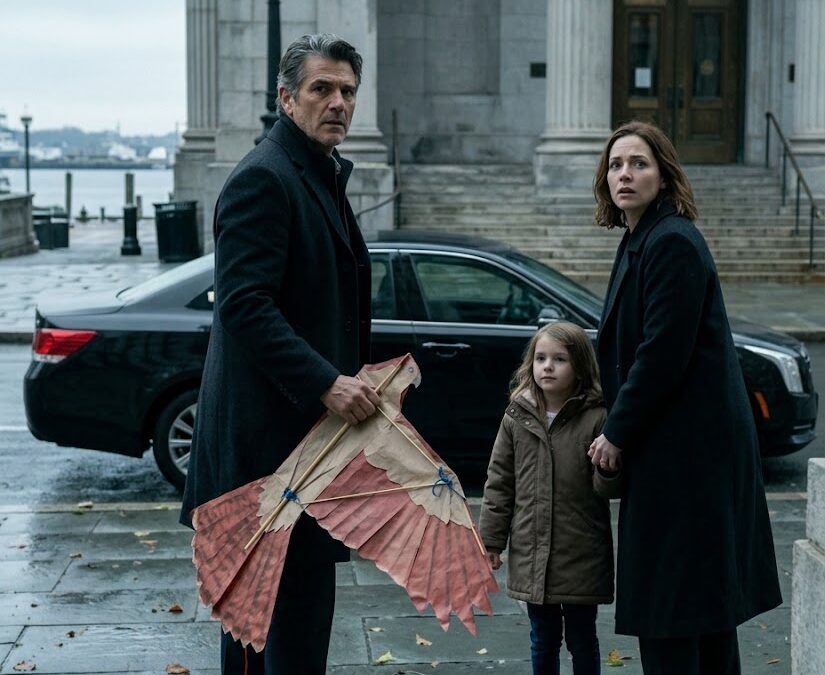
The sedan rolled from the curb.
Rafael stepped between it and us.
His guards moved without drawing attention.
“Inside,” Rafael said.
“Why should I trust you?”
“You shouldn’t.”
“Mom,” Poppy whispered.
“I’m here.”
“Stay close.”
Rafael faced the courthouse doors.
“Call the marshal. Tell her there’s a vehicle matching the surveillance notice.”
One guard was already speaking into his phone.
The sedan paused at the crosswalk.
Then it turned toward the river.
No one chased it.
No one reached for a weapon.
Rafael stayed in front of us until the car disappeared.
“Now,” he said, “you can ask whatever you need.”
“I need to get my daughter to school.”
“I’ll drive you.”
“No.”
“Then I’ll have the center’s marshal escort you.”
“Also no.”
Poppy tugged my sleeve.
“I want to see the fish.”
“Your trip is in an hour.”
“Then we should go.”
Rafael looked at the kite.
“Let me explain one thing.”
“You said my husband was murdered.”
“I said someone arranged his death.”
“You don’t get to soften that.”
“I’m not trying to.”
He glanced at Poppy.
“Can we speak somewhere with witnesses?”
“The school has teachers.”
“Good.”
“You’re coming nowhere near her school.”
“Agreed.”
The agreement came too quickly.
That frightened me more than an argument.
* * *
A courthouse marshal walked us to the staff entrance.
The sedan did not return.
Rafael remained outside.
He watched through the glass as Poppy and I entered.
I took her to the school bus.
Her teacher, Ms. Cardenas, counted the children twice.
I counted Rafael’s guards twice.
Then the bus pulled away.
I hated that I felt safer after it did.
At the justice center, I finished cleaning the second-floor conference rooms.
The work was familiar.
Wipe the table.
Empty the bins.
Leave the water pitcher full.
People talked when they believed no one listened.
I had heard officials arguing about the docks for years.
I knew which files left the building first.
I knew who arrived before the clerks.
And I knew the blue mark on Mateo’s kite.
It matched the ink on freight forms I’d once found in a recycling bin.
Three years earlier, Mateo had come home late.
He’d washed his hands twice.
He said the dock office had spilled carbon paper.
I’d believed him.
I wanted to believe his job was ordinary.
The next morning, the harbor called with news of his fall.
Now I understood why he had washed.
I finished my shift and reported the sedan to the courthouse marshal.
The marshal took my statement seriously.
She asked for the car’s color, plate, and direction.
I had only the first and last.
She entered the information anyway.
Then she offered to contact the police.
I said yes.
My hands shook while I signed.
The law had never helped us before.
But this time, I gave it a chance to try.
* * *
Rafael waited in the public lobby.
He had no guards beside him.
A court clerk sat within earshot.
“Your husband worked night dispatch,” he said.
“For a shipping company.”
“Which one?”
“Bayline Freight.”
Rafael looked at the kite.
“Bayline handled cargo moving through my terminals.”
“You’re saying he worked for you?”
“He worked for a contractor.”
“Which means you knew him.”
“I knew of him.”
“That isn’t the same as knowing him.”
“No.”
“Did you send the note about the aquarium?”
“I didn’t.”
“Did you pay the bill?”
“No.”
“You expect me to believe that?”
“I expect you to check.”
He placed a card on the counter.
The name on it belonged to a lawyer.
“Public records,” he said. “She can verify my company’s charitable accounts.”
“I never asked for money.”
“I know.”
“Then why were you watching us?”
“I wasn’t.”
“Your car was across the street.”
“My car was there because I had a hearing.”
“You’re under oath?”
“I’m standing in a courthouse.”
“That wasn’t my question.”
He accepted the rebuke without answering.
A woman in a charcoal suit approached from the public elevators.
“I’m Mara Chen,” she said. “I represent Mr. Soria’s holding company.”
“I’m not interested in hiring you.”
“You don’t have to.”
She set down a sealed envelope.
“This came from an archived freight file. The clerk’s office released it under a preservation order.”
“Why give it to me?”
“Because it names your husband.”
I didn’t touch it.
“Who requested the order?”
“Mr. Soria.”
“What’s inside?”
“A copy of a manifest. The original was removed from the company archive years ago.”
Rafael looked at the envelope.
“Mateo found a false load.”
“Which load?”
“Number fourteen.”
“The one on the kite?”
“Yes.”
The charcoal ink on the envelope smudged under my thumb.
“He hid this in her toy?”
“I don’t know when he wrote it.”
“But you recognized the code.”
“I did.”
“Why?”
“Because I approved the terminal schedule.”
Mara opened the envelope.
Inside was a photocopy of a manifest.
Two freight containers had been listed as kitchen equipment.
Their weights did not match their cargo descriptions.
At the bottom, Mateo’s initials appeared beside a handwritten correction.
The correction had been crossed out.
“Who verified this?” I asked.
“The shipping registry still has the duplicate filed with customs,” Mara said. “I requested a certified copy.”
“Why wasn’t this investigated then?”
“It was.”
“By whom?”
“An internal auditor. The report said Mateo had altered the record.”
“That’s impossible.”
“His initials are here.”
“My husband never signed a document he hadn’t checked.”
Rafael leaned over the paper.
“Neither did I.”
The photocopy was three years old.
The ink had faded.
The handwriting was Mateo’s.
The correction was not.
I knew because I’d watched him write grocery lists for six years.
His M began with a sharp hook.
The correction had a rounded M.
“Someone copied his initials,” I said.
Mara looked closer.
“You’re certain?”
“I packed his lunches. I signed school forms beside him. I know his handwriting.”
Rafael turned the page.
A second signature appeared at the bottom.
His.
Not on the correction.
On the original approval.
“I approved the schedule,” he said. “I did not inspect every container.”
“Convenient.”
“Yes.”
A court clerk approached.
“Ms. Alvarez, the marshal needs you to confirm the vehicle report.”
“Of course.”
I looked at Rafael.
“This doesn’t prove anything.”
“It proves someone altered the manifest.”
“Someone close enough to use your approval.”
“Yes.”
“Your people.”
“Possibly.”
“Your business.”
“Certainly.”
He didn’t defend himself.
That mattered.
It didn’t make him innocent.
It made him available to question.
Mara gathered the pages.
“The certified registry copy should arrive tomorrow.”
“Then tomorrow, we check it.”
“Agreed.”
Rafael looked at the kite.
“Keep it with you.”
“I was planning to.”
“Someone may try to take it.”
“Then tell the police that.”
He nodded.
“Already did.”
* * *
The certified copy arrived the next afternoon.
A clerk brought it to my office while I was replacing paper towels.
The registry had recorded the original manifest at 10:43 p.m.
The false correction had been added at 11:06.
The clerk’s stamp was valid.
The altered document had come from inside the terminal.
More importantly, the registry copy showed Mateo’s initials beside the phrase HOLD FOR INSPECTION.
The carbon duplicate kept his original mark.
He had not approved the load.
He had stopped it.
“Can you tell who submitted the change?” I asked.
The clerk checked the attached receipt.
“Authorized terminal account.”
“Whose account?”
“C. Vale.”
The name meant nothing to me.
Mara knew it.
“Carter Vale ran Bayline’s dispatch office,” she said.
Rafael stood beside the file cabinet.
“He was my operations chief.”
“Was?”
“He retired six months ago.”
“You let him retire.”
“I didn’t know.”
“Now you do.”
“I do.”
The clerk left a signed chain-of-custody form.
Mara copied it.
The registry offered the original record to law enforcement.
I made sure the request went through the courthouse investigator, not through Rafael.
That evening, Detective Sloane from the port unit called.
She asked me not to discuss the file outside the investigation.
She had already requested Bayline’s account logs.
I felt the first thin thread of relief.
It did not last.
* * *
Two days later, someone entered my apartment while I was at work.
Nothing was missing.
The kitchen chairs had been moved.
The desk drawer had been left open.
The kite’s cardboard sleeve sat on the table.
I called the police from the hallway.
Then I waited outside with my neighbor.
When officers arrived, they photographed the room and took my statement.
They did not promise an arrest.
They did not dismiss me either.
A patrol car stayed on our block that night.
Rafael came to the station only after Detective Sloane asked him to.
“You knew this might happen?” I asked.
“I knew someone might look for the evidence.”
“You could have warned me.”
“I should have.”
“You watched my building?”
“No.”
“Someone watched it.”
“I learned that after you called the police.”
He looked tired.
He had the same dark coat, but no tie.
“Your office can pay for a hotel,” he said.
“No.”
“A security detail?”
“No.”
“Then take the patrol car’s number.”
“I already have it.”
He held out a small paper bag.
“Dinner for Poppy.”
“I don’t need—”
“Her teacher said the field trip ended late. She missed the cafeteria.”
I hadn’t told him that.
The teacher had called the justice center.
Rafael had asked the front desk whether we were safe.
He had not asked for our address.
The receptionist had given him none.
The bag contained a sandwich, an apple, and a carton of milk.
I left it on the counter.
“I’ll pay you back.”
“I didn’t pay for it.”
“Who did?”
“My cook.”
“Does your cook know you use him as a messenger?”
“I’ll ask.”
That almost made me smile.
Almost.
“Do you have children?” I asked.
“No.”
“Then don’t assume a sandwich fixes this.”
“I don’t.”
“Good.”
“I’m sorry about Mateo.”
“You barely knew him.”
“I knew the line on his file.”
“That isn’t a person.”
“No,” he said. “It isn’t.”
He looked at the evidence room door.
“Detective Sloane is working it properly.”
“I’m glad.”
“If Carter Vale altered the record, he may have wanted the cargo moved.”
“Why?”
“I don’t know yet.”
“Then don’t tell me what you think you know.”
“I won’t.”
The investigator came to the station.
She asked for the kite.
I didn’t want to give it up.
She explained the process.
Photographs first.
A property receipt.
Tamper-evident packaging.
I watched every step.
The underside of the wing showed a tiny second mark beneath the shipping code.
Not ink.
A pinprick pattern.
I’d seen similar markings on labels at the justice center’s old records room.
A document-routing punch.
“Can you see that?” I asked.
Detective Sloane leaned closer.
“Those holes?”
“They show which terminal desk handled the manifest.”
She held the kite still.
The pattern had three holes in a triangle.
“Do you know the code?” she asked.
“Bayline used it for the night desk.”
“Could Carter’s desk have used it?”
“Only that desk.”
She made a note.
The kite had not just named a shipment.
It had recorded where the original manifest was processed.
The detective asked Rafael if he recognized the punch.
He did.
“Carter’s office,” he said.
“Could anyone else have access?”
“His deputy. Two clerks. Me.”
“Did you?”
“No.”
“Can you prove that?”
“Building logs.”
“Then provide them.”
He did.
The access log showed Carter Vale entering the dispatch room at 11:02 p.m.
Mateo had entered at 10:19.
No one else used the terminal that night.
Detective Sloane closed her notebook.
“Mr. Soria, I need you to understand that your company is part of this inquiry.”
“I do.”
“I’ll be asking for corporate records.”
“You’ll get them through counsel.”
“Good.”
She turned to me.
“Your husband may have stopped a shipment tied to a serious fraud investigation.”
“What kind of fraud?”
“We’re still determining that.”
“Was it dangerous?”
“I can’t answer yet.”
Rafael’s jaw tightened.
“His daughter is involved.”
“She is not part of the case,” the detective said.
“She’s part of the risk.”
“She’s under police protection.”
Rafael looked at me.
“I should have said something sooner.”
“You should have known sooner.”
“I did not.”
“That’s not the same as being blameless.”
“No.”
His answer was immediate.
The detective took the kite.
I held the property receipt.
Poppy held my hand.
“Will it come back?” she asked.
“After they photograph it,” I said.
“Can it still fly?”
“I think so.”
She nodded solemnly.
“Good.”
* * *
Detective Sloane’s next call came two mornings later.
A patrol officer had found a cut fence behind the school’s parking lot.
No one had entered the building.
The district moved the children inside and notified families.
Poppy sat beside me at home, her crayons lined in a neat row.
“I’m not scared,” she said.
“I know.”
“Can I be a little scared?”
“Any amount you want.”
She drew a house.
Then a large blue door.
Then three small windows.
“Who lives there?” I asked.
“We do.”
“Does it have a lock?”
“Two.”
“What about a dog?”
“Maybe a fish.”
“Excellent guard.”
“Fish don’t bark.”
“They notice everything.”
She considered this.
Then she added a fishbowl.
The police came by after lunch.
They asked whether anyone had contacted me.
I gave them the aquarium note and the earlier electric-bill offer.
The letters had no return address.
They photographed them and collected the envelope fibers.
A postal inspector traced the stamps to a business mail meter.
Bayline Freight’s old office.
The same one Carter Vale had managed.
The note that had offered to pay our bill had been a lure.
Someone wanted to make me expect assistance.
Someone wanted to know whether I’d answer.
I had refused both times.
That refusal had kept our accounts private.
I felt proud of it.
Then I felt sick.
“Does this mean he was watching us?” I asked Detective Sloane.
“It means the sender had access to your name and address.”
“From the death report?”
“Possibly.”
“From the company file?”
“Possibly.”
“Can you tell me which?”
“Not yet.”
Rafael arrived after the detective left.
He stayed on the front stoop.
“I need to give Detective Sloane the original terminal access book,” he said.
“Why are you telling me?”
“Because it may show my signature on the access authorization.”
“Does it?”
“Yes.”
“You signed Carter’s access.”
“I signed it two years before Mateo died.”
“So you enabled him.”
“I gave him the position.”
“You gave him the key.”
“I did.”
He didn’t ask me to excuse it.
I opened the door wider.
“Come in.”
He remained on the stoop.
“Would you rather I didn’t?”
“I don’t know.”
“Then I’ll stay here.”
Poppy came from the kitchen.
She saw him and brought a drawing.
“This is the place with two locks.”
He bent to her level.
“Those are strong locks.”
“They have to be.”
“I understand.”
“Can you fix the fishbowl?”
She held up the picture.
“I don’t know how.”
“You can try.”
“That’s what my mom says.”
“She’s right.”
Poppy stared at him.
“Do you have a house?”
“Yes.”
“Do you have a fish?”
“No.”
“Then who watches it?”
“No one.”
“That’s not safe.”
Rafael accepted this as serious counsel.
“I’ll think about it.”
She handed him the drawing.
“Don’t lose it.”
“I won’t.”
After she went back inside, I stood with him by the door.
“What did Mateo find?”
“A shipment being billed twice.”
“Why would that make someone kill him?”
“It may have uncovered a larger scheme.”
“And the real money?”
“I don’t know.”
“Do you think Carter was stealing from you?”
“I don’t think anymore. I’m checking.”
That sentence was the closest thing to an apology he could offer.
I nodded once.
“Then keep checking.”
* * *
The threat arrived in a plain envelope.
Detective Sloane found it taped inside the courthouse’s staff entrance.
My name had been typed across the front.
There was no letter inside.
Only a photocopy of Poppy’s school photograph.
The police took it as evidence.
They told the school to use its visitor protocol.
They assigned an officer to the building entrance.
They asked me not to share schedules.
The fear was clean and cold.
It had no dramatic shape.
It sat in my stomach while I packed Poppy’s lunch.
It stayed in the car while we drove to her aunt’s apartment.
It followed us home.
Rafael kept away unless Detective Sloane asked him to attend.
He handed over the access book through his lawyer.
His company also delivered account records and internal emails.
He signed a sworn statement that he had no knowledge of the false manifest.
The investigator checked his records.
He had been at a charity board meeting the night Mateo died.
Three people confirmed it.
That did not prove he was a good man.
It narrowed the question.
On the fourth day, Poppy asked if we could visit Mateo’s grave.
We went with her aunt and a police escort.
She carried the kite’s empty paper sleeve.
The actual kite remained in evidence.
At the cemetery, she sat on the grass.
“Dad,” she said, “a big man fixed your kite.”
I wiped my eyes.
“He did.”
“Did you know him?”
“No.”
“Does he know Dad?”
“He knew his work.”
“Can work be a person?”
“Sometimes it’s a piece of one.”
She placed a blue ribbon on the stone.
The ribbon lifted in the wind.
“Dad liked the water,” she said.
“He did.”
“Did he know the bad man?”
“We don’t know yet.”
“I think he did.”
“What makes you think that?”
“He wrote his name.”
She was right.
I had been trying not to let her be right.
Rafael arrived with Detective Sloane after we left the cemetery.
He stood well away from the grave.
“I didn’t want to interrupt,” he said.
“You didn’t.”
“Detective Sloane found the company’s audit file.”
“Was it hidden?”
“No. It was misfiled.”
“Convenient.”
“Carter’s old deputy located it.”
The deputy, Lydia Park, had worked in dispatch for nine years.
She had gone to the police after seeing the manifest copy in the news.
“Why now?” I asked.
“She said Carter told her Mateo had stolen a document,” Detective Sloane said. “She believed him then.”
“And now?”
“She saw the original registry record.”
“What changed?”
“She remembered Carter ordering her to erase a login entry.”
My stomach tightened.
“Did she?”
“No. She printed it.”
“Where is it?”
“Stored with the investigator’s files.”
“Can we see it?”
“Not yet.”
Detective Sloane was careful with every answer.
It made me trust her more.
The audit file showed that Bayline had been overcharged for terminal repairs.
The money had gone to two shell vendors.
The vendors shared a mailing address with Carter’s consulting company.
The scheme had begun before Mateo’s death.
“He was stealing from the company,” I said.
“And from the port authority,” Rafael said.
“Why kill Mateo?”
“Mateo found the double billing and flagged the shipment.”
“Was the cargo part of the fraud?”
“Likely. The container was listed as damaged equipment. It was empty.”
“Then why ship an empty container?”
“To create a false charge and move the expense off the books.”
“And Mateo caught it.”
“Yes.”
The deputy’s printed login record showed Carter entering Mateo’s credentials after the death.
He had used them to alter the manifest.
The audit log had been preserved because Lydia printed it before Carter could erase it.
“Why would he target us now?” I asked.
“Because the old files are resurfacing,” Detective Sloane said. “And he may believe the kite contains a copy of something else.”
“It doesn’t.”
“We know.”
“How?”
“The kite has been examined. No hidden compartment, no attached recording device, no second document.”
The detective turned to Rafael.
“Mr. Soria, your former chief requested access to the archives last week.”
“On whose authority?”
“He used a retired vendor credential.”
“You should have flagged that.”
“We did.”
“Why didn’t I know?”
“Because it would have compromised the investigation.”
He accepted that.
Carter’s motive was no longer just money.
He had spent years keeping his false accounting buried.
He feared the records, and he feared what Mateo had told someone before he died.
The detective had not yet said the name of that someone.
I knew it was coming.
* * *
The next morning, I went to the courthouse records room.
The investigator had asked whether I could identify the old routing punches.
I showed her where they were stored.
The room smelled of paper dust and floor polish.
I had cleaned it every morning for six years.
A torn label on a cabinet matched the triangular holes on the kite.
That desk had routed original freight manifests to the legal archive.
The outgoing records log listed three boxes.
One was marked “Bayline—Terminal 14.”
It had been checked out by Carter Vale the day after Mateo’s death.
No return entry appeared.
“Did you know this was missing?” the investigator asked.
“I knew the cabinet had a gap.”
“Why didn’t you report it?”
“I thought someone had moved the box.”
“Did you check?”
“I asked the records clerk. She said the archive was being reorganized.”
The clerk had since retired.
The gap mattered.
The missing box could contain the original manifest.
It could also contain the chain of orders surrounding Mateo’s final shift.
The investigator photographed the ledger.
Detective Sloane requested a warrant for Carter’s home office and consulting business.
A judge approved it two days later.
The police recovered the box from a storage unit listed under Carter’s company.
It contained contracts, invoices, and the original Bayline ledger.
No one announced the search.
No one held a press conference.
The case moved by paperwork and patient interviews.
That was how the law worked when it was doing its job.
The audit showed Carter had paid the dock supervisor to approve false repair charges.
It showed a second set of invoices.
It showed Mateo’s written objection.
The objection was dated the night he died.
A handwritten note beside it read: “Call Vale before release.”
The investigator asked me to identify the writing.
I recognized Mateo’s block letters.
He had written grocery lists in the same tight hand.
The note did not prove how he died.
It established what he had uncovered.
The medical examiner reviewed the original accident file.
The fall had been from a service platform with a broken railing.
The report had accepted the contractor’s claim that the railing had failed weeks earlier.
No one had investigated who had inspected it last.
The new investigator requested the maintenance logs.
The logs showed a safety inspection the afternoon before Mateo’s fall.
The inspector had signed that the railing was secure.
The inspection signature belonged to a company employee.
His badge log showed he never entered the terminal.
The maintenance report had been forged.
A state investigator reviewed the case.
They interviewed the contractor.
He admitted Carter had asked him to backdate the repair report.
He said Carter told him Mateo had threatened to expose the fraud.
He did not admit to causing the fall.
He said he believed the rail had been loose.
The investigator was direct.
“That testimony does not establish who caused the accident,” she told me. “We’re still working that part.”
“What does it establish?”
“That the safety report was falsified after your husband’s death.”
“By Carter?”
“The contractor says Carter instructed him.”
“Can you prove it?”
“We have a signed invoice and a recorded phone call.”
“Recorded legally?”
“With the contractor’s consent, after he became a cooperating witness.”
The evidence was real.
It was also incomplete.
I learned to live inside that distinction.
* * *
Carter Vale had once been a familiar face in the harbor photographs.
Silver hair.
Perfect suits.
A warm hand on Rafael’s shoulder.
He had retired to a brick house north of the city.
The police arrested him at his consulting office.
They did not bring him to us.
They did not parade him past reporters.
The charges came after a grand jury reviewed the financial records.
Wire fraud.
Falsifying records.
Witness intimidation.
Conspiracy connected to Mateo’s death.
The state did not charge murder.
They had evidence of a cover-up, but not enough to prove who tampered with the railing.
Carter’s lawyer called the charges a vendetta.
He said my husband had been an unreliable employee.
He said the manifest had been altered for routine bookkeeping.
He said Carter had only tried to protect his former company.
His arguments were polished.
They almost worked.
The first hearing was open to the public.
I sat with Detective Sloane and the courthouse victim advocate.
Rafael sat in the back row.
He wore no company pin.
Carter entered between two deputies.
He looked at the ceiling as if he had an appointment there.
His lawyer argued that the witness intimidation letter could not be connected to Carter.
The mail meter traced it to Bayline’s old office, but the building had since changed tenants.
The lawyer called the connection weak.
Then he argued that the school photograph was publicly available.
The school’s website had removed it, but an archived page still showed the class picture.
He was not wrong.
The state’s case needed more.
Detective Sloane testified about the registry copy.
Mara Chen testified about the company records.
Lydia Park testified about the login account.
Carter’s attorney questioned her memory.
“Isn’t it true you were reprimanded by Mr. Vale?”
“Yes.”
“Isn’t it true you wanted revenge?”
“No.”
“You saved an account printout.”
“I saved a record.”
“Without permission.”
“I was told to erase a log.”
“By Mr. Vale?”
“Yes.”
“Three years ago.”
“Yes.”
“And you waited until now to report it.”
“I reported it to my supervisor that same night.”
“Your supervisor is not here.”
“He’s deceased.”
The lawyer paused.
Lydia did not.
“I kept my copy because I knew the original could be changed.”
That was the first independent confirmation.
Then came the decisive proof.
Detective Sloane placed the kite inside a clear evidence sleeve.
The judge allowed it because the defense had challenged the chain of custody.
The paper looked smaller under courtroom lights.
The investigator showed the triangular routing holes.
She compared them to the archived desk punch.
The pattern matched.
The kite’s code identified the night load.
The registry copy confirmed Mateo had placed it on hold.
Lydia’s printout showed Carter had used Mateo’s account afterward.
The old ledger linked the false invoices to Carter’s consulting company.
The kite did not solve the case by itself.
It connected pieces no one could dismiss separately.
Carter’s lawyer objected that a child’s toy was not reliable evidence.
The judge looked at the records.
“The object’s age does not change its chain of custody,” she said.
Carter’s face remained calm.
His fingers did not.
The state presented the contractor’s recorded interview.
Carter had told him to file a false inspection report.
The contractor had initially claimed the repair was routine.
Then he corrected his testimony.
He said Carter had asked him to sign a report for an inspection he never made.
Carter’s lawyer called him a liar.
The contractor admitted he had lied before.
He admitted he wanted immunity.
He also produced the payment record.
His consulting company had received twelve thousand dollars the morning after Mateo died.
The funds came through one of Carter’s shell vendors.
The lawyer argued the payment was for maintenance.
The invoice described it as “site review.”
The report described an inspection that had not occurred.
The two documents did not match.
The judge denied the motion to dismiss.
Carter would face trial.
In the hallway afterward, a reporter approached me.
“Do you believe Mr. Vale killed your husband?”
“I believe the evidence says he covered up what happened.”
“That isn’t the same answer.”
“It’s the answer I can support.”
“Do you want him punished?”
“I want the truth admitted in court.”
“Would you accept an apology?”
“No.”
The reporter’s face tightened.
“Why not?”
“An apology isn’t a substitute for evidence.”
Across the hall, Carter’s lawyer leaned toward his client.
Carter looked at me.
“You should be grateful,” he said.
The deputies turned toward him.
I didn’t raise my voice.
“For what?”
“For the years you were left alone.”
I felt the old anger rise.
Then I looked at the evidence sleeve in Detective Sloane’s hands.
“I was never alone,” I said. “My daughter was with me.”
Carter’s expression shifted.
I walked away.
* * *
The trial lasted three weeks.
The state presented records, witnesses, and the timeline.
Carter’s defense tried to make every piece look small.
A false signature.
A missing box.
A coded paper wing.
A copied login.
A late invoice.
They asked why a man like Carter would risk everything over a minor bookkeeping scheme.
The prosecutor showed the totals.
Four years of false repairs.
Shell vendors.
Inflated insurance claims.
Payments to officials.
The amount approached two million dollars.
Mateo’s discovery threatened the whole structure.
The prosecutor also showed what Carter had done afterward.
He removed the archive box.
He arranged a false report.
He used a dead man’s credentials to shift blame.
He sent anonymous offers to our apartment.
He used company records to obtain our address.
Carter denied sending the notes.
The mail meter had been used by his consulting company.
A former employee identified the printer.
The police found the template on a computer in Carter’s storage unit.
He said someone else had access.
The jury heard that too.
They heard both sides.
The contractor testified that Carter’s instructions had been clear.
Lydia testified she had watched Carter alter the login record.
The records showed the sequence.
No one claimed they had seen Carter touch the railing.
The state did not pretend otherwise.
The murder charge remained unfiled.
The conspiracy count concerned the cover-up and the intimidation.
That distinction made the case less dramatic.
It also made it more honest.
On the ninth day, Rafael testified.
His company records showed he had approved the terminal schedule.
He admitted he had built an operation where one chief controlled too much.
He admitted the company had benefited from weak oversight.
Carter’s lawyer tried to make him look like the true villain.
“You trusted Mr. Vale completely.”
“I trusted his reports.”
“You allowed him to control dispatch.”
“Yes.”
“You never checked the manifest personally.”
“No.”
“You wanted to keep profits moving.”
“I wanted the company to operate.”
“That’s not an answer.”
“It is the answer.”
“Were you afraid of what an audit would uncover?”
“No.”
“Then why didn’t you audit?”
“I should have.”
The lawyer tried again.
“Isn’t it true that Mr. Soria’s business depends on intimidation?”
The state objected.
The judge sustained it.
Rafael looked at the jury.
“My business depended on secrecy,” he said. “That made it possible for Carter to steal.”
The judge warned him to answer only the questions asked.
He nodded.
He did not look at me again.
After his testimony, he was free to leave.
He stayed in the hallway until I came out.
“You told the truth,” I said.
“I told the records.”
“That’s not always the same thing.”
“No.”
“Did you know Mateo was afraid?”
“I never saw him afraid.”
“Did he come to you?”
“No.”
“If he had?”
“I would like to believe I would have listened.”
“That sounds like a convenient answer.”
“It is the only one I have.”
I studied him.
He did not ask me to trust him.
“I’m glad you testified.”
“Thank you.”
“Don’t turn that into forgiveness.”
“I won’t.”
The jury deliberated for two days.
They found Carter guilty of financial fraud, falsifying records, witness intimidation, and conspiracy.
They found him not guilty on the count tied to Mateo’s death.
The evidence could not establish who had caused the fall.
The judge sentenced him to nine years in federal prison, followed by supervised release.
The state ordered restitution to the affected vendors and the port authority.
The company’s insurers reopened the workers’ compensation claim.
The family received a settlement through the court process.
It was not a fortune.
It was enough to clear our debt and fund Poppy’s education account.
I asked the court to pay it directly into the account.
No one called it a gift.
It was compensation owed years earlier.
The contractor received a separate sentence.
The dock supervisor pleaded guilty.
Carter’s motive was finally plain.
He had built a quiet system that stole through invoices and survived through fear.
Mateo had found it.
When Mateo stopped the shipment, Carter believed he had one day to bury the evidence.
He had the railing report falsified after the accident.
He framed Mateo’s account.
He kept the archive box.
He thought a dead worker’s family would never know what the records said.
He was wrong.
* * *
The first week after sentencing, Poppy asked whether Carter was still bad.
“I don’t know,” I said.
“He did bad things.”
“Yes.”
“Can people stop?”
“Some people can.”
“Did he?”
“Not before the judge sentenced him.”
She frowned.
“That’s a long answer.”
“It’s the true one.”
“Was Dad brave?”
“Yes.”
“Was he scared?”
“I think he was.”
“Can you be brave and scared?”
“Yes.”
She nodded.
“I was scared when the fence broke.”
“I know.”
“I went to class anyway.”
“I know that too.”
She leaned against me.
I held her until she asked to get down.
* * *
Rafael came to our apartment once after the trial.
He brought no food.
He brought the final payment record from the insurance settlement.
The court had already sent us a copy.
“This is for your files,” he said.
“I have it.”
“I know.”
“Then why bring it?”
“Because it should be delivered properly.”
“You could have mailed it.”
“I could have.”
He set the envelope on the table.
Poppy watched him from her chair.
“Are you the kite man?” she asked.
“I helped repair the tail.”
“Did you get a fish?”
“Not yet.”
“That means no.”
“It does.”
“What are you waiting for?”
“I’m still choosing a tank.”
“Get a small one.”
“Why?”
“Big tanks are harder to clean.”
I glanced at him.
He took the advice seriously.
“You’re right.”
Poppy drew a fish beside the two-lock house.
Rafael stayed by the door.
“I’m closing the dispatch unit,” he said.
“What does that mean?”
“The company will sell the freight division and put the remaining docks under independent review.”
“Can it afford that?”
“It can.”
“Will the workers lose their jobs?”
“Some may. I’m funding retraining for the ones who stay.”
“That doesn’t erase what happened.”
“No.”
“Then why tell me?”
“Because you asked me to keep checking.”
He was right.
I had asked.
I didn’t owe him a smile.
I gave him a nod.
“What happens now?”
“I testify at the port authority’s review.”
“And after?”
“I don’t know.”
For the first time, he sounded like a man without an answer.
“Maybe that’s useful.”
“Maybe.”
* * *
The insurance company repaired its process after the case.
The port authority required independent review of terminal accounts.
Rafael’s company paid the laborers whose hours had been falsified.
It also agreed to turn over all historical dispatch records.
Mara Chen helped the workers’ union file claims.
I helped the courthouse investigator identify the old paper codes.
The records room needed a cleaner who knew what the marks meant.
The court offered me a permanent position as archive assistant.
I accepted.
The pay was better.
The hours fit the school schedule.
Poppy kept her aquarium trip.
She liked the jellyfish best.
She spent twenty minutes watching them move without touching the glass.
“They look like floating umbrellas,” she said.
“They do.”
“Do you think Dad saw them?”
“Maybe.”
“Maybe he would have liked them.”
“I think he would.”
The school sent home a new fee schedule.
There was an optional summer science camp.
I could afford it now.
I signed the form without counting the balance twice.
That small act felt larger than it should have.
* * *
The months passed.
The police closed the intimidation investigation after Carter’s conviction.
They could not prove he had arranged Mateo’s fatal fall.
They could prove he had concealed the fraud and targeted our family.
The state kept the death case open.
Detective Sloane told me the file would remain available if new evidence appeared.
I thanked her.
I did not ask her to promise a final answer.
Rafael’s company hired an outside compliance director.
He turned over his schedule, his records, and his old approval chain.
The port authority fined the company.
He paid it.
He also gave up control of the freight business.
The newspapers called it a strategic shift.
The workers called it a long overdue change.
I called it a start.
Rafael sent me a letter asking whether I would speak at the workers’ memorial fund meeting.
I declined.
He accepted the answer.
A week later, he asked again, this time through Mara.
Would I consider helping design a records fellowship for children of dockworkers?
I said I needed details.
They sent the budget.
It was independent of Rafael’s company.
The fund would pay for technical training and archive work.
A board of workers, teachers, and public librarians would administer it.
I agreed to advise them.
I did not let Rafael name the program.
The workers chose the name themselves.
The Mateo Alvarez Harbor Records Fellowship.
I cried when I saw it.
Poppy asked why.
“Because people remembered your dad.”
“He didn’t want to be famous.”
“No.”
“Then they can remember him at home.”
“That’s what we do.”
* * *
Rafael’s apology came in person, nearly a year after the trial.
He asked first.
“Would you hear me out?”
“Here?”
“On the courthouse steps.”
I looked at the place where he had knelt to fix the kite.
“Fine.”
Poppy was with her aunt.
The weather had turned warm.
Traffic rolled past the stone entrance.
“I built a system where people took my word,” he said.
“Carter used it.”
“Yes.”
“Your company benefited.”
“Yes.”
“You did not ask how.”
“No.”
“That made his work easier.”
“Yes.”
“I’m sorry,” he said.
“Are you sorry for Mateo?”
“Yes.”
“Or sorry your company was exposed?”
“Both.”
I didn’t expect him to answer that way.
It didn’t make the apology complete.
It made it usable.
“I believe you’re sorry,” I said.
He looked down.
“Thank you.”
“I’m not ready to forgive you.”
“I understand.”
“And even if I do, it doesn’t mean we become friends.”
“I understand.”
“Do you?”
“Yes.”
“Then don’t ask me again.”
“I won’t.”
He kept his word.
He never asked again.
* * *
The fellowship’s first meeting was held in the justice center courtyard.
The school brought students.
The dockworkers brought their families.
The public library brought a display of old harbor maps.
No one wore a suit except the judge.
Rafael sat in the back.
He had no guards.
He was there as a donor, not a decision-maker.
I gave the short opening remarks.
I said the records mattered because someone had once believed nobody would check them.
I said workers deserved to see what their hands helped build.
I said a child’s drawing had helped people look twice.
Then I handed the microphone to Lydia Park.
She talked about keeping the printout.
She talked about how easy it was to erase a record when one person controlled the desk.
She said the paper survived because she had made a second copy.
Poppy sat beside me, drawing a red kite.
After the meeting, a boy asked if he could learn to read old maps.
The librarian gave him a brochure.
His mother looked at the tuition line.
I told her the fellowship covered it.
She started to cry.
Poppy handed her the drawing.
“It’s okay,” she said. “I can make another.”
The mother laughed through her tears.
The boy carried the kite drawing home.
That was the first time the story felt finished.
* * *
Three years later, I became the archive center’s records supervisor.
The old freight codes were digitized.
The port’s paper logs were preserved.
The fellowship sent its first student to college.
Poppy was nine and still asked practical questions.
She had a fish now.
It was small, silver, and named Clerk.
“Why Clerk?” Rafael asked at a school event.
“Because it works all day.”
“It swims.”
“Exactly.”
He kept a tank in his office.
He said Poppy had chosen the filters.
The fish survived.
The office joke did too.
Rafael remained a complicated man.
He testified when the port authority investigated another company.
He closed the last of his private freight accounts.
He still had people who feared him.
He used fewer of them.
I noticed the difference.
We were not a couple.
There was no secret romance waiting beneath the evidence.
There was respect.
Some care.
A boundary that stayed where I placed it.
That was enough.
Once, he asked whether he could visit the archive center with Poppy’s class.
I asked Poppy.
She said yes, if he brought the fish’s photo.
He did.
The children asked him whether he was a kingpin.
He looked at me.
I shrugged.
“It means he used to control a lot of docks,” I said.
“Do you still?” one child asked.
“No,” he said.
“Why not?”
“Because control without questions gets people hurt.”
The children stared at him.
Poppy raised her hand.
“Did you learn that from my kite?”
“I learned it before your kite,” he said. “I listened after.”
She accepted the answer.
* * *
Five years after the courthouse steps, we returned there for the fellowship’s annual ceremony.
The courtyard had new benches.
The old stone had been cleaned.
The staff entrance still smelled faintly of floor polish.
Poppy was eleven.
She carried the restored kite.
The new paper wing was stronger.
The old blue knot remained beneath it, sealed in a clear protective sleeve.
The evidence unit had returned the kite after the trial.
The chain-of-custody receipt stayed in my desk.
Poppy walked to the steps.
“Do you remember the first knot?” I asked.
“Of course.”
“You told him not too tight.”
“He listened.”
“He did.”
She held the kite against the wind.
Rafael stood nearby, speaking with the librarian.
He heard us.
“Are you standing on the tail?” Poppy called.
He looked down.
His shoes were clear.
“Not today.”
“Good.”
A gust lifted the kite.
It rose above the courthouse courtyard.
The paper wing trembled.
Then it steadied.
The blue knot held.
Poppy laughed.
A child’s voice, bright in the open air.
Behind her, the city moved on.
The evidence remained filed.
The workers had their records.
The false invoices had their consequences.
Mateo had his name.
Rafael had learned to ask before he acted.
I had a job I trusted.
Poppy had learned that fear did not cancel courage.
The kite flew over the place where the truth had first surfaced.
And this time, nobody tried to pull it down.
THE END








